Luke 23:22
And he said unto them the third time, Why, what evil hath he done? I have found no cause of death in him: I will therefore chastise him, and let him go.
Translations
And he said to them the third time, Why, what evil has he done? I have found no cause of death in him: I will therefore chastise him, and let him go.
King James Version, KJV Cambridge Paragraph Bible
And he said unto them the third time, Why, what evil hath he done? I have found no cause of death in him: I will therefore chastise him, and let him go.
And he said to them the third time, Why, what evil hath he done? I have found no cause of death in him; I will therefore chastise him, and let him go.
Revised Version, American Standard Version
And he said unto them the third time, Why, what evil hath this man done? I have found no cause of death in him: I will therefore chastise him and release him.
And he a third time said unto them, 'Why, what evil did he? no cause of death did I find in him; having chastised him, then, I will release [him].'
And he said the third time to them, What evil then has this [ man] done? I have found no cause of death in him: I will chastise him therefore and release him.
But, he, the third time, said unto them—Why! what base thing hath this man done? Nothing worthy of death, found I in him. Chastising him, then, I will release him!
Berean Standard Bible, Majority Standard Bible
A third time he said to them, “ What evil has this man done? I have found in Him no offense worthy of death. So after I punish Him, I will release Him.”
He said to them the third time, “ Why? What evil has this man done? I have found no capital crime in him. I will therefore chastise him and release him.”
And he said to them a third time, Why, what evil has he done? I see no reason for putting him to death: I will give him punishment and let him go.
And he sayd vnto them the third time, But what euill hath he done? I finde no cause of death in him: I will therefore chastise him, and let him loose.
Douay-Rheims (Challoner revision)
And he said to them the third time: Why, what evil hath this man done? I find no cause of death in him. I will chastise him therefore, and let him go.
Pictures
Cross-references 20 of 34
- Matthew 27:22-23
Pilate saith unto them, What shall I do then with Jesus which is called Christ? They all say unto him, Let him be crucified.
Pilate finds no cause for death, yet the crowd demands Jesus’ crucifixion.
- John 19:4
Pilate therefore went forth again, and saith unto them, Behold, I bring him forth to you, that ye may know that I find no fault in him.
Pilate declares Jesus innocent, as the crowd demands his death.
- John 18:38
Pilate saith unto him, What is truth? And when he had said this, he went out again unto the Jews, and saith unto them, I find in him no fault at all.
Pilate declares that he finds no fault in Jesus.
- Mark 15:12-15
And Pilate answered and said again unto them, What will ye then that I shall do unto him whom ye call the King of the Jews?
Pilate questions the crowd’s demand to crucify Jesus, despite finding no cause against him.
- Luke 23:4
Then said Pilate to the chief priests and to the people, I find no fault in this man.
Pilate’s verdict that Jesus was innocent is repeated.
- Matthew 27:24
When Pilate saw that he could prevail nothing, but that rather a tumult was made, he took water, and washed his hands before the multitude, saying, I am innocent of the blood of this just person: see ye to it.
Pilate declares Jesus innocent but gives Him over to the crowd.
- Acts 3:13-14
The God of Abraham, and of Isaac, and of Jacob, the God of our fathers, hath glorified his Son Jesus; whom ye delivered up, and denied him in the presence of Pilate, when he was determined to let him go.
They denied the innocent Jesus when Pilate was determined to release him.
- Luke 23:14-15
Said unto them, Ye have brought this man unto me, as one that perverteth the people: and, behold, I, having examined him before you, have found no fault in this man touching those things whereof ye accuse him:
Pilate and Herod find no grounds to condemn Jesus to death.
- John 19:6-7
When the chief priests therefore and officers saw him, they cried out, saying, Crucify him, crucify him. Pilate saith unto them, Take ye him, and crucify him: for I find no fault in him.
Pilate declares Jesus innocent while the leaders demand his death under their law.
- John 19:12-16
And from thenceforth Pilate sought to release him: but the Jews cried out, saying, If thou let this man go, thou art not Cæsar’s friend: whosoever maketh himself a king speaketh against Cæsar.
Rulers pressure Pilate to condemn the innocent Jesus by challenging his loyalty to Caesar.
- Matthew 27:19
When he was set down on the judgment seat, his wife sent unto him, saying, Have thou nothing to do with that just man: for I have suffered many things this day in a dream because of him.
Pilate’s wife warns him not to harm the innocent Jesus.
- Luke 23:12
And the same day Pilate and Herod were made friends together: for before they were at enmity between themselves.
Pilate and Herod became allies during Jesus’ trial.
- Acts 2:23
Him, being delivered by the determinate counsel and foreknowledge of God, ye have taken, and by wicked hands have crucified and slain:
Jesus is condemned despite Pilate finding no cause of death; his crucifixion is charged to human hands.
- Matthew 27:23
And the governor said, Why, what evil hath he done? But they cried out the more, saying, Let him be crucified.
Pilate asks what evil Jesus has done as the crowd demands His death.
- Luke 23:16-18
I will therefore chastise him, and release him.
Pilate proposes releasing Jesus before the people demand Barabbas.
- John 18:39-40
But ye have a custom, that I should release unto you one at the passover: will ye therefore that I release unto you the King of the Jews?
Pilate offers to release Jesus, but the crowd chooses Barabbas.
- Matthew 27:17
Therefore when they were gathered together, Pilate said unto them, Whom will ye that I release unto you? Barabbas, or Jesus which is called Christ?
Pilate offers Jesus beside Barabbas for release.
- Matthew 27:2
And when they had bound him, they led him away, and delivered him to Pontius Pilate the governor.
Both texts describe Jesus being brought before Pilate.
- John 19:1
Then Pilate therefore took Jesus, and scourged him.
Pilate orders Jesus scourged before releasing him for crucifixion.
- John 19:6
When the chief priests therefore and officers saw him, they cried out, saying, Crucify him, crucify him. Pilate saith unto them, Take ye him, and crucify him: for I find no fault in him.
Pilate again declares Jesus innocent before his condemnation.
Commentary
Each commentary is drawn from primary sources: the writings of Ellen G. White and Adventist pioneers and periodicals. Each commentary is separate. Its own words are not a quotation; follow the references to read the source passages.
Ellen G. White
24 sources
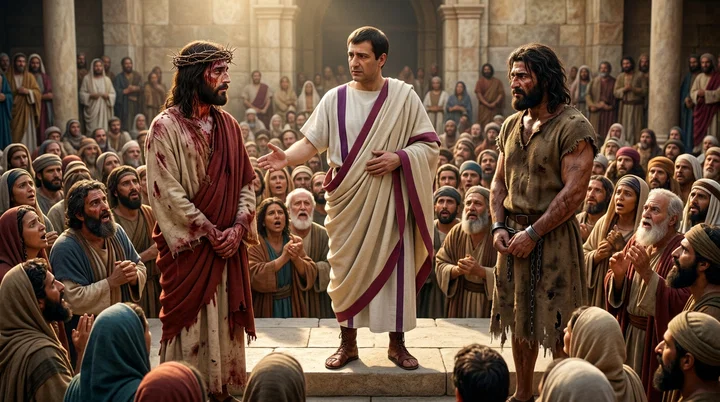
For the third time Pilate asked what evil Jesus had done, declaring repeatedly that He had done nothing deserving death and that he found no fault in Him.DA 733.1–4ST Jul 12, 18993SP 142.2–3 This was said in the judgment hall where His accusers proved nothing guilty against Him while the Jewish priests and rulers pressed the Roman governor to carry out their will.DA 723.1–724.1RH Nov 11, 1915ST Jul 12, 1899 Though convinced of His innocence, Pilate proposed to chastise and scourge Him and then release Him, in order to appease those crying for crucifixion rather than firmly protecting Him.DA 731.6–732.35RED 62.3GC88 501.1–2 That willingness to punish One he knew was guiltless was a cruel compromise of justice and conscience, and his wavering attempt to satisfy the mob only encouraged their demands and intensified the cry for crucifixion.Ms 112, 1897, par. 26–30DA 733.1–4DA 731.6–732.3DA 735.1–5 Despite the verdict of innocence he ordered Christ bruised and mangled by scourging and then delivered Him to a shameful death by crucifixion, while a robber and murderer was released in His place.5RED 62.3ST Jul 12, 1899Lt 12, 1911, par. 8–11ST Jul 7, 1898Ms 55, 1886, par. 28–30
Pilate's Examination and Verdict
The verse belongs to the examination of Jesus before Pilate in the judgment hall.DA 723.1–724.1ST Jul 12, 1899 It was a mock trial in which His accusers proved nothing guilty against Him.ST Jul 12, 1899 At that trial the Jewish priests and rulers pressured the Roman governor to carry out their will.RH Nov 11, 1915
For the third time Pilate asked what evil He had done.DA 733.1–4ST Jul 12, 18993SP 142.2–3Ms 112, 1897, par. 33–34 He declared repeatedly that He had done no evil deserving death.DA 733.1–4 He found no fault in Him at all and no cause for a death sentence in Him.ST Jul 12, 18993SP 142.2–3Ms 112, 1897, par. 33–34 He saw no sign of guilt in Jesus and resolved to investigate the charges before condemning Him.DA 723.1–724.1 He knew Jesus had been brought to the judgment hall for envy.Ms 112, 1897, par. 33–34 He knew that even bound and under accusation His power was the power of God and not of a common man.Ms 112, 1897, par. 33–34 He wanted to save the innocent man rather than give Him up to a maddened power, and his soul was in terrible conflict.Ms 112, 1897, par. 33–34
Herod was stirred up by the chief priests.Ms 55, 1886, par. 28–30 Acting in union with Pilate, he joined in the unjust death.Ms 55, 1886, par. 28–30 By that united action the just and holy Son of God was killed while a murderer was released in His place.Ms 55, 1886, par. 28–30
Compromise Through Unjust Punishment
Though convinced He had done nothing deserving death, Pilate proposed to have Jesus chastised, scourged and beaten and then released, seeking to conciliate and appease those crying for crucifixion rather than firmly protecting Him from their demand for death.DA 731.6–732.35RED 62.3GC88 501.1–2ST May 17, 18994RED 102.2–103.1 He asked again what evil had been done and protested against putting to death One against whom nothing deserving death could be proved, yet offered scourging and release as a middle course.DA 731.6–732.35RED 62.3ST May 17, 1899 That offer stopped short of the protection justice required when no cause for a death sentence had been found.GC88 501.1–2ST May 17, 18994RED 102.2–103.1
Willingness to punish One known to be guiltless was cruel injustice, a compromise of justice and principle.Ms 112, 1897, par. 26–30DA 731.6–732.3ST Nov 2, 1882 It was a failure to stand by the evidence and by conscience and to judge fairly, violating conscience step by step until an innocent man was helped toward a shameful death.Ms 112, 1897, par. 26–30DA 731.6–732.33SP 142.2–3 The yielding that caused Jesus great bodily pain left Pilate himself facing remorse.Ms 112, 1897, par. 26–30
The offer revealed weakness and wavering, letting the mob decide.DA 733.1–4DA 735.1–53SP 142.2–3 Pilate hoped in vain to satisfy the crowd and to stir pity so that they would accept the punishment as sufficient and let Him go.DA 733.1–45RED 63.1ST Jul 11, 1878 The attempt to appease them only encouraged their demands and intensified the cry for crucifixion, helping to bring him under the rulers' influence.DA 733.1–4DA 731.6–732.3ST Nov 2, 1882ST Jul 11, 1878
Jesus was already faint with weariness and covered with wounds after the shameful humiliation of trial, and the proposed chastisement meant His sacred flesh would be further bruised and mangled.5RED 62.3ST Jul 11, 1878 Stripped to the waist with a crown of thorns on His head, He bore long cruel stripes from which blood flowed freely.5RED 63.1 Pale, blood-stained, exhausted and pained, He was scourged before the multitude to gratify the satanic fury of priests and rulers possessed and controlled by Satan and his hellish army.5RED 62.35RED 63.1ST Jul 11, 1878
Despite that verdict of innocence, with His accusers having proved nothing guilty against Him and with the declaration three times made that no fault at all was found in Him, Pilate ordered Christ scourged and then delivered Him to His enemies.ST Jul 12, 1899Lt 12, 1911, par. 8–11ST Jul 7, 1898 He was handed over to wicked men and scourged like a criminal, then given up to suffer a shameful and most cruel death by crucifixion.ST Jul 12, 1899Lt 12, 1911, par. 8–11ST Jul 7, 1898 His own nation demanded His death while the release of Barabbas, a robber and murderer, was demanded instead.Lt 12, 1911, par. 8–11ST Jul 7, 1898
Christ, Barabbas, and Witnesses
Pilate fell back on the pagan and unjust festival custom of freeing one condemned prisoner as a subterfuge to save the innocent prisoner before him.DA 735.1–5Ms 112, 1897, par. 33–34 He set side by side the true and innocent Christ, the Son of God who made the world and all things in it, noble and gentle even in suffering, and the notable Barabbas, a robber, murderer, and debased hardened chief who personified Satan.5RED 63.116MR 259.3–260.1Ms 112, 1897, par. 33–34 Even stripped to the waist, crowned with thorns, pale, blood-stained, exhausted and pained from cruel stripes, Jesus could not hide His noble character, which stood in marked contrast to Barabbas, whose every feature proclaimed him a hardened robber chief.DA 735.1–55RED 63.1 Pilate flattered himself that this contrast between innocence and guilt would convince the people to choose Jesus of Nazareth.Ms 112, 1897, par. 33–34
Stirred by the priests and rulers, the people with one voice roared like wild beasts for Barabbas and demanded His blood.16MR 259.3–260.1Lt 12, 1911, par. 8–11Ms 3, 1898, par. 20–21 Satan was working through those leaders, determined to destroy Christ and cut off communication between heaven and earth.ST Apr 15, 1897 So the crowd chose the robber and murderer over Christ the Son of God, crying for Him to be crucified because He spoke truths they did not want to hear, revealing their hatred.DA 735.1–5ST Jul 11, 1878Lt 31, 1898, par. 13ST Apr 15, 1897 Their demand exposed the injustice of Christ's rejection and the cruelty of the forces driving it.GC88 501.1–2
The trial was a mockery of justice in which religious oppression and falsehood condemned the innocent Son of God, though His accusers proved nothing guilty against Him.ST Jul 12, 189912MR 405.1–406.1 These last scenes of His life on earth, His trial and crucifixion, were witnessed by the heavenly universe, by God the Father, and by Satan and his angels.ST Jul 12, 1899 Angels from the heavenly courts watched their Commander insulted, mocked, scourged, and put into merciless hands.ST Apr 15, 1897
His betrayal, condemnation, humiliation, and the crowd's cry to crucify Him became a severe test for His disciples.4RED 102.2–103.1 He had prepared them beforehand so the crowd's fickleness and betrayal would not take them by surprise or sweep them into despair.4RED 102.2–103.1 Seeing their beloved Teacher treated as a criminal and handed over to wicked men, though no cause of death had been found in Him, gave them cause to mourn and fast and tested their faith, hope, and courage.4RED 102.2–103.1Ms 3, 1898, par. 20–21
The same choice is being made in the world now, when men cry for Barabbas and for Christ to be crucified.16MR 259.3–260.1 The same rejection of Christ is repeated when His saints are persecuted for truths men do not want to hear.Lt 31, 1898, par. 13 Every person individually demonstrates by his life whether he is choosing Satan or Christ.16MR 259.3–260.1
Sources
Pioneers and periodicals
51 sources
Pilate for the third time pressed the crowd to let him release Jesus, asking what evil he had done and declaring that no charge could be sustained and no crime deserving death could be found in him.ST Nov 19, 1894ST Mar 13, 1901ST Nov 9, 1882RH Dec 15, 1863ST Mar 28, 1906 Instead of firmly protecting an innocent man, he offered a compromise to appease the mob by proposing to scourge Jesus and then let him go.ST Nov 2, 1882ST Nov 19, 1894ST Mar 13, 1901ST Nov 9, 1882ST Mar 27, 1901 The crowd was not satisfied but cried out louder for crucifixion, and Pilate yielded to them from fear of the Jews, of being accused as no friend of Caesar, and of losing his position and influence.ST Nov 19, 1894ST Mar 13, 1901ST Mar 28, 1911ST Oct 27, 1898ST Nov 19, 1894 Both Jews and Gentiles shared in the deed, for the priests and rulers pressed for death and handed him over, while the Roman power carried out their will, with the greater guilt resting on those who demanded death after the verdict of innocence.RH Nov 11, 1915ST Mar 28, 1911RH Jul 15, 1875RH Dec 24, 1867ST Jun 7, 1877 He suffered not for any fault of his own but for the sins of the guilty world, giving his innocent life that human lives might be saved and reconciled to God.RH Apr 22, 1862ST Mar 13, 1901RH Jun 24, 1915
Pilate's Thrice-Repeated Verdict
This is Pilate's third appeal to the crowd to yield to his desire to release Jesus.ST Nov 19, 1894ST Mar 13, 1901ST Mar 13, 1901ST Nov 19, 1894ST Oct 27, 1898 For the third time he declared that Jesus had done no evil and nothing deserving death, that he found no cause to execute him, and he still proposed to chastise, scourge or whip him and let him go.ST Nov 19, 1894ST Mar 13, 1901ST Nov 19, 1894ST Oct 27, 1898RH Feb 11, 1862 His repeated efforts to free Jesus confirmed his innocence, yet he did not stand firmly for justice from fear of the Jews.ST Nov 19, 1894ST Mar 13, 1901ST Oct 27, 1898 Despite this finding the crowd's demand for crucifixion prevailed and they continued to demand it.ST Nov 19, 1894ST Mar 13, 1901RH Feb 11, 1862
By asking why Jesus should be condemned and what evil he had done, Pilate emphatically declared that no evil could be found in him and no charge of wrongdoing could be sustained against him.ST Jul 11, 1878RH Dec 15, 1863ST Mar 28, 1906RH Jun 12, 1866 The question exposes the groundlessness of the hatred demanding his condemnation and calls attention to his innocence.RH Dec 15, 1863RH Jun 12, 1866 Though convinced of his innocence, Pilate offered to have him scourged and released to appease the crowd, and they responded by demanding his crucifixion all the more.ST Jul 11, 1878RH Dec 15, 1863ST Mar 28, 1906
By finding no cause of death in him, Pilate declared Jesus innocent, without fault, and guilty of no crime deserving death or execution.ST Nov 19, 1894ST Mar 13, 1901ST Nov 9, 1882RH Mar 21, 1854RH Jul 2, 1857 This declaration of innocence with the offer of a lesser punishment did not satisfy the people, but they cried out even louder for Jesus to be crucified.ST Nov 19, 1894ST Mar 13, 1901ST Nov 9, 1882 The Roman governor thus declared Jesus innocent and then sentenced a man he had acquitted to die, yielding from fear that his office would be endangered.ST Mar 28, 1911RH Jul 2, 1857 It proves both Jews and Gentiles were responsible for crucifying Christ, with the Jews bearing the greater responsibility and greater sin because they pressed for death after the verdict of innocence.ST Mar 28, 1911
The contradiction illustrates how a power can speak as though it upholds justice and humanity while acting unjustly and punishing one declared innocent of any crime deserving death.RH Mar 21, 1854RH Jul 2, 1857 It is a profession of justice joined to an unjust condemnation, condemning an innocent man with no right, saying one thing and doing the opposite by ordering him to be crucified in the next breath.RH Mar 21, 1854RH Jul 2, 1857 A sentence from Pilate as governor of Judea was necessary before execution could proceed, because the power of life and death was vested in the Roman governor.RH Feb 11, 1862 The chastising he proposed and then carried out before giving Jesus up to be crucified was very usual practice among the Romans, the regular course being that the condemned was stripped, whipped, and executed.RH Feb 11, 1862
Pilate knew the charge that Jesus had made himself a king in rebellion against Caesar was false.RH Jul 16, 1861ST He considered Jesus' teaching harmless and his actions no threat to Rome.RH Jul 16, 1861ST Yet he was constrained by fear of unrest and of losing influence with Caesar, fearing to be accused to Caesar as no friend of Caesar and to lose his position and life, so the Jewish leaders who handed Jesus over and rejected him before Pilate and had him killed by the Romans pressed their demand for death and put pressure on him until he gave Jesus over to be crucified.RH Jul 16, 1861ST The guilt for the death rests on those leaders who handed him over.ST
The verse stands against Pilate's earlier violence, for he had massacred Galileans, including innocent people, during unrest at a feast.ST Feb 16, 1882 The same tumult may have led to Barabbas's arrest.ST Feb 16, 1882 This context shows his readiness to use deadly force even though, in Jesus's case, he declared that there was no cause for death.ST Feb 16, 1882
Unjust Scourging Proposal
For the third time Pilate declared that Jesus had done no evil deserving death and that he found no cause to execute him, yet he still proposed to chastise, scourge or whip him and then release him.ST Nov 19, 1894ST Mar 13, 1901ST Nov 9, 1882ST Oct 27, 1898ST May 31, 1899 That offer of a lesser punishment was a compromise to appease the crowd rather than a just decision firmly protecting an innocent man, for fear for his position and influence led him to yield rather than stand against evil.ST Oct 27, 1898ST Apr 29, 1897 His repeated efforts to free Jesus confirmed his innocence, but he still feared the Jews and did not stand firmly for justice.ST Oct 27, 1898ST Apr 29, 1897 Recognizing what is right while acting against it does not clear a person of responsibility, and another person's greater guilt cannot excuse that failure.ST Apr 29, 1897
The chastisement was carried out as a public scourging in the vain hope that the sight would stir pity and that the people would decide the punishment was enough and let Jesus go.ST Jul 11, 1878ST Oct 7, 1886ST Nov 9, 1882 Jesus, already exhausted and wounded, was stripped to the waist and left with long cruel stripes from which blood flowed freely, with a crown of thorns on his head, pale and with his face stained with blood and marked by exhaustion and pain.ST Jul 11, 1878ST Oct 7, 1886 He was then dressed in the purple robe, and Pilate, moved with compassion at seeing him bloodied, made one last effort to save him by presenting him to the people and appealing to his innocence.ST Jul 11, 1878ST Oct 7, 1886ST Nov 9, 1882
Pilate acted inconsistently by putting the innocent Jesus on a par with the convicted Barabbas and leaving the fate of Jesus to the choice of his avowed enemies.ST Jan 17, 1911 He offered Jesus for release instead of Barabbas, a robber and murderer, and Jesus was placed side by side with Barabbas, where his noble character stood in marked contrast to the robber chief whose every feature showed him to be a debased and hardened desperado.ST Jan 17, 1911ST Oct 7, 1886 When Pilate asked whether to release Jesus or Barabbas the chief priests incited the people to ask for Barabbas, who had been convicted of the same crime they charged against Jesus and for which they demanded Jesus' death.
Pilate's willingness to punish a man he knew was innocent compromised justice, for he lacked the courage to stand by his conviction.ST Nov 2, 1882ST Mar 27, 1901ST Mar 13, 1901 Rather than carry out his duty and release Jesus, he proposed having him chastised and then released to appease the mob, and his repeated efforts to evade responsibility only encouraged its demands and made the situation worse.ST Nov 2, 1882ST Mar 13, 1901 His vacillating course grieved away the Spirit of God, and he yielded to the mob, adding a cruel indignity to the unjust treatment of one he had pronounced innocent.ST Mar 27, 1901
Crowd's Demand Prevails
Though Pilate for the third time declared that Jesus had done no evil deserving death and proposed only to chastise him and release him, the people were not satisfied but cried out even louder, insistently and thunderously demanding that he be crucified.ST Nov 19, 1894ST Mar 13, 1901ST Nov 9, 1882RH Dec 15, 1863ST May 31, 1899 His question exposing the groundlessness of their hatred only made them press their demand for crucifixion all the more, setting Pilate's recognition that Jesus did not deserve death in stark contrast with the crowd's continued clamor for his death.RH Dec 15, 1863ST May 31, 1899ST Mar 28, 1906
Pilate yielded to the mob and gave Jesus up to be crucified to protect himself, from fear of the Jews and fear of being accused to Caesar as no friend of Caesar.ST Mar 28, 1911ST Oct 27, 1898ST Apr 29, 1897ST His repeated efforts to free Jesus confirmed his innocence, yet fear for his office, position, influence, and life led him to compromise rather than stand firmly for justice and to sentence a man he had acquitted as innocent to die.ST Mar 28, 1911ST Oct 27, 1898ST Apr 29, 1897RH Jul 16, 1861 He regarded Jesus' teaching as harmless and no threat to Rome and knew the charge of rebellion as king against Caesar was false, but fear of unrest and of losing influence with Caesar constrained him.RH Jul 16, 1861ST
Both Jews and Gentiles were responsible for crucifying Christ, for the Jewish priests, rulers, and leaders pressed for death, handed him over, and rejected him before Pilate, while the Roman governor and power carried out their will and executed him.RH Nov 11, 1915ST Mar 28, 1911ST Jun 7, 1877ST The Jews bore the greater responsibility and greater sin because they pressed for death after the verdict of innocence, condemning him while the Romans carried out the execution.ST Mar 28, 1911ST Jun 7, 1877 A murderer was chosen instead of Christ, for the crowd demanded that Barabbas the robber and murderer be released and that the innocent Christ, the Son of God and Lamb of God, be condemned and crucified between criminals.ST Apr 15, 1897RH Jul 15, 1875RH Dec 24, 1867RH Jun 24, 1915 They rejected the offer of release and preferred a murderer to the Son of God.RH Aug 19, 1873
These last scenes of trial and crucifixion were witnessed by the heavenly universe, with God the Father and Satan and his angels watching, and angels from the heavenly courts watching their Commander insulted, mocked, scourged, and put into merciless hands.ST Jul 12, 1899ST Apr 15, 1897 Satan, determined to destroy Christ and cut off communication between heaven and earth, worked with the priests and rulers of the Jewish nation to kill him.ST Apr 15, 1897 In this public opinion prevailed over justice and Jesus was crucified, showing that a majority can condemn the innocent and oppose what is right.ST Sep 9, 1889ST Jun 28, 1905ST Jun 17, 1903 Pilate as representative of the greatest power on earth yielded to the clamoring for the death of Christ who is himself the Voice of God, proving the voice of the people is capricious and fickle and is not the voice of God, which is the same yesterday, today, and forever, except when individual men and women are commissioned by him to speak his will.ST Jun 28, 1905
Pilate had already declared Jesus innocent and just, yet lacked courage to stand by conviction, and his vacillating course grieved away the Spirit of God and added cruel indignity to unjust treatment of one he had pronounced innocent.ST Mar 27, 1901ST Aug 20, 1896RH Jun 15, 1911 Prejudice turned him from the truth so that he listened to the crowd's demands and sent Jesus to the cross as a criminal.ST Aug 20, 1896 He marveled with Herod and all beholders at Jesus' silence without complaint while abused by the mob, and became still more troubled when he heard Jesus claimed to be the Son of God because he knew Jesus was different from any man he had ever met, yet permitted him to be led away and crucified when the terrible, demon-like howling of the mob crying crucify him prevailed in the crisis.RH Jun 15, 1911
Prophetic and Doctrinal Lessons
Pilate's declaration that no evil deserving death could be found in Jesus is evidence that he suffered not for any fault of his own but for the sins of the guilty world, so that humanity might be reconciled to God.RH Apr 22, 1862ST Mar 13, 1901RH Jun 24, 1915 Though pronounced innocent of any crime deserving death, he was subjected to unmerited punishment as a compromise to satisfy the crowd, scourged and then handed over to be crucified, sacrificing his innocent life so that human lives might be saved.RH Apr 22, 1862ST Mar 13, 1901 He was the innocent Lamb of God, yet Barabbas the robber was chosen instead, and Jesus was condemned and crucified between criminals.ST Mar 13, 1901RH Jun 24, 1915
Declaring Jesus innocent of anything deserving death and then ordering him punished and executed illustrates a power that speaks as though it upholds justice and humanity while acting unjustly.RH Mar 21, 1854RH Jul 2, 1857RH Mar 19, 1857 It is a profession of justice joined to an unjust condemnation, condemning an innocent man with no right, saying one thing and doing the opposite.RH Mar 21, 1854RH Jul 2, 1857 It is the pattern of professing to be lamb-like while speaking like a dragon, acknowledging innocence and then handing over to be executed at the demand of those calling for crucifixion.RH Jul 2, 1857RH Mar 19, 1857
The unjust treatment by which no cause of death was found in Jesus, yet he was condemned and crucified while a murderer was chosen instead, is an example for faithful people who are misunderstood, rejected, or judged falsely to follow his path meekly, trusting God through suffering and looking to the resurrection and rest in heaven.RH Dec 24, 1867 The final scene in which he stood before Pilate and Herod and endured mockery, cruelty, and the events leading to his crucifixion shows the cruelty and folly of sin.RH Jun 10, 1862
Pilate as civil government ratified the will of the people that Christ be crucified, yielding to religious leaders whose voice had become the voice of the masses demanding his death.RH Jun 4, 1908 That act is a fatal example of civil power giving legal force to popular religious demand, the same principle at work when government is asked to maintain Sunday by law because the people demand it.RH Jun 4, 1908RH Sep 1, 1910ST May 10, 1910 Christ was condemned amid demands for religious uniformity despite the absence of a just cause for his death, nailed to the cross by sentiment of the people without truth or justice for a foundation, which condemns laws like Sunday laws enforced only by sentiment of the people.RH Sep 1, 1910ST May 10, 1910 Pressure around the condemnation united political opponents, as Pilate and Herod were united around it, and such a union can lead to crucifixion even while proposing to whip and release one declared to have done nothing deserving death.ST Apr 15, 1889
Those who condemned the innocent Christ to death while crying away with him and demanding that Barabbas be released instead will in the last day cry for the rocks and mountains to fall on them to hide them from his wrath.RH Jul 15, 1875 The same spirit acts today when people by their actions cry away with the commandments of God and choose the traditions of the man of sin instead, and they too will cry for rocks and mountains to fall on them.RH Jul 15, 1875 Their cry will be in vain because it will be impossible to flee the wrath of the soon-coming Lord, and to gain a home in the earth made new they must keep both the commandments of God and the faith of Jesus.RH Jul 15, 1875 Those who claim they would have welcomed him would, if faced with his actual teaching and associations, have joined those demanding his death.RH Jun 6, 1871
Personal Warnings Today
Luke 23:22 is Pilate's third declaration that Jesus was innocent of any crime deserving death while still proposing to have him chastised and released.ST Nov 19, 1894ST Apr 29, 1897ST Mar 13, 1901 His willingness to bargain with the crowd instead of carrying out his duty to release an innocent man cost him his influence, and in the end he gave Jesus up to a mob to protect himself.ST Nov 19, 1894ST Mar 13, 1901 Fear for position and influence and selfish interest led him to a wavering course of compromise and appeasement rather than a just decision standing firmly against evil.ST Nov 19, 1894ST Apr 29, 1897 Everyone faces the same choice of what to do with Christ, and surrendering him to preserve one's own life ultimately means losing the life only he can give, yet he remains faithful.ST Nov 19, 1894
Recognizing what is right while acting against it does not clear a person of responsibility.ST Apr 29, 1897 Another person's greater guilt cannot excuse that failure to do duty.ST Apr 29, 1897 Pilate's repeated efforts to evade responsibility and appease the mob only made the situation worse.ST Mar 13, 1901 Like Herod, he stands as an example of a sinner who feels sorry yet does not truly repent or turn from wrongdoing.RH Sep 22, 1863
The verse also exposes the course taken with a minister who reads the Bible for himself, forms new opinions, and renounces old ones.RH Aug 28, 1856 When his brethren bind him in their measure and cannot stretch his conscience to fit by pulling and tugging, nor trim his broad and liberal views by hacking and hewing, and grow tired of trying to soften his conscience by flagellation, they abandon the effort to change him and scourge him and then release him.RH Aug 28, 1856 Even then they do not let him go without a public manifestation of setting their faces as flint against his wickedness, by forbidding him to preach the gospel of peace and good will to man.RH Aug 28, 1856 The humble Christ shown before Pilate in this verse stands in contrast with the Pope.RH Dec 21, 1911
Sources