John 18:39
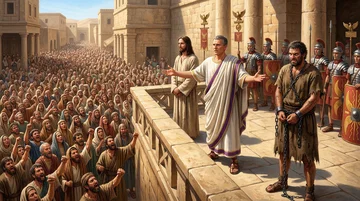
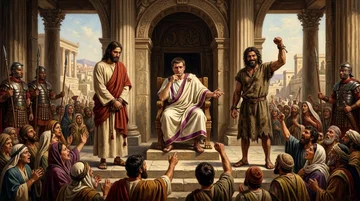
But ye have a custom, that I should release unto you one at the passover: will ye therefore that I release unto you the King of the Jews?
Translations
But you have a custom, that I should release to you one at the passover: will you therefore that I release to you the King of the Jews?
King James Version, KJV Cambridge Paragraph Bible, Revised Version, American Standard Version
But ye have a custom, that I should release unto you one at the passover: will ye therefore that I release unto you the King of the Jews?
But ye have a custom that I should release to you one at the passover: will ye therefore that I release to you the King of the Jews?
and ye have a custom that I shall release to you one in the passover; will ye, therefore, [that] I shall release to you the king of the Jews?'
But ye have a custom that I release [ some] one to you at the passover; will ye therefore that I release unto you the king of the Jews?
Howbeit ye have, a custom, that, some one, I should release unto you, during the passover:—Are ye minded, then, that I release unto you the king of the Jews?
Berean Standard Bible, Majority Standard Bible
But it is your custom that I release to you one prisoner at the Passover. So then, do you want me to release to you the King of the Jews?”
But you have a custom that I should release someone to you at the Passover. Therefore, do you want me to release to you the King of the Jews?”
But every year you make a request to me to let a prisoner go free at the Passover. Is it your desire that I let the King of the Jews go free?
But you haue a custome, that I shoulde deliuer you one loose at the Passeouer: will yee then that I loose vnto you the King of ye Iewes?
Douay-Rheims (Challoner revision)
But you have a custom that I should release one unto you at the pasch: will you, therefore, that I release unto you the king of the Jews?
Pictures
Cross-references 20 of 21
- Luke 23:18-25
And they cried out all at once, saying, Away with this man, and release unto us Barabbas:
The crowd demands Barabbas’s release and Jesus’ crucifixion.
- Mark 15:6-15
Now at that feast he released unto them one prisoner, whomsoever they desired.
Describes Pilate’s Passover offer and the crowd’s choice between Jesus and Barabbas.
- Matthew 27:15-18
Now at that feast the governor was wont to release unto the people a prisoner, whom they would.
Pilate offers Jesus or Barabbas for release at Passover.
- Mark 15:11-14
But the chief priests moved the people, that he should rather release Barabbas unto them.
The crowd chooses Barabbas and demands Jesus’ crucifixion.
- Matthew 27:21-22
The governor answered and said unto them, Whether of the twain will ye that I release unto you? They said, Barabbas.
Pilate offers Jesus or Barabbas, and the crowd chooses Barabbas and demands Jesus’ crucifixion.
- Mark 15:6
Now at that feast he released unto them one prisoner, whomsoever they desired.
Both describe the Passover custom of releasing one prisoner.
- John 19:4
Pilate therefore went forth again, and saith unto them, Behold, I bring him forth to you, that ye may know that I find no fault in him.
Pilate declares that he finds no fault in Jesus.
- John 19:14-16
And it was the preparation of the passover, and about the sixth hour: and he saith unto the Jews, Behold your King!
Continues the account of Christ’s death as the Passover sacrifice.
- Luke 23:20
Pilate therefore, willing to release Jesus, spake again to them.
Both record Pilate’s willingness to release Jesus.
- Leviticus 23:5
In the fourteenth day of the first month at even is the LORD’s passover.
Gives the date of the Passover fulfilled by Christ.
- John 19:10
Then saith Pilate unto him, Speakest thou not unto me? knowest thou not that I have power to crucify thee, and have power to release thee?
Pilate later boasts of power to release Jesus, though he cannot act freely.
- 1 Corinthians 5:7
Purge out therefore the old leaven, that ye may be a new lump, as ye are unleavened. For even Christ our passover is sacrificed for us:
Christ is identified as the Passover sacrifice.
- Luke 23:17
( For of necessity he must release one unto them at the feast.)
Both describe the custom of releasing a prisoner at the Passover feast.
- John 19:15-18
But they cried out, Away with him, away with him, crucify him. Pilate saith unto them, Shall I crucify your King? The chief priests answered, We have no king but Cæsar.
both cited as rejection of the Son
- John 19:5
Then came Jesus forth, wearing the crown of thorns, and the purple robe. And Pilate saith unto them, Behold the man!
Pilate presents Jesus to the crowd with the words “Behold the man.”
- Matthew 27:2
And when they had bound him, they led him away, and delivered him to Pontius Pilate the governor.
Both describe events in Jesus’ trial before his crucifixion.
- Matthew 27:19
When he was set down on the judgment seat, his wife sent unto him, saying, Have thou nothing to do with that just man: for I have suffered many things this day in a dream because of him.
Pilate sits on judgment seat to declare innocence
- Luke 23:16
I will therefore chastise him, and release him.
same plan to chastise then release Jesus
- Jeremiah 23:5
Behold, the days come, saith the LORD, that I will raise unto David a righteous Branch, and a King shall reign and prosper, and shall execute judgment and justice in the earth.
The promised Lord is identified as the King Messiah.
- John 6:15
When Jesus therefore perceived that they would come and take him by force, to make him a king, he departed again into a mountain himself alone.
Jesus withdrew when people tried to make Him king.
Commentary
Each commentary is drawn from primary sources: the writings of Ellen G. White and Adventist pioneers and periodicals. Each commentary is separate. Its own words are not a quotation; follow the references to read the source passages.
Ellen G. White
12 sources
Pilate appealed to the custom of releasing to the people one prisoner of their choice at the Passover, the great national festival.Ms 51, 1897, par. 29–30Lt 290, 1906, par. 6–7DA 735.1–5Ms 112, 1897, par. 33–345RED 61.1 That custom of setting at liberty one prisoner condemned to death was a pagan invention with not one particle of justice in it.Ms 112, 1897, par. 33–34 Pilate knew Jesus was innocent and had found no fault in Him, even recognizing while Jesus was bound and under accusation that His power was the power of God and not that of a common man.Ms 51, 1897, par. 29–30DA 735.1–5Ms 112, 1897, par. 33–345RED 61.1Lt 100, 1910, par. 16
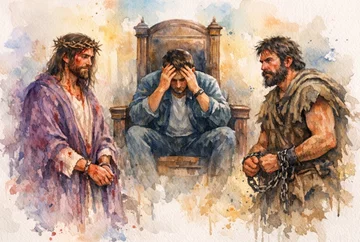
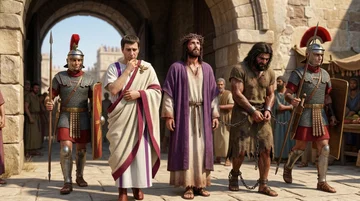
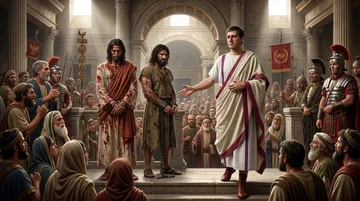
Jesus stood in Pilate's judgment hall because religious leaders and rulers brought Him there for envy, and a lawless mob with those leaders, driven by Satan's hatred, sought to take His life and demanded that He be crucified.DA 735.1–5Ms 112, 1897, par. 33–34ST May 17, 1899Ms 72, 1902, par. 15 With his soul in terrible conflict and fearing a riot, Pilate tried to save an innocent man without directly opposing the priests and rulers by using the custom as a subterfuge.Ms 51, 1897, par. 29–30Ms 112, 1897, par. 33–34 Pilate therefore offered the crowd a choice between Jesus, whom he called the King of the Jews and Jesus of Nazareth, and the notable Barabbas placed side by side with Him, hoping the contrast between innocence and guilt would move them to demand Jesus' release.Ms 51, 1897, par. 29–30Lt 290, 1906, par. 6–7DA 735.1–5Ms 112, 1897, par. 33–345RED 61.1
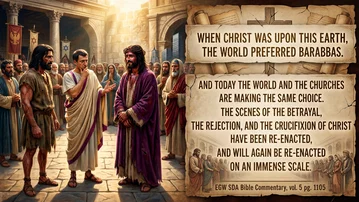
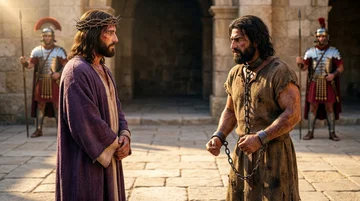
Barabbas stood in most striking contrast to Christ as a notorious robber, thief, and murderer, who pretended to be Christ and claimed religious power and a right to establish a different order of things and set the world right, doing great wickedness and wonderful things through satanic agencies and claiming under satanic delusion that whatever he could obtain by theft and robbery and murder was his own.Ms 51, 1897, par. 29–30Ms 112, 1897, par. 33–345RED 61.1ST May 17, 1899Lt 31, 1898, par. 30–32 Instead the priests and people chose Barabbas and demanded that Jesus be crucified, showing the fickleness of a crowd that had once hailed Him as king and then reviled Him.Ms 51, 1897, par. 29–30Lt 290, 1906, par. 6–7DA 735.1–516MR 259.3–260.15RED 61.1 Jesus submitted to this unjust treatment, though no sin had been proved against Him, as humanity's substitute and surety, and the choice to release a thief and murderer instead of Him reveals the world's moral blindness and rejection of Christ.Lt 100, 1910, par. 16Lt 31, 1898, par. 30–32
Barabbas placed beside Jesus represents Satan, so the people's choice of Barabbas before the Son of God exalted Satan, and the same choice is repeated whenever people reject Christ, with each person demonstrating whom they choose.16MR 259.3–260.1 The choice illustrates how deception leads people to reject Christ, for near the end of time Satan's influence will move people to choose against Christ and cry for His crucifixion.Ms 39, 1894, par. 11–12 The crowd's turning against Jesus showed His disciples that the world's favor could not be trusted, and He prepared them for this trial so that His rejection would not take them by surprise.4RED 102.2–103.1
Sources
Pioneers and periodicals
20 sources
After finding no crime in Jesus, Pilate appeals to the Passover custom of releasing one prisoner and asks whether they want him to release the King of the Jews, still hoping to free Him.ST Sep 24, 1912ST May 6, 1897ST May 10, 1905ST May 10, 1905ST Aug 17, 1904 The custom freed whichever one Jewish prisoner condemned under Roman law the people requested at the feast, to please them and quiet unrest when great crowds gathered.ST Mar 28, 1906ST Nov 9, 1882ST Aug 17, 1904 Stirred by the chief priests, the people reject Jesus and choose Barabbas instead, a robber guilty of insurrection and murder, demanding that Jesus be crucified.ST May 17, 1899ST May 6, 1897ST Feb 5, 1902ST Mar 13, 1901 In doing so Pilate acts unjustly by placing an innocent man whom he has declared faultless on a level with a notorious criminal and leaving His fate to His enemies in order to appease the crowd and protect his own standing.ST Mar 15, 1877RH Jan 31, 1871 Jesus is truly born heir to a throne, but His kingdom is not of this world, and as the Passover sacrifice He is sacrificed on the fourteenth day of the first month to fulfill the type, now reigning from the throne of grace until He establishes His glorious kingdom over all.ST Jun 14, 1905RH Oct 30, 1855ST Jun 7, 1899RH Dec 15, 1868ST Mar 4, 1897
Trial Setting and Custom
The verse belongs to the account of Jesus' trials before the high priest and Pilate, and in it Pilate is making an effort to release Him.ST Sep 24, 1912 After declaring that he found no crime in Jesus, Pilate goes out again to the Jews and appeals to the custom of releasing one prisoner at the Passover, asking whether they want him to release the King of the Jews.ST May 6, 1897 In proposing Jesus as the King of the Jews under that Passover custom, Pilate still hopes to free Him and has no sympathy with the Jewish leaders, but his earlier compromises have left him powerless before them.ST May 10, 1905ST May 10, 1905
Pilate had called together the chief priests, rulers, and people and seated himself on the judgment seat to end the trial by formally declaring Jesus innocent after examination by himself and by Herod.ST Nov 9, 1882 He intends to chastise Jesus to propitiate the priests and then release Him under the custom without further consulting the people, thinking to satisfy the people by the release, the priests by the chastisement, and himself by delivering Jesus from death, but he satisfies none.ST Nov 9, 1882 The custom freed one prisoner at the feast; John confines it to the Passover, while the Synoptists speak of a release at each feast, and the Passover release possibly pointed to Israel's release from Egyptian bondage.ST Nov 9, 1882 Nothing definite is known about the origin of the custom and no trace of it remains in later Jewish writings; it was possibly established by the Romans as policy but was more probably of Jewish origin and continued by the Roman governors.ST Nov 9, 1882
At Passover the Romans customarily released to the Jews whichever prisoner they requested, when people gathered from all parts for their principal feast.ST Mar 28, 1906ST Aug 17, 1904 The custom released one Jewish prisoner condemned under Roman law to please them and let them choose who should go free, intending to ease their sense of Roman oppression and quiet national unrest during the large gathering.ST Mar 28, 1906ST Aug 17, 1904 Some prisoners were viewed by the Jews as patriots for resisting Roman rule or taxes.ST Mar 28, 1906 The Greek word for feast appears here without the definite article while still referring specifically to the Passover, showing that an unarticled feast can mean the definite Passover festival.RH Dec 5, 1907
Rejection, Kingdom, and Fulfillment
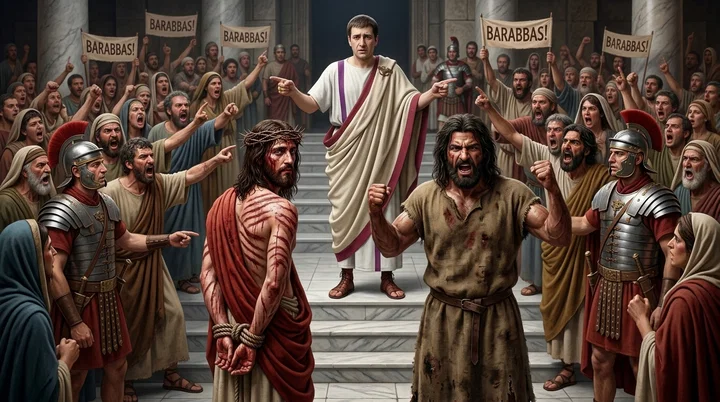
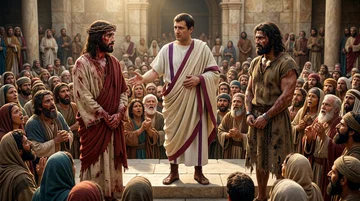
Pilate tried to use the Passover pardon so that the people would choose Jesus, hoping they would choose Him and having confidence they could still be moved in the interest of justice, though he knew the chief priests had handed Jesus over out of envy.ST Aug 17, 1904 After having Jesus scourged, he placed Him beside Barabbas to stir the people's pity and persuade them that Jesus had suffered enough, standing before a roaring crowd in a solemn struggle for what is right.ST Oct 7, 1886RH Apr 2, 1908 Their contrasting appearances emphasized the difference between them.ST Oct 7, 1886RH Apr 2, 1908 Jesus appeared noble, pure, and calm, while Barabbas appeared as a hardened criminal whose face reflected evil.ST Oct 7, 1886RH Apr 2, 1908
The people pressed their claim under the custom but did not ask for Jesus, crying out for Barabbas instead, so Pilate left them to elect between the two.ST Nov 9, 1882 In this, Israel rejected Jesus as the Son, the heir sent last, when He was brought before Pilate at the Passover as the King of the Jews.ST Feb 5, 1902 The people rejected Jesus' release and demanded Barabbas, a robber, a criminal charged with insurrection and murder.ST May 6, 1897ST Mar 13, 1901 They chose Barabbas, a robber and murderer, instead of the Son of God, and demanded that Jesus be crucified.ST May 17, 1899
The chief priests stirred the people to choose Barabbas, who had been convicted of the very crime charged against Jesus. Pilate acted inconsistently by treating an innocent man as equal to a convicted criminal and leaving the innocent man's fate to the choice of His avowed enemies. He presented the people with a choice between Jesus, whom he had declared innocent and faultless, and a notorious robber.ST Mar 15, 1877RH Jan 31, 1871 Yet he acted to appease the crowd and prove loyalty to Caesar and protect his standing rather than wait for an answer about truth or pursue truth and justice.ST Mar 15, 1877RH Jan 31, 1871
The offer stood within the false accusation that Jesus sought to establish a rival earthly kingdom; Jesus did not deny that He was born heir to a throne, but His kingdom is not of this world, and claims that He would be king of a present earthly government are futile.ST Jun 14, 1905 Though pronounced innocent, Jesus was condemned to please the officials, and His submission to undeserved injury and insult shows that His kingdom is not of this world, since neither He nor His subjects resist.ST Jun 7, 1899 He is now on the throne of grace and will establish His glorious kingdom on earth in His own time, superseding all other kingdoms.ST Jun 14, 1905 Pilate's question about releasing Him identifies Him by His royal title, the King of the Jews; this kingship points to His purpose in coming into the world as King and grounds the royal standing and future hope of His followers, who are called to share His reign.ST Mar 4, 1897 Christ, the Passover sacrifice, was sacrificed on the fourteenth day of the first month, fulfilling the Passover type on its appointed day.RH Oct 30, 1855RH Dec 15, 1868
Sources