Translations
American King James Version, King James Version, KJV Cambridge Paragraph Bible, Webster Bible
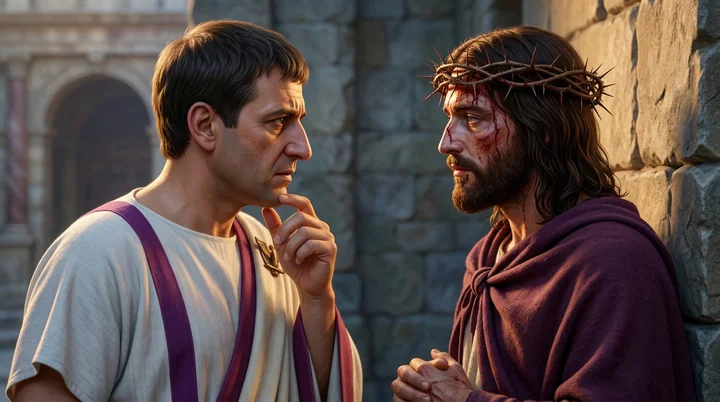
When Pilate therefore heard that saying, he was the more afraid;
Revised Version, American Standard Version
When Pilate therefore heard this saying, he was the more afraid;
When, therefore, Pilate heard this word, he was the more afraid,
When Pilate therefore heard this word, he was the rather afraid,
When, therefore, Pilate heard this word, he was the more afraid;
Berean Standard Bible, Majority Standard Bible
When Pilate heard this statement, he was even more afraid,
When therefore Pilate heard this saying, he was more afraid.
When this saying came to Pilate's ears his fear became greater;
When Pilate then heard that woorde, he was the more afraide,
Douay-Rheims (Challoner revision)
When Pilate therefore had heard this saying, he feared the more.
Pictures
Cross-references
- John 18:36
Jesus answered, My kingdom is not of this world: if my kingdom were of this world, then would my servants fight, that I should not be delivered to the Jews: but now is my kingdom not from hence.
Jesus tells Pilate that his kingdom is not of this world.
- Matthew 27:24
When Pilate saw that he could prevail nothing, but that rather a tumult was made, he took water, and washed his hands before the multitude, saying, I am innocent of the blood of this just person: see ye to it.
Pilate declares Jesus innocent but washes his hands and delivers him to be crucified.
- Luke 23:1-25
And the whole multitude of them arose, and led him unto Pilate.
A parallel account of Jesus’ trial before Pilate.
- John 19:12-16
And from thenceforth Pilate sought to release him: but the Jews cried out, saying, If thou let this man go, thou art not Cæsar’s friend: whosoever maketh himself a king speaketh against Cæsar.
Threatened with accusation before Caesar, Pilate yields and hands Jesus over for crucifixion.
- Mark 15:1-20
And straightway in the morning the chief priests held a consultation with the elders and scribes and the whole council, and bound Jesus, and carried him away, and delivered him to Pilate.
A parallel account of Jesus before Pilate and the events leading to crucifixion.
- John 18:37
Pilate therefore said unto him, Art thou a king then? Jesus answered, Thou sayest that I am a king. To this end was I born, and for this cause came I into the world, that I should bear witness unto the truth. Every one that is of the truth heareth my voice.
Jesus had already identified himself to Pilate as the Messiah.
- John 18:40
Then cried they all again, saying, Not this man, but Barabbas. Now Barabbas was a robber.
contrasts guilty Barabbas freed with innocent Jesus
- Matthew 27:2
And when they had bound him, they led him away, and delivered him to Pontius Pilate the governor.
Jesus is delivered to Pilate for trial.
- Acts 3:13-15
The God of Abraham, and of Isaac, and of Jacob, the God of our fathers, hath glorified his Son Jesus; whom ye delivered up, and denied him in the presence of Pilate, when he was determined to let him go.
Peter recalls the choice of Barabbas and the rejection and killing of Jesus.
- Luke 23:16
I will therefore chastise him, and release him.
Pilate proposes scourging Jesus to appease the crowd.
- John 19:15-18
But they cried out, Away with him, away with him, crucify him. Pilate saith unto them, Shall I crucify your King? The chief priests answered, We have no king but Cæsar.
Continues the account of Jesus’ rejection and crucifixion.
- Matthew 27:18
For he knew that for envy they had delivered him.
Pilate knew Jesus had been delivered up because of envy, not wrongdoing.
- Matthew 27:25
Then answered all the people, and said, His blood be on us, and on our children.
people accept the guilt Pilate evaded
Commentary
Each commentary is drawn from primary sources: the writings of Ellen G. White and Adventist pioneers and periodicals. Each commentary is separate. Its own words are not a quotation; follow the references to read the source passages.
Ellen G. White
12 sources
The saying that made Pilate more afraid was the charge of the Jewish leaders and priests that by their law Jesus ought to die because He made Himself the Son of God.3SP 145.1–2ST Nov 2, 1882ST Jul 11, 18785RED 64.2–65.1RH Jan 23, 1900 The verse belongs to Jesus' trial before Pilate in the judgment hall, where Jesus' calm and noble and kingly bearing amid mockery and suffering made a favorable impression on Pilate and filled him with awe.ST Jul 11, 18785RED 64.2–65.1DA 723.1–724.13SP 144.2–3 There Pilate remembered reports of His miracles, including the raising of Lazarus, as he pressed to learn what charges were brought against Him.DA 723.1–724.1
Pilate had no clear understanding of Christ and His mission, having only an indistinct belief in God and in beings above humanity.ST Jul 11, 18785RED 64.2–65.13SP 144.2–3 Hearing the charge sharpened his suspicion and wondering whether Jesus might be a divine personage, so that he trembled with awe before Him and at His presence and bearing.3SP 145.1–2ST Nov 2, 1882ST Jul 11, 18785RED 64.2–65.13SP 144.2–3 He came to believe Christ was divine, and as conviction grew he felt increasing fear and self-condemnation.ST Jun 3, 1889 His increased fear sent him back into the judgment hall to ask Jesus where He came from, but Jesus gave him no answer.3SP 145.1–2ST Jul 11, 1878RH Jan 23, 1900ST Jun 3, 1889Ms 40, 1897, par. 7–10
Though he declared Jesus innocent and faultless, his fear did not keep him from condemning Him.RH Jan 23, 1900Ms 40, 1897, par. 7–10Ms 74, 1911, par. 17Lt 12, 1911, par. 8–11 He asserted his power to release Him or to crucify Him, yet failed to use his appointed authority to administer justice, and to save his own position handed Him over to be crucified.RH Jan 23, 1900Ms 40, 1897, par. 7–10Ms 74, 1911, par. 17 That boast of power made him responsible for the unjust sentence and condemnation of Christ, for the cruel scourging, and for the insults allowed before any wrong was proved against Him, because he had been chosen and appointed to administer justice yet dared not do it.RH Jan 23, 1900Ms 40, 1897, par. 7–10 Had he used the power he claimed to protect Christ, whom he himself declared innocent, he would not have been held guilty for His death, though Christ still would have been crucified.RH Jan 23, 1900
The trial and condemnation surrounding the verse was the great test Jesus had prepared His disciples to face while He was still with them to comfort and strengthen them.4RED 102.2–103.1 When their Lord was betrayed and humiliated and condemned and reviled by a crowd that had once hailed Him, weak and undecided followers might have yielded to fear and disappointment and drawn others into apostasy.4RED 102.2–103.1 Because faithful disciples had already seen the fickleness of those who turned from Jesus, they were not wholly surprised when professed followers abandoned Him in His trouble, and they did not abandon Him themselves, draw others into apostasy, or rest their faith on the world's changing approval.4RED 102.2–103.1
Sources
Pioneers and periodicals
15 sources
The saying Pilate heard was the Jews' charge that by their law Jesus ought to die because He made Himself the Son of God.ST Nov 2, 1882ST Jul 11, 1878ST May 13, 1897 Hearing it made him more afraid because it sharpened his suspicion that Jesus might be a divine personage, an awe fed by his indistinct belief in God and beings above humanity and by Christ's conduct unlike any he had known and kingly bearing amid mockery and suffering.ST Nov 2, 1882ST Jul 11, 1878RH Jun 15, 1911 His fear was heightened also by the threat that releasing Jesus would make him no friend of Caesar, for he dreaded that an accusation of disloyalty reaching the suspicious Tiberius would ruin him.ST Jul 14, 1881RH Dec 9, 1858 In his increased fear he went back into the judgment hall to ask Jesus whence He came, but Jesus gave him no answer because He had already told him that His kingdom was not of this world and that He was the Messiah, and had no further words for one who yielded principle and authority to a bloodthirsty rabble.ST Jul 11, 1878RH Jan 23, 1900ST May 13, 1897ST May 13, 1897 Though he declared Jesus innocent and his conscience was troubled before Him, weakness and worldly self-interest kept him from doing his plain duty to protect Him, so he yielded to the mob and handed Him over to scourging and crucifixion.RH Dec 9, 1858
The Saying and Fear
The saying that made Pilate more afraid was the Jews' charge that by their law Jesus ought to die because He made Himself the Son of God.ST Nov 2, 1882RH Jan 23, 1900ST Jun 3, 1889ST May 13, 1897ST May 13, 1897 Hearing that claim deepened his fear because it sharpened his suspicion that Jesus might be a divine personage before whom he trembled with awe.ST Nov 2, 1882ST Jul 11, 1878 His awe grew because, though he did not understand Christ's mission, he held an indistinct belief in God and in beings above humanity and wondered whether Jesus might be divine.ST Jul 11, 1878 That wonder was fed because Jesus' conduct had already struck him as unlike that of anyone he had known, and because Jesus' kingly bearing amid mockery and suffering filled him with awe.ST Jul 11, 1878RH Jun 15, 1911
His fear was also heightened by the threat that releasing Jesus would make him no friend of Caesar.ST Jul 14, 1881RH Dec 9, 1858 He knew the suspicious emperor could treat an accusation against him as disloyalty and ruin him, and he feared such an accusation of disloyalty might reach Tiberius Caesar.ST Jul 14, 1881RH Dec 9, 1858 His increased fear moved him to go back into the palace or judgment hall and ask Jesus whence He came.RH Jan 23, 1900ST Jun 3, 1889ST May 13, 1897ST May 13, 1897ST Oct 7, 1886 Jesus gave him no answer.RH Jan 23, 1900ST Jun 3, 1889ST May 13, 1897ST May 13, 1897ST Oct 7, 1886
That silence came because He had already told Pilate that He was the Messiah and that His kingdom was not of this world.ST Oct 7, 1886 He had no further words for one who abused the high office of judge by yielding principle and authority to the demands of a bloodthirsty rabble.ST Oct 7, 1886
Pilate's Failure to Judge
Although Pilate declared Jesus innocent, weakness and self-interest kept him from protecting Jesus and handing him over to brutal treatment followed, for his conscience was troubled as he stood before Jesus as the truth in human form yet he failed to use his authority to shield him. For worldly interest he resisted conscience, yielded to the mob, and ordered the execution and gave Jesus up to brutal treatment and crucifixion.RH Dec 9, 1858 That yielding was driven by fear that releasing Jesus would make him no friend of Caesar, lest an accusation of disloyalty reach the suspicious emperor Tiberius Caesar and ruin him.RH Dec 9, 1858
He dealt inconsistently with a prisoner he knew to be innocent by persistently appealing to the people for consent to do his plain duty and by offering to cruelly scourge an innocent man to appease their unreasoning wrath.ST Mar 13, 1901 His boast that he had power to crucify Jesus or release Him made him responsible for the condemnation of Christ, for the cruel scourging, and for the insults offered before any wrong was proved.RH Jan 23, 1900 This was because he had been chosen and appointed to administer justice yet dared not do it.RH Jan 23, 1900 Had he used the power he claimed to protect Christ, whom he himself declared innocent, he would not have been held guilty for His death, though Christ still would have been crucified.RH Jan 23, 1900
Pilate believed Christ was divine, and as conviction grew he later felt fear and self-condemnation.ST Jun 3, 1889
Prophecy and Wider Lessons
The verse belongs to the account showing that Christ, the Passover sacrifice, was offered on the fourteenth day of the first month, fulfilling the Passover type at its appointed time.RH Dec 15, 1868 The proceedings leading to His death show religious persecution carried out through the state, in that the religious leaders hated His teaching, demanded His blood, and appealed to civil authority, which granted their demand.ST Oct 2, 1893 After hearing the charge that Jesus had made Himself the Son of God, Pilate became more afraid, and the death sentence is the result of religious complaints about His claims and His failure to follow the accusers' Sabbath customs, making Him a victim of religious legislation.ST May 19, 1914
Pilate dealt inconsistently with a prisoner he knew to be innocent, persistently appealing to the people for consent to do his plain duty and offering to cruelly scourge an innocent man to appease their unreasoning wrath, and this belongs with the inconsistency of the rulers in crying for the release of Barabbas, whose crime was practically the same as that charged against Jesus, while at their trials Barabbas was convicted and Jesus was declared innocent.ST Mar 13, 1901 After being declared innocent, Jesus received unmerited torture and mockery by the soldiers of Herod and Pilate, then the compromise scourging, and after all was handed over to His persecutors to be crucified, and in such a cruel manner His life was sacrificed that our lives might be saved.ST Mar 13, 1901 His words could reach the conscience and move even a ruler to fear, as seen when His words made Pilate more afraid, and His followers should speak in ways that likewise make Him known to those around them.ST Oct 28, 1889
Sources