Acts 20:7
And upon the first day of the week, when the disciples came together to break bread, Paul preached unto them, ready to depart on the morrow; and continued his speech until midnight.
Translations
And on the first day of the week, when the disciples came together to break bread, Paul preached to them, ready to depart on the morrow; and continued his speech until midnight.
King James Version, KJV Cambridge Paragraph Bible
And upon the first day of the week, when the disciples came together to break bread, Paul preached unto them, ready to depart on the morrow; and continued his speech until midnight.
And upon the first day of the week, when the disciples came together to break bread, Paul preached to them (ready to depart on the morrow) and continued his speech until midnight.
Revised Version, American Standard Version
And upon the first day of the week, when we were gathered together to break bread, Paul discoursed with them, intending to depart on the morrow; and prolonged his speech until midnight.
And on the first of the week, the disciples having been gathered together to break bread, Paul was discoursing to them, about to depart on the morrow, he was also continuing the discourse till midnight,
And the first day of the week, we being assembled to break bread, Paul discoursed to them, about to depart on the morrow. And he prolonged the discourse till midnight.
And, on the first of the week, when we were gathered together to break bread, Paul went on to discourse with them, being about to depart on the morrow; and he prolonged his discourse until midnight.
On the first day of the week we came together to break bread. Since Paul was ready to leave the next day, he talked to them and kept on speaking until midnight.
On the first day of the week, the disciples came together to break bread. Since Paul was ready to leave the next day, he talked to them and kept on speaking until midnight.
On the first day of the week, when the disciples were gathered together to break bread, Paul talked with them, intending to depart on the next day; and continued his speech until midnight.
And on the first day of the week, when we had come together for the holy meal, Paul gave them a talk, for it was his purpose to go away on the day after; and he went on talking till after the middle of the night.
And the first day of the weeke, the disciples being come together to breake bread, Paul preached vnto them, ready to depart on the morrow, and continued the preaching vnto midnight.
Douay-Rheims (Challoner revision)
And on the first day of the week, when we were assembled to break bread, Paul discoursed with them, being to depart on the morrow: and he continued his speech until midnight.
Pictures
Cross-references 20 of 28
- 1 Corinthians 16:2
Upon the first day of the week let every one of you lay by him in store, as God hath prospered him, that there be no gatherings when I come.
Both describe first-day activity without establishing Sunday as the Sabbath.
- John 20:19
Then the same day at evening, being the first day of the week, when the doors were shut where the disciples were assembled for fear of the Jews, came Jesus and stood in the midst, and saith unto them, Peace be unto you.
Jesus appeared to the disciples on the first day of the week.
- Matthew 28:1
In the end of the sabbath, as it began to dawn toward the first day of the week, came Mary Magdalene and the other Mary to see the sepulchre.
Both use the Greek phrase for the first day of the week.
- Acts 20:11
When he therefore was come up again, and had broken bread, and eaten, and talked a long while, even till break of day, so he departed.
Paul breaks bread after the meeting continues until daybreak, clarifying the timing of the gathering.
- Luke 24:1
Now upon the first day of the week, very early in the morning, they came unto the sepulchre, bringing the spices which they had prepared, and certain others with them.
Both texts identify the first day of the week, the day of Christ’s resurrection.
- 1 Corinthians 11:26
For as often as ye eat this bread, and drink this cup, ye do shew the Lord’s death till he come.
breaking bread commemorates death not resurrection
- Mark 16:9
Now when Jesus was risen early the first day of the week, he appeared first to Mary Magdalene, out of whom he had cast seven devils.
Both texts use the first-day phrase; Mark records Christ’s resurrection on that day.
- Mark 16:2
And very early in the morning the first day of the week, they came unto the sepulchre at the rising of the sun.
Both texts identify the day as the first day of the week.
- Acts 20:13-14
And we went before to ship, and sailed unto Assos, there intending to take in Paul: for so had he appointed, minding himself to go afoot.
Paul and his companions travel from Troas to Assos by land and sea.
- Acts 2:46
And they, continuing daily with one accord in the temple, and breaking bread from house to house, did eat their meat with gladness and singleness of heart,
shows daily breaking bread does not make a Sabbath
- John 20:1
The first day of the week cometh Mary Magdalene early, when it was yet dark, unto the sepulchre, and seeth the stone taken away from the sepulchre.
Both texts call the day of Christ’s resurrection the first day of the week.
- Leviticus 23:32
It shall be unto you a sabbath of rest, and ye shall afflict your souls: in the ninth day of the month at even, from even unto even, shall ye celebrate your sabbath.
The day is reckoned from evening to evening, placing the meeting after the Sabbath.
- Genesis 1:5
And God called the light Day, and the darkness he called Night. And the evening and the morning were the first day.
The day begins with its evening portion, placing the meeting on Saturday night.
- Revelation 1:10
I was in the Spirit on the Lord’s day, and heard behind me a great voice, as of a trumpet,
The Lord’s day is identified with the first day of the week.
- Luke 22:19
And he took bread, and gave thanks, and brake it, and gave unto them, saying, This is my body which is given for you: this do in remembrance of me.
Jesus says the bread is eaten in remembrance of him.
- 1 Corinthians 11:23
For I have received of the Lord that which also I delivered unto you, That the Lord Jesus the same night in which he was betrayed took bread:
Both describe breaking bread, with the supper instituted on the night Jesus was betrayed.
- Acts 2:42
And they continued stedfastly in the apostles’ doctrine and fellowship, and in breaking of bread, and in prayers.
Breaking bread is associated with fellowship and eating together.
- Acts 20:25
And now, behold, I know that ye all, among whom I have gone preaching the kingdom of God, shall see my face no more.
Identifies the gathering as Paul’s farewell meeting.
- Matthew 26:26-28
And as they were eating, Jesus took bread, and blessed it, and brake it, and gave it to the disciples, and said, Take, eat; this is my body.
Jesus institutes the bread and cup at the Last Supper.
- Luke 24:35
And they told what things were done in the way, and how he was known of them in breaking of bread.
Both describe disciples breaking bread together at a meal.
Commentary part 1 of 2
Each commentary is drawn from primary sources: the writings of Ellen G. White and Adventist pioneers and periodicals. Each commentary is separate. Its own words are not a quotation; follow the references to read the source passages.
Ellen G. White
5 sources
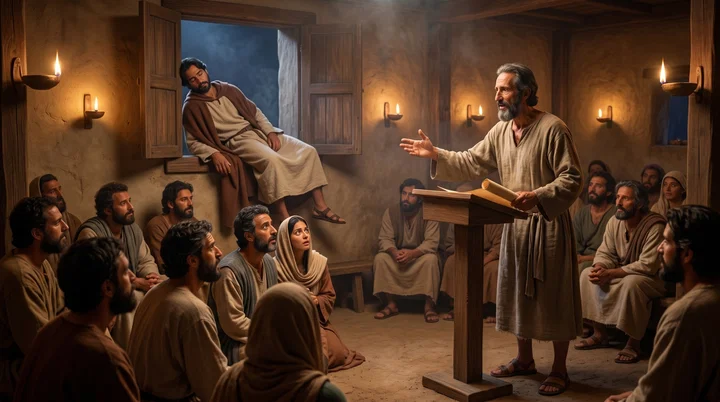
The verse falls in Paul's journey intended to bring him to Jerusalem for Pentecost, after he changed his route because of a plot against his life.AA 389.2–390.2 The gathering it describes took place on the last evening of his seven-day stay at Troas.SLP 196.4–197.1AA 391.2–3 A larger company than usual came together because Paul, their beloved teacher, was about to depart.SLP 196.4–197.1AA 391.2–3 They assembled in an upper room on the third story.SLP 196.4–197.1AA 391.2–3 That upper room was the coolest and pleasantest place for such a gathering on a warm spring evening, and many lights were burning because the nights were dark.SLP 196.4–197.1
Coming together to break bread was partaking of the communion, which the believers shared after Eutychus was restored to life.SLP 196.4–197.1AA 391.2–3 The meeting was connected with that notable miracle of Eutychus being restored to life; Paul preached until midnight and, after the restoration, continued his discourse until dawn of day, until daybreak.DA 842.2–8SLP 196.4–197.1AA 391.2–3 He spoke at such length because his mind was impressed with the perils awaiting him and the uncertainty of meeting them again, because he had matter of great interest and importance to present, and in earnestness of love and solicitude for them.SLP 196.4–197.1 The meeting was held on the evening before the first day of the week and continued until daylight, while Sunday itself was spent by Paul and his companions in physical labor; it is the only religious meeting specifically mentioned as taking place on the first day of the week.DA 842.2–8 The gathering on the first day to break bread does not establish Sunday as a sacred day or Sabbath and does not prove Christians must keep that day, since the disciples also broke bread from house to house on every day of the week, so such meetings were not exclusive to Sunday.DA 842.2–8Lt 123, 1894, par. 10–11
Sources
Pioneers and periodicals
314 sources
The gathering was a night meeting in the dark first part of the first day after the seventh-day Sabbath had ended, in a lighted upper room, with preaching until midnight and speaking on until daybreak and no daytime service.RH Jun 2, 1868ST Feb 15, 1877ST Apr 17, 1884ST Nov 25, 1886ST Aug 24, 1888 It was a single farewell meeting held because departure was next morning, not a regular weekly service, with no wording of custom, command, sacred title, or obligation.ST Jul 19, 1883ST Apr 17, 1884ST Aug 24, 1888ST Sep 20, 1899 The breaking of bread was an ordinary meal for refreshment, and even where taken as the Lord's Supper it was fixed to no day and could be any day, since breaking and preaching were done daily and do not make a day a Sabbath.ST Sep 20, 1899RH Sep 2, 1851RH Jul 4, 1865ST Jul 18, 1878 In the daylight of that same first day Paul and his companions spent the time in ordinary secular labor and travel, Paul walking about nineteen to twenty miles from Troas to Assos while the ship went ahead, treating the day as a common working day and not holy rest.ST Feb 15, 1877ST Apr 17, 1884ST Sep 20, 1899 The verse calls the day only plain first day of the week, giving no command, institution, or authority for Sunday rest or worship and no change or transfer from the seventh to the first, while the seventh day remains God's Sabbath of the fourth commandment.RH Oct 6, 1868RH Aug 22, 1854RH May 12, 1874RH Dec 22, 1863
Meeting Time and Setting
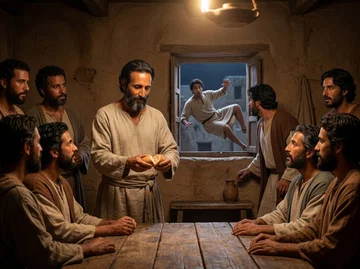
The gathering was a night meeting in the dark part of the first day in a lighted upper room with many lamps because it was dark, with Paul preaching until midnight and then speaking further until daybreak, with no daytime service.ST Apr 17, 1884ST Nov 25, 1886ST Aug 24, 1888ST Mar 3, 1881ST Jul 13, 1882 The breaking of bread followed the preaching after midnight after Eutychus fell asleep and fell from the third-loft window and was taken up dead and restored to life, and the eating and talking continued till daybreak before departure.ST Apr 17, 1884ST Nov 25, 1886ST Aug 13, 1874 The sermon was about five hours from evening to midnight, not fourteen hours from Sunday morning, and there was no daytime service followed by evening service.RH May 5, 1851ST Feb 10, 1887RH Oct 3, 1871 Although a week was spent at Troas only this night meeting is recorded, and its all-night length is explained by the farewell occasion.ST Apr 17, 1884ST Feb 10, 1887
By Bible reckoning from sunset to sunset the evening meeting was at the beginning of the first day, on what is now called Saturday night after the seventh-day Sabbath had ended, confirmed by the lights.ST Feb 15, 1877ST Apr 17, 1884ST Nov 25, 1886ST Aug 24, 1888ST Aug 19, 1875 Since the biblical day begins in the evening, this first-day night was what is now called Saturday night, and the first day began at sunset and ended at sunset the following evening.ST Nov 25, 1886ST Aug 24, 1888ST Jul 13, 1882 A meeting on Sunday night would have belonged to the second day, and it was not a daytime Sunday morning service.ST Aug 19, 1875ST Jul 19, 1883RH Oct 3, 1871RH Sep 10, 1857RH May 2, 1854 Troas was inhabited by Greeks who also reckoned days from sunset, and the many lights in the upper chamber fit a nighttime setting.ST Mar 3, 1881ST Jul 19, 1883ST Jan 8, 1885
The first day is a twenty-four hour period of darkness and light beginning with evening as fixed by evening and morning, not only twelve hours of light.RH Dec 15, 1863RH Dec 12, 1871 Day can also mean the light part as distinct from night, and morrow can mean the next daylight within the same reckoned day.ST Jan 11, 1905RH Dec 15, 1863RH May 8, 1879 The word day is absent in the Greek but is required to complete the sense, and its meaning is fixed by the creation account where evening and morning together were the first day.RH Dec 12, 1871 If the first day is sacred the whole sunset to sunset period should be observed, distinct from secular Sunday.ST Jan 11, 1905RH Dec 12, 1871 The meeting and meal may have begun before the first day had fully closed, and Paul's departure on the morrow does not necessarily mean departure on the second day.ST Jan 11, 1905RH Dec 15, 1863RH May 8, 1879ST Feb 23, 1915
If the day is reckoned from midnight by Roman practice rather than from sunset, the preaching before midnight and the breaking of bread, fall of Eutychus and further talk after midnight fall on different days, with the bread broken on Monday morning or the second day, so the act does not honor Sunday.RH Jun 2, 1868ST Feb 15, 1877ST Nov 25, 1886ST Aug 13, 1874ST Sep 20, 1899 By modern reckoning it was Monday, and by Roman reckoning a meal taken after midnight would fall on the second day.RH Jun 2, 1868ST Aug 13, 1874 The breaking after midnight proves nothing about the first day and does not establish that the Supper was early evening.ST Nov 25, 1886ST Aug 13, 1874RH May 5, 1851 Under that proposed reckoning the nighttime breaking of bread could fall on the second day of the week.RH May 5, 1851
On the Roman reckoning the evening meeting is counted as part of the first day, so ready to depart on the morrow means waiting until Monday morning to travel to Assos. On this view the regular service with breaking and preaching did not violate the Sabbath and separates meeting timing from Sabbath rest. The disciples' gathering to break bread and hear preaching was a regular Christian service, and Paul and his companions waited until the meeting was over before departing for Assos. The weekday meeting and the timing of departure are separate from the question of which day the Sabbath law requires for rest and worship.
Alternatively, the meeting began in the light part of the first day and continued through the night of the second day until Monday morning daylight, since hemeran means day, so that Paul journeyed on the second day after keeping a Sabbath with the disciples.RH Dec 12, 1871RH Dec 12, 1871RH Jan 16, 1866 Days begin at evening, so the twenty-four hour period includes both day and night, and in Scripture day means the light part and night the dark part with midnight distinctly named.RH Dec 12, 1871 The meeting is presented as a day meeting commenced on the first day and not on the first night, not a night meeting exclusively, continuing through the first day and through the second night with healing at midnight of the second day and then speaking and breaking until morning daylight of the second day when departure followed.RH Dec 12, 1871RH Dec 12, 1871 The phrase first day of the week is correct translation with Sabbaton rightly meaning week and day being required to complete the sense, and the meeting was held in an upper room in the third story instead of a seventh-day Jewish synagogue.RH Dec 12, 1871
One view renders the gathering as on the ancient seventh-day Sabbath, as Tyndale rendered Sabbath day, or one day of the Sabbaths with morrow-after-Sabbath possible, deemed more probable as customary convenient assembly time for solemn Supper around A.D. 60 before Sunday replaced the Sabbath.RH Dec 6, 1853ST Oct 26, 1882ST Jan 2, 1879ST Oct 26, 1882 The Sabbath is considered the more probable day because it was a customary, convenient time for an assembly, and Paul could have waited for it to gather the disciples together.ST Oct 26, 1882ST Jan 2, 1879 The day was appointed for the solemn celebration of the Lord's supper, when Christians held sacred assemblies and celebrated communion.ST Oct 26, 1882ST Oct 26, 1882 The change to Sunday came later, not to commemorate resurrection, but because of Jewish superstition.ST Oct 26, 1882
There is no recorded first-day daytime worship meeting or congregation.RH May 5, 1851ST Feb 10, 1887RH May 2, 1854 The account gives no evidence of a first-day daytime worship meeting, does not record a daytime first-day congregation meeting for worship and gospel ordinances, and does not establish a daytime Sunday meeting.RH May 5, 1851ST Feb 10, 1887RH May 2, 1854 It was not called as a special meeting, and it is the New Testament's only account of a public meeting on the first day of the week.RH Sep 10, 1857 The meeting followed the Sabbath, was for communion and farewell, and was in the evening not the morning before First-day morning when departure on the journey resumed.RH May 5, 1851RH Sep 10, 1857RH May 2, 1854
One view disputes that the gathering began in the evening, noting day can mean a twenty-four-hour period, and raises how the day was reckoned without applying it.RH Jun 24, 1873RH Dec 26, 1865RH Jun 17, 1873 Another view denies Paul traveled on the first day, saying he remained and preached while he had traveled on the preceding days, including the preceding Lord's day and the Sabbath before that where travel could be necessary.RH Jul 29, 1873 It is also held the meeting could have taken place after the Sabbath with departure on the first day, and the verse does not establish that the meeting began before evening or that the first day was a Sabbath or day of rest.RH Jun 24, 1873
Greek Words and Translation
In the Greek the word rendered first literally means one, with the feminine noun for day understood though absent yet required to complete the sense, while week is expressed by a plural form of the word for Sabbath, and the word rendered when has no corresponding word in the original.RH Jan 2, 1900RH Dec 12, 1871RH Jul 4, 1865 Literally the clause reads on the first, the disciples being assembled to break bread, Paul preached, with the same participial form in verse 11 meaning having ascended and broken bread.RH Jul 4, 1865RH Dec 12, 1871 The feminine numeral mia meaning one or first agrees with feminine hemera, day, understood, not with neuter sabbaton, with day understood after the numeral by Hebrew usage, making first day of the week grammatically necessary.ST Apr 3, 1879RH May 31, 1864RH Jul 24, 1866 The rendering mian sabbaton as first day of the week is therefore correct, and the grammar does not support one of Sabbaths or the start of a new series of Sabbaths.ST Apr 3, 1879RH May 31, 1864RH Sep 25, 1856 The fitting noun to supply with the expressed or understood feminine first is day, yielding the first day of the week and not the first Sabbath.ST Apr 10, 1879RH Jul 24, 1866ST Oct 21, 1889
The phrase uses hemera for day and sabbaton for week in its regular sense after a numeral marking the day as the seven-day interval from Sabbath to Sabbath, not a Sabbath day.ST May 15, 1884RH Sep 25, 1856RH Sep 25, 1856 Week is the proper translation especially when preceded by a numeral, and the phrase means toward the first day.ST May 15, 1884RH Sep 25, 1856 The same form occurs in Luke 24:1 and in the direction for laying by in 1 Corinthians 16:2.RH Jun 24, 1915ST Mar 27, 1879 It cannot rightly be translated Sabbath, much less both Sabbath and first day of the week in the same text, and the added title Christian Sabbath has no place in it, containing no Sabbath, no religious principle, and no obligation.RH Jun 24, 1915ST May 15, 1884ST Apr 10, 1879 Translated as the Sabbath, the verse gives no proof the meeting occurred on the first day, since Sabbath in every other instance in Acts means the seventh day, just as Sabbath in fifty-nine other places invariably means the seventh day.ST Apr 14, 1887
The whole week was sometimes called a Sabbath because the Sabbath was the principal crowning day, expressing the Hebrew idea of days bounded by and belonging to the Sabbath and reckoned from it.RH Jun 4, 1908RH Dec 13, 1870ST Mar 27, 1879 The other days were reckoned from it as first day of the Sabbath, second day onward toward the next Sabbath, with ownership expressed by the genitive possessive construction.RH Jun 4, 1908ST Mar 27, 1879ST Apr 15, 1897 The verse therefore counts Sunday as day one toward Saturday, preserving creation reckoning and the unbroken cycle, and refers to the first day belonging to the week, not to a newly begun series of Sabbaths.RH Jun 4, 1908RH Dec 13, 1870RH Mar 23, 1905 The days are numbered first, second, third and onward with reference to the seventh-day Sabbath as chief and crowning day, the Sabbath both named and numbered as starting point, and the verse does not call the first day a sabbath or rest day.RH Mar 23, 1905ST Apr 15, 1897 This use of the feminine cardinal mia for the ordinal first, agreeing with feminine day understood and not with neuter sabbaton for which neuter hen would be required, is a Hebrew idiom in harmony with Greek grammar.ST Jun 26, 1901
Those who held the opposite teaching took the verse to read the first of the Christian Sabbaths or first Sabbath, since sabbaton remains Sabbath when joined with first as a horse turned into another pasture does not become a cow.ST Apr 10, 1879RH Jul 24, 1866 On that reading the Greek contains Sabbath in the plural form where English has first day of the week, eighth day and first day being the same, in one of eight places where five inspired writers call the first day Sabbath.ST Apr 10, 1879 This was held to prove the first-day Sabbath kept onward for sixteen centuries and originating with Christ when on earth and with the apostles.ST Apr 10, 1879RH Jul 24, 1866 The original was claimed to call the day the first sabbaton, applying sabbaton to the first day as well as the seventh after the resurrection, though the word does not appear as Sabbath in English translation.RH Jan 23, 1866RH Jan 30, 1866
That claim that the wording means first day of the sabbaths to make resurrection day the Christian Sabbath is challenged by asking how it can be identified as the first day if first day of the week is rejected.RH Aug 10, 1905RH Its Greek wording and grammatical construction support the common translation as first day of the week, not the Sabbath.ST May 15, 1884 Week is a proper translation, and the wording does not establish a change of the Sabbath to the first day.RH Sep 25, 1856RH Apr 12, 1906 To translate it as Sabbath and assert Scripture applies Sabbath to the first day in order to defend Sunday-keeping is groundless, hazards honesty and scholarship, and gives no proof of transfer.RH Sep 25, 1856RH Apr 12, 1906
The word for the disciples is claimed to be an interpolation, so the better reading is said to be Paul and his traveling companions gathered to break bread.ST May 28, 1885 On that reading the gathering was a social meal before a sermon to people of the city drawn by curiosity about Paul, not necessarily Christians.ST May 28, 1885 Thus the verse is held to describe a single meal and sermon, not a religious practice of the Troas Christians or a universally binding observance of the first day.ST May 28, 1885 The word rendered when contains no adverb of time and implies no customary action, literally the disciples being assembled.RH Jul 4, 1865RH Dec 12, 1871 Whether the meeting began in the morning or in the evening with which the first day commences, it does not prove a stated worship-rest day.RH Dec 12, 1871
Travel Work and Miracle
In the morning Paul walked alone on foot by the shorter land route from Troas to Assos to overtake the ship, a distance stated as nineteen miles, nearly twenty miles, nineteen and one-half miles, or twenty miles, while his companions including Luke went ahead by boat by the longer route around the headland, then took him in at Assos and sailed about fifty miles farther to Mitylene toward Jerusalem, and Paul could direct where the ship stopped.ST Feb 15, 1877ST Apr 17, 1884ST Sep 20, 1899ST Sep 28, 1915 While Paul held the farewell night meeting his eight companions were absent, having already sailed by arrangement toward Assos, and after preaching until midnight, the healing of the young man, breaking bread, eating and talking until daybreak, Paul afterward walked to Assos and boarded, with the vessel ready to sail Sunday morning after the seven-day stay and the final service Saturday evening.ST Mar 30, 1882RH May 17, 1860ST Dec 11, 1884ST Aug 19, 1875ST Aug 19, 1875 Paul chose the long night of farewell service and the next-morning walk of about nineteen and a half miles to give more time to do thorough work with the church, and in the afternoon after the evening meeting after the Sabbath he walked from Troas to Assos.ST Aug 19, 1875RH Oct 28, 1915RH Dec 12, 1907
Paul and his companions spent the daylight of that same first day in ordinary secular labor, travel and ship work, Paul walking about nineteen to twenty miles, nineteen miles by land against sixty by water, more than twenty times a Sabbath day's journey, while two companions traveled by sea during the preaching, and this is apostolic example of secular employment showing the day treated as common working traveling day not holy rest.ST Feb 15, 1877ST Apr 17, 1884ST Sep 20, 1899RH Feb 27, 1872 On that first day Paul traveled fifty miles and his companions seventy miles by appointment from Troas to Mitylene, about seventy miles, then as far on following days from Mitylene to Chios, Chios to Samos and Trogyllium, and to Miletus about thirty miles, with Sopater, Aristarchus, Secundus, Gaius, Tychicus, Trophimus, Timothy and Luke, proving they counted the first day no more sacred than the next days.ST Dec 11, 1884ST Jul 30, 1912ST Jul 22, 1897ST Jan 29, 1902RH Oct 22, 1872 Their actions performing labor on the first day are inconsistent with treating that day as the Sabbath, give no command to rest on the first day and no authority for Sunday as a Sabbath, but stand as Bible example of secular work on Sunday while precept and example enjoin the seventh-day Sabbath.ST Jul 30, 1912ST Jul 22, 1897ST Jan 29, 1902RH May 27, 1873
Paul and his companions had stayed seven days at Troas after sailing from Philippi, delayed and arriving too late for the intended Sabbath, waiting a full seven days to spend one Sabbath with the church, and Greeks also reckoned sunset to sunset.ST Jul 19, 1883ST Sep 20, 1899RH Feb 27, 1872RH Aug 19, 1858ST Jun 18, 1894 The companions rested over the Sabbath and sailed after sunset while he stayed for the closing evening meeting, showing regard for the seventh-day Sabbath of the fourth commandment in keeping with his Sabbath preaching manner, and Paul had observed the Sabbath before this meeting.ST Sep 20, 1899RH Feb 27, 1872RH Aug 19, 1858ST Jul 8, 1880 The meeting was a farewell gathering held because Paul expected it to be his last visit and did not expect to see them again, and could have occurred on another evening, and only one meeting is recorded because it was made memorable by an occurrence and a healing, not because it was the only meeting during seven days at Troas.ST Apr 17, 1884ST Jun 18, 1894ST Jul 8, 1880
The meeting is recorded because of the notable miracle in which Eutychus fell asleep, fell from the third loft window and was taken up dead, and was restored to life, and the day is named only because of the miracle of raising the young man and to show they treated it as a common working day.ST Mar 8, 1910ST Oct 22, 1912ST Jul 8, 1880ST Mar 18, 1889ST Feb 20, 1879 Its all-night length is explained by the farewell occasion, with Paul preaching, raising the fallen young man, eating supper and keeping preaching until daybreak Sunday morning, the kind of evening meeting held on any day of the week without making the day holy, and silence about other days does not prove none since Paul hurrying to Pentecost probably preached each day.ST Oct 22, 1912ST Jul 8, 1880ST Mar 18, 1889ST Feb 20, 1879RH Dec 31, 1857 The restoration of Eutychus after life functions ceased is an example of total unconsciousness with no remembered experience in death, an exception to the rule that all the dead except those made immortal at Christ's coming live again only by resurrection through Christ's power, one of several exceptions since the first advent.RH Aug 24, 1905ST Jan 28, 1889
Farewell Occasional Gathering
The gathering was a single isolated occasional farewell meeting held because departure was imminent the next morning, marking the close of a week of labor with expectation of not seeing them again.ST Jul 19, 1883ST Apr 17, 1884RH Jun 7, 1864ST Mar 3, 1881 It has no habitual-meeting wording but simply the disciples being assembled, and does not state custom, regular service, command, sacred title, or obligation.ST Apr 17, 1884ST Sep 20, 1899ST Jul 8, 1880ST Feb 20, 1879RH May 12, 1874 The disciples met on the first day of the week to break bread and Paul spoke until midnight before leaving the next day, which does not establish Sunday communion or Sunday observance of any kind.ST Jul 19, 1883ST Mar 3, 1881ST Aug 13, 1874ST Sep 2, 1886ST Feb 20, 1879 Neither breaking bread nor preaching establishes that the first day was regarded as the Sabbath, since the Supper was not assigned a particular day or frequency and Paul could preach whenever opportunity and need arose.ST Apr 17, 1884ST Feb 20, 1879 If breaking bread on a day made it a Sabbath, the Jerusalem church's practice of breaking bread every day from house to house would make every day a Sabbath.ST Aug 13, 1874ST Sep 20, 1899ST Jul 8, 1880
The verse names breaking bread as the purpose of coming together, not singing, prayer, exhortation or preaching.ST Oct 23, 1884ST Aug 8, 1878 The disciples had spent the Sabbath in religious exercises, and the remaining time before Paul's departure was used for his final preaching and personal counsel.ST Oct 23, 1884 Paul's preaching until midnight was incidental farewell counsel because he was ready to depart on the morrow, not a regular Sabbath meeting by appointment.ST Oct 23, 1884ST Aug 8, 1878 Even celebrating the Supper and hearing preaching at this farewell meeting was fitting and would be proper on any day of the week, while the Greek word for breaking is often used for ordinary meals so it does not certainly mean the Supper.ST Oct 23, 1884ST Aug 8, 1878 Lack of record of preaching on the other six days of the seven-day wait proves nothing, since only a small part of Paul's doings is recorded.ST Aug 8, 1878
One single instance gives not even a distant hint that meeting then was customary and does not establish customary or universally binding observance.ST Aug 24, 1888ST Sep 20, 1899ST Jul 8, 1880ST Mar 18, 1889ST Feb 20, 1879 The wording does not establish every first day, weekly custom, Sabbath change, or Supper command, nor expressly state every Lord's day.ST Sep 20, 1899ST Sep 2, 1886ST Feb 20, 1879RH Sep 7, 1905 This solitary instance does not show that the first day was thereafter regularly devoted to religious worship, while Paul's meetings on the seventh day did not cease when he turned to the Gentiles.RH Jun 7, 1864ST Feb 20, 1879ST Oct 17, 1878 It is the only direct mention in the New Testament of a religious meeting on the first day of the week, the only first-day religious meeting recorded in the Bible, and the only text speaking of public religious exercises on the first day.ST Aug 24, 1888ST Sep 20, 1899ST Jul 8, 1880ST Mar 18, 1889ST Feb 20, 1879 Nothing is said about meeting on that day before or afterward, while Paul is shown preaching on eighty-four Sabbaths.ST Feb 20, 1879ST Oct 17, 1878
Luke carefully notes custom or manner for Sabbath preaching but says nothing of first-day observance as regular custom.RH May 12, 1874ST Oct 17, 1878ST Jan 4, 1877RH Jan 30, 1866RH Jun 2, 1851 Whenever he records an act instancing custom he marks it as wont, manner, custom, weekly or statedly, as for incense, firstborn, Passover, synagogue Sabbath, riverside prayer, Sabbath-after-Sabbath reasoning, and daily breaking and teaching.RH May 12, 1874RH Jan 30, 1866 The verse does not call the gathering the disciples' custom or regular manner, so it does not establish that the disciples regularly met on the first day or that a new religious institution was founded then.RH Jan 30, 1866RH Jun 2, 1851 It records only one individual occasion when the disciples came together to break bread and Paul preached ready to depart, containing no abrogation of the seventh-day law and no injunction to keep the first day holy or as rest.ST Jan 4, 1877RH Jun 2, 1851 It treats this as the only recorded occasion of Paul meeting with the disciples on the first day and argues that it does not establish a regular first-day preaching or worship day, since his regular preaching day was the seventh-day Sabbath.ST Oct 17, 1878ST Jan 4, 1877RH Jun 2, 1851
The meeting itself does not prove the day sacred, since the disciples met and Christ and the apostles preached every day.RH Jan 11, 1906ST Jan 30, 1896ST Jun 10, 1886 Meeting on the first day does not make it a Sabbath since they also met on other days, and one Sunday meeting or many Sunday meetings do not make Sunday the Sabbath.RH Jan 11, 1906ST Jan 30, 1896ST Jun 10, 1886 The day is identified by its number, not by a sacred title, in contrast with the seventh day which is called the Sabbath.ST Jan 30, 1896ST Jun 10, 1886 If the night meeting and all-night preaching make first-day meetings obligatory, its other night details must be equally binding, including meeting at night and preaching all night.ST Sep 15, 1887ST Sep 15, 1887 It gives no example of a daytime first-day meeting after belief that the Saviour rose, and the Sunday-keeping practice described conflicts with the command to keep the Lord's Sabbath.ST Sep 15, 1887ST Sep 15, 1887 Paul and the disciples spending the first day in preaching, prayer and spiritual conversation because Paul was leaving the next day does not show that they met to keep the day holy, that they met every first day, that Christians everywhere or the apostles regularly kept it holy, or that Christ and the apostles appointed the first day as a replacement Sabbath.RH Sep 7, 1905
Meaning of Breaking Bread
The breaking of bread at Troas was an ordinary common meal for refreshment, not the Lord's Supper.RH Sep 2, 1851RH Jul 4, 1865ST Jul 18, 1878ST Aug 8, 1878 The order shows this, for Paul preached first, after midnight healed the young man fallen from the window, then broke bread and ate, then talked in social intercourse until break of day and departed.RH Jul 4, 1865ST Aug 8, 1878ST Apr 13, 1904 The breaking after midnight is described as eating, language never applied to the Lord's Supper, for believers do not come to the Lord's table to eat, and there is no record of the Eucharist at the commencement of the meeting.RH Jul 4, 1865 The use is as in Acts 2:46 and Luke 24:30,35, where breaking of bread means partaking of a common meal and Christ made known in breaking bread is called by no one a communion, and the Greek word is often used for ordinary meals.RH Sep 2, 1851RH Jul 4, 1865ST Jul 18, 1878ST Aug 8, 1878 The disciples came together to break bread and Paul's preaching until midnight was incidental farewell counsel because he was leaving the next day and had much to communicate, not by appointment, and the sermon was between evening and midnight with the bread broken between midnight and break of day.RH Sep 2, 1851ST Aug 8, 1878
The weight of the passages holds that the breaking of bread is the Lord's Supper, the communion service bringing to remembrance the death and sufferings of Jesus Christ.ST Feb 1, 1883ST Oct 22, 1912ST May 27, 1875RH Jun 5, 1860ST May 27, 1875 Those who held it to be a common meal teach as above that it was for refreshment and eating.RH Sep 2, 1851RH Jul 4, 1865ST Jul 18, 1878ST Aug 8, 1878 As the Lord's Supper it commemorates Christ's death by body-breaking on the cross, not his resurrection, looking forward to reunion in his kingdom, solemnizing Paul's last meeting before departing after being with them the entire week and closing his Sabbath service with them.ST Oct 22, 1912ST May 27, 1875RH Jun 5, 1860 It was instituted Thursday evening, certainly not on the first day, is fixed to no day and to no stated time or frequency, is wholly with the people, is eaten evening or night and here after midnight, and its frequency is determined entirely by circumstances with daily house-to-house breaking as at Jerusalem, so it does not make Sunday the Sabbath nor establish a weekly custom from one occurrence alone.ST Feb 1, 1883RH Jul 4, 1865ST Oct 22, 1912 The evening gathering does not show the disciples regarded the first day as a Sabbath or day of rest, since Paul resumed his journey that morning.ST Feb 1, 1883ST Oct 22, 1912ST May 27, 1875RH Jun 5, 1860ST May 27, 1875
Breaking bread does not make a day a Sabbath or sacred.ST Sep 20, 1899RH Aug 18, 1868RH May 1, 1900 If breaking bread on a day made it a Sabbath, the Jerusalem church's practice of breaking bread every day from house to house in Acts 2:46 would make every day a Sabbath.ST Sep 20, 1899RH Jul 4, 1865 Christ broke bread on other days including the seventh without making them Sabbaths, and preaching and breaking were done on other days and would be proper on any day of the week.RH Aug 18, 1868ST Aug 8, 1878 Holding a religious meeting and breaking bread on that day does not make it the Sabbath without divine appointment, just as keeping the seventh day and also meeting and breaking bread on the first day does not make the first day the Sabbath.RH May 1, 1900 Even a direct command to meet on the first day to break bread would not affect the fourth commandment or Sabbath observance.
The disciples coming together means showing the death of Christ by the breaking of his body on the cross, so the meeting commemorated the crucifixion and not the resurrection.RH Dec 12, 1871 The verse gives no hint of abstinence from labor on that day, offers no divine or apostolic precept commanding assembly on that day, does not state that the day is a Sabbath or give instructions to rest from work such as fishing or hunting, and does not even allude to any purpose to commemorate the resurrection.RH Dec 24, 1867RH Dec 12, 1871 The gathering and the Lord's Supper could have served other purposes, and the Supper could properly be observed on any day.RH Dec 12, 1871
The verse does not teach a regular weekly celebration of the Lord's Supper on the first day and gives no command when it must be kept.RH Jul 4, 1865RH May 5, 1851RH Nov 24, 1868ST Dec 9, 1913RH Nov 1850 The word when has no corresponding word in the Greek, reading literally on the first day of the week the disciples being assembled to break bread Paul preached, a simple statement of what happened on that occasion with no indication it had happened before or would happen again, not establishing every first day, weekly custom, or religious duty.ST May 27, 1875RH Jul 4, 1865RH May 5, 1851 A single observance understood as Saturday night, the only recorded first-day instance and the only text speaking of public religious exercises on the first day, does not appoint repeating every succeeding first day or any required schedule, and the New Testament does not restrict communion to a particular weekday.RH May 5, 1851RH Nov 24, 1868ST Dec 9, 1913RH Nov 1850ST Jun 5, 1901 Since the early Christians broke bread every day, the fact that bread was broken on this particular first day cannot make it a Sabbath or show it to be one, and since the bread was broken after midnight the act fell on the second day by both Jewish reckoning and midnight reckoning and by Roman reckoning on Monday morning.RH Nov 24, 1868ST Dec 9, 1913RH Nov 1850ST Jun 5, 1901 It may have been kept then only because Paul was leaving the next day, making the meeting a special occasional gathering rather than a regular example of first-day worship.RH May 5, 1851ST Dec 9, 1913
The breaking of bread is identified with a love-feast and the bread Paul broke, and the account shows the journey began in daylight of that same first day.ST Feb 13, 1912 The meeting may have been a final Lord's Supper sharing arranged before leaving for Jerusalem to celebrate the dying Lord's love, closing a week of apostolic labor, with the wording also rendered simply as the disciples being assembled so it does not by itself prove recurring observance.RH Dec 12, 1871 The disciples assembled and Paul preached first, continuing without stopping until midnight, about five hours not about fourteen hours from Sunday morning, with many lights showing the entire service held in the evening with no daytime service followed by adjournment and then an evening service, and the breaking came after the sermon was closed at midnight.ST Feb 13, 1912RH Dec 12, 1871
The gathering at Troas gives an apostolic example for breaking bread after midnight, joined with setting the church in order through confession and removal of trials, choosing an overseer and a deacon in unity, and setting them apart by laying on of hands.RH Nov 25, 1858 It provides a precedent for a Christian meeting that continued nearly until daybreak, after which the brethren departed on their journeys.RH Nov 25, 1858RH Aug 14, 1860
Sources