Luke 15:29
And he answering said to his father, Lo, these many years do I serve thee, neither transgressed I at any time thy commandment: and yet thou never gavest me a kid, that I might make merry with my friends:
Translations
And he answering said to his father, See, these many years do I serve you, neither transgressed I at any time your commandment: and yet you never gave me a kid, that I might make merry with my friends:
King James Version, KJV Cambridge Paragraph Bible
And he answering said to his father, Lo, these many years do I serve thee, neither transgressed I at any time thy commandment: and yet thou never gavest me a kid, that I might make merry with my friends:
And he answering, said to his father, Lo, these many years do I serve thee, neither have I at any time transgressed thy commandment; and yet thou never gavest me a kid, that I might make merry with my friends:
But he answered and said to his father, Lo, these many years do I serve thee, and I never transgressed a commandment of thine: and yet thou never gavest me a kid, that I might make merry with my friends:
But he answered and said to his father, Lo, these many years do I serve thee, and I never transgressed a commandment of thine; and yet thou never gavest me a kid, that I might make merry with my friends:
and he answering said to the father, Lo, so many years I do serve thee, and never thy command did I transgress, and to me thou didst never give a kid, that with my friends I might make merry;
But he answering said to his father, Behold, so many years I serve thee, and never have I transgressed a commandment of thine; and to me hast thou never given a kid that I might make merry with my friends:
But, he, answering said unto his father—Lo! so many years as these, do I serve thee, and, at no time, a commandment of thine, have I transgressed,—And, unto me, at no time, hast thou given a kid, that, with my friends, I might make merry;
Berean Standard Bible, Majority Standard Bible
But he answered his father, ‘ Look, all these years I have served you and never disobeyed a commandment of yours. Yet you never gave me even a young goat so I could celebrate with my friends.
But he answered his father, ‘ Behold, these many years I have served you, and I never disobeyed a commandment of yours, but you never gave me a goat, that I might celebrate with my friends.
But he made answer and said to his father, See, all these years I have been your servant, doing your orders in everything: and you never gave me even a young goat so that I might have a feast with my friends:
But he answered and said to his father, Loe, these many yeeres haue I done thee seruice, neither brake I at any time thy commadement, and yet thou neuer gauest mee a kidde that I might make merie with my friends.
Douay-Rheims (Challoner revision)
And he answering, said to his father: Behold, for so many years do I serve thee, and I have never transgressed thy commandment, and yet thou hast never given me a kid to make merry with my friends:
Pictures
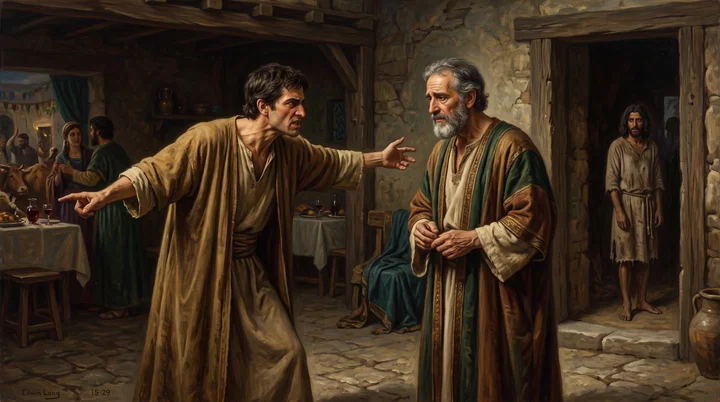
Cross-references
- Luke 15:20-24
And he arose, and came to his father. But when he was yet a great way off, his father saw him, and had compassion, and ran, and fell on his neck, and kissed him.
The father welcomes, restores, and celebrates the returning son.
- Luke 15:4-7
What man of you, having an hundred sheep, if he lose one of them, doth not leave the ninety and nine in the wilderness, and go after that which is lost, until he find it?
The shepherd seeks the lost sheep, and heaven rejoices when it is found.
- Luke 15:17
And when he came to himself, he said, How many hired servants of my father’s have bread enough and to spare, and I perish with hunger!
The returning son remembers his father’s abundant bread while perishing with hunger.
- Luke 15:24
For this my son was dead, and is alive again; he was lost, and is found. And they began to be merry.
The father rejoices that his lost son has returned from the dead.
- Luke 15:16
And he would fain have filled his belly with the husks that the swine did eat: and no man gave unto him.
The prodigal’s hunger and ruin are shown by his longing to eat the swine’s husks.
- Luke 15:21
And the son said unto him, Father, I have sinned against heaven, and in thy sight, and am no more worthy to be called thy son.
The son confesses his sin and unworthiness before the father receives him with joy.
- Luke 15:8-10
Either what woman having ten pieces of silver, if she lose one piece, doth not light a candle, and sweep the house, and seek diligently till she find it?
Both parables show joy when what was lost is found.
- Luke 15:18-19
I will arise and go to my father, and will say unto him, Father, I have sinned against heaven, and before thee,
The returning son plans to confess his sin and unworthiness to his father.
- Luke 15:1-2
Then drew near unto him all the publicans and sinners for to hear him.
The elder brother’s resentment echoes the complaint against welcoming sinners.
- Luke 15:22
But the father said to his servants, Bring forth the best robe, and put it on him; and put a ring on his hand, and shoes on his feet:
The father welcomes his returning son with a robe and ring.
- Luke 18:11-14
The Pharisee stood and prayed thus with himself, God, I thank thee, that I am not as other men are, extortioners, unjust, adulterers, or even as this publican.
The Pharisee’s contempt for a sinner parallels the elder brother’s attitude.
- Luke 15:7
I say unto you, that likewise joy shall be in heaven over one sinner that repenteth, more than over ninety and nine just persons, which need no repentance.
Heaven rejoices over the repentant sinner, unlike the brother who refuses to rejoice.
Commentary
Each commentary is drawn from primary sources: the writings of Ellen G. White and Adventist pioneers and periodicals. Each commentary is separate. Its own words are not a quotation; follow the references to read the source passages.
Ellen G. White
87 sources
The elder son protests that after long years of obedient service he has never received even a small gift to celebrate with his friends, while his wasteful brother is honored with a feast on his return.ST Jan 29, 1894TCBMP 126.2–127.23T 103.1–4 The complaint belongs to the parable of the prodigal son, told with the lost sheep and the lost coin to answer the scribes and Pharisees who murmured because Jesus received sinners, showing that heaven rejoices when the lost repent and return.COL 198.1Ms 16, 1868, par. 2–3Ms 102, 1894, par. 12–14ST Jan 22, 1894STA 14.1 His words expose pride, self-righteousness and resentment, treating sonship as unrewarded labor for expected profit rather than joy, begrudging mercy to another as injustice to himself and refusing to share his father's gladness.ST Jan 29, 1894ST Jan 29, 1894COL 207.2–3COL 203.2–205.1RH Nov 25, 1902 The father answers with patient tenderness that the elder son has always been with him and all is his, yet rejoicing is right because the brother once dead is alive and once lost is found, picturing God's yearning welcome, pity and forgiveness toward every repentant sinner without accusation.ST Jan 29, 18943T 103.1–4GW 157.3TCBMP 128.119MR 259.1–3 The elder son stands for unbelieving Israel and the Pharisees, and for professed believers who grow jealous when labor is spent on the wandering and the newly restored, and the lesson calls those who have remained not to censure or begrudge but to pity, forgive freely, welcome the erring, and cooperate with God in seeking the lost.ST Jan 29, 1894ST Jan 29, 1894Lt 45, 1894, par. 21–2418MR 113.5Lt 71, 1895, par. 27
Parable Setting and Words
Luke 15:29 belongs to the parable of the prodigal son, which stands grouped with the lost sheep and the lost piece of silver to show God's pitying, tender love toward those who stray from Him.COL 198.1Ms 186, 1898, par. 1711MR 367.1 The grouping teaches that He does not abandon those who have turned away and followed their own course, nor leave them in misery when exposed to temptation, but is kind and tender toward them.COL 198.111MR 367.1 Though His children err and stray, if they repent and return He receives them with the joy of an earthly father receiving a long-lost son returning in penitence.18MR 113.5 The verse is set in Jesus' teaching about the lost sheep and the lost being brought back to the fold, which bears on the failure to seek the lost and help bring them in.Ms 16, 1868, par. 2–318MR 113.5
Jesus told these parables of the lost sheep, the lost silver, and the prodigal son in response to the murmuring of the scribes and Pharisees that He associated with sinners and publicans.Ms 102, 1894, par. 12–14 They show mercy and forgiveness toward sinners and present His mission as recovering the lost, not condemning them.ST Jan 29, 1894Ms 102, 1894, par. 12–14 Those who think themselves just are associated with the ninety-nine, in contrast with the repentant wanderer.ST Jan 22, 1894 The teaching is that heaven rejoices over restoration, with greater joy over one repentant sinner than over the ninety-nine who need no repentance, and with joy among the heavenly host when a sinner comes to the Father in repentance.ST Jan 22, 1894STA 14.15T 604.1
The elder son's words claim many years of service and never transgressing a commandment at any time, while complaining that he was never given even a young goat or kid to make merry with his friends.ST Jan 29, 1894TCBMP 126.2–127.23T 103.1–4 His complaint contrasts with the father's joyful welcome, feast, and honor for the lost, returning brother, whom he regards as wasteful, sinful, and undeserving.ST Jan 29, 1894TCBMP 126.2–127.2 His protest arose because the father welcomed the returning prodigal with honor while he himself had continued performing his duties.3T 103.1–4 The words reflect a self-righteous attitude like that of those who condemned Jesus for seeking sinners, showing how apparent faithfulness and continued duty can coexist with a selfish, jealous, and unforgiving spirit stirred by welcome to a repentant sinner.ST Jan 29, 189411MR 370.1 The same welcome shows that one who has sinned can return to the Lord, confess failure, and receive welcome and help for a fresh endeavor.MYP 97.1 The prodigal sons are also connected with children whose parents indulge them and fail to restrain or guide them, so that parental neglect lets self-willed ways grow into destructive courses.11MR 40.3–41.2
The father responds patiently and tenderly, explaining why welcoming the returned son is right and urging the elder son to share in the joy.ST Jan 29, 1894 He assures him that he has always been with him and that all his possessions are his.3T 103.1–4 He declares that rejoicing is right because the lost brother is found and is alive again.3T 103.1–4 The elder brother's complaint is natural, but not right, for the joy of the brother's return outweighs every other consideration.3T 103.1–4
The parable is a most pathetic and touching illustration drawn from familiar daily life and experience to teach spiritual truth and to keep people mindful of spiritual and unseen things, lifting ordinary daily work beyond mere toil.19MR 259.1–3Lt 223, 1905, par. 8–10ST Nov 30, 1915 It commends truth to the conscience, coming right to the point without long, farfetched, complicated reasoning, drawing things both new and old from the treasure-house.19MR 259.1–3 It reads every heart as an open book, touches the heart and awakens the sympathies, and leaves hearers free to accept or reject without forcing belief.19MR 259.1–3 In it the father sees his son afar off, runs to meet him, and rejoices that he who had been thought dead is indeed alive.19MR 259.1–3
Elder Son's Resentful Heart
The complaint lays bare pride, self-righteousness and resentment, for the elder son begrudges the welcome given to his returned brother and treats his father's kindness as an injustice done to himself.ST Jan 29, 1894ST Jan 29, 1894COL 203.2–205.1 Although he pleads many years of service and unbroken obedience, he will not join in rejoicing that the lost is found, and his words are disrespectful toward both father and brother.ST Jan 29, 1894COL 203.2–205.1 His grievance that not even a young goat was ever given him for merry-making with his friends stands in sharp contrast to the father's feast and honor for the returning son, whom he regards as wasteful and undeserving.ST Jan 29, 1894COL 203.2–205.1
He treats life in his father's house not as the joy of sonship but as unrewarded service, having forgone sinful pleasures for expected profit rather than from love.COL 207.2–3 His plea of obedience is put forward as grounds for special reward, revealing pride and a circumspect life centered on what he expects to gain.COL 207.2–3RH Nov 25, 1902Ms 87, 1899, par. 16 In this he follows the temper of those who treat service as earning salvation and expect a fixed return for work done.Ms 87, 1899, par. 16 Had he been in his father's place he would not have welcomed the prodigal at all, and he resents the favor shown as a personal wrong.COL 207.2–3RH Nov 25, 1902
His claim of faithful obedience coexists with selfishness, jealousy, coldness, unthankfulness, unholiness and an unforgiving spirit.Lt 45, 1894, par. 21–24Lt 80, 1898, par. 9–1311MR 370.2–371.111MR 370.111MR 371.2–3 Though he remained at home and served, he felt insulted and entitled to more when his father rejoiced over the returning son.Lt 80, 1898, par. 9–1311MR 370.2–371.1Ms 40, 1899, par. 10–12 He is stubborn and complaining, standing by the struggling soul with contempt instead of helping him return, even while himself needing salvation.Ms 40, 1899, par. 10–12 Apparent faithfulness thus proves able to coexist with resentment toward a repentant sinner.11MR 370.111MR 371.2–3
That resentment turns outward in fault-watching, for he scrutinizes his brother, magnifies mistakes, criticizes and condemns.Lt 80, 1898, par. 9–1311MR 370.2–371.1COL 210.111MR 371.2–3 He uses those faults to justify contempt, indifference and refusal to forgive as the Lord forgives.11MR 370.2–371.1COL 210.1 His jealousy feeds an unforgiving spirit that will not share the father's compassion.Lt 45, 1894, par. 21–24COL 210.1
He is stubborn, self-willed, selfish and complaining, standing without compassion while his brother struggles rather than sharing the father's tenderness toward the repentant.GW 140.2Ms 40, 1899, par. 10–12RH Apr 10, 1900 He looks on those who have gone wrong and on the struggling, returning sinner with indifference or contempt instead of bringing him back to God.GW 140.2RH Apr 10, 1900 Even hard endurance and burden-bearing are spoiled when joined to such a fault-finding and complaining spirit.Ms 29, 1911, par. 69
He supposes his own course righteous and faithful in home duties, imagines he needs no repentance, and expects to be commended and honored in contrast to the prodigal.ST Jan 29, 1894Lt 71, 1895, par. 26 In so doing he fails to understand his father's mercy and his brother's continuing kinship, is unable to sympathize with the father's joy, and is unwilling to receive the repenting brother and rejoice at his return.ST Jan 29, 1894Lt 71, 1895, par. 26 Thereby he reveals his own need of repentance, humility and spiritual renewal.Lt 80, 1898, par. 9–13Lt 71, 1895, par. 26 The same temper appears in those who claim to be commandment keepers while transgressing the law, unthankful and unholy, retaining the form of godliness but denying its power, conformed to worldly principles, exerting influence on Satan's side, with no light in them unto sanctification or holiness.Ms 75, 1898, par. 13–14
His spirit is one of suspicion, dislike, distrust, retaliation and careless disregard for those ready to die.19MR 202.3Lt 71, 1895, par. 25Lt 92, 1895, par. 1–4 Instead of partaking in the shepherd's seeking and in heaven's joy over the rescued lost, he meets returning souls with censure, suspicion, reproach and unkind, untender treatment, repaying them as he himself has been treated.Lt 71, 1895, par. 25Lt 45, 1894, par. 25–27Lt 92, 1895, par. 1–4 Those who have learned by experience what it feels like to be met with suspicion and distrust must not cherish dislike, encourage retaliation, or carry that spirit into labor for others, but keep Christ's prayer before the mind, remember that with every temptation Christ has made a way of escape, refuse discouragement, trust Jesus at the right hand irrespective of what others think or how they treat them, and become overcomers through the blood of the Lamb and the word of testimony.19MR 202.3Lt 92, 1895, par. 1–4
Father's Welcoming Love
The parable shows how God deals with the erring who come back to Him in repentance, for the father waits with yearning love to receive the returning son and prepares a feast to welcome him.GW 157.3TCBMP 128.1 The returning son recognizes his sin and need and comes back to his father as the only one who can help him, and he is met with pity, forgiveness, and joy.TCBMP 128.1 The father sees his son afar off, runs to meet him, and rejoices that he who had been thought dead is indeed alive, commending truth to the conscience and awakening sympathy without forcing belief.19MR 259.1–3 When a sinner repents and comes to the Father, heaven responds with joy, warmth, courtesy, and love.Ms 19, 1890, par. 21
In the gift of His beloved Son the Father has shown His love for the fallen race and made a channel for the outflow of His infinite love, so that all who believe on Jesus Christ are restored again to His favor.Lt 85, 1886, par. 17–18 This gives grand themes for thought and a solid foundation for faith, for nothing more can be asked of God beyond what He has given in infinite love in Jesus as the sacrifice.Lt 85, 1886, par. 17–18 Those who believe on Him will be obedient to all of God's commandments and have life in Jesus Christ.Lt 85, 1886, par. 17–18
The welcome means that repentance is not degrading, and a sinner who turns to God is received with love, forgiveness, and the robe of Christ's righteousness.Lt 76, 1898, par. 18–20 One who has sinned can return to the Lord, confess failure, and receive welcome and help for a fresh endeavor.MYP 97.1 Sinners seeking the Lord for the first time and backsliders who have turned away from God turn unto the Lord with confession and contrition of soul, and none who seek Him in this way seek Him in vain, because Jesus loves them with tender, pitying compassion and died to save them.Ms 21, 1889, par. 96–97 Christ is ready to receive and restore the sinner who comes to Him, and His dying love assures acceptance, peace, and love.Ms 82, 1894, par. 22–24Lt 15a, 1890, par. 9–11 The Father's gracious reception of the one who returns includes the robe of Christ's righteousness and a place at His table.Lt 59, 1898, par. 12–14
Enjoying the privileges of being a son is by complying with the conditions of sonship, for belonging to the father's household entails accepting the father's authority and terms.Lt 164, 1900, par. 21–23Ms 183, 1901, par. 12 Claiming a son's privileges also means accepting a son's obligations, so the restored wanderer is to remain under the shepherd's care rather than return to wandering.Ms 98, 1901, par. 17–20 The returning prodigal must give his whole life, not money alone, submitting to the Father's control and direction for deliverance from sin.10MR 110.3–5 Like the found sheep remaining in the fold, he must not renew his wanderings but stay under care and repay love with obedience, denying self and taking up the cross.ST May 8, 190110MR 110.3–5
The return pictures a backslider or one long separated from God coming back to the Father's house and service, whom God is ready to accept and pardon of all transgressions if he will come humbly to Christ.2T 295.1Lt 59, 1886, par. 1–5 The Majesty of Heaven will meet him even now, cleanse him from sin when he lays hold on Christ, and give him life, for all things are now ready.2T 295.1 Serving sin and the flesh and the devil brings no profit but poor wages, and to go on neglecting this humble way is to perish in sins with no certain hope of eternal life, so the erring one is called to turn and live and not die.2T 295.1 People who have wandered from God can return to their Father's house when they turn to God and humble themselves, and such are urged to confess backsliding and return to God, who will help them.Lt 27, 1890, par. 18–19Lt 27, 1890, par. 1 The Father still loves the son who has left his heavenly Father and calls him to return, for worldly business cannot satisfy his desire for something better and his talents have lasting worth only when he puts Jesus first.Lt 52, 1899, par. 3 Christ has bought him with His blood, and if he believes in Christ, learns from Him, and follows Him, he will receive eternal riches and life with God.Lt 52, 1899, par. 3Lt 52, 1899, par. 1
Returning like the prodigal means turning square about at once, leaving sinful work even at loss of position and trade, declaring to be a Christian from that day, and receiving pardon and love with purified thoughts, changed purposes, and solemn responsibility.3MR 64.5–65.3 The Father's house is the Father's service, set against the service of Satan and of sin, and Christ loves the backslider so much that He died to redeem him, so that leaving Him over the mistakes of brethren grieves His heart.3MR 64.5–65.3 People who have been rescued from sin can help bring other prodigals back to the Father.MH 179.1–2
When the prodigal links himself with God and turns to Him with full decision of soul, giving his heart and soul to God, God will accept him, bless him, and work with him to help other youth give their hearts to God and be converted.Lt 33, 1896, par. 12 The prodigal remains accountable for all the good he might have done and which Jesus died that he might do.Lt 33, 1896, par. 12 God still invites him to take Christ's yoke, lift His burden, learn His meekness and lowliness of heart, and find rest unto his soul.Lt 33, 1896, par. 12
The parable of the prodigal son also represents God's loving treatment of Israel, showing that Israel had resisted the mercy offered by God.ST Feb 27, 1896 God patiently gave His people privileges and blessings, bore with their sins, and sent messengers with warnings and invitations, yet they resisted His grace, neglected their opportunities, and despised and mocked His servants.Ms 56, 1902, par. 5 The parable illustrates the return to the father, applied to people who become willing to receive truth so that they can be saved.Lt 200, 1902, par. 8–10
Who Elder Son Represents
The elder son stands for unrepentant, unbelieving Israel, and for the scribes and Pharisees who condemned Jesus for seeking sinners.ST Jan 29, 1894ST Jan 29, 1894 His claim of many years of service and obedience, with resentment that he never received even a young goat for a feast with his friends, exposes a self-righteous spirit set against the father's joyful welcome of the lost and returning brother.ST Jan 29, 1894ST Jan 29, 1894 That complaint shows a failure to understand the father's mercy and the brother's continuing kinship, and a refusal to recognize publicans and sinners as brothers who should be forgiven, sought, and led to everlasting life, whereas Jesus came to recover the lost and not to condemn them.ST Jan 29, 1894ST Jan 29, 1894
He illustrates Jews who treated service as earning salvation, expecting a fixed return for the amount of work done, enduring hardship while counting themselves entitled to greater reward.Ms 87, 1899, par. 16 He also illustrates those who claim to be commandment keepers while transgressing the law, unthankful and unholy, flattering themselves that they are Christians while using entrusted talents to counterwork God.Ms 75, 1898, par. 13–14 Such retain the form of godliness but in practice deny its power, having no light in them so that their light is darkness and their influence is not unto sanctification or holiness.Ms 75, 1898, par. 13–14 By becoming conformed to the spirit and principles of worldlings they exert their influence on Satan's side and must give an account before God, though Jesus yearns after them as sons and daughters acting the prodigal, longing to do them the good He delights to do but cannot do because of the perversity of their characters.Ms 75, 1898, par. 13–14
He represents professed Christians and established church members who should rejoice when the Lord brings wandering people back into the fold, but instead become envious and jealous when new believers receive attention and labor.21MR 296.5–6Lt 57, 1898, par. 4–5Lt 8, 1898, par. 20–21 Their resentment that work is given to those newly come to the faith, rather than welcoming and helping them, reveals a need for conversion and can hinder God's work.21MR 296.5–6Lt 57, 1898, par. 4–5Lt 8, 1898, par. 20–21
He means selfish displeasure and murmuring when time and labor are given to save the lost instead of to those already in the church.21MR 32.4–33.2Ms 49, 1898, par. 24–25Ms 49, 1898, par. 26–28 It is grumbling that ministers hunt up the lost sheep rather than constantly feed church members with sermons, thinking all attention and labor belong to themselves and expecting to be nursed, speaking as though the church has been robbed of labor it should have had and as though complaining builds up the church.21MR 32.4–33.2Ms 49, 1898, par. 26–28 God is sorely displeased with this attitude, hears the words and sees the attitude, for those who have had labor bestowed on them should know God and Jesus Christ whom He has sent and, with Christ formed within as the hope of glory, should seek to save the lost as light bearers.21MR 32.4–33.2Ms 49, 1898, par. 24–25Ms 49, 1898, par. 26–28 Instead of wearing the yoke of Christ and using strength and talents to help the minister carry the burden and seek perishing souls by precept and example, by burden for souls and sincere prayer, by stretching out hands all the day long and hunting for souls, they act selfishly, show they have not the Spirit of Christ, and hinder soul-saving.Ms 49, 1898, par. 24–25Ms 49, 1898, par. 26–28 A living church is not a gossiping church planting doubt and questioning with evil surmising and jealousy, and to expect to be constantly fed with sermons while doing no righteousness at home or in the church is a curse instead of a blessing.21MR 32.4–33.2Ms 49, 1898, par. 24–25
He stands as a warning to those handling sacred things who claim to love God, that they must properly represent Him by sharing His spirit toward the returning lost instead of complaining.Lt 71, 1895, par. 26 Self-righteous and selfish, feeling his own course righteous and faithful in home duties, supposing he needed no repentance and deserved to be commended and honored, contrasting himself with the prodigal, unable to sympathize with the father's joy and unwilling to receive his repenting brother and rejoice at his return, he thereby revealed his own need of repentance.Lt 71, 1895, par. 26 The same elder-brother spirit appears when some who are called Seventh-day Adventists meet souls for whom Christ gave His precious life with suspicion, dislike, distrust, retaliation, and unkind, untender treatment, repaying them as they themselves have been treated, without patience and forbearance.19MR 202.3Lt 92, 1895, par. 1–4 Those who have learned by experience what it feels like to be treated with suspicion and distrust must not return that spirit, cherish dislike, encourage retaliation, or carry it into labor for others, but must keep the prayer of Christ ever before the mind and answer it in daily attitude and practice.19MR 202.3Lt 92, 1895, par. 1–4 They must remember that with every temptation Christ has made a way of escape, refuse discouragement, trust Jesus at the right hand irrespective of what others think or how others treat them, and become overcomers through the blood of the Lamb and the word of testimony, for such envy and refusal to rejoice reveal a need for conversion and hinder God's work.Lt 57, 1898, par. 4–5Lt 92, 1895, par. 1–4
The prodigal sons are connected with children whose parents indulge them and fail to restrain or guide them, so that self-willed, own-willed ways grow into destructive courses.11MR 40.3–41.2Lt 117, 1898, par. 4–5 The lesson of the prodigal is given for the instruction of youth as a warning against a careless, pleasure-loving, spendthrift life of pleasure and sinful indulgence.MYP 408.1 Such a life expends the inheritance in riotous living and forsakes the fountain of living waters, the fountain of true pleasure, for broken cisterns which can hold no water, leaving the sinner friendless in a strange country, clad in rags, hungry and longing even for the refuse fed to swine.MYP 408.1 The last hope is to return penitent and humbled to the father's house, where the wanderer is welcomed, forgiven, and taken back to a father's heart.MYP 408.1
Call to Restore the Erring
Those who have stayed faithful must not begrudge the compassion and joy shown to one who erred and has returned, for dwelling on another's mistakes is wrong.3T 103.5–104.1TCBMP 128.2 The complaint at the welcome given to the repentant brother may feel natural, but it is not right, because that return is a source of the greatest joy.TCBMP 128.2 The erring need pity and help and sympathy, and above everything else free forgiveness.3T 103.5–104.1TCBMP 128.2
The verse warns against resenting a sinner's restoration and refusing to share the father's compassion, pity, forgiveness, and joy.Lt 45, 1894, par. 21–24Lt 71, 1895, par. 27 Christ's example calls for welcoming the returning sinner with rejoicing.Lt 45, 1894, par. 21–2418MR 113.5 Men are to earnestly cooperate with God in seeking the lost sheep and winning back the prodigal, for though His children err and stray, if they repent and return He receives them with the joy of an earthly father receiving a long-lost penitent son.18MR 113.5 To practice this lesson involves eternal interests, and none should assume the complaining attitude toward a returning prodigal.Lt 71, 1895, par. 27
Tempted and erring people need a loving welcome and an opportunity to recover, not cold, condemning treatment that keeps them at a distance.RH Nov 25, 1902Lt 16, 1887, par. 7–14Ms 113, 1902, par. 30 Presenting years of service and obedience as grounds for special reward while resenting the generous welcome of the returning brother is the opposite of Christ's compassion that restores.RH Nov 25, 1902Lt 16, 1887, par. 7–14 Jealousy and pride and uncharitable feelings in those who claim to be Christians can help keep prodigals from returning to God.Lt 50, 1893, par. 8–9 A cold, Pharisaical spirit must not be indulged toward them.Lt 16, 1887, par. 7–14
Believers frequently pursue a wrong course toward an erring brother by working to make him feel where he erred and keeping his error before him.TCBMP 128.2 Those who have erred do not need this reminding, for they already suffer in feeling and are frequently downcast and discouraged.TCBMP 128.2 What they need is tenderness, not severe judgment after falling under temptation.TCBMP 128.2Lt 16a, 1887, par. 416MR 339.3 The parable shows the love and tenderness of Jesus for erring, fallen people and should soften hearts toward tenderness for those who have fallen.Lt 16a, 1887, par. 416MR 339.3
To neglect people in peril and then resent their restoration is to repeat the elder brother's part.Lt 23, 1894, par. 6–7 He stands by without compassion while his brother struggles, rather than sharing the father's tenderness toward the repentant son.GW 140.2 Looking on those who have gone wrong and on the struggling, returning sinner with indifference or contempt instead of helping bring him back to God shows that the onlooker himself needs salvation.GW 140.2Ms 40, 1899, par. 10–12RH Apr 10, 1900 His stubborn, self-willed, complaining spirit and sense of deserving more than his returning brother stand in contrast to the father's loving welcome and encouragement.Ms 40, 1899, par. 10–12RH Apr 10, 1900
Those who have learned by experience what it feels like to be treated with suspicion and distrust must not return that spirit and must not carry it into labor for others.19MR 202.3Lt 92, 1895, par. 1–4 Meeting returning souls with suspicion, dislike, distrust, retaliation, and unkind, untender treatment, repaying them as they have been treated, is the elder-brother spirit shown when the prodigal came home.19MR 202.3Lt 92, 1895, par. 1–4 Dislike must not be cherished, retaliation must not be encouraged, and others must not be treated as one has been treated.Lt 92, 1895, par. 1–4 Christ's prayer is to be kept ever before the mind and answered in daily attitude and practice, trusting Jesus at the right hand irrespective of what others think or how they treat, refusing discouragement, remembering with every temptation that Christ has made a way of escape, and becoming overcomers through the blood of the Lamb and the word of testimony.19MR 202.3Lt 92, 1895, par. 1–4
The complaining because the father rejoiced over the returned prodigal means selfish displeasure when time and labor are given to save the lost instead of to those already in the church.21MR 32.4–33.2Ms 49, 1898, par. 24–25Ms 49, 1898, par. 26–28 It is grumbling that ministers hunt up the lost sheep rather than constantly feed members with sermons, thinking all attention and labor belong to themselves, expecting to be nursed, and speaking as though the church has been robbed of labor it should have had.21MR 32.4–33.2Ms 49, 1898, par. 24–25Ms 49, 1898, par. 26–28 God is sorely displeased with this attitude.21MR 32.4–33.2Ms 49, 1898, par. 24–25Ms 49, 1898, par. 26–28 Those who truly know God and Jesus Christ whom He sent, with Christ formed within as the hope of glory, will not gossip and plant doubt and questioning nor cherish evil surmising and jealousy, but will seek to save the lost.21MR 32.4–33.2Ms 49, 1898, par. 24–25 A living church is not a gossiping church but an earnest, working church whose members are the Lord's chosen vessels and light bearers carrying salvation to others, taught to reflect truth to all they meet, delivering an effective testimony by precept and example, by burden for souls and sincere prayer, stretching out hands all the day long and hunting for souls, taking Christ's yoke and using strength and talents to help the minister carry the burden and seek perishing souls instead of hindering soul-saving by complaint.Ms 49, 1898, par. 24–25Ms 49, 1898, par. 26–28 To expect to be constantly fed with sermons while doing no righteousness at home or in the church is a curse instead of a blessing.Ms 49, 1898, par. 24–25
The perishing far from the Father's house, hungry and in need and at a distance illustrating the condition of people perishing in sin, are to be regarded with compassion and helped toward salvation.STB 620.1–29T 50.2Ms 45, 1901, par. 8 Prodigals who have left the Father's blessing and turned away are to be encouraged to return to God, to confess backsliding, and not to delay humble return with a humble heart, for God will help them.STB 620.1–2Lt 18f, 1890, par. 2Lt 27, 1890, par. 1RH Mar 16, 1905 They are to be led step by step into rich experience, to the praise of the Lord with weeping joy.RH Mar 16, 1905
Sources
Pioneers and periodicals
93 sources
The elder son stays outside in anger after learning his brother has returned safe and been honored with a feast, and answers his father's pleading with the protest that after many years of obedient service he was never given even a small feast to enjoy with his friends.ST Mar 25, 1880ST Sep 6, 1899ST Sep 6, 1899ST Aug 6, 1894 He pictures unbelieving Israel and the scribes and Pharisees in their indignation that publicans and sinners and the Gentiles should be received into favor as fellow heirs.ST Jan 29, 1894RH Jul 6, 1868STRH Jul 15, 1862ST Nov 22, 1899 His claim of never transgressing exposes pride, envy and entitlement, begrudging mercy to another as injustice to himself and refusing to rejoice over the lost being found.ST Jan 29, 1894ST Jan 29, 1894ST Dec 18, 1901RH Jul 3, 1900RH Jul 3, 1900 His grumbling is foolish and miserable, for he had ever been with his father and shared all his father had, yet remained outwardly dutiful without the loving spirit of family fellowship.ST Mar 25, 1880RH Jul 15, 1862RH Jul 3, 1900RH Feb 16, 1869RH Jul 3, 1900 The father answers patiently and tenderly, assuring him of abiding presence and ownership in all things while explaining that joy is right because the dead is alive and the lost is found, calling all who claim to be children to welcome the repentant instead of misrepresenting God by a cold, critical spirit.ST Jan 29, 1894ST Mar 25, 1880ST Dec 18, 1901ST Nov 22, 1899RH Jul 3, 1900
Verse Setting and Wording
Luke 15:29 is the elder son's answer to his father after the father came out and entreated him when he grew angry and would not go in.ST Mar 25, 1880ST Sep 6, 1899ST Aug 6, 1894 He had come in from the field, heard music and dancing and general demonstrations of joy over the return, inquired of the servants what it meant, and learned from a servant that his brother had come home safe and sound and that the fatted calf had been killed because the father had received him again as from the dead.ST Mar 25, 1880ST Sep 6, 1899ST Aug 6, 1894 It was then that he made his protest and expressed his feelings on hearing the cause of the rejoicing over his brother's return.ST Sep 6, 1899ST Aug 6, 1894ST Aug 6, 1894 His indignation and refusal to go in and welcome his returned brother rested on the thought that his unfaithful brother had left his father and thrown heavy duties upon him that should have been shared, and had wasted the means given him in wicked profligacy until reduced to want, yet was now received with respect and honor beyond anything he himself had ever received while he had faithfully performed the duties of a son.ST Mar 25, 1880 The father's reply meets this feeling toward the father over the returned son by entreating him to receive his brother with gladness and telling him he had ever been with him and all that he had was his, but that the demonstration of joy was right because the lost was found and the dead was alive again.ST Mar 25, 1880ST Aug 6, 1894
In his answer he pleads many years of service and never transgressing his father's commandment at any time, presenting long obedient service without disobedience.ST Sep 6, 1899ST Aug 6, 1894ST Apr 30, 1894 Yet he complains he was never given even a kid or young goat to make merry and celebrate with his friends.ST Sep 6, 1899ST Feb 15, 1883ST Apr 30, 1894 His words express resentment at his father's welcome and celebration for his returning brother and reveal resentment, a sense of entitlement, and failure to share his father's joy over the lost son's return.ST Sep 6, 1899ST Dec 18, 1901ST Feb 15, 1883 His complaint contrasts his sense of deserving a celebration with his anger that his returning younger brother was welcomed with a feast, setting his years of service and obedience bringing him no celebration against the father's generous love and kindness in welcoming the returning prodigal with joy.ST Dec 18, 1901RH Dec 13, 1906 This reflects the Pharisee's attitude toward the father's kindness.RH Dec 13, 1906
The verse belongs to the third story in Luke 15, the parable of the prodigal son or lost son or two sons, which with the Lost Sheep and the Lost Piece of Money teaches the one subject of the lost found and shows God's love and concern for lost and wandering souls.ST Nov 22, 1899ST Nov 21, 1900ST Aug 6, 1894 It was spoken in response to the Pharisees' and scribes' criticism that Jesus received sinners and ate with them, after publicans and sinners gathered to hear him, and it presents God's pitying love toward those who stray from Him, including people who once knew the Father's love but have been led captive by temptation.ST May 4, 1904ST Nov 22, 1899 It is introduced as a certain man having two sons, and its narrative form as illustrative story does not make it literal history.RH Sep 3, 1872 It belongs to a discourse that begins in Luke 15 and continues through Luke 16, teaches the same truth shown in Zaccheus the publican that the Son of man came to seek and to save that which was lost so that even a rich chief publican counted a sinner can receive salvation and prove himself a son of Abraham, and is one of the accounts showing that Jesus' seeking and receiving the lost brings the highest joy in heaven as he receives sinners so they may receive him and become God's children.RH Apr 8, 1858ST Nov 21, 1900
Whom Brothers Represent
The elder son stands for the Jewish people and unbelieving Israel, with the younger son standing for the Gentiles, the two brothers picturing the two peoples.RH Jul 6, 1868STRH Jul 15, 1862 His anger at the welcome given to his returned brother pictures Jewish indignation that the Gentiles should be received into God's favor as fellow heirs of heaven.RH Jul 6, 1868ST Mar 28, 1906 His claim of many years of service without ever transgressing exposes the self-righteousness of Jewish leaders who counted themselves the favored class as Abraham's seed while counting Gentiles and sinners as lost.ST Mar 28, 1906 The parable as a whole represents God's loving treatment of Israel and shows Israel resisting the mercy God offered.ST Jan 29, 1894ST Feb 27, 1896 Blessings claimed without righteous fruit would be taken and given to others.ST Feb 27, 1896
The same elder son stands for the scribes and Pharisees who murmured because Jesus receives sinners and eats with them.ST Nov 22, 1899ST Oct 17, 1900ST Mar 28, 1906 His resentful complaint about years of obedience without even a young goat for a feast with his friends contrasts with the father's joyful welcome of the lost returning brother and reflects the self-righteous attitude of those who condemned Jesus for seeking sinners rather than condemning them.ST Jan 29, 1894ST Jun 13, 1916 Like the elder brother offended at his brother's reception who would not enter the house to share the joy, they resented the welcome given to returning publicans and sinners.ST Nov 22, 1899ST Oct 17, 1900ST Mar 28, 1906 They should have recognized publicans and sinners as brothers to be forgiven, sought, and led to everlasting life.ST Jan 29, 1894ST Oct 17, 1900 To self-righteous religion Christ's work among the lowly as the Friend of publicans and sinners, giving time and thought and prayer and care to the one gone astray, was utterly incomprehensible.ST Jun 13, 1916
He is the Pharisee type of sinner, obedient in outward conduct yet resentful, self-righteous, self-complacent and dissatisfied, counting his years of service and keeping of commands while complaining he was never given even a young goat to celebrate with his friends.ST Aug 5, 1875ST Jan 29, 1902ST Nov 13, 1901 His jealous, self-righteous complaint reveals failure to understand the father's mercy and his brother's continuing kinship.ST Jan 29, 1894ST Sep 28, 1904 A person may thus remain outwardly dutiful yet lack the loving, welcoming spirit of family fellowship.ST Sep 28, 1904 Every person is either like the returning prodigal or like the elder brother, who is in as hard a condition as the prodigal but does not know it.ST Aug 6, 1894 Salvation from sin is held out to him just as to the prodigal, covering every type of sinner from the Pharisee to the prodigal.ST Jan 15, 1902ST Nov 13, 1901
Elder Son's Resentful Spirit
The elder son pleads many years of service and unbroken obedience as grounds for special reward, speaking as though faithful duty should have earned him a feast of his own.RH Nov 25, 1902RH Jul 3, 1900RH Jul 3, 1900ST Mar 17, 1887ST Apr 17, 1907 His boast of never transgressing at any time is a claim few could honestly make.RH Jul 3, 1900RH Dec 27, 1855 Yet he accuses his father of never giving him even a young goat to make merry with his friends, setting his own supposed merit against the welcome given to his returned brother.RH Jul 3, 1900ST Mar 17, 1887RH Dec 27, 1855
His words are pride, jealousy, envy and entitlement, begrudging the honor shown to the prodigal and treating his father's kindness to another as injustice to himself.ST Jan 29, 1894ST Jan 29, 1894ST Jan 29, 1894ST Mar 25, 1880ST Nov 22, 1899 He complains that long service brought him no celebration while the wasteful younger son is met with a feast, and he will not join in rejoicing over the lost being found.ST Jan 29, 1894ST Jan 29, 1894ST Dec 18, 1901 His resentment at the feast contrasts with the father's joy over the son who was lost and is found, and it exposes the self-righteous spirit that condemns mercy to returning sinners instead of sharing the mission to recover them.ST Jan 29, 1894ST Jan 29, 1894ST Nov 22, 1899 It was natural after bearing heavy duties alone while his brother wasted his portion in profligacy, but it was not right, for it pressed fault upon the repentant and withheld the sympathy, pity, love and free forgiveness the erring need.ST Mar 25, 1880
He speaks disrespectfully of both his father and his brother, holding aloof from the erring rather than recognizing kinship and welcoming restoration.ST Jan 29, 1894ST Jan 29, 1894 His cold, condemning, critical and accusing attitude misrepresents God even while claiming sonship, watching for faults to criticize and seeking to justify an unforgiving spirit.ST Dec 18, 1901RH Nov 25, 1902RH Jan 20, 1916 He looks with contempt on the struggling returner instead of helping bring him back, though he himself needs salvation.RH Apr 10, 1900 That complaining spirit stands exactly opposite to Christ as the true Elder Brother and to the angels in heaven who rejoice over one sinner that repents.RH Jul 3, 1900
His grumbling does not reflect unfair treatment, for he had always shared the blessings and privileges of home.ST Nov 22, 1899ST Jun 24, 1897 He was ever with his father and all the father had was his, so his charge tells only one side of the story.ST Mar 25, 1880RH Jul 3, 1900RH Jul 3, 1900 His real trouble was jealousy and envy at the honor and affection shown to his brother, and his refusal to go in showed indignation that respect beyond anything he had received was given to the unfaithful one.ST Mar 25, 1880ST Nov 22, 1899 His misery persisted amid his father's forbearance and kindness, and his grumbling was foolish, for he should have rejoiced at repentance and return.ST Jun 24, 1897ST Jul 1, 1880 He failed to understand his father's mercy, showing that one may remain outwardly dutiful yet lack the loving spirit of family fellowship.ST Jan 29, 1894RH Jul 3, 1900
His discontent illustrates the folly of dissatisfaction amid good and comfortable circumstances, craving more than one deserves or can enjoy.RH Jul 15, 1862 It lays bare the blindness and ingratitude of fallen human nature.RH Jul 15, 1862 His envy over the attention his brother receives suggests the prodigal may become more beloved once the elder grows envious.RH Feb 16, 1869
Father's Loving Response
The father does not answer anger with anger but comes out and pleads patiently and tenderly with the elder son to receive his brother with gladness.ST Jan 29, 1894ST Mar 25, 1880RH Jul 3, 1900 The demonstration of joy is right because the lost is found and the dead is alive again, and that reason is set before the complaining son as the ground for sharing in the rejoicing rather than standing outside.ST Jan 29, 1894ST Mar 25, 1880RH Jul 3, 1900 The complaint itself gives only one side of the story, for it dwells on many years of service and unbroken obedience without even a young goat for merrymaking with friends, while resenting the honor shown to the returned brother.ST Jan 29, 1894ST Mar 25, 1880RH Jul 3, 1900
The son is assured that he is ever with his father and that all the father has is his, which exposes the complaint as overlooking boundless love and constant privilege.ST Mar 25, 1880RH Jul 3, 1900RH Jul 3, 1900 He had always shared the blessings and privileges of home, so his trouble was not unfair treatment but jealousy and envy at the honor and affection now given to his brother.RH Jul 3, 1900RH Jul 3, 1900ST Nov 22, 1899 God's heart yearns over the faithful as well as over the prodigal, and his thoughts toward his children are kind, merciful, and loving.RH Jul 3, 1900ST Apr 17, 1907ST Mar 5, 1912 True joy and merrymaking therefore consist in rejoicing over the lost found and the dead brought to life, in the same spirit as Christ the true Elder Brother and the angels who rejoice over one sinner that repents.RH Jul 3, 1900RH Jul 3, 1900 The elder son's resentment does not change that faithful, patient love, which does not abandon the unworthy but seeks to restore them.ST Apr 17, 1907ST Mar 5, 1912
The welcome given to the returning son is forgiving and full of kindness, with kiss and robe and ring and feast and no frown, and the erring past is buried in oblivion.RH May 9, 1871ST Aug 29, 1895RH Jul 21, 1863 He is received with open arms, pardon, reconciliation, and joy, restored directly to the place of a son and heir and given more than he asked or expected.RH May 9, 1871ST Aug 29, 1895ST Jul 7, 1909 That restoration reinstates the sinner in divine confidence, affection, and esteem, burying sin in the depths of the sea and remembering it no more, without penance or purgatory.ST Aug 29, 1895RH Jul 21, 1863ST Feb 18, 1886 Such loving-kindness draws the sinner back, whereas reproach might drive him away, and it shows God's loving reception of all who turn back to him.RH May 9, 1871ST Aug 29, 1895RH Jan 10, 1907 God is no respecter of persons but shows this great love to the undeserving, whether Jew or Gentile, backslider or sinner.RH May 9, 1871ST Jul 7, 1909RH Jan 10, 1907
God Receives Returning Sinners
The parable displays pitying love toward wanderers, even toward those who once knew the Father's love but were led captive by temptation, and wherever mercy is needed and repentance is shown mercy is applied.RH Jul 6, 1868STRH May 9, 1871RH Jun 14, 1870 The Father looks for the lost before they think of Him and takes the first step to seek them while they are still in rebellion and far away, going out to meet the returning son.ST Nov 7, 1900RH Jan 23, 1913 He welcomes with open arms all who turn back with the whole heart and humbly seek blessing, doing for them more than they ask or expect, with pardon, reconciliation, blessing and joy.RH May 9, 1871RH Jun 14, 1870ST Nov 7, 1900RH Jan 23, 1913 This great love is shown to the undeserving without respect of persons, whether Jew or Gentile, backslider or sinner, offering hope that God receives the lost.RH Jul 6, 1868ST No penance or long list of apologies must first be completed in order to be welcomed and forgiven.ST Nov 7, 1900
Returning means going to the Father's house, where there is bread enough and to spare and where the Father deals bountifully with all His servants, because to go on in sin is starvation of soul and to return is to be satisfied with the bread of life.ST Nov 14, 1900RH Jul 21, 1910 It requires a decided resolution in the name of Jesus to arise and go to the Father, with strong determination to overcome binding sins and with confidence in His willingness to give, since Christ has overcome and has promised to strengthen with might by His Spirit. Mere wishing to overcome, without trust in God and decided action, gains nothing and leaves the sinner to perish, while confident resolution succeeds so that even the weakest can be strong and of good courage because God is for him. The return is made by one wearied, stricken and sin-stained, coming back to the Father's feet with only sin and pain, having exchanged robes of favor for tattered garments and pure springs of mercy for husks and the rioter's wine, asking only for a servant's bread as one unworthy of the name of child and waiting in the dust even for greeting with the rod.ST Mar 25, 1880 There the stained hands are cleansed, the bleeding feet healed and blindness removed, and from the lowliest place mercy and kindness are seen shining in the pardoning face as the cross is close-clasped.ST Mar 25, 1880 Such turning from a wrong course must be a return to the Father rather than reliance on personal effort away from Him, recognizing wrong, owning unworthiness, confessing I have sinned without blaming people or circumstances, casting aside self-righteousness, and showing repentance by a changed life, for pardon is not expected while remaining in sin.RH Jul 21, 1910RH Jul 21, 1910RH Apr 14, 1863ST Oct 27, 1898
God answers the first aspiration of the repentant heart with forgiveness that reinstates the sinner in divine confidence, affection and esteem.ST Feb 18, 1886 When the son is sorry and repents and humbly asks forgiveness, the Father forgives because He cannot help it when He sees how sorry the son is, and then it is settled forever with nothing more said about it, so forgiven sins need not be continually lamented.ST May 27, 1897 Forgiveness is not merely remission of penalty and does not always include remission of penalty, since penalty may be a necessary means to redeem the wrongdoer from the power and dominion of sin, but it buries sin in the depths of the sea, blots it out of the book of remembrance, and remembers it no more against him forever.ST Feb 18, 1886ST Feb 18, 1886 The returning son is restored directly to fellowship with God and to his former honor in his father's house, without stopping to make confession to a priest and receive absolution, with no penance and no purgatory.ST Feb 18, 1886ST May 4, 1876RH Jun 30, 1874 When a wrongdoer has abandoned sin and acknowledged it without concealment, palliation or defense, and has borne its penalty unshrinkingly and done all that conscience and duty require to repair its evil, he is to be treated with magnanimous, generous, trusting forgiveness after the same pattern, as the law of the Christian household and church.ST Feb 18, 1886
There is joy in the presence of God's angels over one sinner who repents, and the return of the prodigal to his father illustrates a sinner's repentance.RH Aug 3, 1869 Jesus' seeking and receiving the lost brings the highest joy in heaven, for He receives sinners so they may receive Him and become God's children. The one prodigal was not forgotten by his father, just as the shepherd leaves the ninety and nine to find the one lost sheep, showing God's personal love for the individual so that no one is lost in the great mass of mankind but each is individually understood, specially loved and brought to perfection as if there were no others needing such love.RH Mar 25, 1909 The parable thus illustrates Christ's mission to seek and save the lost and His tender, loving care toward those who stray, rather than harsh treatment or destruction.ST Sep 24, 1896
This rejoicing puts no premium on sin and does not mean God loves to have His people go astray for the joy of recovering them.ST Jul 2, 1885 To obey is better than sacrifice, and sinning that grace may abound and doing evil that good may come stand condemned, for God rejoices over the returning prodigal because He abhors sin and rejoices that the erring one returns to loyalty and obedience.ST Jul 2, 1885 Repentance must come before good works, and forgiveness does not excuse continuing in sin, so those held captive must seek God's help and resolutely break free, with tender mercy ready to help as soon as they earnestly begin to return.RH Jun 14, 1870RH Apr 14, 1863 All men remain God's children and possible heirs even while wandering in the bondage of sin, kept under the law as under a severe master to be led to accept the promise, and this probationary life gives opportunity to acknowledge Him as Father and become sons indeed, yet without returning sinners die as slaves.ST Mar 8, 1899ST Nov 14, 1900 Compassion seeks the lost and wills that none perish, but gives no warrant to presume on mercy, for the incorrigible will receive punishment according to the greatness of the grace they abuse, and enjoying the privileges of sonship involves accepting the conditions of sonship.ST May 8, 1901ST Jul 2, 1885
Warning and Care for Erring
To refuse welcome to a repentant sinner is to show the resentful spirit of the elder son, who stressed many years of service and unbroken obedience while complaining that honor was given to his returning brother, and such refusal reveals a Pharisaic spirit rather than the Spirit of Christ.ST Dec 18, 1901ST Nov 22, 1899 That self-righteous claim to have served faithfully and never disobeyed misrepresents God and makes those who claim to be His children cold, critical, and accusing toward their brethren.ST Dec 18, 1901ST Aug 6, 1894 In contrast to the prodigal's humility and confession, the elder brother expects the father's favor while refusing to repent and to acknowledge his own fault. Every person stands in one of the two positions, either like the returning prodigal or like the elder brother, who is in as hard a condition as the prodigal but does not know it.ST Aug 6, 1894
Those who have erred and returned often suffer in feeling and are desponding and discouraged, and they need sympathy and help, pity and love, personal kindness, interest, and effort to bring them back.ST Mar 25, 1880RH Apr 10, 1900ST May 3, 1899ST Feb 10, 1904 Above everything else they need free forgiveness, not severe judgment and censure nor having the fault continually pressed upon them and reminded of their error, as brother commonly treats brother when one has erred and repented.ST Mar 25, 1880RH Nov 25, 1902 The elder brother's stubborn, self-willed, complaining attitude and cold condemnation stand opposite to the loving welcome erring people need, for he looked on a struggling returning sinner with contempt instead of helping bring him back to God.RH Apr 10, 1900RH Nov 25, 1902 The return of the erring and repenting is a source of the greatest joy, as the heavenly Father sinned against meets the repentant sinner in full compassion, pity, and forgiveness.ST Mar 25, 1880 The family setting of the parable calls for concern for lost brothers and sisters and for personal work to welcome home the lost and to seek and restore those who have wandered.RH Dec 3, 1857ST May 3, 1899ST Feb 10, 1904
The family bond remains even when fellowship is broken, but a brother who refuses reconciliation stays outside harmonious family life by his own choice.RH Sep 15, 1910ST Feb 10, 1904ST Sep 28, 1904 If he persists in disloyalty and indifference he risks finally losing his inheritance and being disinherited.RH Sep 15, 1910ST Feb 10, 1904 The relationship is not restored by force, and while the wanderer remains unwilling or outside the celebration, the faithful brother continues to hope and watch and pray for his return.RH Sep 15, 1910ST Feb 10, 1904ST Sep 28, 1904 One who is restored to fellowship enters it by acknowledging the father and his brothers and sisters and living in loyalty and love, and then takes on a burden to seek others who are wandering.ST Feb 10, 1904RH Sep 15, 1910 He who has himself been tempted and tried and saved by a message of love, sought by the Saviour and brought back to the fold with a heart filled with love for Christ, understands soul-saving and knows how to seek the lost and point sinners to the Lamb of God, and by the ministry of such ones many prodigals are brought to the Father and encouraged to leave the service of Satan for the service of Christ and to work for others.ST Sep 8, 1914
The story applies to bringing a wanderer back to the Father's house and fold, where there is bread enough and to spare, which is God's fold and the society of His people, with leading by the gentle Shepherd, feeding with heavenly manna, lifting of wandering feet out of mire, setting on the Rock of Ages, and full joy.RH Oct 13, 1904RH Sep 1, 1874RH Jul 27, 1869 It applies to receiving church members who withdrew and now return, to reclaiming backsliders, to welcoming those freed from degrading habits, to telling the dying who think themselves too wicked to be forgiven of the Father's love that leads to repentance, and to counting a prodigal sister's life as precious as a brother's.RH May 9, 1912RH Nov 30, 1905 It models a parent's enduring obligation to continue to guide and care for a wayward child and to receive a returning child with forgiveness and forbearance, for rebellion does not end that care.RH Jul 25, 1871 It warns youth against straying for worldly pleasure and calls for patience toward slow change.RH Feb 15, 1912RH Jul 27, 1869
The parable is also used to contrast staying at home with the Father with what might have been, so that seeing that loss reveals the depth of sin. Backsliding by a Christian is like the prodigal leaving his father's house again.ST Oct 4, 1877 The way to improve the dwellings of the poor is to improve the man who lives there, calling the husband enslaved to drink and impurity and gambling in his misery to come home that night because God loves him there and then.ST Apr 10, 1907 Thoughts of home, with its sacred ties and childhood joys, memories of a Christian home, family circle, and parental love and sympathy in trial and distress and sickness, still restrain sin and crime and turn steps homeward and lives to righteousness, love, mercy, and truth.RH Feb 15, 1912 Hardship and suffering clear the wanderer's vision until memory of that distant home in its holiness and purity, peace and plenty, where even servants had bread to spare while he perished with hunger, awakens guilt and unworthiness and one longing desire to return as a penitent, even for the most menial place, with empty hands and swelling heart, to receive robe and ring and feast while angels sing.ST Jan 2, 1907RH Mar 18, 1858RH Feb 15, 1912 To make the prodigal appealing without responsibility, or to claim other churches as prodigals returning to Rome, obscures sin, personal responsibility, and the need for Christ's atonement.ST Jan 2, 1907
Sources