Luke 15:30
But as soon as this thy son was come, which hath devoured thy living with harlots, thou hast killed for him the fatted calf.
Translations
But as soon as this your son was come, which has devoured your living with harlots, you have killed for him the fatted calf.
But as soon as this thy son was come, which hath devoured thy living with harlots, thou hast killed for him the fatted calf.
but as soon as this thy son was come, which hath devoured thy living with harlots, thou hast killed for him the fatted calf.
But as soon as this thy son had come, who hath devoured thy living with harlots, thou hast killed for him the fatted calf.
but when this thy son came, which hath devoured thy living with harlots, thou killedst for him the fatted calf.
but when this thy son came, who hath devoured thy living with harlots, thou killedst for him the fatted calf.
but when thy son — this one who did devour thy living with harlots — came, thou didst kill to him the fatted calf.
but when this thy son, who has devoured thy substance with harlots, is come, thou hast killed for him the fatted calf.
But, when, this thy son, who had devoured thy living with harlots, came, thou didst sacrifice, for him, the fatted calf;
Berean Standard Bible, Majority Standard Bible
But when this son of yours returns from squandering your wealth with prostitutes, you kill the fattened calf for him!’
But when this your son came, who has devoured your living with prostitutes, you killed the fattened calf for him.’
But when this your son came, who has been wasting your property with bad women, you put to death the fat young ox for him.
But when this thy sonne was come, which hath deuoured thy good with harlots, thou hast for his sake killed the fat calfe.
Douay-Rheims (Challoner revision)
But as soon as this thy son is come, who hath devoured his substance with harlots, thou hast killed for him the fatted calf.
Pictures
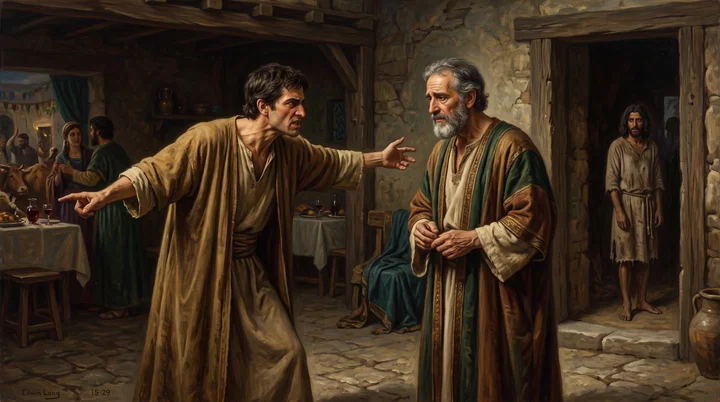
Cross-references 20 of 21
- Luke 15:20-24
And he arose, and came to his father. But when he was yet a great way off, his father saw him, and had compassion, and ran, and fell on his neck, and kissed him.
The father welcomes the returning son and celebrates his restoration.
- Luke 15:7
I say unto you, that likewise joy shall be in heaven over one sinner that repenteth, more than over ninety and nine just persons, which need no repentance.
Heaven rejoices over one sinner who repents.
- Luke 15:24
For this my son was dead, and is alive again; he was lost, and is found. And they began to be merry.
The father celebrates because his lost son has returned and is alive again.
- Luke 15:10
Likewise, I say unto you, there is joy in the presence of the angels of God over one sinner that repenteth.
Both parables portray joy in heaven over a sinner who repents.
- Luke 15:18-19
I will arise and go to my father, and will say unto him, Father, I have sinned against heaven, and before thee,
quotes the prodigal's penitential return
- Luke 15:1-2
Then drew near unto him all the publicans and sinners for to hear him.
The Pharisees’ complaint about Jesus receiving sinners parallels the elder brother’s resentment.
- Luke 15:22-23
But the father said to his servants, Bring forth the best robe, and put it on him; and put a ring on his hand, and shoes on his feet:
The father welcomes his returning son with honor and celebrates, provoking the elder brother’s resentment.
- Luke 15:13
And not many days after the younger son gathered all together, and took his journey into a far country, and there wasted his substance with riotous living.
Describes the riotous living the elder accuses him of.
- Luke 15:16
And he would fain have filled his belly with the husks that the swine did eat: and no man gave unto him.
The prodigal’s hunger among the swine contrasts with the father’s abundant provision.
- Luke 15:21
And the son said unto him, Father, I have sinned against heaven, and in thy sight, and am no more worthy to be called thy son.
The returning son confesses his sin before the father's celebration.
- Psalms 103:13
Like as a father pitieth his children, so the LORD pitieth them that fear him.
The father’s pity for his son illustrates God’s compassion.
- Luke 15:23
And bring hither the fatted calf, and kill it; and let us eat, and be merry:
The son complains that the fatted calf was killed for a celebration.
- Luke 15:17
And when he came to himself, he said, How many hired servants of my father’s have bread enough and to spare, and I perish with hunger!
The prodigal comes to his senses and recognizes his father’s abundant provision.
- Luke 15:4-6
What man of you, having an hundred sheep, if he lose one of them, doth not leave the ninety and nine in the wilderness, and go after that which is lost, until he find it?
The shepherd seeks the lost sheep and rejoices, as the Father receives the prodigal.
- Matthew 18:12-13
How think ye? if a man have an hundred sheep, and one of them be gone astray, doth he not leave the ninety and nine, and goeth into the mountains, and seeketh that which is gone astray?
Both describe seeking the lost and rejoicing when one is found.
- Luke 15:12
And the younger of them said to his father, Father, give me the portion of goods that falleth to me. And he divided unto them his living.
shows the selfish demand for the estate that was wasted
- Luke 15:18
I will arise and go to my father, and will say unto him, Father, I have sinned against heaven, and before thee,
shares arising to go to the Father
- Luke 15:6
And when he cometh home, he calleth together his friends and neighbours, saying unto them, Rejoice with me; for I have found my sheep which was lost.
The elder brother resents the celebration, while Christ rejoices over the recovered lost.
- Luke 15:8-9
Either what woman having ten pieces of silver, if she lose one piece, doth not light a candle, and sweep the house, and seek diligently till she find it?
Both parables celebrate finding what was lost and the joy that follows.
- Hosea 14:4
I will heal their backsliding, I will love them freely: for mine anger is turned away from him.
God’s free love heals the wanderer.
Commentary part 1 of 2
Each commentary is drawn from primary sources: the writings of Ellen G. White and Adventist pioneers and periodicals. Each commentary is separate. Its own words are not a quotation; follow the references to read the source passages.
Ellen G. White
87 sources
The verse gives the elder son's angry charge that his brother wasted the family's means in shameful indulgence, and his resentment that the father killed the fatted calf and made a feast for his return.ST Jan 29, 1894COL 198.4–199.1TCBMP 126.2–127.2 By saying this thy son instead of my brother he contemptuously disowns the prodigal and refuses to share his father's joy.ST Jan 29, 1894ST Jan 29, 1894COL 207.2–3 That charge of waste with harlots is the elder brother's complaint, not the father's judgment upon the returning son.Lt 52, 1899, par. 3 The father is right to welcome and feast because the son was lost and is found, was dead in sin and is alive again, and he receives the repentant child with pity and forgiveness without reproach or taunting for the past.TCBMP 126.2–127.23T 103.5–104.1ST Jan 29, 18943T 103.1–4Ms 24, 1891, par. 88 The elder son's selfish, proud, envious, self-righteous spirit represents unbelieving Israel and the Pharisees who murmured because Jesus received sinners, and it warns the church still against envying new converts and hindering the seeking and joyful welcoming of the lost.ST Jan 29, 1894ST Jan 29, 1894COL 207.2–3Lt 45, 1894, par. 21–24GW 140.2
Words and Setting
The words belong to the elder son, who accuses his returned brother of having consumed the family property in immoral living with prostitutes and resents that the father has killed the fatted calf and made a feast to celebrate his homecoming.ST Jan 29, 1894COL 198.4–199.1TCBMP 126.2–127.2GW 157.3 The complaint charges the father with unfairness and stands in sharp contrast to the father's welcome of the lost son, for the honor given is right because one who was lost and dead in sin has returned and is alive again, and that fact outweighs all other considerations.ST Jan 29, 1894TCBMP 126.2–127.23T 103.1–4 He had stayed in the field faithfully doing a son's duties while his brother left home, threw the shared duties upon him, and wasted the father's means in wicked profligacy until reduced to want, yet on his return the wanderer is received with respect and honor beyond anything ever given the elder son.3T 103.1–4 The elder son is indignant at the joyful welcome, refuses to go in and receive his brother, and sets his own many years of service without transgression and without even a young goat for merry-making against the feast prepared for one who consumed his living in such a way.COL 198.4–199.1COL 197.23T 103.1–4 His bitterness is self-justifying resentment at free forgiveness and a failure to share his father's joy over restoration, and it is answered by the father's entreaty to rejoice because the brother was lost and is found, was dead in sin and iniquity but is alive again and come to his moral senses abhorring sin.COL 198.4–199.1COL 197.23T 103.1–4 The celebration belongs to a story in which the father welcomes the returning son with yearning love rather than accusations of wrath, reflecting the joy over a lost person brought back to God.COL 197.2GW 157.3
By saying this thy son instead of my brother he contemptuously disowns the prodigal and refuses to share his father's joy.ST Jan 29, 1894ST Jan 29, 1894COL 207.2–3 The form of address exposes selfishness, pride, envy, contempt, disrespect, jealousy, and a hard-hearted spirit that treats the father's kindness as an insult to himself and regards mercy shown to the returned sinner as injustice.ST Jan 29, 1894COL 207.2–3 In this he represents unrepenting, unbelieving Israel, which refused to recognize tax collectors and sinners as brothers who should be forgiven, sought, and led to everlasting life.ST Jan 29, 1894 The father answers patiently and tenderly, explains why celebrating the lost son's return is right, and seeks to awaken compassion in the elder brother, for repentant sinners are welcomed by the heavenly Father without reproach or taunts, and what is required is penitence.ST Jan 29, 1894ST Jan 29, 1894
The charge of waste with prostitutes is the elder brother's complaint, not the father's judgment of the younger son.Lt 52, 1899, par. 3 The parable in which the charge occurs was given to answer the criticism of those who complained that Jesus associated with sinners, to teach mercy and forgiveness, and to show that His mission was to recover the lost.ST Jan 29, 1894Ms 102, 1894, par. 12–14ST Jan 29, 1894 Christ drew the story from facts of life and experience familiar to His hearers in order to illustrate immortal truth and make the lesson of the spiritual and unseen accessible through daily life.3MR 333.2–3Lt 223, 1905, par. 8–10ST Nov 30, 1915 His use of such surroundings shows openness to the influences of nature and delight in gathering spiritual teaching from everyday life, so that with His other parables and illustrations it was given to interest every mind and appeal to every heart, and the daily task instead of being a mere round of toil would be brightened and uplifted by constant reminders of the spiritual and unseen.3MR 333.2–3ST Nov 30, 1915 He came right to the point with no long, farfetched, complicated reasoning, illustrating truth in all its bearings to commend truth to the conscience, touch the heart and awaken sympathy, as when the father sees his son afar off, runs to meet him, and rejoices that he who had been thought dead is indeed alive, and then He leaves hearers free to accept or reject it as they choose.19MR 259.1–3 The lesson means much and must be carefully studied together with the lost sheep and the lost piece of silver, considered more critically and obeyed with purpose by having the Spirit of Jesus in councils in going out to search for, find, and bring back those who have strayed from the fold, for practicing it involves eternal interests.Lt 71, 1895, par. 27Ms 81, 1893, par. 61–63
Younger Son's Wasteful Course
The younger son could rightfully claim nothing and should have had nothing, yet he selfishly demanded his portion of his father's estate in order to separate his interests from his father and manage it to suit his own inclination and live by his own wishes.TCBMP 123.13T 100.3–101.2 He withdrew to a distance that he might not be troubled with counsel or reproofs and advice, correction and restraint, that he might even forget he had a father, feeling under no obligation and bracing his selfish rebellious spirit with the thought that part of the property belonged to him.TCBMP 123.13T 100.3–101.2 He despised restraint and was determined to have pleasure in any way he chose, and after receiving treasure of which he was undeserving he spent all his father had given him in sinful indulgence and extravagant pleasure with harlots.3T 100.3–101.2MYP 408.1COL 199.2–200.3 His young years, strength, and spiritual aspirations and gifts received from God were consumed by lust, showing how a life devoted to sinful pleasure wastes what God has entrusted.3T 100.3–101.2COL 199.2–200.3
Famine brought pinching want and destitution and brought him down to feeding swine, far from his father's house and far from God and perishing with hunger.3T 100.3–101.29T 50.2Ms 45, 1901, par. 8 He had separated from God and stayed away from Him so long, serving sin and the flesh and the devil for poor wages with no profit.2T 295.1 Even then God is ready to accept him and pardon all his transgressions if he will but come, meeting him even now, with the Majesty of Heaven inviting him to come that he may have life and with the message of mercy that all things are now ready.2T 295.1 Christ is ready to cleanse him from sin and welcome him home, forgiven and restored, when he lays hold upon Him, and the way back is so humble that pride resists it, yet there is no other way, so that to neglect it with false hopes and perish in sins after so many convictions is to travel a road ending in death, and he must search his heart, turn, and live.MYP 408.12T 295.1
His wayward course could grow out of indulgence at home and a failure to restrain and train him.11MR 40.3–41.2Lt 117, 1898, par. 4–5 The verse also pictures the condition of those who claim to be commandment keepers while living as the prodigal, transgressing the law, unthankful and unholy.Ms 75, 1898, par. 13–14 They flatter themselves that they are Christians while employing entrusted talents to counterwork God and use them against Him, and there is no light in them and their influence is not unto sanctification or holiness.Ms 75, 1898, par. 13–14 Jesus yearns after these sons and daughters who are acting as the prodigal son and longs to do them the good He delights to do, but He cannot do it because of the perversity of their characters.Ms 75, 1898, par. 13–14
Father's Joyful Forgiving Welcome
The father meets the erring child who comes back in repentance with pity, compassion, tenderness and free forgiveness, and he does not meet him with reproach or taunts nor bring up the past against him.3T 103.5–104.1ST Jan 29, 1894RH Jan 19, 1911COL 203.2–205.1TCBMP 128.1 What is required is penitence, for the son recognizes his sin and neglect, values his father's love, acknowledges his claims, and returns because he needs help that only his father can give.ST Jan 29, 1894TCBMP 128.1 The one who has erred and repented suffers in feeling and is often desponding and discouraged, and needs pity, help and sympathy, and above everything else free forgiveness rather than reminding of mistakes.3T 103.5–104.1 A sinner who comes back to God in repentance is received with love, not rejected or degraded.Lt 76, 1898, par. 18–20
The killing of the fatted calf and the honor given to the returned brother are right and a cause for joy because the younger son was lost and is found, was dead in sin and iniquity but is alive again.TCBMP 126.2–127.23T 103.1–4Ms 24, 1891, par. 88 He has come to his moral senses abhorring sin, and that fact overbears all other considerations, including the elder son's resentment at waste with harlots and at honor beyond anything his own faithful field service ever received.TCBMP 126.2–127.23T 103.1–4 The parable thus answers self-justifying resentment at free forgiveness with the father's entreaty to rejoice that the brother was lost and is found.3T 103.1–4
The story shows God's pitying love for those who stray, for though they turn away He does not leave them in their misery but is kind and tender toward them amid temptation.COL 198.118MR 113.5 He takes the first step to seek sinners while they are still rebelling, as a shepherd seeks a lost sheep, and His heart yearns for the wanderer while he is far off wasting what he has received.ST Jan 22, 1894 Longing to return is the Spirit's tender appeal drawing the wanderer back, yet even the parable's picture falls short of the Father's infinite compassion. When the lost are restored, and when even the poorest sinner returns in repentance, heaven rejoices with warmth, courtesy and love, and that joyful reception calls men to cooperate earnestly with God in seeking the lost sheep and winning back the prodigal.18MR 113.5Ms 19, 1890, par. 21STBk 14.1
God's dealing with erring people who come back in repentance reveals infinite love, shown in the Father giving His beloved Son as a sacrifice that opens a channel for His infinite love.Lt 85, 1886, par. 17–18 Through that gift all who believe on Jesus Christ are restored again to His favor, obey all of God's commandments, and have life in Jesus Christ.Lt 85, 1886, par. 17–18 The restoration is full and free, for the Father entreats the erring to return, puts His arm about him, covers his rags, gives him the ring of royalty and Christ's righteousness, and gives him a place at the Father's table as one who receives Christ as personal Saviour.GW 140.2Lt 59, 1898, par. 12–14
Christ is ready to accept, cleanse and restore the sinner who will but come, confess mistakes, lay hold upon Him, and link himself with God with full decision of soul.2T 295.1MYP 97.1Lt 33, 1896, par. 12Ms 82, 1894, par. 22–24Lt 15a, 1890, par. 9–11 His love shown at Calvary and in His death on the cross assures the sinner of acceptance, peace and love, and none who comes is cast out.Ms 82, 1894, par. 22–24Lt 15a, 1890, par. 9–11 The way back is so humble that pride resists it, yet there is no other way, and to neglect it with false hopes and perish in sins after so many convictions is to travel a road ending in death, so he must search his heart, turn and live, and then God will work with the returned one to help other youth give their hearts to God and be converted.2T 295.1Lt 33, 1896, par. 12 The father's welcome also illustrates God's loving patience toward Israel and Jesus' loving dealings with them, His willingness to suffer for their sins and bear their guilt despite their resistance to His grace and their neglect of His privileges and refusal of His invitations.ST Feb 27, 1896Ms 56, 1902, par. 5
Elder Brother's Resentful Spirit
The elder son's words lay bare selfishness, pride, envy, jealousy, contempt and disrespect toward his father, a cold, jealous, self-righteous and hard-hearted spirit that treats the father's kindness to the returned sinner as an insult to himself.ST Jan 29, 1894COL 207.2–3Lt 45, 1894, par. 21–24Lt 80, 1898, par. 9–1311MR 370.2–371.1 By calling him this thy son rather than my brother he contemptuously disowns the prodigal and refuses to share the father's joy over mercy shown.ST Jan 29, 1894COL 207.2–3 He accuses his father of unfairness and favoritism, complaining that one who wasted the family's wealth in profligacy is welcomed with a feast and the fatted calf while his own supposed faithfulness goes unrewarded.ST Jan 29, 1894Lt 45, 1894, par. 21–24Lt 80, 1898, par. 9–13 The father answers patiently and tenderly, explaining why celebration is right and seeking to awaken compassion in the elder brother.ST Jan 29, 1894 Those who welcome a repentant sinner are therefore to follow the father's gracious welcome with sympathy, forgiveness and joy rather than resenting it.Lt 45, 1894, par. 21–24
He stands by with indifference and contempt while a soul makes its struggle against the flood of temptation, complaining instead of helping.GW 140.2Ms 40, 1899, par. 10–12RH Apr 10, 1900 His stubborn, self-willed and selfish complaint condemns the returning son and resents the welcome, exposing how God regards hardness toward depraved, guilty, suffering souls.GW 140.2Ms 40, 1899, par. 10–12RH Apr 10, 1900 In heart he is like the Pharisee who says he is not as other men, claiming to be a co-worker with Christ yet refusing sympathy to the repentant.GW 140.2 This stands in stark contrast to the Father who loves His erring child, entreats him to return, puts His arm about him, covers his rags and gives him the ring of royalty.GW 140.2Ms 40, 1899, par. 10–12 God expects His servants to seek and rescue those who have strayed and rejoices when they are restored, rather than meeting them with cold rejection.RH Apr 10, 1900Ms 113, 1902, par. 30
He represents unrepenting, unbelieving Israel, which refused to recognize publicans and sinners as brothers who should be forgiven, sought and led to everlasting life.ST Jan 29, 1894ST Feb 27, 1896 Like the Pharisees he fails to share the Father's joy when the lost return, revealing jealousy and contempt.ST Jan 29, 1894GW 140.2 His complaint reflects the belief that long service and hardship entitled him to greater reward, for the Jews likewise treated service as earning salvation as though work must receive a set payment.Ms 87, 1899, par. 16
He contrasts his many years of faithful service without transgression with the feast for the profligate, indignant that he who stayed in the field doing a son's duties never received even a kid for merry-making while his brother who left, threw shared duties upon him and wasted the father's means in wicked profligacy until reduced to want is received with respect and honor beyond anything ever shown him.3T 103.1–4Lt 71, 1895, par. 26Ms 87, 1899, par. 16 He refuses to go in and receive his brother, believing long hardship entitled him to greater reward.3T 103.1–4Ms 87, 1899, par. 16 Even bearing hardships and burdens does not make such service Christlike when resentment spoils it, for fault-finding misunderstands God's way of dealing with people.Ms 29, 1911, par. 69 His self-righteous confidence that his own course has been righteous and faithful in home duties, needing no repentance and deserving to be commended and honored, keeps him from sympathizing with the father's joy.Lt 71, 1895, par. 26
His faultfinding magnifies another's wrongs to excuse his own unforgiving heart, watching for faults, criticizing them and emphasizing them to justify himself.Lt 80, 1898, par. 9–13COL 210.111MR 370.1 Though he stayed at home he focused on his brother's past wrongs and refused to forgive, and that accusation reflected Satan's spirit, not the forgiving spirit of the Lord.11MR 370.2–371.111MR 370.1 Such criticism of those struggling against temptation instead of showing them pity places accusers where they cannot receive God's favor.COL 210.1 His feelings are a spirit of suspicion, censure and evil surmising toward the repentant, while Christlike love meets misery and repentance with compassion, sympathy and mercy.11MR 371.2–3Lt 45, 1894, par. 25–27 Those who judge another harshly should remember their own failings, humble themselves and put away such thoughts, for Christ alone can remove suspicion and help the erring be restored to God.11MR 371.2–3
His complaint was natural but not right, picturing the frequent wrong course of brother toward brother in working to make the one who has erred feel where he has erred and keeping his error and mistakes before him.3T 103.5–104.1TCBMP 128.2 Those who have erred and repented suffer in feeling and are often desponding and discouraged, needing pity, help, sympathy and above everything else free forgiveness rather than reproach.3T 103.5–104.1TCBMP 128.2 His selfish unwillingness to receive the repenting brother and rejoice at his return itself proves his need of repentance.Lt 71, 1895, par. 26 It reveals indifference and careless disregard for those ready to die and refusal to partake of God's shepherd heart toward the lost, though God Himself goes after the lost sheep, heals backsliding, loves freely and fills all heaven with joy at the finding.Lt 71, 1895, par. 26Lt 71, 1895, par. 25
The same jealousy appears in church members who envy the attention and care given to people newly brought into the faith instead of rejoicing that the Lord is gathering wandering souls.21MR 296.5–6Lt 57, 1898, par. 4–5Lt 8, 1898, par. 20–21 They murmur when ministers spend time hunting for lost souls and giving truth to those who do not know it instead of constantly preaching to and feeding the church, wanting all labor and attention for themselves to keep themselves alive.21MR 32.4–33.2Ms 49, 1898, par. 24–25Ms 49, 1898, par. 26–28 They count grace shown to a repentant sinner as neglect of themselves, gossip and plant doubt, questioning, evil surmising and jealousy instead of seeking to save the lost, and fail to do righteousness in their own homes and in the church.21MR 32.4–33.2Ms 49, 1898, par. 24–25 Instead of using strength and talents to help the minister carry the burden and make his labors a success in seeking perishing souls, they speak unjust sentiments as though the church had been robbed of labor it should have had.Ms 49, 1898, par. 26–28 God is much displeased with that attitude and has heard their words, for those who love Christ will love those for whom Christ died, while the elder-brother spirit greatly hinders adding souls to the church.21MR 32.4–33.2Ms 49, 1898, par. 26–28 A living church with Christ formed within will instead rejoice and join in seeking the lost.21MR 32.4–33.2
Seeking and Welcoming the Lost
The whole chapter of the lost belongs to the church as its charge to prize the work of heaven for reclaiming the lost, to go out to search for those who have strayed from the fold, to find them and bring them back into the fold and to the saving knowledge of the truth, and to rejoice when they are restored.Ms 16, 1868, par. 2–3RH Apr 10, 1900ST Oct 31, 19169T 50.2Ms 81, 1893, par. 61–63 The elder brother's condemnation of the returning son and resentment of the father's welcome warns that those who themselves need salvation may meet a struggling sinner with contempt instead of help, while God expects His servants to seek and rescue the straying.RH Apr 10, 1900Ms 81, 1893, par. 61–63 The lessons of the prodigal son with the lost sheep are to be considered more critically and obeyed with purpose, by having the Spirit of Jesus Christ in councils for this searching and restoring work.Ms 16, 1868, par. 2–3Ms 81, 1893, par. 61–63
Those who welcome a repentant sinner are to follow the father and not the elder brother, meeting him with sympathy, pity, help, tenderness, compassion, mercy, forgiveness and joy, and above everything else free forgiveness, not with cold rejection, reproach, censure, or constant reminding of mistakes.3T 103.5–104.1Lt 45, 1894, par. 21–24TCBMP 128.1TCBMP 128.2RH Nov 25, 1902 The elder brother's complaint that his profligate brother was honored while his own faithful service went unrewarded was natural but not right, and it pictures the frequent wrong course of brother toward brother in laboring to make the one who has erred feel where he has erred and keeping his error before him.3T 103.5–104.1Lt 45, 1894, par. 21–24TCBMP 128.2 One who has erred and repented suffers in feeling and is often desponding and discouraged, and the return itself is a source of the greatest joy to the Father who was sinned against, for He meets the erring, repentant child who recognizes his sin and neglect, values his father's love, acknowledges his claims, and comes because he needs help only his father can give, with compassion, pity and forgiveness.3T 103.5–104.1TCBMP 128.1TCBMP 128.2 The prodigal needs a loving welcome rather than cold rejection, with the tenderness, love and sympathy due to the erring.RH Nov 25, 1902Lt 59, 1886, par. 1–5
Criticism, faultfinding, censure, jealousy, self-righteousness and harshness toward youth who make mistakes in youthful indiscretion, and toward those who have done wrong, are displeasing to God, withhold due tenderness, drive wanderers away from God and from the truth, drive them farther from God, and can keep souls out of the kingdom.Lt 59, 1886, par. 1–53MR 64.5–65.3Lt 50, 1893, par. 8–9 The prodigal's wrongs may be only the simple errors of youthful indiscretion, not sins of a character to be treated with great severity, as with one who has become a thorough backslider through discouragement, the temptation of Satan, and the mistakes of brethren who did not know how to deal with youth.Lt 59, 1886, par. 1–53MR 64.5–65.3 The duty taught is to labor tenderly for the backslider and urge immediate return like the prodigal to his Father's house and his Father's service, leaving the service of Satan and of sin and giving God time, talent and influence instead of robbing Him, for to keep on in backsliding grieves the heart of Christ who loved the sinner and died to redeem him, and whose tender, compassionate love shines from the cross, so that a brother's mistake gives no excuse for grieving Christ and turning from Jesus.Lt 59, 1886, par. 1–53MR 64.5–65.3 That return calls for immediate decision even at loss of position and trade, earnest prayer, and a decided promise before God and angels and witnesses to be a Christian from that day, which the Father evidences with pardon and love in a purified mind, changed purposes, and happy thankfulness.3MR 64.5–65.3
Some called Seventh-day Adventists repeat the elder brother's spirit toward the returned prodigal, meeting him with suspicion, distrust, dislike, unkindness and retaliation instead of kind and tender welcome, and that same spirit will be shown toward those who need their help the most.19MR 202.3Lt 92, 1895, par. 1–4 Those who have learned by experience how it feels to be met with distrust and suspicion must not manifest the same spirit in return, must not treat others as they were treated, and must practice nothing of the kind in labor for others.19MR 202.3Lt 92, 1895, par. 1–4 They must keep Christ's prayer ever before the mind and answer it in daily attitude and practice, exercising patience and forbearance, refusing discouragement, trusting Jesus at the right hand, and becoming overcomers through the blood of the Lamb and the word of testimony by the way of escape Christ has made with every temptation.19MR 202.3Lt 92, 1895, par. 1–4
The return of the prodigal to his father pictures sinners being brought back to God, and shows that prodigals far from the father and perishing with hunger can be restored to the Father, that those who have left God and those who have left the Father's house and blessing may be encouraged to return, and that people who turn back can be reached with truth and saved, for truth brought into life experience is a saving power.MH 179.1–2Lt 200, 1902, par. 8–10STB 620.1–2STB 147.59T 50.2 A wayward person should not delay returning to family and to God, but should come back at once with a humble heart, with humble confession and contrition under the Holy Spirit, confessing backslidings and entering the heavenward path, as with Arthur and Rosetta as prodigals who had left their Father's house and blessing.Lt 18f, 1890, par. 2Lt 27, 1890, par. 1 They are to be led step by step into submission, to be reached by a message of love, and to find in Christ sure help and tender compassion.Lt 200, 1902, par. 8–10Lt 18f, 1890, par. 2Lt 27, 1890, par. 1
Conditions of Restored Sonship
The fatted calf killed for the returning son pictures the privileges of sonship claimed on coming home, but enjoying those privileges requires consenting to accept a son's obligations and living in accordance with the father's will.Ms 183, 1901, par. 12Lt 164, 1900, par. 21–23Ms 98, 1901, par. 17–20ST May 8, 190110MR 110.3–5 The welcome shows the father's readiness to receive, yet it does not remove the call to live as a son and to remain under the shepherd's care in the fold rather than renewing wandering.Ms 183, 1901, par. 12Lt 164, 1900, par. 21–23Ms 98, 1901, par. 17–20ST May 8, 1901 Claiming a son's place therefore means compliance with the conditions of sonship, not feasting while returning to former wandering.Ms 183, 1901, par. 12Lt 164, 1900, par. 21–23Ms 98, 1901, par. 17–20ST May 8, 190110MR 110.3–5
Return demands unreserved surrender, the gift of the whole life and not money alone, repaying love with obedience and abiding faithfulness.10MR 110.3–5 It requires denying self, taking up the cross, obeying direction, and submitting to control.10MR 110.3–5 It is leaving the service of Satan and of sin and returning to the Father's service, for to keep on in backsliding grieves the heart of Christ who loved the sinner and died to redeem him.3MR 64.5–65.310MR 110.3–5 The severe charge of devouring the living with harlots need not always fit such a backslider, since one made a thorough backslider through discouragement, temptation of Satan, and mistakes of brethren who did not know how to deal with youth may have only the simple errors of youthful indiscretion rather than sins of a character deserving such great severity.3MR 64.5–65.3
The return calls for immediate decision even at loss of position and trade, with earnest prayer and a decided promise before God and angels and witnesses to be a Christian from that day.3MR 64.5–65.3 The Father then evidences pardon and love with a purified mind, changed purposes, and happy thankfulness.3MR 64.5–65.3
Sources
Pioneers and periodicals
215 sources
In the parable of the lost son the words are the elder son's angry answer when his father entreats him to come in to the feast, spoken outside the house after he has heard the music and learned his brother has returned.ST Mar 25, 1880ST Aug 6, 1894ST Sep 6, 1899 By calling him thy son instead of my brother he refuses to own him as a brother, showing contempt, envy and lack of compassion.ST Jan 29, 1894ST Aug 6, 1894ST Aug 6, 1894 He charges that the returned youth devoured his father's living with harlots, and contrasts that waste with his own long faithful service, complaining that the fatted calf is killed for such a one while he never received even a young goat to enjoy with his friends.ST Mar 25, 1880ST Mar 25, 1880ST Aug 6, 1894RH Jan 20, 1916ST Nov 22, 1899 His complaint pictures the scribes and Pharisees murmuring because Jesus welcomed publicans and sinners, and more broadly all longtime professed believers who resent grace shown to the returning lost.ST Jan 29, 1894ST Aug 6, 1894ST Nov 22, 1899RH Jul 3, 1900ST Oct 17, 1900 Against that resentment the feast he resents reveals God's unchanged pity, seeking love and lavish welcome, receiving the truly penitent without reproach as sons and heirs with joy, and calling all to share that joy instead of standing outside in self-righteous coldness.RH May 9, 1871ST May 4, 1904ST Aug 29, 1895ST Nov 22, 1899ST Aug 11, 1914
Parable Setting and Wording
Luke 15:30 belongs to the parable of the prodigal or lost son in Luke 15, one of three parables of the lost spoken together on one occasion to teach one common lesson.RH Nov 9, 1916ST May 4, 1904 The fifteenth chapter presents loss followed by finding and rejoicing, teaching that the lost are found, showing the value the Son of God places on a soul, and showing joy in heaven over one sinner who repents.RH Nov 12, 1914 The three parables teach the same lesson as the account of Zacchaeus, that the Son of man came to seek and to save that which was lost, explaining how a rich man can be saved.ST Nov 21, 1900 The parable is highlighted as an important parable in which a sinner squanders his father's gifts and is then welcomed by his father on return.RH Nov 9, 1916
The discourse that begins in Luke 15 continues into Luke 16, and the account beginning with a man who had two sons is introduced in the same way as the other parables, with no indication that the narrative changes to literal history.RH Sep 3, 1872RH Apr 8, 1858 Luke 15:11-32, which includes this verse, is a parable and not a record of actual occurrences.RH Sep 3, 1872ST Jun 18, 1885 Its parabolic character is recognized from the nature of its text and context even though it is not expressly called a parable in Scripture.ST Aug 19, 1880 It is therefore figurative story and not literal history, and not proof about the dead speaking and acting in hades.RH Sep 3, 1872
The verse records part of the answer the elder son made to his father when entreated to come in, spoken together with verse 29.ST Aug 6, 1894ST Sep 6, 1899 He stands outside the house and refuses to go in to the feast for his returned brother, speaking in anger to his father.ST Aug 6, 1894ST Jul 1, 1880 He had been in the field and did not know his brother had returned, but he heard music and general demonstrations of joy, asked the servants what it meant, and they explained that his brother had returned and the fatted calf was killed for that reason.ST Mar 25, 1880ST Mar 25, 1880 The killing was the father's own act to make the return an occasion of special rejoicing because he had received his son again as from the dead, whom they had thought dead, joined with especial tokens of respect and clothing him as an obedient son.ST Mar 25, 1880ST Mar 25, 1880 The father entreated the elder to receive his brother with gladness, telling him he had ever been with his father and all his father had was his, but that this demonstration of joy was right because the lost was found and the dead was alive again.ST Mar 25, 1880 Even when his father comes out and entreats him the elder with a hard heart refuses to enter, seeking freedom away from his father's presence, making himself supremely miserable so that kindness and forbearance avail nothing, fostering in his impenitent heart the worm that gnaws.ST Jul 1, 1880
By calling the returned youth this thy son instead of my brother, the elder son distances himself from him and refuses to acknowledge him as a brother.ST Jan 29, 1894ST Jan 29, 1894ST Aug 6, 1894 His words reveal selfishness, pride, envy, contempt, disrespect toward his father, and lack of compassion.ST Jan 29, 1894ST Aug 6, 1894 He represents the attitude of the Pharisees toward sinners and of unrepenting, unbelieving Israel refusing to recognize publicans and sinners as brothers who should be forgiven, sought, and led to everlasting life, and the parable also applies personally, that people are either returning to the Father or acting like the faultfinding elder brother who is in deep need without recognizing it.ST Jan 29, 1894ST Aug 6, 1894 The father answers patiently and tenderly, explains why celebrating the lost son's return is right, and seeks to awaken compassion in the elder brother, for repentant sinners are welcomed by the Heavenly Father without reproach or taunts, what is required being penitence, and anyone who longs to return to the Father's house is welcomed despite having squandered what was given.ST Jan 29, 1894ST Jan 29, 1894ST Apr 30, 1894
He charges that this son devoured the father's living with harlots and with wicked profligacy until reduced to want, after leaving his father and throwing the heavy responsibilities that should have been shared by both upon his elder brother, while the elder had faithfully performed the duties of a son.ST Mar 25, 1880ST Aug 6, 1894 He contrasts that waste with his own many years of service in which he never transgressed a commandment, yet never received even a kid or young goat to make merry with his friends.ST Aug 6, 1894 He complains that the father killed the fatted calf and made a feast of joyful welcome for the returned son and received him with respect and honor beyond anything the elder had ever received.ST Mar 25, 1880ST Aug 6, 1894ST Mar 30, 1882 The fatted calf is the feast the father gives to welcome the returned son.ST Mar 30, 1882 Christ used this familiar event from life to illustrate spiritual truth and remind people of the spiritual and unseen in daily life, while the accusation against the returning son illustrates a human world estranged from God whose sin pierces God's heart.ST Nov 30, 1915RH Dec 5, 1907
Prodigal's Wasteful Course
The younger son selfishly demanded his portion when he had no rightful claim and deserved nothing, then carried it far from his father to forget him and to escape counsel, advice, restraint and obligation.ST Mar 25, 1880ST Aug 11, 1914ST Oct 10, 1900RH Jun 12, 1900 He despised restraint and was determined to be happy in pleasure of his own choosing, and unlike the lost sheep and coin his return would require a change of will and a choice to come back.ST Mar 25, 1880ST Oct 10, 1900 His going away pictures humanity made in God's image becoming disobedient and departing from God through sin, separated from Him and lost under the power of sin and death.ST Aug 11, 1914RH Jun 12, 1900
He spent all his father gave him in riotous, extravagant and dissolute living, devouring the family property with harlots and immoral companions in sinful indulgence and ease and luxury.ST Mar 25, 1880ST May 26, 1909ST Aug 11, 1914ST Sep 10, 1894 Prodigals grow tired of living with their heavenly Father and serving Him, wander away from home, and lavishly spend time and means that all belong to God on the pleasures of sin which last only for a season.ST Mar 25, 1880ST May 1, 1901 His wealth and the promise of youth were consumed by lust.ST May 26, 1909ST Aug 11, 1914
His course was breaking away from divine authority and love to give himself to lust, reaching misery and despair, and in its fuller picture to drink and gambling, to forged checks to pay for gambling under liquor's influence after the saloon opened the way to ruin, to abandoning family, to feeding with swine and spoiling his field of labor.ST Mar 25, 1880RH Dec 9, 1862RH Nov 30, 1905ST Mar 13, 1901 He sank into degradation, hunger, rags, tattered soiled garments, friendlessness, want, wretched privation and misery brought upon himself through disobedience and separation, returning wearied, stricken, saddened, ashamed and defiled with crimson-stained hands and bleeding faltering feet.ST Mar 25, 1880ST Mar 25, 1880RH Nov 30, 1905 That life brings deep unhappiness and weariness, robs life of what made it noble and dear, wastes the body so it grows weak and old before its time with lowered resistance and breaks down to untimely and unnecessary death in middle age from even a slight cause, and shows the unregenerated sinner lost and the world estranged with its limited good that cannot give lasting happiness and peace.RH Feb 28, 1871ST Feb 26, 1902ST Nov 25, 1930RH Nov 30, 1905ST Sep 10, 1894 Yet even after sowing such wild oats he can still find his way back to his Father's house before death.ST Nov 25, 1930
The story gives in brief every trait of fallen man turning from his wayward course: departure from home, abandonment to the sins of an unholy world, the suffering that necessarily follows, hardship and famine and hunger that bring the idle and wasteful to his senses, remorse over slighted love, and restoration to sonship.ST Aug 26, 1875RH Feb 15, 1912ST Nov 14, 1878ST Feb 26, 1902 Saying I will arise is language of strong determination without which no victories are gained, for merely wishing for bread or wishing to overcome leaves the sinner to starve in sin.RH Feb 15, 1912 Return must be made in confidence that the Father's house has bread enough and to spare, by decided resolution rather than wishing, even if at first hoping only to return as a servant.RH Feb 15, 1912ST Nov 14, 1878 His experience of sin and its wages teaches him to value the father's love and the joy and peace of reconciliation.ST Feb 26, 1902ST Feb 26, 1902
His waste is the loss known only when what might have been by staying at home with the Father is realized, settling for husks while forgetting the bread in his father's house.RH Feb 28, 1871RH Jul 23, 1914 Devouring his living is the wasteful morning of carelessness that sows a crop of cares and ripens into the want-filled evening of pain, for carelessness brings suffering while painstaking care protects against pain.RH Feb 28, 1871 Taking the Heavenly Father's good gifts and wasting them in sinful, selfish indulgence, if persisted in, may end with both body and soul lost forever.ST Nov 25, 1930 Wandering from God is feeding on husks, and returning to God is coming home to the Father for a deeper experience in divine things.RH Feb 28, 1871RH Jul 23, 1914
One application pictures the waster as a bright son from a wealthy, influential and good home who wastes his living in gambling and drink and is driven from home in anger.ST Sep 10, 1894ST Mar 13, 1901 The father keeps loving and seeking him, growing old and feeble traveling from state to state searching for him, while the mother wears out with sorrow and loved ones at home keep watching and praying for return.ST Mar 13, 1901 At last the son found in saloon and gambling den owns that he ruined his father, quits liquor and drink and cards for good to go with his father, and his return breaks the fascination of wine and the card table for others and turns their thoughts to home and parents far away.ST Mar 13, 1901 Another pictures a daughter quarreling with her mother, running away into a place of wickedness and a life of sin that brings deep unhappiness and weariness, then remembering mother and innocent days at home, desiring to leave sin, being led to the Saviour, and being received with praise and thanksgiving to God, tears of gratitude and rejoicing over restoration in Christ and new work of leading others, including her own family, to Him.ST Sep 10, 1894 Apart from these, one isolated reading takes the elder son's charge to mean that the father helped bring about the ruin by providing lavishly and then rebuking the son for yielding to dissipation.ST Jul 17, 1884
Father's Forgiving Welcome
The parable reveals God's mercy and pitying love toward repentant sinners, His tender concern and compassion for lost and wandering and outcast people, correcting the idea that He has no pity for sinners.RH May 9, 1871ST May 4, 1904ST Nov 22, 1899RH Nov 9, 1916 His love does not change during separation but longs for their salvation, welcoming them when they return, clothing and honoring them and calling for rejoicing, and the elder brother's inability to understand that love exposes his criticism of the welcome.RH Apr 20, 1916RH Jan 12, 1911 That unchanging love is set forth as the pattern of love to be shown to one another.RH Apr 20, 1916
The Father takes the first step to seek sinners while they are still in rebellion, like a shepherd seeking a lost sheep, lovingly seeking the wanderer and looking for him before he thinks of Him.ST Jan 22, 1894ST Jun 25, 1912ST Aug 11, 1914 He goes out in great heart-love to meet the returning one while yet a great way off, puts His arms about his neck and plants the kiss of welcome and forgiveness and pardon and reconciliation even before any confession of wrongdoing.ST Aug 11, 1914 He answers the sinner's desire to return before confession is made and gives more abundantly than can be asked.RH Jun 4, 1901 The longing to return is the Spirit's tender appeal drawing the wanderer back, and every wanderer who allows Him to be brought home is welcomed, though the picture still falls short of infinite compassion.ST Jun 25, 1912
When the son returns he is received again as a son and restored to sonship and to his place as an heir, not left as a portionless field servant nor assigned a servant's place, and his former wrongs are not held against him.ST Aug 29, 1895ST Dec 15, 1909 The killing of the fatted calf was the father's own act to make the return an occasion of special rejoicing because the lost is found and the dead is alive again, joined with especial tokens of respect and clothing him as an obedient son.ST Mar 25, 1880 He is welcomed with open arms into a house filled with joy, clothed with the best robe, given a ring, honored with a royal feast in gladsome honor of a deeply mourned and long-lost son, while the angels rejoice.ST Dec 10, 1894ST Aug 11, 1914ST Jan 2, 1907 The elder brother, out in the field, did not know of the return but heard music and general demonstrations of joy, asked the servants what it meant, and was told his brother had returned and the calf was killed for that reason.ST Mar 25, 1880
That welcome is without reproach or taunting and does not bring the past up against him, for the past is forgiven and forgotten, buried in oblivion and blotted out forever.RH Jan 19, 1911RH Jul 21, 1863RH Dec 23, 1915 The returning sinner is received with kindness and celebration and full restoration to a place as near the Father's heart as those who never wandered and have been more fortunate in pilgrimage.RH Jul 21, 1863RH Mar 13, 1879 God likewise forgives and welcomes with immediate joy when a lost child comes home.ST Nov 7, 1900 The honor of robe and feast belongs to humble confession without concealment or defense, and would not have been given to an unrepentant return seeking to justify wrongdoing.RH Feb 16, 1869
The feast is a feast of love expressing wholehearted, lavish, unselfish welcome that gives not scraps but the best, even royal honor and the robe of righteousness to the greatly unworthy who squandered property with prostitutes.ST Sep 9, 1875ST May 21, 1896 It shows the Father's house has bread enough and more than enough to satisfy starving souls, so that continuing in sin starves the soul while returning brings satisfaction through the bread of life, and those who strayed should trust the Father and come daily rather than remain away and starve.ST Nov 14, 1900ST Nov 22, 1883 The fatted calf is the joyful welcome given to those who turn to Him even from spiritual emptiness and longing for home.ST Jul 29, 1908 The return of even one sinner in repentance brings joy to the angels, for repentance is a sacred work approved by God and not to be ashamed of.RH Aug 3, 1869
The rejoicing does not put a premium on sin and does not mean God loves to have His people go astray for the joy of recovering them.ST Jul 2, 1885 He rejoices not because He loves sin but because He abhors sin and because the erring one returns to loyalty and obedience.ST Jul 2, 1885 Forgiveness brings the sinner into God's family to train in obedience and does not license return to sin.ST Apr 1, 1886
Father-love and mother-love for a wayward child is only a reflection of God's everlasting love for sinners.ST Oct 4, 1899 He gives personal attention and love to each individual, not forgetting or abandoning the one prodigal, so that no one is lost in the crowd.RH Mar 25, 1909 His generous welcome to the prodigal does not mean His heart is against the faithful son, for He yearns over both prodigal and faithful with thoughts of peace, kindness, mercy and love.ST Apr 17, 1907 His love for the redeemed is delight in those purchased by blood, expressed in loving welcome and rejoicing over the returned son.
Sources