Luke 20:25
And he said unto them, Render therefore unto Cæsar the things which be Cæsar’s, and unto God the things which be God’s.
Translations
And he said to them, Render therefore to Caesar the things which be Caesar’s, and to God the things which be God’s.
And he said unto them, Render therefore unto Cæsar the things which be Cæsar’s, and unto God the things which be God’s.
And he said unto them, Render therefore unto Cesar the things which be Cesar’s, and unto God the things which be God’s.
And he said to them, Render therefore to Cesar the things which are Cesar's, and to God the things which are God's.
And he said unto them, Then render unto Caesar the things that are Caesar’s, and unto God the things that are God’s.
And he said unto them, Then render unto Cæsar the things that are Cæsar’s, and unto God the things that are God’s.
and he said to them, 'Give back, therefore, the things of Caesar to Caesar, and the things of God to God;'
And he said to them, Pay therefore what is Caesar's to Caesar, and what is God's to God.
And, he, said unto them—Well then! render the things of Caesar, unto Caesar, and the things of God, unto God.
Berean Standard Bible, Majority Standard Bible
So Jesus told them, “ Give to Caesar what is Caesar’s, and to God what is God’s.”
He said to them, “ Then give to Caesar the things that are Caesar’s, and to God the things that are God’s.”
And he said, Then give to Caesar the things which are Caesar's, and to God the things which are God's.
Then he sayd vnto them, Giue then vnto Cesar the things which are Cesars, and to God those which are Gods.
Douay-Rheims (Challoner revision)
And he said to them: Render therefore to Caesar the things that are Caesar’s: and to God the things that are God’s.
Pictures
Cross-references
- Matthew 22:19-21
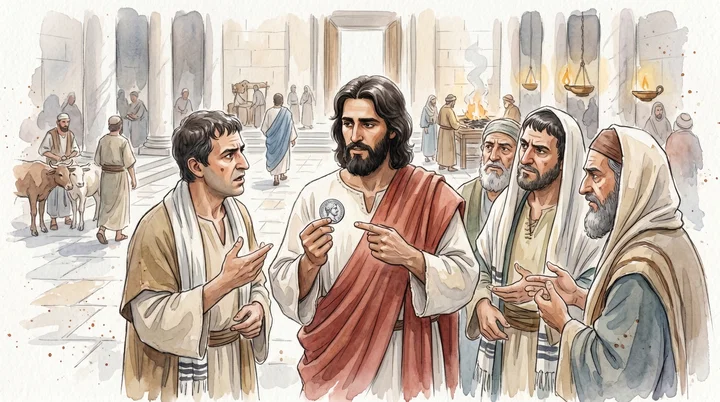
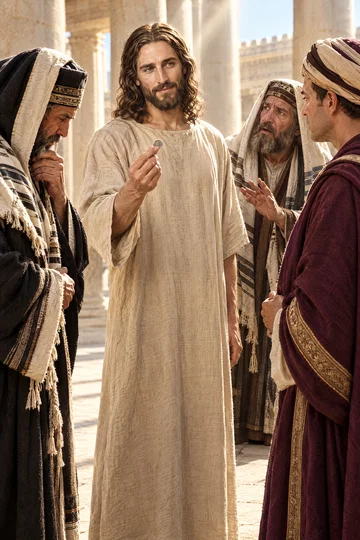
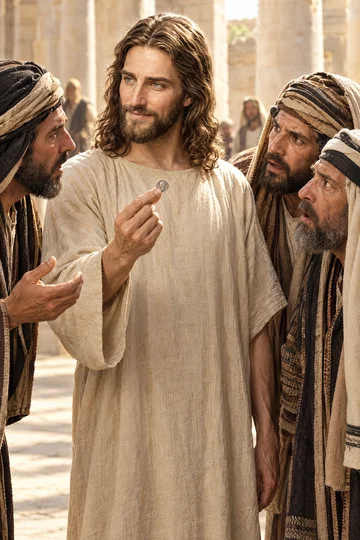
Shew me the tribute money. And they brought unto him a penny.
Jesus distinguishes what is owed to Caesar from what is owed to God.
- Mark 12:17
And Jesus answering said unto them, Render to Cæsar the things that are Cæsar’s, and to God the things that are God’s. And they marvelled at him.
Jesus distinguishes what is due to Caesar from what is due to God.
- Romans 13:7
Render therefore to all their dues: tribute to whom tribute is due; custom to whom custom; fear to whom fear; honour to whom honour.
Specifies dues owed to civil authorities and connects civic obligations with rendering what is due.
- Acts 5:29
Then Peter and the other apostles answered and said, We ought to obey God rather than men.
Both distinguish duties to God from human authority when their demands conflict.
- John 18:36
Jesus answered, My kingdom is not of this world: if my kingdom were of this world, then would my servants fight, that I should not be delivered to the Jews: but now is my kingdom not from hence.
Both distinguish Christ’s kingdom from earthly civil rule.
- Romans 13:1
Let every soul be subject unto the higher powers. For there is no power but of God: the powers that be are ordained of God.
Both connect civil authority with God’s ordaining.
- 1 Peter 2:13-17
Submit yourselves to every ordinance of man for the Lord’s sake: whether it be to the king, as supreme;
Believers submit to human authorities while honoring the king and fearing God.
- Acts 4:19
But Peter and John answered and said unto them, Whether it be right in the sight of God to hearken unto you more than unto God, judge ye.
Both distinguish duties to human authorities from obedience owed to God.
- Luke 23:2
And they began to accuse him, saying, We found this fellow perverting the nation, and forbidding to give tribute to Cæsar, saying that he himself is Christ a King.
Jesus is accused of forbidding tribute, contrary to his teaching.
- Daniel 3:16-18
Shadrach, Meshach, and Abed-nego, answered and said to the king, O Nebuchadnezzar, we are not careful to answer thee in this matter.
The Hebrews refuse the king’s command to worship a false god.
- Romans 13:5
Wherefore ye must needs be subject, not only for wrath, but also for conscience sake.
Both texts connect submission to civil authority with conscience.
- Romans 13:4
For he is the minister of God to thee for good. But if thou do that which is evil, be afraid; for he beareth not the sword in vain: for he is the minister of God, a revenger to execute wrath upon him that doeth evil.
Civil authority bears the sword against wrongdoing.
- Matthew 17:27
Notwithstanding, lest we should offend them, go thou to the sea, and cast an hook, and take up the fish that first cometh up; and when thou hast opened his mouth, thou shalt find a piece of money: that take, and give unto them for me and thee.
Jesus paid the tribute tax.
- Jeremiah 27:5-8
I have made the earth, the man and the beast that are upon the ground, by my great power and by my outstretched arm, and have given it unto whom it seemed meet unto me.
God grants Nebuchadnezzar civil rule over nations.
- Luke 20:9-19
Then began he to speak to the people this parable; A certain man planted a vineyard, and let it forth to husbandmen, and went into a far country for a long time.
same reading's parable of the husbandman
Commentary
Each commentary is drawn from primary sources: the writings of Ellen G. White and Adventist pioneers and periodicals. Each commentary is separate. Its own words are not a quotation; follow the references to read the source passages.
Ellen G. White
21 sources
Jesus gave this answer when spies tried to trap him over paying the Roman tax, hoping to accuse him of rebellion if he opposed it or of opposing God's law if he approved it.Ms 78, 1897, par. 15–163SP 42.2 He pointed to Caesar's image and inscription on the tribute coin to identify what belonged to the government, and answered directly rather than evading the question.Ms 78, 1897, par. 15–16DA 601.1–602.5ST Feb 8, 1899 The answer establishes that meeting the legitimate claims of civil government, including taxes and obedient subjection to its laws, is right and lawful and does not break God's law.DA 601.1–602.53SP 43.1ST Apr 25, 18783SP 129.3–130.1ST Jul 4, 1878 That obedience is due only so long as it does not conflict with higher duty, for first allegiance belongs to God and his claims must be met at all times.DA 601.1–602.53SP 43.1ST Apr 25, 1878Ms 78, 1897, par. 17–18 Giving God what belongs to him rebukes neglect of duty to him and requires that he receive first from a person's means in tithes and offerings, a duty that debt does not excuse and prosperity should enlarge into proportionate self-sacrifice.3SP 43.2SG4 210.1ST Apr 25, 18781T 220.21T 220.3
Trap and Candid Answer
The saying was given as an answer to spies sent to trap Jesus over paying tribute to Caesar, where denying its lawfulness could be reported to Rome as rebellion and approving it could be used to charge Him with opposing God's law.3SP 42.2 He did not accept either side of the trap they had prepared, but settled their question and upset their plans.3SP 42.2 Before answering He asked whose image and inscription were on the tribute coin, and they were Caesar's, thereby identifying what belonged to Caesar's government.Ms 78, 1897, par. 15–16DA 601.1–602.5ST Feb 8, 1899ST Jul 4, 1878
He answered the disputed Roman tax directly and candidly rather than evading it, establishing a clear principle that settled the vexed question for many hearers, though some remained dissatisfied.Ms 78, 1897, par. 15–16ST Feb 8, 1899Ms 78, 1897, par. 17–18 His wise reply exposed the hypocrisy and presumption of the questioners, left them with nothing more to say, and showed those present that their plot had failed.DA 725.3–6DA 601.1–602.5ST Feb 8, 18993SP 42.2 Romans who were present saw that the plot had failed.DA 725.3–6 It stands as an example of meeting an artful question meant to entangle with plain intelligence, bringing light to listeners and sowing seeds of truth.Ms 71, 1897, par. 27
The verse teaches that duty to the reigning power, including paying tribute, is right and lawful and does not break God's law, contrary to the claim among the Jews that paying a foreign power violated Jewish law.ST Jul 4, 1878 Jesus Himself paid the tribute and taught His disciples to do so, proving He was no leader of sedition.3SP 129.3–130.15RED 49.2–50.1ST Jul 4, 1878 That fact contradicts the later false accusation that He forbade paying tribute to Caesar or led rebellion against Roman rule.3SP 129.3–130.15RED 49.2–50.1ST Jul 4, 1878 The verse belongs to His warnings about rejecting the Son of God, and its warning applies in every age to those who refuse Christ as Redeemer unless they repent.DA 600.3
Duties to Government and God
The verse lays down a clear dividing line between two different obligations, assigning to civil power what belongs to it and to God what belongs to Him, while giving God first place in loyalty.DA 601.1–602.5Ms 78, 1897, par. 17–18 Those who live under a civil government and enjoy its protection are to satisfy its rightful demands, furnishing taxes and the support it requires.DA 601.1–602.5ST Apr 25, 1878ST Jun 29, 1882 They are at the same time to remain peaceably subject to the laws of the land and obey them.3SP 43.1ST Jun 29, 1882ST Jun 29, 1882
That submission to earthly authority is conditional, holding only where it does not clash with duty to a higher authority.DA 601.1–602.53SP 43.1ST Apr 25, 1878ST Jun 29, 1882ST Jun 29, 1882 Even while honoring civil claims, people are to obey God always and to meet His claims upon them at all times.3SP 43.1ST Apr 25, 1878ST Jun 29, 1882ST Jun 29, 1882
Israel's loss of independence and coming under Rome illustrates the principle from the other side, for subjection to Rome and Roman control of Jerusalem came as punishment for unfaithfulness and turning away from God.DA 601.1–602.53SP 43.2ST Apr 25, 1878ST Jun 29, 1882 Had the Jews faithfully met what they owed to God, they would not have been left a broken nation under foreign domination.DA 601.1–602.53SP 43.2ST Jun 29, 1882
Giving God His Due
The command to give to God what belongs to Him rebukes neglect of obligations to God and requires that those obligations be met.3SP 43.2ST Apr 25, 1878ST Jun 29, 1882 Had those obligations been faithfully fulfilled, the Jews would not have become a broken nation under foreign rule, for Roman control of Jerusalem was the penalty for apostasy from God.3SP 43.2ST Apr 25, 1878ST Jun 29, 1882 Those living under civil government are to give that government the support it claims, including taxes, and to remain peaceably subject to the laws of the land, so long as doing so does not conflict with duty to God, whom they must obey at all times.ST Apr 25, 1878
What is owed to God must be given to God, just as what is owed to others must be given to them, for God has the first and sacred claim on a suitable proportion of a person's means in tithes and offerings.SG4 210.11T 220.3 That duty to render to God what belongs to Him comes before claims on one's possessions for children, and to withhold a suitable proportion for their benefit is to rob God.SG4 210.11T 220.3 Duties to God remain distinct from debts owed to other people, so being in debt does not excuse withholding an offering from God or postponing giving until every debt is paid.1T 220.2 A person in debt should subtract the amount owed from what is possessed and give a proportion of what remains to the Lord.1T 220.2 Those whom God has prospered should respond with self-sacrifice and offerings proportionate to the blessings received, since neglect of God's requirements through attachment to possessions and worldly business turns His blessings into a curse.RH Aug 2, 1870
Sources
Pioneers and periodicals
88 sources
Jesus met a trap over paying tribute to Caesar by calling for the tribute coin and dividing what bears Caesar's image from what bears God's, giving each what is its own.ST Feb 8, 1899ST Oct 18, 1899ST Oct 28, 1913ST Sep 30, 1886 What carries the stamp of earthly rule, like tax money and outward civil duty, is owed to civil government, while faith, conscience, the soul, worship and obedience under God's law are owed to God alone and lie outside the state's rightful reach.ST Sep 24, 1894RH Jul 18, 1912ST Jun 25, 1912 Church and state therefore stand independent, each supreme in its own sphere, with civil power ordained only for temporal matters such as taxes, civil peace and protection of rights, and with no authority to command belief, coerce worship, enforce religious observance or doctrine, or tax all to support religion.RH Jul 25, 1912ST Jul 1, 1908RH Mar 23, 1905ST Jun 23, 1914 For that reason the conscience is free before God, the Sabbath belongs to God and not to Caesar, and laws compelling Sunday or Sabbath observance take for Caesar what is God's.ST Apr 4, 1906ST Jan 30, 1907ST Jan 23, 1907ST Jun 25, 1912 Christians are still to honor rulers and pay tribute and taxes peaceably even under pagan rule, yet when human law claims what is God's or contradicts God's law, loyalty to God comes first.ST Feb 8, 1899ST Oct 30, 1901ST Sep 2, 1889ST Sep 30, 1886RH May 12, 1868
Trap, Coin, and Response
The saying was given in the Temple at Jerusalem when the Pharisees took counsel to ensnare Jesus in His talk and sent their disciples with the Herodians to question Him.ST Oct 18, 1899ST Oct 28, 1913ST Oct 10, 1906 They approached with flattering words to ask whether it was lawful to give tribute to Caesar, seeking to entangle Him and find a pretext for putting Him to death.ST Oct 18, 1899ST Oct 25, 1910 The trap lay in forcing an answer that could be used against Him either way, for denial of the tax could be charged as treason while affirmation would alienate Jews who resented Roman rule.ST Oct 10, 1906ST Oct 25, 1910RH Mar 9, 1869 That dilemma bore especially on what the promised Messiah should say about paying tribute, whether He should tell the people to pay.ST Oct 10, 1906RH Mar 9, 1869 It stands among captious questions put after the parable of the husbandman and before the discourse on the destruction of Jerusalem, within Luke 18:24 through Luke 21.ST Oct 18, 1899ST Oct 28, 1913
Jesus perceived their wickedness and called them hypocrites, demanding to see the tribute money.ST Feb 8, 1899ST Oct 18, 1899 Using a coin familiar to His hearers, He had them bring a penny and asked whose image and inscription it bore, and when they answered Caesar's He taught the candid principle that what belongs to Caesar should be rendered to Caesar and what belongs to God to God.ST Oct 18, 1899ST Mar 12, 1885 The image and superscription identified the money with Caesar and showed that paying the tax was lawful, so the answer did not evade the trap but settled it by principle.ST Feb 8, 1899ST Sep 30, 1886 That teaching showed obedience to the ruling power rather than sedition, for He Himself paid tribute and taught His disciples to do so, contrary to the claim among the Jews that it was against their law to pay a foreign power.ST Jul 4, 1878ST Sep 30, 1886
His wise answer silenced the questioners before the people so that they could not take hold of His words, and they marveled, held their peace, left Him and went away confused.ST Jul 29, 1897ST Oct 18, 1899RH Mar 9, 1869 It settled the disputed question for many hearers even though some remained dissatisfied, and it exposed hypocrisy and presumption.ST Feb 8, 1899 Because He taught and practiced payment of tribute and duty to the reigning power as right and lawful, the later charge that He forbade tribute to Caesar is proved false.ST Jul 4, 1878ST Sep 30, 1886
What Belongs to Whom
What bears the stamp of earthly government belongs to that government, as money bearing Caesar's image and superscription belongs to Caesar, while what bears God's stamp, as heaven's stamp and the Sabbath, belongs to God alone and must not be given to Caesar.ST Sep 24, 1894 Civil government has authority in civil matters, and tribute is to be paid and life lived peaceably, but the command to render to Caesar does not authorize the state to claim what belongs to God or to command disobedience to God's law.ST Sep 24, 1894 Human ordinances are to be obeyed unless they are lifted above their proper place and used to command conscience against God, and when they are so used God is to be obeyed rather than people, which is not a breach of the peace.ST Sep 24, 1894 Judgment of those who reject Christ's words is left to the last day rather than given to human beings to take His place.
Caesar stands for civil government and temporal things and the management of temporal things, which alone are to be given to civil power.RH Jul 18, 1912ST Jun 25, 1912ST Jun 24, 1913ST Aug 1, 1911 What belongs to God is faith, reason, conscience, the soul, worship, and duty under the first four commandments, which are answerable to God and directed by reason or conviction, not imposed by civil law.ST Jun 25, 1912ST Jun 24, 1913ST Aug 1, 1911ST Feb 17, 1914 Faith is not a matter to be regulated by a corporate body, monarch, state, or federal government, and duties to God, including the first four commandments, lie outside the state's proper authority, while civil authorities may regulate outward duties between people.ST Jun 25, 1912ST Jun 24, 1913ST Aug 1, 1911ST Feb 17, 1914 Civil government may protect everyone's right to worship according to conscience, but religious legislation goes beyond its proper limit because people differ in belief and worship.RH Jul 18, 1912
The verse fixes the boundary between civil government and religion by distinguishing in general what is due to civil authority from what is due to God and directing that each be given what properly belongs to it.ST Feb 22, 1910RH Sep 16, 1909ST Aug 10, 1882 Earthly authorities are owed what properly belongs to them and God is owed what belongs to Him, without making their claims interchangeable. Service owed to civil authority is distinct from service owed to God, and worship belongs to God and cannot rightly be demanded by human authority.ST Feb 22, 1910ST Jul 28, 1898 Civil and spiritual authority have distinct spheres applying to individual duties, not to joining church and state or making patriotism a religious duty.ST Jul 28, 1898
By distinguishing what belongs to Caesar from what belongs to God, the answer denies Caesar and the state any claim to divinity, for Caesar is not God and what is due to God must not be given to the state.ST Oct 4, 1899ST May 15, 1901 God remains the higher authority to whom rulers like all others owe what is due to Him, and no state may rightly demand what is due to God.ST Oct 4, 1899ST May 15, 1901 Rulers are accountable to God for abusing their power, for their authority is bounded by the law of nature and of God including justice, and exceeding those bounds is sin for which they answer in the judgment.ST May 15, 1901 The distinction therefore teaches complete separation of religion and the state.ST Oct 4, 1899ST May 15, 1901
Civil government has authority over civil matters such as taxes and outward conduct toward other people, and Christians should obey civil laws even under unjust rule so long as obedience does not violate duty to God.ST Oct 30, 1901RH Jul 14, 1904ST Jan 2, 1907 A person's duty to God belongs to the individual soul and cannot be claimed by earthly rulers, for civil rulers have authority over the things that belong to Caesar but not over conscience or the worship owed to God.ST Oct 30, 1901ST Jan 2, 1907 When human law conflicts with God's law, or when Caesar claims what is God's or commands disobedience to Him, loyalty to God must come first and the claim must be resisted.ST Oct 30, 1901RH May 12, 1868RH Jul 14, 1904ST Jan 2, 1907 Such resistance and refusal to obey that command is right, no civil power has the right to prevent a person from serving God, and obeying God rather than people in that case is not a breach of the peace.ST Sep 24, 1894RH Jul 14, 1904ST Jan 2, 1907
Separate Spheres of Authority
The saying draws a line between two orders that are independent, each supreme in its own sphere, and forbids their union, domination, combination, or intermingling.RH Jul 25, 1912RH Mar 23, 1905ST Jun 23, 1914ST Jun 25, 1894RH Sep 7, 1911 Civil government and the spiritual kingdom of Christ occupy separate spheres, so what belongs to Caesar is to be rendered to Caesar and what belongs to God to God.RH Jul 25, 1912RH Mar 23, 1905ST Jun 23, 1914ST Jun 25, 1894RH Sep 7, 1911 Civil rulers have authority over temporal matters while God has authority over spiritual matters, and a state church falsely unites what Christ separates.RH Jul 25, 1912ST Jun 23, 1914RH Jul 9, 1908 For that reason civil government is not to be made responsible for religious duties, nor used to enforce religious claims, nor to support or propagate religion, including religious instruction paid for by compulsory taxation.RH Mar 23, 1905RH Sep 7, 1911
Civil government has authority only over civil and temporal things between people, such as taxes and outward conduct.ST Jun 25, 1894RH Nov 12, 1908ST Nov 8, 1905ST Jun 6, 1906 It is ordained to secure inalienable natural rights, to protect the exercise of religion, and to regulate conduct that violates the rights of others or the civil peace.ST Nov 8, 1905 It has no rightful authority over religious belief or practice, conscience, worship, or moral duty owed to God.ST Jun 25, 1894RH Nov 12, 1908ST Nov 8, 1905ST Jun 6, 1906 Religion is not to be rendered to civil governments, and worship with the duties of conscience is to be reserved to God while Caesar is given his lawful due in service and payment.ST Jul 1, 1908 Therefore the state must not command or coerce belief, prescribe when or how people shall worship or rest, enforce religious observance or doctrine, establish a national religious standard by Congress, make patriotism a religious duty, or legislate religious obligation.ST Jul 1, 1908ST Jun 25, 1912RH Nov 12, 1908ST Nov 8, 1905ST Jun 6, 1906 Opposition to putting religious doctrines or duties into state or national law is grounded in devotion to Christ rather than self-interest, and it protects each person's freedom of conscience to worship or not worship and to practice or not practice religious precepts.ST Jun 25, 1912
The church for its part must not join itself to human government nor use its power, political rings, or civil law to carry out the mission of the gospel or to control political and civic affairs.STST Apr 4, 1906ST Dec 23, 1903 Christ did not rely on Caesar's power but sought to convince and convert, and the decisive early progress of His religion came without state support and amid governmental opposition.ST Dec 23, 1903 Later reliance of the church on state aid contributed to the Dark Ages, and preserving the distinction guards against religious authority extending over every part of life, hypocrisy in politics, and persecution.ST Apr 4, 1906ST Dec 23, 1903 Leaving the church's work of spreading the gospel to pursue civil laws on religious matters follows the course of the Herodians who joined with the Pharisees in the tribute question.ST
The same distinction warns against partnership between church and state in education, requiring that the responsibilities of government and religion remain distinct.RH Mar 16, 1905ST Jul 12, 1905 People are to give the state its rightful civic tribute while reserving religious instruction and service to God for the sphere of faith.RH Mar 16, 1905ST Jul 12, 1905 Supporting private religious schools through private subscriptions fulfills duty to Caesar without charging the public treasury for sectarian teaching.ST Jul 12, 1905
Freedom of Conscience Protected
Christ's kingdom is not of this world, and therefore His servants do not fight to keep Him from being delivered to His enemies.ST Jun 11, 1912 Though He could have prayed for more than twelve legions of angels, He refused force and the sword to defend Himself, and all who take the sword shall perish with the sword.ST Jun 11, 1912 Giving to civil rulers what belongs to them while giving to God what belongs to God marks civil claims as distinct from divine claims and does not teach that political action can make an earthly nation His kingdom.ST Jun 11, 1912ST Sep 28, 1882
The Gospel is to be advanced by convincing and converting rather than by compelling through civil penalties, with power given through Christ's Spirit rather than through the state.ST Oct 10, 1906 The church must not join itself to human government or use its power to carry out its mission, for seeking state power to do the church's work dishonors God and denies that Christ's power is sufficient.ST Oct 10, 1906 Christians should ask from the state protection and only protection, leaving every person with God and his own conscience, while being faithful in testimony for truth and duty and living right lives instead of using civil law to enforce observance and promote religion and morality.ST Oct 10, 1906ST Jul 15, 1897 Any observance that is not the free choice of the soul itself is not pleasing to God and will not receive His blessing, and resort to force confesses the inadequacy of moral motives and moral suasion.ST Jul 15, 1897 Such compulsion is failure and criminal blunder that exasperates and disgusts citizens who are not Christians, turns them away from the churches and from the Bible, and makes it much harder to bring them under holy religion.ST Jul 15, 1897
The command establishes a pure, spiritual, and universal religion for all mankind, vindicating liberty of religion for the conscience of the individual and the right of individuality even in religion, and in religion above all.ST Jun 25, 1912ST Jun 24, 1913ST Aug 1, 1911 Civil power is to be given only what belongs to civil power, which is the management of temporal things, while faith, reason, conscience, the soul, and the sanctuary of the soul belong to God and must never be regulated by a corporate body, monarch, state, or federal government.ST Jun 25, 1912ST Jun 24, 1913ST Aug 1, 1911 Religion belongs to duty to God, which concerns worship according to conscience, and civil government has no authority over how a person worships or whether he worships but is ordained only to protect every person in the exercise of inalienable rights.ST Dec 17, 1896ST Oct 2, 1893 Its full fruitage was not immediate, for individuals received and acted upon it through the ages but no nation did, and for nearly two thousand years it lay dormant until latter times when Providence ordained that it should be generally received and exhibited before the whole world on a national scale in a government founded and conducted upon this principle. Out of respect for religion and not from indifference, this was embodied in a national constitution and government that gives no civil establishment to religion and leaves worship free, requires no religious test, makes no law respecting an establishment of religion or prohibiting its free exercise, declares all men created equal with unalienable rights to life, liberty, and the pursuit of happiness secured by governments deriving just powers from the consent of the governed, and withholds from the federal government power to invade the home of reason, the citadel of conscience, and the sanctuary of the soul, so that the infinite Spirit of eternal truth might move in its freedom and purity and power and men might be made happy and free in this short civil life as well as in the unending life to come.ST Jun 25, 1912ST Dec 17, 1896ST Jun 24, 1913ST Aug 1, 1911
Not heeding this separation brings tyranny and bondage, for civil power has no right to command worship, enforce one doctrine and religion, or punish differences of faith. This is seen when believers are condemned for not worshiping as rulers worship, ordered to be crushed, proscribed, cursed, excommunicated and shunned, committed to the flames with their writings, commanded to conform under threat of being harried out of the land, hanged, or imprisoned for holding meetings and exercising freedom in matters of religion. The history of the Dark Ages proves why the separation must never be broken, for the rule that government and religion were one and indivisible was broken by the new universal religion, upheld in the early Gospel, then lost when the chief of the Roman Empire adopted the religion of freedom and bound it in an unholy connection with the unholy state, stripping it of universality and enthralling Christianity to political power.ST Aug 1, 1911ST Aug 2, 1905ST Jul 16, 1902 When a nation permits religious legislation it opens the way to church-state control and ultimately to religious persecution, and this warning applies to the United States in its turn away from the liberty expressed in its founding documents.ST Jul 19, 1905
Religious freedom is priceless and outside civil authority's control, while each person owes civil authority what properly belongs to it.ST Feb 13, 1907 A person may fulfill civil duties as a good citizen while keeping religious belief and practice free from human control, since conscience is an inward matter with which God alone can properly deal.ST Feb 13, 1907ST Jul 17, 1907 No person or group is owed an explanation for religious belief so long as civil responsibilities are met.ST Jul 17, 1907
Sabbath Beyond Civil Power
The Sabbath bears God's image and superscription and is marked by Him as holy, so it belongs to God and must be rendered to God alone rather than claimed by civil government through legislation.ST Jan 30, 1907ST Jan 23, 1907ST Feb 8, 1905 Tribute in civil things may be given to Caesar, but the Sabbath is the Lord's and not Caesar's, and civil authority has no right to meddle with it, control religious faith and observance, or enforce religious doctrines.ST Jan 30, 1907ST Jan 11, 1899ST Mar 19, 1894 Its observance is accountable to God rather than the state, and calling it the state's Lord's day does not make it the state's to command.ST Mar 19, 1894ST Feb 8, 1905 If the distinction between what belongs to civil authority and what belongs to God were followed, there would be no legislation on the Sabbath.ST Feb 8, 1905
To require Sunday observance by law is to demand for Caesar what belongs to God, by setting civil authority to direct religious observance.ST Apr 4, 1906ST Jun 3, 1908RH Jun 8, 1916 Civil government may punish crime but may not take God's place to decide or punish sin, compel religious teaching or practice such as Sunday keeping, baptism, or the Lord's Supper, or use civil power to enforce a religious day, and such attempts lead toward persecution as exemplified by the Inquisition.ST Apr 4, 1906ST Jun 3, 1908ST Jun 11, 1912 Punishing people for work on a particular day exceeds civil authority, because working to earn a living is not a crime and the day does not make it one, while Sunday is not the Sabbath commanded by God so obedience to such laws is not a matter of sin and enforcement wrongly entangles religion and the state.ST Mar 29, 1899ST Jun 11, 1912 The Sunday holiday is Rome's special protege and belongs to Rome rather than to God, so to parade letter carriers on Sunday is to render to Rome what is Rome's in Rome's own way.ST Mar 29, 1899ST Oct 15, 1894
The state has no authority to prescribe or compel observance of Sunday or even of the true Sabbath by law or majority vote, for religious duties belong to God and not to civil compulsion.ST Jul 15, 1897ST Mar 20, 1907 Observance of the true Sabbath commanded in the fourth commandment rests on divine law and does not require civil enforcement, and to enforce religious observance through civil law abandons the Christian principle for a pagan one.ST Jul 15, 1897RH Oct 8, 1908 Coercion produces hypocrites rather than Christians, since what is not the free choice of the soul is not pleasing to God and will not receive His blessing.ST Jul 15, 1897 The state should give protection and only protection, safeguarding natural rights to exercise religion without prescribing when or how people worship or rest, while believers should live right lives, testify faithfully to truth and duty, and leave every person with God and his own conscience.ST Jul 15, 1897ST Jul 15, 1897 Using civil law to enforce the Lord's day and promote religion and morality is failure and criminal blunder that confesses the inadequacy of moral motives and moral suasion, exasperates and disgusts citizens who are not Christians, turns them from the churches and the Bible, and makes it much harder to bring them under holy religion.ST Jul 15, 1897ST Apr 22, 1889 The same distinction both opposes government-enforced religious observance and defends each person's liberty to keep Sunday or another day according to conscience.ST Jul 15, 1897ST Apr 22, 1889
Obedience, Giving, and Citizenship
Christians living under civil government should give that government the support it claims, including paying tribute and taxes, while giving God what belongs to Him, and paying what government rightly requires is right because government is ordained to maintain its laws and support its officers.ST Feb 8, 1899ST Sep 2, 1889 Since Jews lived under Roman protection they were to provide the support Rome required and remain peaceably subject to the laws of the land, obeying them so long as obedience did not violate duty to God.ST Apr 25, 1878ST Jun 29, 1882ST Sep 30, 1886 This civil allegiance is owed even when the ruling power is pagan and idolatrous, for the coin bearing Caesar’s image and inscription showed the tax to be lawful, and Jesus Himself paid tribute and taught His disciples to do so, showing obedience to the ruling power rather than sedition.ST Feb 8, 1899ST Sep 30, 1886 Honoring authority and obeying laws peaceably applies regardless of ruler or religion where duty to God is not compromised, and learning to obey human law disciplines and prepares for obeying divine law, while revolt against law in anarchy is linked with infidelity.ST Apr 25, 1878ST Jun 29, 1882ST Sep 2, 1889
Paying taxes to civil government does not fulfill obligations to God, for God is still owed what belongs to Him.RH Feb 21, 1871RH Sep 4, 1866RH Jun 9, 1859 Since all worldly goods are lent by God, giving to support His cause, including tithes and pledged offerings and systematic benevolence, is part of rendering to God what is His and should be met as promptly as Caesar’s demands.RH Feb 21, 1871RH Jul 17, 1866RH Jun 30, 1859RH Jun 9, 1859 Pledges for the Lord’s work should therefore be set at what one can truly give and paid promptly, preferably monthly, because a pledge on paper is not funds actually placed in the treasury.RH Jul 17, 1866RH Sep 4, 1866 Those whom God has prospered should respond with proportionate self-sacrifice and offerings, since attachment to possessions and worldly business that neglects God’s requirements turns His blessings into a curse.RH Aug 2, 1870
The verse teaches honest dealing as the essence of true Christianity, evading no just obligation but recognizing and satisfying the proper claims of civil government while also giving God what belongs to God.RH Oct 27, 1910ST Oct 25, 1910 This honesty calls for a well-balanced life that gives both Caesar and God what is due to them, directing effort by proper estimates of what matters.RH Oct 27, 1910ST Oct 25, 1910 Life is a matter of duty rather than self-pleasing or self-pampering, and because people belong to God neither personal culture nor even personal salvation is to be the chief end of activity; the chief aim is to do what is due to God. While living in the world the church may need to follow worldly plans and customs in business transactions, yet it must still give God what belongs to Him, distinguishing obligations to civil society from obligations to God.
The things that are Caesar’s have been taken by some to mean voting, doing duty at the polls, attending primaries, holding office, and putting Christian men in political rings and machines so that Christian men control the world, with duty to Caesar equal to duty to God, so that the pulpit must be taken into politics to regulate and reform the state and to enforce Sabbath laws.ST Jul 29, 1897 The weight of teaching holds the opposite, that Christ gave Himself to the work of His Father’s kingdom and did not try to remodel or purify Caesar’s corrupt political system, teaching Christians to devote time to bringing people to the power of the Gospel rather than forming or managing political parties.ST Jan 24, 1900RH Sep 18, 1856 Jesus refused to be drawn into political-party contention, distinguishing civil duties owed to rulers from devotion owed to God rather than supporting worldly political strife.ST Jan 24, 1900RH Sep 18, 1856 Christians may take part in government as citizens while the church as a church must not use political power or civil law to carry out its religious mission but must appeal to conscience, since the state may regulate conduct violating others’ rights or civil peace but must not compel religious or moral observance; thus a person may petition as a citizen on a weekday, but a church has no right to use its worship or authority to urge government to adopt its measures.RH Oct 5, 1911
Neglect of obligations to God led to national subjection, for faithful obedience would have spared the Jewish nation from becoming broken and subject to foreign rule, and Roman control over Jerusalem was the penalty for apostasy from God.ST Apr 25, 1878ST Jun 29, 1882ST Jun 29, 1882 Those who care for God’s things may trust Him to care for them and theirs.ST Nov 13, 1893 Keeping God’s great code harms no one but honors the equal rights of all, and to infringe another person’s rights is to offend God as Author of all rights and to become answerable before His judgment for each infringement.ST Dec 24, 1912 To argue that refusing a civil law, including a Sunday-observance law, makes a person undeserving of government protection is a reasoning that could be turned to justify withdrawing protection from Sabbath keepers and exposing them to harm.RH Mar 13, 1900
Sources