Luke 22:16
For I say unto you, I will not any more eat thereof, until it be fulfilled in the kingdom of God.
Translations
For I say to you, I will not any more eat thereof, until it be fulfilled in the kingdom of God.
For I say unto you, I will not any more eat thereof, until it be fulfilled in the kingdom of God.
for I say unto you, I will not any more eat thereof, until it be fulfilled in the kingdom of God.
For I say to you, I will not any more eat of it until it shall be fulfilled in the kingdom of God.
for I say unto you, I will not eat it, until it be fulfilled in the kingdom of God.
for I say unto you, I shall not eat it, until it be fulfilled in the kingdom of God.
for I say to you, that no more may I eat of it till it may be fulfilled in the reign of God.'
For I say unto you, that I will not eat any more at all of it until it be fulfilled in the kingdom of God.
For, I say unto you—In nowise shall I eat it, until it have been fulfilled in the kingdom of God.
Berean Standard Bible, Majority Standard Bible
For I tell you that I will not eat it again until it is fulfilled in the kingdom of God.”
for I tell you, I will no longer by any means eat of it until it is fulfilled in God’s Kingdom.”
For I say to you, I will not take it till it is made complete in the kingdom of God.
For I say vnto you, Hencefoorth I will not eate of it any more, vntill it bee fulfilled in the kingdome of God.
Douay-Rheims (Challoner revision)
For I say to you, that from this time I will not eat it, till it be fulfilled in the kingdom of God.
Pictures
Cross-references 20 of 27
- 1 Corinthians 11:26
For as often as ye eat this bread, and drink this cup, ye do shew the Lord’s death till he come.
The Supper proclaims the Lord’s death until he comes.
- Matthew 26:29
But I say unto you, I will not drink henceforth of this fruit of the vine, until that day when I drink it new with you in my Father’s kingdom.
Jesus promises to share the feast anew with his disciples in the kingdom.
- Revelation 19:9
And he saith unto me, Write, Blessed are they which are called unto the marriage supper of the Lamb. And he saith unto me, These are the true sayings of God.
The promised future meal is the marriage supper of the Lamb.
- 1 Corinthians 5:7
Purge out therefore the old leaven, that ye may be a new lump, as ye are unleavened. For even Christ our passover is sacrificed for us:
Christ is identified as the Passover sacrifice, fulfilling the paschal type.
- Mark 14:25
Verily I say unto you, I will drink no more of the fruit of the vine, until that day that I drink it new in the kingdom of God.
Jesus says he will drink the fruit of the vine anew in God’s kingdom.
- Exodus 12:14
And this day shall be unto you for a memorial; and ye shall keep it a feast to the LORD throughout your generations; ye shall keep it a feast by an ordinance for ever.
The Passover feast was a type to be fulfilled in God’s kingdom.
- John 13:26-30
Jesus answered, He it is, to whom I shall give a sop, when I have dipped it. And when he had dipped the sop, he gave it to Judas Iscariot, the son of Simon.
Judas receives the sop and leaves before the memorial is instituted.
- Luke 22:30
That ye may eat and drink at my table in my kingdom, and sit on thrones judging the twelve tribes of Israel.
Both describe eating in the kingdom of God.
- 1 Corinthians 11:20
When ye come together therefore into one place, this is not to eat the Lord’s supper.
The Lord’s Supper is presented as the Passover’s substitute, awaiting fulfillment.
- Exodus 12:6-8
And ye shall keep it up until the fourteenth day of the same month: and the whole assembly of the congregation of Israel shall kill it in the evening.
The Passover lamb was slain at the appointed time and eaten that night.
- Exodus 12:15
Seven days shall ye eat unleavened bread; even the first day ye shall put away leaven out of your houses: for whosoever eateth leavened bread from the first day until the seventh day, that soul shall be cut off from Israel.
Passover used unleavened bread, as did the Supper.
- John 18:28
Then led they Jesus from Caiaphas unto the hall of judgment: and it was early; and they themselves went not into the judgment hall, lest they should be defiled; but that they might eat the passover.
They avoid defilement so they can eat the Passover, while rejecting the true Lamb.
- Exodus 12:8
And they shall eat the flesh in that night, roast with fire, and unleavened bread; and with bitter herbs they shall eat it.
Passover observance replaced by Lord's Supper
- Exodus 12:21-23
Then Moses called for all the elders of Israel, and said unto them, Draw out and take you a lamb according to your families, and kill the passover.
The Passover lamb’s blood spared Israelite homes from the destroyer.
- 1 Corinthians 11:23
For I have received of the Lord that which also I delivered unto you, That the Lord Jesus the same night in which he was betrayed took bread:
Links the supper’s institution to the night Jesus was betrayed.
- Luke 22:7
Then came the day of unleavened bread, when the passover must be killed.
Identifies the day for preparing the Passover.
- 1 Corinthians 11:27-29
Wherefore whosoever shall eat this bread, and drink this cup of the Lord, unworthily, shall be guilty of the body and blood of the Lord.
Both connect the Lord’s Supper with its proper observance.
- Luke 22:21
But, behold, the hand of him that betrayeth me is with me on the table.
Judas is present at the meal despite his coming betrayal.
- Luke 17:20-21
And when he was demanded of the Pharisees, when the kingdom of God should come, he answered them and said, The kingdom of God cometh not with observation:
Addresses the claim that the kingdom was already present among the Pharisees.
- 1 Corinthians 15:50
Now this I say, brethren, that flesh and blood cannot inherit the kingdom of God; neither doth corruption inherit incorruption.
Both address the kingdom of God and when it will be inherited.
Commentary
Each commentary is drawn from primary sources: the writings of Ellen G. White and Adventist pioneers and periodicals. Each commentary is separate. Its own words are not a quotation; follow the references to read the source passages.
Ellen G. White
11 sources
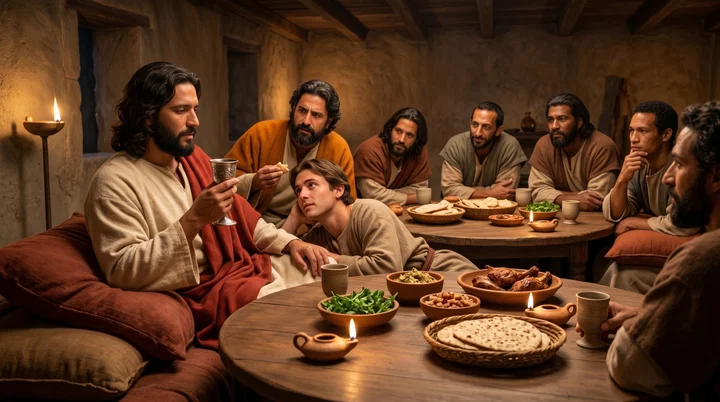
Jesus spoke these words to His disciples gathered about the table with Him in the upper chamber at the Passover supper, His last Passover before His suffering and crucifixion, in the few quiet hours before Gethsemane.3SP 83.2–84.15RED 4.2–5.1Ms 54, 1897, par. 1–2ST May 23, 1878DA 642.3–4 Their meetings had usually been seasons of calm joy, but on this night He was troubled, with a burdened heart, a troubled spirit, and a shadowed countenance, and He spoke in tones of touching sadness.3SP 83.2–84.1ST May 23, 1878DA 642.3–4 He clearly foresaw His near suffering, grieved over the ingratitude and cruelty of those He came to save and the terrible fate awaiting them, and the disciples saw that something weighed heavily on Him and sympathized without knowing the cause, while He used the time for their benefit.3SP 83.2–84.1ST May 23, 1878DA 642.3–4 With strong desire and longing He expressed His wish to eat this Passover with them before He suffered, yet declared He would not eat of it again until it be fulfilled in the kingdom of God.3SP 83.2–84.15RED 4.2–5.1Ms 54, 1897, par. 1–2Ms 106, 1903, par. 8–11DA 642.3–4
This was virtually the last Passover ever to be celebrated, because type was to meet antitype when the Lamb of God, the spotless Lamb about to offer Himself for sin, was slain for the sins of the world, and Christ was soon to receive His full baptism of suffering.3SP 83.2–84.15RED 4.2–5.1DA 652.1–2ST May 23, 1878SG3 225.1 The Passover recalled Israel's deliverance from Egypt and pointed forward to Christ, commemorating the deliverance and the innocent lamb slain in Egypt whose blood on the doorposts turned away the destroying angel.SG3 225.1ST Jul 4, 1878 That was fulfilled in Christ as the sinless, spotless Lamb of God whose merits alone avert the judgment and condemnation of fallen man.SG3 225.1ST Jul 4, 1878 He spoke in obedience to the Jewish law, observing all its divinely appointed ordinances, and identified Himself with the paschal lamb as its great antitype by connecting the Lord's Supper with the Passover.5RED 48.1ST Jul 4, 1878
At this last Passover the declaration marks the transition from the Passover, which was to end with its types pointing to His death, to the Lord's Supper, which He instituted there as a lasting memorial service commemorating His death in its place.3SP 83.2–84.1Ms 35, 1897, par. 1–2DA 652.1–2ST May 23, 1878SG3 225.1 Immediately after this declaration He took the cup and gave thanks and told them to divide it among themselves, declaring He would not drink of the fruit of the vine until the kingdom of God comes.DA 642.3–4
Sources
Pioneers and periodicals
44 sources
At His last Passover with His disciples on the night He was betrayed, Jesus said He would not share that meal with them again as He was then doing until it takes place in the kingdom of God.ST May 23, 1878RH May 10, 1864ST Sep 27, 1910ST Oct 22, 1894RH May 10, 1864 In the parallel saying He likewise would not drink the fruit of the vine until He drinks it new with His disciples in the Father's kingdom.ST May 12, 1898 That was virtually the last Passover ever kept, for type met antitype when Christ, the Lamb of God, died on the same day and month the Passover lamb had been slain for fifteen centuries.ST May 23, 1878ST Apr 2, 1912ST Mar 3, 1909 Just at its close He instituted the Lord's Supper with its bread and cup to take the place of the Passover whose time had ended, as a memorial of His death to be observed in remembrance of Him.ST Dec 30, 1889ST Mar 3, 1909ST Mar 3, 1909ST Feb 7, 1878ST Dec 11, 1879 His abstaining points to the future time when He will eat and drink anew with His immortal people in God's kingdom at the marriage supper of the Lamb in the New Jerusalem near the throne.RH Mar 1, 1870ST Sep 26, 1878ST Apr 5, 1883ST Mar 6, 1879ST Aug 22, 1878
Last Passover Setting
The saying was uttered at Christ's last Passover with His disciples in the upper chamber, in the few quiet hours before Gethsemane and His apprehension in the garden, on the night He was betrayed.ST May 23, 1878ST Sep 27, 1910RH Jan 28, 1862ST Nov 15, 1883ST Jul 21, 1898 It belonged to a farewell meeting with His disciples out of which the Lord's Supper grew as a Christian institution, and because those events of the last supper are so closely connected with His death their order and circumstances call for careful study.ST Nov 15, 1883ST Jul 21, 1898 He ate that Passover on the night after the lambs were slain on the fourteenth day of the first month, identified as Thursday night, and that same night He instituted the Lord's Supper.RH Feb 5, 1914ST Jan 25, 1910ST Nov 19, 1912ST May 11, 1915 He was taken that night to be crucified the next day, so that His eating of the Passover with His disciples came just before His suffering and death.ST Apr 2, 1912ST Nov 19, 1912ST May 11, 1915
He spoke in touching sadness, weighed down by clearly foreseeing His near suffering and grieved by the ingratitude and cruelty of those He came to save and the terrible fate awaiting them, yet He spent those quiet hours between Him and Gethsemane for the disciples' benefit.ST May 23, 1878 The record of that supper, including the partaking of the bread and the wine and His words concerning them, agrees precisely with the records of the other evangelists and with Paul's account received directly from the Lord, showing competent eyewitness knowledge of the fact.RH Jan 28, 1862 A casual reading indicates Judas was present and partook, and Jesus shared the meal with him despite knowing his deceit and unfaithfulness.RH Jul 29, 1873RH Jan 8, 1914 Whether Judas was present when the memorial itself was instituted, and the exact relative time when the memorial was instituted and the Passover was eaten, requires careful examination and comparison of the united testimony of the evangelists, and the question matters as an objection urged against close communion.RH Jul 29, 1873RH Jul 29, 1873
At that last Passover the kingdom of God was still future, for He said He would eat it again when fulfilled in the kingdom, and therefore the kingdom had not been set up before His ascension.RH Sep 22, 1863
Sense Of Abstaining
The refusal concerns that particular meal shared with the disciples on that night, not the Passover institution left unfulfilled as a type.RH May 10, 1864RH May 10, 1864 He would not again eat and drink with them in the manner He was then doing until it takes place in the kingdom of God.RH May 10, 1864ST Oct 22, 1894RH May 10, 1864 His words point forward to a later occasion when He would share it again with His disciples in the kingdom.RH May 10, 1864ST Oct 22, 1894 In the parallel saying He likewise would not drink of the fruit of the vine until He drinks it new with His disciples in the Father's kingdom.ST May 12, 1898
Fulfillment comes in stages rather than all at once.RH May 10, 1864 Much had already been fulfilled, yet its remaining part would be fulfilled in the kingdom of God.RH May 10, 1864 The sacrificial type of the Passover was fulfilled through His death.RH May 10, 1864
By contrast, the verse is also taken to mean the Passover would no longer be eaten until fulfilled in God's kingdom, its observance ceasing after the crucifixion and resurrection unto complete fulfillment.RH May 10, 1864 Those who held otherwise taught that it does not mean the Passover will be eaten again in the kingdom, because the typical service lost its significance when type met antitype in the sacrifice of Christ the real Passover.ST Mar 3, 1914
Passover Type Fulfilled
The meal was fulfilled in its timing when Christ, the Lamb of God who takes away the sin of the world, died on the same day and month on which the Passover lamb had been slain for fifteen centuries, having been taken that very night to be crucified.ST Apr 2, 1912 This was virtually the last Passover ever celebrated, for at its close type met antitype in the slaying of the Lamb of God for the sins of the world.ST May 23, 1878ST Mar 3, 1909 The Passover was both commemorative and typical, pointing back to deliverance from Egypt and the angel of death and forward to the greater deliverance by Christ in freeing His people from sin and eternal death.ST Mar 3, 1909
As the lamb's blood in Egypt spared Israelite homes from judgment, so the merits of the sinless Lamb of God alone avert judgment and condemnation for fallen humanity.ST Jul 4, 1878ST Sep 30, 1886 The innocent lamb slain in Egypt, whose blood on the doorposts turned away the destroying angel, foreshadowed the salvation Jesus brings in fulfillment of Israel's deliverance commemorated by the feast.ST Jul 4, 1878ST Sep 30, 1886 In obedience to the Jewish law He observed all its divinely appointed ordinances and then identified Himself with the paschal lamb as its great antitype by connecting the Lord's Supper with the Passover.ST Jul 4, 1878
The Passover service was done away at the crucifixion, when the type met the antitype in the sacrifice of Christ the real Passover and the typical service lost its significance.ST Mar 3, 1914 At the Passover table He looked forward to the future fulfillment of the kingdom of God, when God returns to rule His world and make all things new.RH Jul 24, 1855 This re-enthronement was the joy set before Him as He endured the cross, and it assures the kingdom's permanence and blessedness.RH Jul 24, 1855
Lord's Supper Instituted
Just at the close of the last Passover supper, when type met antitype and the Passover ordinance came to an end, another ordinance was instituted to take its place.ST Mar 3, 1909ST Mar 3, 1909ST Nov 19, 1912 That new celebration was the Lord's Supper with its ordinance of humility, given as the substitute for the Passover whose time had ended, and distinct from Easter as a heathen institution.ST Mar 3, 1909ST Feb 7, 1878 The Passover that thus closed was both commemorative and typical, pointing back to deliverance from Egypt and the angel of death and forward to the greater deliverance by Christ in freeing His people from sin and eternal death.ST Mar 3, 1909 The institution followed immediately after the Jewish Passover, the Passover account continuing through verse 18 before the Lord's Supper was set in place.ST Feb 7, 1878ST Nov 19, 1912
The farewell meeting with the disciples grew into this Christian institution, commanded to be observed in remembrance of Him.ST Dec 30, 1889ST Jul 21, 1898 It was first observed before His death, when it expressed faith in the death still to come, and after His death it is observed in memory of Him who has died.ST Dec 11, 1879 It remains a memorial of both His crucifixion and His coming.ST Mar 3, 1909 Instituted in a private room and given to chosen disciples on the night before the crucifixion, it is a memorial of His death whose emblems of body and blood recall His suffering for sin at Gethsemane and Calvary, and as the solemn ordinance left for that purpose it should be carefully and often observed.RH May 27, 1873RH Dec 13, 1870
The Supper provides only unleavened bread and the cup called the fruit of the vine, never called wine, meaning freshly pressed unfermented grape juice that does not make men drunken.ST Jul 13, 1915ST Feb 7, 1878ST Feb 23, 1915 Because the meal was kept at Passover, when all ferment and leaven was searched out of houses and destroyed and only unleavened bread was used, the drink was likewise unfermented, and no fermented drink is ever used in sacred feasts.ST Jul 13, 1915ST Feb 7, 1878 Only the pure juice of the grape fitly represents the blood shed for mankind, since fermentation is a symbol of corruption and decay, so no drunkard's drink was provided or encouraged at His table.ST Jul 13, 1915ST Feb 7, 1878 Fermented wine therefore has no foundation in Scripture for use in the ordinance, and unfermented wine is the only thing authorized for it.ST Feb 23, 1915
Partaking commemorates the Saviour's death as a work now required under the Gospel, replacing the works of the typical or ceremonial law.ST Aug 13, 1896 Its purpose is to help sinners humbly repent of transgressions of the moral law and exercise faith in the Saviour for remission of sins, for justification, for strength to keep God's law, and for salvation.ST Aug 13, 1896 There is no merit in partaking, and those who do it properly declare themselves unworthy and in perishing need of pardon, justification, divine aid, and final salvation, and cannot by it merit pardon, justification, or salvation.ST Aug 13, 1896
Future Kingdom Feast
The abstinence points to a future time when Christ and His people, the children of the heavenly family, will share the bread and wine anew in God's kingdom at the marriage feast of the Lamb.ST Aug 22, 1878 That marriage supper is eaten in the Father's presence near the throne in the New Jerusalem after the saints are made immortal and received into Christ's presence as invited guests.RH Mar 1, 1870ST Sep 26, 1878ST Apr 5, 1883ST Mar 6, 1879 They are raised and gathered to the New Jerusalem as guests at that feast, where Christ introduces them to the holy city and to the Father.RH Mar 1, 1870ST Sep 26, 1878ST Aug 22, 1878
It is the grand celebration of Christ taking His own throne and His royal city, the capital of His everlasting kingdom, and of His assumption of throne and city.RH Mar 1, 1870ST Sep 26, 1878 He drinks the fruit of the vine anew with His immortal saints there after gathering them to the Father and bringing them into His Father's presence.ST Apr 5, 1883ST Mar 6, 1879 That sharing marks the consummation and completion of the new covenant.ST Apr 5, 1883ST Mar 6, 1879 It comes before Christ and the saints enter upon the judgment of the wicked.ST Sep 26, 1878
The present breaking of bread anticipates that feast shared with the saints of all ages at the marriage supper of the Lamb.RH Oct 22, 1857 The saints must be prepared for it, clothed in the wedding garment, the white linen that is the righteousness of the saints.RH Oct 22, 1857
Sabbath And Sunday
The Passover looks forward to its complete fulfillment in the kingdom of God, and that same future fulfillment is applied by analogy to the Sabbath.RH May 10, 1864 In that analogy the Lord's Supper serves in the meantime as the substitute for the Passover, and in the same way the Lord's day is said to serve as the substitute for the seventh-day Sabbath until its own fulfillment.RH Feb 13, 1872
Jesus celebrated the breaking of bread on Thursday evening, not on the first day of the week, and instituted the Supper on a weekday night, so breaking of bread is not required on Sunday nor tied to Sunday.ST Jan 13, 1881ST May 27, 1875 It was done on Thursday evening by Jesus and on every day by the disciples, and Sunday therefore has no exclusive scriptural claim on communion.ST Jan 13, 1881ST May 27, 1875 There is no biblical precedent or commandment requiring Sunday communion or Sunday observance, and celebrating communion on Sunday is as allowable as on any day.ST May 27, 1875 A church has the right to celebrate the Supper on Saturday or another weekday, but Sunday communion cannot be imposed as a church duty on a scriptural basis.ST May 27, 1875 Jesus celebrated the Supper with His disciples on the night before His crucifixion, identified as Thursday night, and though His death followed the next day, those events did not make that day sacred.ST May 11, 1915
Faithful Observance Today
The ordinance that takes the place of the Passover whose time has ended is to be celebrated acceptably only by those living in obedience to God and at peace with the brethren.ST Mar 3, 1909 Its sacred emblems belong to true followers of Christ, not to worldlings nor to those who profess faith while living in sin.RH May 27, 1873 Whether Judas was present and partook when that memorial of the Lord's death called communion was instituted matters because it is urged as an objection against close communion.RH May 27, 1873RH Jul 29, 1873
Sharing that Passover meal with Judas despite knowing his deceit and unfaithfulness did not mean approving his conduct, for eating with someone is no approval of that person's ways.RH Jan 8, 1914 The last supper left behind a solemn ordinance as a memorial of His death whose emblems recall His suffering for sin at Gethsemane and Calvary.RH Dec 13, 1870 That ordinance is to be carefully and often observed.RH Dec 13, 1870
Sources