Luke 23:19
( Who for a certain sedition made in the city, and for murder, was cast into prison.)
Translations
(Who for a certain sedition made in the city, and for murder, was cast into prison.)
( Who for a certain sedition made in the city, and for murder, was cast into prison.)
(who for a certain sedition made in the city, and for murder, was cast into prison.)
(Who, for a certain sedition made in the city, and for murder, was cast into prison.)
Revised Version, American Standard Version
one who for a certain insurrection made in the city, and for murder, was cast into prison.
who had been, because of a certain sedition made in the city, and murder, cast into prison.
who was one who, for a certain tumult which had taken place in the city, and [ for] murder, had been cast into prison.
who indeed, because of a certain revolt which had occurred in the city, and of murder, had been thrown into prison.
Berean Standard Bible, Majority Standard Bible
(Barabbas had been imprisoned for an insurrection in the city, and for murder.)
one who was thrown into prison for a certain revolt in the city, and for murder.
Now this man was in prison because of an attack against the government in the town, in which there had been loss of life.
Which for a certaine insurrection made in the citie, and murder, was cast in prison.
Douay-Rheims (Challoner revision)
Who, for a certain sedition made in the city, and for a murder, was cast into prison.
Pictures
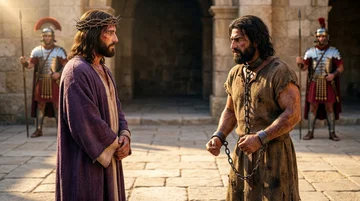
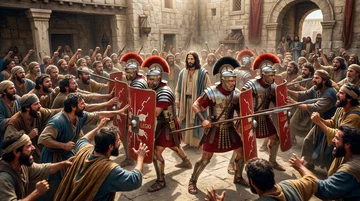
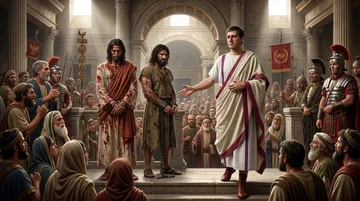
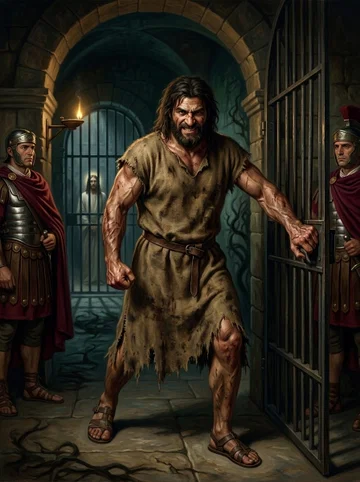
Cross-references
- John 18:40
Then cried they all again, saying, Not this man, but Barabbas. Now Barabbas was a robber.
The crowd chooses Barabbas, identified as a robber, instead of Jesus.
- Mark 15:7
And there was one named Barabbas, which lay bound with them that had made insurrection with him, who had committed murder in the insurrection.
Also describes Barabbas’s insurrection and murder.
- Matthew 27:16
And they had then a notable prisoner, called Barabbas.
Names Barabbas as the notorious prisoner presented with Jesus.
- Matthew 27:20-21
But the chief priests and elders persuaded the multitude that they should ask Barabbas, and destroy Jesus.
The leaders persuade the crowd to choose Barabbas over Jesus.
- Luke 23:25
And he released unto them him that for sedition and murder was cast into prison, whom they had desired; but he delivered Jesus to their will.
Barabbas is released while Jesus is handed over.
- Mark 15:11-15
But the chief priests moved the people, that he should rather release Barabbas unto them.
The crowd is stirred to choose Barabbas and demand Jesus’ crucifixion.
- Acts 3:14
But ye denied the Holy One and the Just, and desired a murderer to be granted unto you;
The people rejected Jesus and asked for the imprisoned murderer to be released.
- Luke 23:32-33
And there were also two other, malefactors, led with him to be put to death.
Barabbas’s release led to Jesus being crucified between two malefactors.
- Matthew 27:21
The governor answered and said unto them, Whether of the twain will ye that I release unto you? They said, Barabbas.
same choosing of Barabbas over Jesus
- Matthew 27:17
Therefore when they were gathered together, Pilate said unto them, Whom will ye that I release unto you? Barabbas, or Jesus which is called Christ?
Pilate offers the crowd a choice between Jesus and Barabbas, imprisoned for sedition and murder.
- John 18:19-28
The high priest then asked Jesus of his disciples, and of his doctrine.
The trial narrative leads into Pilate’s choice between Jesus and Barabbas.
- Matthew 27:26
Then released he Barabbas unto them: and when he had scourged Jesus, he delivered him to be crucified.
same scourging as a criminal
- Matthew 27:24
When Pilate saw that he could prevail nothing, but that rather a tumult was made, he took water, and washed his hands before the multitude, saying, I am innocent of the blood of this just person: see ye to it.
Pilate washes hands innocent
Commentary
Each commentary is drawn from primary sources: the writings of Ellen G. White and Adventist pioneers and periodicals. Each commentary is separate. Its own words are not a quotation; follow the references to read the source passages.
Ellen G. White
21 sources
The verse identifies Barabbas as a prisoner held for taking part in a seditious uprising in the city and for murder, a notorious robber chief and hardened, murderous criminal.DA 723.1–724.1DA 735.1–55RED 63.119MR 277.1–278.1ST May 17, 1899
By the feast custom of releasing whatever prisoner the people desired, Pilate set the innocent Jesus who is called Christ against Barabbas, even having Jesus scourged in the vain hope of rousing pity and a sense of justice.5RED 63.1ST May 17, 18995RED 61.1
Inflamed by the priests and rulers, the maddened multitude with one voice demanded that Barabbas be released and that Jesus be crucified and put to open shame.DA 735.1–519MR 277.1–278.1ST May 17, 18995RED 61.1
In that choice a guilty murderer was released in His stead while the just and holy Son of God, declared innocent by Pilate, was scourged as the worst of criminals and lifted up to die as a malefactor.DA 723.1–724.1DA 735.1–519MR 277.1–278.1
That decision was Satan's fierce determination to destroy the champion of God and cut off communication between heaven and earth, and Barabbas stands for Satan, so the crowd's choice for Barabbas before Christ is repeated whenever people choose against Christ.16MR 259.3–260.1Lt 31, 1898, par. 13Lt 12, 1911, par. 8–11SW 63.1ST Apr 15, 1897
Barabbas and His Crimes
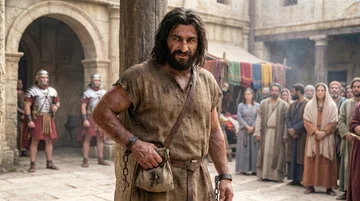
Barabbas was a prisoner cast into prison for a sedition made in the city and for murder, held for taking part in a city revolt, rebellion, or uprising.DA 723.1–724.1DA 735.1–519MR 277.1–278.1ST May 17, 18995RED 61.1 His crimes stand in contrast to Jesus, whom the authorities sought to have condemned while Pilate declared Him innocent and His release was set aside for Barabbas.DA 723.1–724.1DA 735.1–519MR 277.1–278.1 He was a robber and murderer, a notable robber and robber chief and murderous criminal, repulsive in appearance with every feature proclaiming him a debased and hardened desperado.5RED 63.1ST May 17, 18995RED 61.1Lt 12, 1911, par. 8–11SW 63.1 Set in direct contrast with Christ the Son of God, he was the robber and murderer the maddened throng demanded to have released while demanding Christ's death and putting Him to open shame.ST May 17, 1899Lt 12, 1911, par. 8–11SW 63.1ST Apr 15, 1897
Barabbas had pretended to be Christ and, under satanic delusion, claimed religious power and a right to establish a different order of things.Ms 112, 1897, par. 33–34 He used theft, robbery, and murder to pursue what he claimed was his and to set the world right.Ms 112, 1897, par. 33–34 A cross had already been prepared for his execution, and that cross was laid on the bruised and bleeding shoulders of Jesus as He passed out of the gate of Pilate's house.ST Jul 18, 1878 The two men who were to suffer death at the same time with Jesus were companions of Barabbas, and crosses were also laid upon them.ST Jul 18, 1878
Jesus Trial Before Pilate
Luke 23:19 belongs to the account of Jesus' trial before Pilate and His journey from Pilate's judgment hall to Calvary, and that account stands connected with the death of Judas, whose lifeless body was a sign that retribution was already falling on those guilty of Jesus' blood.DA 722.5
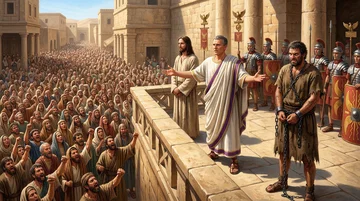
By the feast custom of releasing one prisoner whomsoever the people desired, Pilate placed the innocent Saviour, Jesus who is called Christ, against Barabbas.5RED 61.1 He had Jesus scourged in the vain hope of exciting pity, hoping the contrast would rouse the crowd to a sense of justice so they would decide that punishment was sufficient and save Jesus.5RED 63.15RED 61.1 When Jesus and Barabbas stood together before Pilate in the judgment hall, the priests and rulers and the people who took active part in the death of Christ mingled their voices with the rabble throng.ST May 17, 1899
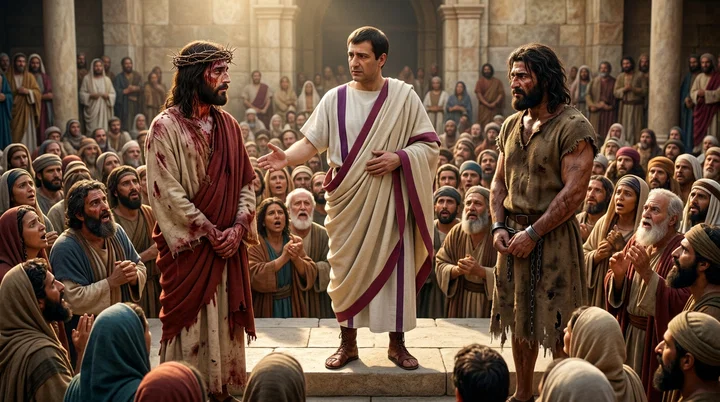
Jesus stood side by side with Barabbas before the multitude with a crown of thorns on His head and stripped to the waist, revealing long cruel stripes from which blood flowed freely.5RED 63.1 His face was stained with blood and marked by exhaustion and pain, yet His noble character could not be hidden but stood out in marked contrast with Barabbas.5RED 63.1
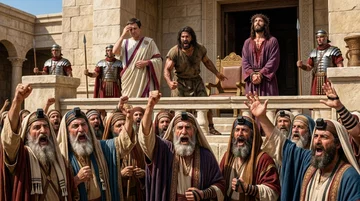
The Jewish priests and rulers forced the Roman governor to do their will, while Jesus was condemned to the cross.DA 735.1–5RH Nov 11, 1915 They had inflamed the people to insane fury and started the cry for Jesus to be taken away and for Barabbas to be released, and the mob took it up.5RED 61.1 The crowd, stirred up by the priests and rulers and trusting human leaders, rejected Christ and chose a robber and murderer in His place, joining the frenzied demand to crucify Jesus.SW 63.17RED 76.3 When Pilate asked whom to release they shouted for Barabbas to be released, and when he asked what to do with Jesus they shouted for Him to be crucified, while Pilate declared he found no fault in Jesus, washed his hands as innocent of His blood, and delivered Christ to be crucified, and the people answered that His blood be on them and on their children.ST May 17, 1899
The multitude who had hailed Jesus as their king turned fickle, hissed at Him and reviled Him, and cried for Him to be crucified in the great trial of His betrayal and condemnation in the judgment hall, His humiliation, and His death on the cross.4RED 102.2–103.1 Jesus knew this ordeal beforehand and knew the unbelieving and weak in faith among His followers, and He let an earlier testing sift them while He was still present to comfort and strengthen His chosen.4RED 102.2–103.1 So the faithful few would be prepared for His betrayal and death and would not be overwhelmed with surprise at the insult to their Master.4RED 102.2–103.1 They would remember the inconstant favor of the world they had already seen, would not hang their faith on the opinions of others, and would not be carried away when professed friends turned from Him in His trouble and faint-hearted ones sank beneath fear and disappointment.4RED 102.2–103.1
The Choice and Its Meaning
With one voice and hearts filled with frenzy the maddened throng chose Barabbas for release instead of Jesus and clamored for Jesus to be crucified and put to open shame.ST May 17, 18995RED 61.1Lt 12, 1911, par. 8–11ST Apr 15, 1897 Stirred up by the priests and rulers and trusting human leaders, priests and rulers and people mingled their voices with the rabble throng, the priests starting the cry, Away with this man, and release unto us Barabbas, which the mob took up shouting Release unto us Barabbas, and when asked what to do with Jesus shouting Crucify Him, crucify Him.ST May 17, 18995RED 61.1SW 63.1 Pilate declared he found no fault in Jesus yet washed his hands as innocent of His blood and delivered Christ to be crucified, while the people answered His blood be on us and on our children.ST May 17, 1899Lt 12, 1911, par. 8–11 The choice set a murderer, a robber and murderer held for sedition and murder in a city revolt, in place of the just and holy Son of God, the innocent and holy Prince of heaven and beloved Teacher, whom Herod and Pilate killed.DA 723.1–724.1DA 735.1–519MR 277.1–278.1Lt 31, 1898, par. 13ST Apr 15, 1897 While the guilty Barabbas was released in His stead, Jesus whom Pilate declared innocent was scourged as the worst of criminals and lifted up on the cross to die as a malefactor.DA 735.1–5ST Jul 7, 1898
The choice was the work of Satan with fierce determination to destroy the champion of God and of truth and by one desperate act to cut off all communication between the world and heaven.ST Apr 15, 1897 Confederating with the priests and rulers of the Jewish nation to kill Christ, Satan was at the head of those who reviled and crucified Christ and led the cruel mob in its abuse of the Saviour.Lt 12, 1911, par. 8–11ST Apr 15, 1897 Angels witnessed these cruel deeds, and the decision was a sight for the heavenly universe, watched with intense interest from the heavenly courts.Lt 12, 1911, par. 8–11ST Apr 15, 1897 Barabbas represents Satan, whom the crowd chose before Christ the Son of God, and that choice is repeated in the world whenever people choose against Christ, each person's choices showing whom they choose.16MR 259.3–260.1 That repeated choosing is seen in persecuting Christ in the person of His saints, in trusting human leaders, and in the world's rejection of Christ the Life and Light it did not know.Lt 31, 1898, par. 13SW 63.1Lt 93, 1893, par. 20–22
The crowd's choosing of this criminal instead of Jesus shows what people do when they are not under God's Spirit, and represents the spirit of those who will oppose God's people in the coming crisis.19MR 277.1–278.1 His pure life and holy teaching convicted them of sin, and their rejection of Him illustrates why hearts that love sin may hate the Bible and resist its truth.STE 59.3 Seeing their beloved Teacher so humiliated and rejected in place of murderous Barabbas, with their hope that He would take His place on David's throne shattered, the disciples had cause to mourn and fast.Ms 3, 1898, par. 20–21ST Jul 7, 1898 Their grief was deepened and their faith tried, with hope and courage failing.Ms 3, 1898, par. 20–21ST Jul 7, 1898
Sources
Pioneers and periodicals
34 sources
Barabbas lay in prison at Jerusalem for leading an uprising in the city and for murder.ST Nov 19, 1894ST Mar 13, 1901ST Nov 9, 1882 He was a notorious robber chief, a hardened and debased desperado whose very appearance marked his guilt, standing in stark contrast to the harmless and innocent Jesus.ST May 10, 1905ST Jan 17, 1911ST Oct 7, 1886 Though Pilate repeatedly declared he found no fault in Jesus, at the united cry of the priests, rulers and people he released the convicted criminal to them and delivered Jesus to be scourged and crucified.ST Nov 19, 1894ST Mar 13, 1901ST Nov 19, 1894 The guilty man went free while the innocent One was condemned, for Barabbas was truly guilty of the very sedition against the government falsely charged against Jesus.ST Nov 9, 1882ST Jan 17, 1911ST Oct 27, 1898 The choice was driven by envy and carnal enmity against God, stirred by the leaders and confederated with Satan to destroy the champion of truth, and it is repeated today whenever men reject God's commandments and choose the traditions of the man of sin.ST Jul 23, 1912RH Jul 15, 1875ST May 17, 1905ST Jun 16, 1898
Barabbas's Crime and Character
Barabbas was a prisoner cast into prison for a certain sedition or insurrection made in the city and for murder.ST Nov 19, 1894ST Mar 13, 1901ST Nov 19, 1894ST Jan 17, 1911 The city where the uprising took place is understood as Jerusalem, and he is identified as a man imprisoned for taking part in that insurrection there and committing murder.ST Nov 9, 1882ST Nov 19, 1894 He had taken part in an insurrection against the government and was held for sedition and murder.ST May 10, 1905ST Jan 17, 1911 His imprisonment was for both the city uprising and the murder connected with it.ST Nov 19, 1894ST Mar 13, 1901ST Nov 19, 1894
He was a robber and murderer, even a robber chief, a notorious, repulsive, debased and hardened desperado and murderous criminal.ST May 17, 1899ST May 10, 1905ST Jan 17, 1911ST Oct 7, 1886 His every feature proclaimed his character, and he had escaped justice until his imprisonment for sedition and murder.ST Jan 17, 1911ST Oct 7, 1886 He is set in direct contrast to the harmless and innocent Jesus, the innocent Lamb of God, with his guilt standing against Jesus' innocence.ST Jul 23, 1912ST Jan 17, 1911RH Jun 24, 1915 When the two stood together, Jesus' noble character stood out in marked contrast to Barabbas, even while Jesus was scourged and bleeding.ST May 17, 1899ST Oct 7, 1886
His opposition to Roman rule made him appear to some people a patriot and a seeker of Israel's deliverance from Roman rule.ST Nov 9, 1882ST Oct 4, 1910 There was influential sympathy for him among the leading Jews, which helped explain the call for his release.ST May 10, 1905 In reality he was an outlaw and an exponent of constant uprising against the Roman government, truly guilty of designs against the government by sedition and murder.ST Oct 4, 1910ST Jun 16, 1898 He was guilty of the same sedition falsely charged against Jesus.ST Nov 9, 1882
A cross had already been prepared for his execution, and that cross prepared for Barabbas was laid on the bruised and bleeding shoulders of Jesus as He passed out of the gate of Pilate's house.ST Jul 18, 1878 The two men who were put to death at the same time with Jesus and crucified beside Him were companions of Barabbas, and crosses were also laid upon them.ST Jul 18, 1878ST Jan 31, 1911 The events of the verse are associated with the tumult in Jerusalem during which Pilate's soldiers killed many people.ST Feb 16, 1882
Trial Before Pilate
Pilate repeatedly declared that he found no fault in Jesus and desired to release him, yet he acted inconsistently by treating the innocent Jesus as comparable to a convicted criminal.ST Nov 19, 1894ST Mar 13, 1901ST Nov 19, 1894ST Oct 27, 1898 He had Jesus scourged in the vain hope that pity would lead the people to accept that punishment as enough, but finally he yielded under pressure and delivered Jesus to be crucified.ST Nov 19, 1894ST Oct 27, 1898ST Oct 7, 1886 The release of Barabbas in place of Jesus contrasts the guilty criminal, imprisoned for taking part in a city uprising and for murder, with the innocent Christ whom Pilate repeatedly sought to free but ultimately surrendered.ST Nov 19, 1894ST Nov 19, 1894ST Oct 27, 1898
At the demand of the chief priests and rulers and the people crying out all together, Pilate released Barabbas to them and handed Jesus over to be crucified.ST Nov 19, 1894ST Mar 13, 1901ST Nov 19, 1894 When he asked whom to release they shouted for Barabbas, and when he asked what to do with Jesus they shouted to crucify him.ST May 17, 1899ST Jan 17, 1911 Pilate washed his hands as innocent of his blood, and the people answered that his blood be upon them and upon their children.ST May 17, 1899 The crowd thus chose the release of Barabbas, a robber and murderer held for sedition and murder, while demanding the crucifixion of Jesus though Pilate had found no fault in him.ST Nov 19, 1894ST Jan 17, 1911
The exchange sets the guilty convicted criminal against the innocent Christ.ST Jan 17, 1911ST Oct 27, 1898ST Oct 7, 1886 Barabbas was convicted of practically the same sedition falsely charged against Jesus, yet the guilty man was released while Jesus, declared innocent, was condemned and crucified.ST Nov 9, 1882ST Jan 17, 1911ST Oct 27, 1898ST Mar 13, 1901 His opposition to Roman rule made him appear to some a patriot, though he was truly guilty of the charge brought falsely against Jesus.ST Nov 9, 1882 The people were urged to seek his release even though the chief priests had demanded Jesus' death for the same crime they charged against him, and Pilate left the fate of one he had declared innocent to his avowed enemies.
The two men were placed side by side before the multitude, Barabbas a robber chief and repulsive, debased and hardened desperado whose every feature proclaimed his character.ST Oct 7, 1886 Jesus stood stripped to the waist revealing long cruel stripes from which blood flowed freely, with a crown of thorns on his head and face stained with blood and marked by exhaustion and pain, yet his noble character stood out in marked contrast to Barabbas.ST Oct 7, 1886 When Jesus and Barabbas stood together before Pilate in the judgment hall, priests and rulers and people mingled their voices with the rabble throng and chose Barabbas rather than the Son of God.ST May 17, 1899 Jesus was scourged as the worst of criminals while the guilty Barabbas was released in his stead, then lifted up on the cross to die as a malefactor.ST May 17, 1899ST Jul 7, 1898ST Oct 7, 1886
The account belongs to the history of Jesus' trial and execution and burial, which is told with minute accuracy in its allusions to customs, opinions, political events, and circumstances of the time.RH Feb 11, 1862 That history places Jesus before Pontius Pilate as governor of Judea, whose sentence was necessary before execution because power of life and death was vested in the Roman governor.RH Feb 11, 1862 It records derision of the condemned as customary before and during execution, scourging before crucifixion as usual Roman practice, writing of the accusation and affixing it to the instrument of punishment, writing it in three languages as common for public notices at Jerusalem, bearing of the cross by the condemned as constant practice, and giving up the body for burial at the request of friends as law or custom unless the criminal was infamous.RH Feb 11, 1862 The circumstantial manner with many subordinate details, each supplying a point of comparison with other histories and knowledge of manners and institutions of that period, and brought in accidentally in a natural and undesigned way with nothing out of place or forced to give probability, affords presumption in favor of the history and strong evidence for its truth, since a fabricated story would not hazard so many detectable circumstances nor blend truth so artfully with falsehood.RH Feb 11, 1862
Meaning of the Choice
The choice shows human judgment at its worst, condemning the innocent and freeing the wicked, for prejudice turns people away from truth until they condemn the innocent.ST Aug 20, 1896RH Dec 24, 1867 It was a populace stirred by its leaders into violent injustice, clamoring so insistently and thunderously for the death of Christ that even Pilate, the representative of the greatest earthly power, yielded and took the life of the Voice of God Himself.ST Jun 28, 1905ST Mar 26, 1912 The pagan saying that the voice of the people is the voice of God is thereby proved false, for the voice of the people is the voice of God only when individual men and women are commissioned by Him to speak His will.ST Jun 28, 1905
The decision was the work of Satan with fierce determination to destroy the champion of God and of truth and by one desperate act to cut off all communication between the world and heaven, confederating with the priests and rulers of the Jewish nation to kill Christ.ST Apr 15, 1897 It reveals his power over minds under deception, turning people into liars and murderers, and it was a sight for the heavenly universe, watched with intense interest from the heavenly courts.ST Jul 23, 1912ST Apr 15, 1897 Those who so rejected and crucified Jesus in favor of a robber and murderer will see Him in glory as King of Kings and Lord of Lords.ST Jul 23, 1912 The Jews made that choice from the natural carnal mind that is enmity against God, because they had resisted the Spirit of God.ST Jun 16, 1898 They delivered Jesus from envy of His influence among the people shown in the great ovation a few days before, while secretly sympathizing with Barabbas and his rebellion as an exponent of constant uprising against the Roman government.ST Jun 16, 1898 Their course was inconsistent, persecuting Jesus on alleged designs against the government of which Barabbas by sedition and murder was truly guilty, and in reality they were against Him because His deeds were righteous and their own were evil, acting the part of Cain.ST Jun 16, 1898 Their choice for a convicted rebel over the innocent Jesus, demanded by the chief priests, increased the danger of Roman oppression.ST May 17, 1905
The final scenes before Pilate and Herod display the madness and cruelty of sin in mockery and cruelty endured before the crucifixion.RH Jun 10, 1862 Pilate and Herod exemplify sinners who may feel sorry yet continue in wrongdoing, for their sorrow is not the brokenness that comes from recognizing sin and turning to God.RH Sep 22, 1863 Even those who claim they would have welcomed Jesus would have rejected Him as the crowd did if He denounced the Pharisees and associated with publicans and the lower orders.RH Jun 6, 1871 Jewish priests and rulers forced the Roman governor to do their will and condemn Jesus to the cross, and in rejecting Jesus Israel rejected its rightful King.RH Nov 11, 1915RH Jun 29, 1916 He is the humble Prince of Peace and King of love, whose kingdom is universal and everlasting and who is to reign in lives and save completely, and the cry for Caesar as king is the bitter result of choosing human rule over God.RH Jun 29, 1916 The choice was sin and iniquity against God and His Son, done by the very elders and chief priests and Jewish mob who led the cry to crucify Him though Pilate repeatedly pronounced Jesus innocent and just, yet God loved even those murderers and sent His risen Son to bless them by turning every one of them away from iniquities.RH Jun 15, 1911 Christ's followers may likewise be misunderstood, rejected, and treated as vile, yet should endure meekly and faithfully in the path He trod.RH Dec 24, 1867 Seeing their beloved Teacher so humiliated and rejected, scourged as the worst of criminals while the guilty murderous Barabbas was released in His stead and then lifted up on the cross to die as a malefactor, with their hope that He would take His place on David's throne shattered, the disciples had cause to mourn and fast, their faith tried and their hope and courage failing.ST Jul 7, 1898
Warning and Application Today
The united demand for Barabbas was a united rejection of Jesus in which the innocent One was condemned.RH Jul 15, 1875 Those who joined in that rejection will in the last day cry for the rocks and mountains to fall on them to hide them from the wrath of Him whom they condemned.RH Jul 15, 1875 The same choice is repeated today whenever people by their actions reject the commandments of God and choose instead the traditions of the man of sin.RH Jul 15, 1875 They too will cry for the rocks and mountains to fall on them, but their cries will be vain because flight from the wrath of the soon-coming Lord will be impossible.RH Jul 15, 1875 To gain a home in the earth made new, both the commandments of God and the faith of Jesus must be kept.RH Jul 15, 1875
The cry to release Barabbas exposes a readiness to condemn one regarded as a religious offender while overlooking familiar wrongdoing close at hand.ST Dec 18, 1893 The demand for his release, though he lay in prison for sedition made in the city and for murder, while Jesus was nailed to the cross, shows that popular feeling frees the guilty and condemns the innocent.ST May 10, 1910 Rule by the sentiment of the people therefore has no truth or justice for its foundation.ST May 10, 1910 That same unjust sentiment that crucified Christ as the Son of God is what enforces Sunday laws.ST May 10, 1910
Those who rejected Jesus in favor of a robber and murderer and joined the murderous demand for His crucifixion will see Him in glory as King of Kings and Lord of Lords.ST Jul 23, 1912
Sources