Mark 15:11
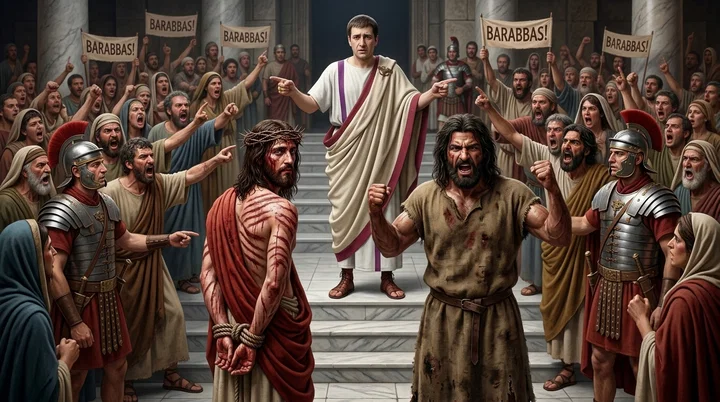
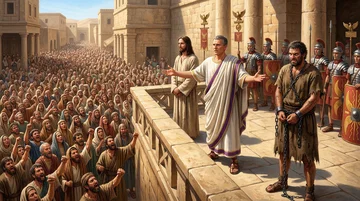
But the chief priests moved the people, that he should rather release Barabbas unto them.
Translations
American King James Version, Douay-Rheims (Challoner revision)
But the chief priests moved the people, that he should rather release Barabbas to them.
King James Version, KJV Cambridge Paragraph Bible
But the chief priests moved the people, that he should rather release Barabbas unto them.
But the chief priests moved the people that he should rather release Barabbas to them.
Revised Version, American Standard Version
But the chief priests stirred up the multitude, that he should rather release Barabbas unto them.
and the chief priests did move the multitude, that he might rather release Barabbas to them.
But the chief priests stirred up the crowd that he might rather release Barabbas to them.
But, the High-priests, stirred up the multitude, that, rather Barabbas, he should release unto them.
Berean Standard Bible, Majority Standard Bible
But the chief priests stirred up the crowd to have him release Barabbas to them instead.
But the chief priests stirred up the multitude, that he should release Barabbas to them instead.
But the people were moved by the chief priests to make him let Barabbas go free.
But the high Priestes had moued the people to desire that he would rather deliuer Barabbas vnto them.
Pictures
Cross-references
- Matthew 27:20-21
But the chief priests and elders persuaded the multitude that they should ask Barabbas, and destroy Jesus.
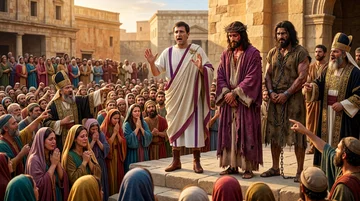
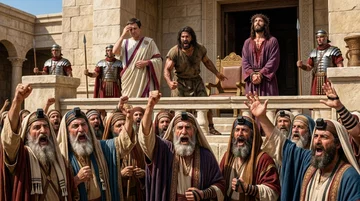
The chief priests persuade the crowd to choose Barabbas for release.
- Luke 23:18-25
And they cried out all at once, saying, Away with this man, and release unto us Barabbas:
The crowd demands Barabbas’s release instead of Jesus and calls for Jesus to be crucified.
- John 18:40
Then cried they all again, saying, Not this man, but Barabbas. Now Barabbas was a robber.
The crowd chooses Barabbas, identified as a robber, instead of Jesus.
- Luke 23:4
Then said Pilate to the chief priests and to the people, I find no fault in this man.
Pilate declares Jesus faultless amid the injustice of choosing Barabbas.
- John 19:1-16
Then Pilate therefore took Jesus, and scourged him.
Pilate finds no fault in Jesus while seeking to release him.
- Mark 15:7
And there was one named Barabbas, which lay bound with them that had made insurrection with him, who had committed murder in the insurrection.
Barabbas was bound for insurrection and murder.
- Mark 15:15
And so Pilate, willing to content the people, released Barabbas unto them, and delivered Jesus, when he had scourged him, to be crucified.
Jesus was scourged and delivered to crucifixion while Barabbas was released.
- Matthew 27:22
Pilate saith unto them, What shall I do then with Jesus which is called Christ? They all say unto him, Let him be crucified.
The people demand Jesus’ crucifixion at the priests’ urging.
- Luke 23:14-15
Said unto them, Ye have brought this man unto me, as one that perverteth the people: and, behold, I, having examined him before you, have found no fault in this man touching those things whereof ye accuse him:
Herod and Pilate find Jesus innocent, yet the people still demand his release be denied.
- Luke 23:21
But they cried, saying, Crucify him, crucify him.
The people cry out for Jesus to be crucified.
- Acts 3:14
But ye denied the Holy One and the Just, and desired a murderer to be granted unto you;
The people rejected Jesus and asked for a murderer to be released.
- Matthew 27:24
When Pilate saw that he could prevail nothing, but that rather a tumult was made, he took water, and washed his hands before the multitude, saying, I am innocent of the blood of this just person: see ye to it.
Pilate delivers Jesus and washes his hands to escape responsibility.
- John 19:6
When the chief priests therefore and officers saw him, they cried out, saying, Crucify him, crucify him. Pilate saith unto them, Take ye him, and crucify him: for I find no fault in him.
The stirred crowd demands that Jesus be crucified.
- Matthew 27:19
When he was set down on the judgment seat, his wife sent unto him, saying, Have thou nothing to do with that just man: for I have suffered many things this day in a dream because of him.
Pilate’s wife warns him that Jesus is a just man.
- John 19:5
Then came Jesus forth, wearing the crown of thorns, and the purple robe. And Pilate saith unto them, Behold the man!
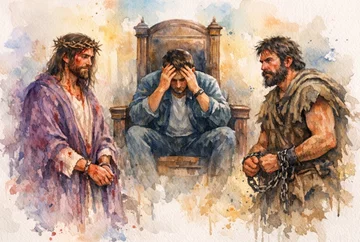
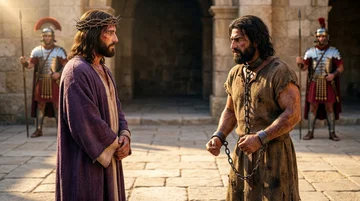
Pilate presents scourged Jesus beside Barabbas for pity
- John 18:19-28
The high priest then asked Jesus of his disciples, and of his doctrine.
Both recount events surrounding Jesus’ arrest and trial.
- Isaiah 53:3
He is despised and rejected of men; a man of sorrows, and acquainted with grief: and we hid as it were our faces from him; he was despised, and we esteemed him not.
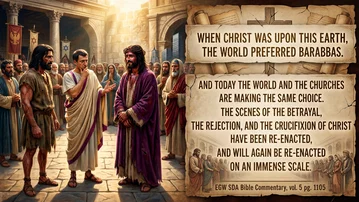
The people’s choice of Barabbas fulfills the prophecy of the Messiah being despised and rejected.
Commentary
Each commentary is drawn from primary sources: the writings of Ellen G. White and Adventist pioneers and periodicals. Each commentary is separate. Its own words are not a quotation; follow the references to read the source passages.
Ellen G. White
10 sources
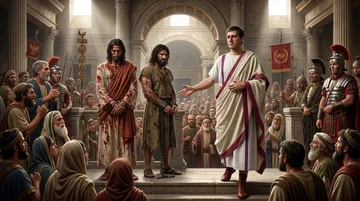
The scene is the judgment-hall of Pilate the Roman governor, where Jesus stands bound as a prisoner with a guard of Roman soldiers around Him and the hall fast filling with spectators, while just outside stand the judges of the Sanhedrin, priests, rulers, elders and the mob who after condemning Jesus have come to have Pilate confirm and execute the sentence but will not enter because they would be ceremonially defiled and kept from the Passover feast, while murderous hatred has defiled their hearts and because they have rejected Christ the real Passover Lamb the feast has lost its significance for them.DA 723.1–724.1 Pilate regarded Jesus as innocent and sought to release Him and save His life, even having Him scourged and mocked hoping to excite pity and satisfy priestly malice.ST Jun 3, 1889DA 735.1–5 He expected that the contrast between guilty, notorious Barabbas and the innocent Christ would lead the people to choose Jesus.Ms 112, 1897, par. 33–34
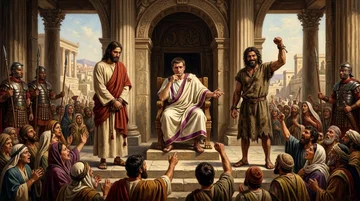
The chief priests were determined that Jesus should not be released, saw weakness in punishing a man declared innocent, knew Pilate was trying to save Him, and reasoned that pressing the matter to a decided issue would gain their end, acting from fanatical hatred toward Him who as the light of the world had exposed their darkness and error.DA 735.1–5 They stirred up, inflamed and moved the people, priests, rulers and mob to mad fury to demand that Barabbas be released unto them instead of Jesus and to raise the cry for the crucifixion of Jesus.ST Jun 3, 1889DA 735.1–5ST Jun 3, 188919MR 277.1–278.1Ms 112, 1897, par. 33–34 The priests started the cry and the mob took it up after they had inflamed the people against Jesus.ST Jun 3, 18894RED 102.2–103.1 The choice set gentle, suffering, innocent Jesus, the beloved Teacher and Son of God who made the world and all things in it, against hardened, guilty, notorious, murderous Barabbas, a ruffian, thief and murderer, and the contrast convicted beholders even as the people chose Barabbas.DA 735.1–516MR 259.3–260.119MR 277.1–278.1Ms 112, 1897, par. 33–34ST Jul 7, 1898
The verse shows Jesus in the hands of wicked men with His own nation clamoring for His blood, and the choice is part of His descent into humiliation approaching the cross alongside the crown of thorns, the purple robe, the mock bowing and striking with the reed, the scourging as the worst of criminals, and being lifted up on the cross dying as a malefactor.ST Jul 7, 1898 The crowd's demand for Barabbas and later call to crucify Jesus reveals how quickly public favor could turn against Him, and the disciples who had seen this fickleness were prepared not to base their faith on the crowd's approval.4RED 102.2–103.1 In the disciples' experience the choice centered on their beloved Teacher in whom they centered their hopes of eternal life and whom they thought was to take His place on David's throne, and witnessing His humiliation fulfilled His word that the Bridegroom would be taken away, giving them cause to mourn and fast, with their faith tried and their hope and courage failing.ST Jul 7, 1898
Barabbas represents Satan in character when set beside Christ, so choosing him expressed the people's rejection of Christ and their choice of Satan's rule.16MR 259.3–260.1Ms 39, 1894, par. 10 The choice shows what people may do when they are not under the control of God's Spirit, and it is repeated whenever people choose against Christ, with each person's choices showing whom they have chosen.16MR 259.3–260.119MR 277.1–278.1 The choice represents the spirit of those who will oppose Christ's followers in the coming crisis and serves as a picture of the deception near the end of time, when people who have rejected truth will again choose Barabbas and call for Christ to be crucified.19MR 277.1–278.1Ms 39, 1894, par. 10
Sources
Pioneers and periodicals
16 sources
The verse records that at the feast when Pilate customarily released whatever prisoner the multitude asked for, the chief priests stirred the people to demand Barabbas instead of Jesus after Pilate had offered to release the King of the Jews.ST Jun 3, 1889ST Jun 3, 1889ST May 25, 1904ST Mar 28, 1906 Barabbas was a notorious robber and murderer bound with insurrectionists, yet the priests moved the tumultuous crowd to prefer him to the innocent Lamb of God, who was then condemned to die between criminals.ST May 10, 1905ST Mar 13, 1901RH Jun 24, 1915RH Feb 27, 1872 Pilate and Herod both declared they found no fault in Jesus worthy of death, and Pilate repeatedly sought to release Him, but the crowd cried out together for Barabbas and then for crucifixion until their voices prevailed.ST Jun 15, 1904ST Mar 13, 1901ST Oct 27, 1898 That rejection fulfills that He was despised and rejected, and that the just suffered once for sins for the unjust to bring sinners to God.ST Jun 15, 1904RH Jun 24, 1858 The choice exposes the darkness of an apostate people who could not see an innocence clear even to a heathen judge, and its inconsistency in condemning Jesus for the same sedition of which Barabbas stood convicted, while it marked His descent into humiliation toward the cross.ST Jul 7, 1898ST Jun 15, 1904
Trial Setting and Choice
The chief priests stirred up the people to demand the release of Barabbas instead of Jesus, having first inflamed them against Jesus.ST Jun 3, 1889ST Jun 3, 1889ST Mar 28, 1906 The priests started the cry and the mob took it up, and the crowd followed their demand despite Pilate's regard for Jesus as innocent and his repeated efforts to show that innocence.ST Jun 3, 1889ST Jun 3, 1889ST Mar 28, 1906
The demand took place at the feast when Pilate customarily released one prisoner whom the people asked for.ST May 25, 1904 The multitude began asking him to do as he was wont to do, and Pilate answered by offering to release the King of the Jews, for he perceived that for envy the chief priests had delivered Jesus up, while Barabbas lay bound with insurrectionists who had committed murder in the insurrection.ST May 25, 1904 The account parallels the scene in Luke 23:13-24, where Pilate calls together the chief priests and rulers and people and declares that he and Herod found no fault in Jesus touching the accusations and nothing worthy of death.ST Mar 13, 1901 He proposes to chastise and release him, but the crowd cries out together for Barabbas, imprisoned for insurrection and murder, to be released instead, then shouts for crucifixion until their loud voices prevail and Pilate sentences that what they asked should be done.ST Mar 13, 1901
Barabbas was a robber, murderer, and notorious criminal bound with insurrectionists who had committed murder in the insurrection.ST May 25, 1904ST May 10, 1905ST Mar 13, 1901 He had sympathizers among influential Jews because of his insurrection, so the priests' appeal served their interests and helped turn the people against Jesus.ST May 10, 1905 The crowd's demand for him increased the pressure on Pilate to condemn Jesus.ST Mar 13, 1901 The robber was thus preferred to the innocent Lamb of God, who was then condemned to die between criminals.RH Jun 24, 1915 The people chose a man known to be a murderer over Jesus, though such a choice might once have seemed impossible.RH Feb 27, 1872
The priests moved the people by bribery and by the influence of their leaders at the Passover when Jerusalem was full of a tumultuous crowd.RH Jul 16, 1861 The treasure of the temple was used to bribe the people, and three parties combined against Jesus — the Herodians and Sadducees who hated the Nazarene and were impatient of the Roman yoke, the Pharisees who bitterly resented his three years of severe rebukes, and the reckless populace always ready to join sedition for gain.RH Jul 16, 1861 So the seditious rabble seized on Jesus and, trusting their leaders and believing Pilate winked at their sedition, kept shouting for his crucifixion after the council of the priests had condemned him to death.RH Jul 16, 1861 The verse belongs to the final scene of Jesus' life as he stood before Pilate and suffered the cruelty and folly of sin that led to his crucifixion.RH Jun 10, 1862 The surrounding events were foreshadowed by the belief that Barabbas could bring Israel deliverance from Roman rule and that the people might rally behind him.ST Oct 4, 1910
Prophecy Doctrine and Significance
The stirring of the people to demand Barabbas instead of Jesus was the despising and rejecting foretold in Isaiah 53:3, and comparing that fulfilled prediction with its fulfillment guides the understanding of unfulfilled prophecy.RH Jun 24, 1858 The trial before Pilate ending in unjust death, with the world's official declaration by Pilate that no fault was found in Him, fulfilled that the just suffered once for sins for the unjust to bring sinners to God.ST Jun 15, 1904 That rejection through moving the people to choose Barabbas exposed the apostate people of God as unable to see Christ's innocence that was clear even to the mind of a heathen judge, proving how great is the darkness when the light within is darkness.ST Jun 15, 1904
The act exposed insincerity and inconsistency, because Barabbas had been convicted of the same crime charged against Jesus and for which Jesus' death was demanded. It also exposed Pilate's inconsistency in placing a man he had declared innocent on a par with one who had been convicted and leaving the fate of the innocent to the choice of His avowed enemies. The choice presented the gospel in its perfection to great Rome, represented by Pilate, when in further malignity Barabbas was chosen over Jesus.ST Oct 27, 1898 That malignity would yield neither to law nor justice in the declarations of both Pilate and Herod that Jesus was innocent and worthy of no punishment, nor to pity at the sight of the scourged, beaten, bruised, bleeding Man.ST Oct 27, 1898
Jesus answered with no word of retaliation, unresentful and unresisting under every indignity and insult.ST Oct 27, 1898 Pilate finding no evidence of crime, Christ's dignified bearing unlike other criminals, Pilate's failed effort to turn Him over to Herod, and repeated efforts to release Him met with fresh outbursts of malignity convinced Pilate that before him stood One more than man and appealed to him to do right whatever the consequences, yet he remained undecided because he feared the Jews.ST Oct 27, 1898 The choosing of murderous Barabbas in place of their beloved Teacher, in whom the disciples centered their hopes of eternal life and whom they thought was to take His place on David's throne, with His own nation clamoring for His blood while He was in the hands of wicked men, was part of His descent into humiliation approaching the cross.ST Jul 7, 1898 That descent stood alongside the crown of thorns, the purple robe, the mock bowing and striking with the reed, the scourging as the worst of criminals, and being lifted up on the cross dying as a malefactor.ST Jul 7, 1898 Witnessing this fulfilled His word that the Bridegroom would be taken away, giving the disciples cause to mourn and fast, with their faith tried and their hope and courage failing.ST Jul 7, 1898
Sources