Matthew 27:21
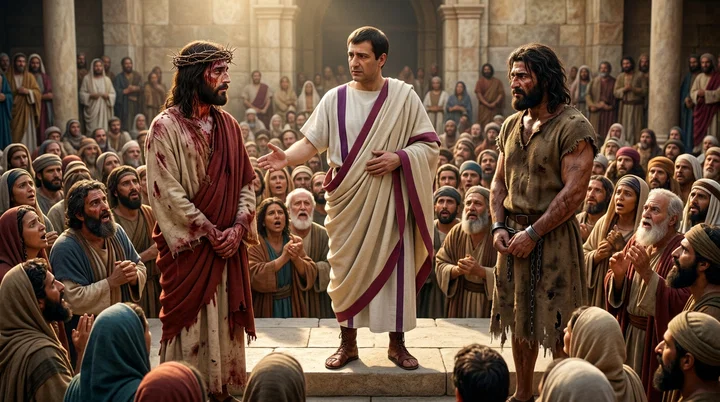
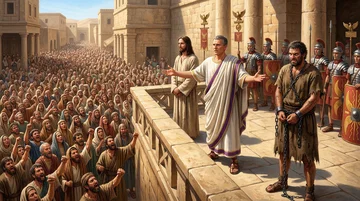
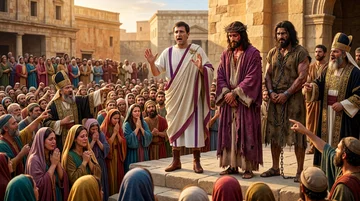
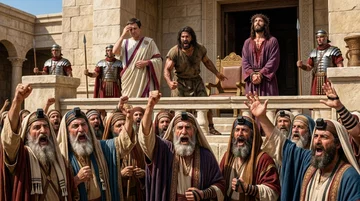
The governor answered and said unto them, Whether of the twain will ye that I release unto you? They said, Barabbas.
Translations
The governor answered and said to them, Whether of the two will you that I release to you? They said, Barabbas.
King James Version, KJV Cambridge Paragraph Bible
The governor answered and said unto them, Whether of the twain will ye that I release unto you? They said, Barabbas.
The governor answered and said to them, Which of the two will ye that I release to you? They said, Barabbas.
But the governor answered and said unto them, Whether of the twain will ye that I release unto you? And they said, Barabbas.
But the governor answered and said unto them, Which of the two will ye that I release unto you? And they said, Barabbas.
and the governor answering said to them, 'Which of the two will ye [that] I shall release to you?' And they said, 'Barabbas.'
And the governor answering said to them, Which of the two will ye that I release unto you? And they said, Barabbas.
Now the governor, answering, said unto them—Which of the two desire ye I should release unto you? And they said—Barabbas!
Berean Standard Bible, Majority Standard Bible
“ Which of the two do you want me to release to you?” asked the governor.“Barabbas,” they replied.
But the governor answered them, “ Which of the two do you want me to release to you?”They said, “Barabbas!”
But the ruler made answer and said to them, Which of the two is it your pleasure that I let go free? And they said, Barabbas.
Then the gouernour answered, and said vnto them, Whether of the twaine will ye that I let loose vnto you? And they said, Barabbas.
Douay-Rheims (Challoner revision)
And the governor answering, said to them: Whether will you of the two to be released unto you? But they said, Barabbas.
Pictures
Cross-references 20 of 22
- Luke 23:18-25
And they cried out all at once, saying, Away with this man, and release unto us Barabbas:
Records the crowd choosing Barabbas over Jesus and demanding Jesus’ crucifixion.
- John 18:39-40
But ye have a custom, that I should release unto you one at the passover: will ye therefore that I release unto you the King of the Jews?
Pilate offers Jesus for release, but the crowd chooses Barabbas.
- Mark 15:11-15
But the chief priests moved the people, that he should rather release Barabbas unto them.
The chief priests incite the crowd to choose Barabbas, and Pilate hands Jesus over to be crucified.
- John 19:15
But they cried out, Away with him, away with him, crucify him. Pilate saith unto them, Shall I crucify your King? The chief priests answered, We have no king but Cæsar.
The crowd rejects Jesus and demands his death, choosing Caesar over their King.
- Acts 3:14
But ye denied the Holy One and the Just, and desired a murderer to be granted unto you;
The people rejected Jesus and asked for a murderer to be released.
- Luke 23:19
( Who for a certain sedition made in the city, and for murder, was cast into prison.)
Identifies Barabbas as an insurrectionist and murderer imprisoned for his crimes.
- Matthew 27:25-26
Then answered all the people, and said, His blood be on us, and on our children.
The crowd’s choice leads to Jesus being handed over for crucifixion.
- Luke 23:4
Then said Pilate to the chief priests and to the people, I find no fault in this man.
Pilate declares that he finds no fault in Jesus.
- Luke 23:21
But they cried, saying, Crucify him, crucify him.
The crowd cries for Jesus to be crucified.
- Luke 23:16
I will therefore chastise him, and release him.
Pilate offers to chastise Jesus and release him.
- John 18:19-28
The high priest then asked Jesus of his disciples, and of his doctrine.
Describes events in Jesus’ trial before Pilate, including the choice involving Barabbas.
- Mark 15:9
But Pilate answered them, saying, Will ye that I release unto you the King of the Jews?
Pilate asks whom the crowd wants released.
- Mark 15:7
And there was one named Barabbas, which lay bound with them that had made insurrection with him, who had committed murder in the insurrection.
Identifies Barabbas as a murderer released instead of Christ.
- Matthew 27:15
Now at that feast the governor was wont to release unto the people a prisoner, whom they would.
gives Passover pardon custom Pilate used
- Mark 15:12
And Pilate answered and said again unto them, What will ye then that I shall do unto him whom ye call the King of the Jews?
Records Pilate’s follow-up question about Jesus.
- Mark 15:13
And they cried out again, Crucify him.
Records the crowd calling for Jesus’ crucifixion.
- Luke 23:15
No, nor yet Herod: for I sent you to him; and, lo, nothing worthy of death is done unto him.
Herod finds Jesus innocent, yet Jesus is rejected.
- John 18:37-38
Pilate therefore said unto him, Art thou a king then? Jesus answered, Thou sayest that I am a king. To this end was I born, and for this cause came I into the world, that I should bear witness unto the truth. Every one that is of the truth heareth my voice.
Pilate questions Jesus about truth before declaring him faultless.
- Isaiah 53:8-9
He was taken from prison and from judgment: and who shall declare his generation? for he was cut off out of the land of the living: for the transgression of my people was he stricken.
The prophecy is linked to Jesus’ condemnation and death.
- Acts 2:36-38
Therefore let all the house of Israel know assuredly, that God hath made that same Jesus, whom ye have crucified, both Lord and Christ.
Peter confronts the crowd with crucifying Jesus, prompting repentance and baptism.
Commentary
Each commentary is drawn from primary sources: the writings of Ellen G. White and Adventist pioneers and periodicals. Each commentary is separate. Its own words are not a quotation; follow the references to read the source passages.
Ellen G. White
38 sources
At the Passover feast Pilate asked the crowd whether he should release Jesus or Barabbas, following the custom of freeing one condemned prisoner.3SP 141.1–142.1RH Jan 23, 1900DA 735.1–5 He set the innocent Prince of life beside a notorious robber and murderer, hoping the open contrast between righteousness and guilt would move the people to choose Jesus.RH Jan 23, 190019MR 263.2–264.1Ms 112, 1897, par. 33–34 Pilate knew Jesus was guiltless and had been delivered for envy, yet he surrendered his judgment to the mob and gave Him up to be crucified.3SP 141.1–142.1RH Jan 23, 1900Ms 29, 1909, par. 12–17ST Jun 3, 1889 The chief priests and rulers, moved by envy and fear of losing place, stirred up the crowd to demand Barabbas and cry out for Christ's death.3SP 141.1–142.1RH Jan 23, 1900DA 735.1–5 That cry chose Satan the rebel and murderer before Christ the Truth, and the same choice faces every person today between receiving Christ unto life and rejecting His mercy unto wrath and final ruin.19MR 263.2–264.116MR 259.3–260.1Lt 20, 1902, par. 7–9Lt 31, 1898, par. 33–35
Passover Choice and Setting
At the feast it was the pagan and unjust custom to set free one prisoner condemned to death at the great national festival, and Pilate used it to try to save Jesus by asking the Passover crowd which of the two he should release, Jesus or Barabbas.3SP 141.1–142.1RH Jan 23, 1900Ms 112, 1897, par. 33–34 He set the true and innocent Christ, Jesus which is called Christ, side by side with the notable Barabbas, a notorious robber, thief and murderer, flattering himself that the open contrast between innocence and guilt, light and darkness, sin and righteousness, truth and falsehood would be so convincing that all could see it and be moved to pity and to choose Jesus of Nazareth.RH Jan 23, 1900DA 735.1–5Ms 112, 1897, par. 33–34 Barabbas stood in most striking contrast as a base and guilty criminal and wicked pretender to Christ who under satanic delusion claimed that whatever he could obtain by theft and robbery and murder was his own, who did wonderful things through satanic agencies, and who claimed religious power and the right to establish a different order of things and to set the world right.Ms 112, 1897, par. 33–34 Pilate already knew Jesus was innocent, that the charges were false and unsubstantiated, that the leaders had delivered Him for envy, and he had received added light through the dream sent to his wife and through inward conviction that even bound and accused His power was the power of God and not of a common man, yet in terrible conflict of soul he was too weak to obey it and do justice.3SP 141.1–142.1RH Jan 23, 1900ST Jun 3, 1889Ms 112, 1897, par. 33–34 The crowd, stirred up and instructed by the priests and rulers, with satanic madness refused the Lord of glory, the Prince of Life bearing the seal of heaven and full of goodness, mercy and truth, and demanded that Barabbas be released, thereby showing they preferred the society of a murderer to that of the sinless One, while envy and malice overpowered justice and bigotry and prejudice prevailed through Satan working through the religious leaders.3SP 141.1–142.1RH Jan 23, 1900ST Jun 3, 1889 By that appeal to the crowd Pilate surrendered his own judgment and weakened his authority.3SP 141.1–142.1
The question belongs to the trial in which Jesus, bound as a prisoner, was brought before Pilate while the Jewish leaders and a crowd pressed him to confirm and carry out the sentence against Jesus.Ms 29, 1909, par. 12–17DA 723.1–724.1 The Jewish priests and rulers pressed the Roman governor to do their will, choosing Barabbas, a robber and murderer, for release instead of Jesus, the Son of God who was going to the cross.ST May 17, 1899RH Nov 11, 1915 This choice formed part of the trial in which Jesus, though innocent, was condemned and rejected unto crucifixion, and in which Pilate failed to do justice.Ms 29, 1909, par. 12–17ST May 17, 1899
The people who had hailed Him as king now turned against Him, reviled Him, and were determined that He should not be released.DA 735.1–54RED 102.2–103.1 When Pilate presented Jesus and Barabbas and asked which prisoner they wanted, they demanded that Barabbas be released and that Jesus be crucified.DA 735.1–54RED 102.2–103.1 Satan stood at the head of those who reviled and crucified Christ and led the cruel mob in its abuse of the Saviour, putting Christ to open shame by cruel deeds witnessed by angels.Lt 132, 1910, par. 4–9 Pilate declared to the maddened throng that he found no fault in Christ, yet he delivered Him into their hands, and they crucified Him.DA 735.1–5Lt 132, 1910, par. 4–9
Jesus and Barabbas Contrasted
Barabbas was a notorious robber, thief and murderer, a base, guilty and hardened criminal set against Jesus when the choice of release was offered.3SP 141.1–142.1Lt 59a, 1895, par. 27–28Ms 78, 1893, par. 55–56Ms 56, 1894, par. 3–4 He was a wicked pretender to Christ who under satanic delusion claimed that whatever he could obtain by theft and robbery and murder was his own.3SP 141.1–142.1Ms 112, 1897, par. 33–34 He did wonderful things through satanic agencies, claimed religious power and the right to establish a different order of things and to set the world right.Ms 112, 1897, par. 33–34
Set against him was Jesus, the innocent, pure, holy and undefiled Prince of Heaven and Prince of Life.Lt 59a, 1895, par. 27–28RH Jan 23, 1900Ms 56, 1894, par. 3–4 He is the Son of God who made the world and all things therein, the world's Redeemer whose humanity bore the impress of the divine.Ms 78, 1893, par. 55–5616MR 259.3–260.1 He clothed His divinity in the garb of humanity, and He still wears that garb.21MR 349.6–350.3
Pilate set the true and innocent Christ side by side with Barabbas so that all could see the open contrast.RH Jan 23, 190019MR 263.2–264.1Ms 112, 1897, par. 33–34 That contrast was light against darkness, sin against righteousness, and truth against falsehood, with the Lord of glory full of goodness, mercy and truth standing against guilt.RH Jan 23, 1900 Pilate flattered himself that the difference between innocence and guilt would be so convincing as to move the people to pity and to choose Jesus of Nazareth.Ms 112, 1897, par. 33–34
Pilate Priests and Crowd
Pilate knew Jesus was innocent, that the charges against Him were false and unsubstantiated, and that the leaders had delivered Him for envy, and he had received added light through the dream sent to his wife and through inward conviction that even bound and accused His power was the power of God and not of a common man, yet in terrible conflict of soul he was too weak to obey that light and do justice.RH Jan 23, 1900ST Jun 3, 1889Ms 112, 1897, par. 33–34 By putting the question of release to the crowd he surrendered his own judgment and weakened his authority, and though he declared to the maddened throng that he found no fault in Christ he failed to do justice and delivered Him into their hands to be crucified.3SP 141.1–142.1Ms 29, 1909, par. 12–17Lt 132, 1910, par. 4–9 The customary release gave him an opportunity to free Jesus, but the opportunity was lost when he appealed to the people instead of acting on what he knew.3SP 141.1–142.1Ms 29, 1909, par. 12–17
The chief priests, elders, and rulers, instructed by Caiaphas, stirred up and instructed the mob to reject Jesus and demand Barabbas.3SP 141.1–142.1DA 735.1–5ST Jun 3, 1889Ms 56, 1894, par. 3–412MR 387.2–388.1 They acted from envy, malice, jealousy, bigotry, and prejudice, because He drew the attention of the people away from themselves, did greater works than they ever had done or could do, and might become higher in authority than they and become king of the Jews.3SP 141.1–142.1RH Jan 23, 1900SG3 174.2–176.1 Determined that Jesus should not be released, they prevailed upon the people despite Pilate's effort to move them to pity and despite his declaration that he found no fault in Him.DA 735.1–5ST Jun 3, 1889 Instructed by the priests and rabbis, the people rejected the innocent, pure, and undefiled Son of God and chose a guilty man over Him.RH Jan 23, 1900Ms 56, 1894, par. 3–4
To prevent His becoming king they seized Him privately, hired false witnesses to testify falsely against Him so they could condemn Him and put Him to death, and refused Him as king.SG3 174.2–176.1 With satanic madness and satanically impelled rage the crowd chose Barabbas, a murderer and thief, to be released instead of Christ, the world's Redeemer, thereby showing they preferred the society of a murderer to that of the sinless One.RH Jan 23, 1900Ms 78, 1893, par. 55–56Lt 132, 1910, par. 4–9 Their cry, Crucify Him, crucify Him, meant they would not accept Him as their king and thought that by taking His life they could prevent His becoming king, while Satan stood at the head of those who reviled Him and led the cruel mob in putting Him to open shame by deeds witnessed by angels.SG3 174.2–176.1Lt 132, 1910, par. 4–9 The same rejection of light that grieves God's Spirit is shown today by whether people obey the light they have received, revealing whether they would have joined those who called for His death.Ms 10, 1894, par. 24–25
Caiaphas wore the high priestly robes but had no vital connection with God, being uncircumcised in heart and without capacity or heavenly authority or light for the priestly work.12MR 387.2–388.1 With the tyrannous, deceptive, ambitious, and corrupt priesthood he proved unworthy of the office, so that the true Jewish high priesthood ended with him.12MR 387.2–388.1 In directing the choice of Barabbas and crying out for the crucifixion of Christ the priests acted as representatives of the Jewish nation, placed themselves under the despised Roman jurisdiction, and by declaring submission to Caesar cut themselves off from God as His church.12MR 387.2–388.1
Choice Between Christ and Satan
The judgment-hall cry for Barabbas was the final choice between Christ, the Truth, and Satan, the rebel, robber, apostate, liar, and murderer.16MR 259.3–260.1Ms 39, 1894, par. 10 Barabbas stood for Satan personified and represented him in character, so the roaring demand to release Barabbas chose Satan before Christ and exalted Satan over the Son of God who made the world and all things therein.16MR 259.3–260.1Ms 39, 1894, par. 10 That choosing was a yoking up with Satan, and to those with true religion Satan appeared linked with the men who triumphantly shouted blasphemy against Christ as He bore the insults of Satan and his agencies.Ms 106, 1897, par. 5
Choosing Barabbas expressed rejection of Christ in His holy character, of heaven's light when presented, of the message of mercy concerning God's commandments and the faith of Jesus, and of the only provision for cleansing from sin.Ms 39, 1894, par. 10 Refusing the light brings deception, darkness, and rebellion, and choosing Satan's falsehoods aligns people with the chief liar and the disloyal and turns them away from the Son of God. The same rejection is repeated whenever people reject Christ and choose another leader, betraying Him in the person of His saints, and near the end of the world those who reject truth will again cry for Barabbas and demand Christ's crucifixion.Ms 39, 1894, par. 11–12
The rulers' decisive choice to have Barabbas instead of Christ fixed their character for life and exposed hearts needing the molding of the Spirit of God.12MR 411.3–4 It revealed selfishness, fraud, discontent, unholy passions, and hypocrisy cloaked by religious dress and ceremony that contradicted the Passover rites they kept, while they deceived the people by an outward appearance of sanctity and reviled One who came from heaven to save a perishing world, in whose heart zeal for right and justice and for the glory of God was the highest object, who was Commander of all heaven.12MR 411.3–4Ms 106, 1897, par. 5 Their choice gave evidence that profession of piety and of love for God, and claim to know the Scriptures, neither made them sons of God nor led them to represent His character.12MR 411.3–4Ms 106, 1897, par. 5
The choice preferred a thief and murderer though no fault could be found in Christ, and it represented rejecting His rule and discouraging the Father's purpose despite the boundless gift of salvation offered.Lt 31, 1898, par. 33–35Ms 28, 1897, par. 46–48 Those who reject His mercy face God's wrath, while those who receive and believe in Him have hope and eternal life.Lt 31, 1898, par. 33–35 At the final judgment those who cast Him out and chose another in His place must answer for it.
Repeated Choice and Consequences
The same decision set before the crowd still faces every person today, the choice between the side of the rabble and the side of those faithful to Christ, between Christ and the apostate and opposing power, between having the Man Christ Jesus for King and having Barabbas for king.19MR 263.2–264.116MR 259.3–260.1Lt 20, 1902, par. 7–9Lt 23, 1896, par. 25–27 It is made by the power of the will in the few years left to give proof, by sanctifying the will to God, accepting His invitation without delay, obeying known truth, and receiving pardon, or by refusing the invitation, clinging to habits, resisting truth, accepting what suits one's own ideas, hardening the heart, and continuing in disobedience.Lt 20, 1902, par. 7–9Lt 23, 1896, par. 25–27Ms 13, 1897, par. 5 A person's course of action and daily life shows whom he has chosen, saying in effect Barabbas, Barabbas, and crucify Him, and carries solemn responsibility and accountability to God for encouraging transgression by example.19MR 263.2–264.116MR 259.3–260.1Ms 13, 1897, par. 5Lt 93, 1893, par. 18–19 The choice reveals the spirit of man and what humanity will do when not under the control of the Spirit of God, as men inspired of Satan standing under the black banner of the powers of darkness.Lt 59a, 1895, par. 27–28 Those who resist God's Spirit become spiritually blind to reject truth and choose evil over Christ, and that same blindness comes when the Word of Life is overlooked and the Scriptures are not searched, when precious truth that would elevate, sanctify, refine, and fit for immortality is set aside for novels, stories, imagination, and trifles, leaving men weighed in the balances and found wanting.Ms 28, 1897, par. 30–34Ms 1, 1869, par. 10–12
The choice is repeated whenever people reject Christ and choose another leader, betraying Him in the person of His saints. Those who reject light and grieve God's Spirit bring deception, darkness, and rebellion upon themselves, and show by whether they obey the light they have received whether they would have joined those who called for His death.Ms 10, 1894, par. 24–25 Near the end of the world and in the great crisis and final test before us, people who reject truth will again cry for Barabbas and demand Christ's crucifixion, for Barabbas in character represented Satan and choosing him expressed rejection of Christ in His holy character and preference for Satan's way.Ms 39, 1894, par. 11–12Ms 39, 1894, par. 10 Their choice determines destiny.Lt 93, 1893, par. 18–19 The cruelty of that coming crisis could not have been comprehended beforehand, so greater faith is needed to stand the test and trial ahead, with prayer for the Lord to increase faith.Lt 59a, 1895, par. 27–28
The disappointment of worldly hopes and the sight of the beloved Teacher condemned while the murderous Barabbas was preferred grieved the disciples and tried their faith and hope, yet Jesus had prepared His true disciples through earlier tests and while still with them strengthened their faith for the trial of His condemnation and crucifixion.DA 394.2–3ST Jul 7, 1898 By refusing God's way Jerusalem's people brought humiliation upon themselves; God left them to the choice they had made, permitted them to carry out their rebellious purposes and follow the purposes of their unsanctified hearts, withdrew His Spirit and heaven's protection, and Jerusalem was humiliated and brought low.RH Oct 8, 1901Lt 98, 1900, par. 31–33 The people's sentence against Christ was connected with the later doom that came upon them, for at Jerusalem's destruction many were crucified and crosses stood thickly around Calvary.DA 840.5 That warning points also to the world's destruction, because people will continue to refuse God's mercy until the end of earth's history.Lt 98, 1900, par. 31–33
The rulers' decisive choice fixed their character for life and exposed hearts needing the molding of the Spirit, with selfishness, fraud, discontent, unholy passions, and hypocrisy cloaked by religious dress and ceremony contradicting the Passover they kept.12MR 411.3–4 Joined to the cries to crucify Christ and to take His blood upon themselves and their children, it brought real guilt and curse upon them, torturing their hearts with the blight of God's curse, though Christ never spurns the true penitent but hates hypocrisy covered by religion.12MR 411.3–4 When judgment reveals the meaning of the cross, rejection of heaven's light and of the only provision for cleansing from sin will be seen as a choice for Barabbas instead of the Prince of Peace. At the final judgment, when compelled to look upon Him and when accumulated guilt is laid bare, those who slighted His love and abused His compassion by choosing a robber and murderer in His stead will remember the choice with indescribable confusion, the scales falling from their eyes to see what they might have been had they received Christ and improved their opportunities, with His self-denial and great humiliation, His suffering in Gethsemane and in the judgment hall, His condemnation and scourging while pronounced innocent, His crowning with thorns and crucifixion, the taunts of priests and rulers, and every tone of entreaty and every act of insult and mockery standing as fresh in memory as when done, and must answer for casting Him out and choosing another in His place.Lt 59a, 1895, par. 27–28RH Jun 18, 190121MR 349.6–350.3
Sources
Pioneers and periodicals
65 sources
Pilate formally put the Passover choice of prisoners to the crowd, asking which of the two they wanted released, and they answered Barabbas.ST May 19, 1898ST May 19, 1898ST Nov 9, 1882 Barabbas was a robber, murderer and insurrectionist, while Jesus stood beside him innocent, harmless and worthy of no death as the Prince of Life.RH Jan 23, 1900ST Mar 28, 1906ST Aug 17, 1904 The chief priests and elders persuaded the multitude to ask for Barabbas and destroy Jesus, and Pilate, though repeatedly declaring Jesus innocent and knowing he was delivered for envy, compromised from fear for his position and left the decision to the crowd.ST Jun 3, 1889ST May 19, 1898ST Oct 27, 1898ST Apr 29, 1897ST Jun 26, 1893 That choosing of a thief and murderer instead of the Son of God exposed the principles of Satan's rule, allowing evil to reveal its character in the great controversy between good and evil. The same choice stands before every person and nation between Christ and evil, to choose Christ rather than follow the multitude, for those who slight his love by choosing Barabbas will at the final judgment see with confusion what they might have been had they received him.RH Jun 18, 1901ST Mar 28, 1906ST Mar 5, 1894
Trial Setting Described
Pilate formally asked the crowd, under the Passover custom of releasing a prisoner, which of the two prisoners they wanted released, and they answered Barabbas.ST May 19, 1898ST May 19, 1898ST Nov 9, 1882ST Mar 13, 1901 This was one of his attempts to persuade them to release Jesus, and in it he tried to shift the responsibility for releasing Jesus onto the priests and rulers by getting them to consent to His pardon.ST Nov 9, 1882ST Mar 13, 1901 The answer came after the chief priests and elders had persuaded and stirred the people to reject Jesus.ST May 19, 1898ST May 19, 1898 His wavering had already strengthened the Jews to press their case with greater urgency, and this effort to throw off responsibility only made his burden heavier and opened the way to their further demand for death by crucifixion and to his compromising offer to chastise Jesus and then release Him.ST Mar 13, 1901
He had examined Jesus before His accusers and found no fault touching what they accused Him of, and Herod had sent Him back having found nothing worthy of death.ST Mar 13, 1901ST Oct 27, 1898 He repeatedly declared Jesus innocent, desired to release Him, proposed to chastise Him and release Him, spoke again to that end, and a third time asked what evil He had done.ST Mar 13, 1901RH Jun 15, 1911 The choice of Barabbas yielded neither to law nor justice in the declarations of both Pilate and Herod that Jesus was innocent, nor to pity at the sight of the scourged, beaten, bruised and bleeding Man.ST Oct 27, 1898 By putting an innocent man on a level with a convicted man and leaving His fate to the choice of His avowed enemies, Pilate acted inconsistently.
They cried out all together, Away with this Man, demanded Barabbas, who had been cast into prison for insurrection made in the city and for murder, and shouted for crucifixion.ST Mar 13, 1901 They were instant with loud voices asking that He might be crucified, and their voices prevailed, and Pilate gave sentence that what they asked should be done.ST Mar 13, 1901RH Jun 15, 1911 He condemned Christ because he feared the mob stirred up by the priests, and the crowd's choice amid loud pressure was part of the public pressure that led to the crucifixion despite repeated declarations of innocence.RH Jun 15, 1911ST Jun 26, 1893ST May 10, 1910
The choice belongs to the historically accurate account of Christ brought to Pontius Pilate, governor of Judea at that time, whose sentence was necessary before execution could proceed because power of life and death was vested in the Roman governor.RH Feb 11, 1862 The surrounding details of derision of the condemned, scourging before crucifixion, writing the accusation and affixing it to the instrument of punishment in three languages, bearing the cross, and giving the body for burial at the request of friends match the customary law and practice of that period.RH Feb 11, 1862 This minute accuracy about customs, opinions, political events and circumstances, with natural consistency in subordinate details without forced introduction, gives evidence for the truth of the main story of trial, execution and burial.RH Feb 11, 1862
The scene stands in the Roman hall at Pilate's judgment seat and bar and at Herod's judgment seat, where Jew and Gentile joined together in hatred against Him and chose Barabbas to be released instead of Him.RH Nov 12, 1872RH Jun 10, 1862 There He stood mocked and beaten, crowned and wounded, bearing bitter sarcasm, cruel jest, buffet, spitting, the crown of thorns and the old purple robe before the final tragedy of the crucifixion.RH Nov 12, 1872RH Jun 10, 1862 It shows the cruelty, madness and folly of sin and of the master whom the world serves, to be pondered in solemn, tearful mood.RH Jun 10, 1862
Prisoners Contrasted Sharply
Barabbas was a robber and murderer, a convicted insurrectionist and desperado held in prison for insurrection made in the city and for murder.ST Mar 28, 1906ST Aug 17, 1904 He had been arrested as a ringleader in a disturbance, and is identified as Joseph Barabbas.ST Feb 16, 1882 His aim to restore Israel reflected the hope for political deliverance.ST Oct 4, 1910
Set against him stood Jesus, innocent, harmless, and guilty of no crime worthy of death.ST Mar 28, 1906ST Aug 17, 1904 Only a few days before he had been highly honored by the very same people who now called for his rival.ST Aug 17, 1904 He stood there as the Prince of Life bearing the seal of heaven, the Son of God and the innocent Lamb of God going to the cross.RH Jan 23, 1900RH Jun 24, 1915
Placed side by side, the two stood in open contrast between light and darkness, sin and righteousness, truth and falsehood.RH Jan 23, 1900 Jesus’ noble character contrasted with Barabbas’s hardened criminality.ST Oct 7, 1886 His courage was joined with gentleness, innocence and peace rather than anger or pride, and he remained composed in self-possession under indignity, exemplifying calm repose as a steady mind sustained by faith and loving confidence in the Father.RH May 5, 1863ST Jul 29, 1886 He met that choice with no word of retaliation, unresentful and unresisting under every indignity and insult.ST Oct 27, 1898
Thus a murderer was saved while the Prince of Life was condemned to die.ST Oct 11, 1899 Jesus was hung between two criminals, having willingly gone to suffering so that even his foes might be freed.ST Oct 11, 1899RH Jun 24, 1915
Leaders and Crowd Deciding
When the governor asked which of the two prisoners should be released, the crowd answered Barabbas, because the chief priests and elders had persuaded, stirred and incited the multitude to ask for Barabbas and destroy Jesus, to reject Jesus and clamor for his blood.ST Jun 3, 1889ST May 19, 1898ST May 19, 1898ST Aug 17, 1904RH Oct 14, 1862 Pilate gave the multitude the choice between Jesus and Barabbas, expecting the people to choose the innocent One, but persuaded by the priests they demanded that Barabbas be released.ST Jun 3, 1889ST Aug 17, 1904 Jesus was harmless and innocent and had been highly honored by the same people only a few days before, while Barabbas was a convicted insurrectionist, murderer, robber and desperado, yet they chose Barabbas.ST Aug 17, 1904
The priests delivered Jesus to Pilate and sought Barabbas from envy of his influence among the people seen in the great ovation a few days before, while secretly sympathizing with Barabbas and his constant uprising against the Roman government.ST Jun 16, 1898 They dishonestly and perfidiously incited the people to ask for Barabbas and demand Christ for crucifixion, thereby becoming actively criminal and responsible for the crime as those who fired the mind of the perpetrators.ST Sep 22, 1898 They were actuated by bigotry, which produced hatred of religious innovation and bitter opposition to any interference with their immemorial institutions, and by cupidity, which produced violent opposition from fear of losing their prestige and the perquisites of their religio-official positions, because Christ as mediator between God and man robbed them of their distinctive and exclusive function.ST Sep 22, 1898 They showed insincerity by repudiating Christ prematurely and maliciously refusing to use their superior wisdom to reconcile Christ with prophecy.ST Sep 22, 1898
The malignant choice of the Jews in choosing Barabbas over Jesus yielded neither to law nor justice in the declarations of both Pilate and Herod that Jesus was innocent, nor to pity at the sight of the scourged, beaten, bruised and bleeding man.ST Oct 27, 1898 It was inconsistent satanic fury, persecuting Jesus for alleged designs against the government while favoring Barabbas who was really guilty of such designs.ST Jun 16, 1898 They chose Barabbas and rejected Jesus because they were acting out the natural carnal mind that is enmity against God after resisting the Spirit of God, and in reality because Jesus' deeds were righteous and their own were evil, in this acting the part of Cain.ST Jun 16, 1898 Jesus met that choice with no word of retaliation, unresentful and unresisting under every indignity and insult.ST Oct 27, 1898
Stubborn unbelief led the people to choose the murderer Barabbas over Jesus and to demand Jesus' crucifixion, and their preference for a murderer and rejection of the innocent Saviour reveal how sin deepens impenitence and turns people against Christ.RH Apr 16, 1867 Stirred by the priests, they chose Barabbas and clamored for Jesus' blood in the judgment hall, in a determined rebellion against Christ that persisted among the Jews.RH Oct 14, 1862 Their abundant but false religion helped bring about the crucifixion of Jesus.RH Jul 10, 1860 The religious leaders and influential people opposed Jesus, while only a few, including fishermen and people of low status, received him, so the opposition of respected leaders did not disprove his claims.RH Sep 15, 1868
The condemnation came from people who professed to be looking for the Messiah and had been entrusted with the prophecies that were minutely fulfilled in him.ST Jun 9, 1898 The Jewish council used threats and intimidation to obtain the Roman governor's sanction for an unjust trial of an innocent man.ST Jun 9, 1898 The Pharisees who chose Barabbas and rejected Christ, thus murdering Christ, were strict to wear texts of God's word in conspicuous places on their persons, but that outward display did not make them any better and did not keep them from murdering Christ.RH Nov 5, 1901 Mentioning God or displaying his word does not by itself make a person or thing good, and omitting mention of God does not by itself make a person or thing bad.RH Nov 5, 1901
Pilate's Failure Examined
Pilate already knew the charges against Jesus were false and unsubstantiated, and that the leaders had delivered Him for envy, and he had received added light through the dream sent to his wife, yet he was too weak to obey it and do justice.RH Jan 23, 1900ST Jun 3, 1889ST Oct 27, 1898 The setting of Jesus which is called Christ before the Passover crowd beside Barabbas, a robber and murderer, was part of God's presentation of the gospel in its glorious perfection to great Rome in the person of Christ, to convince Pilate that One more than man stood before him and to appeal to him to do right whatever the consequences.RH Jan 23, 1900ST Oct 27, 1898 Pilate was convinced, yet he remained undecided because he feared the Jews.RH Jan 23, 1900ST Oct 27, 1898
His wavering had already strengthened the Jews to press their case with greater urgency, and his effort to throw off responsibility by getting the priests and rulers to consent to a Passover pardon under the custom of releasing a prisoner only made his burden heavier and the situation more difficult.ST Mar 13, 1901 He had Jesus scourged, hoping the sight of His suffering would satisfy the crowd and move them to pity.ST Oct 7, 1886 That answer rejecting Jesus' release and demanding Barabbas instead revealed the people's choice of a noted criminal charged with insurrection and murder over the innocent Prisoner, and it opened the way to their further demand for Jesus' death by crucifixion and to the compromising offer to chastise Jesus and then release Him.ST Oct 7, 1886ST Mar 13, 1901
Pilate compromised with evil instead of deciding for the right in the now, setting Jesus, the Innocent and Righteous One, against Barabbas the murderer and leaving the choice to the multitude.ST Apr 29, 1897 He did this from fear of the people and fear of the mob stirred up by the priests, and from fear for his position, influence, wealth, honor, and standing before Caesar, choosing policy and expediency over principle and yielding to fear and pressure rather than standing by the Truth before him though finding no fault in Him.ST Apr 29, 1897ST Jun 26, 1893RH Sep 28, 1911 In that moment of compromise he bartered away principle, character, and eternal life, and he also lost the very influence over the people he hoped to strengthen.ST Apr 29, 1897 No one can wash his hands of evil without standing positively against it, the greater guilt of others does not clear personal guilt, and only standing without respect to others in the sight of God allows Christ to wash heart and hand free from sin.ST Apr 29, 1897
The choice takes place as the priests and elders call for Jesus to be crucified, connected with Pilate's wife's plea to spare the innocent Jesus.ST Oct 27, 1898 Pilate's failure to protect Him leads to the guilt and curse associated with His death.ST Oct 27, 1898
Prophecy and Time Fulfilled
The choosing of Barabbas stands as the fulfillment of Isaiah 53:8, the taking away of the suffering servant in judgment.RH Jun 24, 1858 It belongs to the day Christ was condemned by Pilate and crucified, the day He gave His life for humanity.RH Feb 13, 1872 That day is recorded in Matthew 27 as His crucifixion at the last Passover He attended.ST Dec 23, 1897 That Passover is dated to A.D. 31, and so anchors the reckoning of the length and timing of His ministry.ST Dec 23, 1897
His crucifixion was the great sacrifice for the sins of humanity. It occurred in the middle of the seventieth week. By that death the sacrificial system was brought to an end.
Gospel Truth Revealed
The cry for Barabbas the thief and murderer instead of Christ the Son of God, and the release of Barabbas with the handing over of Jesus to be crucified, laid bare the principles of Satan's rule. In the great controversy between good and evil, such evil was permitted to reveal its character, so that the heavenly universe and humanity could see the righteousness of God's purposes.
The judgment-hall scene stands as the final choice between Christ, the Truth, and Satan, the rebel, robber, apostate and murderer. It is the choice between rejecting the message of mercy concerning God's commandments and the faith of Jesus, and accepting the truth as it is in Jesus, for to choose Satan's falsehoods is to align with the chief liar and the disloyal and to turn away from the Son of God. That choice between Barabbas and Jesus is darkness and light, error and truth, human tradition and God's word, Babylon and Zion, Antichrist and Christ.ST Mar 5, 1894 Choosing the murderer because they were themselves murderers, proud, haughty and covetous, doing works to be seen of men and devouring widows' houses, proved the nation then belonged to Babylon and could be claimed by Babylon as her subjects, being in spiritual Babylon because their life comported with the Babylonian rather than the God-given standard, serving the Babylonian prince Satan in opposition to God as his children possessed by unclean demons while few were possessed by the Spirit of God.ST Apr 30, 1896
The verse belongs to Christ's suffering, whose example subdues pride and discontent.ST Apr 17, 1879 Arraigned before the governor while the crowd chose Barabbas for release, Jesus was rejected and suffered unjustly, giving an example in bearing shame and loss.RH Mar 26, 1861 Following Christ therefore means faithfully bearing the cross through suffering and unjust judgment, rather than measuring Christian perfection by extraordinary spiritual experiences.RH Jul 30, 1867RH Aug 14, 1860 In the judgment hall He remained composed while the crowd chose Barabbas, and that self-possession exemplifies calm repose in God amid turmoil, showing that Christian repose is not inaction but a steady mind sustained by faith and loving confidence in the Father.ST Jul 29, 1886 The scene before Pilate is thus an image of His humility.RH Dec 21, 1911
That scene at Pilate's judgment hall marks the contrast between stopping short of death and complete consecration.ST Sep 12, 1900 An offering merely bruised and released could picture going with Jesus to Gethsemane and Pilate's hall, but only an offering whose blood was shed and whose flesh was consumed could picture going with Him to Calvary, since shedding of blood means giving of life, without which there is no remission, and the sacrificial offering represents the one who offers it.ST Sep 12, 1900
Placed beside Barabbas the robber and murderer, who was chosen before the Son of God amid a cry inspired by priests and rulers sounding like the bellowing of wild beasts, Jesus endured a foreseen humiliation.ST Mar 26, 1912 He foresaw it when the Greeks came seeking Him, knowing they would soon see Him in a position they did not then dream of while He stood in the shadow of the cross.ST Mar 26, 1912 That rejection was part of His propitiation for man's sins, by which all who accept Him are brought into perfect harmony with God.ST Mar 26, 1912 It also made the disciples witness their beloved Teacher condemned while the murderous Barabbas was preferred in His place, a grief and a trial of their faith and hope.ST Jul 7, 1898
Choice Repeated Today
The cry for Barabbas was the decisive choice between Christ and evil, and every person and every nation must make that same choice, a choice which once made cannot be reversed.ST Mar 28, 1906 The lesson is to choose Christ the Son of God rather than Barabbas the son of Abbas, to choose Jesus rather than follow the multitude, for the alternatives are darkness and light, error and truth, human tradition and God's word, Babylon and Zion, Antichrist and Christ.ST Mar 28, 1906ST Mar 5, 1894 That choice is repeated whenever light from heaven is presented and men reject Christ and choose another leader in His place. Refusing light brings deception, darkness and rebellion, and those who reject the truth reject Christ and the only provision for cleansing from sin, betray Him in the person of His saints, and at the final judgment must answer for casting Him out and choosing another.
Barabbas the robber and murderer stands for Satan the leader of rebellion against God, so to honor Satan by exalting the spurious sabbath is to choose Barabbas over Christ.ST Mar 12, 1894 The same parallel condemns choosing the first day of the week instead of the Lord's seventh-day Sabbath.RH Feb 14, 1854 The misleading of the people by the chief priests and elders to reject the light given in Jesus and take Barabbas was a smaller rejection than the present rejection by Protestant churches that oppose God's holy law and the testimony of Old and New Testaments concerning fulfilled prophecy, that cover with error and confusion the truths expressly made known for the last perilous days, and that warn against those spreading these truths as heresy and fanaticism.RH Jun 13, 1865
In the events around the cry, religious leaders used alliance with Roman civil power to condemn Jesus to death because He rejected their traditions made into civil law, the Jewish priests and rulers pressing the Roman governor to do their will.RH Nov 11, 1915 This shows how a church joined to the state can use state power against dissenters even against God, with civil government drawn into a religious judgment about sin and compelled to execute Christ.ST Oct 9, 1907 The same spirit continues when men oppose the cause of Jesus and religious professors spread lies and slander against those preaching present truth.RH Mar 15, 1860 The world's preferring its foes to its best friends and rejecting good men and reform, and the people's rejecting God's messenger in the present truth of their time, prove that popular opinion can be gravely wrong in religion and is no guide to truth.RH Jul 2, 1861ST Jul 4, 1878RH Apr 14, 1874
Jesus on trial sets the same choice now before every reader between the word of God and human conclusions, with the Bible on trial in the house of its friends where each must witness for it or against it.ST Jul 15, 1908 Pilate set himself against the Rock of the word, and his name with Nimrod, the Pharaohs, Sennacherib, Agag, Belshazzar, Alexander, Antiochus, Herod, Judas Iscariot, Nero and others is written in black characters of hopeless doom and lives only in infamy, remembered only for opposition to truth, while the men are dead and the Rock stands.ST Jul 15, 1908 Choosing Barabbas rather than Christ also illustrates the choice between Christ and a religious movement that excludes Him through enforced religion of works, recurring before Christ's second advent in whether to follow Christ or the federation movement.ST Jul 21, 1914 Jerusalem's rejecting Christ and choosing Barabbas represents rejecting God's way for a human alternative, standing as a sign of the failure of earthly, fleshly hopes.ST Apr 11, 1900
Judgment and Consequences Warned
The choosing of Barabbas instead of Christ shows what rejection of Christ truly is, a choice for Barabbas instead of the Prince of Peace that will be fully seen when judgment reveals the meaning of the cross.RH Jun 18, 1901 Sinners slight His love and abuse His compassion by choosing in His stead Barabbas, a robber and murderer.RH Jun 18, 1901 At the final judgment, when the accumulated guilt of the world is laid bare, those who pierced Him will remember that choice with indescribable confusion.RH Jun 18, 1901 Then the scales will fall from their eyes to see what they might have been had they received Christ and improved their opportunities, with every tone of His entreaty and every act of insult and mockery standing as fresh in memory as when done.RH Jun 18, 1901
Jerusalem's people by choosing Barabbas and refusing God's way brought humiliation upon themselves.RH Oct 8, 1901 God left them to the choice they had made and permitted them to carry out their rebellious purposes.RH Oct 8, 1901 Their rejection of His mercy led to the withdrawal of His Spirit and protection, illustrating the result of disobedience.RH Oct 8, 1901 They came to feel Barabbas's cruelty, and their rejection of the Son of God preceded the destruction of Jerusalem by the Romans.RH Oct 8, 1901ST Aug 18, 1909
The crowd's choosing of Barabbas when asked which of the two prisoners should be released forms part of the condemnation and delivery of Jesus to crucifixion despite His judge declaring Him innocent.RH Nov 18, 1862 It was the crowd choosing Barabbas, a robber and murderer, for release instead of Jesus the Son of God, and that choice belonged to their rejection of Christ and led to His crucifixion.ST May 17, 1899RH Nov 18, 1862
Sources