Matthew 27:17
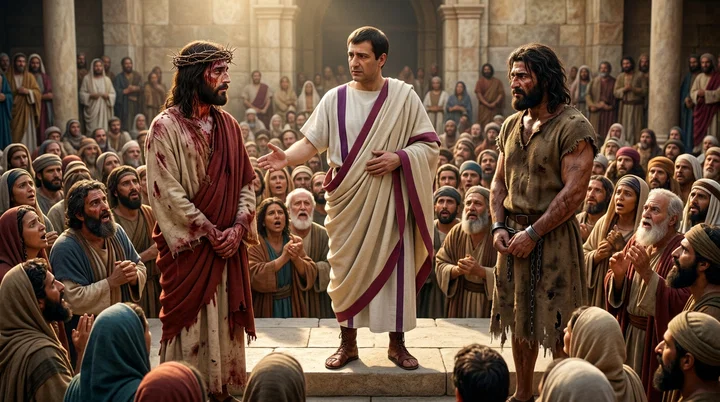
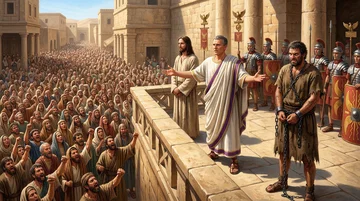
Therefore when they were gathered together, Pilate said unto them, Whom will ye that I release unto you? Barabbas, or Jesus which is called Christ?
Translations
Therefore when they were gathered together, Pilate said to them, Whom will you that I release to you? Barabbas, or Jesus which is called Christ?
King James Version, KJV Cambridge Paragraph Bible
Therefore when they were gathered together, Pilate said unto them, Whom will ye that I release unto you? Barabbas, or Jesus which is called Christ?
Therefore when they were assembled, Pilate said to them, Whom will ye that I release to you? Barabbas, or Jesus, who is called Christ?
When therefore they were gathered together, Pilate said unto them, Whom will ye that I release unto you? Barabbas, or Jesus which is called Christ?
When therefore they were gathered together, Pilate said unto them, Whom will ye that I release unto you? Barabbas, or Jesus who is called Christ?
they therefore having been gathered together, Pilate said to them, 'Whom will ye I shall release to you? Barabbas or Jesus who is called Christ?'
They therefore being gathered together, Pilate said to them, Whom will ye that I release to you, Barabbas, or Jesus who is called Christ?
They therefore having come together, Pilate, said to them—Whom will ye I should release unto you? Barabbas? or Jesus, who is called Christ?
Berean Standard Bible, Majority Standard Bible
So when the crowd had assembled, Pilate asked them, “ Which one do you want me to release to you: Barabbas, or Jesus who is called Christ?”
When therefore they were gathered together, Pilate said to them, “ Whom do you want me to release to you? Barabbas, or Jesus who is called Christ?”
So when they came together, Pilate said to them, Whom will you have? Barabbas, or Jesus, who is named Christ?
When they were then gathered together, Pilate said vnto the, Whether will ye that I let loose vnto you Barabbas, or Iesus which is called Christ?
Douay-Rheims (Challoner revision)
They therefore being gathered together, Pilate said: Whom will you that I release to you, Barabbas, or Jesus that is called Christ?
Pictures
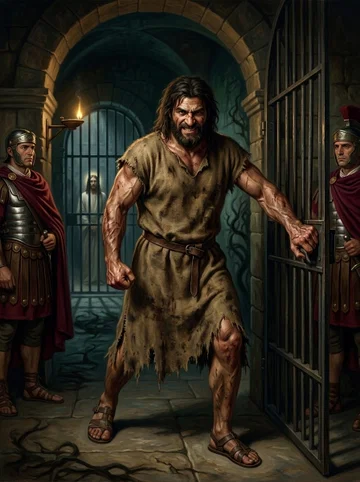
Cross-references 20 of 33
- Luke 23:18-25
And they cried out all at once, saying, Away with this man, and release unto us Barabbas:
The crowd demands Barabbas’s release and Jesus’ crucifixion.
- John 18:39-40
But ye have a custom, that I should release unto you one at the passover: will ye therefore that I release unto you the King of the Jews?
Pilate offers Jesus or Barabbas, and the crowd chooses Barabbas.
- Mark 15:6-15
Now at that feast he released unto them one prisoner, whomsoever they desired.
Pilate offers the crowd Barabbas or Jesus, and they choose Barabbas.
- Matthew 27:22
Pilate saith unto them, What shall I do then with Jesus which is called Christ? They all say unto him, Let him be crucified.
The crowd answers Pilate by demanding Jesus’ crucifixion.
- John 19:15
But they cried out, Away with him, away with him, crucify him. Pilate saith unto them, Shall I crucify your King? The chief priests answered, We have no king but Cæsar.
The rulers reject Jesus as king and claim Caesar as their king.
- Luke 23:19
( Who for a certain sedition made in the city, and for murder, was cast into prison.)
Identifies Barabbas’s crime and imprisonment.
- Matthew 27:24
When Pilate saw that he could prevail nothing, but that rather a tumult was made, he took water, and washed his hands before the multitude, saying, I am innocent of the blood of this just person: see ye to it.
Pilate yields to the crowd and washes his hands instead of releasing Jesus.
- John 18:38
Pilate saith unto him, What is truth? And when he had said this, he went out again unto the Jews, and saith unto them, I find in him no fault at all.
Pilate declares that he finds no fault in Jesus.
- Acts 3:14
But ye denied the Holy One and the Just, and desired a murderer to be granted unto you;
Peter contrasts the Holy and Righteous One with the murderer the crowd chose.
- Luke 23:21
But they cried, saying, Crucify him, crucify him.
The crowd demands that Jesus be crucified.
- John 19:6
When the chief priests therefore and officers saw him, they cried out, saying, Crucify him, crucify him. Pilate saith unto them, Take ye him, and crucify him: for I find no fault in him.
Pilate declares Jesus innocent as the crowd calls for his crucifixion.
- Luke 23:4
Then said Pilate to the chief priests and to the people, I find no fault in this man.
Pilate declares Jesus faultless during the trial.
- John 18:37
Pilate therefore said unto him, Art thou a king then? Jesus answered, Thou sayest that I am a king. To this end was I born, and for this cause came I into the world, that I should bear witness unto the truth. Every one that is of the truth heareth my voice.
Jesus explains his kingship and witness to truth during his hearing before Pilate.
- Mark 15:9
But Pilate answered them, saying, Will ye that I release unto you the King of the Jews?
parallel account of Pilate's offer
- Mark 15:6
Now at that feast he released unto them one prisoner, whomsoever they desired.
same Passover release custom
- Mark 15:7
And there was one named Barabbas, which lay bound with them that had made insurrection with him, who had committed murder in the insurrection.
Barabbas is identified as an insurrectionist who committed murder.
- Matthew 27:25-26
Then answered all the people, and said, His blood be on us, and on our children.
The crowd’s choice is followed by Jesus’ condemnation and crucifixion.
- Mark 15:15
And so Pilate, willing to content the people, released Barabbas unto them, and delivered Jesus, when he had scourged him, to be crucified.
Also recounts Barabbas’s release and Jesus being delivered to be crucified.
- 1 Timothy 6:13
I give thee charge in the sight of God, who quickeneth all things, and before Christ Jesus, who before Pontius Pilate witnessed a good confession;
Christ testified before Pilate.
- John 19:4
Pilate therefore went forth again, and saith unto them, Behold, I bring him forth to you, that ye may know that I find no fault in him.
Pilate presents Jesus to the crowd while declaring that he finds no fault in him.
Commentary
Each commentary is drawn from primary sources: the writings of Ellen G. White and Adventist pioneers and periodicals. Each commentary is separate. Its own words are not a quotation; follow the references to read the source passages.
Ellen G. White
32 sources
Pilate set Jesus which is called Christ beside the notorious robber and murderer Barabbas and asked the gathered multitude to choose which prisoner the Passover custom would release.3SP 141.1–142.15RED 61.1RH Jan 23, 1900 He hoped the visible contrast between innocence and guilt would awaken their sense of justice and lead them to free Jesus, whom he knew to be true and delivered for envy.3SP 141.1–142.15RED 61.1DA 733.1–4 Stirred by the priests and rulers, the people instead demanded Barabbas and called for Christ to be crucified, rejecting the Lord of glory and preferring a murderer's company to the Son of God.COS 148.5–7Ms 40, 1897, par. 3–6Ms 29, 1909, par. 12–17 Set side by side before the whole heavenly universe, the two men stood as a contrast of righteousness and sin, truth and falsehood, and light and darkness that all could see.Ms 40, 1897, par. 3–6RH Jan 23, 1900Ms 112, 1897, par. 37–40 That choice still confronts every person, for to refuse Christ and His truth is to choose Barabbas, who personifies Satan the first rebel, while to accept Him is to stand with Christ against the powers of darkness.Ms 25, 1896, par. 17–1819MR 263.2–264.1Lt 30, 1900, par. 5–6
The Trial Setting
At the Passover feast it was the governor's custom to release to the people one prisoner of their choosing, a pagan usage with no foundation in justice yet observed at the great national festival.3SP 141.1–142.15RED 61.1RH Jan 23, 1900DA 733.1–4ST Nov 2, 1882 Jesus stood bound as a prisoner before Pilate after the Sanhedrin had condemned Him and sought Roman confirmation of its sentence.DA 723.1–724.1RH Nov 11, 1915 The Jewish priests and rulers forced the governor to act against Him.DA 723.1–724.1RH Nov 11, 1915 The setting exposed the leaders' care for ceremonial purity alongside murderous hatred in their hearts.DA 723.1–724.1 The crowd's part in His death carried guilt for His blood pointing toward retribution, while His trust amid overwhelming human power stands as an example.DA 722.5RH Nov 11, 1915
Pilate knew Jesus was true and innocent, delivered for envy, with the false charges disproved by testimony and evidence.RH Jan 23, 1900ST Nov 2, 1882ST Jun 3, 1889 He knew His power even bound and under accusation was not that of a common man but of God, and by the warning light given through his wife he knew Him to be a just man.RH Jan 23, 1900Ms 112, 1897, par. 33–34 Yet in terrible conflict he was too weak to obey the light, daring neither to yield Him to the maddened power nor openly to refuse it.RH Jan 23, 1900Ms 112, 1897, par. 33–34 He failed to do justice, pronouncing Him innocent and declaring he found no fault in Him, yet having Him scourged, condemned and delivered to crucifixion.Ms 29, 1909, par. 12–17Lt 59a, 1895, par. 27–28DA 735.1–5 Pilate hoped that presenting Jesus, whom he called Christ, side by side with the notable Barabbas would awaken the people's sense of justice.3SP 141.1–142.15RED 61.1DA 735.1–5ST Jul 11, 1878 He flattered himself that the visible contrast between innocence and guilt would be so convincing as to move them to choose the release of Jesus of Nazareth.DA 733.1–4DA 735.1–5Ms 112, 1897, par. 33–34
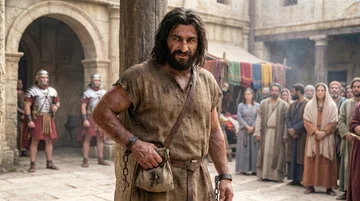
Barabbas was a notorious, base thief, robber, rebel, cruel murderer and condemned criminal.COS 148.5–7Lt 59a, 1895, par. 27–28Ms 14, 1893, par. 11–12Ms 136, 1899, par. 30–33Lt 30, 1900, par. 5–6 He claimed to be the Messiah, a pretended Christ who had done great wickedness and wonderful things through satanic agencies.DA 733.1–4Ms 112, 1897, par. 33–34 Under satanic delusion he claimed religious power and a right to establish a different order of things and to set the world right, claiming as his own whatever he could obtain by theft and robbery and murder.Ms 112, 1897, par. 33–34 The priests, rulers and rabbis stirred up, inflamed and persuaded the poor, ignorant multitude to demand Barabbas.3SP 141.1–142.15RED 61.1Ms 112, 1897, par. 37–40Ms 136, 1899, par. 30–33ST Jun 3, 1889 They drove the choice despite Pilate's recognition of Jesus' innocence and his questions of what evil He had done.RH Jan 23, 1900ST Nov 2, 1882ST Jun 3, 1889DA 735.1–5
The Meaning of the Rejection
Pilate set Jesus, whom he called Christ, beside Barabbas before the gathered multitude, and the whole heavenly universe looked on as the two men stood side by side in a contrast between righteousness and sin, truth and falsehood, and light and darkness that could be seen by all, with the Prince of Life bearing the seal of heaven placed beside Barabbas.Ms 40, 1897, par. 3–6RH Jan 23, 1900Ms 112, 1897, par. 37–40 The One so presented was the sinless, innocent, pure and holy Son of God bearing the divine image, the Prince of Heaven and Lord of glory, the King of the Jews and the Galilean who made the world and all things in it, full of goodness, mercy and truth, while Barabbas placed beside Him was a base thief, notorious robber, rebel, cruel and guilty murderer whose appearance bore the marks of Satan's character.Lt 59a, 1895, par. 27–28RH Jan 23, 1900Ms 14, 1893, par. 11–12Ms 25, 1896, par. 17–18Ms 136, 1899, par. 30–33 The criminal and murderer was thus set beside the sinless Son of God, and the choice led to Jesus' condemnation and death.Ms 150, 1899, par. 3–5
The people chose Barabbas and demanded Christ's crucifixion, taking part in the choice that condemned Him, rejecting the Lord of glory and sparing the guilty murderer and robber, preferring a murderer's society and company to the Son of God, so that God was refused and put to open shame in His Son.COS 148.5–7Ms 40, 1897, par. 3–6RH Jan 23, 1900Ms 112, 1897, par. 37–40Ms 14, 1893, par. 11–12 The same people who a few days before had loudly proclaimed His wonderful works and poured forth praise and hosannas as He rode into Jerusalem as king now reviled Him and cried for His crucifixion, showing how fickle the world's favor is.Ms 112, 1897, par. 37–404RED 102.2–103.1DA 394.2–3 Their sudden reversal was the hour and the power of darkness, a crisis that tested the disciples, whose faith He had sought to strengthen while still with them so that the cries against Him would not take them wholly by surprise, make them depend on popular opinion, or overthrow them.Ms 112, 1897, par. 37–404RED 102.2–103.1DA 394.2–3
Stirred by the priests, rulers and rabbis and led by Satan, once the covering cherub, with his angels in human form among the lawless throng, the people cried with zeal and desperation like the bellowing of wild beasts, Not this man, but Barabbas.Ms 112, 1897, par. 37–40Ms 10, 1894, par. 24–25 Satan was personified in Barabbas, a murderer from the beginning, and the people acted as children of their father the devil.Ms 112, 1897, par. 37–40 Henceforth Barabbas was the choice of the Jews whose dictation as a nation they would act out, filled with madness at the very name of Christ.Ms 112, 1897, par. 37–40 The choice was driven by envy, with religious prejudice, bigotry and corrupting influences prevailing through the religious element.Ms 40, 1897, par. 3–6RH Jan 23, 1900RH Aug 20, 1901 It shows how people who claim to know God can reject Christ and side against Him, and it reveals the spirit of man and what humanity will do when not under the control of the Spirit of God, acting inspired by Satan and standing under the black banner of the powers of darkness.Lt 59a, 1895, par. 27–28RH Jan 23, 1900Ms 14, 1893, par. 11–12
Though pronounced innocent, Jesus was delivered to crucifixion, the innocent, pure and undefiled Galilean given over though Pilate declared he found no fault in Him.Ms 56, 1894, par. 3–4Lt 132, 1910, par. 4–9 His death was the perfect sacrifice for the sins of the whole world.Ms 56, 1894, par. 3–4 By suffering the cruel death of shame on the cross of Calvary, witnessed by angels in heaven, with Satan at the head of those who reviled, abused and crucified Him and led the cruel mob, the Redeemer proved the falsity of Satan's charges against God and vindicated God in the sight of the angels as One willing to make the greatest sacrifice that could be made for man.Lt 132, 1910, par. 4–9
The Choice Repeated Today
Pilate's question setting Jesus which is called Christ against Barabbas set two opposing sides before the crowd, Christ and the apostate, and stands as a symbol of the final choice between Christ, who is the Truth, and Satan, the first rebel represented and personified by Barabbas.Ms 25, 1896, par. 17–18Lt 30, 1900, par. 5–616MR 259.3–260.1 To choose Barabbas is to reject Christ, to refuse the light and truth presented, and to refuse Christ the only provision for cleansing from sin.19MR 263.2–264.116MR 259.3–260.1 To choose Christ is to accept the message of mercy concerning God's commandments and the faith of Jesus, while to choose Satan is to accept his falsehoods, to join the disloyal, and to reject the Son of God.
That same choice is being made in the world now, when men in effect call for Barabbas and for Christ to be crucified and exalt Satan on that occasion.16MR 259.3–260.1 The crowd's choice is repeated today, and each person shows and demonstrates by his own life and course of action whom he is individually choosing, whether to stand with Christ or against Him.Ms 25, 1896, par. 17–1819MR 263.2–264.116MR 259.3–260.1Ms 13, 1897, par. 5 Near the end of time Satan's deception will lead people who have rejected the truth to choose Barabbas, who represents Satan, and to demand Christ's death.Ms 39, 1894, par. 11–12 Satan who stirred the world to choose a robber and murderer instead of the Son of God holds the same bitter hatred against commandment-keeping people who will not worship the papal institution, stirring the whole world against them, and those today who allow envy, hatred and unbelief to control them will persecute God's people even as the Jews persecuted Christ.RH Aug 20, 1901
The scene is a revelation of what those on that side will do in the great crisis before us, whose cruelty could not be comprehended beforehand.Lt 59a, 1895, par. 27–28 Rejecting light and grieving God's Spirit leaves people open to the prince of darkness, and rejection of Jesus will be brought to account at the final judgment.Ms 10, 1894, par. 24–25 To show one would not have joined those who cried for His death one must obey the light given today, live as Christ lived and turn from a wandering, restless disposition.Ms 10, 1894, par. 24–25Ms 13, 1897, par. 5 The responsibility to decide calls for greater faith and prayer to stand the test and trial to come.Lt 59a, 1895, par. 27–2819MR 263.2–264.1 The disciples had been prepared so the cries against Jesus would not take them wholly by surprise, make them depend on popular opinion, or overthrow the faith He had sought to strengthen while still with them.4RED 102.2–103.1DA 394.2–3
Sources
Pioneers and periodicals
43 sources
Pilate offered the Passover crowd gathered for the feast their customary choice of one prisoner to be released, setting Jesus who is called Christ beside Barabbas the notorious robber, murderer and insurgent.RH Jan 23, 1900ST Nov 2, 1882ST Nov 9, 1882ST Mar 13, 1901ST Oct 7, 1886 Pilate knew Jesus had been delivered for envy and had found with Herod no fault worthy of death, and he hoped that contrasting the innocent Jesus with Barabbas would move the people to choose justice.RH Jan 23, 1900ST Nov 2, 1882ST Jul 11, 1878ST Mar 13, 1901ST Oct 7, 1886 The chief priests and rulers instead stirred and persuaded the multitude to ask for Barabbas and to demand that Jesus be crucified.RH Jan 23, 1900ST Jun 9, 1898ST Mar 13, 1901ST Oct 7, 1886ST Mar 13, 1901 The offer thus set the Prince of Life bearing the seal of heaven beside Barabbas, so that light and darkness, sin and righteousness, truth and falsehood could be seen by all.RH Jan 23, 1900 The choice between the principles represented by Barabbas and Christ remains in every age, symbolizing the final choice between Christ who is the Truth and Satan the first rebel, in which rejecting Christ rejects the only provision for cleansing from sin.ST Jun 3, 1908
Passover Trial Setting
The custom at the feast was for the Roman governor to release one prisoner chosen by the people, and the governor's offer of Barabbas or Jesus which is called Christ belongs to that Passover custom used to please the people gathered from all parts of the province for their principal feast, who were allowed to choose who should be released.RH Jan 23, 1900ST Nov 2, 1882ST Jul 11, 1878ST Oct 7, 1886ST Aug 17, 1904 Pilate tried by that custom to free Jesus after publicly declaring Him without fault, still having confidence the people could be moved in the interest of justice, and he tried to shift responsibility onto the priests and rulers by getting them to consent to the Prisoner's pardon, proposing that the Prisoner be chastised and then released.ST Mar 13, 1901ST Aug 17, 1904ST Mar 13, 1901 Every evasion of duty made the situation more difficult and strengthened the demand, until the people demanded not only death for Jesus but death by crucifixion, and after Pilate appealed a third time to the mob to let him do what he should have done in spite of them, their voices prevailed so that he gave sentence that what they asked should be done.ST Mar 13, 1901ST Mar 13, 1901
The proceeding exactly fits the political order then in force, because Pilate was governor of Judea at that time and a sentence from him was necessary before proceeding to execution since the power of life and death was vested in the Roman governor, showing the minute accuracy of the account.RH Feb 11, 1862 The verse falls within the account of the day of the crucifixion, which is the most momentous day because Jesus gave His life for humanity and bore the curse of the law.RH Feb 13, 1872 That crucifixion in this chapter is dated to the last Passover Jesus attended, in A.D. 31, which with the length of His ministry and the timing of the Passovers places the beginning of His ministry and His birth in the season of fruitage rather than on December 25.ST Dec 23, 1897 Read with the following chapter without division, the passage connects to the Jews coming to Pilate on the Sabbath day to say Jesus had declared He would rise after three days and to ask that the sepulcher be made sure before that time expired, and to Pilate telling them they had a guard to go and do it, so that they sealed the stone and set a watch in the end of the Sabbath, right down in the very closing part of the Sabbath day.ST Jul 16, 1912
Barabbas was a notorious robber, murderer and insurgent imprisoned for insurrection and murder after taking part in an uprising, while Jesus had taught obedience and submission rather than resistance to Roman rule, though the rulers falsely charged Jesus with sedition and sought Barabbas's release and Jesus's condemnation.ST Nov 9, 1882ST Mar 13, 1901ST Mar 13, 1901 Pilate called together the chief priests and rulers and people, declared that he had examined Jesus and with Herod had found no fault touching the accusations and nothing worthy of death, and proposed to chastise and release Him, but was met with the united cry to release Barabbas and to crucify Jesus.ST Mar 13, 1901 The people's preference for a violent opponent of Rome reflected the strong popular desire for national independence, and the choice favored Barabbas the robber over the innocent Lamb of God, leading to Jesus' death between two criminals.ST Nov 9, 1882RH Jun 24, 1915 When set side by side, Jesus had been scourged and bore visible signs of pain and exhaustion yet His noble character remained clear, while Barabbas appeared a hardened, degraded robber, the contrast being meant to move the people to pity Jesus.ST Oct 7, 1886
The scene stands in the Roman hall at Pilate's judgment seat, where Jesus was mocked and beaten, crowned and wounded, with Jew and Gentile joining together in hatred against Him before He went on to Golgotha, in the last scene of His earthly life.RH Nov 12, 1872RH Jun 10, 1862 That endurance of mockery and cruelty before the crucifixion reveals the madness of sin and the cruelty of the world's master.RH Jun 10, 1862 A lesser-held teaching links the passage to Pilate's massacre of Galileans, proposing that Joseph Barabbas, arrested as a ringleader in the unrest, may have been the one released instead of Jesus.ST Feb 16, 1882
Motives and Pressures
Pilate knew Jesus had been delivered for envy and was convinced by testimony and evidence that the charges against him were false.RH Jan 23, 1900 He had examined Jesus and, with Herod, had found no fault touching the accusations and nothing worthy of death, and he had also received light through a warning from his wife that Jesus was a just man.RH Jan 23, 1900ST Mar 13, 1901 Yet he was too weak to obey the light.RH Jan 23, 1900
He hoped that contrasting the innocent Jesus with Barabbas, a notorious robber and murderer, would move the crowd to choose justice and release Jesus.ST Nov 2, 1882ST Jul 11, 1878ST Oct 7, 1886 He arranged the choice so the people would choose Jesus, because he still had confidence the people could be moved in the interest of justice.ST Aug 17, 1904 He used for this the governor's Passover custom of releasing one prisoner chosen by the people gathered from all parts of the province for their principal feast, even one condemned under Roman law.ST Jul 11, 1878ST Oct 7, 1886ST Aug 17, 1904
He tried to shift responsibility onto the priests and rulers by getting them to consent to the prisoner's pardon under that custom.ST Mar 13, 1901 He called together the chief priests and rulers and people, declared his finding of no fault, and proposed to chastise Jesus and release him to appease the wrath stirred by cowardly shirking of responsibility.ST Mar 13, 1901ST Mar 13, 1901 He appealed a third time to the mob to let him do what he should have done in spite of them.ST Mar 13, 1901
Every evasion of duty made the situation more difficult and strengthened the Jews to press harder.ST Mar 13, 1901 The people then demanded not only death for Jesus but death by crucifixion, and their voices prevailed so that Pilate gave sentence that what they asked should be done.ST Mar 13, 1901ST Mar 13, 1901
The chief priests and rulers prompted, stirred, persuaded and inflamed the crowd to ask for Barabbas instead, though Pilate asked what evil Jesus had done.RH Jan 23, 1900ST Nov 2, 1882ST Jun 3, 1889ST Oct 7, 1886 Working through bigotry and prejudice, with Satan working through the religious element, they prevailed and led at once to the cry to crucify Jesus.RH Jan 23, 1900 The Jewish council also used threats and intimidation to secure the Roman governor's approval of the unjust trial of an innocent man.ST Jun 9, 1898
God presented the gospel in its glorious perfection before great Rome, with Rome represented by Pilate and the gospel by Jesus Christ, as part of God's effort to save Pilate.ST Oct 27, 1898 Pilate's repeated efforts to release the innocent man, together with Christ's dignified bearing unlike common criminals, his trust in a higher power, and the declarations of innocence by both Pilate and Herod, convinced Pilate that before him stood one more than man and appealed to him to do right whatever the consequences.ST Oct 27, 1898 Yet he remained undecided because he feared the Jews and refused to identify himself with the suffering innocent one.ST Oct 27, 1898
Meaning of the Choice
The offer placed the Prince of Life, bearing the seal of heaven, before the people beside Barabbas, so that the contrast between light and darkness, sin and righteousness, truth and falsehood could be seen by all.RH Jan 23, 1900 The people rejected the Lord of glory and chose Barabbas, a robber and murderer, thereby preferring the society of a murderer to that of the One who was sinless and full of goodness, mercy and truth.RH Jan 23, 1900 Satan worked through the religious element so that bigotry and prejudice prevailed, leading at once to the cry to crucify Jesus though asked what evil He had done.RH Jan 23, 1900 The choice then made was a choice between the principles represented by Barabbas and by Christ, and that choice remains relevant in every age rather than calling people to decide Pilate's case anew.ST Jun 3, 1908 Sympathy for suffering is not enough if a person rejects the principles for which He lived and died.ST Jun 3, 1908
The choice between Jesus and Barabbas symbolizes the final choice between Christ, who is the Truth, and Satan, the first rebel. Choosing Christ means accepting the message of mercy concerning God's commandments and the faith of Jesus, while choosing Satan means accepting his falsehoods, joining the disloyal, and rejecting the Son of God. Setting the Son of God beside a thief and murderer, with priests and rulers persuading the people to choose Barabbas and reject Jesus and to demand His death, revealed enmity against Christ and the principles of Satan's rule. In the great controversy between good and evil, this injustice was allowed in order to expose those principles to the heavenly universe and humanity.
The people's preference for a violent opponent of Rome reflected the strong popular desire for national independence.ST Nov 9, 1882 Barabbas was an insurgent who had taken part in uprising and murder, while Jesus had taught obedience and submission rather than resistance to Roman rule, though rulers falsely charged Jesus with sedition and still sought Barabbas's release and Jesus's condemnation.ST Nov 9, 1882 Some imagined that the choice could decide who would lead Israel's deliverance, rallying to Jesus to make Him king as the promised Shiloh as a political deliverer to free Israel from oppressors, with Barabbas presented as another possible agent of national liberation.ST Oct 4, 1910 The question exposes insincerity and inconsistency, in that the Jews demanded death for Jesus for a crime while asking freedom for Barabbas convicted of that same crime, and in that Pilate, after declaring Jesus innocent, placed a man he had declared innocent on a par with a convicted man and left the fate of the innocent to the choice of His avowed enemies, whom the chief priests had stirred up. The crowd's turn illustrates how the world rejects its best friend and favors its foes, since people who had praised Jesus and been healed by Him — the lame healed and sight given to the blind — later saved a murderer and cried for the crucifixion of the Prince of Life, who willingly went to suffering so that even His enemies might be freed.ST Oct 11, 1899RH Jul 2, 1861
Prophecy and Sacrifice
Jesus stood under a mock trial and was condemned in judgment to suffer death under color of public justice, with Pilate as judge declaring Him innocent yet delivering Him to be crucified, in fulfillment of what was foretold of Messiah.RH Nov 18, 1862 The condemnation came from people who professed to look for the Messiah yet rejected the One in whom the prophecies of the coming Messiah had been fulfilled, using threats and intimidation to secure the Roman governor's approval of an unjust trial of an innocent man.ST Jun 9, 1898 Jesus, the Lord of the Sabbath, nailed to the cross as the great sacrifice for human sin, was cut off in the middle of the seventieth week and thereby brought sacrifice and offering to an end.
When Pilate asked the gathered crowd whom to release, Barabbas or Jesus which is called Christ, the people chose the robber and murderer rather than the Son of God.ST May 17, 1899ST Oct 11, 1899RH Jun 24, 1915 The choice favored Barabbas, a robber, over the innocent Lamb of God, so the murderer was saved while the Prince of Life was put to death and Jesus died between two criminals.ST May 17, 1899ST Oct 11, 1899RH Jun 24, 1915 The same people who had praised Jesus and whom He had blessed by healing the lame and giving sight to the blind turned against Him and cried for His crucifixion.ST Oct 11, 1899 He willingly went to suffering so that even His enemies might be freed.ST Oct 11, 1899
Doctrines Illustrated Here
The condemnation in Matthew 27:17 shows church leaders joining with the state and turning civil power against Jesus because He rejected their traditions when they were made into law. The choice of Barabbas instead of Jesus pictures the choosing of the first day of the week instead of Christ the Lord of the Sabbath, so that the fourth commandment is wrongly applied to the substitute day.RH Feb 14, 1854 Just as Barabbas was chosen in place of Christ, the first day is chosen in place of the seventh-day Sabbath.RH Feb 14, 1854
Jerusalem's rejection of Christ in favor of Barabbas represents the failure of earthly, fleshly hopes and of seeking salvation through human effort.ST Apr 11, 1900 At the judgment hall where Jesus faced release or death, merely accompanying Christ through suffering is only partial consecration, like an offering bruised and then let go, while giving one's life with Him to Calvary is complete consecration.ST Sep 12, 1900 That full surrender is represented by sacrificial blood flowing and flesh consumed.ST Sep 12, 1900 The scapegoat is an exception, because it represents Satan, not Christ or the Christian.ST Sep 12, 1900
Example Warning and Application
In the judgment hall Jesus answers insult and indignity with no word of retaliation, remaining unresentful and unresisting under abuse.ST Oct 27, 1898 Set before the governor while the crowd gathers for the choice, he faces questioning, insults and the mob without fear or wavering from the truth, with courage joined to the gentleness and innocence of a lamb.RH May 5, 1863 The scene lays bare the madness of sin and the cruelty of the world's master.RH Jun 10, 1862 Against that turmoil his calm self-possession is repose in God, a steady mind able to bear duty and distress, grounded in faith in the heavenly Father and confidence in his promises.ST Jul 29, 1886 He stands humble before the Roman governor, yet trusting God amid overwhelming human power, and that trust is set forth as the example for Christians.RH Nov 11, 1915RH Dec 28, 1911
Following him through that unjust trial toward the cross defines Christian perfection as resolutely taking up the cross and following him through suffering.RH Jul 30, 1867RH Aug 14, 1860 It does not lie in seeking extraordinary spiritual experiences.RH Aug 14, 1860 He stands there as Truth itself before Pilate, and Pilate's yielding to the crowd rather than defending him warns against fearfully abandoning truth when it is opposed.RH Sep 28, 1911 That popular clamor which chose Barabbas's freedom and demanded Jesus' death proves the crowd's judgment, especially in religious matters, is no infallible guide.RH Apr 14, 1874
Pilate stands among those who lift puny hands against the mighty plans and precepts of the word of God and set themselves against the Rock.ST Jul 15, 1908 Apart from opposition to truth his name would have been lost in oblivion, but joined to that opposition it lives only in infamy, written in black characters of hopeless doom on the pages of history, while he is dead and the Rock stands.ST Jul 15, 1908 The choice of Barabbas for release and Jesus for crucifixion is afterward held against the elders and chief priests as their sin.RH Jun 15, 1911 Mere sympathy for his suffering is not enough if a person rejects the principles for which he lived and died.ST Jun 3, 1908 Reading the account of his sufferings is the appointed way to see the gospel's power to subdue pride and cast out discontent.ST Apr 17, 1879
Choosing Barabbas is rejecting Christ, the only provision for cleansing from sin, by rejecting the light and truth presented. That rejection will be brought to account at the final judgment. Choosing Christ is accepting the message of mercy concerning God's commandments and the faith of Jesus, in contrast to accepting falsehood, joining the disloyal and choosing the first rebel, who is Satan. Each reader therefore must decide and witness for or against the word of God on trial, choosing the word of God or human conclusions.ST Jul 15, 1908
Satan stirred the world to choose a robber and murderer instead of the Son of God, working through religious leaders and guides who ought to have led in right paths but persuaded the poor, ignorant multitude to reject the Son of God and choose Barabbas in his place.RH Aug 20, 1901 He holds the same bitter hatred and malignity against the commandment-keeping people who will not worship the institution of the papacy, stirring the whole world against them.RH Aug 20, 1901 Those today who allow envy, hatred and unbelief to control them will persecute the people of God even as the Jews persecuted Christ.RH Aug 20, 1901 That same worldly spirit of rejecting Jesus and releasing Barabbas reappears in religious people who spread lies and slander and support persecution of those preaching present truth.RH Mar 15, 1860 It is repeated when Protestant churches reject the greater light of present truth about God's holy law and the fulfillment of prophecy, ignoring it, covering it with error and confusion, and warning people against those who spread it, just as the chief priests and elders rejected the great light given in Christ and misled the people to reject him too.RH Jun 13, 1865
Sources