Matthew 27:20
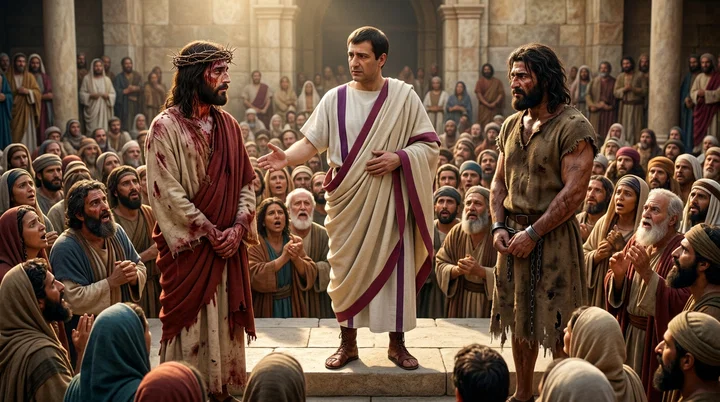
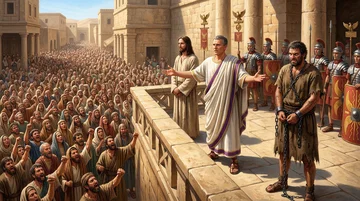
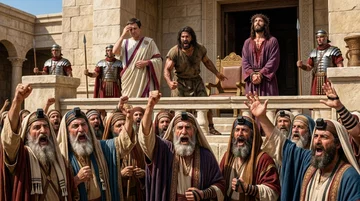
But the chief priests and elders persuaded the multitude that they should ask Barabbas, and destroy Jesus.
Translations
American King James Version, King James Version, KJV Cambridge Paragraph Bible, Webster Bible
But the chief priests and elders persuaded the multitude that they should ask Barabbas, and destroy Jesus.
Revised Version, American Standard Version
Now the chief priests and the elders persuaded the multitudes that they should ask for Barabbas, and destroy Jesus.
And the chief priests and the elders did persuade the multitudes that they might ask for themselves Barabbas, and might destroy Jesus;
But the chief priests and the elders persuaded the crowds that they should beg for Barabbas, and destroy Jesus.
But, the High-priests and the elders, persuaded the multitudes, that they should claim Barabbas, but, Jesus, should, destroy.
Berean Standard Bible, Majority Standard Bible
But the chief priests and elders persuaded the crowds to ask for Barabbas and to have Jesus put to death.
Now the chief priests and the elders persuaded the multitudes to ask for Barabbas and destroy Jesus.
Now the chief priests and those in authority got the people to make request for Barabbas, and for Jesus to be put to death.
But the chiefe Priestes and the Elders had persuaded the people that they shoulde aske Barabbas, and should destroy Iesus.
Douay-Rheims (Challoner revision)
But the chief priests and ancients persuaded the people, that they should ask Barabbas, and make Jesus away.
Pictures
Cross-references 20 of 30
- Luke 23:18-23
And they cried out all at once, saying, Away with this man, and release unto us Barabbas:
The crowd demands Barabbas and presses Pilate to crucify Jesus.
- John 18:40
Then cried they all again, saying, Not this man, but Barabbas. Now Barabbas was a robber.
The crowd chooses Barabbas instead of Jesus.
- Mark 15:11
But the chief priests moved the people, that he should rather release Barabbas unto them.
The chief priests stir the crowd to choose Barabbas instead of Jesus.
- John 19:15
But they cried out, Away with him, away with him, crucify him. Pilate saith unto them, Shall I crucify your King? The chief priests answered, We have no king but Cæsar.
The leaders reject Jesus as king and declare Caesar their king.
- Matthew 27:24
When Pilate saw that he could prevail nothing, but that rather a tumult was made, he took water, and washed his hands before the multitude, saying, I am innocent of the blood of this just person: see ye to it.
Pilate yields to the crowd and washes his hands.
- Matthew 27:1
When the morning was come, all the chief priests and elders of the people took counsel against Jesus to put him to death:
The chief priests and elders consult together against Jesus.
- Matthew 26:3-5
Then assembled together the chief priests, and the scribes, and the elders of the people, unto the palace of the high priest, who was called Caiaphas,
Religious leaders plot secretly to kill Jesus.
- Luke 23:18
And they cried out all at once, saying, Away with this man, and release unto us Barabbas:
The crowd demands Barabbas’s release and Jesus’s death.
- Matthew 27:15
Now at that feast the governor was wont to release unto the people a prisoner, whom they would.
Pilate used the festival custom of releasing a prisoner in an attempt to save Jesus.
- Matthew 27:25
Then answered all the people, and said, His blood be on us, and on our children.
The crowd accepts responsibility for Jesus’ blood, including for their children.
- Acts 3:14-15
But ye denied the Holy One and the Just, and desired a murderer to be granted unto you;
Peter describes the people choosing a murderer and killing the Prince of Life.
- John 19:6
When the chief priests therefore and officers saw him, they cried out, saying, Crucify him, crucify him. Pilate saith unto them, Take ye him, and crucify him: for I find no fault in him.
The leaders demand Jesus’ crucifixion despite Pilate finding no fault in him.
- Matthew 27:12
And when he was accused of the chief priests and elders, he answered nothing.
Jesus remains silent when accused by the chief priests and elders.
- Luke 23:23-25
And they were instant with loud voices, requiring that he might be crucified. And the voices of them and of the chief priests prevailed.
The rulers and crowd press Pilate to release Barabbas and condemn Jesus.
- Matthew 27:16
And they had then a notable prisoner, called Barabbas.
Notable Barabbas is set beside Jesus as a false Christ.
- Luke 23:21
But they cried, saying, Crucify him, crucify him.
Records the crowd’s cry to crucify Jesus.
- Mark 15:13
And they cried out again, Crucify him.
Records the crowd crying to crucify Jesus.
- Luke 23:4
Then said Pilate to the chief priests and to the people, I find no fault in this man.
Pilate declares Jesus innocent.
- John 18:19-28
The high priest then asked Jesus of his disciples, and of his doctrine.
Both describe events surrounding Jesus’ trial and rejection.
- Luke 23:16
I will therefore chastise him, and release him.
Pilate offered to chastise then release Jesus
Commentary
Each commentary is drawn from primary sources: the writings of Ellen G. White and Adventist pioneers and periodicals. Each commentary is separate. Its own words are not a quotation; follow the references to read the source passages.
Ellen G. White
32 sources
At the Passover feast a custom allowed release of whatever prisoner the people chose, and Pilate, knowing Jesus innocent and delivered for envy, tried to use it to save Him while the chief priests and elders persuaded and stirred the multitude to ask for Barabbas and destroy Jesus.3SP 141.1–142.1Ms 29, 1909, par. 12–17RH Jan 23, 1900Ms 150, 1906, par. 1–3Ms 112, 1897, par. 33–34 The choice set Jesus, the innocent, holy Prince of Life and Son of God, full of goodness and truth, beside Barabbas, a notable and notorious thief, robber and murderer who claimed by satanic delusion whatever he could get by violence as his own, so all could see light against darkness and innocence against guilt.3SP 141.1–142.1Lt 59a, 1895, par. 27–28RH Jan 23, 1900 The multitude took active part with their own voices, roaring like wild beasts for Barabbas and crying crucify Him, choosing a robber and murderer rather than the Son of God, with blood guilt resting on priests, rulers and people.RH Jan 23, 1900ST Jun 3, 1889ST May 17, 1899 The leaders acted from envy and hatred because He exposed their error, from blind cruel prejudice, and Satan stood at their head leading priests, rulers and mob, showing what professed followers of God do when not controlled by His Spirit.RH Jan 23, 1900Ms 40, 1897, par. 11–15RH Jan 23, 1900 That judgment-hall scene is a symbol of the closing scenes of earth's history, when every person individually demonstrates by action whether to choose Christ the Truth as King or Barabbas who stands as Satan personified, the robber, liar and murderer.Lt 59a, 1895, par. 27–2816MR 259.3–260.1Lt 20, 1902, par. 7–9Ms 13, 1897, par. 5
The Trial Choice
At the Passover feast a custom allowed the release of whatever condemned prisoner the people chose.RH Jan 23, 1900Ms 112, 1897, par. 33–34 Pilate was in terrible conflict to save Jesus, whom he knew to be innocent and to have been delivered for envy, and whose power even bound and accused he knew was the power of God and not of a common man.Ms 29, 1909, par. 12–17RH Jan 23, 1900Ms 112, 1897, par. 33–34 To save Him without directly opposing the maddened power demanding Him, he tried to use this pagan invention without justice in it, failing to do the justice his office required in the unjust trial of the innocent Saviour.Ms 29, 1909, par. 12–17Ms 112, 1897, par. 33–34 He flattered himself that presenting the true and innocent Christ side by side with the guilty Barabbas would make the contrast between innocence and guilt so convincing that the multitude would choose Jesus of Nazareth.Ms 112, 1897, par. 33–34
The verse sets Jesus beside Barabbas so that all could see the contrast between light and darkness, sin and righteousness, truth and falsehood, innocence and guilt.RH Jan 23, 1900Ms 112, 1897, par. 33–34 Jesus is the innocent, holy, pure and undefiled Prince of Heaven and Prince of Life, the Son of God who made the world and all things therein, still clothed in divinity in humanity, bearing the seal of heaven, sinless and full of goodness, mercy and truth.Lt 59a, 1895, par. 27–28RH Jan 23, 190016MR 259.3–260.1Ms 112, 1897, par. 33–34Ms 56, 1894, par. 3–4 Barabbas opposite Him was a notable and notorious prisoner, a thief, robber and murderer, a hardened and notorious character who had done great wickedness.3SP 141.1–142.1Lt 59a, 1895, par. 27–28RH Jan 23, 1900Ms 112, 1897, par. 33–34Ms 56, 1894, par. 3–4 Under satanic delusion he claimed that whatever he could obtain by theft and robbery and murder was his own, did wonderful things through satanic agencies, pretended to be Christ, and claimed religious power and a right to establish a different order of things and to set the world right.Ms 112, 1897, par. 33–34
The Sanhedrin had condemned Jesus and brought Him to Pilate to have the sentence confirmed and carried out.DA 723.1–724.1 The chief priests and elders, including Caiaphas with the other priests, and the Jewish priests and rulers as professedly pious leaders, persuaded, stirred up and instructed the multitude to ask for Barabbas and destroy Jesus.3SP 141.1–142.1Ms 29, 1909, par. 12–17Ms 150, 1906, par. 1–3ST Jun 3, 1889Ms 56, 1894, par. 3–4 The priests began the cry themselves which the mob then took up, turning the people against the innocent prisoner.ST Jun 3, 1889 They pressed the Roman governor to carry out their will against Jesus even as He went to the cross.RH Nov 11, 1915
The people took active part with their own voices in the rejection.ST May 17, 1899 When asked whom to release they shouted, Release unto us Barabbas, like bellowing wild beasts, and when asked what to do with Jesus they cried the more, Crucify him, crucify him, even when asked what evil He had done.RH Jan 23, 1900ST Jun 3, 1889ST May 17, 1899 Thus they chose a robber and murderer rather than the Son of God, against whom no charge was proved, refusing the Lord of glory and showing they preferred the society of a murderer.RH Jan 23, 1900ST May 17, 1899 Pilate declared he found no fault in Him, told them to take Him and crucify Him, and washed his hands as innocent of His blood, the crowd answering His blood be on us and on our children, and the deed was done with blood guilt on priests, rulers and people.ST May 17, 1899
Motives, Guilt, and Aftermath
The guides and instructors of the people claimed to be the most pious people on earth and ought to have pointed them to Jesus as the Lamb of God and led them in right paths, yet they led them to reject the Son of God, the Light of the world, the Way, the Truth and the Life.Ms 40, 1897, par. 11–15RH Jan 23, 1900RH Aug 20, 1901 The multitude they persuaded were poor and ignorant, not knowing the Scriptures that testify of Christ, and because they trusted human leaders they were stirred to reject Christ and choose a robber and murderer instead.Ms 40, 1897, par. 11–15RH Jan 23, 1900SW 63.1 Against Jesus no charge was proved and no crime was convicted, yet he was given up by the ruler to a shameful death.RH Jan 23, 1900
They acted from envy and jealousy of His influence and authority, and from hatred because He exposed their darkness and error.Ms 40, 1897, par. 11–15SG3 174.2–176.1DA 735.1–5 It was blind, unreasonable, vindictive and cruel prejudice and bigotry, which maddens people and renders them insane.RH Jan 23, 1900Ms 40, 1897, par. 11–15RH Jan 23, 1900 Satan worked through the religious element and stood at the head of those reviling Christ, leading the cruel mob with the priests and rulers, and those who rejected light and grieved God's Spirit were led by him.RH Jan 23, 1900Ms 10, 1894, par. 24–25Lt 132, 1910, par. 4–9 This reveals what people do when not controlled by God's Spirit and when God's love does not rule the heart, and reveals the murderous spirit that can control professed followers of God whose profession of piety and love for God and knowledge of Scripture did not make them God's children or reflect His character.RH Jan 23, 1900Ms 10, 1894, par. 24–25
Despite Pilate's efforts to show Jesus innocent and to stir sympathy for Him, their influence turned the people against the innocent, pure and undefiled prisoner and helped bring about His condemnation and crucifixion.DA 735.1–5Ms 56, 1894, par. 3–4Lt 132, 1910, par. 4–9 They sought to stop Jesus from becoming king, but His death made Him Redeemer and ruler.SG3 174.2–176.1 By submitting with perfect calmness to insult and outrage without retaliation and without using divine power to release Himself, Christ under this unjust demand gave the perfect sacrifice for the sins of the whole world and proved false Satan's charges against God, vindicating God before the angels in heaven as willing to make the greatest sacrifice for man, yet God's overruling did not lessen their guilt.SG3 174.2–176.1Ms 56, 1894, par. 3–4Lt 132, 1910, par. 4–9
The consequences followed at once and afterward, for Judas's death was followed by signs of remorse among witnesses and thoughts of retribution for those guilty of Jesus' blood.DA 722.5 The priests' malice and the people's rage were followed by events so terrifying to the Romans that crucifixion soon fell out of use in Judea, and when later revived at Jerusalem's destruction the Jews themselves became its victims and multitudes suffered the doom they had pronounced on Christ.DA 840.5 With the act of instructing the people to choose Barabbas and crying for Christ's crucifixion the Jewish high priesthood with Caiaphas ended, for proud, overbearing and wicked, tyrannous, deceptive and ambitious, wearing priestly robes with no vital connection with God and uncircumcised in heart, with neither capacity nor heavenly authority nor light to show what the priest's work was, its ministration was utterly corrupt and could make nothing perfect.12MR 387.2–388.1 As representatives of the nation the priests placed themselves under the despised Roman jurisdiction and unchurched themselves.12MR 387.2–388.1 Yet those same priests, rulers and listeners were present at Pentecost and, hearing the disciples in the Spirit's courage declare that the humiliated, spit-upon, thorn-crowned and crucified man is the Prince of Life and Son of God at God's right hand, trembled while the people were seized with conviction and anguish for having crucified Him.ST May 17, 1899
The public rejection tested the disciples, for the fickle crowd that had hailed Jesus as king turned against Him.4RED 102.2–103.1DA 394.2–3 Seeing their own nation call for His blood and choose the murderous Barabbas instead of their beloved Teacher disappointed their worldly hopes and caused them to mourn and fast.DA 394.2–3ST Jul 7, 1898 But their earlier experience of changing favor prepared them not to be surprised or base faith on the crowd's opinions when He was betrayed, condemned and crucified, and Jesus had prepared His true followers for the ordeal and His presence strengthened their faith.4RED 102.2–103.1DA 394.2–3
Those responsible will suffer punishment in the day of God before the assembled universe.RH Jan 23, 1900 When sinners are compelled at the final judgment to look upon Him whom they slighted, their confusion is indescribable as they remember choosing a murderer and robber in His stead, followed by Jesus crowned with thorns, scourged and crucified, with every insult as fresh as when done, making them realize what they might have been had they received Christ and improved their opportunities.RH Jan 23, 190021MR 349.6–350.3
Choosing Christ or Barabbas
The judgment-hall scene is a symbol of the closing scenes of earth's history, when mankind is given the choice between Barabbas and Jesus.Lt 59a, 1895, par. 27–2816MR 259.3–260.1 It is the choice between Christ the Truth and Satan the first rebel, liar, robber and murderer. Barabbas stands as Satan personified, while Jesus is the innocent and holy Prince of Heaven, the Son of God who made the world and all things therein.Lt 59a, 1895, par. 27–2816MR 259.3–260.1 The roar of voices like wild beasts crying for Barabbas was the choosing of Satan before Christ and the exaltation of Satan.16MR 259.3–260.1 Choosing Satan's falsehoods means rejecting the message of mercy about God's commandments and the faith of Jesus, and aligning with the disloyal rather than the Son of God. That cry to demand Jesus' death came from people inspired by Satan, revealing what people will do when they are not controlled by God's Spirit and foreshadowing the conduct of those aligned with darkness in a future crisis.Lt 59a, 1895, par. 27–28
Choosing Barabbas represents rejecting Christ, for rejecting the light of truth is rejecting Christ and the only means of cleansing from sin. The choice to cast Christ out is repeated whenever people reject him and choose another leader. Refusing light brings deception, false witness and rebellion. Those who give loyalty to anyone but Christ can be controlled by that deception until their actions amount to choosing Barabbas and rejecting Christ. The cross scene also shows what human nature can do when God's love does not rule the heart.
That choice becomes a pattern for the end of time, when people deceived by Satan will reject Christ and call for His followers to be treated as He was.Ms 39, 1894, par. 11–12 Christ is betrayed again when His saints are betrayed. As the leaders then stirred the people against Jesus, so religious leaders will incite bitterness and prejudice against present truth.9T 239.2 They will prompt people to oppose it violently in ways they otherwise would not have considered.9T 239.2
The same choice is being made today, when each person individually demonstrates by action whether to choose Barabbas and crucify Christ.16MR 259.3–260.1 Each must decide whether to give the will to God and choose Christ as King rather than a robber and murderer as king.Lt 20, 1902, par. 7–9 A person's conduct reveals which one is chosen.Ms 13, 1897, par. 5 Choosing Christ means living as Christ lived, turning from restless disposition, vain thoughts and cravings for lesser things.Ms 13, 1897, par. 5 Filling the mind with Scripture and meditating on its truths leads to pursuing virtue, holiness and growth in the divine life.Ms 13, 1897, par. 5
The scene sets the crowd influenced by its leaders against Christ and calls everyone to decide whether to stand with Christ or against Him.19MR 263.2–264.1 Anyone whose example encourages transgression is accountable to God.19MR 263.2–264.1 Rejecting present light can place a person under the prince of darkness, for Satan led those who rejected light and grieved God's Spirit.Ms 10, 1894, par. 24–25 Obeying the light received is the test of whether one would have joined those who cried for Jesus to be crucified.Ms 10, 1894, par. 24–25 The repeated casting out of Christ brings accountability before God at the final judgment.
Sources
Pioneers and periodicals
54 sources
At His trial before Pontius Pilate the Roman governor who alone held the power of life and death, Jesus was set before the multitude beside Barabbas under the Passover custom of releasing a chosen prisoner, though Pilate with Herod had examined Him and found no fault worthy of death.RH Jan 23, 1900RH Nov 18, 1862ST Mar 13, 1901ST Mar 13, 1901 The chief priests and elders persuaded the multitude to ask for Barabbas, a notable prisoner convicted of insurrection, robbery and murder, and to destroy Jesus, who was harmless, innocent and sinless, until with loud voices crying for Barabbas and for Jesus to be crucified they prevailed and Pilate gave sentence.RH Jan 23, 1900ST Jun 3, 1889ST May 17, 1899ST Mar 13, 1901ST Oct 11, 1899 That condemnation was unjust, for the judge declared Him innocent and just yet delivered Him to be crucified from envy and fear of the mob stirred by the priests, whose wavering and clamor moved him against his own judgment.RH Jan 23, 1900RH Nov 18, 1862ST Oct 27, 1898ST Mar 13, 1901 The choice set the Son of God, the Prince of Life crucified as the great sacrifice for human sin, against a thief and murderer, revealing the principles of Satan's rule and the cruelty of sin when God's love does not rule the heart, which heavenly beings beheld without interfering that Satan's character might be fully revealed.RH Feb 13, 1872ST Oct 11, 1899RH Jun 10, 1862 The judgment-hall scene stands as a symbol of the closing scenes of earth's history when people choose either Christ the Truth or Satan the first rebel and murderer, showing that the multitude's voice led by religious rulers is no unerring guide, and that the priests using threats to compel the Roman governor is an example of church uniting with state power to usurp God's place over conscience.RH Jun 8, 1869ST Oct 9, 1907
Trial Setting and Wording
The word rendered elders is the Greek word presbuteros, and the verse records that the chief priests and elders persuaded the multitude to ask for Barabbas and to destroy Jesus.ST May 19, 1898RH Jan 9, 1855 Their influence turned the crowd against Jesus and toward the demand that He be crucified.ST May 19, 1898
The event belongs to the account of Jesus' condemnation, trial and execution before Pontius Pilate, governor of Judea.RH Nov 18, 1862RH Feb 11, 1862 A sentence from Pilate was necessary before Jesus could be executed, because the power of life and death was vested in the Roman governor.RH Feb 11, 1862 It was part of the day of His trial, condemnation and death, above all His death for sinful humanity, and of His last scene on earth before Pilate and Herod, where Jew and Gentile were joined together against Him in the judgment hall and in the Roman hall before Pilate's judgment seat.RH Nov 18, 1862RH Feb 13, 1872RH Nov 12, 1872RH Jun 10, 1862
At the Passover feast custom allowed the release of a prisoner whom the people chose.RH Jan 23, 1900 Pilate examined Jesus before the chief priests, rulers and people and found no fault in Him touching the things whereof He was accused, with Herod agreeing that nothing worthy of death had been done by Him.ST Mar 13, 1901 Pilate desired to chastise Jesus and release Him, and tried to shift responsibility for releasing Him onto the priests and rulers by getting them to consent to a Passover pardon.ST Mar 13, 1901ST Mar 13, 1901
Pilate set before the multitude Jesus which is called Christ beside Barabbas.RH Jan 23, 1900ST Aug 17, 1904 Jesus was harmless and innocent, the Prince of Life bearing the seal of heaven, sinless and full of goodness, mercy and truth, the innocent Lamb of God and the same One the people had so highly honored only a few days before.RH Jan 23, 1900ST Oct 11, 1899ST Aug 17, 1904RH Jun 24, 1915 Barabbas, also called Joseph Barabbas, was a notable prisoner, a desperado and leader in the uprising, convicted of insurrection made in the city and of robbery and murder and cast into prison for them, arrested during the unrest.RH Jan 23, 1900ST Mar 13, 1901ST Aug 17, 1904ST Feb 16, 1882 Pilate expected the people would surely choose Jesus.ST Aug 17, 1904
The priests began the cry and the mob took it up, for the scornful chief priests deriding Jesus and the elders murmuring Crucify stirred and persuaded the multitude.ST Jun 3, 1889ST Oct 27, 1898 They cried out all together for Barabbas to be released unto them instead, shouting Release unto us Barabbas and Not this man, but Barabbas.ST May 17, 1899ST Mar 13, 1901ST Aug 17, 1904 When Pilate asked what to do with Jesus which is called Christ they answered Let Him be crucified, crying Crucify Him, crucify Him and being instant with loud voices until they prevailed.ST May 17, 1899ST Mar 13, 1901ST Aug 17, 1904 Pilate then gave sentence that what they asked should be done, declared he found no fault in Him, told them to take Him and crucify Him, and washed his hands as innocent of His guiltless blood, and the crowd answered His blood be on us, and on our children.ST May 17, 1899ST Mar 13, 1901ST Oct 27, 1898
The surrounding details show minute accuracy consistent with the customs, opinions, political events and institutions of that time.RH Feb 11, 1862 They include derision of the condemned before and during execution, scourging before crucifixion, and stripping and whipping before execution.RH Feb 11, 1862 They include displaying Jesus scourged beside Barabbas in hope that the contrast between His noble character and the robber's hardened, debased appearance would move the people to pity Jesus and consider His punishment sufficient.ST Oct 7, 1886 They include writing the accusation and fixing it to the cross, writing public notices at Jerusalem in three different languages, the condemned bearing His cross, and giving up the body to be buried at the request of friends unless the criminal was infamous.RH Feb 11, 1862
Unjust Persuasion and Motives
The condemnation was a mock trial in which Jesus was declared innocent by his judge and yet delivered to be crucified.RH Nov 18, 1862 Neither the declarations of innocence by both Pilate and Herod nor pity at the sight of Jesus scourged, beaten, bruised and bleeding could bend the priests to law or justice in their demand for Barabbas and the death of Jesus on unproved charges.ST Oct 27, 1898 The crowd's violent outcry prevailed over Pilate's repeated declarations that Jesus was innocent and just, and Pilate allowed him to be crucified.RH Jun 15, 1911
Pilate knew Jesus had been delivered for envy, yet handed him over despite knowing he was innocent, while no one spoke in his defense.RH Jan 23, 1900 His wavering strengthened the Jews to press their case with more urgency, and his attempt to shift responsibility by getting the priests and rulers to consent to a Passover pardon left him worse off, with responsibility growing heavier with every effort to throw it off and every evasion making the situation harder.ST Mar 13, 1901 Fear of the mad, thoughtless mob stirred up by the priests moved the magistrate to condemn against his own judgment, and popular clamor and the crowd's sentiment and pressure helped bring about the crucifixion.ST Jun 26, 1893RH Sep 28, 1911ST May 10, 1910 Pilate acted inconsistently by making Jesus' fate a choice for his avowed enemies after declaring him innocent, while the priests acted inconsistently by seeking the release of Barabbas, convicted of the same crime they charged against Jesus, while demanding the death of the innocent one.
The persuaders were the religious leaders, guides and instructors who claimed to be the most pious people on earth and ought to have pointed the people to Jesus as the Lamb of God and guided them in right paths, but who instead led them to reject the Son of God, the Light of the world, the Way, the Truth and the Life, against whom no charge was proved.RH Jan 23, 1900RH Aug 20, 1901 The people persuaded were poor and ignorant, not knowing the Scriptures which testify of Christ.RH Jan 23, 1900 They acted from envy and jealousy of Jesus' influence, from blind, unreasonable, vindictive, cruel prejudice and satanic madness that maddens people and renders them insane, with Satan working through the religious element in bigotry and prejudice and with hatred under Satan's control.RH Jan 23, 1900RH Jan 23, 1900 The priests inspired rebellion against Jesus by turning the people against him until they clamored for his blood in the judgment hall, and that rebellion against Christ persisted among the Jews.RH Oct 14, 1862 Their persuasion was dishonest and perfidious, driven by bigotry as hatred of religious innovation and bitter opposition to interference with immemorial institutions, and by cupidity as fear of losing prestige and benefits of religious office since Christ as mediator took away their distinctive function.ST Sep 22, 1898 They repudiated Christ prematurely and maliciously refused to use superior wisdom to reconcile him with prophecy, resisting God's Spirit from the enmity of the carnal mind.ST Jun 16, 1898ST Sep 22, 1898 They secretly sympathized with Barabbas's opposition to Roman rule even while accusing Jesus of designs against the government, for their real opposition was that his deeds were righteous while theirs were evil, like Cain.ST Jun 16, 1898
Their choice followed unbelief and stubbornness and a growing refusal to repent that brought them to bear false witness against the innocent Son of God and press for his death.RH Apr 16, 1867 Hopes for political deliverance also turned the crowd, since Barabbas appeared as a supposed champion of Israel's deliverance while Jesus did not meet expectations of a king who would lead an uprising against Rome.ST Oct 4, 1910 The priests and rulers pressed the Roman governor to carry out their will even as Jesus went to the cross, and the one who stirs up the perpetrator is responsible for the crime.RH Nov 11, 1915ST Sep 22, 1898 Those who guarded the prophecies of the Messiah thus helped bring about the unjust condemnation of the very Messiah they professed to await.ST Jun 9, 1898
Sacrifice and Great Controversy
That day was above all the day of His death for sinful humanity, when He was crucified as the great sacrifice for human sin.RH Feb 13, 1872 His death came in the middle of the seventieth week and brought the sacrificial and ceremonial system to an end. The day on which He died was not set apart as sacred, yet His death was the greatest act of love for humanity and the most momentous event in His history.RH Feb 13, 1872 He went willingly to suffering so that even His enemies may be freed.ST Oct 11, 1899
The persuaded choice set Jesus the Son of God against Barabbas the thief and murderer, demanding Barabbas's release and Jesus's crucifixion. That choice revealed the principles of Satan's rule. Heavenly beings witnessed it with sorrow and indignation and did not interfere, because the great conflict between good and evil required Satan's character and government to be fully revealed. The last scene before Pilate and Herod ending in crucifixion displays the cruelty and madness of sin.RH Jun 10, 1862 It shows what human nature can do when God's love does not rule the heart.
He met that unjust choice with no word of retaliation, remaining dignified, unresentful and unresisting under every indignity and insult.ST Oct 27, 1898 He was calmly self-possessed amid turmoil, showing faith in His heavenly Father and loving confidence in God's promises and trusting in a power higher than Pilate knew.ST Oct 27, 1898ST Jul 29, 1886 He faced the mob's hostility without fear or wavering, courageous and gentle rather than submitting to its demands.RH May 5, 1863 That bearing, with all the events of His trial before Pilate, was God's presentation of the gospel in glorious perfection to great Rome in the person of Pilate.ST Oct 27, 1898 It convinced Pilate that Jesus was more than man and appealed to him to do right whatever the consequences, though Pilate feared the Jews and remained undecided.ST Oct 27, 1898
Prophetic and Doctrinal Lessons
The judgment-hall scene is a symbol of the closing scenes of earth's history, when each person chooses either Christ the Truth or Satan the first rebel, liar, robber and murderer, and to choose Satan's falsehoods is to reject the message of mercy concerning God's commandments and the faith of Jesus and to align with the disloyal rather than the Son of God. Choosing Barabbas is rejecting Christ, for rejecting the light of truth is rejecting Christ and the only means of cleansing from sin. That choice to cast Christ out is repeated whenever people reject Him and choose another leader, bringing accountability before God at the final judgment. Refusing light brings deception, false witness and rebellion, and loyalty given to anyone but Christ can be controlled by that deception until actions amount to choosing Barabbas.
The crowd's decision did not make it right, for the majority led by religious rulers rejected the truth which was with the few who received Jesus.RH Jun 8, 1869 Popular opinion clamoring for Jesus' death and Barabbas's release is therefore not an unerring guide in religious matters.RH Apr 14, 1874 The status and apparent piety of religious and influential leaders who rejected Jesus and helped turn the multitude against Him did not make their judgment right.RH Sep 15, 1868
In union of church with state, religious opposition to Jesus' disregard for traditions that had been made civil law was used to employ state power to condemn Him. The Jewish authorities thereby used civil power to condemn Christ, with threats compelling the Roman governor to execute Him.ST Oct 9, 1907 This is an example of civil government claiming authority over conscience and usurping God's place.ST Oct 9, 1907
That choice is a comparison for choosing the first day of the week instead of the seventh-day Sabbath called the Lord's Sabbath.RH Feb 14, 1854 It is a pattern for choosing to honor Satan by exalting the spurious Sabbath instead of honoring Christ.ST Mar 12, 1894 Even though Jesus' resurrection assured the end of Satan's reign, people can still choose the leader of rebellion over the Prince of Life.ST Mar 12, 1894
The crime of rejecting light set before them and covering truth with error and confusion is repeated with greater guilt by Protestant churches in 1865, who reject greater light than was rejected then.RH Jun 13, 1865 That greater light is God's holy law and the testimony of Old and New Testaments concerning fulfillment of prophecy and grand truths expressly made known for the last perilous days, which they ignore while warning others against those who spread them as heresy and fanaticism.RH Jun 13, 1865 Likewise religious leaders who honored past prophets rejected God's present truth in Jesus the Son of God sent to them, and reverence for earlier messengers did not keep them from opposing God's work in their own time.ST Jul 4, 1878
Jerusalem rejecting Christ and choosing Barabbas stands for Israel's rejection of Christ and God in favor of Barabbas and Caesar and for the failure of hopes founded on human power.ST Apr 11, 1900 When Christ came His own received Him not but chose Barabbas the murderer because they were themselves murderers, proud, haughty and covetous, doing works to be seen of men and devouring widows' houses.ST Apr 30, 1896 That choice proves they were in spiritual Babylon, living by the Babylonian standard rather than the God-given standard, claimed as subjects by Babylon whose wickedness passes upon all nations, serving Satan the Babylonian prince in opposition to God as his children, with unclean demons possessing many and the Spirit of God possessing few.ST Apr 30, 1896
Their religion opposed obedience to God and led to persecuting those who served Him.RH Jul 10, 1860 The same spirit appears in religious people who slander and persecute those preaching what they regard as present truth, where religious profession does not prevent opposing Christ, recalling the Pharisee who considered himself better than others.RH Mar 15, 1860 The Pharisees were hypocrites whose murder of Christ was not prevented by strict practice of wearing texts of God's word conspicuously on their persons, and that outward display did not make them better.RH Nov 5, 1901
The choice makes Barabbas appear better to the crowd than Christ, illustrating how people can reject their best friend and prefer an enemy.RH Jul 2, 1861
Those same priests, rulers and listeners were present at Pentecost and heard the disciples, full of courage by the Holy Spirit's power, declare that the Man humiliated, spit upon, crowned with thorns and crucified is the Prince of Life and Son of God now at God's right hand.ST May 17, 1899 Priests and rulers trembled while the people were seized with conviction and anguish over having crucified Him, with blood guilt resting on priests, rulers and people who had taken active part with their own voices in His rejection.ST May 17, 1899 The disciples would see their own nation call for Jesus' blood and choose the murderous Barabbas instead of their Teacher, testing their faith and causing them to mourn and fast.ST Jul 7, 1898
As those responsible they will suffer punishment in the day of God before the assembled universe.RH Jan 23, 1900 Pilate's wife prayed him to shield and spare the guiltless blood, the Crucified of Galilee, but he did not mark her prayer, and that horror became his stain and curse, withering his early joy and casting his lot far from Rome beneath the skies of Gaul.ST Oct 27, 1898 Pilate set himself against the Rock of God's word and lifted his hand against its plans and precepts, so his name is written in black characters of hopeless doom and would have been lost in oblivion except for association with opposition to truth, and now lives only in infamy while the Rock stands.ST Jul 15, 1908
Christian Example and Warning
Reading the chapter containing the persuading of the multitude to ask for Barabbas and destroy Jesus is a help appointed for the fretful or discontented Christian, because contemplation of Christ's sufferings subdues pride and discontent.ST Apr 17, 1879 The persuading belongs to Jesus' arraignment before the judgment hall, where He endured suffering and shame as the example of Christ bearing the cross.RH Mar 26, 1861RH Jul 30, 1867RH Aug 14, 1860 Following Him through that judgment before Caiaphas and Pilate onward to Calvary means resolutely taking up the cross and following Him through rejection and suffering.RH Mar 26, 1861RH Jul 30, 1867RH Aug 14, 1860 Christian and angelic perfection is shown in that following, not in seeking continual joy or extraordinary spiritual experiences.RH Jul 30, 1867RH Aug 14, 1860
Christ is betrayed again when His saints are betrayed.
Sources