Mark 14:41
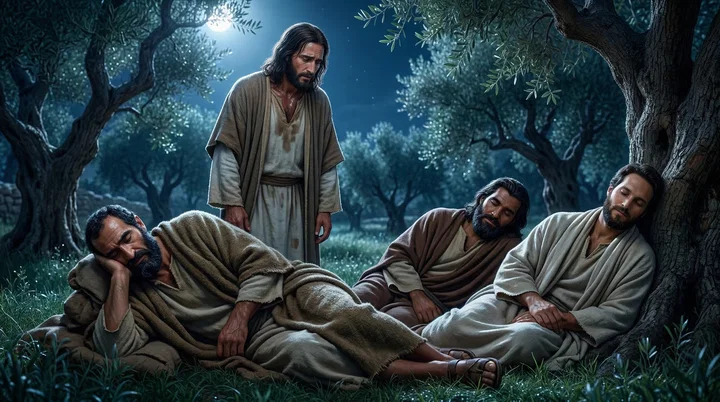
And he cometh the third time, and saith unto them, Sleep on now, and take your rest: it is enough, the hour is come; behold, the Son of man is betrayed into the hands of sinners.
Translations
And he comes the third time, and says to them, Sleep on now, and take your rest: it is enough, the hour is come; behold, the Son of man is betrayed into the hands of sinners.
King James Version, KJV Cambridge Paragraph Bible
And he cometh the third time, and saith unto them, Sleep on now, and take your rest: it is enough, the hour is come; behold, the Son of man is betrayed into the hands of sinners.
And he cometh the third time, and saith to them, Sleep on now, and take your rest: it is enough, the hour is come; behold, the Son of man is betrayed into the hands of sinners.
Revised Version, American Standard Version
And he cometh the third time, and saith unto them, Sleep on now, and take your rest: it is enough; the hour is come; behold, the Son of man is betrayed into the hands of sinners.
And he cometh the third time, and saith to them, 'Sleep on henceforth, and rest — it is over; the hour did come; lo, the Son of Man is delivered up to the hands of the sinful;
And he comes the third time and says to them, Sleep on now, and take your rest. It is enough; the hour is come; behold, the Son of man is delivered up into the hands of sinners.
And he cometh the third time, and saith unto them—Ye are sleeping the remaining time and taking your rest:—It is enough! the hour hath come! Lo! the Son of Man is being delivered up into the hands of sinners.
Berean Standard Bible, Majority Standard Bible
When Jesus returned the third time, He said, “ Are you still sleeping and resting? That is enough! The hour has come. Look, the Son of Man is betrayed into the hands of sinners.
He came the third time and said to them, “ Sleep on now, and take your rest. It is enough. The hour has come. Behold, the Son of Man is betrayed into the hands of sinners.
And he came the third time, and said to them, Go on sleeping now and take your rest: it is enough; the hour has come; see, the Son of man is given up into the hands of evil men.
And he came the third time, and said vnto them, Sleepe henceforth, and take your rest: it is ynough: the houre is come: beholde, the Sonne of man is deliuered into the hands of sinners.
Douay-Rheims (Challoner revision)
And he cometh the third time, and saith to them: Sleep ye now, and take your rest. It is enough: the hour is come: behold the Son of man shall be betrayed into the hands of sinners.
Pictures
Cross-references 20 of 27
- Matthew 26:40-46
And he cometh unto the disciples, and findeth them asleep, and saith unto Peter, What, could ye not watch with me one hour?
Jesus returns to the sleeping disciples before his betrayal and announces that the hour has come.
- Luke 22:39-46
And he came out, and went, as he was wont, to the mount of Olives; and his disciples also followed him.
Parallel account of Jesus’ prayer and the sleeping disciples.
- Luke 22:45-48
And when he rose up from prayer, and was come to his disciples, he found them sleeping for sorrow,
Luke recounts the sleeping disciples, Jesus’ call to pray, and Judas’s betrayal.
- Matthew 26:45-50
Then cometh he to his disciples, and saith unto them, Sleep on now, and take your rest: behold, the hour is at hand, and the Son of man is betrayed into the hands of sinners.
Matthew recounts Jesus’ words to the sleeping disciples and Judas’s arrival to betray him.
- Luke 22:44
And being in an agony he prayed more earnestly: and his sweat was as it were great drops of blood falling down to the ground.
Describes Jesus’ agony and sweat like drops of blood.
- Isaiah 53:5
But he was wounded for our transgressions, he was bruised for our iniquities: the chastisement of our peace was upon him; and with his stripes we are healed.
The servant suffers and is wounded for others’ transgressions.
- Mark 14:37
And he cometh, and findeth them sleeping, and saith unto Peter, Simon, sleepest thou? couldest not thou watch one hour?
Jesus rebukes Peter for sleeping instead of watching.
- Luke 22:48
But Jesus said unto him, Judas, betrayest thou the Son of man with a kiss?
Jesus confronts Judas for betraying him with a kiss.
- Matthew 26:39
And he went a little further, and fell on his face, and prayed, saying, O my Father, if it be possible, let this cup pass from me: nevertheless not as I will, but as thou wilt.
Jesus prays in Gethsemane for the cup to pass, submitting to the Father's will.
- Hebrews 5:7
Who in the days of his flesh, when he had offered up prayers and supplications with strong crying and tears unto him that was able to save him from death, and was heard in that he feared;
Jesus prays in anguish during his earthly suffering and submits to God.
- Mark 14:66-72
And as Peter was beneath in the palace, there cometh one of the maids of the high priest:
Peter denies Jesus three times, then remembers Jesus’ words and weeps.
- 2 Corinthians 5:21
For he hath made him to be sin for us, who knew no sin; that we might be made the righteousness of God in him.
The sinless Christ was treated as a sinner to bear human guilt.
- John 18:1-12
When Jesus had spoken these words, he went forth with his disciples over the brook Cedron, where was a garden, into the which he entered, and his disciples.
parallel account of the garden agony
- Mark 14:34
And saith unto them, My soul is exceeding sorrowful unto death: tarry ye here, and watch.
same sorrow unto death
- Matthew 26:38
Then saith he unto them, My soul is exceeding sorrowful, even unto death: tarry ye here, and watch with me.
Christ expresses overwhelming sorrow in Gethsemane.
- Mark 14:30
And Jesus saith unto him, Verily I say unto thee, That this day, even in this night, before the cock crow twice, thou shalt deny me thrice.
Jesus foretells Peter’s denial before the disciples sleep in Gethsemane.
- Mark 8:31
And he began to teach them, that the Son of man must suffer many things, and be rejected of the elders, and of the chief priests, and scribes, and be killed, and after three days rise again.
words they should have remembered
- Isaiah 53:12
Therefore will I divide him a portion with the great, and he shall divide the spoil with the strong; because he hath poured out his soul unto death: and he was numbered with the transgressors; and he bare the sin of many, and made intercession for the transgressors.
He was numbered with transgressors as he was betrayed into sinners’ hands.
- Mark 14:50
And they all forsook him, and fled.
His closest followers forsook him and fled.
- Luke 22:54-62
Then took they him, and led him, and brought him into the high priest’s house. And Peter followed afar off.
Peter denies Jesus after the disciples fail to watch and pray.
Commentary
Each commentary is drawn from primary sources: the writings of Ellen G. White and Adventist pioneers and periodicals. Each commentary is separate. Its own words are not a quotation; follow the references to read the source passages.
Ellen G. White
21 sources
On His third return He found the disciples asleep and told them the time for rest was ended, for the hour had come when He would be handed over into the hands of sinners and they must rise to meet His betrayer.Ms 42, 1897, par. 23–27Ms 184, 1901, par. 12DA 685 He spoke as the mob was heard approaching, led by Judas with an armed crowd to seize Him with a kiss of betrayal.Ms 42, 1897, par. 23–27Ms 184, 1901, par. 12ST Dec 9, 1897 In that night of agony the sinless Son of God was bearing the sins of the whole world, with the iniquity of all laid upon Him who knew no sin.DA 685.2Ms 134, 1905, par. 3 After praying three times for the cup to pass He chose to save humanity at any cost to Himself, becoming the propitiation by which sinners could be counted innocent.ST Jan 15, 1902Ms 134, 1905, par. 3 Coming in hope of a word of love to strengthen Him, He found them overcome with sleep and was left to face the powers of darkness alone, for the flesh is weak even when the spirit is willing.Ms 184, 1901, par. 125RED 22.1–3ST Jan 15, 1902ST Nov 25, 1889Ms 45, 1892, par. 6–9
Hour and Setting in Gethsemane
Coming a third time to the disciples He found them asleep and told them the time for rest was over, for the hour had come and the Son of man was being handed over into the hands of sinners.Ms 42, 1897, par. 23–27Ms 184, 1901, par. 12DA 685DA 694.3–45RED 22.1–3 He roused them to rise and go to meet His betrayer, facing the coming arrest with awareness and resolve.Ms 42, 1897, par. 23–27Ms 184, 1901, par. 12ST Dec 9, 1897DA 694.3–45RED 22.1–3 He spoke the words at the very moment the footsteps of the mob searching for Him were heard, even as those seeking Him approached.Ms 184, 1901, par. 12DA 694.3–43SP 101.3–102.2 Judas was leading them with an armed crowd and the high priest following, and Judas identified Him with a kiss while addressing Him as Master.Ms 42, 1897, par. 23–27ST Dec 9, 18973SP 101.3–102.2
This belongs to the night of His last agony in Gethsemane, a place He had often visited for meditation and prayer but never before with a heart so full of sorrow.DA 685.2 Through His earthly life He had walked in the light of God's presence, unforsaken by the Father because He always did what pleased Him, even in conflict with men inspired by Satan.DA 685.2 In Gethsemane He seemed shut out from the light of God's sustaining presence and numbered with the transgressors.DA 685.2
In solitude through fearful hours of great agony He was prostrated on the ground, with bloody sweat forced from His pores staining the sod.Lt 54, 1874, par. 15–16DA 685.2 His soul was exceeding sorrowful even unto death as He felt how terrible the wrath of God against transgression is.DA 685.2 Sin appeared so dreadful to Him and the weight of guilt so great that He was tempted to fear it would shut Him out forever from His Father's love.DA 685.2
Bearing Sin to Save
In Gethsemane the sinless Son of God bore the sins of the whole world, and His suffering went beyond that of any other human being.Ms 134, 1905, par. 3 Upon Him who knew no sin was laid the iniquity of us all, the guilt of fallen humanity.DA 685.2Ms 134, 1905, par. 3 Sin appeared dreadful to Him, and the weight of guilt was great.DA 685.2
He prayed three times as He faced the horror of bearing sin and its consequences, asking that the cup might pass from Him.ST Jan 15, 1902Ms 43, 1909, par. 10–12 At this decisive moment He chose to save humanity at any cost to Himself and to become its propitiation.ST Jan 15, 1902 The sinless Christ was treated as a sinner so that sinners could be treated as innocent, taking humanity, living without sin, and making atonement for human transgression.Ms 134, 1905, par. 3
His suffering shows complete submission to God's will, for though He could have refused humiliation He accepted it and went toward death.Ms 134, 1905, par. 3 An angel strengthened Him to accept the cup and endure its bitter woe.Ms 43, 1909, par. 10–12 Had He refused to drink it, the human race would have faced eternal ruin.Ms 43, 1909, par. 10–12
His betrayal, trial, and crucifixion were part of Satan's attack, yet after repeated prayer for deliverance He continued toward the sacrifice He had come to make.ST Aug 8, 1878 His being betrayed into the hands of sinners points to the similar persecution His followers will face for His sake, including false testimony instigated by religious rulers.ST Jun 3, 1897 Cruelty inflicted on those who belong to Him, whom He redeemed with His blood and called by His name, counts as cruelty done to Him.ST Jun 3, 1897
His betrayal, suffering, and death were a trial for which He had prepared His faithful disciples.4RED 102.2–103.1 Because they had already seen followers turn away from Him, they would not be wholly surprised when the crowd rejected Him and those who had professed love for Him abandoned Him.4RED 102.2–103.1 Their faith was not to rest on the fickle approval of others.4RED 102.2–103.1 James was with Him in the night of agony in the garden after being asked whether he could share His cup and baptism, and when James was later imprisoned and put to death he understood those words more fully as a call to share in Christ's suffering.7RED 68.1
Sleeping Disciples and Warning
For the third time He came hoping for a word of love to strengthen and comfort Him and found them fast asleep, overcome and weary and heavy with sleep, dropped back into unconsciousness.Ms 184, 1901, par. 125RED 22.1–3ST Jan 15, 19023SP 101.3–102.2Ms 45, 1892, par. 6–9 They had seen the glory shining around Him and felt no further fear for Him, and their sleep was caused by Satan and his evil angels when love for their suffering Master should have kept them awake.3SP 101.3–102.2Ms 45, 1892, par. 6–9 He looked sorrowfully upon them as He aroused them, longing in deep woe and grief for their sympathy in His agony.DA 694.3–45RED 22.1–33SP 101.3–102.2Ms 45, 1892, par. 6–9Ms 43, 1909, par. 10–12 That longing proves the desire for love and sympathy is implanted in the heart by God Himself, a need shared even by one like Paul who seemed indifferent to hardship yet yearned for companionship in loneliness and desertion.RH Dec 28, 1911
Their drowsiness kept them from hearing His voice and receiving strengthening evidence of the angels' presence before the trials ahead.ST Jan 15, 1902 They had only a dim sense of its power and glory, and missed what could have strengthened them for the terrible events ahead.Ms 59, 1897, par. 7 By failing to keep watch and pray despite His warnings they were left unprepared for the test of His arrest and death.ST Jan 15, 1902
He desired them to watch with Him so they would better understand the sorrow pressing on Him and be fitted to behold His death on Calvary's cross.Ms 45, 1892, par. 6–9 Watching would have kept before them His repeated warnings that men would turn against Him and put Him to death and that He would rise again, so rays of hope would shine amid gloom and faith would hold when Satan and his angels seemed to gain the victory.Ms 45, 1892, par. 6–9 It would have taught them He came not to set up an earthly kingdom with them as chief rulers but to suffer and die for the sins of the world and to set up a kingdom of love, peace, and purity in hearts until men are fitted for heaven.Ms 45, 1892, par. 6–9 It would have made them ready to bear the scorn and mockery that fell on Him and not leave Him alone in bitter trial.Ms 45, 1892, par. 6–9
During His hour of trial they gave way to sleep instead of watching with Him and left Him to face the agony and the powers of darkness alone.ST Nov 25, 1889Ms 45, 1892, par. 6–9 Their failure shows the flesh is weak though the spirit is willing, even in Peter who said he would go to prison and death with Christ yet could not watch one hour.Ms 45, 1892, par. 6–9 Peter afterward in true contrition returned with blinding tears to that same place, prostrated himself where his Saviour had been prostrated, and remembered sleeping during those prayers.Lt 54, 1874, par. 15–16 Broken in heart, with penitential tears moistening the sod, he left converted and humbled, ready to pity the tempted, sympathize with the weak and erring, caution the presumptuous, and strengthen his brethren.Lt 54, 1874, par. 15–16 John was among the three disciples permitted to witness the agony in Gethsemane.BS 45.1–3
Sources
Pioneers and periodicals
52 sources
He comes the third time to find them asleep again after urging them to watch and pray, announces that the hour has come for the Son of man to be handed over into the hands of sinners, tells them to rise and go, and Judas at once arrives with an armed crowd to identify Him with a kiss.ST Dec 9, 1897ST Mar 31, 1909ST Jun 6, 1878ST Dec 30, 1889RH Mar 14, 1865 The words about sleeping on and taking rest are a question rather than permission to keep sleeping, followed at once by the command to rise and go.RH Jan 8, 1861 The words close His repeated solitary prayer in which He asked three times for the bitter cup to be removed if possible and then yielded His own will to His Father's will, while bearing the sins and misery of the world as His own in separation from His Father.ST Jan 15, 1902ST Dec 15, 1898ST Sep 30, 1889ST Jun 24, 1886RH Apr 7, 1868 The supreme crisis of the world was met not at the cross but in Gethsemane, where alone with God He consecrated Himself anew to become the everlasting sacrifice for humanity.ST Mar 7, 1906 Because the disciples slept instead of watching and praying they were left unprepared and without courage for His arrest, and their sleep calls the soul not to remain asleep when it ought to keep watch with Christ and pray lest it enter into temptation.ST Jan 15, 1902ST Jun 3, 1886ST Apr 11, 1900ST May 10, 1905RH Jan 9, 1872
Text and Garden Setting
The words about sleeping on and taking rest are to be taken as a question, not as permission to continue sleeping, with the command to rise and go coming immediately after.RH Jan 8, 1861 This reading removes any contradiction between telling them to sleep and telling them to get up, and it agrees with Luke's account of finding them asleep and telling them to rise and pray.RH Jan 8, 1861
The verse falls within the account of Jesus' last hours, which includes His crucifixion and resurrection and gives details not found in the other Gospels.ST Mar 10, 1909 It is set in Gethsemane on the night of the betrayal, after He has prayed through the hours of darkness.RH Feb 3, 1863 His prayer there prepared and strengthened Him to bear the suffering about to come.RH Feb 3, 1863
That garden was low and still, among ancient olive trees with down-bending boughs swaying in the gentle spring breeze under the soft radiance of the paschal moon.ST Mar 7, 1906 On that bright paschal moonlit night the garden lay placid and tranquil under a cloudless sky with hushed birds and quiet breeze and stillness of death.ST Apr 14, 1914 He was there alone at midnight, burdened for souls under the weight of the world of woe, wrestling in fervent pleading prayer with yearning love and soul distress and agony breaking His great heart of love.RH Jan 16, 1908 Among the olive trees He was worn out with love and shame, with the little gray olive leaves kind to Him, and when He came out He was content with death and shame, drawn to be slain on a tree.ST Jul 8, 1897
The permission of rest is given because the hour has come, spoken after the disciples could not watch with Him for one hour while His heart was breaking.ST Jul 26, 1883 They left Him forsaken even by those who loved Him best, exceeding sorrowful, denied and alone as He is betrayed.ST Jul 26, 1883
Christ's Prayer and Anguish
The verse closes repeated solitary earnest prayer in Gethsemane, where three times the bitter cup was asked to be removed if possible and then the Son's own will was given up to the Father's will, and that yielding in the midst of suffering shows humility and submission most clearly.ST Jan 15, 1902ST Jun 24, 1886RH Apr 7, 1868ST Jun 12, 1907 The repeated asking for the cup to pass shows the full strain of that hour, while the submission shows faith fixed on God and unfailing in the Father's goodness, love, wisdom and power, willing to drink the cup so that people might be saved.ST Nov 14, 1906 At this decisive moment, facing the horror of bearing sin and its consequences, humanity was chosen to be saved at any cost to Himself, and He became its propitiation.ST Jan 15, 1902
Though holy and sinless and guiltless, He bears the sins and misery of the world as His own, including the weight of the sins of past ages and the shame of the guilty.ST Dec 15, 1898ST Sep 30, 1889ST Apr 14, 1914 He suffers sin's greatest torture in separation from His Father's side while love and power are withheld.ST Apr 14, 1914 His anguish was not chiefly fear of the physical pain of crucifixion, for the bodily horrors of the cross were slight beside the burden of sin laid on Him; as the sinless one He bore the guilt of others under God's righteous judgment and gave Himself as an offering for sin to accomplish redemption.ST Jul 14, 1881 He is sorrowful and alone before betrayal, with the cross still to come and the cup of suffering to drink, and His sorrow reveals the depth of His love.ST Oct 10, 1906
His suffering is so intense that He weeps and sheds blood instead of tears, with drops of blood trickling down His worn face, bowed in sorrow unto death amid doubt, conflict and dread at the approach of death.ST Dec 15, 1898ST Apr 14, 1914ST May 6, 1889 The cup was not taken away, but strength was sent from above and He was steadied by an angel from heaven.ST Apr 14, 1914ST May 6, 1889 He prayed most earnestly and urgently, pouring forth petitions from agony in the deep recesses of His soul, so that angels came to the relief of their beloved Commander.ST Aug 24, 1915RH Jul 9, 1872 Almost every word spoken in that tremendous scene was prayer for deliverance, for strength, and above everything for resignation, increasing in ardor and fervency in proportion to pain, and proving prayer is the soul's refuge from the storm.ST Aug 24, 1915RH Jul 9, 1872
His prayer prepared and strengthened Him to bear the suffering about to come, and His going apart alone as He approached the sacrifice at Calvary shows how a person may prepare for the great moments of life.RH Feb 3, 1863ST Nov 21, 1892 In His hour of agony He longed for the sympathy of His disciples, proving that the desire for love and sympathy is implanted in the heart by God Himself.RH Dec 28, 1911 When He most needed comfort His disciples were asleep and could give Him no human aid or earthly friendship, and His experience of being forsaken enables Him to understand and sympathize with people when others fail them.ST Mar 11, 1897
Hour of Betrayal
The hour has come that ends the prayer in Gethsemane and brings the betrayal, for the Son of man is now being handed over into the hands of sinners and the disciples are told to rise and go.ST Dec 9, 1897ST Mar 31, 1909RH Mar 14, 1865 The traitor arrives at once with an armed crowd and hands over the Son of God to those who will kill him, identifying Jesus with a kiss while addressing him as Master.ST Dec 9, 1897RH Mar 14, 1865 After enduring the greatest temptation and the decisive battle over the world's destiny, Jesus in that moment faces the betrayal and conquers while bearing the world's sins as his own.ST Mar 31, 1909
That arrival of the hour begins the ordeal of Gethsemane, condemnation, humiliation, and crucifixion.ST Oct 8, 1896 This trial would test His followers, and the faint-hearted might fall away when the crowd turned against Him.ST Oct 8, 1896 The earlier crisis among His followers had prepared the chosen disciples for what was coming, while Jesus was still present to comfort and strengthen them.ST Oct 8, 1896
The garden scene is bound together with repeated prayer for deliverance and with the betrayal that followed.ST Aug 8, 1878 Betrayal, trial, and crucifixion were part of Satan's attack, yet He continued toward the sacrifice He had come to make.ST Aug 8, 1878
Being betrayed into the hands of sinners points to the similar persecution His followers will face for His sake, including false testimony instigated by religious rulers.ST Jun 3, 1897 Cruelty inflicted on those who belong to Christ is counted as cruelty done to Christ Himself, who redeemed them with His blood and called them by His name.ST Jun 3, 1897
Sleeping Disciples
He came the third time and found them asleep again in Gethsemane just as the hour of His betrayal arrived.ST Jan 15, 1902ST Dec 30, 1889RH Mar 14, 1865RH Jul 21, 1868 Though He had urged them to watch and pray, they could not remain awake with Him for one hour in His deepest trial.ST Jan 15, 1902ST Nov 25, 1889ST Dec 30, 1889 They did not know what to answer Him, and their hearts sank at His words.RH Jul 21, 1868 They left Him to face the agony and the powers of darkness alone, without their companionship.ST Nov 25, 1889ST Jun 6, 1878ST Dec 30, 1889RH Mar 14, 1865
Peter, James, and John were His exclusive companions, chosen to be with Him in His agony in the lonely shades of Gethsemane.RH Jun 8, 1869ST Jul 4, 1899 Their being allowed closer access to the mysteries of His work shows that God may give some deeper insight to some than to others without showing partiality.ST Jul 4, 1899 While the weight of sin and woe pressed Him to agonizing prayer, the three were wrapped in unconscious slumber through His unutterable anguish.RH Jun 8, 1869 Their senses were benumbed as under a spell, with apathy and a deathlike stupor reigning over their minds.RH Jun 8, 1869RH Jul 6, 1869 Their sleep exposes how the natural heart shrinks from suffering and how human nature faints and falters at crosses, self-denial, and the Christian warfare, in contrast to their delight on the mount of transfiguration.RH Jun 8, 1869
Their failure was followed by following afar off to trial and crucifixion, and even zealous Peter denied his suffering Lord despite his confidence that he would remain faithful.RH Jun 8, 1869RH Jan 9, 1872 This lays bare poor fallen human nature that could have no hope of being saved except for God's infinite mercy.RH Jun 8, 1869 They should have watched and wept over Him while angels kept vigil as He faced deep grief and struggle.ST Jun 6, 1878 Their drowsiness kept them from hearing His voice and receiving the strengthening evidence of the angels' presence before the trials ahead.ST Jun 6, 1878
They failed to keep watch and pray despite His warnings, leaving them unprepared for the test of His arrest and death and without courage when He was arrested.ST Jan 15, 1902ST May 10, 1905 Jesus was strengthened for His ordeal through communion with an angel, and the disciples could have been strengthened too if they had stayed awake.ST May 10, 1905 Peter would not have denied Jesus if he had watched and prayed instead of sleeping.ST May 10, 1905RH Jan 9, 1872 The scene belongs to the contrast between the multitudes who came with swords, lanterns, and staves and those who slumbered or betrayed, and the few who watched with Jesus in Gethsemane.ST Jan 8, 1902
In Gethsemane the suffering Son of God and man is revealed as Prince Messiah, enduring anguish marked by tears and blood before His betrayal.RH Nov 11, 1862 He is worn out with love and shame among the olive trees.ST Jul 8, 1897 When He comes out He is content with death and shame, drawn to be slain on a tree.ST Jul 8, 1897
Victory and Atonement
Mark 14:41 marks the close of the supreme crisis of the world, even of the universe.ST Mar 7, 1906 That crisis was met not at the cross with its mocking soldiers, ridiculing priests, excruciating pain, and hiding of the Father's face, but in Gethsemane.ST Mar 7, 1906 There, all alone with God and not amid jubilant crowds, while the most stalwart followers slept and knew nothing of the struggle, He yielded Himself again with renewed consecration, facing all the suffering, to become the supreme and everlasting sacrifice for humanity.ST Mar 7, 1906 The crucifixion and the resurrection were only the demonstration in life of the submission already made in Gethsemane.ST Mar 7, 1906 That submission was greater than when He gave Himself as a Lamb slain from the foundation of the world, than when He took the form of a servant and became an angel among angels, than when He was made in the likeness of man, and than when He met and conquered the mighty temptations of the adversary at the beginning of His ministry by faith in the Word of God.ST Mar 7, 1906
After enduring the greatest temptation and the decisive battle over the world's destiny, Jesus faces the betrayal and conquers while bearing the world's sins as His own.ST Mar 31, 1909 His consecrated suffering for human grace in lonely sorrow at the hour of betrayal lays the foundation of humanity's future bliss.ST Mar 31, 1909ST Mar 5, 1902
His agony began the suffering that led to the cross, and Gethsemane stands as a symbol of atonement.ST Feb 24, 1887 He endured sorrow, pain, and anguish to recover what humanity lost through sin and save the lost.ST Feb 24, 1887 His struggle in Gethsemane, where He prayed three times giving up His own will to do the Father's will, together with His sufferings on Calvary, magnifies and intensifies the holiness of the law given at Sinai.ST Jun 12, 1907 The hour of trial in Gethsemane meant final victory for the sinner.ST May 19, 1909ST May 26, 1909 He faces the suffering ahead, resolves to go forward, and steps down to death on the cross, the lowest point of His humiliation, undertaken for those in need.ST Apr 8, 1889
Call to Watchfulness
The garden scene where Jesus wakes His weary disciples, fallen asleep at a fearful hour and forgetful of His pain, calls for spiritual watchfulness, that the soul should not remain asleep when it ought to keep watch with Christ.ST Jun 3, 1886 His fervent prayer in Gethsemane before His betrayal, bowed on the ground through the night pouring out His soul, is set as a pattern to follow in prayer.RH Aug 10, 1869RH Jun 26, 1866 He prayed repeatedly, most earnestly and urgently, pouring forth petitions from agony in the deep recesses of His soul, so that angels came to relief, proving prayer is the soul's refuge from the storm, showing the way out in distress and in hours of darkness.ST Aug 24, 1915 His praying brings relief, help and deliverance to the trusting child who prays in simplicity and resignation, and stands as the model for enduring deep distress and the hour of approaching death, afflicted yet resigned, grieved and wounded yet submissive.ST Aug 24, 1915RH Jul 9, 1872 Almost every word He spoke in that tremendous scene was prayer from the recesses of His soul — prayer for deliverance, prayer for strength, and above everything prayer for resignation, increasing in ardor and fervency in proportion to pain, teaching that prayer must occupy and support believers in their darkest hours.RH Jul 9, 1872 While the three disciples slept as He prayed before His coming suffering and death, His seeking strength from God contrasts with their failure, giving the lesson that believers should follow His example by finding a quiet place to pray in the morning.RH Mar 12, 1914
His willingness to endure that suffering and die for sinners points people toward eternal life with God.RH Jun 26, 1866 Dwelling on that scene together with Golgotha means attentively remembering His extreme suffering and merits, and this remembrance strengthens lively faith and joyful hope and loosens undue attachment to the world.RH Jan 21, 1858 Watching through nights of care in anxious prayer for a wandering one, as a father yearns over a prodigal son, gives mortals only a small mite of knowledge of that midnight anguish in the garden under the weight of the world of woe.RH Jan 16, 1908 Yet that sorrow imparts sympathy for others and is met by His grace, ruling love, and abiding presence.RH Jan 16, 1908 His path through anguish, bowed in sorrow unto death amid doubt, conflict, and dread at the approach of death, gives people hope and help as they face their own conflicts, for the cup was not taken away but strength was sent from above so He could die for humanity.ST May 6, 1889
Believers are taught never to deem their burden too heavy when beckoned where grief and toil blend and asked to sip a briny cup, for heaven's balm falls on the head that low bendeth.ST Apr 14, 1914 Those who feel the tempter's power are to go to dark Gethsemane, see His conflict, not turn away from His grief, and learn from Him to watch and pray.RH Jun 23, 1910 The words Sleep on are applied as a warning for the present: while Jesus is coming to people now, they must not remain spiritually indifferent but watch and pray so they do not enter into temptation.ST Apr 11, 1900 For when Jesus says Sleep on at that later time, it will mean that the opportunity for mercy has ended and eternal ruin is certain.ST Apr 11, 1900 When Christ comes and finds His people sleeping He will bid them sleep on and leave them asleep, which means to be left with the door of the heart shut against the Saviour after He has stood ready to enter and after He withdraws Himself forever.
Therefore thorough awakening is needed now, with humbling under the mighty hand of God and seeking meekness and righteousness, bursting open the heart door and receiving Christ to joy, so as to finish the great work yet to be done, be ready to meet the coming Lord, and be hid in the day of the Lord's fierce anger. Christ's third call to His sleeping disciples is compared with the third angel's call in the last days, which is to awaken sleeping energies, for those who face no opposition, trouble, scorn, or affliction are asleep. The disciples' condition, in which apathy and a deathlike stupor reigned supreme over their minds and came at times with terrible power so that preaching seemed almost useless, pictures worldliness, stagnation, and spiritual death with a lack of piety and devotion to God.RH Jul 6, 1869 It leaves precious souls in imminent danger of being lost unless aroused by the Spirit of God and the power which comes from above.RH Jul 6, 1869
Sources