Mark 15:8
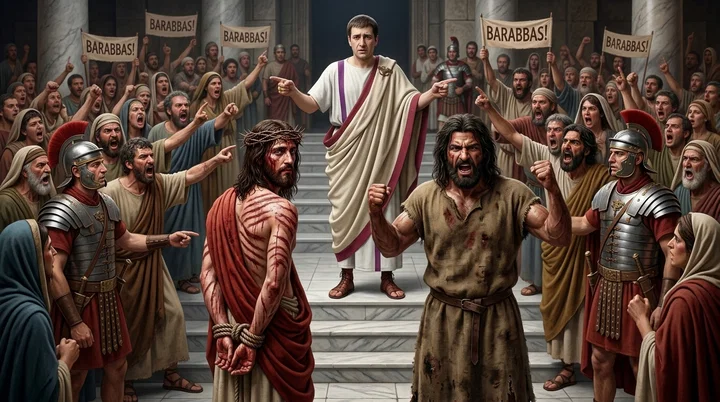
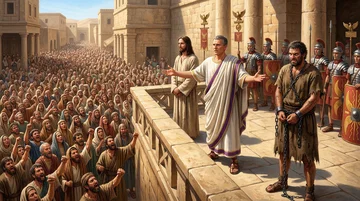
And the multitude crying aloud began to desire him to do as he had ever done unto them.
Translations
And the multitude crying aloud began to desire him to do as he had ever done to them.
King James Version, KJV Cambridge Paragraph Bible
And the multitude crying aloud began to desire him to do as he had ever done unto them.
And the multitude crying aloud, began to desire him to do as he had ever done to them.
Revised Version, American Standard Version
And the multitude went up and began to ask him to do as he was wont to do unto them.
And the multitude having cried out, began to ask for themselves as he was always doing to them,
And the crowd crying out began to beg [ that he would do] to them as he had always done.
And, going up, the multitude began to be claiming—according as he was wont to do for them.
So the crowd went up and began asking Pilate to keep his custom.
So the crowd cried out and began asking Pilate to keep his custom.
The multitude, crying aloud, began to ask him to do as he always did for them.
And the people went up, requesting him to do as he had done for them in other years.
And the people cried aloude, and began to desire that he woulde doe as he had euer done vnto them.
Douay-Rheims (Challoner revision)
And when the multitude was come up, they began to desire that he would do, as he had ever done unto them.
Pictures
Cross-references
- John 18:39-40
But ye have a custom, that I should release unto you one at the passover: will ye therefore that I release unto you the King of the Jews?
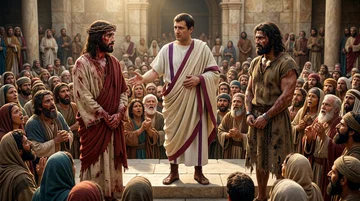
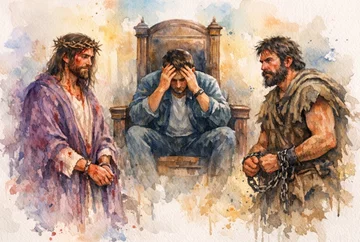
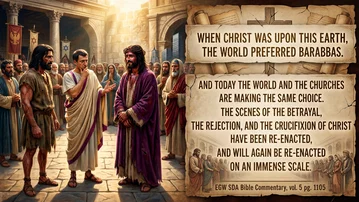
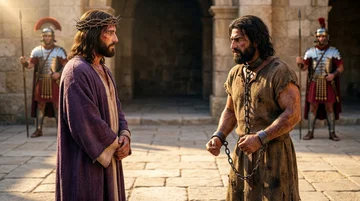
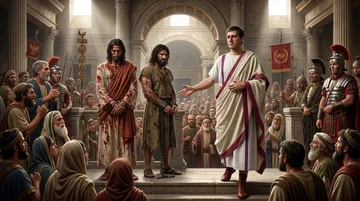
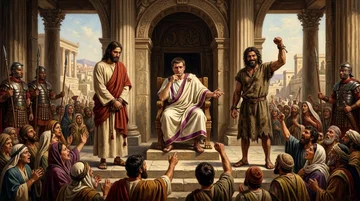
Pilate offers Jesus’ release, but the crowd chooses Barabbas.
- Matthew 27:15-21
Now at that feast the governor was wont to release unto the people a prisoner, whom they would.
The crowd chooses Barabbas for release instead of Jesus.
- Luke 23:18-25
And they cried out all at once, saying, Away with this man, and release unto us Barabbas:
The crowd demands Barabbas’s release instead of Jesus.
- John 19:1-16
Then Pilate therefore took Jesus, and scourged him.
Continues the parallel account of Jesus’ hearing before Pilate.
- Luke 23:17
( For of necessity he must release one unto them at the feast.)
Reports the custom of releasing a prisoner at the feast.
- Matthew 27:20-21
But the chief priests and elders persuaded the multitude that they should ask Barabbas, and destroy Jesus.
The crowd asks Pilate to release Barabbas instead of Jesus.
- Luke 23:16
I will therefore chastise him, and release him.
Pilate's compromise to chastise then release Jesus
- Matthew 27:24
When Pilate saw that he could prevail nothing, but that rather a tumult was made, he took water, and washed his hands before the multitude, saying, I am innocent of the blood of this just person: see ye to it.
Pilate delivers Jesus and washes hands
- Luke 23:4
Then said Pilate to the chief priests and to the people, I find no fault in this man.
states Pilate found no fault in same trial
Commentary
Each commentary is drawn from primary sources: the writings of Ellen G. White and Adventist pioneers and periodicals. Each commentary is separate. Its own words are not a quotation; follow the references to read the source passages.
Ellen G. White
7 sources
The cry went up in the judgment-hall of Pilate the Roman governor, where Christ stood bound as a prisoner with a guard of soldiers around Him while the hall filled with spectators and the judges of the Sanhedrim, the priests, rulers, elders, and the mob waited outside.DA 723.1–724.1 The Sanhedrin had condemned Jesus and had come to Pilate to have the sentence confirmed and executed.DA 723.1–724.1 The Jewish officials would not enter the Roman hall, lest ceremonial defilement keep them from the Passover, yet murderous hatred had already defiled their hearts.DA 723.1–724.1 Their rejection of Christ, the real Passover lamb, had emptied the feast of meaning for them.DA 723.1–724.1
What the multitude began to desire was Pilate's customary festival practice of releasing one condemned prisoner at the Passover.ST Jun 3, 1889DA 735.1–5Ms 112, 1897, par. 33–344RED 102.2–103.1 Pilate tried to use that custom to secure Jesus' release.DA 735.1–5Ms 112, 1897, par. 33–34 He hoped that setting the innocent Jesus beside the notorious Barabbas would lead the crowd to choose Jesus.Ms 112, 1897, par. 33–34 But the crowd's demand frustrated his attempt to spare Him.DA 735.1–5
The crowd loudly asked Pilate to follow that custom after being stirred up and inflamed against Jesus by the priests, rulers, and leaders.ST Jun 3, 1889ST Jun 3, 1889DA 735.1–5 In doing so the mob called for Barabbas to be released instead of Jesus.ST Jun 3, 1889ST Jun 3, 1889 That demand rejected the innocent Jesus and chose a criminal in His place.ST Jun 3, 1889
It was the same crowd that had hailed Jesus as king, now turned against Him, reviling Him and calling for His crucifixion, showing how quickly popular favor could change.4RED 102.2–103.1 The scene shows Satan represented and chosen before the Son of God.16MR 259.3–260.1 That choice is repeated whenever people choose against Christ, with each person demonstrating whom they choose.16MR 259.3–260.1
Sources
Pioneers and periodicals
16 sources
The crowd went up to Pilate and loudly began clamoring for him to release to them at the feast the one prisoner they asked for, as he had always done.ST Jun 3, 1889ST May 25, 1904RH Nov 30, 1916 The custom was a Passover pardon by which the Roman governor freed one Jewish prisoner condemned by Roman law when the people gathered for their principal feast, as good policy to please them and letting them choose who would be freed.ST Mar 13, 1901ST Aug 17, 1904 After publicly declaring he found no fault in Jesus, Pilate tried to avoid deciding by using the pardon to shift responsibility onto the priests and rulers and induce them to consent to Jesus' release, hoping the people would choose Jesus, yet by seeking to free through pardon one he had declared innocent he virtually conceded condemnation.ST Mar 13, 1901ST Aug 17, 1904 Stirred up against Jesus by the chief priests and rulers, the mob demanded the pardon of Barabbas, a noted criminal, robber and known murderer charged with insurrection and murder, thus rejecting the innocent Jesus and choosing in his place one convicted of the same crime they charged against Jesus.ST Jun 3, 1889ST Jun 3, 1889 Pilate's declaration that he found no fault in Christ stands as the world's official testimony that Christ was unjustly put to death as the just suffering for the unjust to bring sinners to God, while the apostate people of God could not see what was clear to the mind of a heathen judge.ST Jun 15, 1904
Words and Custom
The crying aloud was the crowd going up to Pilate and loudly beginning to clamor for him to do for them what he had always done.ST Jun 3, 1889ST May 25, 1904RH Nov 30, 1916ST Mar 13, 1901ST May 25, 1904 What they asked was the customary release at the feast of the one prisoner they named.ST May 25, 1904RH Nov 30, 1916ST Mar 13, 1901ST Mar 10, 1909ST May 25, 1904 The call was to grant them the pardon they expected at the feast.ST Jun 3, 1889ST May 25, 1904RH Nov 30, 1916ST Mar 13, 1901ST Mar 10, 1909
The custom was the Passover pardon by which the Roman governors freed one Jewish prisoner condemned by Roman law.ST Mar 13, 1901ST Aug 17, 1904 It was used when the people came from all parts of the province for their principal feast, as good policy to please them.ST Aug 17, 1904 There was added pleasure in letting them choose who would be freed.ST Aug 17, 1904
The appeal was made to Pilate as governor of Judea, and his sentence was necessary before Jesus could be executed because power of life and death was vested in the Roman governor.RH Feb 11, 1862 The demand for the customary release belongs with the scourging before crucifixion, the derision of the prisoner, the bearing of the cross, the accusation written and affixed to the cross in three languages, and the giving of the body to friends for burial.RH Feb 11, 1862 All these agree with the customs, opinions, political arrangements, and constant practices of that time and place.RH Feb 11, 1862 The details are given circumstantially and incidentally, with nothing out of place or forced in to give probability.RH Feb 11, 1862 Their consistency in small points with what is known from elsewhere proves the history true, for an inventor would not hazard so many circumstances each giving a point of comparison and a chance of detection, nor blend truth so artfully with falsehood.RH Feb 11, 1862
Trial Before Pilate
The cry for release according to custom was turned into a cry for Barabbas after the chief priests and rulers inflamed the mob and stirred them up against Jesus.ST Jun 3, 1889ST Jun 3, 1889 The crowd, so moved, called for Barabbas to be released instead of Jesus, rejecting the innocent and choosing a criminal in his place.ST Jun 3, 1889ST Jun 3, 1889
Pilate had examined the charges of the Jewish council and publicly declared he found no fault in Jesus, yet he sought to free through pardon one he had declared innocent and thereby virtually conceded condemnation.ST Aug 17, 1904 His resort to the pardon came after sending Jesus to Herod had failed to rid him of the case and left Jesus back on his hands with the Jews pressing more urgently, and it was another attempt to shirk responsibility and shift it onto the priests and rulers by inducing them to consent to release under the prestige of the Passover custom.ST Mar 13, 1901ST Aug 17, 1904 He hoped the people would choose Jesus, for he knew the chief priests had delivered Him from envy while still trusting the people could be moved in the interest of justice.ST Aug 17, 1904 That course was inconsistent in placing a man declared innocent on a level with a convicted man and leaving the fate of the innocent to the choice of His avowed enemies, and the attempt failed with the weight of responsibility growing heavier with the effort to throw it off.ST Mar 13, 1901
The people scouted release for Jesus and demanded the pardon of Barabbas, a noted criminal, robber and known murderer charged with insurrection and murder.ST Jun 3, 1889ST Jun 3, 1889ST Mar 13, 1901RH Jun 24, 1915 Barabbas had been convicted of the same crime the Jews charged against Jesus and for which they demanded Jesus' death, exposing their insincerity and inconsistency. The crowd that might once have been expected to favor Jesus instead demanded a known murderer and later called for Jesus to be crucified, choosing a robber over the innocent Christ.RH Feb 27, 1872RH Jun 24, 1915 They demanded not only death but death by crucifixion, so that Pilate appealed a third time to the mob to let him do his duty and offered to have the Prisoner chastised and then released to appease their wrath.ST Oct 27, 1898ST Mar 13, 1901RH Feb 27, 1872
The demand belonged to God presenting the gospel in glorious perfection before Rome in Jesus Christ to save Pontius Pilate.ST Oct 27, 1898 Jesus met the malignant choice with no word of retaliation, and stood before Pilate dignified and unlike common criminals, trusting in a higher power.ST Oct 27, 1898 Unresentful and unresisting under scourging, beating, bruising, bleeding, indignity and insult, He convinced Pilate that He was more than man and urged him to do right whatever the consequences, yet Pilate stayed undecided because he feared the Jews.ST Oct 27, 1898 After one more effort through the dream given to his loved wife Claudia Procula warning him to have nothing to do with that righteous Man, he refused to identify himself with the suffering Innocent One and delivered Jesus to the mad mob while trying to escape responsibility and ease conscience by washing his hands in water.ST Oct 27, 1898
Doctrine and Lessons
Mark 15:8 belongs to Christ's trial before Pilate, in which Pilate declared he found no fault in Christ.ST Jun 15, 1904 That declaration was the world's official testimony that Christ was unjustly put to death as the just suffering for the unjust to bring sinners to God.ST Jun 15, 1904 The apostate people of God could not see what was clear to the mind of a heathen judge, showing how great is the darkness when the light within is darkness.ST Jun 15, 1904 The crowd asking Pilate to follow his customary practice of releasing a prisoner at the feast might once have been expected to favor Jesus, yet instead demanded the release of a known murderer and later called for Jesus to be crucified.RH Feb 27, 1872
This reversal illustrates how little people know what they will do, while God knows and foretells human actions.RH Feb 27, 1872 The people's readiness to rally around Jesus and seek Israel's deliverance reflects their expectation of a political kingdom, an expectation that Jesus could fulfill by accepting kingship.ST Oct 4, 1910 The scene of Christ before Pilate pictures Christ's humility in contrast with the pope.RH Dec 21, 1911
Sources