Mark 15:9
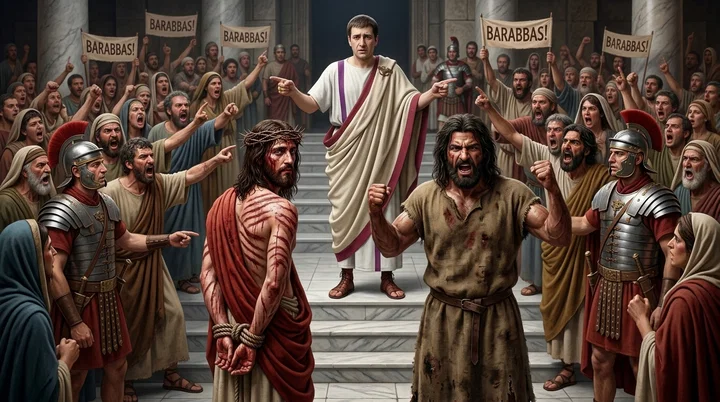
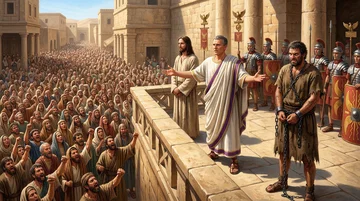
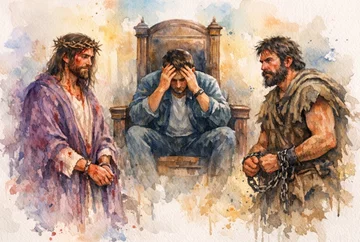
But Pilate answered them, saying, Will ye that I release unto you the King of the Jews?
Translations
But Pilate answered them, saying, Will you that I release to you the King of the Jews?
King James Version, KJV Cambridge Paragraph Bible
But Pilate answered them, saying, Will ye that I release unto you the King of the Jews?
But Pilate answered them, saying, Will ye that I release to you the King of the Jews?
Revised Version, American Standard Version
And Pilate answered them, saying, Will ye that I release unto you the King of the Jews?
and Pilate answered them, saying, 'Will ye [that] I shall release to you the king of the Jews?'
But Pilate answered them saying, Will ye that I release to you the King of the Jews?
But, Pilate, answered them, saying—Will ye, I release unto you, the King of the Jews?
Berean Standard Bible, Majority Standard Bible
“ Do you want me to release to you the King of the Jews?” Pilate asked.
Pilate answered them, saying, “ Do you want me to release to you the King of the Jews?”
And Pilate said in answer to them, Is it your desire that I let the King of the Jews go free?
Then Pilate answered them, and said, Will ye that I let loose vnto you the King of ye Iewes?
Douay-Rheims (Challoner revision)
And Pilate answered them, and said: Will you that I release to you the king of the Jews?
Pictures
Cross-references
- Luke 23:18-23
And they cried out all at once, saying, Away with this man, and release unto us Barabbas:
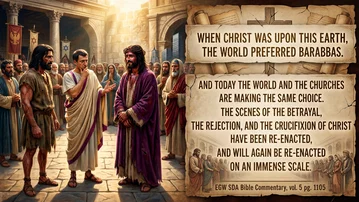
The crowd demands Barabbas instead of Jesus and calls for Jesus’ crucifixion.
- Matthew 27:19
When he was set down on the judgment seat, his wife sent unto him, saying, Have thou nothing to do with that just man: for I have suffered many things this day in a dream because of him.
Pilate’s wife warns him not to harm Jesus.
- John 18:39-40
But ye have a custom, that I should release unto you one at the passover: will ye therefore that I release unto you the King of the Jews?
Pilate offers to release Jesus, but the crowd chooses Barabbas.
- Matthew 27:17
Therefore when they were gathered together, Pilate said unto them, Whom will ye that I release unto you? Barabbas, or Jesus which is called Christ?
Pilate asks the crowd whether to release Jesus or Barabbas.
- John 19:4
Pilate therefore went forth again, and saith unto them, Behold, I bring him forth to you, that ye may know that I find no fault in him.
Pilate declares that he finds no fault in Jesus during the trial.
- Luke 23:4
Then said Pilate to the chief priests and to the people, I find no fault in this man.
Pilate declares that he finds no fault in Jesus.
- Matthew 27:21
The governor answered and said unto them, Whether of the twain will ye that I release unto you? They said, Barabbas.
Pilate asks whom the people want released, and they choose Barabbas.
- John 18:28
Then led they Jesus from Caiaphas unto the hall of judgment: and it was early; and they themselves went not into the judgment hall, lest they should be defiled; but that they might eat the passover.
Jesus is led to Pilate’s judgment hall after his hearing before the Jewish leaders.
- John 18:37
Pilate therefore said unto him, Art thou a king then? Jesus answered, Thou sayest that I am a king. To this end was I born, and for this cause came I into the world, that I should bear witness unto the truth. Every one that is of the truth heareth my voice.
Jesus identifies himself to Pilate as a king whose mission is to bear witness to the truth.
- Matthew 27:22
Pilate saith unto them, What shall I do then with Jesus which is called Christ? They all say unto him, Let him be crucified.
Pilate asks what to do with Jesus, and the crowd demands his crucifixion.
- John 18:38
Pilate saith unto him, What is truth? And when he had said this, he went out again unto the Jews, and saith unto them, I find in him no fault at all.
Pilate's faultless verdict precedes the offer.
- John 19:6
When the chief priests therefore and officers saw him, they cried out, saying, Crucify him, crucify him. Pilate saith unto them, Take ye him, and crucify him: for I find no fault in him.
The crowd demands crucifixion despite Pilate’s verdict of innocence.
- John 19:5
Then came Jesus forth, wearing the crown of thorns, and the purple robe. And Pilate saith unto them, Behold the man!
Pilate presents the scourged Jesus to stir pity before offering to release him.
- Luke 23:22
And he said unto them the third time, Why, what evil hath he done? I have found no cause of death in him: I will therefore chastise him, and let him go.
Pilate declares Jesus innocent and proposes releasing him.
- Matthew 27:24
When Pilate saw that he could prevail nothing, but that rather a tumult was made, he took water, and washed his hands before the multitude, saying, I am innocent of the blood of this just person: see ye to it.
Pilate washes hands instead of releasing the Innocent One
- Luke 23:15
No, nor yet Herod: for I sent you to him; and, lo, nothing worthy of death is done unto him.
Herod agrees Jesus deserves no punishment yet Pilate still fears
- Luke 23:11
And Herod with his men of war set him at nought, and mocked him, and arrayed him in a gorgeous robe, and sent him again to Pilate.
Herod sends Jesus back to Pilate.
- Isaiah 53:7
He was oppressed, and he was afflicted, yet he opened not his mouth: he is brought as a lamb to the slaughter, and as a sheep before her shearers is dumb, so he openeth not his mouth.
Jesus stands before Pilate without answering the accusations.
Commentary
Each commentary is drawn from primary sources: the writings of Ellen G. White and Adventist pioneers and periodicals. Each commentary is separate. Its own words are not a quotation; follow the references to read the source passages.
Ellen G. White
9 sources
Jesus stood bound as a prisoner inside Pilate's judgment hall, surrounded by a guard of soldiers and rapidly gathering spectators, while the judges of the Sanhedrin, priests, rulers, elders and mob stayed outside the entrance because entering would ceremonially defile them and keep them from the Passover.DA 723.1–724.1 Their hatred had already defiled their hearts, and their rejection of Christ as the true Passover lamb had left the feast without meaning for them.DA 723.1–724.1 Pilate had been called hastily from his bedchamber determined to act quickly with official severity, but on looking closely at Jesus he found no guilt, fear, boldness or defiance, only goodness, nobility, and a calm and dignified bearing marked by heaven.DA 723.1–724.1 That sight stirred his better nature and recalled what he had heard of the healings and resurrections, what his wife had told him, and reports that Lazarus had been raised after four days dead, so he resolved to require the accusers to state and prove their charges before he would condemn the prisoner whom he regarded as innocent.ST Jun 3, 1889DA 723.1–724.1ST Jun 3, 1889Ms 112, 1897, par. 33–34
In the verse Pilate asks the crowd with great earnestness whether they want him to release Jesus as the King of the Jews.ST Jun 3, 1889Ms 112, 1897, par. 37–40DA 733.1–4ST Jun 3, 1889Ms 112, 1897, par. 33–34 He offers this under the festival custom of freeing one condemned prisoner, presenting a choice between Jesus and Barabbas, whom he presents as Jesus who is called Christ set side by side with Barabbas.Ms 112, 1897, par. 37–40DA 733.1–4ST Jun 3, 1889Ms 112, 1897, par. 33–3416MR 259.3–260.1 Pilate asks this because he thinks the people did not understand his first offer, and he is trying to save Jesus' life and avoid condemning an innocent man despite pressure from the religious leaders and the crowd.ST Jun 3, 1889DA 733.1–4DA 735.1–5 He hopes that the contrast between the gentle, suffering and dignified Saviour and the notorious, hardened criminal Barabbas will arouse the people's sense of justice, pity and sympathy and lead them to choose Jesus in opposition to the priests and rulers.DA 733.1–4DA 735.1–5Ms 112, 1897, par. 33–34
Before this appeal Pilate had Jesus scourged and mocked, hoping the sight would move the multitude to pity and to accept that punishment as sufficient and would even satisfy the malice of the priests.DA 735.1–5 But the Jews recognized it as weakness in one already declared innocent and as an effort to save the prisoner, so they grew more determined that Jesus should not be released and pressed for a final decision to secure His death, a fanatical hatred stirred by the priests that Pilate did not understand.DA 735.1–5 The appeal fails because the priests stir up the people and, under satanic influence, the crowd rejects the offer, demands Barabbas the guilty murderer instead of Jesus, and calls for Jesus to be crucified, a cry that astonishes Pilate.Ms 112, 1897, par. 37–40DA 733.1–4ST Jun 3, 188916MR 259.3–260.1
The crowd's choice shows rejection of God in Christ and willingness to follow Satan's direction, with Barabbas standing for Satan chosen before Christ the Son of God.Ms 112, 1897, par. 37–4016MR 259.3–260.1 The same choice is repeated in the world where each person shows by conduct whether Christ is chosen.16MR 259.3–260.1 The verse belongs to a condemnation that exposes the fickleness of a crowd that once hailed Jesus as king but now demands His crucifixion.4RED 102.2–103.1 Jesus prepared His faithful disciples for that reversal so that insults from the crowd and the turning away of professed followers would not surprise them or cause them to abandon faith.4RED 102.2–103.1
Sources
Pioneers and periodicals
19 sources
Pilate asks the gathered multitude whether he should set free for them Jesus, whom he titles the King of the Jews, according to the Passover custom of releasing one condemned prisoner of their choosing.ST Jun 3, 1889ST May 25, 1904ST Mar 28, 1906ST Mar 13, 1901ST Aug 17, 1904 He asks this to avoid condemning a man he knows to be innocent and worthy of no death, hoping to turn the choice toward Jesus and to shift the responsibility from himself.ST Jun 3, 1889ST Mar 28, 1906ST Oct 27, 1898 Stirred up by the priests and rulers, the crowd rejects Jesus and with loud united cries demands Barabbas, a prisoner held for insurrection and murder, until their voices prevail and sentence is given as they asked.ST Nov 9, 1882ST Mar 13, 1901ST Mar 28, 1906 That public finding of no fault stands as the world's official testimony that Christ died unjustly, the just suffering for the unjust to bring sinners to God.ST Jun 15, 1904ST Mar 13, 1901 His offer and its rejection fulfills Isaiah 53:3 in His being despised and rejected of men, the innocent cast aside for a robber, and lays bare that His own brethren delivered Him through envy, the most cruel attribute of the sinful heart.RH Jun 24, 1858ST Dec 25, 1901ST Aug 17, 1904RH Jun 24, 1915
Question and Its Setting
Pilate asked the gathered crowd whether they wanted him to release to them Jesus, whom he called the King of the Jews.ST Jun 3, 1889ST Mar 28, 1906ST Oct 4, 1910RH Dec 28, 1911 He gave this answer to the multitude who had come asking for the customary release of a prisoner at the feast.ST May 25, 1904ST Mar 13, 1901 The request drew on the Passover custom by which the governors released one condemned Jewish prisoner chosen by the people gathered from the province for the feast.ST Mar 13, 1901ST Aug 17, 1904 The account fits the political setting and customs of the time, in which Pilate was the Roman governor of Judea and Roman governors held the power of life and death.RH Feb 11, 1862
The question came after Jesus had been sent back from Herod, when Pilate called together the chief priests and rulers and people and declared that having examined Jesus he found no fault touching the accusations and nothing worthy of death.ST Mar 13, 1901 It came after presenting Jesus and Barabbas as the choices and after receiving his wife's message, when Pilate formally asked the people whom they wished him to release.ST Nov 9, 1882 It was one of Pilate's repeated attempts to persuade them to release Jesus, for he proposed to chastise and release Him and spoke again desiring to release Him.ST Nov 9, 1882ST Mar 13, 1901 The Gospel accounts differ in the order of these attempts.ST Nov 9, 1882
In asking, Pilate sought to avoid condemning Jesus, whom he regarded as innocent and as having done no crime worthy of death.ST Jun 3, 1889ST Mar 28, 1906 He tried to free Jesus by a pardon after publicly declaring Him faultless on the charges brought by the Jewish council, hoping to frame the choice so the crowd would choose Jesus.ST Aug 17, 1904 He still trusted the people could be moved to act justly, and he made the offer because he knew the chief priests had handed Jesus over from envy.ST Aug 17, 1904 At the same time he tried to shift responsibility for releasing Jesus to the people and to get the priests to withdraw and escape responsibility himself.ST Oct 27, 1898ST Mar 13, 1901 His offer to release the King of the Jews was his repeated effort to do right while fear of the Jews left him undecided.ST Oct 27, 1898
The people answered that they wanted Barabbas, who was in prison for insurrection and murder.ST Nov 9, 1882ST Mar 13, 1901 Stirred up by the priests and rulers, they rejected Jesus' release and demanded Barabbas instead.ST Jun 3, 1889ST Mar 28, 1906RH Jun 24, 1915 They cried out together for Barabbas and shouted Crucify Him until their loud voices prevailed.ST Mar 13, 1901 Their cry astonished Pilate, and Pilate gave sentence that what they asked should be done, so that the innocent Jesus was rejected in favor of a robber and condemned to death.ST Jun 3, 1889ST Mar 13, 1901RH Jun 24, 1915
Meaning and Lessons
Pilate's offer to release the King of the Jews came after he called together the chief priests and rulers and the people, following Jesus being sent back from Herod, and declared that having examined Him he found no fault touching the accusations and nothing worthy of death, proposing to chastise and release Him and speaking again desiring to release Him.ST Mar 13, 1901ST Aug 17, 1904 That public declaration that He was faultless on the charges brought by the Jewish council was the world's official declaration that Christ was unjustly put to death, showing He suffered as the just for the unjust to bring sinners to God.ST Jun 15, 1904 As a heathen judge Pilate saw Christ's innocence clearly while God's apostate people could not see it, showing how great is the darkness when the light within is darkness.ST Jun 15, 1904 He made the offer by using the governors' Passover custom of releasing one condemned Jewish prisoner chosen by the people gathered from the province for the feast, hoping to frame the choice so the crowd would choose Jesus.ST Aug 17, 1904
The offer and its rejection begins the fulfillment of Isaiah 53:3, showing Christ despised and rejected by men when the release was offered and the people rejected Him and demanded His crucifixion.RH Jun 24, 1858 The innocent Jesus was rejected in favor of a robber and condemned to death, when Pilate offered to release Jesus as the King of the Jews but the crowd chose Barabbas instead.RH Jun 24, 1858RH Jun 24, 1915 The motive exposed in the offer is envy, for Jesus was delivered to death by His own brethren, the Jews, through envy.ST Dec 25, 1901ST Aug 17, 1904 Joseph was a type of Christ, and as the patriarchs moved with envy sold Joseph into Egypt, so Jesus' brethren handed Him over to die, and envy is the most cruel attribute of the sinful heart, before which no one is able to stand.ST Dec 25, 1901
By offering Jesus alongside Barabbas, a convicted man accused of the same crime and in prison for insurrection and murder, Pilate treated an innocent man as equal to a criminal and left His fate to the choice of His avowed enemies.ST Mar 13, 1901 The chief priests incited the people to demand Barabbas's release, exposing their inconsistency in seeking Jesus' death while asking for the release of a man convicted of the charge they made against Jesus. The crowd cried out together for Barabbas and shouted Crucify Him until their loud voices prevailed, and Pilate gave sentence that what they asked should be done.ST Mar 13, 1901 God set the Gospel before Rome in Pilate in order to save him, using Christ's dignified, trusting, unresentful and unresisting bearing under unproved charges, scourging, beating and insult, Pilate finding no crime in Him, Herod finding Him worthy of no punishment, the priests choosing Barabbas and refusing law, justice and pity, and the dream given to Pilate's wife Claudia Procula warning to have nothing to do with that righteous Man, all to move Pilate to do right whatever the cost because he knew Jesus was innocent and more than a man.ST Oct 27, 1898 But fear of the Jews left him undecided, and he refused to identify with the suffering Innocent One and delivered Jesus to the mob while washing his hands, his offer to release the King of the Jews being his repeated effort to get the priests to withdraw and to escape responsibility.ST Oct 27, 1898
The last scene of Jesus' life before His crucifixion, when He stood before Pilate, shows Him enduring cruel mockery and the folly and cruelty of sin.RH Jun 10, 1862 It presents Christ before Pilate as humble.RH Dec 28, 1911RH Dec 21, 1911 In that humility He stands in contrast with the Pope.RH Dec 21, 1911 The crowd's eventual preference for releasing a murderer instead of Jesus illustrates how events can lead people to actions they might once have thought impossible of themselves, though God knew and foretold what they would do.RH Feb 27, 1872
Sources