Matthew 27:15
Now at that feast the governor was wont to release unto the people a prisoner, whom they would.
Translations
Now at that feast the governor was wont to release to the people a prisoner, whom they would.
King James Version, KJV Cambridge Paragraph Bible
Now at that feast the governor was wont to release unto the people a prisoner, whom they would.
Now at that feast, the governor was wont to release to the people a prisoner, whom they would.
Revised Version, American Standard Version
Now at the feast the governor was wont to release unto the multitude one prisoner, whom they would.
And at the feast the governor had been accustomed to release one to the multitude, a prisoner, whom they willed,
Now at [ the] feast the governor was accustomed to release one prisoner to the crowd, whom they would.
But, feast by feast, the governor had been wont to release one unto the multitude, a prisoner whom they were desiring.
Berean Standard Bible, Majority Standard Bible
Now it was the governor’s custom at the feast to release to the crowd a prisoner of their choosing.
Now at the feast the governor was accustomed to release to the multitude one prisoner whom they desired.
Now at the feast it was the way for the ruler to let free to the people one prisoner, at their selection.
Nowe at the feast, the gouernour was wont to deliuer vnto the people a prisoner whom they would.
Douay-Rheims (Challoner revision)
Now upon the solemn day the governor was accustomed to release to the people one prisoner, whom they would.
Pictures
Cross-references 20 of 22
- Mark 15:6-15
Now at that feast he released unto them one prisoner, whomsoever they desired.
Describes the Passover prisoner-release custom and the crowd’s choice of Barabbas.
- Luke 23:18-25
And they cried out all at once, saying, Away with this man, and release unto us Barabbas:
The crowd chooses Barabbas’s release and demands Jesus’ crucifixion.
- John 18:39-40
But ye have a custom, that I should release unto you one at the passover: will ye therefore that I release unto you the King of the Jews?
Pilate offers to release a prisoner at Passover, but the crowd chooses Barabbas over Jesus.
- Luke 23:17
( For of necessity he must release one unto them at the feast.)
Both describe the custom of releasing a prisoner at the feast.
- John 19:1-16
Then Pilate therefore took Jesus, and scourged him.
Pilate gives in to pressure and hands Jesus over to be crucified.
- Matthew 27:22
Pilate saith unto them, What shall I do then with Jesus which is called Christ? They all say unto him, Let him be crucified.
records crowd demand for crucifixion after refusing release
- Matthew 26:5
But they said, Not on the feast day, lest there be an uproar among the people.
Both verses use the same Greek word for a feast day.
- John 18:40
Then cried they all again, saying, Not this man, but Barabbas. Now Barabbas was a robber.
Names Barabbas as the prisoner the crowd chose.
- Acts 3:14-15
But ye denied the Holy One and the Just, and desired a murderer to be granted unto you;
The people rejected Jesus and asked for a murderer to be granted instead.
- Luke 23:16
I will therefore chastise him, and release him.
Pilate offers to chastise and release Jesus.
- Matthew 27:19
When he was set down on the judgment seat, his wife sent unto him, saying, Have thou nothing to do with that just man: for I have suffered many things this day in a dream because of him.
Pilate takes judgment seat to declare innocence
- John 18:28
Then led they Jesus from Caiaphas unto the hall of judgment: and it was early; and they themselves went not into the judgment hall, lest they should be defiled; but that they might eat the passover.
Jesus is led to Pilate’s judgment hall before his rejection.
- Mark 15:7
And there was one named Barabbas, which lay bound with them that had made insurrection with him, who had committed murder in the insurrection.
Identifies Barabbas as an insurrectionist and murderer.
- Matthew 27:20-21
But the chief priests and elders persuaded the multitude that they should ask Barabbas, and destroy Jesus.
The crowd chooses Barabbas instead of Jesus.
- Matthew 27:26
Then released he Barabbas unto them: and when he had scourged Jesus, he delivered him to be crucified.
scourging as usual Roman practice
- Luke 23:13
And Pilate, when he had called together the chief priests and the rulers and the people,
Pilate gathers rulers and people before using custom
- Luke 22:1
Now the feast of unleavened bread drew nigh, which is called the Passover.
The passage cites this verse as another use of the same word.
- Matthew 27:24
When Pilate saw that he could prevail nothing, but that rather a tumult was made, he took water, and washed his hands before the multitude, saying, I am innocent of the blood of this just person: see ye to it.
Pilate washes hands instead of releasing Jesus
- Luke 23:4
Then said Pilate to the chief priests and to the people, I find no fault in this man.
Pilate's verdict of innocence
- Matthew 27:2
And when they had bound him, they led him away, and delivered him to Pontius Pilate the governor.
brought to Pilate together with release custom
Commentary
Each commentary is drawn from primary sources: the writings of Ellen G. White and Adventist pioneers and periodicals. Each commentary is separate. Its own words are not a quotation; follow the references to read the source passages.
Ellen G. White
16 sources
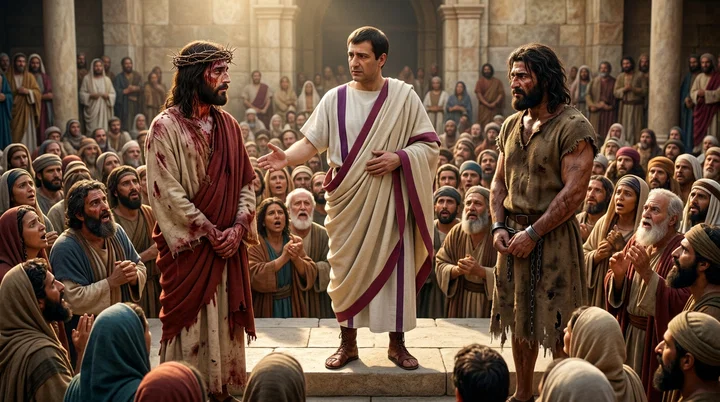
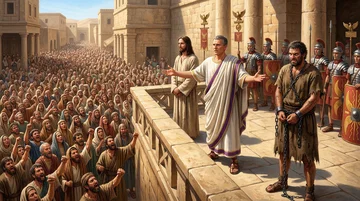
At the great national Passover feast the Roman governor was accustomed to release to the people one condemned prisoner whom they chose.Ms 40, 1897, par. 3–63SP 141.1–142.1Ms 29, 1909, par. 12–17 Pilate knew Jesus was innocent and tried to use the custom to free Him by setting Him beside Barabbas, hoping the contrast would move the crowd to choose justice, though the custom itself was a pagan invention without justice in it.3SP 141.1–142.1DA 735.1–55RED 61.1 The choice set the innocent, righteous and merciful Son of God against Barabbas, a notorious robber and murderer, and stirred up by the priests and rulers the crowd demanded Barabbas and rejected Jesus.Ms 40, 1897, par. 3–6RH Jan 23, 1900ST Jun 3, 1889 Though Pilate declared he found no fault in Christ, he delivered Him to the maddened throng and they crucified Him, while Satan led the abuse and angels witnessed men putting Him to open shame.DA 735.1–5Lt 132, 1910, par. 4–9 That judgment-hall choice is repeated whenever people choose against Christ, for every person at the close of earth's history will choose either Christ and the truth or Satan and his falsehoods, and to reject the light is to reject Christ and crucify Him afresh.16MR 259.3–260.1
Passover Release Custom
At the Passover feast, the great national festival, the governor was accustomed to release to the people one prisoner, a condemned prisoner, whom they chose.Ms 40, 1897, par. 3–63SP 141.1–142.1Ms 29, 1909, par. 12–17RH Jan 23, 1900Ms 112, 1897, par. 33–34 The custom gave the crowd a choice between Jesus and Barabbas, and thus became the means by which the people rejected the innocent Jesus and chose a criminal for release.Ms 29, 1909, par. 12–17DA 723.1–724.1ST Jun 3, 1889 The verse belongs to the trial and condemnation of Jesus, showing the conduct of the professedly pious Jews when the Jewish priests and rulers pressured the Roman governor to carry out their will.Ms 150, 1906, par. 1–3DA 723.1–724.1RH Nov 11, 1915
Pilate knew Jesus was innocent and tried to use the custom as a way to free Him, setting Jesus beside Barabbas and hoping the contrast would persuade the crowd to choose justice and spare Jesus.3SP 141.1–142.1DA 735.1–55RED 61.1Ms 112, 1897, par. 33–34ST Nov 2, 1882 His use of the custom was a subterfuge, and the custom itself was a pagan invention without justice in it.Ms 112, 1897, par. 33–34 The choice set the innocent, righteous, sinless, just and merciful Son of God and Creator against Barabbas, a notorious robber and murderer.Ms 40, 1897, par. 3–6RH Jan 23, 19005RED 61.1ST Nov 2, 1882Lt 132, 1910, par. 4–9 Stirred up by the priests and rulers, and driven by prejudice and satanic influence, the crowd demanded Barabbas and rejected Jesus, preferring a murderer's company to Christ and turning the custom into the means to demand Christ's death.RH Jan 23, 1900ST Jun 3, 18895RED 61.1ST Nov 2, 1882Lt 132, 1910, par. 4–9
Though Pilate declared to the maddened throng that he found no fault in Christ, he delivered Him into their hands and they crucified Him.DA 735.1–5Lt 132, 1910, par. 4–9 Satan stood at the head of those who reviled and crucified Christ, leading the cruel mob in abuse to provoke retaliation or drive Him to free Himself by miracle, while angels witnessed men putting Him to open shame.Lt 132, 1910, par. 4–9 The same crowd that had hailed Him as king turned against Him, reviled Him, and cried for His crucifixion, showing how fickle popular favor is.DA 394.2–34RED 102.2–103.1 The crisis tested the disciples as their hopes and worldly ambitions were disappointed, but Jesus had prepared His faithful followers for this rejection so they would not be surprised, base their faith on others' opinions, or be drawn away.DA 394.2–34RED 102.2–103.1
Choice Repeated Today
The judgment-hall scene belongs to the closing events of earth's history, when every person must choose between Christ and Satan. The choice is between Christ, the Truth, and the message of God's commandments and the faith of Jesus on the one side, and Satan and his falsehoods on the other. To choose Satan's falsehood is to identify with the rebel and to turn away from the Son of God. At the feast the governor customarily set a prisoner before the people for release, forcing the decision between Barabbas and Jesus, the Son of God and Creator.16MR 259.3–260.1
In that decision Barabbas stands for Satan, so that the people's demand for Barabbas over Christ is repeated whenever anyone chooses against Christ.16MR 259.3–260.1 Each person's actions make plain which one has been chosen.16MR 259.3–260.1 To choose Barabbas instead of Christ is to reject Christ when heavenly light is presented, for to reject the truth is to reject Christ Himself. He is the only provision for cleansing from sin, so such rejection is as crucifying Him afresh, and those who reject Him will answer to God for that choice.
Sources
Pioneers and periodicals
43 sources
At the yearly Passover the Roman governor followed a custom of freeing one condemned Jewish prisoner chosen by the people.RH Jan 23, 1900ST May 19, 1898ST Dec 23, 1897ST Nov 9, 1882ST Aug 17, 1904 Pilate declared Jesus innocent and tried to use that pardon to set Him free, hoping the crowd would choose justice.ST Mar 13, 1901ST Oct 27, 1898ST Oct 7, 1886ST Mar 28, 1906 Stirred by the priests and rulers, the people instead chose Barabbas, a notorious robber and murderer, and demanded that Jesus be crucified.ST Mar 13, 1901ST Oct 27, 1898ST Oct 7, 1886 By that custom they rejected the innocent, sinless Prince of Life and preferred a criminal's company to Christ's.RH Jan 23, 1900ST Jun 3, 1889ST Oct 11, 1899RH Jun 24, 1915 The judgment-hall choice represents the closing events of earth's history, when all will choose either Christ and truth or Satan and falsehood.
Words and Feast Custom
The Greek word rendered feast means a festival or feast day, not the weekly Sabbath, the same word discussed in connection with Colossians 2:16.RH Jul 22, 1852ST Mar 25, 1875RH Nov 7, 1854ST Jul 29, 1875 Even without the definite article, the phrase for the feast definitely denotes the Passover.RH Dec 5, 1907 The word rendered at in at the feast can mark time, meaning at or during, a use that supports rendering the same Greek word as at the time of in connection with Christ's coming in 2 Thessalonians 2:9.RH Sep 17, 1861
The feast is the yearly Passover, the last Passover Jesus attended, dated to A.D. 31, when the people were gathered from all parts of the province for their principal feast.RH Jan 23, 1900ST Dec 23, 1897ST Mar 28, 1906ST Jan 17, 1911ST Mar 28, 1906 The governor was wont to release to the people at the feast one prisoner, a Jewish prisoner condemned by Roman law, pardoned from punishment, whom they would choose.ST May 19, 1898ST Nov 9, 1882ST Aug 17, 1904ST Mar 13, 1901ST Feb 16, 1882 Nothing definite is known about the origin of the release custom and no trace of it is found in later Jewish writings; it was possibly established by the Romans as policy but was more probably of Jewish origin and continued by the Roman governors.ST Nov 9, 1882
The custom was meant as Roman policy to please the Jews, to ease their sense of Roman rule and calm national feeling during the annual gathering, with added pleasure in letting them choose who should be released.ST Mar 28, 1906ST Aug 17, 1904 Some prisoners guilty against Rome were regarded by the Jews as patriots for resisting Roman authority or tax collectors.ST Mar 28, 1906 The phrase for the release points to a release at each of the feasts, while John confines it to the Passover, with a possible reference to the release of Israel from Egyptian bondage.ST Nov 9, 1882
Pilate's Trial Actions
The verse belongs to the final scene of Jesus' life before Pilate in the judgment hall and Roman hall at Pilate's judgment-seat, leading through suffering to crucifixion and Golgotha, where Jew and Gentile joined in hatred against Him as He stood mocked, beaten, crowned and wounded.RH Nov 12, 1872RH Jun 10, 1862RH Aug 14, 1860
It is part of the condemnation in judgment in which Messiah suffered death under color of public justice, when the Roman governor agreed to the Jewish council's demands and condemned an innocent man.RH Nov 18, 1862ST Jun 9, 1898
It belongs to the alliance of church leaders with Roman authority to bring about His death, in which religious leaders used civil power against Jesus because He rejected traditions they had made binding as civil law, the priests and rulers pressuring the governor to carry out their will.RH Nov 11, 1915
Pilate called together the chief priests and rulers and people, seated himself on the judgment seat, and repeatedly declared Jesus innocent, having examined Him and found no fault touching the accusations, nor had Herod, with nothing worthy of death done by Him.ST Mar 13, 1901
He knew Jesus to be innocent, found no crime in Him, and was convinced He was more than man.ST Nov 2, 1882ST Oct 27, 1898ST Oct 7, 1886ST Aug 17, 1904
Pilate used the release custom in repeated efforts to free Jesus, hoping the people would choose justice and Jesus' release, setting the terms so they would choose Jesus though knowing the chief priests had delivered Him from envy.ST Nov 2, 1882ST Oct 27, 1898ST Oct 7, 1886ST Mar 28, 1906ST Aug 17, 1904
He intended to chastise Jesus to propitiate the priests and then release Him under the custom without further consulting the people, thinking to satisfy the people by the release, the priests by the chastisement, and himself by saving Jesus from death.ST Mar 13, 1901ST Nov 9, 1882
He also used the Passover pardon to shift responsibility for releasing Jesus onto the priests and rulers by inducing them to consent.ST Mar 13, 1901
Pilate put Jesus on a level with a convicted criminal and left the innocent man's fate to the choice of His avowed enemies.
The chief priests stirred the people, who claimed the custom for themselves and clamored for it without demanding Jesus.ST Nov 9, 1882
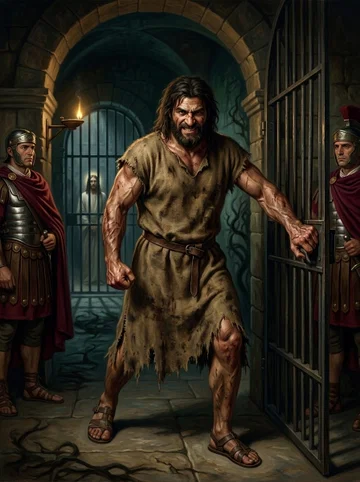
Barabbas, called Joseph Barabbas, was a notorious robber, thief and murderer, cast into prison for insurrection made in the city and for murder, convicted of the very crime charged against Jesus.ST Nov 2, 1882ST Mar 13, 1901ST Oct 7, 1886ST Jan 17, 1911
Placed beside Barabbas for the people's choice, Jesus' bloodied, exhausted appearance and noble character stood in sharp contrast to Barabbas's hardened, criminal appearance.ST Oct 7, 1886
Persuaded by the priests and rulers, the people chose Barabbas for release and demanded that Jesus be crucified, crying out all together and shouting Crucify Him, instant with loud voices until their voices prevailed.ST Jun 3, 1889ST Mar 13, 1901ST Oct 27, 1898ST Oct 7, 1886
Pilate gave sentence that what they asked should be done, released Barabbas and handed Jesus over for crucifixion.ST Mar 13, 1901ST Jan 17, 1911
The Jews met every effort for Jesus with fresh outbursts of malignity, yielding neither to law nor justice in the declarations of Pilate and Herod nor to pity at the sight of the scourged, beaten, bruised, bleeding man.ST Oct 27, 1898
Pilate appealed a third time to do his duty and to appease the mob by chastising and releasing Jesus, but every evasion made the situation more difficult and left him worse off, his wavering strengthening the Jews to press with greater urgency until the weight of responsibility grew heavier.ST Oct 27, 1898ST Mar 13, 1901
Jesus answered the choice and all indignity and insult with no word of retaliation, unresentful and unresisting, maintaining complete self-possession with dignified bearing.ST Oct 27, 1898ST Jul 29, 1886
His calm pressed Pilate's heart to do right whatever the consequences.ST Oct 27, 1898
Pilate still feared the Jews, remained undecided, refused to identify with the suffering innocent one, and delivered Him to the mob.ST Oct 27, 1898
He lifted his puny hand against mighty plans and precepts and set himself against the rock of the word, so his name and fate stand in hopeless doom and infamy and would have been lost in oblivion except for opposition to truth, while the Rock stands.ST Jul 15, 1908
The minute details of the trial, execution and burial history agree with the customs, opinions, political events and institutions of that time, including the necessity of sentence from Pontius Pilate as governor of Judea, the vesting of life and death power in the Roman governor, derision of the condemned, scourging before crucifixion, the accusation in three languages, bearing the cross, and giving the body for burial at friends' request, as confirmed from Tacitus, Josephus, Suetonius and other ancient authors.RH Feb 11, 1862
The circumstantial, undesigned manner flowing naturally from the narrative gives presumption for the history and strong evidence of its truth.RH Feb 11, 1862
Theological Significance
The day covered by the trial before Pilate, condemnation, mocking, scourging and crucifixion is more memorable than any other in Christ's history because in his death he showed love for humanity and bore the curse of the law.RH Feb 13, 1872 That day itself was not set apart as sacred, for the crucifixion has its memorial in the Lord's Supper rather than in an appointed day of observance.RH Feb 13, 1872
At the feast when a prisoner could be released according to the people's choice, the people saved a murderer and demanded the death of Jesus, the Prince of Life.ST Oct 11, 1899 Barabbas, a robber, was chosen for release instead of Jesus, the innocent Lamb of God, who was condemned to death between criminals.RH Jun 24, 1915 Jesus willingly went to suffer so that even his enemies might be freed.ST Oct 11, 1899
Being bruised and beaten and then released could represent only a partial consecration, not the complete self-giving represented by a sacrificial offering whose life was given.ST Sep 12, 1900
The custom of allowing the people to choose a prisoner for release at the feast became the occasion for the world choosing Barabbas, a prisoner, over Christ.RH Jul 2, 1861RH Feb 14, 1854 That choice of a robber over the Lord illustrates how people can hate and destroy their best friend and the good while loving their foes.RH Jul 2, 1861RH Feb 14, 1854
Releasing a prisoner chosen by the people was customary at Passover, and when the choice was offered between Barabbas and Jesus the crowd demanded Barabbas, so the custom became the means by which the people rejected the innocent Jesus and chose a criminal for release.RH Jan 23, 1900ST Jun 3, 1889 They chose Barabbas, a robber and murderer, instead of the sinless, just and merciful Christ, showing that they preferred a murderer's company to his.RH Jan 23, 1900 Prejudice and satanic influence drove their choice.RH Jan 23, 1900
Prophecy and Present Appeal
The judgment-hall scene stands as a representation of the closing events of earth's history, when every person will choose either Christ, the Truth, and the message of God's commandments and the faith of Jesus, or Satan and his falsehoods, thereby identifying with the rebel and turning from the Son of God. The people's choice of Barabbas instead of Christ represents rejecting Christ when heavenly light is presented, for rejecting the truth is rejecting Christ, the only provision for cleansing from sin. That rejection is like crucifying Him afresh, and those who reject Him will answer to God for that choice.
Israel's choice of Barabbas instead of Christ was a rejection of Christ and God in favor of earthly power, with Jerusalem as the symbol of that failure.ST Apr 11, 1900 That choice illustrates the hopelessness of human hopes and of salvation by human works.ST Apr 11, 1900 In the trial the chief priests and elders rejected the light given in Christ and misled the people against the truth, opposing God's holy law and the testimony of the Old and New Testaments about fulfilled prophecy, turning the people from truth as heresy and fanaticism and covering truth with error and confusion while still doing much outward religious work.RH Jun 13, 1865
The light they rejected is less than the greater light of the grand truths for the last perilous days now rejected and opposed, making the present rejection a greater and similar crime that eats out the vitality of popular Christianity and leaves the willing deceived.RH Jun 13, 1865 The crowd's demand for Barabbas's release and Jesus' death shows popular opinion leading people to evil, proving that the people's voice is not an unerring guide, especially in religious matters.RH Apr 14, 1874 The same spirit of choosing Barabbas for release and Jesus for crucifixion is active when religious people persecute those preaching the truth and spread lies and slander against them.RH Mar 15, 1860
Jesus, the Truth, stood as the prisoner before Pilate, and the crowd's pressure led Pilate to turn away from Him, warning that people today may also fail to stand for truth out of fear of the crowd.RH Sep 28, 1911 The setting of Jesus before Pilate in the judgment hall illustrates that Christian perfection includes resolutely bearing the cross and following Christ through unjust treatment, rather than depending on extraordinary spiritual experiences.RH Aug 14, 1860 His complete self-possession and calm under pressure in Matthew 27:15-31 exemplifies Christian repose, a steady trust in God that remains firm amid turmoil and does not mean inaction.ST Jul 29, 1886 The account of Christ's sufferings in this chapter can help subdue pride and discontent, and reading the chapter to a fretful or gloomy Christian brings the Gospel's healing influence to the heart.ST Apr 17, 1879
Sources