Matthew 25:28
Take therefore the talent from him, and give it unto him which hath ten talents.
Translations
Take therefore the talent from him, and give it to him which has ten talents.
King James Version, KJV Cambridge Paragraph Bible
Take therefore the talent from him, and give it unto him which hath ten talents.
Take therefore the talent from him, and give it to him who hath ten talents.
Revised Version, American Standard Version
Take ye away therefore the talent from him, and give it unto him that hath the ten talents.
'Take therefore from him the talent, and give to him having the ten talents,
Take therefore the talent from him, and give it to him that has the ten talents:
Therefore take away, from him, the talent, and give unto him that hath the ten talents;
Berean Standard Bible, Majority Standard Bible
Therefore take the talent from him and give it to the one who has ten talents.
Take away therefore the talent from him and give it to him who has the ten talents.
Take away, then, his talent and give it to him who has the ten talents.
Take therefore the talent from him, and giue it vnto him which hath tenne talents.
Douay-Rheims (Challoner revision)
Take ye away therefore the talent from him, and give it to him that hath ten talents.
Pictures
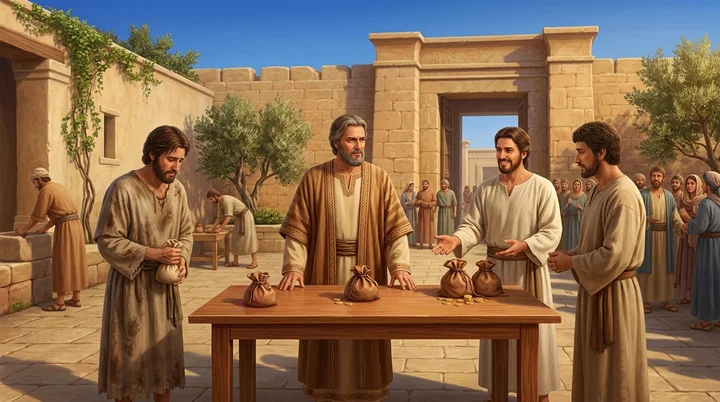
Cross-references 20 of 33
- Matthew 25:21
His lord said unto him, Well done, thou good and faithful servant: thou hast been faithful over a few things, I will make thee ruler over many things: enter thou into the joy of thy lord.
The faithful servant is commended for using his entrusted talents and receives greater responsibility.
- Luke 19:12-26
He said therefore, A certain nobleman went into a far country to receive for himself a kingdom, and to return.
A parallel parable shows servants held accountable for using what their master entrusted.
- Matthew 25:15
And unto one he gave five talents, to another two, and to another one; to every man according to his several ability; and straightway took his journey.
Each servant receives talents according to ability to put them to use.
- Revelation 22:12
And, behold, I come quickly; and my reward is with me, to give every man according as his work shall be.
Both connect each person’s reward with their work.
- Luke 12:48
But he that knew not, and did commit things worthy of stripes, shall be beaten with few stripes. For unto whomsoever much is given, of him shall be much required: and to whom men have committed much, of him they will ask the more.
Greater gifts bring greater responsibility.
- Matthew 25:23
His lord said unto him, Well done, good and faithful servant; thou hast been faithful over a few things, I will make thee ruler over many things: enter thou into the joy of thy lord.
The master commends faithful servants and rewards their faithful use of entrusted responsibility.
- Luke 19:24-26
And he said unto them that stood by, Take from him the pound, and give it to him that hath ten pounds.
The unused pound is taken from the unfaithful servant and given to the servant with ten.
- Matthew 25:18
But he that had received one went and digged in the earth, and hid his lord’s money.
The servant hides his entrusted talent instead of using it, leading to its removal.
- Luke 16:10
He that is faithful in that which is least is faithful also in much: and he that is unjust in the least is unjust also in much.
Faithfulness in small duties shows fitness for greater trust.
- Matthew 25:19
After a long time the lord of those servants cometh, and reckoneth with them.
The master returns to reckon with his servants for what they were entrusted with.
- Matthew 25:1-13
Then shall the kingdom of heaven be likened unto ten virgins, which took their lamps, and went forth to meet the bridegroom.
Both parables warn of neglect and call for readiness for the Bridegroom’s coming.
- Luke 19:20
And another came, saying, Lord, behold, here is thy pound, which I have kept laid up in a napkin:
Both describe hiding entrusted money in a napkin.
- Luke 19:26
For I say unto you, That unto every one which hath shall be given; and from him that hath not, even that he hath shall be taken away from him.
Both teach that what the unfaithful lack is taken away and given to the faithful.
- Matthew 25:16-17
Then he that had received the five talents went and traded with the same, and made them other five talents.
The servants put their entrusted talents to work and gain more.
- 2 Corinthians 5:10
For we must all appear before the judgment seat of Christ; that every one may receive the things done in his body, according to that he hath done, whether it be good or bad.
Both describe people receiving according to their deeds.
- Luke 8:18
Take heed therefore how ye hear: for whosoever hath, to him shall be given; and whosoever hath not, from him shall be taken even that which he seemeth to have.
What a person seems to have may be taken away.
- Matthew 25:24
Then he which had received the one talent came and said, Lord, I knew thee that thou art an hard man, reaping where thou hast not sown, and gathering where thou hast not strawed:
The servant’s complaint explains why he hid the talent and lost it.
- Luke 19:17
And he said unto him, Well, thou good servant: because thou hast been faithful in a very little, have thou authority over ten cities.
Faithful servants are rewarded with authority according to their gains.
- Matthew 25:20
And so he that had received five talents came and brought other five talents, saying, Lord, thou deliveredst unto me five talents: behold, I have gained beside them five talents more.
The servant faithfully returns the talents with added gain.
- Matthew 25:14
For the kingdom of heaven is as a man travelling into a far country, who called his own servants, and delivered unto them his goods.
The master entrusts his goods to his servants, illustrating stewardship of spiritual gifts.
Commentary part 1 of 3
Each commentary is drawn from primary sources: the writings of Ellen G. White and Adventist pioneers and periodicals. Each commentary is separate. Its own words are not a quotation; follow the references to read the source passages.
Ellen G. White
215 sources
The command takes back what was left unused by the unfaithful servant and entrusts it to the one who faithfully used ten talents to gain more.ST Oct 23, 1901Ms 19, 1899, par. 5–7 It belongs to the parable of the talents, which teaches readiness for Christ's return by diligent work with what He left in charge during His absence until He comes to reckon with His servants.COL 325.1–2COL 325.3–326.2RH Oct 2, 1900 All that is entrusted remains God's own property on loan, bought by Christ's blood and lent to be improved and returned to Him with increase.19MR 389.2–4RH Dec 17, 1901Lt 108, 1896, par. 13–15 Powers faithfully used to bless others grow and draw still greater trust and reward, while powers turned inward, left idle or buried weaken, decay and are finally withdrawn.Ms 9, 1891, par. 1–3COL 364.1MYP 300.45T 457.2–459.1MYP 301.1 At the judgment every talent is examined by exact heavenly record, with faithful improvement bringing eternal life and the joy of the Lord and with neglect and misuse bringing condemnation and loss.Ms 138, 1903, par. 8ST Jul 8, 1889ST Nov 20, 18844T 468.2GW92 454.1–2
Parable Setting and Servants
The verse belongs to the parable of the talents in Matthew 25, which teaches readiness for Christ's second coming by diligent work rather than idle waiting during the Master's absence after His departure from earth to heaven.COL 325.1–2COL 325.3–326.2RH Oct 2, 1900 In the parable servants receive their master's goods according to ability while He is away, each given his work from the lowest to the greatest with varied trusts proportioned to capability, and light is to shine forth and be reflected rather than hid under a bushel.COL 325.1–2Lt 1, 1883, par. 56–59Ms 13, 1895, par. 12–15 Christ gave this as definite instruction to prepare His disciples for their work, requiring earnest vigilant labor by waiting, watching, praying and working with personal consecration, cultivated heart-holiness and no spiritual declension, striving to increase capability for continually better work with every facility provided for intelligent labor.RH Oct 2, 1900Lt 1, 1883, par. 56–59 The transfer of the talent shows entrusted gifts carry responsibility, pointing forward to the general judgment and a day of reckoning not far distant when each case is decided according to faithfulness in work entrusted, for men are justified by faith but judged and rewarded according to works.ST Nov 20, 1884Lt 1, 1883, par. 56–59Ms 13, 1895, par. 12–15 God does not expect talents no one can give, but requires unselfish use of ability in upbuilding the Redeemer's kingdom, putting sacred trusts out to the exchangers for advancing truth and bringing souls to repentance and not leaving them idle through worldly interests, with fulfillment of promise and endowment with power from on high according to faith and obedience shown by works.Lt 1, 1883, par. 56–59Ms 13, 1895, par. 12–15
The servants represent those who profess to serve Christ and have accepted His service, belonging to Him by purchase at infinite cost through His precious blood, sufferings, humiliation and agony to redeem the world from eternal ruin.COL 325.3–326.2Lt 154, 1897, par. 14Ms 13, 1895, par. 12–15 All people are God's property, time, strength, intellect and means being lent to men and women to be improved by use and returned with increase, and every reasoning person will answer at the judgment for how this claim was met.COL 325.3–326.2Ms 21, 1899, par. 13ST Jul 24, 1901 The ransom money has been paid for every son and daughter of Adam, yet it will not shield from retribution those who refuse allegiance, withhold talents from His service and bury the Lord's goods in the earth, which is robbery of God and reproach against Maker and Redeemer charged in the ledger of heaven.ST Aug 1, 1911ST Jul 24, 1901 Trading with the Lord's money in this life is bound up with the second advent, when on His return He will reckon individually with His servants as individually as the bestowment was made, expecting proportionate gain, His reward with Him to give every man according as his work shall be, which requires denying idol self, lifting the cross of self-sacrifice and giving means to advance truth.Ms 21, 1899, par. 13Lt 21, 1898, par. 12–13 Faithful service offered with a pure sincere heart is pleasing to Him, and having only one talent gives no room for waste of God-given time in regrets, but every moment must be spent using what was given to exalt His name rather than man, that He may be met in peace when He comes to receive His own with usury.Lt 154, 1897, par. 14Ms 21, 1899, par. 13
The parable follows the parable of the ten virgins and stands within the instruction of Matthew 25:14-46, which is to be studied and compared with the life record.Lt 214, 1906, par. 13RH Aug 2, 1906Ms 166, 1905, par. 9–10 It contrasts servants who put entrusted talents to work and gained more, with five talents invested so they become ten, against the servant who did not trade, use and improve what was given.Lt 305, 1904, par. 10–11COL 329.1COL 329.2 What matters is not how much is received but what is done with it, for talents however few are to be put to use in developing every power and faculty and growing in capability and usefulness to do the greatest good possible.COL 329.1COL 329.2 The verse therefore warns against boasting and self-sufficiency, which is fearfully dangerous and makes the words of Christ of no effect, calling instead for walking in Christ's footsteps in humility of faith, putting away self-trust and committing day by day and hour by hour to the Saviour to constantly receive and impart His grace.Lt 214, 1906, par. 13RH Aug 2, 1906Ms 166, 1905, par. 9–10
The reckoning belongs to the general judgment, when God alone judges the use of talents lent, now proving fidelity and discerning capabilities, time and talents employed, and in the day of reckoning scrutinizing returns from every talent with works standing clearly revealed and rewarding each according to what was done.17MR 204.1–205.1ST Nov 20, 1884 Heaven keeps exact records, and the books are opened to examine improvement, from the humblest to the most exalted, with special reference not only to revolting sins but to neglect of what might have been done, and with destiny determined by faithful improvement or lack thereof.ST Jul 2, 190217MR 204.1–205.1 Servants who increase what they receive are rewarded, while the servant who buries his gift, misuses entrusted gifts and does no faithful work, is condemned as slothful and untrustworthy, unworthy of admittance to the heavenly courts, pictured as cast into outer darkness and suffering eternal loss.ST Jul 8, 1889ST Nov 20, 18844T 468.2ST Jul 2, 1902 The loss is the forfeiture of opportunities for usefulness, for a gift left unused is taken away and added to the gifts of one who used his gifts well, and to those who use what they have God gives greater gifts, working with them to increase and strengthen every faculty as grace overcomes inclination, forms new habits, enlarges the heart and rouses dormant energies for more and better work.ST Nov 20, 1884ST Jul 2, 1902 At Christ's reckoning He will not be satisfied with bare return but will require His own with usury, having made every provision through Christ's death to place needed qualification within reach of all, so that even those highly gifted bear heavier responsibility, men err in honoring bustle and show above humble work done as unto God, and those faithful with few receive just as large a reward as one entrusted with many.ST Jul 2, 190217MR 204.1–205.1 The warning applies to neglect of God's requirements in property, time and abilities, where excuses are rebellion, loving self and possessions more than God and His cause, letting self-seeking hold the largest place, forgetting God, disqualifying for usefulness that might have been filled, disappointing the Master, causing souls to be lost and bearing penalty for resulting evil, for every hour of careless inaction and unimproved opportunity is eternal loss with no further return after working time ends.ST Jan 14, 1886ST Jul 2, 1902
Taking and Giving Talent
The talent left unused is taken from the servant who failed to trade with it, use it and improve it faithfully, and is given to the servant who has ten talents through faithful use, so what is neglected is forfeited by the unfaithful and committed to faithful users who receive more, greater responsibility and further opportunities.ST Oct 23, 1901Ms 19, 1899, par. 5–7Ms 81, 1899, par. 1–7Ms 184, 1907, par. 1–5 The talents are the Master's goods entrusted as a trust to be put to work, whether gifts and abilities natural or spiritual to be used in Christ's service, and each must employ what is given and answer for his own stewardship rather than pass it to another or bury it or use it for selfish ends.ST Oct 23, 1901Ms 19, 1899, par. 5–7Ms 81, 1899, par. 1–7Ms 26, 1899, par. 4–8 Even those with less ability have opportunity and responsibility to use and share what they have, and faithful putting to use causes increase while neglect brings loss.ST Oct 23, 1901Ms 184, 1907, par. 1–5
The removal points both to the final judgment and to a gradual retribution in this life, where unused powers weaken, decay, rust from inaction and are finally withdrawn and given to another.Ms 9, 1891, par. 1–3COL 364.1 Powers used to bless others increase, while powers turned inward, left idle or buried diminish, dwindle away and are lost, and refusing to share what is received leaves one with nothing to give and gradually dwarfs and destroys the soul's faculties.Ms 9, 1891, par. 1–3COL 364.1 Those who do not know or trust God will not risk using what He has given in His service, and when they use their powers for earthly gain while ignoring the world's need they lose those abilities.Ms 9, 1891, par. 1–3COL 364.1 The talent taken from the unfaithful and given to the fruitful illustrates that the Lord's property must be invested for Him, that faithful use leads to greater ability and fruitfulness, and that present inability does not erase responsibility for opportunities and powers once given or for possibilities that could have been developed.5T 457.2–459.1STB 18.1STBk 87.1STB 17.5
The one found faithful is entrusted with still more, and when faithfulness is proved the command is to entrust greater responsibility, heavier burdens and rulership over many, so that through the grace of Christ the faithful worker grows under the continual leading of the Spirit to greater efficiency unto the full measure of a man in Christ Jesus.MYP 300.4MYP 301.1ST Jul 2, 1902 God measures each person's ability and gives every man his work according to his several ability, and even the one-talented man is expected to do his best, for had he traded with his lord's goods the Lord would have multiplied the talent.MYP 300.4MYP 301.1Ms 13, 1900, par. 6 The smallest trust can increase through diligent use, one talent may be doubled and two may grow to four, and faithful improvement to the utmost of ability causes other talents to be given and as those are faithfully improved still others are added, so talents continually increase.RH Oct 26, 1911ST Jul 2, 1902Ms 13, 1900, par. 6 While a person uses what he has, God works with him to increase and strengthen every faculty, and as he yields himself as an instrument for the Holy Spirit, grace denies old inclinations, overcomes powerful propensities, forms new habits, enlarges the heart to receive more power, rouses dormant energies and gives new life to palsied faculties for more and better work.ST Jul 2, 1902 Reward is in proportion to faithfulness and development on a wider scale hereafter, for even gaining only one talent with one talent when the work has been in proportion to ability brings just as sure a reward as gaining a larger number, while unfaithfulness in small matters shows a person cannot be trusted with greater responsibilities and those with greater gifts must not despise the service of those with fewer.RH Oct 26, 1911Ms 13, 1900, par. 6MC 60.1–3
The transfer also applies to people and institutions entrusted with resources for God's work, where means and opportunities selfishly concentrated, withheld from needy fields, or invested in worldly schemes are removed from unfaithful stewards and entrusted to other agencies willing to advance the work.Ms 173, 1901, par. 14–15ST Oct 31, 1900RH May 15, 1900RH May 23, 19075T 350.2–3 Life, abilities and material means are talents entrusted by God, not possessions to use only for oneself, and those who selfishly keep them for their own interests or squander physical, mental and moral strength rather than advancing His kingdom face an accounting in which the privilege of using them can be taken away.RH May 23, 19075T 350.2–3ST Sep 27, 1883 Light and truth received make a person responsible, and knowingly turning away from them while professing Christ yet failing to live and work according to received light risks losing what was entrusted, for God can continue His work without the selfish and covetous.RH May 15, 1900ST Sep 27, 1883
Nature of Entrusted Talents
What God entrusts remains His own property on loan, not the servant's own, and the taking of the talent from the unfaithful and giving it to him who has ten shows that endowments must be invested for Him who bestowed them to advance His glory and not buried in worldly enterprises or treated as personal property.19MR 389.2–4RH Dec 17, 1901Lt 108, 1896, par. 13–15ST Nov 20, 18842T 243.2–244.1 The trust is sacred and higher because eternal interests are involved, secured by Christ who paid with His own blood and sufferings, His life and humiliation and agony, to claim entire obedience, and skill even to accumulate worldly goods counts only when turned to account for Him.19MR 389.2–4Lt 108, 1896, par. 13–15 All blessings and gifts come from God and belong to Him, and each person made a steward of His grace must trade upon them diligently and conscientiously in His service according to the directions in God's Word for the upbuilding of the cause of truth, keeping self out of sight and Christ held before the world while doing the best to be perfect with no thread of selfishness or worldly ambition woven into the work.19MR 389.2–4RH Jun 27, 1907 Even the humblest service becomes a consecrated gift when exercised in doing the Master's bidding to promote His glory, and talents improve and multiply as they are used in the service of the Master.19MR 389.2–4RH Jun 27, 1907
The talents include spiritual, mental and physical ability, intellect, affection, conscience, reason, sympathy, health, strength, time, influence, position, possessions, opportunities and privileges, with life itself a sacred trust.RH Oct 26, 1911RH Apr 9, 1901ST Jan 23, 1893GC 487.2 They include practical abilities such as education, skill, tact, perseverance and zeal, the pen and the voice, writing and publishing and speaking and giving, and sanctified affection to be used to warn the world and help others see true holiness.ST Jun 3, 1889RH Apr 9, 1901GW92 434.2 They include the Word as counsellor and the light and knowledge of truths about His second coming, and the light and truth of God's word with the Holy Spirit as gift, to be used for God's glory and the good of others in service to Christ including care for the poor, afflicted, orphaned and fatherless and sharing the knowledge that leads to salvation.ST Jun 3, 1889GC 487.2 A profession of faith alone has no value as proof of genuine faith, for love shown through works is counted genuine and actions done from love, however small, are accepted and rewarded by God.GC 487.2
The talents include temporal possessions and material means, money, houses, lands, property and revenue lent by the Lord to be put into circulation and invested for His benefit to advance the cause of truth and save others, rather than selfishly held back, buried or used only for personal advantage.1T 197.12T 658.1–659.1ST Jul 23, 18942T 243.2–244.1 People with little are as responsible as people with much, and both are in danger of loving possessions too greatly, so consecration to God with unselfish interest in His cause and priority to the salvation of others is required, and wealth can distort judgment so that even withholding a little selfishly endangers loss of what was given.2T 658.1–659.1ST Jul 23, 18942T 666.1–2 Those who receive truth are responsible to use what they have to promote God's glory and benefit others, for the servant who keeps means from doing good loses what was entrusted while faithful servants receive reward, and hiding it from fear or covetousness leaves it useless to God and others rather than freeing from responsibility.Ms 53, 1894, par. 36–381T 197.12T 666.1–2 The divine treasure includes truth, light and knowledge of present truth about the second coming, the Sabbath and the third angel's message, with grace, faith, obedience and love to grow with light received.Ms 53, 1894, par. 36–38ST Jun 3, 1889GC 487.2
God distributes talents unequally according to each person's known powers, capacities and ability to use them, not capriciously, giving each a distinct sphere and appointed work and special place designated on earth to work in cooperation with Christ for the salvation of souls, which is the true object of life and the link binding man to Christ and to others.ST Jul 2, 1902 Even the humblest and poorest have needed work and no idlers are excused, for inequality is wisdom not injustice, and God equally honors improvement of each trust whether great or small, expecting returns according to what a man has and not according to what he has not.ST Jul 2, 19022T 667.1–22T 244.2–245.3 Those with one or two talents should use them well rather than reach for responsibilities or gifts not entrusted to them or compare work with another's, for God accepts faithful work in proportion to ability and requires no greater return than is proportionate to the trust received.2T 667.1–22T 244.2–245.3 Diligent service even in a humble sphere proves loyalty and satisfies the Lord, and work well done with a small gift wholly devoted to God is accepted just as readily as work done with greater ability, so the talent left unimproved is taken away and given to him who faithfully improved ten.ST Jul 2, 1902
Specific talents include the ability to write books and resulting royalties as a gift for which the possessor alone is accountable to Him, with each man's special work appointed him of God to trade upon and develop, and no man can buy or sell his talent or its product or place all profits beyond a mere pittance under control of publishing house or conference to invest as other men see fit without incurring great and dangerous responsibility.Lt 54, 1895, par. 34–37 Such demand to surrender stewardship as if incapable of managing it is error, unjust and unequal, narrow and conceited, not heaven-inspired and without marks of God, springing from selfishness and blindness and a wrong standpoint that takes responsibilities that cannot be treated justly or managed successfully and resorts to unfair means to wring entrusted talents from men, and efforts to bring books wholly under such human control will not succeed.Lt 54, 1895, par. 34–37 Individual judgment is such a gift that workers are to use and improve rather than depend on the mind of certain leading workers to define duties, for one man's mind and judgment is not capable of controlling and molding a conference and a president must not consider his individual judgment to control the judgment of all, since individual and church each have responsibilities of their own.JIOKP 39.2 Voice and musical ability and ability to sing are talents of influence to be cultivated and used to glorify Him rather than for self-pleasing or leading away from God, which does harm instead of good.TBC1882 76.2MYP 293.3 Influence entrusted to a person may be wasted in service of Christ's enemy but can be redirected to serve Christ and His workers, and the physician's precious golden opportunity to speak for Christ in the sickroom is a talent meant to bear abundant fruit whose neglect leaves the gift unused and forfeits its intended increase.6T 233.1–2HSFM 183.3–4
Faithful Use Brings Increase
The present is trading time, in which capabilities, opportunities, time, goods and means entrusted by God must be actively, wisely, diligently and productively used, cultivated, traded and improved to the best of ability by putting them out to the exchangers for the Master, and mere church membership does not secure entrance into the kingdom without close, critical examination of how each is trading on the Lord's talents for the One who gave His life for the world.Ms 25, 1908, par. 16Lt 1a, 1872, par. 17–19RH Apr 11, 1912 What is lent remains His own, not owned by the holder, and must be used faithfully for Him rather than to satisfy personal impulses, so that it increases and is returned to the Giver with interest, making holders producers as well as consumers.STB 17.5STB 17.6RH Apr 11, 1912 A gift left unused is taken away and added to the one who has used well, for God desires every gift to be used and to users He gives greater gifts, working with them while they use what they have to increase and strengthen every faculty.STBk 87.1ST Jul 2, 190218MR 140.2–4 As the holder yields as an instrument for the Holy Spirit, grace denies old inclinations, overcomes powerful propensities, forms new habits, enlarges the heart to receive more power, rouses dormant energies and gives new life to palsied faculties for more and better work.ST Jul 2, 1902Lt 86, 1895, par. 7–8 At the reckoning Christ will not be satisfied with bare return of principal but will require His own with usury, for He expects increase, has made every provision for it and has placed needed qualification within reach of all through His death, and returning what was given is not enough when accountability covers the increase that could have been made by growing in knowledge and virtue and using time, influence and abilities.ST Jul 2, 190218MR 140.2–4 In judgment special reference is made not only to revolting sins but to neglect of what might have been done, to good left undone and opportunities wasted, and the untrustworthy slothful servant who lets self-seeking hold the largest place forgets God, fails to improve, disqualifies himself for usefulness, disappoints his Master, causes souls to be lost and bears the penalty for failing God's purpose and for resulting evil and loss, with every hour of careless inaction and every unimproved opportunity an eternal loss.ST Jul 2, 190218MR 140.2–4 God rewards every servant who works with self-denying, self-sacrificing zeal for salvation, and everyone who has denied self and been purified through belief of the truth will at once begin missionary work for the perishing, putting all into advancing the work Christ came to do and laboring as the self-sacrificing Redeemer labored until the reproach of indolence is wiped away.Ms 25, 1908, par. 16RH Apr 11, 1912
Reward and commendation depend not on number returned but on faithfulness in improving trust, so gaining only one with one when work was proportionate to ability brings just as sure and just as large a reward as gaining many, for God accepts according to what a man has, not what he lacks.2T 667.1–2GW92 450.3 Different abilities and responsibilities are entrusted according to known ability, and those with few talents and humbler spheres are not expected to produce what those with greater advantages can, yet their diligent service proves loyalty and satisfies the Lord when wholly devoted to Him.2T 244.2–245.32T 656.2–657.2 The expected return is proportionate to the trust received, and recompense is proportionate to improvement, fidelity, perseverance and earnest effort, so each may strive for the highest reward without comparing work with another's or reaching for abilities not entrusted.GW92 450.32T 244.2–245.3 Eternal rewards are purchased by Christ, not earned as personal merit, but judgment considers works.GW92 450.3 One given one talent is responsible for that one, not for five or two, and must put it to use for God's glory and the advancement of His work rather than keep it back through fear, distrust or love of money, for which the steward must answer.2T 244.2–245.32T 656.2–657.2
Trading means flowing into the missionary channel and beginning at once upon the very first endowment to put goods out by precept and example, calling attention to the value of sacred truth, presenting it, seeking wisdom from God daily, searching the Scriptures diligently, praying, planning intelligently and realizing co-partnership with God, thereby becoming channels of light who receive increased light and ability.Ms 184, 1907, par. 8–10Lt 86, 1895, par. 7–8Lt 96, 1906, par. 5 Every reasoning person has committed to him talents of means, influence and powers of mind that are Christ's, not his own, to be improved according to capability by occupying till He comes, employing them for His glory to provide for daily necessities, bless others, advance His cause and save precious souls bought with infinite price, putting money and influence out to become a co-worker with Christ and angels.Lt 1a, 1872, par. 17–19Lt 96, 1906, par. 5 To hide in a napkin and bury in the earth is to handle the Lord's goods as one's own, seek self-advantage, feel no accountability as steward and prove by works to be no Christian.Lt 1a, 1872, par. 17–19 After a long time the Master comes to strictest account when probation closes and houses and lands cannot be taken to heaven, and each receives in exact proportion to zeal, fidelity and success in trading, the faithful entering the joy of their Lord as rulers over many with souls as stars in a crown of rejoicing, while the trust is taken from the idle unprofitable servant and given to the faithful.Lt 1a, 1872, par. 17–19SPBC 128.3–4 It is not profitable to keep bestowing the most precious material on those who do not use what is already committed, so servants must learn to trade before they can accumulate, and those who improve where they are instead of waiting for further education will be blessed and given more.OEWP 36.1–37.1Lt 86, 1895, par. 7–8 Ability for work must be put to use in active service, for it is by using ability that men learn how to employ talents, and ministers must apportion work to those standing idle, encourage them to trade, correct blunders and set them at work again.SPBC 128.3–4OEWP 36.1–37.1 Those who so trade are educated by the Lord and given executive ability, receive the gospel as the power and wisdom of God, are transformed in life and character into the character of Christ as living epistles known and read of all men, and have the Holy Spirit as efficiency through a contrite sense of weakness cast upon Christ, who presents truth anew and works with human effort.SPBC 128.3–4Lt 86, 1895, par. 7–8 Diligent trading means working to the point, moving intelligently, applying truth to the heart, obeying God, using every opportunity to share the Word and bring others to Christ, and creating a strong influence in favor of the truth as stewards of His grace purchased by His blood for eternal life.Ms 184, 1907, par. 8–10Lt 96, 1906, par. 5
Ability grows through exercise, observation, study, communion with God and discipline, and putting talents to work brings greater ability and fruitfulness, while neglecting them leaves God's people weak.STBk 87.13T 57.34T 411.1–412.2 God tests and proves His people, taking what is entrusted from the unfaithful who neglects it and giving it to the one who has used faithfully, which illustrates that He expects His gifts as His own property to be invested for Him and rewards faithful service, whereas neglect makes one an unprofitable servant and brings judgment while diligent use brings reward.STBk 87.13T 57.34T 411.1–412.2 Present inability does not erase responsibility for opportunities and powers once given or for possibilities that could have been developed.5T 457.2–459.1 This calls for regular self-examination of how physical, mental and spiritual powers are being used to serve and please the Lord rather than for personal convenience.5T 457.2–459.1STB 18.1
Faithful use must come from a consecrated heart in entire dependence on God and not merely from intelligence, eloquence, human wisdom or self-sufficiency, with surrender joining weakness to might and the Holy Spirit enabling the work.MYP 30.2–31.1Lt 119, 1899, par. 9Lt 189, 1905, par. 7–9 Christ's work is the example and model for all missionary endeavor, calling for unreserved surrender and consecration of time, talents and goods to be traded upon for Him and returned with interest gained, putting all into the cause to advance what He came to do, with recipients of His bounty imparting to Him who bought them with His blood and gave all.RH Apr 11, 1912Ms 56, 1901, par. 3Lt 189, 1905, par. 7–9 To have His religion is to surrender all absolutely and consent to the guidance of the Holy Spirit, through whose gift moral power is given so that talents entrusted for God's service are kept and their efficiency greatly multiplied.MYP 30.2–31.1Lt 52, 1901, par. 16–19 Every talent is lent by the Lord and belongs to Him, to be continually improved by spending human powers in doing His will from the heart, and with the end at hand talents are to be used with utmost effort to proclaim the last message of mercy.Lt 189, 1905, par. 7–9Lt 52, 1901, par. 16–19 Divine power is imparted to the humble trusting worker who looks unto Jesus, whom God makes His representative, greatly blesses and makes wise unto salvation, while those who lift themselves in self-confidence and vanity are left to follow their own wisdom and are humbled by defeat, for life is not its own but bought with a price and consecration means placing self on the altar as a living sacrifice following Him who gave His life for the world.Lt 189, 1905, par. 7–9 Various endowments are not to be hidden in the world but used to benefit and bless it and multiplied by constant use, and taking hold in earnest, especially the sacred trust of sanitarium work, as laborers together with God, glorifying God and not man, dying to self, living the spiritual life Christ gives, watching unto prayer and exerting holy influence, sows seed unto eternal life and is respected and honored by God above the whole world.Ms 56, 1901, par. 3Lt 52, 1901, par. 16–19 This requires entire surrender to Christ as forgiving Saviour, coming out and being separate, touching not the unclean, serving one Master, with His personal contact building up the soul, making it fruitful in good works, supplying its ever-recurring wants and being made unto believers wisdom and righteousness and sanctification.Lt 119, 1899, par. 9Lt 52, 1901, par. 16–19 The servant's work matters in judgment, while acceptance with God rests on faith.Lt 119, 1899, par. 9
Unfaithfulness Brings Loss
The slothful servant hid his lord's money in the earth, did no good with it, lived for self, excused himself as having only one talent, and came with murmuring and complaint.RH Jun 27, 1907Ms 73, 1900, par. 3–4Lt 11, 1865, par. 2–3 He feared his lord and misrepresented Him as a hard man who reaps where he has not sown and gathers where he has not strawed, supposing the requirements too severe and that he himself would not be benefited since God would gather the increase Himself.Lt 11, 1865, par. 2–3Ms 9, 1898, par. 1–6Ms 150, 1899, par. 57–59 He failed even to put the money to the exchangers so the lord returning from the far country could receive his own with usury, which revealed lack of faith and love, unbelief, a false ungenerous view of God, and a stubborn rebellious heart.RH Jun 27, 1907Ms 73, 1900, par. 3–4Lt 11, 1865, par. 2–3Ms 9, 1898, par. 1–6Ms 150, 1899, par. 57–59 Because he was wicked and slothful and failed to use what was lent according to ability, the sentence is that what he had is taken from him and given to the faithful servant who traded wisely and now has ten talents, joined to casting the unprofitable servant into outer darkness where there is weeping and gnashing of teeth, in contrast to the good and faithful who are made ruler over many and enter the joy of their lord.RH Jun 27, 1907Ms 73, 1900, par. 3–4Lt 11, 1865, par. 2–3Ms 198, 1899, par. 40–42 Endowments from Christ are lent, not owned, to be consecrated body, soul and spirit to God's service and wisely used so they increase, for God entrusts gifts according to ability, expects increase, and will require them again at His coming; the servant who had improved even one talent would have received the same commendation as he who gained five, while gifts unused for God are lost and gifts used are increased.RH Jun 27, 1907Ms 73, 1900, par. 3–4Ms 9, 1898, par. 1–6Ms 198, 1899, par. 40–42 God is a rich giver and provider, a fountain of inexpressible love, who places men in the world as a vineyard let out to husbandmen to trade upon His goods, return fruit in its season, and lay up foundation for the time to come, and faithful stewardship is using His bountiful provisions to relieve suffering human beings bought with the blood of His only-begotten Son given so whosoever believes should not perish but have everlasting life; the one-talent man hiding it as only a consumer instead of becoming a provider, anxious to benefit himself and thinking increase must be given back to the owner, loses through unbelief what is then given to him who faithfully improved ten talents.Ms 150, 1899, par. 57–59
Hiding the talent in the earth means professing to love Jesus while feeling no interest for sinners around, seeking merely to save one's own soul and remaining indifferent to their condition and destiny, which cannot long retain God's favor and throws away opportunity to secure salvation and a star-gemmed crown.SBAWP 21.2Lt 1a, 1872, par. 17–19 It is handling the Lord's goods as one's own, seeking self-advantage in dealing, feeling no accountability as His steward, giving soul and body to the world for years, making saving and gathering life's object while eternal riches do not attract, and letting the world occupy the soul temple with no room for Jesus and His love and peaceful presence.4T 51.1–2Lt 1a, 1872, par. 17–19Lt 27, 1890, par. 8 It is keeping only a form of godliness destitute of power and spirit, bearing the image of the earthly instead of the heavenly, professing heavenly citizenship without corresponding works, rendering half-hearted service instead of living wholly for Christ, with selfish interests prominent and bad example to others, leaving only chaff with no wheat when God sifts and tests purposes and motives.4T 51.1–2Lt 27, 1890, par. 8Ms 42, 1898, par. 5–9 To bury talents in the world is to be an unfaithful dishonorable steward serving Satan instead of the Lord, refusing special stewardship, resisting Christ crucified presented and the pleading Spirit, and stubbornly holding to Satan's side; to hide the talent in a napkin is to prove by works to be no Christian.Lt 1a, 1872, par. 17–19Ms 42, 1898, par. 5–9 It is going where there are already numerous believers and many privileges, feeling testimony not needed, taking no special burden and doing scarcely anything, laying off former office, experience and responsibility instead of doubling energy, watchfulness, prayer and diligent duty, and seeking pecuniary advantage while neglecting service, which brings dearth of soul and dwarfed spirituality, makes idlers in the vineyard and dead weights increasing the labor of burden-bearers, and fast becomes withered branches.2T 114.2–4 That course weakens the mind by sin, leaves faith mingled with unbelief and skepticism, and if sickness and death come brings eternal loss, so those long burying talents must without delay surrender to God, look to Jesus dying on Calvary that they might live, and receive new life from above begotten by the Spirit to bear the heavenly image; for all influence that might have been exercised and all improvement talents would have made if put into service will be charged to account, and when weighed in the balances the steward will be found wanting with wasted opportunities and no excuse.Lt 27, 1890, par. 8Ms 42, 1898, par. 5–9
Burying includes slavery to the world and ruling love of gain, with heart, anxiety, persevering labor, tact and skill cultivated to serve earthly possessions instead of heavenly things.ST Feb 24, 18874T 51.1–25T 275.1–276.1 It means investing means in earthly treasures such as enriched farms and buildings added to building, houses and lands, banks, and business and earthly improvements, tying up the Lord's resources instead of putting them out to the exchangers by flowing into the missionary channel to carry the warning message and win souls.Ms 114, 1905, par. 6–13ST Feb 24, 1887ST Feb 8, 18922T 674.1–676.1 It includes binding means in uncertain mining investments and worldly enterprises, which leaves the work without needed means, and spending strength, time and affection on business cares, bodily indulgence, selfish indulgence and love of this world, with nothing left for the poor or the cause that can rise to heaven in gifts and offerings.Ms 114, 1905, par. 6–13ST Jan 27, 1876ST Feb 8, 1892 Improved farms and buildings cannot be taken into heaven or presented as heavenly gain but will be consumed by the fires of the last days, and exalting the earthly above the eternal leaves the heart able only to estimate earthly treasure and unable to appreciate heavenly treasure.ST Feb 24, 1887ST Feb 8, 1892ST Feb 8, 1892 Every talent of means and of physical and mental power is given to prove men as probationers whether worthy to be entrusted with eternal riches, and must be used to the utmost and developed by exercise for saving souls and reflecting light, not buried in farms and business; those who so invest and withhold means rob God, lay hay, wood and stubble on the foundation, show no right estimate of eternal riches and are unfitted for heaven.ST Feb 8, 18925T 275.1–276.1 Their whole life work will be in ashes, the reward they might have gained as faithful stewards eternally lost, a host of souls they might have saved unsaved through neglect, and if themselves saved only as by fire, while those buried in earthly tastes perish with their treasures; the same ability, industry and skill used in worldly business should be consecrated to God's work, lest abilities buried in worldly pursuits be taken from the unfaithful and given to the faithful user.ST Feb 8, 18925T 275.1–276.1
Neglect wastes opportunities and privileges that cannot be replaced, for returning what was given is not enough and the Master at reckoning will not be satisfied with bare return but will require His own with usury, having made every provision for increase and placed needed qualification within reach of all through Christ's death.ST Jul 2, 190218MR 140.2–4 Spiritual idleness is spiritual unfaithfulness, and he who does not improve talents is a slothful untrustworthy servant unworthy of admittance into the heavenly courts; in the judgment special reference is made not only to revolting sins but to neglect of what might have been done, including neglected opportunities to grow in knowledge and virtue and to use time, influence and abilities for God.ST Jul 2, 190218MR 140.2–4 Failing to use entrusted powers in good works brings condemnation even when no grievous sins have been committed, for he who is unfaithful in least is unfaithful also in much, and all his work bears the impression of unfaithfulness which none will be pleased to meet where wrath is revealed against those who knew God yet glorified Him not nor were thankful but became vain and darkened.ST Apr 15, 1886 Doing feeble lifeless work, depending on preaching, complaining, and letting self-seeking hold the largest place forgets God, fails to improve talents, disqualifies for usefulness that might have been filled, disappoints the Master, causes souls to be lost, and bears penalty for failing God's purpose and for evil and lost souls resulting from neglect, for every hour of careless inaction and every unimproved opportunity is eternal loss.ST Jul 2, 19025T 92.26T 295.2 The more of this world's goods a person has the greater the accountability for what is done with entrusted talents, and God holds each accountable for light and privileges received; merely accepting truth outwardly without practicing it leaves one without Christ's righteousness like a guest without the wedding garment, and refusing to improve gifts forfeits favor, with the gift left unused taken away and added to him who used well while powers used grow stronger and dormant energies rouse to more and better work.ST Jul 2, 19025T 92.26T 295.2
Misusing or wasting abilities and influence is robbing God, for what is entrusted belongs to the Lord, is lent to be used and increased for the Master, and must not be hidden, left unused, or spent to gratify harmful appetite.FE 83.2ST Jan 27, 1876CH 83.3 Giving the mind to novel reading wastes God-given powers, fails the command to make the most of talents and improve every talent, and puts the reader under Satan's control often unknowingly instead of using talents for Christ.6MR 262.1 Spending His substance on tobacco, needless ornamentation, selfish display and amusement, and spending strength on business cares and bodily indulgence, deprives God of increase and is a great wrong and crime for which the Master coming to investigate conduct takes the talent from the unfaithful and gives it to the faithful who use what they have for God.ST Jan 27, 1876CH 83.3TBC1882 76.2 Employing speech and influence to cast suspicion, create distrust and counteract His work turns abilities from blessing into ruin, for hiding ability is fearful misuse casting away the crown of life, and using abilities to harm others brings ruin and silencing.FE 83.2ST Sep 18, 1884 Even small capacities sanctified by love can do good and quick discerning minds can do grand work in enlightening minds in truth, while a gift such as music is to glorify God and when used for self-pleasing or leading away does harm; burying God-given abilities forfeits the reward represented by the crown of life, with the talent taken from him who hides it and given to him who faithfully developed what was entrusted.ST Jan 27, 1876ST Sep 18, 1884TBC1882 76.2
Judgment Reward and Punishment
At the judgment God examines how each person has used abilities and opportunities entrusted to them, including time, resources, words, money, influence, and the light of truth, and people are judged by works which reveal character.GC88 487.2–3GC 487.2MC 60.1–3ST Nov 20, 1884 Justification is by faith but judgment and reward are according to works, with the charge including neglect of what might have been done and unfaithfulness in small matters showing unfitness for greater trust.Ms 81, 1893, par. 69–72MC 60.1–3ST Nov 20, 1884 The final test turns on practical benevolence, with genuine faith shown only by love expressed in action, mere profession having no value, while even small acts done from love are accepted and rewarded.GC88 487.2–3GC 487.2Ms 81, 1893, par. 69–72 That doubling of entrusted means is shown in blessing the needy and relieving the destitute rather than hoarding or burying, in hearts made grateful by liberality, in loosing bands of wickedness, undoing heavy burdens, letting the oppressed go free, breaking every yoke, dealing bread to the hungry, bringing the poor that were cast out to the house, and covering the naked.2T 684.2 Every person from the lowliest to the highest receives talents in trust proportioned to capability, with no idlers excused, and the entrusted capital including spiritual advantages and light of truth must be used to God's glory to elevate the whole man, increasing usefulness and fitness to return increase with usury, since faith works by love and purifies the soul to become a temple for the Lord.Ms 81, 1893, par. 69–72
Faithful servants who use what is entrusted productively recognize ability and gain as from God and receive the Master's approval and reward.2T 284.3 Right use brings eternal riches, blessing, glorious reward and eternal life, the joy of the Lord, divine strength and wisdom, endowment with power from on high, Christ's final commendation as good and faithful, and a position in His service.Lt 1a, 1872, par. 17–19DA 91.1GW92 168.3RH Dec 14, 1916 Each receives in exact proportion to zeal, fidelity and success in trading, entering the joy of the Lord as rulers over many, with crowns they might have lost placed on faithful heads and with every soul they were the means of saving adding stars to crowns in glory and increasing eternal reward.SG4 196.1Lt 1a, 1872, par. 17–19 The talents mean not only ability to preach and teach but temporal means and money to be put out to usury by putting it into the cause to spread truth and save souls, to provide necessities, bless others, advance the cause, and become co-workers with Christ and angels.SG4 196.1Lt 1a, 1872, par. 17–19 As judgment passes upon the house of God angels keep a faithful record of every man's work with sentence recorded by name, while houses and lands cannot be taken to heaven and probation closes with strictest account.SG4 196.1Lt 1a, 1872, par. 17–19
Failing to use entrusted powers brings condemnation, forfeiture of favor and loss of what was given, with the unused talent taken from the slothful servant who did nothing with it and given to the faithful, and the unprofitable servant cast into outer darkness.Ms 138, 1903, par. 8GW92 454.1–2ST Apr 15, 1886 Condemnation falls even when no grievous sins have been committed, for spiritual idleness is spiritual unfaithfulness and hiding the Lord's treasure instead of using it to His glory loses even what is held.ST Apr 15, 1886 He who is unfaithful in least is unfaithful also in much, and all such work bears the impression of unfaithfulness which none will be pleased to meet in the judgment where wrath is revealed against those who knew God yet glorified Him not nor were thankful but became vain and darkened. The more of this world's goods a person has the greater the accountability for the Lord's entrusted talents, so burying means in houses and lands or in the earth and spending time and means in self-gratification and selfish indulgence with nothing for the poor or the cause, so that it never rises to heaven in gifts and offerings, brings that taking away. God holds each accountable for light and privileges received, refusing to improve them forfeits His favor, and those entrusted with truth and ability who neglect seeking and saving the lost through selfish ease become slothful servants, with merely outward acceptance of truth leaving them without Christ's righteousness like a guest without the wedding garment, and with misuse bringing curse, strict account and, unless there is repentance and faith, eternal loss and the second death.5T 92.26T 295.2
Eternal rewards are purchased by Christ, not earned as personal merit, but judgment considers each person's works.GW92 450.3 At the judgment each life work is examined and each receives reward proportionate to efforts, improvement, fidelity, perseverance and earnest effort, with faithful self-denying service rewarded in proportion to work done and every deed weighed so that nothing done sincerely is wasted.GW92 450.3STB 542.1ST Jul 17, 1901 Each may strive for the highest reward, the Master requiring servants not only to grow in grace but to improve committed talents by letting light shine through virtuous life and unselfish acts that testify for God, lead beholders to desire the righteousness that produced such fruit, honor God, and transform the selfish into the divine image more powerfully than words.GW92 450.3ST Feb 10, 1887 This requires receiving day by day increased illumination corresponding with growth in knowledge of Bible truth, going from strength to strength, grace to grace, and glory to glory, with talents including means, influence, light and mental powers to be used to share truth, do good and save souls.ST Feb 10, 18874T 52.1–2
The present is trading time in which God-given capabilities and opportunities, including means, speech and influence, must be used for the Master by putting them out to the exchangers and multiplying them by wise investment, for God requires increase and will not accept less than faithful growth.Ms 25, 1908, par. 16Lt 170, 1907, par. 16Lt 190, 1907, par. 12 Mere church membership does not secure entrance into the kingdom, so each must make close critical examination of trading on the Lord's talents and what as a church member is done for Him who gave His life for the world, at once beginning missionary work for the perishing after denying self and purifying the soul through belief of truth.Ms 25, 1908, par. 16 Opportunity to invest gifts for salvation of others is now, but probation may end and each account be fixed, wealth then serving God's cause and relieving the widow and fatherless, with faithful unselfish use bringing blessing and joy at reaping.ST Oct 22, 1894 Readiness for Christ's soon coming includes unselfish watchful labor, since character is not perfected by prayerful meditation alone nor religion by mere activity, but diligent service must be joined with personal piety and care for spiritual life.ST Nov 20, 1884 Christ scrutinizes every talent when bestowing rewards and expects interest in proportion to capital entrusted, having right to this service by paying purchase money through humiliation and agony, the very name of servant meaning work and responsibility to use all capabilities and opportunities for wise improvement, presenting divine treasures of truth by living witnesses to all men rather than burying them in the world where they bring no return, increasing them by careful fidelity for humanity's good and God's glory, making the kingdom first instead of putting all strength of brain, bone and muscle into worldly business lest spiritual interests be imperiled and eternal bliss lost, denying self even to martyrdom, for he that loses life for Christ's sake will find it unto eternal life.Ms 16, 1890, par. 2–3Lt 190, 1907, par. 12
Sources