Matthew 26:58
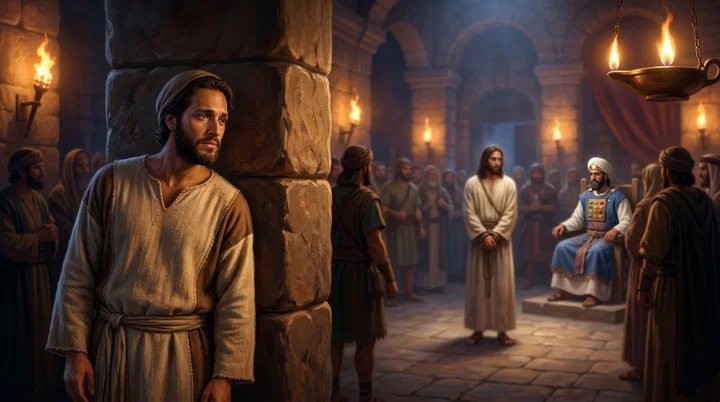
But Peter followed him afar off unto the high priest’s palace, and went in, and sat with the servants, to see the end.
Translations
But Peter followed him afar off to the high priest’s palace, and went in, and sat with the servants, to see the end.
King James Version, KJV Cambridge Paragraph Bible
But Peter followed him afar off unto the high priest’s palace, and went in, and sat with the servants, to see the end.
But Peter followed him at a distance, to the high priest's palace, and went in, and sat with the servants to see the end.
Revised Version, American Standard Version
But Peter followed him afar off, unto the court of the high priest, and entered in, and sat with the officers, to see the end.
and Peter was following him afar off, unto the court of the chief priest, and having gone in within, he was sitting with the officers, to see the end.
And Peter followed him at a distance, even to the palace of the high priest, and entering in sat with the officers to see the end.
Now, Peter, was following him afar off, unto the court of the High-priest,—and, entering within, was sitting with the attendants, to see the end.
Berean Standard Bible, Majority Standard Bible
But Peter followed Him at a distance, right up to the courtyard of the high priest. And he went in and sat down with the guards to see the outcome.
But Peter followed him from a distance to the court of the high priest, and entered in and sat with the officers, to see the end.
But Peter went after him at a distance, to the house of the high priest, and went in and took his seat with the servants, to see the end.
And Peter followed him a farre off vnto the hie Priestes hall, and went in, and sate with the seruants to see the ende.
Douay-Rheims (Challoner revision)
And Peter followed him afar off, even to the court of the high priest. And going in, he sat with the servants, that he might see the end.
Pictures
Cross-references
- Luke 22:54
Then took they him, and led him, and brought him into the high priest’s house. And Peter followed afar off.
Peter follows Jesus at a distance into the high priest’s house.
- John 18:15-16
And Simon Peter followed Jesus, and so did another disciple: that disciple was known unto the high priest, and went in with Jesus into the palace of the high priest.
John recounts Peter following Jesus to the high priest’s palace, where John helps him enter.
- Mark 14:54
And Peter followed him afar off, even into the palace of the high priest: and he sat with the servants, and warmed himself at the fire.
Peter follows Jesus at a distance and sits with the servants.
- Matthew 26:69-75
Now Peter sat without in the palace: and a damsel came unto him, saying, Thou also wast with Jesus of Galilee.
Peter’s distant following leads into his denial of Jesus and subsequent grief.
- John 18:17
Then saith the damsel that kept the door unto Peter, Art not thou also one of this man’s disciples? He saith, I am not.
A servant questions Peter after he follows Jesus at a distance, and Peter denies being his disciple.
- Matthew 27:1-2
When the morning was come, all the chief priests and elders of the people took counsel against Jesus to put him to death:
Continues Jesus’ trial and condemnation as he is delivered to Pilate.
- Matthew 26:47-50
And while he yet spake, lo, Judas, one of the twelve, came, and with him a great multitude with swords and staves, from the chief priests and elders of the people.
Judas identifies Jesus, and the crowd lays hands on him and takes him.
- Matthew 26:63-66
But Jesus held his peace. And the high priest answered and said unto him, I adjure thee by the living God, that thou tell us whether thou be the Christ, the Son of God.
Jesus is condemned after the high priest declares his words blasphemous.
- Matthew 26:67
Then did they spit in his face, and buffeted him; and others smote him with the palms of their hands,
Christ is spat upon and struck in the palace.
- Matthew 26:52
Then said Jesus unto him, Put up again thy sword into his place: for all they that take the sword shall perish with the sword.
Jesus rebukes Peter’s reliance on the sword and tells him to put it away.
- Luke 22:55
And when they had kindled a fire in the midst of the hall, and were set down together, Peter sat down among them.
Peter sat among those warming themselves by the fire.
- John 18:18
And the servants and officers stood there, who had made a fire of coals; for it was cold: and they warmed themselves: and Peter stood with them, and warmed himself.
Describes Peter warming himself at the fire among the servants.
- Luke 22:61
And the Lord turned, and looked upon Peter. And Peter remembered the word of the Lord, how he had said unto him, Before the cock crow, thou shalt deny me thrice.
Christ’s look broke Peter’s heart.
- Matthew 26:33-35
Peter answered and said unto him, Though all men shall be offended because of thee, yet will I never be offended.
Peter’s confident promise at the Last Supper contrasts with his later failure.
- John 18:10
Then Simon Peter having a sword drew it, and smote the high priest’s servant, and cut off his right ear. The servant’s name was Malchus.
Peter’s sword stroke preceded his flight.
- Luke 22:33
And he said unto him, Lord, I am ready to go with thee, both into prison, and to death.
Peter’s resolve to follow Jesus into prison and death contrasts with following afar off.
- Matthew 27:35-50
And they crucified him, and parted his garments, casting lots: that it might be fulfilled which was spoken by the prophet, They parted my garments among them, and upon my vesture did they cast lots.
Jesus is led to Calvary and crucified.
- Matthew 16:16
And Simon Peter answered and said, Thou art the Christ, the Son of the living God.
Peter confesses Jesus as the Christ, the Son of God.
- Matthew 26:41
Watch and pray, that ye enter not into temptation: the spirit indeed is willing, but the flesh is weak.
Peter’s failure to watch and pray illustrates the need to resist temptation.
- Matthew 27:11-26
And Jesus stood before the governor: and the governor asked him, saying, Art thou the King of the Jews? And Jesus said unto him, Thou sayest.
Jesus faces judgment before Pilate.
Commentary
Each commentary is drawn from primary sources: the writings of Ellen G. White and Adventist pioneers and periodicals. Each commentary is separate. Its own words are not a quotation; follow the references to read the source passages.
Ellen G. White
16 sources
Peter turned back after fleeing and trailed Jesus at a distance with John to the high priest's courtyard, where he went inside and sat with the servants and onlookers around the fire to watch how the trial would end.Ms 29, 1909, par. 2–4DA 710.2–711.15RED 27.2–33SP 107.2–3ST Jun 6, 1878 Jesus had been dragged as a prisoner through the dark streets before dawn to the palace of Caiaphas, where the council sat fully assembled to put Him on trial for His life in a mere mockery of justice.3SP 115.3–116.25RED 27.1ST Jun 13, 1878 Not wanting to be known as a disciple, Peter carelessly mingled with the hostile crowd to seem indifferent, and that compromise placed him in temptation that ended in denial with cursing and swearing.Ms 29, 1909, par. 2–45RED 27.1DA 710.2–711.15RED 27.2–33SP 107.2–3 His failure shows that even confident pledges of loyalty collapse without strength from above, and hiding faith for fear of ridicule or suffering is itself a denial of Christ.Ms 29, 1909, par. 2–45RED 27.1DA 710.2–711.1 Following afar off still warns against a half-hearted, timid service that stays outwardly near yet does not receive Christ as a personal Saviour, while following closely means imitating His life and principles until they are reproduced in a joyful and peaceful life.ST Oct 25, 1899Ms 1, 1867, par. 16–1811MR 108.2RH Oct 7, 1909
At the High Priest's Palace
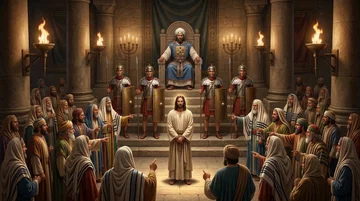
Jesus was hurried as a captive under insult and mockery through the dark streets before dawn to the palace of Caiaphas, the officiating high priest.3SP 115.3–116.25RED 27.1 He was brought into the judgment hall where the council was fully assembled to try Him for His life in what was only a mockery of an examination.3SP 115.3–116.25RED 27.1ST Jun 13, 1878 There Caiaphas presided, seated on the throne of judgment in gorgeous robe with glittering tiara and costly breastplate.3SP 115.3–116.2ST Jun 13, 1878 The judges and those specially interested in the trial were on either side, Roman soldiers were ranged on the platform below the throne, and the eyes of a multitude were upon Jesus amid wild excitement.3SP 115.3–116.2ST Jun 13, 1878
Against that splendor Jesus stood at the foot of the throne in coarse, homely garb.3SP 115.3–116.2ST Jun 13, 1878 Yet He was calm, serene, and majestic, and a holy influence emanated from Him and pervaded the atmosphere around Him.3SP 115.3–116.2ST Jun 13, 1878 This was He who had reigned in the courts of heaven, crowned and in garments of brightness attended by holy angels.3SP 115.3–116.2ST Jun 13, 1878 His bearing stood in strong contrast to the excited and malignant bearing of Annas and Caiaphas, who with their persecutors coarsely accused Him, sneeringly questioned Him, and reviled Him with the whole assembly.3SP 115.3–116.25RED 27.1 It was the coldest hour of the night before dawn, and a fire had been lighted in the hall with a company gathered around it standing and warming themselves, which is where Peter took his place.5RED 27.2–33SP 107.2–3ST Jun 6, 1878
Peter's Dangerous Compromise
After deserting Jesus in the garden, Peter with John followed at a distance to the palace, entered the high priest's court, and sat with the servants and the people to see the end and to watch the mock trial.Ms 29, 1909, par. 2–4DA 710.2–711.15RED 27.2–33SP 107.2–35RED 33.1 John was well known as a disciple and was admitted into the hall where Jesus was questioned, then he spoke for Peter and obtained entrance for him also.5RED 27.2–33SP 107.2–3 With John's help Peter came inside and took his place with the company gathered around the fire to warm himself.5RED 27.2–33SP 107.2–3
Peter did not wish to be recognized as a disciple, so he presumptuously mingled carelessly with the crowd around the fire to appear indifferent and to be taken for one of those who had brought Jesus there.DA 710.2–711.15RED 27.2–33SP 107.2–3ST Jun 6, 1878 That effort to seem unconcerned placed him among those hostile to his Master.DA 710.2–711.1 He stood and warmed himself with the rest in the coldest hour of the night before dawn when the fire had been lighted in the hall.5RED 27.2–3ST Jun 6, 1878
That attempt to appear indifferent exposed him to temptation and led to his denial.DA 710.2–711.1 His presence there leads into the account of his denial with cursing and swearing, showing that even a disciple who had confidently pledged faithfulness could fail in time of trial without strength from above.Ms 29, 1909, par. 2–45RED 27.1 Disguising faith from fear of ridicule or suffering is itself a denial of Christ.DA 710.2–711.1
While enduring coarse accusation, sneering questioning, and reviling in a mockery of an examination, Jesus was pierced more keenly by hearing His beloved disciple deny Him than by anything His enemies inflicted.5RED 27.1 Peter and John's presence mattered because public testimony about Jesus' works could have vindicated Him and turned the people against the Sanhedrin's secret proceedings.5RED 33.1
Following Christ Closely Today
Following at a distance warns that being outwardly near Christ brings no blessing when faith is only casual, for true faith trusts God's word and power rather than merely pressing close among others where He is present.ST Oct 25, 1899 Following far off pictures a half-hearted service that is timid and cowardly, shaped by love of the world and of self and by love of frivolous amusements.Ms 1, 1867, par. 16–1811MR 108.2 It pictures professing believers who do not receive Christ as a personal Saviour and do not practically receive His grace and righteousness into the life.RH Oct 7, 1909 In them the gospel fails to become saving power, not because the gospel is deficient, but because they do not follow closely.RH Oct 7, 1909
Staying at a distance instead of hiding in Jesus and depending on Him entirely reveals wrong ideas of Christ and of Christian character.Lt 26, 1893, par. 17–23 It shows itself by excuses, by refusal to take hold in earnest, and by an unchristlike course of life.Lt 26, 1893, par. 17–23 In that state a person is not converted and is lost unless he becomes a converted man.Lt 26, 1893, par. 17–23 Following closely means imitating His life, habits, and principles from correct knowledge of them, so that those principles are reproduced in a Christlike life.Ms 1, 1867, par. 16–1811MR 108.2 Wholehearted service to Him produces a joyful, peaceful Christian life.Ms 1, 1867, par. 16–18
Following fully means staying near Him rather than following afar off.Lt 23, 1890, par. 46 The proper response to reproof for keeping too far from Him is to resolve to draw nearer to God.ST Jul 22, 1875 Conversion brings recognition of one's mistakes with genuine repentance.Lt 23, 1890, par. 46
Sources
Pioneers and periodicals
63 sources
After his Master was arrested at night and all the disciples fled, Peter followed at a distance to the palace and court of Caiaphas the high priest, and through another disciple's influence went in and sat with the servants and officers around the fire to see the end.ST Apr 29, 1897ST Mar 6, 1901ST Feb 3, 1909ST Mar 27, 1901ST Aug 8, 1906 He followed because he could not forget his Lord, still drawn by love and curiosity even while offended and smarting under rebuke, yet unwilling to be recognized as his disciple for fear of ridicule and suffering.ST Mar 14, 1906ST Aug 8, 1906ST Mar 14, 1906ST Jan 31, 1911ST Aug 8, 1906 He waited at a distance hoping Jesus would still use divine power to scatter his enemies as before, so he could avoid openly identifying himself until there might be opportunity to fight for him.ST Mar 14, 1906ST Aug 8, 1906ST Dec 30, 1889 That distance was the secret of his denial, for by separating himself and mingling with unbelievers to conceal his discipleship he placed himself on the enemy's ground in the way of temptation, where he could not watch and pray and receive strength to resist.ST Aug 8, 1906ST Dec 30, 1889ST Aug 8, 1906ST Aug 8, 1906ST Aug 8, 1906 Safety is to keep close to Jesus at all hazards, going in with him even to the judgment hall and to death and never following afar off, for those who walk closely are beyond temptation's reach.ST Aug 8, 1906ST Dec 30, 1889ST Mar 14, 1906RH May 9, 1907ST Oct 9, 1901
Arrest and Trial Setting
After the arrest Peter followed at a distance to the palace and court of Caiaphas the high priest, where the scribes and the elders were gathered together, and he went in and sat with the officers and servants to see the end, remaining near Jesus but not openly standing with him.ST Mar 6, 1901ST Feb 3, 1909ST Mar 27, 1901RH Feb 5, 1914RH Feb 13, 1872 The assembly at Caiaphas's house included the Sanhedrin, priests, scribes and elders, men whose teachings and conduct Jesus had publicly condemned.ST Mar 27, 1901 This entering of the high priest's palace to watch what would happen belongs among the proofs that Christ's church uses spiritual means rather than force.ST Sep 3, 1894
The verse belongs to the account of the Messiah's rejection and suffering, showing his arrest and the events leading to his trial as part of his being despised and rejected, on the day of his crucifixion, a day made more memorable than any other in his history because he gave his life for sinful humanity.RH Nov 18, 1862RH Feb 13, 1872 In the chronology set out, Jesus was arrested at night and taken straight to trial.RH Feb 5, 1914 The taking before the Jewish authorities stands in the sequence from Annas's condemnation to Caiaphas's condemnation and then to Pilate's death sentence.ST Dec 24, 1912
This following came after all the disciples forsook Jesus and fled and after the young man, probably Mark, who followed with him fled when seized, leaving Jesus alone with his enemies to be bound with an utterly needless precaution and taken first to Annas the former high priest, father-in-law to Caiaphas who then held office, as the leaders sought to allay jealousy and unite all possible against him.ST Mar 14, 1906 The judgment hall held the council with Caiaphas presiding on the throne of judgment in gorgeous robe with glittering tiara and costly breastplate, Jesus standing at its foot to be tried for his life calm and serene and majestic in coarse clothing, though he had reigned in the courts of heaven crowned and in garments of brightness attended by holy angels.ST Jun 13, 1878 Judges and those specially interested in the trial sat on either side, Roman soldiers were ranged on the platform below the throne, and a multitude kept their eyes upon Jesus amid wild excitement while a holy influence pervaded the air.ST Jun 13, 1878
There Jesus as accused culprit met Caiaphas as judge and was condemned at the highest court of his own nation, the Sanhedrin, as a malefactor and false prophet for blasphemy, not for breaking the Sabbath, the Sabbath-breaking charge having arisen on other occasions when he healed people.ST Dec 6, 1883RH Feb 16, 1911ST Mar 6, 1901 The meeting of the two persons is of world-wide and ages-long import, with vital lessons centered on the name, character, mission and end of each around whom all its events revolve.ST Mar 6, 1901 The surrounding mockery and rejection show how quickly hollow homage gives way to open outrage.RH Dec 29, 1863
Peter entered through John's influence and, admitted within, did not stand beside Jesus but took his place with the company around a fire lighted in the hall in the coldest hour of the night before dawn, standing and warming himself with the servants and soldiers.ST Apr 29, 1897ST Jun 6, 1878ST Aug 8, 1906ST Dec 30, 1889ST Aug 8, 1906 He mingled carelessly with those who had brought Jesus there and with the mocking crowd, hoping to blend in and be mistaken for one of them because he did not want to be recognized as Jesus' disciple.ST Apr 29, 1897ST Jun 6, 1878ST Aug 8, 1906 Instead of going to Jesus he waited to see what would happen before openly identifying himself, and that distance and failure to watch and pray left him vulnerable and began the course that led to denial when questioned.ST Aug 8, 1906ST Dec 30, 1889ST Aug 8, 1906
Why Peter Followed Afar
Peter followed because he could not forget his Lord or let Him go, still drawn by love and curiosity even while offended and smarting under the Master's rebuke for the sword.ST Mar 14, 1906ST Aug 8, 1906ST Aug 8, 1906ST Jan 10, 1911 His was the divided and hesitant course of one who loves the Lord yet does not follow closely.ST Aug 8, 1906ST Aug 8, 1906RH May 29, 1855 He expected Jesus still to use divine power and authority to scatter His enemies and defeat them as he had seen Him do in cleansing the temple, so he waited to see what would happen before openly identifying himself.ST Mar 14, 1906ST Aug 8, 1906ST Dec 30, 1889ST Aug 8, 1906 He hoped there might still be opportunity to fight for Christ and to prove how valiant was his heart and how strong his right hand.ST Mar 14, 1906
That motive shows he had learned little of the spirit of his Master and the principles of His kingdom.ST Mar 14, 1906 His earlier attempt to defend Jesus with the sword did not prove true courage or regenerated life but revealed human aggressiveness.ST Mar 14, 1906RH Feb 5, 1914 It warns all who profess His name yet would promote and advance His kingdom by carnal means, which profit nothing, for all who take the sword perish with the sword.ST Mar 14, 1906
After his will was crossed and his sword taken from him, his earlier readiness to follow to prison and death failed in a smaller difficulty.ST Jan 18, 1916 Now that Jesus' cause was unpopular he did not want to face ridicule, persecution and suffering with Him.ST Mar 14, 1906ST Jan 10, 1911 His fear of being identified, trembling before scorn and unable to bear reproach, led him anxiously to hide his connection in cowardice and failure of loyalty when association might bring danger.ST Mar 14, 1906ST Jan 31, 1911ST Jan 10, 1911 His conduct stands as a lasting record that zeal for Christ's cause can coexist with distance from Christ.ST Jan 17, 1900
He wanted both to stay safe after escaping arrest and to see what would happen.ST May 3, 1899 That physical distance reflected spiritual coldness and lack of closeness to the Master.RH May 29, 1855ST Feb 16, 1915 It was a following without faith that walks by sight in its own wisdom and strength and traditions and stays so far behind what is followed that it never catches up.RH May 29, 1855ST Feb 16, 1915ST Apr 23, 1902
Distance Leads to Denial
Peter's denial is explained by his distance after he refused repeated reproof and grew sensitive under it, for in separating himself from Jesus and following at a distance he became open to the enemy's temptation and made Satan's success possible.ST Dec 30, 1889ST Aug 8, 1906ST Aug 8, 1906ST Aug 8, 1906 To follow afar off is to let reproof stir selfish resentment and to brood over it until Christ is far ahead, and to let pride, ambition, avarice, greed and pleasure come between the soul and Christ.ST Aug 8, 1906ST Dec 30, 1889ST Aug 8, 1906 When that happens words and acts and looks no longer proclaim discipleship, so that others must ask whether one is His disciple, and there is reason to fear a denial that brings rebuke and humiliation.ST Aug 8, 1906ST Dec 30, 1889
Instead of going to Jesus, Peter sat indifferently warming himself among servants, soldiers and scoffers in the high priest's palace, having entered through John's influence while still drawn by love and curiosity yet waiting to see what would happen before openly identifying himself.ST Aug 8, 1906ST Aug 8, 1906ST Dec 30, 1889ST Aug 8, 1906 He mingled with unbelievers and copied their speech and conduct to conceal his Christian identity, which put him on the enemy's ground in the way of temptation and left him with no assurance against denying the Lord.ST Aug 8, 1906RH Jul 13, 1911ST Jan 14, 1886 That anxious effort to hide was his first step into compromise, showing that serious failure begins by drawing away through small steps.ST Mar 14, 1906ST Apr 20, 1882 His failure to watch and pray began the course that led to repeated denials when questioned, for though a strong man who trembled before scorn and could not bear reproach, he could not endure the ridicule of a simple maid and thrice denied with cursing that he knew his Lord.ST Mar 14, 1906ST Dec 30, 1889ST Apr 20, 1882ST Jan 10, 1911
Had he stayed close to Jesus his every word and act and look would have proclaimed that he loved Jesus above all earthly flattery or gain, the question whether he was also one of His disciples would never have been asked, and he would have been less vulnerable and could have received strength to resist.ST Dec 30, 1889ST Aug 8, 1906ST Aug 8, 1906ST May 3, 1899 Safety is to keep with Jesus at all hazards, going in with Him even to the judgment hall, to condemnation, to loss of reputation and to death, and never to be found following afar off.ST Aug 8, 1906ST Dec 30, 1889ST Aug 8, 1906 It is better to be with Christ even amid suffering than to be without Him even in blessedness, following with Him in trial and suffering up to Calvary just as in glory and honor on the Mount of Transfiguration and in the triumphal entry.ST Mar 14, 1906RH Jun 8, 1869 Christian perfection is resolutely following Christ through suffering rather than seeking rare spiritual experiences or constant ecstatic joy.RH Aug 14, 1860
Following afar off means shrinking from trials and crosses instead of cheerfully bearing them, forgetting precious promises and yielding to doubts, fears, discouragement and lack of faith and fortitude, thereby denying the Lord if not in word at least in spirit.RH Jun 8, 1869 It means trying to have both worlds by keeping a distant half-hearted connection while seeking this world and its pleasures, a divided service that brings little joy and leaves Christians joyless and spiritless.RH Jan 14, 1915 It is applied to neglecting soul-saving work, prayer and missionary meetings and other means of grace.RH Jul 13, 1911 Being near Christ outwardly with only casual faith brings no blessing, for true faith trusts God's word and power rather than merely pressing close, and the disciples' nearby presence while seeking safety and relief from a sore conscience did not amount to the sympathy and understanding He needed.ST Oct 25, 1899RH May 26, 1904 Yet Peter's failure shows that even someone who has followed Christ can fall, and God meets the returning sinner with forgiving tenderness.RH Oct 31, 1912
Warning for Believers Today
To follow at a distance is to court denial, and the warning is never to follow at a distance but to follow with him and keep close under all circumstances.ST Jul 22, 1875ST Mar 14, 1906RH May 9, 1907ST Oct 9, 1901ST Nov 24, 1887 This is no time to follow afar off, but to draw near in trust and friendship relying on his unfailing care and to walk as closely with him as can be.ST Jul 22, 1875RH May 9, 1907ST Nov 24, 1887RH Jan 5, 1860 Those who walk closely are beyond temptation's reach, while distance lets the enemy come between the believer and the compassionate Redeemer.ST Oct 9, 1901ST Nov 24, 1887 It is better to be with Christ even amid suffering than to be without him even in blessedness, in trial and suffering as in the judgment hall and toiling up to Calvary just as in glory and honor as on the Mount of Transfiguration and in the triumphal entry.ST Mar 14, 1906
His church uses spiritual means rather than force, and his arrest and bringing before the high priest stands joined to religious authorities acting alongside armed force.ST Sep 3, 1894RH Jul 23, 1914 Peter followed after all the disciples forsook and fled and after the young man, probably Mark, who followed with him fled when seized, leaving Jesus alone with his enemies to be bound with an utterly needless precaution and taken to Annas the former high priest, father-in-law to Caiaphas who then held office, as the leaders sought to allay jealousy and unite all possible against him.ST Mar 14, 1906 Peter could not forget his Lord or leave him even while smarting under the rebuke for his use of the sword, and he followed and entered the palace to see what would happen, hoping there might still be opportunity to fight for Christ.ST Mar 14, 1906ST Sep 3, 1894 He expected the Master still to assert authority as he had seen him do in cleansing the temple, so that he could prove how valiant was his heart and how strong his right hand, which shows he had learned little of the spirit of his Master and the principles of his kingdom.ST Mar 14, 1906 All who profess his name yet seek to promote and advance his kingdom by carnal means are warned that such means profit nothing, for all who take the sword perish with the sword, and seeking to advance his kingdom by the gospel of force is of men not of God.ST Mar 14, 1906
Keeping Christ at a distance amid a crowd drawn to conflict and curiosity dulls devotion and can lead one to join those who mock him, and the call is to close faithful following through life rather than distance that lets the enemy come between the believer and the compassionate Redeemer.ST Apr 14, 1914ST Nov 24, 1887 Distant fellowship exposes a disciple to severe temptation and the danger of separating from him, for physical distance reflects spiritual coldness and lack of closeness.ST Feb 16, 1915ST Jan 14, 1886 Those who do not stay close may go on to deny him in word and through their actions, as distant following led Peter to deny his Master when it became easy so far away to deny knowing him.RH Oct 5, 1911ST Feb 16, 1915 Peter followed at a distance and joined the servants in the palace watching to see what would happen, illustrating how people who do not stay close to the Lord may go on to deny him.RH Oct 5, 1911ST Jan 14, 1886
Following afar off is applied to neglecting soul-saving work, prayer and missionary meetings and other means of grace, and to mingling with unbelievers and copying their speech and conduct to conceal Christian identity, which places a person on the enemy's ground in the way of temptation.RH Jul 13, 1911 Peter's placing himself among the servants and his prior decision not to be identified left him vulnerable when the test came, and his denial followed that choice.RH Jul 13, 1911 Avoidable absence from church and neglect of Christian fellowship is infallible evidence of that spiritual decay, for disciples who first follow at a distance afterwards do not know him.RH Jul 13, 1911RH Dec 31, 1914RH May 9, 1865 The phrase describes a lack of full commitment in young people urged to see the privileges of service and follow wholly, and in those who have drifted and need to return in repentance to a closer walk with God.RH Mar 18, 1909RH May 9, 1912ST Feb 16, 1882
Following at a distance pictures professing believers who do not receive Christ as personal Saviour, in whom the gospel fails to become saving power not because the gospel is deficient but because they do not follow closely and practically receive his grace and righteousness.RH Oct 7, 1909 Following without staying close is linked to reproving wrong without Christ's spirit and to being removed from public work, as seen when Peter followed at a distance and entered the palace.RH Oct 12, 1916 Delaying to overcome a reluctant spirit brings sure consequences including loss of blessing.RH Oct 2, 1900
Sources