Translations
What think you? They answered and said, He is guilty of death.
King James Version, KJV Cambridge Paragraph Bible, Webster Bible
What think ye? They answered and said, He is guilty of death.
Revised Version, American Standard Version
what think ye? They answered and said, He is worthy of death.
what think ye?' and they answering said, 'He is worthy of death.'
What think ye? And they answering said, He is liable to the penalty of death.
How, to you, doth it seem? And, they, answering, said: Guilty of death, he is.
Berean Standard Bible, Majority Standard Bible
What do you think?”“ He deserves to die,” they answered.
What do you think?”They answered, “ He is worthy of death!”
What is your opinion? They made answer and said, It is right for him to be put to death.
What thinke yee? They answered, and said, He is guiltie of death.
Douay-Rheims (Challoner revision)
What think you? But they answering, said: He is guilty of death.
Pictures

Cross-references 20 of 32
- Mark 14:64
Ye have heard the blasphemy: what think ye? And they all condemned him to be guilty of death.
The council condemns Jesus as guilty of death after hearing the blasphemy accusation.
- Matthew 27:11-26
And Jesus stood before the governor: and the governor asked him, saying, Art thou the King of the Jews? And Jesus said unto him, Thou sayest.
Continues the account of Jesus’ condemnation before Pilate and the call for his crucifixion.
- Luke 22:66-71
And as soon as it was day, the elders of the people and the chief priests and the scribes came together, and led him into their council, saying,
The council questions Jesus’ identity and responds to his claim with a verdict of condemnation.
- John 18:13-14
And led him away to Annas first; for he was father in law to Caiaphas, which was the high priest that same year.
Jesus is brought first to Annas, while Caiaphas had already counseled that he should die.
- John 18:31
Then said Pilate unto them, Take ye him, and judge him according to your law. The Jews therefore said unto him, It is not lawful for us to put any man to death:
The Jewish leaders said they lacked authority to execute Jesus and sought Roman judgment.
- Matthew 27:35-50
And they crucified him, and parted his garments, casting lots: that it might be fulfilled which was spoken by the prophet, They parted my garments among them, and upon my vesture did they cast lots.
Jesus undergoes crucifixion and dies, fulfilling the sentence of death.
- Luke 23:14
Said unto them, Ye have brought this man unto me, as one that perverteth the people: and, behold, I, having examined him before you, have found no fault in this man touching those things whereof ye accuse him:
Pilate declared Jesus innocent before the council condemned him to death.
- Acts 2:23
Him, being delivered by the determinate counsel and foreknowledge of God, ye have taken, and by wicked hands have crucified and slain:
Jesus’ death fulfilled God’s purpose, yet those who condemned and crucified him remained accountable.
- John 19:13
When Pilate therefore heard that saying, he brought Jesus forth, and sat down in the judgment seat in a place that is called the Pavement, but in the Hebrew, Gabbatha.
Pilate brought Jesus to the judgment seat before the crowd’s verdict was carried out.
- Matthew 26:59
Now the chief priests, and elders, and all the council, sought false witness against Jesus, to put him to death;
The leaders seek testimony to condemn Jesus.
- Matthew 27:1
When the morning was come, all the chief priests and elders of the people took counsel against Jesus to put him to death:
Continues the account with the council’s next action.
- Matthew 26:57
And they that had laid hold on Jesus led him away to Caiaphas the high priest, where the scribes and the elders were assembled.
Jesus is brought before the high priest and council.
- Isaiah 53:7
He was oppressed, and he was afflicted, yet he opened not his mouth: he is brought as a lamb to the slaughter, and as a sheep before her shearers is dumb, so he openeth not his mouth.
Jesus silent before accusers
- Isaiah 53:8-9
He was taken from prison and from judgment: and who shall declare his generation? for he was cut off out of the land of the living: for the transgression of my people was he stricken.
Foretells the Messiah’s condemnation and death.
- Mark 15:1
And straightway in the morning the chief priests held a consultation with the elders and scribes and the whole council, and bound Jesus, and carried him away, and delivered him to Pilate.
Continues the council’s proceedings in Mark’s account.
- Luke 23:23-24
And they were instant with loud voices, requiring that he might be crucified. And the voices of them and of the chief priests prevailed.
The crowd demanded Jesus’ crucifixion, and Pilate sentenced him.
- Acts 3:13-14
The God of Abraham, and of Isaac, and of Jacob, the God of our fathers, hath glorified his Son Jesus; whom ye delivered up, and denied him in the presence of Pilate, when he was determined to let him go.
Peter accused the people of rejecting Jesus and choosing his death.
- John 19:7
The Jews answered him, We have a law, and by our law he ought to die, because he made himself the Son of God.
They specified blasphemy as the basis for their death sentence.
- John 2:19
Jesus answered and said unto them, Destroy this temple, and in three days I will raise it up.
Jesus’s temple saying was used as a charge against him.
- John 19:6
When the chief priests therefore and officers saw him, they cried out, saying, Crucify him, crucify him. Pilate saith unto them, Take ye him, and crucify him: for I find no fault in him.
The chief priests and officers cry, “Crucify him.”
Commentary
Each commentary is drawn from primary sources: the writings of Ellen G. White and Adventist pioneers and periodicals. Each commentary is separate. Its own words are not a quotation; follow the references to read the source passages.
Ellen G. White
18 sources
The council answered the high priest's demand by declaring Jesus deserving of death under sentence of death.COS 130.1–2DA 698.1–700.5DA 698 This was the verdict of the night trial before Caiaphas the presiding high priest and the Sanhedrin in the palace judgment hall, held in the dark early morning after Jesus was hurried through dark streets by an armed band.DA 6983SP 115.3–116.25RED 27.1 It was drawn from His own public confession under solemn oath that He was the Christ, the Son of God, who would sit at the right hand of power and come in the clouds of heaven.COS 130.1–2Ms 51, 1897, par. 125RED 39.3–40.2 The condemnation was an unjust, hostile and predetermined proceeding where false testimony was arranged yet no charge could be proved against His faultless life, in violation of their own rules of justice.Ms 51, 1897, par. 12DA 698.1–700.55RED 35.3–36.2 The One thus condemned as worthy of death is the Lord of life and future Judge of heaven and earth, who will come with power and great glory escorted by angels to pronounce sentence on His enemies and judge every person according to deeds.ST Jun 27, 18783SP 120.2–121.1DA 707.2–708.1
Trial Setting and Verdict
The answer “He is guilty of death” belongs to the night trial before Caiaphas the officiating high priest and the Sanhedrin council in the palace judgment hall, held in the very dark early morning after Jesus had been hurried through dark and narrow streets by an armed band with torches and lanterns amid insult and mockery.DA 6983SP 115.3–116.25RED 27.1 It was a mockery of an examination in which He was coarsely accused by His persecutors, sneeringly questioned by the priest, and reviled by the whole assembly.5RED 27.1 His keenest pang in that place came not from His enemies but from hearing His beloved disciple deny Him with cursing and swearing.5RED 27.1
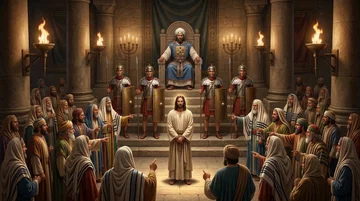
In the hall Caiaphas sat as presiding officer on the throne of judgment, with judges and specially interested parties ranged on either side and Roman soldiers ranged on the platform below, while the watching multitude looked on.3SP 115.3–116.2ST Jun 13, 1878 Jesus stood at the foot of the throne in coarse clothing to be tried for His life before the multitude.3SP 115.3–116.2ST Jun 13, 1878 He stood calm and serene and majestic, with dignified bearing and a holy, God-like presence from which a holy influence emanated.3SP 115.3–116.2ST Jun 13, 1878 That presence was in strong contrast to the excited, malignant, sneering haughtiness of Annas and Caiaphas in gorgeous priestly robe with glittering tiara and costly breastplate once flashed with God’s glory.3SP 115.3–116.2ST Jun 13, 1878 The contrast reveals who was truly being judged, for Jesus in coarse, homely garb had reigned crowned in the courts of heaven, clothed in brightness and attended by holy angels.3SP 115.3–116.2ST Jun 13, 1878 Even the hardened multitude questioned whether a man of such presence should be sentenced as a common criminal, and Caiaphas himself was momentarily struck with admiration and conviction that this man was akin to God.3SP 115.3–116.2ST Jun 13, 1878 He banished the thought and in sneering, haughty tones demanded a mighty miracle, which Jesus ignored, and perceiving the influence turning in Jesus’ favor he hastened the trial toward death.3SP 115.3–116.2ST Jun 13, 1878
The verdict was secured by Jesus’ own public, voluntary confession under the most solemn oath.5RED 39.3–40.2ST Jun 27, 18783SP 120.2–121.1 When adjured by the living God by the highest authority in the nation, He answered Thou hast said, declaring Himself to be the Christ, the Son of God, the Judge of the world who would sit on the right hand of power and come in the clouds of heaven.COS 130.1–2Ms 51, 1897, par. 125RED 39.3–40.2ST Jun 27, 18783SP 120.2–121.1 At that declaration the high priest rent his garments to display pretended horror, to appear jealous for the insulted majesty of heaven, and to rouse the excited people to violence.COS 130.1–2Ms 102, 1897, par. 5–6ST Jun 27, 18783SP 120.2–121.1 Lifting his hands toward heaven, he charged blasphemy needing no further witnesses or preliminaries and demanded immediate condemnation.COS 130.1–2Ms 102, 1897, par. 5–6ST Jun 27, 18783SP 120.2–121.1 He then put the question to the council for their decision, asking What think ye.COS 130.1–2Ms 102, 1897, par. 5–6ST Jun 27, 1878
In answer the assembled priests, judges, chief priests and elders all declared Him deserving of death and guilty under sentence of death.COS 130.1–2DA 6985RED 39.3–40.25RED 35.3–36.2ST Feb 5, 1880 The answer was given in exulting yet hidden malicious satisfaction, in hypocrisy and unbelief, with the judges pressing close and repeating the question whether He was the Christ.3SP 120.2–121.1 Their hearts were set against the light of heaven, so that no tracing of prophecy about the Messiah and no mighty miracles could make them believe or release Him.Ms 51, 1897, par. 123SP 120.2–121.1
Unjust Condemnation and Reversal
The death sentence was not the finding of a fair inquiry but the object of a hostile, secret, mock proceeding entered upon with a prior determination to secure death.DA 698.1–700.55RED 35.3–36.25RED 33.1 False statements, testimony and accusations were arranged to present Him in the worst possible light, yet no charge could be substantiated from the witnesses though His life and teaching were faultless.Ms 51, 1897, par. 125RED 35.3–36.2ST Feb 5, 1880Lt 50, 1889, par. 6–9 The methods violated their own rules of justice, sought charges that would satisfy both Jewish and Roman authorities, and kept the proceeding secret so the people could not testify in His defense, lest public vindication condemn the council, secure His release and restore Him to honor.DA 698.1–700.55RED 33.1
The judges acted in jealousy and fear that He would gain authority, in hypocrisy and unbelief and hidden yet exulting malicious satisfaction, with hearts set against the light of Heaven.3SP 120.2–121.1ST Feb 5, 1880 They rejected Him as king and refused belief though confronted with tracings of prophecy concerning the Messiah and with mighty miracles, blind to the prophecies they themselves were fulfilling.Ms 51, 1897, par. 123SP 120.2–121.1ST Feb 5, 1880
Caiaphas, a Sadducee, was cut to the quick because Christ's testimony assailed his cherished denial of the resurrection of the dead and of a future reckoning in which all stand before God to be rewarded according to works.Ms 102, 1897, par. 5–6 There opened momentarily before him a panorama of the final judgment, with graves giving up their dead and hidden secrets exposed and himself standing with soul laid open before the all-seeing eternal Judge.Ms 102, 1897, par. 5–6 Even His Godlike presence convicted Caiaphas for a moment, with admiration, that this man was akin to God.3SP 115.3–116.2ST Jun 13, 1878
He banished the conviction, was maddened, and in sneering haughty tones demanded a mighty miracle which Jesus ignored; then, perceiving an influence working in Jesus' favor even among the hardened multitude, he hastened the trial.Ms 102, 1897, par. 5–63SP 115.3–116.2ST Jun 13, 1878 By rending his priestly garment in pretended zeal to display horror and appear jealous for the insulted majesty of Heaven, he did the very thing God had commanded should not be done, and so stood himself under God's condemnation.Ms 102, 1897, par. 5–6Ms 102, 1897, par. 15–16 Beneath a gorgeous priestly dress covering a wicked heart he acted under Satan's inspiration and did the work of the enemy of God, and by that rending he ended his own priesthood and disqualified himself for the priestly office though he still acted as priestly judge and officiating high priest.Ms 102, 1897, par. 15–16 Afterward he could not act without unreasonable passion, scourged by a tortured conscience but without the sorrow that leads to repentance.Ms 102, 1897, par. 15–16
Jesus knew His announcement would secure His condemnation and so gave the designing priests their object and advantage.5RED 39.3–40.2ST Jun 27, 18783SP 120.2–121.1 That condemnation unleashed satanic fury, so that the people roared like wild beasts and rushed upon bound Jesus demanding His death.3SP 122.1–3 Only the interference of the Roman soldiers by force of arms held back the violence of the mob and kept Him from being torn in pieces before His judges, preserving Him to be hanged on the cross of Calvary.3SP 122.1–3
The scene is a reversal, for the One condemned as deserving death and under a death sentence is the Lord of life and glory and the future Judge of all the earth.ST Jun 27, 1878DA 707.2–708.1 He will be seated at the right hand of God as supreme Judge of heaven and earth from whose decision there is no appeal, and instead of being surrounded and abused by a riotous mob headed by priests and judges He will come in the clouds of heaven with power and great glory escorted by legions of angels to pronounce sentence on His enemies and judge every person according to deeds.ST Jun 27, 1878DA 707.2–708.1
By killing Him to keep Him from gaining authority, His enemies brought about the very outcome they meant to prevent, for Christ became the Redeemer of mankind and Saviour of the world.ST Feb 5, 1880 God's providential use of their crime for good did not lessen their guilt.ST Feb 5, 1880
Sources
Pioneers and periodicals
43 sources
He was condemned to death by the council after the high priest tore his robes as if hearing blasphemy and called for their judgment.ST May 27, 1889ST Mar 6, 1901ST Mar 6, 1901 The charge that brought the verdict was His own sworn confession that He was the Christ the Son of God, with the added claim that they would see Him seated at the right hand of power and coming in the clouds of heaven.ST Jun 27, 1878RH Feb 8, 1915ST Dec 1, 1898ST Feb 20, 1901 The court judged Him a blasphemer deserving death under their religious law, a sentence they could pronounce but had no authority to carry out.ST Mar 15, 1877ST Mar 28, 1911ST Dec 24, 1912 It was therefore taken to Pilate to be confirmed and executed, and He was finally crucified by Rome not for blasphemy but on the changed political charge of treason for claiming to be King.ST Mar 15, 1877ST Oct 14, 1913ST Oct 1, 1896ST Mar 15, 1877 The condemnation was unjust bigotry from men who refused to test His claims by Scripture, hated His reproof of their sin, and feared His authority, yet in that same confession He declared the reversal when He will come in glory with angels as supreme Judge to pronounce sentence on His enemies.ST Jun 27, 1878ST Feb 5, 1880RH Nov 18, 1862ST Jun 18, 1912ST Sep 2, 1889
Trial Setting and Sequence
The condemnation was pronounced at night before Caiaphas the high priest, after Jesus had been bound though binding was utterly needless.ST Mar 14, 1906ST Mar 28, 1906 He was taken first to Annas, the former high priest and father-in-law of Caiaphas who then held the office, in order to allay all jealousy and unite all possible opposition against Him.ST Mar 14, 1906 There He was examined while Peter denied Him.ST Mar 28, 1906
The same verdict also covers the morning decision of the elders and chief priests and scribes, after they led Jesus into their council and asked if He was the Son of God and He answered Ye say that I am.ST Jun 18, 1912 It belongs to the account of the arrest and trials and to passion week.ST Feb 3, 1909ST Mar 28, 1906 It fell within the day of His crucifixion.RH Feb 13, 1872
It took place in the judgment hall, where Caiaphas sat as presiding officer on the throne of judgment with judges and interested parties on either side and Roman soldiers ranged on the platform below.ST Jun 13, 1878 Jesus stood at the foot of the throne in coarse clothing before the multitude, calm, serene, dignified and majestic with a holy influence emanating from Him.ST Jun 13, 1878 This stood in strong contrast to the excited, malignant, sneering haughtiness of Annas and Caiaphas in gorgeous robe with glittering tiara and costly breastplate.ST Jun 13, 1878
He stood alone as an accused culprit before the highest court of His own nation, with Caiaphas sitting as judge and head of that court.ST Mar 14, 1906ST Mar 6, 1901 All the disciples had forsaken Him and fled in the Garden, with even the young man, probably Mark, who followed Him fleeing when they sought to take him.ST Mar 14, 1906 The decision was not a mere incident of a day in the life of the nation but an event of world-wide and ages-long importance.ST Mar 6, 1901
The trial before the high priest was one of three trials by the high priest, Pilate, and Herod the king.ST Mar 15, 1877 It lay on the path from the palace of a proud Caiaphas to the judgment hall of an unjust Pilate and to an ignominious Calvary.RH Aug 14, 1860 After the death sentence the execution was carried into effect by the Romans as an execution, not an assassination.ST Mar 15, 1877
Words and Legal Force
After tearing his garments and declaring that affirming to be the Christ, the Son of God, who would sit at the right hand of power and come on the clouds of heaven was blasphemy, Caiaphas put the question what think ye to the council.ST May 27, 1889ST Mar 6, 1901ST Mar 6, 1901 They answered by declaring Him worthy of death and pronouncing Him guilty of a capital offense.ST May 27, 1889ST Mar 6, 1901ST Mar 6, 1901 That verdict secured the condemnation the priests had sought, and was followed at once by spitting in His face and buffeting and mocking Him.ST May 27, 1889ST Mar 6, 1901
The council thus convicted Him of blasphemy and judged Him deserving of death under Jewish ecclesiastical law.ST Mar 15, 1877ST Mar 28, 1911ST Dec 24, 1912 In so doing they judged Him a false prophet and a malefactor.ST Mar 15, 1877RH Feb 16, 1911 They could pronounce the sentence of death but lacked authority to carry the death penalty into effect.ST Mar 15, 1877ST Mar 28, 1911ST Dec 24, 1912
The Jewish sentence was therefore taken from Caiaphas to Pilate so that he could confirm and approve it and carry it into effect.ST Mar 15, 1877ST Oct 14, 1913 Pilate and Herod refused to carry out that Jewish sentence because blasphemy under Jewish religious law was no crime under Roman law, and they intended to release Him.ST Mar 15, 1877 Even though the Roman governor found no fault in Him, Pilate later passed the sentence despite declaring that he found no fault and no crime in Him.ST Mar 15, 1877ST Dec 24, 1912ST May 17, 1905
He was therefore not finally executed for blasphemy but was afterward condemned and crucified by Pilate on the changed political charge of high treason against Caesar for claiming to be King.ST Mar 15, 1877 The charge was also cast as a crime against the Roman state, portraying Him as an enemy of Caesar, showing how religious persecution can be justified as defense of civil authority.ST Mar 15, 1877ST Oct 1, 1896 The death sentence was then carried into effect by the Romans as an execution, not an assassination.ST Mar 15, 1877ST Mar 15, 1877
Claim That Condemned Him
The charge laid against Him was that He was the Son of God, and He was condemned for declaring Himself the Son of God and the Christ.RH Feb 8, 1915ST Feb 20, 1901 He was condemned because He persistently said that He was the Son of God and asserted His divinity.ST Feb 20, 1901 His judges reasoned that this claim made Him equal with God.ST Feb 20, 1901
The verdict was secured by His own public, voluntary confession under the most solemn oath when adjured by the living God by the highest authority in the nation.ST Jun 27, 1878 He had kept silent while hired false witnesses disagreed, and while condemnation was already determined upon, but when put under oath before the living God He could only answer truthfully.ST Jun 27, 1878ST Dec 1, 1898ST Feb 20, 1901 That truthful answer was Thou hast said, that He was the Christ, the Son of God, given knowing it would secure His condemnation and give the designing priests their object.ST Jun 27, 1878ST Dec 1, 1898
With that answer He added that hereafter they would see the Son of man sitting on the right hand of power and coming in the clouds of heaven.ST Jun 27, 1878ST Mar 6, 1901 His claim about coming again in glory and sitting at God's right hand was judged blasphemy and led to His condemnation.ST Mar 6, 1901RH Feb 8, 1915ST Jun 30, 1881 That declaration was held to need no further witnesses and no further evidence of guilt.ST Jun 27, 1878ST Dec 1, 1898
The high priest, to appear jealous for the insulted majesty of Heaven, rent his garments and declared this blasphemy needing no further witnesses, to rouse the excited people to violence.ST Jun 27, 1878ST Mar 6, 1901 The verdict before the high priest rested on that one charge only of blasphemy, with no charge of Sabbath-breaking brought against Him at that hearing.ST Dec 6, 1883 His not denying the blasphemy charge and His silence did not make the false accusation true.ST Dec 6, 1883 In another account the hearing is described as arraigning Him at last on two accusations, that He had broken the Sabbath and that He made Himself equal with God, which He denied neither nor sought to correct, leaving the impression among friends as well as enemies that He had broken the Sabbath.ST Dec 6, 1883
Unjust Motives and Guilt
The cry that He was guilty of death was blind bigotry and injustice, pronounced by men whose very office required compassion on the ignorant and erring.ST Feb 5, 1880RH Nov 18, 1862ST Jun 18, 1912 It came after false testimony had been arranged and suborned witnesses brought forward, because His enemies could not establish a charge against Him.ST Feb 5, 1880ST Jun 18, 1912ST Feb 20, 1901 It stands as part of the unjust judgment that led to His crucifixion.ST Feb 5, 1880RH Nov 18, 1862ST May 8, 1879
Prejudice had driven all sense of justice and mercy from their hearts.ST Jun 18, 1912ST Sep 2, 1889 They refused the truth He taught them from the writings of Moses in which they professed to believe, and hated Him for reproving their traditions and hypocrisy and sin.ST Jun 18, 1912 They determined to destroy Him who came to save them.ST Feb 5, 1880ST Jun 18, 1912 His holy life and pure teaching convicted them of sin, and rather than submit to that conviction and be changed they rebelled and condemned the One whose life exposed them.ST Jun 18, 1912ST Sep 2, 1889
Jealousy and fear that He would gain authority drove them to reject Him as King and seek His death.ST Feb 5, 1880RH Jul 25, 1854 In this they showed themselves bitter opponents of Christ, though He was the Son of God sent as a Saviour and His suffering and crucifixion were then coming upon Him.ST Feb 5, 1880RH Jul 25, 1854ST May 8, 1879 Yet by killing Him they brought about the very outcome they meant to prevent, for Christ became the Redeemer of mankind and Saviour of the world.ST Feb 5, 1880 God's providential use of their crime for good did not lessen their guilt.ST Feb 5, 1880
Though He was the promised Messiah, spoke truth, and was blameless, a fair application of the law would have acquitted Him.RH Oct 27, 1874RH Oct 27, 1874RH Oct 27, 1874 The failure lay in wrong interpretation and in refusal to examine His claims and test His fulfillment of prophecy.RH Oct 27, 1874RH Oct 27, 1874RH Oct 27, 1874 He was rejected without being fairly tested by Scripture with an open desire to learn, because events were expected to unfold differently.RH Oct 27, 1874RH Oct 27, 1874RH Oct 27, 1874
Even in that hour His Godlike presence convicted Caiaphas for a moment that this man was akin to God, before he banished the thought.ST Jun 13, 1878 That same presence made even the hardened multitude question sentencing Him as a common criminal.ST Jun 13, 1878 Caiaphas, perceiving the influence, hastened the trial toward death.ST Jun 13, 1878
Doctrine and Prophecy Declared
In that confession He set before His judges a reversal of the scene to come, when He as Lord of life and glory would be seated at the right hand of God as supreme Judge of heaven and earth from whose decision there is no appeal.ST Jun 27, 1878 Instead of being surrounded and abused by a riotous mob headed by priests and judges, He would come in the clouds of heaven with power and great glory escorted by legions of angels to pronounce sentence on His enemies.ST Jun 27, 1878 The verdict was secured by His own public, voluntary confession under the most solemn oath that He was the Christ, the Son of God.ST Jun 27, 1878 When adjured by the living God by the highest authority in the nation He answered Thou hast said, and added that hereafter they would see the Son of man sitting on the right hand of power and coming in the clouds of heaven, knowing this announcement would secure His condemnation and give the designing priests their object.ST Jun 27, 1878 The high priest, to appear jealous for the insulted majesty of Heaven and to rouse the excited people to violence, rent his garments and declared this blasphemy needing no further witnesses.ST Jun 27, 1878
The mock trial looks back to a suffering that will never be repeated when He comes again in glory.ST Dec 7, 1904 The trial before the chief priests and elders fell on the day of His crucifixion, on which He showed His love for humanity above all other days by giving His life and bearing the curse for sinners.RH Feb 13, 1872 Caiaphas asked the council what think ye after rending his garments and declaring that Jesus had spoken blasphemy by affirming that He is the Christ, the Son of God, who shall sit at the right hand of power and come on the clouds of heaven, and the council answered that He is worthy of death, after which they spit in His face and buffeted and mocked Him.ST Mar 6, 1901 Though innocent and able to defend Himself, He bore being spat upon, struck, buffeted and mocked without anger or resentment so that sinners may be saved.ST Mar 6, 1901RH Nov 5, 1872
The decision belonged to passion week and to a great moral crisis when the rulers of a nation wrote its doom.ST Mar 28, 1906 It was the night condemnation before Caiaphas the high priest after examination before Annas where Peter denied Him, in which after suborned witnesses testified Jesus under oath declared Himself to be the Son of God, and for this was adjudged guilty of blasphemy and deserving to die.ST Mar 28, 1906 It was followed at once by brutal abuse from the servants who mocked and beat Him and spit in His face and blindfolded and struck Him while taunting Him to tell who struck Him, continuing till cruelty grew weary.ST Mar 28, 1906 In the same way such hearts have treated His followers in later centuries.ST Mar 28, 1906
Pattern and Christian Application
The condemnation shows a court that held itself competent to judge and pass sentence, yet wanted Roman power to carry out its sentence at its bidding.ST Jun 7, 1899 The rulers would not restate the charge before Pilate, both from pride that ignored their lack of power to execute and because blasphemy was no crime under Roman law and would have been scornfully dismissed.ST Jun 7, 1899 Their willingness to forget dignity and own their subjection rather than lose their victim shows malicious hatred under the name of religious zeal that will eat any humiliation to gain its end.ST Jun 7, 1899 It gives the pattern of ecclesiastical authority demanding the secular arm enforce its decrees.ST Jun 7, 1899
The same verdict illustrates how religious persecution can be justified as defense of civil authority, since the charge of blasphemy was also cast as a crime against the Roman state by portraying Him as an enemy of Caesar.ST Oct 1, 1896 As the Jewish leaders declared Christ worthy of death, so the Papacy declared its opponents worthy of death by calling them heretics, infidels, apostates, or traitors.ST Jul 4, 1911 That parallel reaches to the persecution and execution of believers during the Papacy's 1,260-year period of power.ST Jul 4, 1911 To put even a heretic to death is itself a greater heresy.ST Jul 4, 1911
The verse is also bound to religious leaders using their authority to persecute people who reject their demands, drawing a direct parallel between such coercion and the priests' condemnation of Jesus.RH Jul 23, 1914 After hollow homage and mockery His accusers declared Him deserving of death, showing how easily outward profession can give way to open rejection and outrage.RH Dec 29, 1863
The judgment hall where He was condemned was a place of trial and shame like toiling up Calvary, opposite in character to the Mount of Transfiguration and the triumphal entry.ST Mar 14, 1906 His followers must therefore keep close to Him under all circumstances, in reproach and suffering as well as in glory and triumph, and never follow afar off.ST Mar 14, 1906 Keeping close keeps them from denying Him, whereas Peter's course shows that aggressive action with the sword followed by denial can reflect the human heart rather than the courage of a regenerated life.ST Mar 14, 1906RH Feb 5, 1914
Christians must be willing to follow Him through that trial before Caiaphas as they take up the cross, on the path from the palace of a proud Caiaphas to the judgment hall of an unjust Pilate and to an ignominious Calvary.RH Jul 30, 1867RH Aug 14, 1860 Christian perfection does not consist in continual joy, uninterrupted transports of praise, ceaseless raptures of joy, ecstasies, extraordinary visions or revelations, or building a tabernacle on Mount Tabor to enjoy rare sights there.RH Jul 30, 1867RH Aug 14, 1860 It is shown by resolutely taking up the cross and by faithful endurance with Christ through injustice and suffering.RH Jul 30, 1867RH Aug 14, 1860
Sources