Matthew 27:30
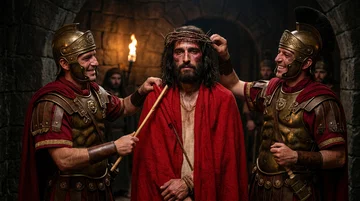
And they spit upon him, and took the reed, and smote him on the head.
Translations
And they spit on him, and took the reed, and smote him on the head.
King James Version, KJV Cambridge Paragraph Bible
And they spit upon him, and took the reed, and smote him on the head.
And they spit upon him, and took the reed, and struck him on the head.
Revised Version, American Standard Version
And they spat upon him, and took the reed and smote him on the head.
And having spit on him, they took the reed, and were smiting on his head;
And having spit upon him, they took the reed and beat [ him] on his head.
And, spitting upon him, they took the reed, and began striking upon his head.
Berean Standard Bible, Majority Standard Bible
Then they spit on Him and took the staff and struck Him on the head repeatedly.
They spat on him, and took the reed and struck him on the head.
And they put shame on him, and gave him blows on the head with the rod.
And spitted vpon him, and tooke a reede, and smote him on the head.
Douay-Rheims (Challoner revision)
And spitting upon him, they took the reed, and struck his head.
Pictures
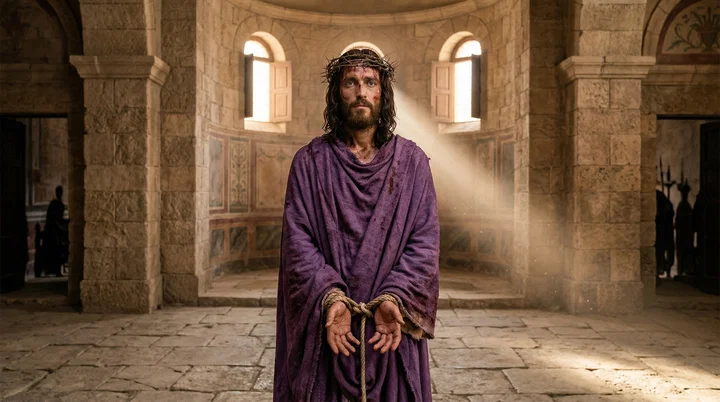
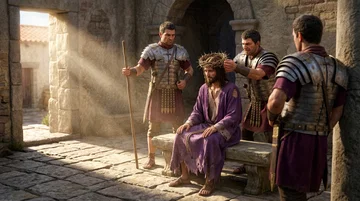
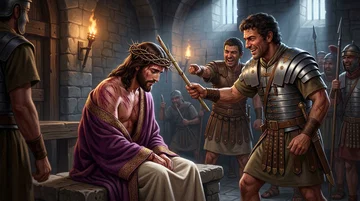
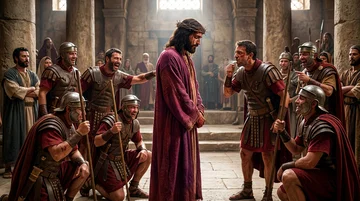
Cross-references 20 of 34
- John 19:2-3
And the soldiers platted a crown of thorns, and put it on his head, and they put on him a purple robe,
Jesus is crowned with thorns, mocked, and struck by the soldiers.
- Mark 15:19
And they smote him on the head with a reed, and did spit upon him, and bowing their knees worshipped him.
Soldiers strike Jesus with a reed and spit on him.
- Isaiah 53:3
He is despised and rejected of men; a man of sorrows, and acquainted with grief: and we hid as it were our faces from him; he was despised, and we esteemed him not.
Describes the rejected and sorrowful Sufferer.
- Isaiah 53:7
He was oppressed, and he was afflicted, yet he opened not his mouth: he is brought as a lamb to the slaughter, and as a sheep before her shearers is dumb, so he openeth not his mouth.
Both show Christ’s silent endurance under abuse.
- Matthew 27:37
And set up over his head his accusation written, THIS IS JESUS THE KING OF THE JEWS.
The title declaring Jesus King was fixed over the cross of shame.
- Isaiah 50:6
I gave my back to the smiters, and my cheeks to them that plucked off the hair: I hid not my face from shame and spitting.
Foretells the Servant being struck and spat upon.
- Matthew 26:67
Then did they spit in his face, and buffeted him; and others smote him with the palms of their hands,
Both describe Jesus being spat on and struck during his abuse.
- John 19:17
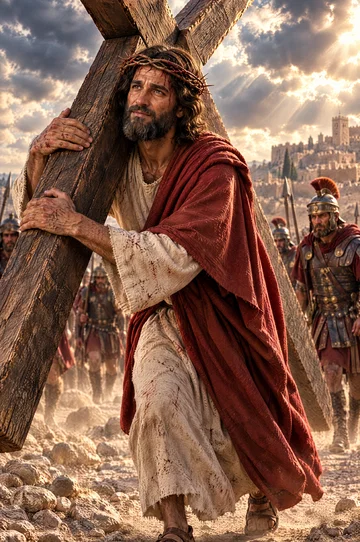
And he bearing his cross went forth into a place called the place of a skull, which is called in the Hebrew Golgotha:
Jesus is led away to be crucified after being rejected.
- Matthew 27:35
And they crucified him, and parted his garments, casting lots: that it might be fulfilled which was spoken by the prophet, They parted my garments among them, and upon my vesture did they cast lots.
The mocking culminates in Christ’s crucifixion for sin.
- Hebrews 12:3
For consider him that endured such contradiction of sinners against himself, lest ye be wearied and faint in your minds.
Jesus endured hostility from sinners.
- Luke 22:63-65
And the men that held Jesus mocked him, and smote him.
Jesus is mocked, struck, and insulted.
- Isaiah 53:5
But he was wounded for our transgressions, he was bruised for our iniquities: the chastisement of our peace was upon him; and with his stripes we are healed.
The Messiah suffers and is wounded while bearing humanity’s sins.
- Matthew 27:26
Then released he Barabbas unto them: and when he had scourged Jesus, he delivered him to be crucified.
Roman scourging leads into the cruel mocking of Jesus.
- Matthew 27:42-43
He saved others; himself he cannot save. If he be the King of Israel, let him now come down from the cross, and we will believe him.
The rulers’ taunts at the cross accompany the abuse directed at Jesus.
- 1 Peter 2:21
For even hereunto were ye called: because Christ also suffered for us, leaving us an example, that ye should follow his steps:
Christ’s abuse exemplifies the suffering believers are called to follow.
- 1 Peter 2:23
Who, when he was reviled, reviled not again; when he suffered, he threatened not; but committed himself to him that judgeth righteously:
Jesus endures insult and suffering without retaliation.
- Luke 23:36
And the soldiers also mocked him, coming to him, and offering him vinegar,
vinegar offered in same mocking
- Psalms 22:16-18
For dogs have compassed me: the assembly of the wicked have inclosed me: they pierced my hands and my feet.
Jesus’ suffering and the division of his garments fulfill David’s prophecy.
- Micah 5:1
Now gather thyself in troops, O daughter of troops: he hath laid siege against us: they shall smite the judge of Israel with a rod upon the cheek.
The smiting of Israel’s judge with a rod is fulfilled in Jesus being struck.
- Luke 23:11
And Herod with his men of war set him at nought, and mocked him, and arrayed him in a gorgeous robe, and sent him again to Pilate.
Herod’s men mock Jesus and dress him in a splendid robe.
Commentary
Each commentary is drawn from primary sources: the writings of Ellen G. White and Adventist pioneers and periodicals. Each commentary is separate. Its own words are not a quotation; follow the references to read the source passages.
Ellen G. White
39 sources
The verse describes soldiers humiliating Jesus in the judgment hall before His crucifixion, spitting on Him and taking the reed placed in His hand as a mock scepter and striking Him on the head, driving the crown of thorns into His brow until blood ran down His face.Ms 29, 1909, par. 185RED 58.1–2SG1 50.13SP 138.1–28MR 241.2–242.3 He bore the insult with uncomplaining patience and godlike fortitude, refusing to retaliate, to use His divine power against His tormentors, or to call for angels to rescue Him.5RED 58.1–23SP 143.1–2ST Jul 11, 1878COS 149.7–150.1ST Jul 11, 1878 His unfailed human endurance under such provocation kept His life perfect and His offering complete, so that as the true Isaac not spared at the last moment He could redeem lost humanity.ST Jul 11, 1878STSE 41.2–42.1COS 149.7–150.1EW 138.13T 369.2–3 Those who spat on Him, struck Him, and mocked His kingship will see Him again in kingly majesty as King of kings and Lord of lords, and turn from His gaze in terror and remorse.ST Mar 26, 1894SG1 214.1–215.1EW 250.2–251.1 Because He endured without seeking applause or fearing threats, His followers must measure their self-denial by His, and beholding His meekness under the thorns should humble sinners to repentance and consecrate them to patient, self-sacrificing service.8MR 241.2–242.3Lt 1a, 1861, par. 2–5Lt 51, 1886, par. 4–10Ms 75, 1910, par. 19–21GW92 360.3
Mockery Before Crucifixion
Matthew 27:30 describes the soldiers humiliating Jesus in His suffering before the crucifixion, when in the cruelty of the judgment hall they spat upon Him, took the reed, and struck Him on the head.Ms 29, 1909, par. 188MR 241.2–242.3GW92 360.3 It was mockery before His crucifixion, adding suffering and humiliation as He endured spit and blows to the head.ST Feb 19, 1880ST Jul 11, 1878GC88 643.1–4 His treatment displays the shame and physical suffering He endured in the way of salvation, which He bore without seeking applause or fearing the world's threats.Ms 29, 1909, par. 188MR 241.2–242.3 Together with His conflict in the wilderness of temptation, His life of self-sacrificing love, His soul agony in Gethsemane, and His agony upon the cross, it teaches self-sacrifice, patience under affliction, solemn consecration to God, and fitting preparation for holy work.GW92 360.3 Though He had taken human nature, He was sustained by godlike fortitude, made no murmur, and did not depart from His Father's will.ST Jul 11, 1878
The reed had been put in His hand as a mock scepter in blasphemous mockery of His kingship as the Prince of life.SG1 50.13SP 138.1–2GC 643.1–2 With it went an old purple kingly robe placed upon His form and a crown of thorns bound upon His sacred head and noble brow.SG1 50.1Lt 1a, 1861, par. 2–5GC 643.1–2 He was mockingly bowed to and saluted with Hail King of the Jews amid coarse jesting and cruel mocking by an infuriated mob, holding the mimic scepter in His unresisting hand.SG1 50.1Lt 1a, 1861, par. 2–5GC 643.1–2 His persecutors striking Him on the head with the reed they had put in His hand belonged to the coming trial of the disciples, for seeing their beloved Teacher so abused would cause them to mourn and fast as their faith, hope, and courage failed.ST Jul 7, 1898
The reed was then taken from His hand to smite Him upon the head.5RED 58.1–2SG1 50.1EW 138.3 The blows drove the crown of sharp thorns into His temples.5RED 58.1–2SG1 50.13SP 138.1–2ST Jul 11, 18781T 240.2 Blood trickled and ran down His face and beard and flowed from His holy brow.SG1 50.13SP 138.1–2ST Jul 11, 18781T 240.2EW 138.3
The act belongs to an extended ordeal preceded by a night of prayer to His Father.MH 509.1 After His midnight seizure in Gethsemane as a murderer, He who is the truth was scorned as a deceiver and hunted from place to place as a criminal, dragged to and fro from palace to judgment hall and arraigned twice before the priests, twice before the Sanhedrin, twice before Pilate, and once before Herod.ST Dec 4, 1893ST Nov 30, 1882 His own nation took the most active part in contempt toward Him while His friends and even His own brethren denied and forsook Him.ST Dec 4, 1893 Being spat upon and struck on the head with the reed belongs with being lacerated with stripes, crowned with thorns, mocked and derided as a false king, mocked, scourged, and condemned, ending at last in crucifixion on the cross.ST Dec 4, 1893ST Nov 30, 1882 He was hurried from Pilate's court with the cross prepared for Barabbas laid on His bruised and bleeding shoulders, and two thieves were also taken to be put to death with Him as He was led out bearing the heavy burden amid the wailing of the daughters of Jerusalem and the jeering of the crowd toward Calvary.COS 155.1ST Nov 30, 1882 His being delivered into the hands of wicked men brought Him mockery and scourging.5T 637.1
Every such cruelty was set in operation as Satan the apostate angel instigated it, joining buffeting temptation to physical torment, working through power over the hearts of men as Heaven beheld.ST Dec 4, 1893ST Nov 30, 1882 Satan stirred the Jewish leaders and the crowd to mock and abuse Jesus, and the deceiver's control made people act as liars and murderers.ST Mar 26, 1894 The ignorant, hardened and corrupt soldiers who forced the crown of thorns on His head and smote Him amid taunts and revilings acted in comparative ignorance, not knowing He was the Sent of God, unacquainted with Old Testament history and without the abundant light given to the Jewish nation, thinking to please the priests and rulers by abusing Him, and would not have treated Him so cruelly had that light been given to them.12MR 394.3–395.1 The greatest guilt and heaviest responsibility belonged not to Pilate, Herod, or the soldiers, but to those who stood in the highest places in the nation, the repositories of sacred trusts that they were basely betraying.12MR 394.3–395.1 Angels were present in the judgment hall and could scarcely endure the sight, marveling at His bearing of the abuse without using divine power to seal the lips of scoffers, paralyze the smiting hand, or flash forth righteous indignation.12MR 394.3–395.1Ms 39, 1898, par. 21–22
The verse belongs to His great trial before betrayal and crucifixion, when Christ the Son of God was handed over to the people for crucifixion and subjected to humiliation and insult by a jeering crowd with mockery, jeering, reviling, and blasphemous insults.3SP 148.14RED 102.2–103.1 The disciples were prepared for this treatment and were not to be surprised when the crowd reviled their Master.4RED 102.2–103.1
Patient Sacrifice for Salvation
He bore the spitting and the blows with uncomplaining patience, gentleness and dignity, meeting insult and suffering without a murmur and without departing from His Father's will.3SP 143.1–2ST Jul 11, 1878ST Jul 11, 1878 Even when the strokes drove the thorns into His temples so that blood ran down His face and beard and flowed from His brow, He endured with calm dignity and godlike fortitude, sustained though He had taken human nature.ST Jul 11, 1878ST Jul 11, 1878 His meekness and patience under this test upheld the perfection of His human life.ST Jul 11, 1878
He refused to retaliate or to use His divine power to escape, though the mockery and violence were meant to provoke Him to complain or to deliver Himself.5RED 58.1–2ST Jul 11, 1878EW 138.1 He would not seal the lips of the scoffers, paralyze the smiting hand, or flash forth righteous indignation upon those who taunted and reviled Him, to the marvel and mystery of angels.12MR 394.3–395.1 Though He could have asked His Father for a legion of angels to assist Him, He opened not His mouth but endured all slight and indignity heaped upon Him.21MR 366.1Lt 8, 1854, par. 10–11 His humanity had to withstand the test without failure for Him to remain the perfect offering.ST Jul 11, 1878COS 149.7–150.1
As the Lamb whose sacrifice could redeem humanity, His unresisting endurance kept the plan of salvation from failing.ST Jul 11, 1878EW 138.1 It behooved Him as the innocent Sufferer to suffer all this — to be spit upon, crowned with thorns, and stretched on Calvary's cross to die an ignominious death for sins — to make a way of escape for lost man.21MR 366.1Lt 8, 1854, par. 10–11 He is the true Isaac offered for the sins of the world, enduring humiliation in the judgment hall and on the way to Calvary through to death on the cross.STSE 41.2–42.13T 369.2–3 Unlike Isaac He was not spared at the last moment by an angel's message that He need not die, and though legions of angels waited sorrowfully hoping to prevent His shameful death, they were not permitted to rescue Him until He bowed His head and died amid jeers, taunts and revilings.STSE 41.2–42.13T 369.2–3
His humiliation and suffering reveal the cost of His sacrifice and stand as the supreme proof of God's love for humanity.1T 240.23T 369.2–3 Though Pilate declared Him without fault, men who hated His reproof and sinless character crucified Him to get Him out of the way, beating Him with rods until the cruel thorns pierced His holy brow.Ms 75, 1910, par. 19–21 He bore the heaviest humiliations anyone can bear, humiliation all the way through, even to being hung with nails through His hands and feet and counted as nothing more than other dying men.1T 240.2Ms 75, 1910, par. 19–21
Future Glory and Discipleship
The spitting and the blows of the reed belong to the humiliation of the Prince of life, when the purple robe was put upon Him, the crown of thorns upon His sacred brow, and the mimic scepter in His unresisting hand in blasphemous mockery.ST Mar 26, 1894GC 643.1–2 Those who then mocked, smote, and spat upon Him will behold Him again in His glory at His coming, and at the raising of the wicked dead they will see Him in kingly majesty and recognize in Him the One they mocked and crucified.ST Mar 26, 1894SG1 214.1–215.1EW 250.2–251.1GC 643.1–2 They will turn from His piercing gaze in terror and remorse, seeking to flee from the overpowering glory of His presence, yet they are still to see Him sitting on the right hand of power as King of kings and Lord of lords.ST Mar 26, 1894SG1 214.1–215.1GC 643.1–2GC88 643.1–4
That ordeal of condemnation and abuse became a severe test for His disciples, and they had been prepared beforehand not to be surprised when their Master was reviled by a jeering crowd.4RED 102.2–103.1DA 394.2–3 The hostility surrounding Him exposed the danger that disappointed, self-seeking followers would abandon Him and draw others away, and Jesus met His disciples in an earlier test while still with them so that His presence might strengthen the faith of those who remained loyal and prepare them for the trial ahead.DA 394.2–3 Seeing their beloved Teacher in the hands of wicked men, crowned with thorns and treated with derision, insult, and mockery, with the reed they had put in His hand used to strike His head, killed their hope that He would deliver Israel.ST Jul 7, 1898Ms 80, 1886, par. 3–5Ms 3, 1898, par. 20–21 Their faith, hope, and courage failed, giving them cause to mourn and fast, and after He was stretched upon the cross at Calvary as a malefactor and died as a criminal, and was taken down and laid in Joseph's new tomb, they were left in terrible anguish and agony.ST Jul 7, 1898Ms 80, 1886, par. 3–5Ms 3, 1898, par. 20–21
He bore all this humiliation without seeking applause or fearing the threats of the world, though Pilate declared Him without fault and men who hated His reproof and sinless character crucified Him to put Him out of the way.8MR 241.2–242.3Ms 75, 1910, par. 19–21 From Gethsemane through rejection by the murderous throng crying for His blood, to being led away pale, weak, and fainting to crucifixion, stretched upon the wooden cross with nails through tender hands and feet and hung in agony while angels veiled their faces and the sun hid its light, with the reed smiting Him and driving the thorns into His temples till blood flowed from His holy brow, He endured the heaviest humiliations all the way through, beaten with rods, the cruel thorns piercing His brow, even to being counted as nothing more than other dying men.Lt 1a, 1861, par. 2–5Ms 75, 1910, par. 19–21 Since He went to no greater depths in humility in behalf of fallen humanity, no self-denial can be called hard and the narrow way is not too strait, for He demands all, entire consecration, separation from the world and from dead heartless professors, and transformation by the renewing of the mind.Lt 1a, 1861, par. 2–5Ms 75, 1910, par. 19–21 Those who recognize Him as Saviour and Helper must be willing to do anything the Lord asks, to be partakers of His sufferings in hard places without seeking honor from others, trusting His sympathy and grace to bring them through trials to see Him in His kingdom.Ms 75, 1910, par. 19–21 As the meek Lamb and innocent Sufferer He opened not His mouth under all slight and indignity, though He could have asked His Father for a legion of angels, being spit upon, crowned with thorns, and stretched on Calvary's cross to die an ignominious death because it behooved Him so to suffer to make a way of escape for lost man, and His patient endurance leaves those saved by Him no room to complain or murmur at any sacrifice for their own sins but calls them to crave the suffering part, to learn to suffer more, to deny self, and to be perfectly subdued by grace from passion and impatience.21MR 366.1Lt 8, 1854, par. 10–11
Beholding His meekness and loveliness as crowned with thorns and nailed to the cross for sins should humble the sinner and break the heart, bringing shame and humiliation in the dust over a course condemned by God and leading to repentance.Lt 51, 1886, par. 4–10 Together with His conflict in the wilderness of temptation, His life of self-sacrificing love, His soul agony in Gethsemane, and His agony upon the cross, the cruelty of the judgment hall where He was spit upon and smitten on the head with the reed teaches self-sacrifice, patience under affliction, solemn consecration to God, and fitting preparation for holy work.GW92 360.3 One whom God has honored by choosing to unite him with the angels in ministering to souls and enlightening them with divine truth must make that great object supreme, put all his energies to its accomplishment, make every other consideration secondary, and feel the solemn obligations resting upon him.GW92 360.3
Sources
Pioneers and periodicals
93 sources
They spat on him and took the reed from his hand and struck him on the head, turning contemptuous mockery into repeated physical abuse in his humiliation before execution.RH Feb 1, 1870RH Nov 18, 1862ST Apr 17, 1879 The reed had been placed in his right hand as a fragile mock scepter for a false coronation, with bowing the knee and crying Hail, King of the Jews, a platted crown of thorns and a purple robe, and was then seized as a weapon to beat him.ST Dec 10, 1894ST Sep 23, 1889ST Dec 17, 1912 The blows drove the thorns into his temples so that blood trickled from his brow over his face and beard and fell to the ground, leaving him marred, exhausted and torn.ST Jul 11, 1878RH Dec 9, 1858ST Nov 11, 1880 He bore it all meekly without retaliation or use of divine power to escape, suffering as the sinless Lamb of God to meet the law's demand for death, uphold God's justice and secure pardon, out of wondrous love for guilty souls and for each sinner.ST Jul 11, 1878ST Jul 18, 1878RH Feb 21, 1865ST Mar 11, 1908 The mockery did not undo his kingship, for the same thorn-crowned head will soon wear a crown of glory when he comes again as conquering King, and his patient endurance marks the road his followers must travel through scorn to glory.RH Dec 12, 1865RH Feb 8, 1870ST Jan 29, 1880ST Dec 8, 1914RH Jan 23, 1866
Scene and Historical Setting
Matthew 27:30 belongs to the closing scenes of Jesus' trial before Pilate in Matthew 27:1-66, specifically Matthew 27:11-31.RH Feb 13, 1872ST Mar 13, 1901 That passage records the same trial before Pilate described in Luke 23:13-24, where Pilate declares he and Herod found nothing worthy of death in Jesus, proposes to chastise and release Him, is answered with demands for Barabbas and shouts to crucify Jesus, and at last gives sentence that what the crowd asked should be done.ST Mar 13, 1901 It describes the abuse He suffered before His crucifixion and burial, on the day He died for sinful humanity and showed His love above all others, through which God's mercy and love were displayed most wondrously.RH Feb 13, 1872RH Oct 23, 1860 It stands before He was led out of the city bearing His cross to Golgotha to be crucified, the climax of His life of love as the Lamb of God dying so that sinful, mortal people might have life.ST Nov 14, 1906 It shows Jesus being mocked and abused by the soldiers and crowd after Pilate's sentence, spat on and struck, until they tired of mocking Him, took off the robe they had put on Him, and led Him away to be crucified.ST Apr 4, 1906
The abuse follows Pilate's sentence and a scourging offered as a compromise to appease unreasoning wrath, a double punishment and cruel sacrifice of His life so that our lives might be saved.ST Mar 13, 1901 He had been scourged in public, crowned with thorns, and left bearing bloodied stripes, then crowned with thorns and clothed in purple with the reed still in hand.ST Oct 7, 1886ST Nov 9, 1882 In derision of His claim to be king He had been stripped, put in an old robe of royal color, given a platted crown of thorns and a reed in His right hand for a scepter, mocked with bended knee and the cry Hail, King of the Jews, then spat on and beaten on the head with the reed so the thorns pierced Him on every side.ST Jul 14, 1881 Left exhausted and torn by the scourge and disfigured with blood trickling from His temples and over His face, He was brought out by the governor and presented in battered, helpless, bloodied condition in hope the sight would move the people to pity and consent to His release.ST Oct 7, 1886ST Jul 14, 1881ST Nov 9, 1882 Pilate hoped that seeing His suffering would move the crowd to pity, and His appearance moved Pilate himself to pity, but did not soften His enemies, and priests and people renewed with unrelenting rage the cry to crucify Him.ST Oct 7, 1886ST Jul 14, 1881ST Nov 9, 1882
The tormentors were Roman soldiers continuing mockery of Jesus as a supposed king, adding physical cruelty and humiliation to the scourging and abuse He endured before execution.RH Dec 9, 1858 They were a cruel band of executioners joined by clamoring enemies, priests and the crowd, renewing wanton mockery after Pilate ordered Jesus scourged as preparation for execution.ST Jul 14, 1881 This derision was the customary treatment given to criminals at that time before execution and during it, entering naturally into the history and fully consistent with the customs, opinions, political arrangements and institutions of that period.RH Feb 11, 1862 It is illustrated by the soldiers' favorite sport of making a mock Saturnalia king: every year at the festival of Saturn the soldiers put royal robes on an appointed mock king who directed wild carousing for a certain number of days and was then put to the sword, and mock imitations of that riotous celebration were a favorite amusement with condemned culprits handed over to executioners as objects of sport.ST Jun 8, 1904 So the spitting on Christ and smiting Him on the head with the reed was that customary sport done to one who had incurred the soldiers' displeasure.ST Jun 8, 1904
After His midnight seizure in Gethsemane as a murderer He was dragged to and fro from palace to judgment hall, arraigned twice before the priests, twice before the Sanhedrim, twice before Pilate and once before Herod, hurried from tribunal to tribunal by night to Pilate's bar and Herod's judgment-seat.ST Nov 30, 1882RH Jun 10, 1862 He who is the truth was scorned as a deceiver and hunted from place to place as a criminal, with His own nation taking the most active part in contempt toward Him while friends and even His own brethren denied and forsook Him.ST Dec 4, 1893 At Pilate's bar and Herod's judgment-seat, in the last scene of His life on this polluted earth, He bore spitting together with bitter sarcasm, cruel jest, buffet, crown of thorns and old purple robe, with laceration by stripes and mocking and deriding as a false king, leading to the final tragedy of the crucifixion on the cross.ST Dec 4, 1893RH Jun 10, 1862 Herod mocked Him for calling Himself king, and after being mocked, scourged and condemned He was led out to be crucified bearing the heavy burden of the cross amid the wailing of the daughters of Jerusalem and the jeering of the crowd.ST Nov 30, 1882 Every such cruelty was set in operation as Satan the apostate angel instigated it, joining buffeting temptation to physical torment, stirring the Jewish leaders and the crowd to mock and abuse Jesus so that the deceiver's control made people act as liars and murderers.ST Dec 4, 1893ST Mar 26, 1894
Wicked men under Satan's control added pain to Christ's dying agony with mock kneeling and cries of Hail, King of the Jews and taunts to save Himself and vinegar offered Him, while He said Father, forgive them for they know not what they do, showing they acted in ignorance.ST Apr 3, 1893 That ignorance formed the basis for Peter's charge that the same people denied the Holy One and the Just and killed the Prince of life, yet did it through ignorance as did their rulers, and his call to repent and be converted that sins may be blotted out.ST Apr 3, 1893 The scene is to be pondered in solemn, tearful mood by the soul separated from earthly things and pointed upward to heaven, for it exposes cruelty and madness, the madness and folly of sin, and the cruelty of the master whom the world acknowledges.RH Jun 10, 1862 Satan worked through power over the hearts of men, and through human and political powers made a final attempt to destroy Jesus, with the Roman governor Pilate using Roman authority to have Jesus crucified and buried in a tomb sealed with the Roman seal.ST Nov 30, 1882ST Oct 25, 1905 The Roman power thus served as Satan's instrument against Christ, but the attempt failed, for Jesus rose from death and was caught up to God and His throne, and those who rejected and mistreated Him will later see Him in glory as King of kings and Lord of lords.ST Mar 26, 1894ST Oct 25, 1905
The crucifixion recorded in Matthew 27 occurred at the last Passover He attended, in the spring of A.D. 31.ST Dec 23, 1897ST Nov 2, 1915 Counted back through a three-and-one-half-year ministry begun at thirty years of age six months before His first Passover, this places His birth about six months before Passover in the autumn fruitage season around September.ST Dec 23, 1897 This shows He was not born on December 25.ST Dec 23, 1897 A few days after His discourse, the Lord of the Sabbath was nailed to the cross as the great sacrifice for human sin. He came in His first advent without royal pomp or crown and endured scorn, taunts, grief and shame before the injured King was put to death.RH Jul 28, 1874 The trial and crucifixion are terrible scenes of Calvary so vividly described that a reader can imagine witnessing them, here represented by figures of Christ in agony with thorn-crowned head intended to arouse pity.RH Oct 5, 1911ST Jun 29, 1882
Words and Physical Details
They spat on him and, taking the reed, struck him on the head, turning contemptuous mockery into repeated physical abuse in his humiliation before execution.RH Feb 1, 1870RH Nov 18, 1862ST Apr 17, 1879RH Jun 24, 1858ST Jan 27, 1904 The Son of God submitted to rough blows from an infuriated, mocking mob, and that suffering was for humanity, for each person.RH Feb 1, 1870ST Jan 27, 1904ST Jan 23, 1907 His humiliation and suffering reveal power to subdue pride and cast out discontent in the fretful or gloomy, and remembering what was endured helps believers endure.RH Feb 1, 1870ST Apr 17, 1879
The reed had been placed in his right hand as a fragile mock scepter for a false coronation, with bowing the knee, crying Hail, King of the Jews, a platted crown of thorns, an old robe of royal color or purple covering wounds, and afterward a magnificent title over the cross.ST Nov 13, 1893RH Dec 9, 1858ST May 21, 1912ST Jul 14, 1881 The gestures of homage were derision, not respect, contempt expressed as spitting on the cheek rather than friendship and thorns rather than honor.ST Dec 10, 1894ST May 21, 1912 The scepter-reed was then taken from his hand to beat him, so the false scepter became a weapon and the mock coronation added physical cruelty to scourging and abuse before execution.ST Sep 23, 1889ST Dec 17, 1912ST Nov 13, 1893RH Dec 9, 1858
The blows with the reed drove the thorns into his temples on every side and forced the crown to pierce his skin, so that blood trickled from his brow over his face and beard and fell to the ground.ST Jul 11, 1878RH Dec 9, 1858ST Jul 14, 1881 Left exhausted and torn by the scourge, bearing bloodied stripes, he was disfigured with blood trickling from his temples and over his face, with marred, pale face and fainting thorn-encircled head.ST Nov 11, 1880ST Jul 14, 1881ST Dec 23, 1913 His bowed, burdened figure on the way to the cross, bearing the cross with bloodied face and thorn-crowned brow, contrasts with earthly splendor, while the thorn-crowned Savior writhing in pain condemns rulers who guard the Sabbath yet bring about the death of its Lord.ST Nov 11, 1880RH Jan 9, 1866ST Dec 23, 1913
The crown of thorns shows he bore the earth's curse of thorns as well as humanity's curse, and by bearing both he gained the right to redeem both earth and humanity.ST Mar 19, 1885ST Mar 19, 1885 The blood on the ground shows he paid the redemption price for the dominion, begun when his bloodlike sweat fell in Gethsemane and fully paid when his blood fell beneath the cross.ST Mar 19, 1885
He meekly bore scorn, shameful jest, cruel words, buffetings, revilings and torture, and no wrathful answer came from his pure lips.ST Jul 18, 1878ST Mar 11, 1908RH May 5, 1863ST Oct 28, 1897 He endured without malice, flinching, pride or fear, with calm dignity, composed trust in God, godlike fortitude and undaunted yet gentle courage, making no murmur.ST Jul 11, 1878ST Jul 11, 1878ST Mar 11, 1908RH May 5, 1863 He refused to retaliate or use divine power to escape and did not depart from his Father's will, displaying the courage of the Lion of Judah joined with the innocence and peace of the Lamb, and his meekness and patience under this test upheld the perfection of his human life necessary to be the redeeming Lamb.ST Jul 11, 1878ST Jul 11, 1878RH May 5, 1863ST Oct 28, 1897
Prophecy and Redemptive Meaning
The spitting and the striking on the head with a reed fulfill Micah 5:1.RH Jun 24, 1858 The same abuse fulfills the picture of the despised and afflicted servant in Isaiah 53, for it is the rejection and suffering of the Messiah as the despised and rejected Sufferer crucified at Calvary.RH Nov 18, 1862ST Feb 6, 1907 It belongs to the predicted fate of a just teacher who would be persecuted, imprisoned, scourged, and put to death.ST Oct 7, 1875
He endured the striking and mocking while remaining pure and sinless, and that suffering was the bruising of His heel by Satan, while Satan inflicted the pain his own head was being bruised, signifying his defeat. The smiting belongs to the scorn, suffering, and unjust treatment He endured going to die for sinners as the precious Lamb of God bearing the sin of the world as a condemned man.RH Feb 21, 1865RH Oct 28, 1858RH Oct 20, 1863 He pours out His soul and wounds His temples on Calvary to save fallen man from death's control so mortals might enter heaven.RH Aug 21, 1860RH Oct 20, 1863 In this He met the law's demand for death, upheld God's justice while making a way to justify believers, paid for human sin, and secured pardon.RH Oct 28, 1858RH Oct 20, 1863 Though His anguish was great He rose victorious over the grave and gave His life for His people and foes, and a few days after His discourse the Lord of the Sabbath was thus nailed to the cross as the great sacrifice for human sin.RH Aug 21, 1860 This humiliation was one of the steepest trials on His way to the cross to die for humanity's redemption.RH Jun 23, 1868
His shame, mocking, scourging, and blows were borne in wondrous love for guilty souls, for each sinful soul, for you and for me.ST Jan 27, 1904ST Jul 18, 1878RH Jan 19, 1905 They were endured not for personal exaltation or gain but from love and His purpose to save the lost and give them life, that those He came to save might receive the crown of life.RH Jun 4, 1908RH Jan 19, 1905ST Sep 27, 1877 The contempt and blows were endured that sin's degraded slave might no longer remain in fearful bondage of soul and mind ending in dark despair, but find in His blood cleansing for sin, healing for the heart, and freedom from the load of sin and guilt.RH Jan 19, 1905 In this suffering God Himself suffered with His Son.RH Jan 19, 1905 The suffering that climaxes at Calvary cumulates a life filled with cruel crosses and thorns, willingly borne as He carried human sin and sorrow and consented to die.ST Sep 27, 1877
The minute accuracy of the derision and its full consistency with the customs, opinions, political arrangements, and institutions of that period prove the Gospel history true and not invented, since an inventor would not risk so many checkable circumstances and the detail enters naturally without forced insertion.RH Feb 11, 1862 The derision was the customary treatment given to criminals at that time before execution and during it.RH Feb 11, 1862 His remaining virtuous, self-denying, charitable, and forgiving under scourging and contempt supports that He was not an impostor.RH May 26, 1868 Beholding this suffering gives a still clearer discovery of the dreadful evil and exceeding sinfulness of sin than the change of angels into devils, the driving of Adam from Paradise with loss of God's favor and image and the bringing of death and all woe into the world, or the sweeping off of a whole world in manifestation of God's just displeasure against sin.RH May 27, 1873 The treatment of the harmless Jesus displays the evil produced by cherished self-centeredness and shows how far a being endowed with glory, beauty, and wisdom can be transformed by sin.ST Mar 11, 1903 The persecution and crucifixion revealed the character of evil and its ruler and made the consequences of sin unmistakable.ST Mar 11, 1903 It exposes cruelty and madness, the madness and folly of sin, and the cruelty of the master whom the world acknowledges.RH Jun 10, 1862
Every such cruelty was set in operation as Satan the apostate angel instigated it, joining buffeting temptation to physical torment.ST Dec 4, 1893 Satan stirred the Jewish leaders and the crowd to mock and abuse Jesus, and the abuse with the scourging and crown of thorns showed how the deceiver's control could make people act as liars and murderers.ST Mar 26, 1894 People share responsibility for the sin that brought Him to the cross.ST Mar 18, 1913 Those who rejected and mistreated Him will later see Him in glory as King of kings and Lord of lords.ST Mar 26, 1894 Those who struck Him will be present on the great decisive day when He calls His children home and seals the sinner's doom.RH May 20, 1858
Kingship and Second Coming
The mocking does not undo his kingship, for the suffering and lowliness themselves reveal royal glory and lineage.ST Sep 23, 1889ST Dec 17, 1912 The reed put in his right hand as a false scepter becomes a weapon to strike his head, and the blows and insults accompany the crown of thorns and mock coronation.ST Sep 23, 1889ST Dec 17, 1912 Though a mighty King born into the world, he lets a cruel band of soldiers press thorns upon his holy head and brow, bow the knee in derision, and pierce and tear his form.RH Dec 12, 1865 He accepts the crown of thorns and purple robe and the cry of King of the Jews while rejecting actual earthly rule, so the mockery expresses contempt for the earthly kingship he had refused.RH Jan 2, 1900
The same sacred head once crowned with thorns will soon wear a golden crown when he comes again as conquering King seated on the great white cloud to bring deliverance to his saints and recompense to proud oppressors.RH Dec 12, 1865 The mocked King is the same Lord who will return for his people, the silent prisoner of the railing mob and thorn-crowned King of the Jews and nail-pierced sacrifice being the carpenter of Nazareth and the risen and ascended anointed one who will soon appear in the opening heavens.ST Dec 8, 1914RH Mar 21, 1912 At his return the reed is replaced by a scepter of power and then of gold, and the brow that wore thorns and bled is enclosed by a crown of glory and beheld as the King in untold beauty.RH Jan 23, 1866RH Jul 5, 1864 Then as Mighty Conqueror he raises the dead and living saints to victory over death and gathers them to be forever with him, and those who have known and loved him here will still know and love him there and rejoice in his salvation without fear.RH Jul 5, 1864RH Mar 21, 1912 The record made by deeds and thoughts tells for or against a person's right to gaze on that brow, join the song of the immortal, and praise him in glory as Savior and King.RH Jan 23, 1866
The one then mocked and struck is now crowned with everlasting glory and not with thorns today.ST May 20, 1908ST Dec 15, 1898 The Babe of Bethlehem and Man of Calvary, left gory and led away, will erelong rise on earth and descend from the skies. Having faced Gethsemane and Calvary and the prison house and the tomb, he came forth from it all a conqueror.RH Feb 4, 1915 That same Jesus is on board today not as passenger but as Pilot with his hand on the helm, directing and steadying his people through coming tempests and driving the ship on by divine providence to the land of promise.RH Feb 4, 1915
Corruption by Earthly Power
The spitting and the striking on the head with the reed give the pattern for how worldly power treats Christianity when it claims to honor it.ST Jan 23, 1907ST Jan 24, 1906ST Feb 22, 1910ST Jul 4, 1900 Earthly rulers who profess to honor Christianity wound and degrade and abase and corrupt it by alliance with temporal power and with state power and by forcing worldly sovereignty upon the church.ST Jan 23, 1907ST Feb 22, 1910ST Jul 4, 1900 They offer outward honors and outward gestures of homage while treating it with contempt and humiliation and harm, injuring it even as they hail it, just as Christ was hailed and given a reed and then struck.ST Jan 24, 1906ST Feb 22, 1910ST Jul 4, 1900
To thrust temporal sovereignty upon Christ to make him king of this world through politics and law, and to thrust it upon Christianity and upon the church, is to repeat that false enthronement and that mock coronation and mock kingship.ST Nov 13, 1893ST May 21, 1912ST Oct 24, 1895ST Apr 3, 1928 It is hailing him while spitting upon him and smiting him on the head and on the cheek with the fragile reed put in his hand for a scepter, together with bowing the knee and crying Hail, crowning with thorns, covering with purple the wounds inflicted by the tormentors' own hands, and inscribing magnificent titles over the cross on which he was fixed to perish in ignominy and pain.ST Nov 13, 1893ST May 21, 1912ST Oct 24, 1895ST Apr 3, 1928 So to crown and enthrone the church only corrupts and wounds her and fixes her to perish in ignominy and pain rather than aiding her.ST Nov 13, 1893ST May 21, 1912ST Oct 24, 1895ST Apr 3, 1928 Christianity is therefore in far greater danger of being corrupted by alliance with power than of being crushed by its opposition.ST Apr 3, 1928
Example and Call to Follow
The blows of the reed make humiliation a painful image of suffering with Christ and bearing his cross, and such suffering marks discipleship and is honored by faith because it will be exchanged for glory and joy.RH Feb 8, 1870ST Jan 29, 1880 Humiliation and pain for his sake belong to bearing the cross, and though painful now these trials are worth more than earthly treasure because they will be changed into joy and glory, just as the crown of thorns gives way to a crown of great beauty.RH Feb 8, 1870ST Jan 29, 1880 He meekly bore spit and blows to the head with crown of thorns, reed, and mock homage as part of his sorrowful mission to save sinners, leaving an example for Christians facing scorn or opposition not to shun the cross or compromise principle to avoid reproach.RH Oct 17, 1854RH Jun 20, 1871 He is the pattern of faithfulness to be followed faithfully even in suffering and humiliation, marking out the road through this vale of woe so that followers should not expect an easier road or escape from scoffs and sneers.RH Oct 17, 1854RH Jun 20, 1871ST Mar 14, 1906 They are to bravely bear the warning message even when tempted, tried, torture-torn and winning scorn, for victory comes only through strife and life is entered only through deep suffering.RH Jun 20, 1871ST Mar 14, 1906
The suffering that reached its climax in death on the cross, with spitting and smiting on the head with the reed together with crown of thorns and mocking, was not belonging to that hour alone but the cumulation of a life filled with cruel crosses and crowns of thorns.ST Jul 22, 1908 As that climax was met through fixed character formed by a life of faith, day by day the Christian must have such growth in faith and consequent strength of character that crucial tests will find him strong to endure the most fiery trial.ST Jul 22, 1908
His humiliation and suffering reveal power to subdue pride and cast out discontent, and reading the account can help a fretful or gloomy Christian.ST Apr 17, 1879ST Apr 17, 1879 Remembering what he endured without complaint, including the crown of thorns, teaches his followers to seek his patient, humble mind.ST Apr 17, 1879ST Apr 17, 1879 His dreadful suffering with spit and blows to the head makes believers thankful for their own trials and encourages them to endure hardship on the way to eternal life.RH Dec 30, 1858 Though innocent he bore cruel insult and abuse patiently and offered no resistance, showing how considering his suffering helps people endure injustice without being provoked by it.ST Oct 28, 1897 His endurance of the indignity of being spat upon and struck is an example of meekness and forbearance when others cause injury, teaching lowliness, meekness, and long-suffering with forbearing one another under trifling injury rather than flying off at indignity.RH Mar 18, 1858
Though treated with cruelty and reproach, he continued to love his tormentors and pray for them.RH Aug 3, 1916 His response to those who mocked him was prayer, revealing his love for his enemies.RH Aug 3, 1916ST Jun 30, 1914 While enduring wicked men adding pain to his dying agony by spitting and striking on the head with the reed, with mock kneeling and cries of Hail king of the Jews and taunts to save himself and vinegar offered him, he said Father forgive them for they know not what they do, showing they acted in ignorance.ST Apr 3, 1893 That ignorance formed the basis for charging that same people with denying the Holy One and the Just and killing the Prince of life, yet saying they did it through ignorance as did their rulers, and calling them to repent and be converted that sins may be blotted out.ST Apr 3, 1893 Coming to die for the perishing though his own received him not, and bearing such abuse, is the pattern for apostles and every true missionary to suffer and die if need be for the rebellious.ST Apr 3, 1893
His bruised head and the reed's blows recall the agony and scorn he bore for sinners and are signs of his love.RH Aug 14, 1866 Beholding his sacred body made all one wound by abuse at Pilate's bar, on the way to being stretched on the tree to redeem the ruined race, constrains the beholder to adore his unequaled pain and love.RH May 27, 1873 His fainting head encircled with thorns and streaming with blood where a king would wear jewels is his perfect beauty and victorious charm, making him lovelier than all the world beside and worthy not only of love but of adoration.ST Nov 11, 1880 Through the scenes of his trial and death God's mercy and love were displayed most wondrously, and his humiliation and cruel mockery before Calvary endured for humanity's sake calls for love and wholehearted devotion.RH Oct 23, 1860RH Sep 11, 1866 Remembering his suffering and love for afflicted people, alongside his suffering in Gethsemane and his mangled, bleeding form on the cross, brings comfort to one enduring serious injury and gives hope amid sorrow and scorn.RH Apr 10, 1900
The reed represents the carnal heart's refusal to submit to Christ and its mockery of him, while willful sin nails him to the cross and crucifies him afresh.RH Nov 12, 1861 The suffering of oppressed people is likened to Christ being mocked, bound, sold, and scourged again in them.RH May 19, 1863 His persecutors striking him on the head with the reed they had put in his hand as they mocked him in purple robe and crown of thorns belonged to the disciples' coming trial, when seeing their beloved Teacher abused would cause them to mourn and fast as faith, hope, and courage failed.ST Jul 7, 1898
His earthly mission was successful even when the stone sealed his tomb, so its success is not measured by apparent outcome.ST Feb 4, 1913 His shame and suffering belong to the way through which he won victory, and his followers also find the path to God through the cross onward to victory.ST Jul 7, 1914 Enduring despising and thorny pain, with crown of thorns sinking deep into his holy head when struck with the reed and spit upon in contempt, strengthens believers who are despised by the world and must walk upon thorns.RH Jan 9, 1866 As the loving Lamb he tasted the bitter cup of death for sinful passions, evil habits and many transgressions, purchasing sinners and delivering them from bondage so they serve sin no more and live because he lives and rose.RH Jan 9, 1866
Sources