Exodus 12:4
And if the household be too little for the lamb, let him and his neighbour next unto his house take it according to the number of the souls; every man according to his eating shall make your count for the lamb.
Translations
And if the household be too little for the lamb, let him and his neighbor next to his house take it according to the number of the souls; every man according to his eating shall make your count for the lamb.
And if the household be too little for the lamb, let him and his neighbour next unto his house take it according to the number of the souls; every man according to his eating shall make your count for the lamb.
and if the household be too little for the lamb, let him and his neighbour next unto his house take it according to the number of the souls; every man according to his eating shall make your count for the lamb.
And if the household shall be too small for the lamb, let him and his neighbor next to his house take it according to the number of the souls; every man according to his eating shall make your count for the lamb.
and if the household be too little for a lamb, then shall he and his neighbour next unto his house take one according to the number of the souls; according to every man’s eating ye shall make your count for the lamb.
and if the household be too little for a lamb, then shall he and his neighbor next unto his house take one according to the number of the souls; according to every man’s eating ye shall make your count for the lamb.
'(And if the household be too few for a lamb, then hath he taken, he and his neighbour who is near unto his house, for the number of persons, each according to his eating ye do count for the lamb,)
And if the household be too small for a lamb, let him and his neighbour next unto his house take [ it] according to the number of the souls; each according to [ the measure] of his eating shall ye count for the lamb.
But if the household be too small for a lamb, then shall he and his neighbour that is near unto his house take one, according to the number of souls,—each man according to his eating, shall ye number for the lamb.
Berean Standard Bible, Majority Standard Bible
If the household is too small for a whole lamb, they are to share with the nearest neighbor based on the number of people, and apportion the lamb accordingly.
and if the household is too little for a lamb, then he and his neighbor next to his house shall take one according to the number of the souls. You shall make your count for the lamb according to what everyone can eat.
And if the lamb is more than enough for the family, let that family and its nearest neighbour have a lamb between them, taking into account the number of persons and how much food is needed for every man.
And if the housholde be too litle for the lambe, he shall take his neighbour, which is next vnto his house, according to the nomber of the persons: euery one of you, according to his eating shall make your count for the lambes,
Douay-Rheims (Challoner revision)
But if the number be less than may suffice to eat the lamb, he shall take unto him his neighbour that joineth to his house, according to the number of souls which may be enough to eat the lamb.
Pictures
Cross-references 20 of 37
- 1 Corinthians 5:7
Purge out therefore the old leaven, that ye may be a new lump, as ye are unleavened. For even Christ our passover is sacrificed for us:
Christ is identified as the Passover lamb sacrificed for believers.
- Exodus 12:13
And the blood shall be to you for a token upon the houses where ye are: and when I see the blood, I will pass over you, and the plague shall not be upon you to destroy you, when I smite the land of Egypt.
The blood marks the houses spared from judgment.
- John 1:29
The next day John seeth Jesus coming unto him, and saith, Behold the Lamb of God, which taketh away the sin of the world.
Jesus is identified as the Lamb prefigured by the Passover lamb, who takes away sin.
- Exodus 12:11
And thus shall ye eat it; with your loins girded, your shoes on your feet, and your staff in your hand; and ye shall eat it in haste: it is the LORD’s passover.
Both describe the Passover meal eaten in readiness to leave Egypt in haste.
- John 18:28
Then led they Jesus from Caiaphas unto the hall of judgment: and it was early; and they themselves went not into the judgment hall, lest they should be defiled; but that they might eat the passover.
The leaders avoid defilement so they can eat the Passover.
- John 19:36
For these things were done, that the scripture should be fulfilled, A bone of him shall not be broken.
Jesus’s bones remain unbroken, fulfilling the Passover lamb’s pattern.
- Exodus 12:8
And they shall eat the flesh in that night, roast with fire, and unleavened bread; and with bitter herbs they shall eat it.
Both require the shared lamb to be eaten that night, roasted with unleavened bread and bitter herbs.
- Luke 22:15
And he said unto them, With desire I have desired to eat this passover with you before I suffer:
Jesus shares the Passover meal with his disciples before suffering.
- Deuteronomy 16:1-6
Observe the month of Abib, and keep the passover unto the LORD thy God: for in the month of Abib the LORD thy God brought thee forth out of Egypt by night.
Describes the later observance of the Passover meal.
- Matthew 26:26-28
And as they were eating, Jesus took bread, and blessed it, and brake it, and gave it to the disciples, and said, Take, eat; this is my body.
Christ's supper answers Moses' Passover.
- Exodus 12:29-30
And it came to pass, that at midnight the LORD smote all the firstborn in the land of Egypt, from the firstborn of Pharaoh that sat on his throne unto the firstborn of the captive that was in the dungeon; and all the firstborn of cattle.
The midnight death of Egypt’s firstborn fulfills the Passover warning.
- Exodus 12:46
In one house shall it be eaten; thou shalt not carry forth ought of the flesh abroad out of the house; neither shall ye break a bone thereof.
The Passover lamb’s unbroken bones foreshadow Christ’s death.
- 1 John 1:7
But if we walk in the light, as he is in the light, we have fellowship one with another, and the blood of Jesus Christ his Son cleanseth us from all sin.
The lamb’s blood connects with Christ’s blood, which cleanses from sin.
- Hebrews 11:28
Through faith he kept the passover, and the sprinkling of blood, lest he that destroyed the firstborn should touch them.
Passover blood was applied as an act of faith.
- Leviticus 23:5-6
In the fourteenth day of the first month at even is the LORD’s passover.
It gives the dates of Passover and the seven-day Feast of Unleavened Bread.
- Exodus 12:21-23
Then Moses called for all the elders of Israel, and said unto them, Draw out and take you a lamb according to your families, and kill the passover.
The shared lamb belongs to the instructions for the Passover sacrifice and protection.
- 1 Peter 1:19
But with the precious blood of Christ, as of a lamb without blemish and without spot:
Christ is described as an unblemished sacrificial lamb.
- John 6:51
I am the living bread which came down from heaven: if any man eat of this bread, he shall live for ever: and the bread that I will give is my flesh, which I will give for the life of the world.
The paschal lamb symbolizes Christ giving his flesh for the life of the world.
- Exodus 12:27
That ye shall say, It is the sacrifice of the LORD’s passover, who passed over the houses of the children of Israel in Egypt, when he smote the Egyptians, and delivered our houses. And the people bowed the head and worshipped.
The Passover recalls deliverance from Egypt.
- Numbers 9:1-14
And the LORD spake unto Moses in the wilderness of Sinai, in the first month of the second year after they were come out of the land of Egypt, saying,
It records a Passover observed during Israel’s wilderness journey.
Commentary
Each commentary is drawn from primary sources: the writings of Ellen G. White and Adventist pioneers and periodicals. Each commentary is separate. Its own words are not a quotation; follow the references to read the source passages.
Ellen G. White
29 sources
On the last night of bondage in Egypt, when Israel was to be released, any household too small to eat a whole lamb was to join with the nearest neighbor to share one, counting according to the number of souls and how much each would eat.PP 274.1–2COS 103.1–4DA 76.1ED 42.22SP 36.1 The lamb was to be slain without blemish and its blood struck on the doorposts as the outward token, so that when judgment fell at midnight on the firstborn the destroying angel would pass over that house, and its roasted flesh was to be eaten that same night within with unleavened bread and bitter herbs, in haste and readiness for the journey.PP 274.1–2COS 103.1–4SG3 222.2DA 76.1 The innocent lamb and its slaughter stood for Christ, the sinless Lamb of God, and was fulfilled in His death as the antitypical Lamb slain at the crucifixion.2SP 36.13SP 128.1LC1 29.2–30.1 Its blood on the doorposts represented Christ's blood shed for the sins of the world, whose merits alone shelter the believing sinner from wrath and avert judgment and condemnation.2SP 36.13SP 128.1LC1 29.2–30.1 The provision benefited only those who gathered the family together and followed God's directions in faith, with parents implicitly obeying so that themselves and their children were covered, and the meal was to be kept as a solemn remembrance to turn hearts to God's mercy and to teach children to love, reverence and trust Him.ED 42.22SP 36.1LC1 29.2–30.1ST Dec 9, 18802MR 147.2–148.1
Sharing the Lamb That Night
If a household was too small for a whole lamb, it was to join with the nearest neighbor to share one lamb or kid without blemish, counting according to the number of souls and how much each person would eat.PP 274.1–2ED 42.22SP 36.1LC1 29.2–30.1RH Sep 19, 1854 The sharing belonged to the household's meal and count, with provision made according to the size of the household and each one's share in eating.ED 42.22SP 36.1LC1 29.2–30.15RED 48.1 The direction allowed a small household to unite with others so that nothing would be wasted and all would partake.PP 274.1–2ED 42.2RH Sep 19, 1854
The direction belonged to the first Passover, eaten on the night of release from slavery in Egypt.COS 103.1–4DA 76.1 That night was the last night of bondage, the birth of the Hebrew nation, when there appeared no token of deliverance.COS 103.1–4DA 76.1 God had warned Pharaoh of the final judgment on the Egyptians and commanded the Hebrews to prepare for immediate release.COS 103.1–4DA 76.1
God gave special directions through Moses to preserve Israel and their families from the plague about to be sent upon Egypt and for leaving Egypt.PP 274.1–2SG3 222.2Ms 5, 1854, par. 2–3 They were to slay a lamb or kid without blemish and strike its blood with hyssop upon the two side-posts and upper door-post as an outward token and sign.PP 274.1–2SG3 222.2DA 76.1 When God smote the firstborn of man and beast and executed judgment against the gods of Egypt, the destroying angel coming at midnight would pass over and not enter that marked house, keeping the destroying plague from them, while unmarked homes were left no different from the Egyptians.PP 274.1–2SG3 222.2RH Sep 19, 1854Ms 5, 1854, par. 2–3
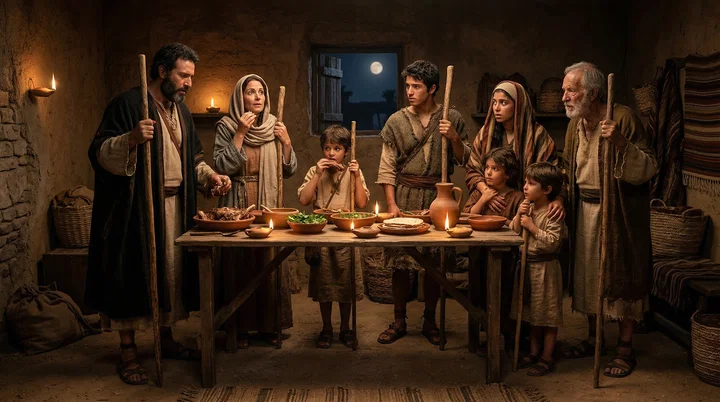
The roasted flesh was to be eaten that same night within the houses, gathered together around a table with dishes prepared.PP 274.1–2SG3 222.2PP 275 It was eaten with unleavened bread and bitter herbs, which represented the bitterness of slavery.PP 274.1–2COS 103.1–4SG3 222.2 The meal was eaten in haste and in readiness for the journey to freedom, with loins girded, shoes on feet and staff in hand, because it is the Lord's passover.PP 274.1–2COS 103.1–4ST Nov 2, 1915 In later reenactment at Jerusalem it was a hasty meal at a night assembly, rehearsed in solemn silence with the story of the sprinkled blood, the destroying angel sweeping over the buildings, and the march out of bondage with the slaying and mourning of the firstborn.ST Nov 2, 1915PP 275
The solemn ordinance was instituted on the night of the last plague upon Egypt, more severe than any before it.SG3 244.21SP 217.2 That night was terrible to the Egyptians and glorious to the people of God.SG3 244.21SP 217.2 Its nature and effect had been told beforehand by Moses to Pharaoh, to the people of Egypt, and to the Israelites.SG3 244.21SP 217.2 At that time the king and his idolatrous priests still opposed Moses to the last, while the people desired that the Hebrews be permitted to leave Egypt.SG3 244.2
Lamb Pointing to Christ
The innocent Passover lamb and its slaughter stood for Christ, the sinless Lamb of God, and pointed to His death, fulfilled in Jesus as the antitypical Lamb slain at the crucifixion.2SP 36.13SP 128.1LC1 29.2–30.15RED 48.1ST Jul 4, 1878 The household provision according to number and eating belonged to the instructions commemorating Israel's deliverance from Egypt, whose deliverance from destruction prefigured salvation through Christ.LC1 29.2–30.15RED 48.1ST Jul 4, 1878ST Dec 9, 1880 The lamb that caused the destroying angel to pass over Israelite homes prefigured the sinless Christ, and the feast kept that deliverance in memory.3SP 128.15RED 48.1ST Dec 9, 1880
The requirement that the lamb be set apart before sacrifice was fulfilled when, while the people were assembling at Jerusalem for Passover, Jesus by a voluntary act permitted the triumphal entry to present Himself publicly as Redeemer and set Himself apart as an oblation.DA 571.2–4 He clearly foresaw that this would bring Him to the cross, but His purpose was to call attention to the sacrifice crowning His mission to a fallen world.DA 571.2–4 The events preceding His great sacrifice were to direct all eyes to Him and bring Him before every mind, so that all would follow His rapid progress to the final scene.DA 571.2–4 His death for the sins of the world was thus to become a subject of deep thought and study with every fact verified beyond doubt, leading many after His crucifixion to recall these events in connection with His trial and death, to search the prophecies, and to be convinced He was the Messiah.DA 571.2–4
The blood placed on the doorposts represented Christ's blood shed for the sins of the world, which cleanses the believing sinner from sin and shelters the believer from God's wrath and coming wrath.2SP 36.1LC1 29.2–30.1ST Dec 9, 18804RED 91.1–2 It was a sign of safety to the Hebrews, whose merits alone avert judgment and condemnation as the true propitiation for human sin.3SP 128.1ST Jul 4, 18784RED 91.1–2 Eating the lamb recalled the protection given when Egypt's firstborn were slain and was meant to reveal the Lamb of God who gives His flesh for the life of the world.4RED 91.1–2DA 388.2–389.2 It was to be received through the symbol so that His life nourishes the soul unto everlasting life, and to make the symbol all-important while its significance goes unnoticed is not discerning the Lord's body, the same truth that eating Christ's flesh and drinking His blood gives eternal life.DA 388.2–389.2
The Passover and its counting for the lamb cannot be fully explained or understood apart from Christ, for its religious meaning points to Him as revealed in the Old Testament.3SP 388.1–2SLP 82.1–2ST Jul 17, 1879 He is identical with the Messiah foretold by Moses and the prophets in mission, suffering, death, resurrection and ascension, whose voice spoke through prophets and patriarchs from Adam onward, the key that unlocks the Old Testament and gives access to its rich treasures.SLP 82.1–2ST Jul 17, 1879 Without receiving the Saviour now revealed, all the services and ceremonies are valueless, and rejecting Him makes them valueless.3SP 388.1–2SLP 82.1–2ST Jul 17, 1879 The ceremony was instituted by Christ before His incarnation and was bound up with His life and mission, part of the rite He observed as a child pointing to the work He would accomplish for the heirs of covenant promises.IRCUP 10.1Ms 104, 1897, par. 8–919MR 163.2–3 Its type met its antitype when He was present even as the religious leaders and priests who had condemned Him to die prepared to eat it.Ms 104, 1897, par. 8–919MR 163.2–3
Household Faith and Instruction
God's provision in the lamb availed only those who did the work He required, and their doing showed their faith in the provision He had made for salvation.2SP 36.1LC1 29.2–30.1ST Dec 9, 1880 The family was to gather together in the dwelling place, and all the members of the household were to follow God's directions together.Ms 59, 1895, par. 40–44
Israel was to gather its children and families inside the houses and mark the doorposts with blood so that the destroying angel would pass over.RH Sep 19, 1854Ms 5, 1854, par. 2–3 The blood-marked homes were spared while the Egyptians were not, and to fail to follow the instruction left an Israelite no different from the Egyptians.RH Sep 19, 1854Ms 5, 1854, par. 2–3
The slain lamb prefigured the slaying of the Son of God and the efficacy of His blood shed for the salvation of the sinner.2MR 147.2–148.1Ms 26, 1885, par. 28–34 Its blood on the door was a sign that the household accepted Christ as the promised Redeemer and was shielded from the destroyer's power.2MR 147.2–148.1Ms 26, 1885, par. 28–34 The parents evidenced their faith by implicitly obeying the directions given, and their obedient faith covered themselves and their little children who have had no test of character, so that the destroying angel passed over every house that had the mark.2MR 147.2–148.1Ms 26, 1885, par. 28–34
The lamb and its meal formed part of the solemn remembrance of the sprinkled blood, the death-dealing angel, and deliverance from bondage.ED 42.2LC1 29.2–30.1ST Dec 9, 1880 That remembrance turned the people from worldly cares to remember God's works, mercy, and loving-kindness, and it strengthened love, reverence, and trust in Him.LC1 29.2–30.1ST Dec 9, 1880 It was reenacted in a hasty meal at a night assembly, with loins girded, shoes on feet, and staff in hand, while in solemn silence the story of the sprinkled blood, the destroying angel, and the march out of bondage was rehearsed.ST Nov 2, 1915 Joined to the delight of the journey, the beauty of nature, kindly association, the recounting of past experiences, and the singing of wilderness songs and God's commandments, the ceremony stirred the imagination, impressed the heart, and fixed the memory in children and youth.ST Nov 2, 1915 In this the parents' responsibility is shown, to gather, teach, and prepare their children in obedience, standing in the place of God to them to educate them in obedience and submission.2MR 147.2–148.1Ms 59, 1895, par. 40–44
Sources
Pioneers and periodicals
91 sources
The verse directs that when a household was too small to eat a whole Passover lamb, the man was to join with his next-door neighbor to share one lamb, counting the company by the number of souls and by what each person could eat.ST May 28, 1894ST May 28, 1894 The share was measured from the size of the company and each one's capacity, for the lamb did not grow or shrink to fit the number, and a company could be ten to twenty persons with all in the house freely partaking.RH Sep 23, 1902RH Feb 3, 1852RH May 6, 1852ST Apr 21, 1881 The lamb was always ample, for never was the household too large for the lamb.ST Mar 29, 1899 The lamb represents Christ, the sinless Lamb of God, whose shed and applied blood shelters from wrath, secures forgiveness, and causes God to pass over covered sin.ST Jul 4, 1878ST Apr 13, 1904ST Sep 30, 1886 The shared meal united the households into one family through feeding upon Him, so every person today may call his neighbor to share in Christ the sufficient Saviour.RH Feb 19, 1901ST Mar 29, 1899RH Jun 10, 1915
Sharing Rule Stated
When a household was too little for a Passover lamb, the man was to join with his neighbor next to his house to share one lamb together.ST May 28, 1894ST May 28, 1894ST Feb 11, 1903ST Dec 11, 1901ST Jan 21, 1889 The count for the lamb was to be made according to the number of souls and according to every man's eating, with the number of people and the amount each could eat determining the share.ST May 28, 1894ST May 28, 1894ST Feb 11, 1903ST Dec 11, 1901ST Jan 21, 1889 This direction belongs to the Passover ordinance given in close connection with the hurried departure from Egypt after the tenth plague, within the preparations for the final plague and the promised safety of those sheltered by the lamb's blood.ST Feb 11, 1903 The lamb was thus apportioned to the number of diners, counting the participants according to how much each person would eat.ST May 28, 1894ST Dec 11, 1901ST Jan 21, 1889
The size of the company and what each person could eat determined the share of food from the lamb.RH Feb 3, 1852RH May 6, 1852 The lamb did not miraculously increase or diminish to match the number of people, nor was it miraculously enlarged when more joined.RH Feb 3, 1852RH May 6, 1852 A Passover company formed in this way could include ten to twenty people.ST Apr 21, 1881
The provision was for everyone in the household, including parents, children, and servants.RH Sep 23, 1902 Every man according to his eating means each person freely partaking according to capacity, as of Christ the living bread.RH Sep 23, 1902 The lamb was always ample for the household, and never was the household too large for the lamb.ST Mar 29, 1899 Christ Jesus is the paschal lamb and a sufficient Saviour for every soul with salvation in plenteous degree for all, so every man today may call his neighbor to share in the feast.ST Mar 29, 1899
The word for eating covers both eating and drinking.ST Oct 8, 1894 Drink was therefore optional in the command, but a seven-day festival made drink a necessity in practice.ST Oct 8, 1894 What that drink was to be was left to circumstances and common sense, with one absolute rule that nothing leavened or fermented was permitted at the sacred memorial feast under the heaviest penalty.ST Oct 8, 1894
Passover Setting Described
Exodus 12:4 stands in Exodus 11 to 13 on the last plague, the Passover, and the going out of Egypt.ST Jan 25, 1910 It belongs to the Exodus 9 to 12 block on the plagues, standing just before the first Passover and the leading by fire and cloud, the passage through the Red Sea, and the song of triumph in Exodus 13 to 15.RH Jan 20, 1916 It stands in the closing Exodus 5 to 12 crisis over oppression and the right to worship when Pharaoh refused to let Israel hold a feast until broken by plagues and direct miraculous intervention, when death visited every family.RH Mar 25, 1909 It follows the brick-making burdens of chapter 1 and the slaying of the firstborn in chapter 12.ST Dec 14, 1915 It comes one month before the manna and Sabbath account in Exodus 16 and is presented as an episode in the nation's history.ST Apr 24, 1879ST Nov 21, 1911
It belongs to the original Passover directions given in Egypt just before freedom from slavery.ST Oct 7, 1930 The lamb had to be taken and slain at the appointed time before departure and eaten in haste that same night before deliverance, with proper preparation and nothing left till morning, and afterward continued as a memorial.ST Oct 7, 1930ST Oct 7, 1930 The ordinance was instituted on the terrible night for Egyptians and glorious night for God's people, commanding each family alone or with others to slay a lamb as God gave directions to preserve Israel from the plague about to fall.ST Mar 25, 1880 The lamb was slain with blood put on the doorposts so the destroyer would pass over, eaten on the first night with unleavened bread eaten through the seven-day feast.RH Dec 10, 1867 Later observances added requirements not in the original and not practicable in the wilderness.ST Feb 22, 1899
The fuller direction required each family at the beginning of Abib to take a first-year lamb without spot on the tenth day and keep it up.RH Sep 3, 1857 The whole assembly was to kill it on the fourteenth between the two evenings, about three o'clock or later, by the people themselves and not by the priest, each Israelite acting for his company.RH Jan 15, 1914RH Sep 3, 1857 It was roasted whole with no bone broken and eaten at night in haste with bitter herbs and unleavened bread, with loins girded, shoes on feet, and staff in hand like pilgrims starting for a pleasant land.RH Jun 24, 1873ST Aug 13, 1885RH Sep 3, 1857 Its blood was sprinkled with hyssop on lintel and side posts.RH Sep 3, 1857 The annual commemoration was on the fourteenth at even with seven days of unleavened bread from the fifteenth and the firstfruits sheaf waved on the morrow after the Sabbath.RH Sep 3, 1857
The lamb was taken for each family and eaten in the home.ST Jun 3, 1897 Israelite families gathered in Goshen on Passover eve with roasted lamb, unleavened bread, and blood on the doorposts, watching and praying in awe.ST Dec 7, 1904 Even households with members absent in dungeons kept the gathering and prayed in assurance God would restore them.ST Dec 7, 1904
These directions were followed in preparing the Passover eaten by Jesus and His disciples, so they ate the paschal lamb, the number who would eat determining the share when a household joined with its nearest neighbor.ST Sep 20, 1910 The night meal with girded loins, shoes, staff, unleavened bread, and bitter herbs was later reenacted at Jerusalem in solemn silence with rehearsal of the sprinkled blood, the destroying angel, and the march out of bondage.ST Nov 2, 1915 Joined with journey delight, nature, association, past experiences, wilderness songs, and commandments, it stirred imagination, impressed hearts, and fixed memory in children and youth.ST Nov 2, 1915
Slaying the lamb alone was not enough; the blood had to be applied to the doorposts, or judgment would have fallen even on an Israelite household.ST Dec 25, 1901 The command required trusting God's word rather than reason or precedent on Israel's final night in Egypt.ST Apr 2, 1894 The timely notice to prepare to leave shows a divine hand leading step by step to ready the people for stirring scenes.RH Oct 2, 1866
Abib or Nisan was made the first month of the sacred year, retrieving the spring beginning about the vernal equinox, seventh when reckoned by the civil year from creation.RH Nov 7, 1871RH Sep 3, 1857 The month was regulated by the new moon, with the fourteenth of Abib coinciding with the full moon and able to fall on any weekday. The chapter gives the law of Passover and unleavened bread with the second day of unleavened bread as the start for numbering fifty days.ST Apr 24, 1879
Israel in Egypt worshiped God and kept His ordinances, such as circumcision, which was necessary to eat the Passover and for which they were ready, showing they had not forgotten past dealings.RH Sep 24, 1872
Memorial Of Deliverance
The Passover takes its name from the passing over of blood-marked Hebrew houses on the night the firstborn in every Egyptian family was slain.ST May 22, 1907RH Jan 14, 1862RH Jan 7, 1862 The destroying angel saw the token of blood and did not enter to smite, but spared the Israelites as he passed over to slay the firstborn of the Egyptians.ST May 22, 1907ST May 8, 1879 This was the first Passover, kept at Rameses in Egypt on the night Israel was led out of bondage.ST May 22, 1907 It was ordained as a memorial of God's passing over Israel when He struck the Egyptians, beginning with the slaying of the paschal lamb on the fourteenth day of the first month and extending through seven days in which nothing but unleavened bread was eaten, reaching its great antitype when Christ the passover was sacrificed.RH Jan 14, 1862RH Jan 7, 1862
It was given as a fit memorial to keep fresh in thought the deliverance of Israel from slavery in Egypt with a mighty hand and stretched-out arm.RH Nov 15, 1853ST Sep 13, 1877 It was to be observed repeatedly to preserve in strong remembrance how the destroying angel passed over Israelite dwellings on his fearful path when Egypt's firstborn sons were doomed to die.RH Jul 28, 1904RH Nov 15, 1853ST Sep 13, 1877 With it stood the Feast of Unleavened Bread, which memorialized how the Egyptians hurried Israel away and declared the bread eaten in the flight from Egypt.RH Jan 7, 1862RH Nov 15, 1853ST Sep 13, 1877 When sons ask what this service means the answer is that with mighty hand Jehovah brought them up from Egypt's land.ST Sep 13, 1877 The ordinance looks back to that deliverance and forward to Christ's sacrifice, being both a memorial of God's power to deliver Israel from Egyptian bondage and a type of Christ the Passover lamb and His greater deliverance of His people from the bondage of sin.RH Jul 28, 1904ST Jun 11, 1894ST Apr 23, 1896
The weekly Sabbath is not one of these yearly memorials and is not spoken of as a memorial of that deliverance, for the Passover is the appointed memorial of it.ST Sep 13, 1877RH Nov 15, 1853 A weekly rest cannot keep in memory a day that could come round but once a year, and a rest cannot be a memorial of a rush and hasty flight.ST Sep 13, 1877 After God bared His arm to lift Israel's suffering and bring them from beneath the oppressor's rod where they could freely serve and worship God, He charged them to remember the Sabbath day as to whom their homage should be paid.ST Sep 13, 1877 Through the deliverance from Egypt God demonstrated His wisdom, love, power, and right to rule and showed Israel its obligation to obey Him.ST Mar 7, 1906 That deliverance from earthly foes, celebrated in the song of Moses as triumph, was a type of release from the bondage of sin and the world and of entrance into the heavenly Canaan, and at last the redeemed will sing not only the song of Moses but the song of the Lamb, meaning redemption from earthly foes as well as from all sin.ST Jun 11, 1894ST Mar 18, 1889ST Jan 30, 1912
The Passover was a newly established institution given with explicit directions for how it was to be celebrated, when and by whom, and for what purpose, including the lamb-sharing provision for the deliverance and its remembrance.RH Jul 28, 1904RH Mar 14, 1865RH Mar 9, 1905 Its explicit directions for keeping it show how a new institution is established, in contrast to the familiar reference to the already existing Sabbath in Exodus 16, in the same manner that Genesis 2 gives the origin of the Sabbath.RH Mar 14, 1865 Though the Passover and its feast were called perpetual, that designation does not by itself mean they must continue forever, since their appointed period may have expired.RH Apr 15, 1873
Christ The Lamb
The lamb slain under this direction is Christ, the innocent, sinless and perfect Lamb of God.ST Jul 4, 1878ST Apr 13, 1904ST Sep 30, 1886RH Nov 26, 1861 Its blood shed for the household and sprinkled on the doorposts prefigures His merits and blood, through which forgiveness and the blotting out of sin are secured.ST Mar 25, 1880ST Apr 13, 1904ST Sep 30, 1886 That blood cleanses the believing sinner from sin, shelters from coming wrath, and causes God to pass over covered sins so they are not cut off.ST Mar 25, 1880ST Dec 9, 1880ST Apr 13, 1904 The lamb's very innocence shows the truth that the one who atones for sin must have no failings of his own.RH Nov 26, 1861 Its blood was Israel's safety on the night the firstborn died, accepted as the means saving them from destruction when the destroyer saw the token and did not enter to smite.ST Dec 9, 1880ST Jun 3, 1897ST Oct 25, 1905 The institution in Egypt with the destroying angel thus points to Christ crucified as our Passover.ST Jun 3, 1897ST Apr 5, 1899
The paschal lamb typified Christ's death and was fulfilled in Jesus, the antitypical Lamb slain at the crucifixion.ST Aug 8, 1878ST Sep 30, 1886RH Feb 21, 1856 He identified Himself as such by connecting the Lord's Supper with the Passover, and as Moses instituted the Passover so Christ in superior degree instituted the Supper.ST Sep 30, 1886RH Feb 19, 1861 The Passover and its connected service are Christ revealed in the Old Testament and cannot be explained without Him.ST Jul 17, 1879 He is the key unlocking the Old Testament and giving access to its rich treasures, and all religious services and ceremonies are valueless if the Saviour they represent is rejected.ST Jul 17, 1879 Christ is a sufficient Saviour for every soul with salvation in plenteous degree for all, and the lamb was for everyone to freely partake as living bread, with the household distribution including parents, children and servants according to each person's eating.ST Mar 29, 1899RH Sep 23, 1902
The joining of household with nearest neighbor in one shared meal united the households, and feeding upon Christ likewise unites believers as one family.RH Feb 19, 1901 From that household service gospel lessons were drawn pointing to Jesus as Messiah and Saviour.RH Feb 19, 1901RH Jun 10, 1915 The Passover looked back to Israel's deliverance from Egypt and forward to Christ's sacrifice, as the true Paschal Lamb whose death after the sixty-nine weeks was predicted in Daniel's prophecy.RH Jul 1, 1873RH Feb 2, 1911 The deliverance setting began God's teaching of the plan of salvation through the sanctuary and its rites. Understanding the exodus and the Mosaic sacrificial types is necessary to understand Christ as the fulfillment of Moses and the prophets, distinguishing the true Christ of the prophets from false Christs.RH Nov 8, 1906
Counted according to his eating, only the body of the symbolic man responded to the call out of Egypt, because the Head had not yet been made manifest in the flesh, while the calling in Hosea included both Head and body.ST Sep 2, 1913 The solemn Passover representing Christ calls for personal self-examination and readiness, asking whether sins are washed away if God's decision or death should come tonight.ST
Prophecy And Last Days
The lamb appointed to be slain on the fourteenth day of the first month between the evenings met its antitype in the death of the Lamb of God on that same day.RH Nov 8, 1906RH Feb 3, 1853ST Aug 13, 1874RH Mar 31, 1874 That fixed timing predicts the day of Christ's crucifixion.RH Nov 8, 1906RH Feb 3, 1853RH Jun 17, 1915 The exact correspondence shows God honoring the feast and its fulfillment rather than honoring the first day of the week.ST Aug 13, 1874RH Mar 31, 1874 The provision for sharing the lamb according to the number of souls and their eating belongs to that Passover pattern fulfilled in Christ.RH Feb 3, 1853RH Mar 31, 1874
By the same occurrence-day pattern the types of the example and shadow meet fulfillment on their occurrence day, as with firstfruits in the resurrection and Pentecost in its outpouring.RH Nov 8, 1906 So the seventh-month cleansing of the sanctuary was expected to meet its antitype when the twenty-three hundred days ended in the seventh month of 1844.RH Nov 8, 1906 The plagues of Egypt in Exodus 7 to 12 foreshadow the seven last plagues, showing they will be as real and literal as those were.RH Dec 23, 1851ST Jul 18, 1878ST Oct 28, 1930 As the plagues of Egypt came just prior to the deliverance of Israel, the seven last plagues will sweep the world just before final deliverance as wrath without mercy when forgiveness will never be granted any more.RH Dec 23, 1851ST Oct 28, 1930 As Israel remained through the plagues on Egypt, God's people remain on earth through the fearful last events but are protected while calamities fall around them.RH Dec 23, 1851ST Jul 18, 1878ST Oct 28, 1930
Houses marked with the blood of the paschal lamb were spared as the destroying angel passed over to slay the firstborn of the Egyptians.ST May 8, 1879 That sparing is a pattern for the sealing of the 144,000, showing the seal of God is a distinguishing mark or religious characteristic through which servants of God will be exempted from judgments falling on the wicked around them.ST May 8, 1879 The plagues were appropriate and merciful to show Egypt that Israel's one God is all-embracing, all-efficient, all-powerful and all-wise, while Egypt's many gods worshiped by king and peasant are nothing in the sight of Jehovah.ST Nov 1, 1899ST Nov 27, 1901 By ten plagues God humbled proud Egypt to the dust and annihilated the supposed power of its many gods, and gave each Israelite abundant opportunity for personal knowledge of the King of kings and Lord of lords.ST Nov 1, 1899ST Nov 27, 1901 The deliverance of the firstborn of believers was surpassingly impressive, while in rejecting homes not one firstborn escaped the destroyer's hand.ST Nov 27, 1901 Joined with the opening of the Red Sea for Israel to pass over dry shod and the drowning of the Egyptians, the sweetening of Marah, bread from heaven, and water from the flinty rock, this made the title of the Lord who brought them from bondage far more comprehensive than the God of Abraham, Isaac, and Jacob.ST Nov 27, 1901
Sabbath Distinct From Passover
The Passover is the memorial God gave of the flight and deliverance from servitude and slavery in Egypt, and the Sabbath is not commanded or spoken of as a memorial of that deliverance.RH Dec 17, 1857ST May 31, 1905RH Apr 30, 1872RH Nov 15, 1853 One memorial answers for that event, and there is no fitness in taking the Sabbath from its proper office of commemorating God's rest after six days of labor in making heaven and earth and making it also commemorate the rush from Egypt on the fourteenth of the first month.RH Dec 17, 1857ST May 31, 1905 The Passover ordinance was given as a fit memorial to keep fresh in thought how with mighty hand and stretched-out arm deliverance was brought nigh through judgment, when the destroying angel passed over Israelite dwellings on his fearful path while Egypt's firstborn sons were doomed to die, to be observed repeatedly to preserve strong remembrance, joined with the Feast of Unleavened Bread declaring how the Egyptians hurried Israel away, so that when sons ask what this service means the answer is that with mighty hand Jehovah brought them up from Egypt's land.RH Nov 15, 1853ST Sep 13, 1877 The weekly Sabbath is not one of these yearly memorials, for a weekly rest cannot keep in memory a day that could come round but once a year, and a rest cannot be a memorial of a rush and hasty flight.ST Sep 13, 1877 After God bared His arm to lift suffering and bring Israel from beneath the oppressor's rod where they could freely serve and worship Him, He charged them to remember the Sabbath day as to whom their homage should be paid.ST Sep 13, 1877
The Passover directions belonged to that one year and prove nothing about the week beginning with the year or month. The holy days in connection with the Passover feast were not necessarily on the weekly Sabbath, but were yearly sabbaths distinct from the seventh-day Sabbath of the Lord. Beginning or closing the month or year did not leave a defective short week, for the weeks were all full seven days, so the days of the week fell on different dates of the month. The requirement to share the Passover lamb when a household is too small to eat it, with the number of people and their expected food needs determining how many share it, shows that the Sabbath prohibition on kindling fires was temporary and intended for the wilderness, since once Israel entered the promised land the Passover was to be regularly observed and roasting its lamb could fall on the Sabbath, creating a conflict if the fire prohibition still applied.RH Jan 7, 1862
A memorial cannot be moved to another time and still commemorate the original event, so the Sabbath memorial of God's creation rest cannot be kept on a different day, as the specific occasion set for celebrating the Passover shows.RH Jun 2, 1851 The Passover is a memorial of deliverance from Egypt as a past event, though its beneficent fruits abide still.ST Apr 7, 1909 The Passover occupied a night, unlike the Sabbath which occupied a day, and unlike the resurrection which came in a moment of time between night and day as a life from above.ST Apr 7, 1909 The fourteenth of Abib coincided with the full moon in a month regulated by the new moon and could fall on any day of the week, so the Passover date was not invariably a Friday. The Exodus 12 account of the departure from Egypt stands one month before the fall of the manna and the Sabbath account in Exodus 16, and is involved in the dispute over the institution of the Jewish Sabbath and where Sunday becomes the seventh day.ST Apr 24, 1879
The Passover was in the spring, the same season in which the Lord's resurrection occurred, and is wholly separate from Easter, which comes from the Anglo-Saxon Eostre, the Teutonic Austro, goddess of spring worshiped with feasting and flowers. The Passover is an institution of God's appointment given in His Word, and the claim that Easter has entered into the Passover and with divine light transfigured it, making one of the old and the new, exalts human traditions, appointments and institutions above the Word and institutions of God.ST Dec 9, 1897 The Passover is an example of a Jewish feast whose observance was a matter of indifference in the Roman church and should not have caused controversy.ST Dec 9, 1897 The explicit directions for keeping the Passover show how a new institution is established in the chapter that gives the origin of the Passover institution, in contrast to the familiar reference to the already existing Sabbath in Exodus 16, in the same manner that Genesis 2 gives the origin of the Sabbath.RH Mar 14, 1865 Abib is identified as the first month of Israel's sacred year, which is the seventh month when the civil year is reckoned from creation.RH Nov 7, 1871
Family And Fellowship Application
When a household was too small to eat a whole lamb, it was to join with the household of its nearest neighbor, and the company was counted according to the number of souls and according to every man's eating, with the number of people and their needs determining the share.RH Sep 19, 1854RH Feb 19, 1901ST Mar 29, 1899 The shared meal united the households, and feeding upon Christ likewise unites believers as one family.RH Feb 19, 1901 The lamb was always ample for the household, and never was the household too large for the lamb, for Christ Jesus is the paschal lamb and a sufficient Saviour for every soul, with salvation in plenteous degree for all, so every man today may call his neighbor to share in the feast.ST Mar 29, 1899
On the night of judgment on Egypt's firstborn, children and families were gathered inside homes marked with blood and remained under its protection.RH Sep 19, 1854ST Parents are therefore to keep their children within the protection of the covenant and of Christ's redeeming blood, marking the household by obedience.RH Sep 19, 1854ST Failing to follow the instruction left Israel no different from the Egyptians.RH Sep 19, 1854 The slain lamb represented Christ's death, and the blood on the doorposts represented Christ's blood, which cleanses the believing sinner from sin and shelters from coming wrath, but the provision benefits only those who do the work God requires, their actions showing their faith in His provision for salvation.ST Dec 9, 1880ST Obeying the command to kill the lamb and apply its blood to the doorposts so the destroying angel would pass over required trusting God's word rather than relying on reason or precedent.ST Apr 2, 1894
Sources