Translations
American King James Version, King James Version, Webster Bible
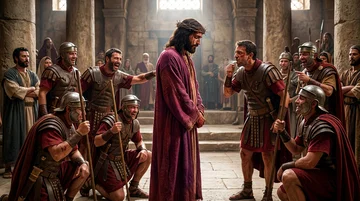
And said, Hail, King of the Jews! and they smote him with their hands.
and said, Hail, King of the Jews: and they smote him with their hands.
Revised Version, American Standard Version
and they came unto him, and said, Hail, King of the Jews! and they struck him with their hands.
and said, 'Hail! the king of the Jews;' and they were giving him slaps.
and came to him and said, Hail, king of the Jews! and gave him blows on the face.
and kept coming unto him, and saying—Joy to thee! O King of the Jews!—and were giving unto him smart blows.
And they went up to Him again and again, saying, “ Hail, King of the Jews!” and slapping Him in the face.
And they kept saying, “ Hail, King of the Jews!” and slapping Him in the face.
They kept saying, “ Hail, King of the Jews!” and they kept slapping him.
And they kept coming and saying, Long life to the King of the Jews! And they gave him blows with their hands.
And saide, Haile, King of the Iewes. And they smote him with their roddes.
Douay-Rheims (Challoner revision)
And they came to him, and said: Hail, king of the Jews; and they gave him blows.
Pictures
Cross-references
- Matthew 27:29-30
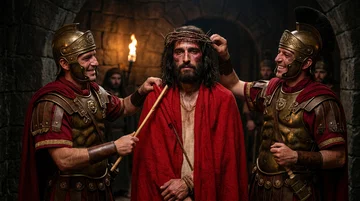
And when they had platted a crown of thorns, they put it upon his head, and a reed in his right hand: and they bowed the knee before him, and mocked him, saying, Hail, King of the Jews!
The soldiers mock Jesus as king and strike him.
- Mark 15:16-19
And the soldiers led him away into the hall, called Prætorium; and they call together the whole band.
The soldiers mock Jesus as king, dress him in purple, crown him with thorns, and strike him.
- Luke 23:11
And Herod with his men of war set him at nought, and mocked him, and arrayed him in a gorgeous robe, and sent him again to Pilate.
Herod and his soldiers mock Jesus and dress him in a robe.
- John 18:36
Jesus answered, My kingdom is not of this world: if my kingdom were of this world, then would my servants fight, that I should not be delivered to the Jews: but now is my kingdom not from hence.
Jesus says his kingdom is not of this world.
- Isaiah 53:5
But he was wounded for our transgressions, he was bruised for our iniquities: the chastisement of our peace was upon him; and with his stripes we are healed.
Jesus’ wounds fulfill the suffering borne for human sin.
- Matthew 27:30
And they spit upon him, and took the reed, and smote him on the head.
same striking with the reed
- John 19:12
And from thenceforth Pilate sought to release him: but the Jews cried out, saying, If thou let this man go, thou art not Cæsar’s friend: whosoever maketh himself a king speaketh against Cæsar.
threat that forced Pilate to proceed
- John 18:38
Pilate saith unto him, What is truth? And when he had said this, he went out again unto the Jews, and saith unto them, I find in him no fault at all.
Pilate asks what truth is while the Truth stands before him.
- John 19:14-16
And it was the preparation of the passover, and about the sixth hour: and he saith unto the Jews, Behold your King!
rejection as king ends in crucifixion
- Matthew 26:67
Then did they spit in his face, and buffeted him; and others smote him with the palms of their hands,
Jesus is abused after being brought before Caiaphas.
- Matthew 27:2
And when they had bound him, they led him away, and delivered him to Pontius Pilate the governor.
Jesus is delivered to Pilate before the soldiers mock and strike him.
- Revelation 19:12
His eyes were as a flame of fire, and on his head were many crowns; and he had a name written, that no man knew, but he himself.
The thorn crown contrasts with Christ’s many conqueror’s crowns.
- Matthew 26:49
And forthwith he came to Jesus, and said, Hail, master; and kissed him.
Judas betrays Jesus with a kiss.
- Matthew 27:24
When Pilate saw that he could prevail nothing, but that rather a tumult was made, he took water, and washed his hands before the multitude, saying, I am innocent of the blood of this just person: see ye to it.
Pilate washes his hands rather than defend Jesus.
- Luke 23:42
And he said unto Jesus, Lord, remember me when thou comest into thy kingdom.
The thief acknowledges Jesus as King despite his humiliation and receives pardon.
Commentary
Each commentary is drawn from primary sources: the writings of Ellen G. White and Adventist pioneers and periodicals. Each commentary is separate. Its own words are not a quotation; follow the references to read the source passages.
Ellen G. White
21 sources
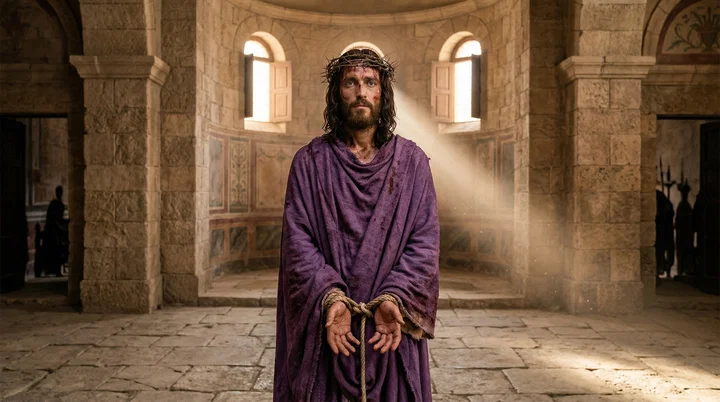
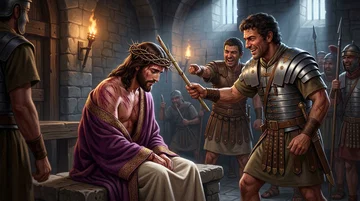
The soldiers mocked Jesus as King of the Jews, greeting Him with royal honor while striking Him with their hands.COS 149.7–150.15RED 58.1–2Ms 51, 1897, par. 31–32 They dressed Him in the symbols of kingship to humiliate Him, placing a crown of thorns on His head, wrapping Him in a tattered purple robe, and putting a reed in His hand as a scepter in place of His true crown and robe of majesty and glory.5RED 58.1–2Ms 51, 1897, par. 31–323SP 138.1–2 They repeatedly snatched the reed from Him to beat Him on the head, driving the thorns into His brow and temples until blood ran down His face and beard.SG1 50.13SP 138.1–21T 240.2 He endured the insults and blows with composure, meekness, patience, and dignity, without complaint or retaliation.COS 149.7–150.15RED 58.1–2ST Jul 11, 1878 The mockery and violence were meant to provoke Him to free Himself by divine power, which Satan hoped would cause the plan of salvation to fail.COS 149.7–150.1EW 138.1 His faithful endurance under this test kept Him a perfect voluntary offering, as the Just One bearing the sins of the world to redeem sinners to God by His blood.COS 149.7–150.11T 240.2EW 138.3EW 138.1Lt 1a, 1861, par. 2–5
The Mock Coronation
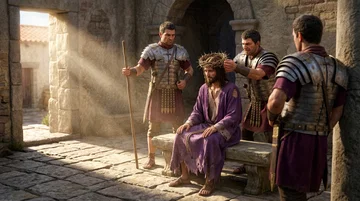
The soldiers mocked Jesus as King of the Jews, hailing Him with a royal greeting and smiting Him with their hands.COS 149.7–150.15RED 58.1–2Ms 51, 1897, par. 31–325RED 63.1DA 735.1–5 The mockery was contempt offered under the appearance of honoring Him as King, part of the suffering His disciples would witness before His death.DA 735.1–5Ms 3, 1898, par. 20–21 It was a cruel mock coronation, with insults and blows heaped upon Him while He wore the crown of thorns and bore the marks of scourging.5RED 58.1–25RED 63.1
The symbols of kingship were turned into instruments of humiliation.3SP 138.1–21T 240.2 He wore a crown of thorns and a tattered purple robe, an old cast-off robe put upon Him in derision, and held a reed as a scepter while soldiers and crowd bowed to Him in mock homage.5RED 58.1–2Ms 51, 1897, par. 31–323SP 138.1–21T 240.2Lt 106a, 1896, par. 27 In this He exchanged His royal crown for a crown of thorns and His robe of majesty and glory for the cast-off garment.3SP 138.1–2Lt 106a, 1896, par. 27 He was clad in the purple robe with the crown plaited for His brow as He approached the cross, mocked by persecutors bowing before Him.Ms 51, 1897, par. 31–32ST Jul 7, 1898
The reed placed in His hand as a scepter was repeatedly taken from Him and used to strike His head.SG1 50.13SP 138.1–2EW 138.3 The blows drove the thorns into His temples and brow, piercing them so that blood ran down His face and beard.SG1 50.13SP 138.1–21T 240.2EW 138.3Lt 1a, 1861, par. 2–5 The soldiers first bowed and saluted Him as king of the Jews, then struck His head with the reed.SG1 50.1EW 138.3 They dressed Him in a purple robe, mocked His kingship, crowned Him with thorns, and struck Him with the reed until blood flowed.SG1 50.1Lt 1a, 1861, par. 2–5
The mocking took place amid scourging and further degradation.Ms 137, 1897, par. 6–8ST Jul 11, 1878Ms 51, 1897, par. 31–32 He was scourged, spat upon, degraded, wounded and exhausted, drinking the cup of suffering after betrayal and seizure when His captors laid hold of His person.Ms 137, 1897, par. 6–8ST Jul 11, 1878Ms 78, 1910, par. 29 His captors put the crown of thorns upon His head and pressed it into His temples to cause Him every possible suffering before driving nails through His hands and feet.Ms 137, 1897, par. 6–8Ms 78, 1910, par. 29 After the second scourging, with the cross laid upon Him, He fainted beneath its burden, and the sight stirred pity in the women of Jerusalem.ST Jul 11, 1878Ms 95, 1897, par. 14
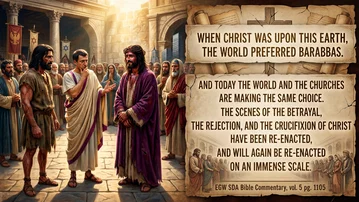
After scourging He was displayed before the crowd wearing the crown of thorns, though Pilate declared he found no fault in Him.Ms 137, 1897, par. 6–83SP 143.1–2 Pilate hoped the wounded, exhausted sight would move the people to pity.ST Jul 11, 18783SP 143.1–2 Instead the priests' hatred prevented compassion, the crowd's fury demanded His death, and His own nation clamored for His blood.ST Jul 11, 18783SP 143.1–2ST Jul 7, 1898 He was treated as the worst of criminals, scourged as such, and Barabbas was chosen in His place.3SP 143.1–2ST Jul 7, 1898
Endurance, Sacrifice, and Example
He met the royal greeting of mockery and the blows of hands with composure, meekness, patience, dignity, gentleness and longsuffering, without complaint or retaliation, and even in pain His suffering did not erase His kingly dignity.COS 149.7–150.15RED 58.1–2ST Jul 11, 1878EW 138.1DA 735.1–5 The abuse was meant to provoke Him to retaliate or to use His divine power to free Himself, and Satan hoped that mockery and violence would provoke such a response and thereby cause the plan of salvation to fail.COS 149.7–150.1EW 138.1 His faithfulness under this test was necessary to carry out the plan of salvation as a voluntary sacrifice, for any failure in His human life would have made Him an imperfect offering.COS 149.7–150.1EW 138.3EW 138.1Ms 95, 1897, par. 14
As the Just One for the unjust He bore the burden of the world's sins and gave His life and what He gave up for humanity, so that His blood could redeem sinners to God.1T 240.2Lt 1a, 1861, par. 2–516MR 31.1 His experience makes Him close to those who suffer for truth and virtue, for when His saints are persecuted Christ suffers in their person, and their persecutors are dealing with Christ.Ms 137, 1897, par. 6–8 His suffering is an example that puts the self-denial required of His followers in perspective and a reason not to regard that self-denial as too great.1T 240.2Lt 1a, 1861, par. 2–5
The scene was witnessed by His disciples, in whom their hopes of eternal life were centered and who thought He would take David's throne, and seeing their beloved Teacher abused and condemned marked the taking away of the Bridegroom when the children of the bride-chamber had cause to mourn and fast.4RED 102.2–103.1ST Jul 7, 1898Ms 3, 1898, par. 20–21 Their faith, hope and courage were tried and failing as they saw Him lifted up on the cross dying as a malefactor, while His own nation clamored for His blood and Barabbas was chosen in His place.ST Jul 7, 1898Ms 3, 1898, par. 20–21 Yet having seen how fickle worldly favor is, they were thereby prepared to face insult and violence themselves.4RED 102.2–103.1ST Jul 7, 1898Ms 3, 1898, par. 20–21
Sources
Pioneers and periodicals
50 sources
Roman soldiers mocked Jesus as King of the Jews after Pilate had Him scourged, putting a crown of thorns on His head and a purple garment on Him, hailing Him in false honor while striking Him with their hands.ST May 13, 1897ST Jul 14, 1881RH Dec 9, 1858ST May 13, 1897ST Jan 23, 1907
Pilate declared Him innocent and found no crime in Him, yet handed Him over to scourging and mockery rather than risk his own interests, hoping the sight would move the people to pity and consent to His release.ST May 13, 1897ST Jul 14, 1881RH Dec 9, 1858ST Oct 7, 1886
He bore the humiliation and blows for humanity and for sinners, though adored by angels, sacrificing His life so that others might be saved.RH Oct 30, 1855ST Jan 27, 1904RH Jun 4, 1908ST Mar 13, 1901
The crown, robe, reed, and greeting were derisive signs of earthly kingship which He accepted as mockery rather than as real rule, for His kingdom is not of this world, yet beneath the purple and thorns His divinity still shone through, turning the mockery into an ironic sign of His true royal dignity.ST Sep 23, 1889ST Dec 17, 1912RH Jan 2, 1900RH Aug 26, 1875RH Jun 24, 1902
He endured the scorn and blows with patience and without anger, and that patient endurance is the pattern for His followers to walk in peace and union with God, subduing pride and bearing reproach for Him.ST Jul 11, 1878ST Apr 17, 1879RH May 26, 1868ST Jul 18, 1878ST Mar 11, 1908
The Mocking Scene
John 19:3 shows Roman soldiers mocking Jesus as King of the Jews after Pilate had Him scourged, having plaited a crown of thorns and put it on His head and arrayed Him in a purple garment, then coming to Him hailing Him and striking Him with their hands.ST May 13, 1897ST May 13, 1897ST Jan 23, 1907ST Oct 31, 1916ST Nov 9, 1882 The mocking belongs to the condemnation of Christ, leading Pilate to bring Jesus out wearing the crown of thorns and purple garment while declaring he found no crime in Him.ST May 13, 1897ST Oct 7, 1886ST Nov 9, 1882 Their gestures of honor were part of His humiliation, not genuine respect, the greeting and mockery coming amid blows and other abuse while Jesus was already exhausted and wounded before being led to crucifixion.ST Jan 23, 1907ST Oct 31, 1916
The mock coronation included stripping Him and putting on Him an old robe of royal color, plaiting a crown of thorns for His brow, putting a reed in His right hand for a scepter, bowing the knee before Him saying Hail, King of the Jews, then spitting upon Him and smiting Him on the head with the reed, cruelly forcing the thorns to pierce Him on every side.ST Jul 7, 1898ST Jul 14, 1881RH Dec 9, 1858RH Jun 20, 1871 In one account this bowing, striking, thorn-crowning and purple-robing took place under Herod's command before Jesus was sent back to Pilate.ST Jan 17, 1911 The honor was false honor joined to abuse: hailing Christ as King while smiting Him on the cheek, bowing the knee and crying Hail while spitting and striking, putting a fragile reed for scepter in His hand, crowning with thorns, and covering with purple the wounds inflicted by the same hands.ST Apr 3, 1928
He was left torn with the stripes of the scourge, exhausted and disfigured, stripped to the waist and bearing bloodied stripes, with blood trickling from His temples over His face.ST Jul 14, 1881RH Dec 9, 1858ST Oct 7, 1886 The abusers are Roman soldiers, and also described as an infuriated mob, a hostile crowd, His enemies, and His persecutors who treated His claim to kingship with scorn.ST Jan 27, 1904RH Dec 12, 1865ST Nov 13, 1893RH May 12, 1904ST Jan 13, 1898 The mocking and beating came after Pilate's sentence and before His own clothes were put back on Him and He was led away to be crucified, as steps in His thorn-crowned, blood-stained, cross-bearing journey to sacrifice and death as King of the Jews.RH Apr 8, 1902ST Apr 4, 1906
Pilate's Condemnation Proceedings
Pilate declared Jesus innocent and found no crime in Him, yet handed Him over to be scourged and mocked rather than risk his own interests, inflicting unmerited cruelty on one declared innocent.ST May 13, 1897ST Oct 7, 1886ST Mar 13, 1901 The scourging was ordered as a preparatory step to execution, to satisfy the fury of the crowd demanding His death.ST Jul 11, 1878ST Jul 14, 1881RH Dec 9, 1858 Pilate had Him scourged and then brought Him out wearing the crown of thorns and purple garment in a battered, helpless state, torn with stripes, exhausted and disfigured with blood trickling from His temples over His face, in hope the sight would move the people to pity and consent to His release.ST Jul 14, 1881RH Dec 9, 1858ST Oct 7, 1886ST Nov 9, 1882 Beside Barabbas, Jesus' noble character stood in contrast with the robber's hardened appearance, but Barabbas was chosen in His place while His own nation clamored for His blood.ST Jul 7, 1898ST Oct 7, 1886
Priests and people renewed the demand to crucify Him, and Pilate, fearing for worldly interest lest the Jews accuse him to Tiberius Caesar as not Caesar's friend, resisted conscience and ordered the execution to proceed.ST Jul 14, 1881RH Dec 9, 1858 Their claim to have no king but Caesar broke their last bond as a nation to God and exposed Pilate's cowardice and their disloyalty to God. Pilate was brought face to face with Incarnate Truth in humble beauty from the glorious court on high, with troubled conscience knowing Jesus was innocent, though His battered, suffering appearance did not look like royalty.RH Sep 28, 1911 Duty and justice required him to use his stately power to stay the mad mob in its derision and hellish cry and to save the Man from scourging and crucifixion, and beneath the purple robe and crown of thorns His divinity still revealed its light to wake the Roman's conscience and break the pride of his strong spirit, but he denied his conviction and his best Friend and spoke the dreaded sentence to take Him, scourge Him, and crucify Him.RH Aug 26, 1875
What is recorded took place in Jerusalem, the city where Christ lived and died and the birth-place of Christianity, together with His scourging and crucifixion.RH Dec 25, 1856 The treatment resembled the yearly festival of Saturn, in which soldiers appointed a mock king in royal robes to direct wild carousals for a certain number of days before he was put to the sword, treating the condemned culprit handed to executioners as an object of sport.ST Jun 8, 1904 The weight of the accounts places the bowing, striking, thorn-crowning, and purple-robing mockery under Pilate after the scourging, while in one telling it took place under Herod's command before Jesus was sent back to Pilate.ST May 13, 1897ST Jul 14, 1881ST Jan 17, 1911 The scourge, thorny crown, and Roman cross were brought by the chief priests and Pharisees as their last argument against the teachings of Jesus.RH Oct 11, 1870
Anger or abusiveness in religious controversy proves the angry party is on the wrong side, for one who contends for what he regards as truth with love of truth in his heart never needs to become angry or act in any way unworthy, and abuse is the last resort of those who cannot maintain a position yet are determined to adhere to it.RH Oct 11, 1870 The mocking and physical abuse is acted out in the Central American Good Friday representation of Jesus' crucifixion.RH Jul 7, 1910
Sacrifice and True Kingship
The mocking belongs to the sacrifice as the antitype of the Passover: the paschal lamb was slain on the fourteenth day of the first month, and Christ the Lamb of God was sacrificed and died on that day in fulfillment of the type.RH Oct 30, 1855ST Aug 13, 1874RH Dec 15, 1868 The humiliation and rough blows were endured for humanity and for sinners, though He was adored by angels.ST Jan 27, 1904RH Jun 4, 1908 His life was sacrificed so that others might be saved.RH Jun 4, 1908ST Mar 13, 1901
The crown, purple robe, reed, and greeting were derisive signs of earthly kingship which He accepted as mockery rather than as real crown or rule, thereby rejecting earthly kingship at the close of His ministry, for His kingdom is not of this world.RH Jan 2, 1900 Yet His meek endurance of insult and blows reveals His kingship and glory, so that the mockery became an ironic sign of His true royal dignity and His suffering crowned Him with a crown of thorns.ST Sep 23, 1889ST Dec 17, 1912 Beneath the purple robe and crown of thorns His divinity still revealed its light, falling upon the Roman heart to wake conscience and break the pride of the strong spirit, leaving Him standing in mock purple as a true King without a throne and a sovereign Lord without command.RH Aug 26, 1875 In abasement He appears crownless, poor, disrobed, bleeding, weak and meek, yet sublime in that weakness and more than kingly in that meekness as the Son of God, greater than Pilate and Rome compelling the world by arms, the true King who will reign and who is now in glory interceding.RH Jun 24, 1902
The humiliation contrasts with His return: He does not come again mocked in purple robe with thorns, but as Conqueror to certain victory, now crowned with everlasting glory.RH Jul 24, 1856ST Oct 23, 1901 He wears on His brow a brighter crown than ever shone on an earthly monarch, descending in all the Father's glory with shining hosts of angels to gather His saints home.RH Jul 24, 1856 He endured scorn and physical abuse as part of the sufferings through which He was made perfect, bringing the soul nearer to God.ST Feb 13, 1907 He alone wore that crown of contempt and reproach, and His life and death and work stand by themselves and are not reproduced in any other man, for in humiliation He trod the winepress alone; to put even an emblem of that crown on another man signifies taking the place and sharing the work of Christ alone and is blasphemy.RH Dec 2, 1873
The scene marks the taking away of the Bridegroom, when the children of the bride-chamber had cause to mourn and fast.ST Jul 7, 1898 It was witnessed by His disciples, in whom hopes of eternal life were centered and who thought He was to take His place on David's throne, while His own nation clamored for His blood and Barabbas was chosen in His place.ST Jul 7, 1898 Their faith was tried and their hope and courage failed as they saw Him clad in the purple robe with the crown of thorns plaited for His brow, mocked as King of the Jews by persecutors bowing before Him and striking Him with the reed placed in His hand, scourged as the worst of criminals and lifted on the cross dying as a malefactor.ST Jul 7, 1898 He is the sweet, suffering Saviour with thorns pressing His anguished brow, slowly shedding His bloody price as the perpetual Sacrifice, while heaven mourns Him.ST Nov 17, 1898
Corruption by Earthly Power
John 19:3 pictures how earthly power treats Christianity when it takes temporal sovereignty over it, for the tormentors hail Jesus as King of the Jews and strike Him, pretending to honor Him while wounding and humiliating Him.ST May 21, 1912ST Jan 24, 1906ST Jul 4, 1900ST Feb 22, 1910 Rulers profess honor with a greeting and outward symbols of sovereignty, yet treat it with violence and contempt, outwardly honoring Christ and His cause while harming Him.ST Jan 24, 1906ST Jul 4, 1900ST Feb 22, 1910ST Apr 3, 1928 Those who impose worldly power on Christianity profess reverence for its Author while repeating the mockery of His kingship.ST Nov 13, 1893ST Jul 4, 1900ST Apr 3, 1928
To thrust temporal sovereignty upon Christianity is to treat her the same way her Author was treated, offering outward reverence that wounds and shames. It is false honor joined to abuse, hailing Christ as King while smiting Him on the cheek, bowing the knee and crying Hail while spitting and striking Him. It crowns with thorns, puts a fragile reed for a scepter in His hand, covers with purple the wounds inflicted by the same hands, and sets a magnificent title over the cross on which He was fixed to perish in ignominy and pain. Alliance with earthly power therefore brings Christianity into far greater danger of being corrupted than opposition brings of being crushed, proving that Christianity needs not the support of the state and is its own defense.
Those who impose temporal sovereignty on Christ repeat the treatment given Him by those who mocked His kingship, feigning honor toward Him and His cause while harming Him, for His kingdom is not of this world.ST Nov 13, 1893ST Jul 4, 1900ST Apr 3, 1928 His suffering with the crown of thorns, together with the cross and resurrection, is preferable to compromising His holy mission through worldly principles or methods.ST Jul 25, 1911
Patience and Discipleship
He bore the scourging and abuse inflicted to satisfy the fury of the crowd demanding His death with patience and dignity while wounded and exhausted, meekly enduring scorn, shameful mockery, cruel treatment and blows without answering with anger, giving an example of patience in bearing hardship.ST Jul 11, 1878RH May 26, 1868ST Jul 18, 1878 Buffeted, scorned, spit upon, crowned with thorns and clothed in purple with no malice in His heart, His patient endurance under mockery and abuse is the pattern for the true missionary to walk in peace and union with God no matter what vexes the soul, receiving needed strength from His life and the power of His Holy Spirit for ministry.ST Mar 11, 1908 Remembering these sufferings, mockery and blows can subdue pride and discontent in those who are fretful or gloomy.ST Apr 17, 1879 His suffering, including the crown of thorns He wore, calls for sympathy and humility rather than a demand for an easy life or self-pleasure.
Though adored by angels He endured cruel mocking and blows for the sake of sinners, and His suffering love moves believers to serve Him and bear reproach for Him through His grace.RH Jun 4, 1908 Wicked men dressed Him in an old purple robe, pierced His sacred brow with a crown of thorns, bowed the knee before Him in mockery, and greeted Him with contempt as King of the Jews, and His willing humiliation as the great pattern for His followers rebukes professed followers who shun the cross to escape reproach, calling them to Christian integrity that endures contempt and stands in evil times unsullied from fashionable sins.RH Jun 20, 1871 Pontius Pilate was brought face to face with Incarnate Truth in humble beauty from the glorious court on high, with troubled conscience knowing Jesus was innocent, so that duty and justice required him to use his stately power to stay the mad mob in its derision and hellish cry and to save Him from scourging and crucifixion, yet he denied his conviction and his best Friend, spoke the dreaded sentence to take Him, scourge Him, and crucify Him, and never repented of that choice, and the same test comes to every reader, who must pass sentence and decide whether to take Jesus as leader or condemn Him to die.
The chief priests and Pharisees brought the scourge, the thorny crown, and the Roman cross as their last argument against His teachings, and anger or abusiveness in religious controversy proves the angry party is on the wrong side, because one who contends for what he regards as truth with love of truth in his heart never needs to become angry or act in any way unworthy, while abuse is the last resort of those who cannot maintain a position yet are determined to adhere to it right or wrong.RH Oct 11, 1870 He is the sweet, suffering Saviour with thorns pressing on His anguished brow, slowly shedding His bloody price as the perpetual Sacrifice while heaven mourns Him, and men need the mist raised from their eyes to see and know Him in His suffering.ST Nov 17, 1898
Sources