Leviticus 24:8
Every sabbath he shall set it in order before the LORD continually, being taken from the children of Israel by an everlasting covenant.
Translations
American King James Version, King James Version, Webster Bible
Every sabbath he shall set it in order before the LORD continually, being taken from the children of Israel by an everlasting covenant.
Every sabbath he shall set it in order before the Lord continually, being taken from the children of Israel by an everlasting covenant.
Every sabbath day he shall set it in order before the LORD continually; it is on the behalf of the children of Israel, an everlasting covenant.
Every sabbath day he shall set it in order before Jehovah continually; it is on the behalf of the children of Israel, an everlasting covenant.
'On each sabbath-day he arrangeth it before Jehovah continually, from the sons of Israel — a covenant age-during;
Every sabbath day he shall arrange it before Jehovah continually, on the part of the children of Israel: [ it is] an everlasting covenant.
Sabbath day by sabbath day, shall he order it before Yahweh continually,—from the sons of Israel as an age-abiding covenant:
Berean Standard Bible, Majority Standard Bible
Every Sabbath day the bread is to be set out before the LORD on behalf of the Israelites as a permanent covenant.
Every Sabbath day he shall set it in order before the LORD continually. It is an everlasting covenant on the behalf of the children of Israel.
Every Sabbath day regularly, the priest is to put it in order before the Lord: it is offered for the children of Israel, an agreement made for ever.
Euery Sabbath hee shall put them in rowes before the Lord euermore, receiuing them of the children of Israel for an euerlasting couenant.
Douay-Rheims (Challoner revision)
Every sabbath they shall be changed before the Lord, being received of the children of Israel by an everlasting covenant:
Pictures
Cross-references
- 1 Samuel 21:6
So the priest gave him hallowed bread: for there was no bread there but the shewbread, that was taken from before the LORD, to put hot bread in the day when it was taken away.
The showbread removed before the LORD was replaced with fresh bread that day.
- 1 Chronicles 9:32
And other of their brethren, of the sons of the Kohathites, were over the shewbread, to prepare it every sabbath.
The Kohathites prepared the showbread every Sabbath.
- Exodus 25:30
And thou shalt set upon the table shewbread before me alway.
Names the bread placed continually before the Lord.
- John 6:35
And Jesus said unto them, I am the bread of life: he that cometh to me shall never hunger; and he that believeth on me shall never thirst.
The showbread represents Christ as the bread of life.
- Matthew 12:5
Or have ye not read in the law, how that on the sabbath days the priests in the temple profane the sabbath, and are blameless?
Priests perform Sabbath service in the temple without blame.
- John 6:51
I am the living bread which came down from heaven: if any man eat of this bread, he shall live for ever: and the bread that I will give is my flesh, which I will give for the life of the world.
The showbread symbolizes Christ, the living bread who gives life.
- Exodus 20:8-11
Remember the sabbath day, to keep it holy.
The showbread’s weekly arrangement follows the Sabbath’s holy rhythm.
- Hebrews 9:2
For there was a tabernacle made; the first, where in was the candlestick, and the table, and the shewbread; which is called the sanctuary.
Describes the sanctuary table and the bread set on it.
- Mark 2:26
How he went into the house of God in the days of Abiathar the high priest, and did eat the shewbread, which is not lawful to eat but for the priests, and gave also to them which were with him?
Jesus recalls David eating the priestly bread.
- Matthew 12:4
How he entered into the house of God, and did eat the shew bread, which was not lawful for him to eat, neither for them which were with him, but only for the priests?
Jesus refers to David eating the sacred bread.
- John 6:48
I am that bread of life.
Christ is the living bread pictured by the showbread.
- Exodus 16:23
And he said unto them, This is that which the LORD hath said, To morrow is the rest of the holy sabbath unto the LORD: bake that which ye will bake to day, and seethe that ye will seethe; and that which remaineth over lay up for you to be kept until the morning.
Sabbath bread preparation for ordinary use contrasts with the sanctuary bread.
- Numbers 4:7
And upon the table of shewbread they shall spread a cloth of blue, and put thereon the dishes, and the spoons, and the bowls, and covers to cover withal: and the continual bread shall be thereon:
Calls the bread on the table continual.
- Luke 6:4
How he went into the house of God, and did take and eat the shewbread, and gave also to them that were with him; which it is not lawful to eat but for the priests alone?
Jesus cites David eating the shewbread to defend Sabbath eating.
- Leviticus 6:14-18
And this is the law of the meat offering: the sons of Aaron shall offer it before the LORD, before the altar.
Both describe the bread and grain offering set apart for the LORD.
- Leviticus 22:10-12
There shall no stranger eat of the holy thing: a sojourner of the priest, or an hired servant, shall not eat of the holy thing.
Both concern who may eat the holy bread.
- Leviticus 21:22
He shall eat the bread of his God, both of the most holy, and of the holy.
Both concern eating the holy and most holy bread.
- Exodus 31:17
It is a sign between me and the children of Israel for ever: for in six days the LORD made heaven and earth, and on the seventh day he rested, and was refreshed.
Connects the Sabbath with God’s rest after creation.
- Revelation 1:12-13
And I turned to see the voice that spake with me. And being turned, I saw seven golden candlesticks;
John saw the golden candlestick in heaven.
Commentary
Each commentary is drawn from primary sources: the writings of Ellen G. White and Adventist pioneers and periodicals. Each commentary is separate. Its own words are not a quotation; follow the references to read the source passages.
Ellen G. White
1 source
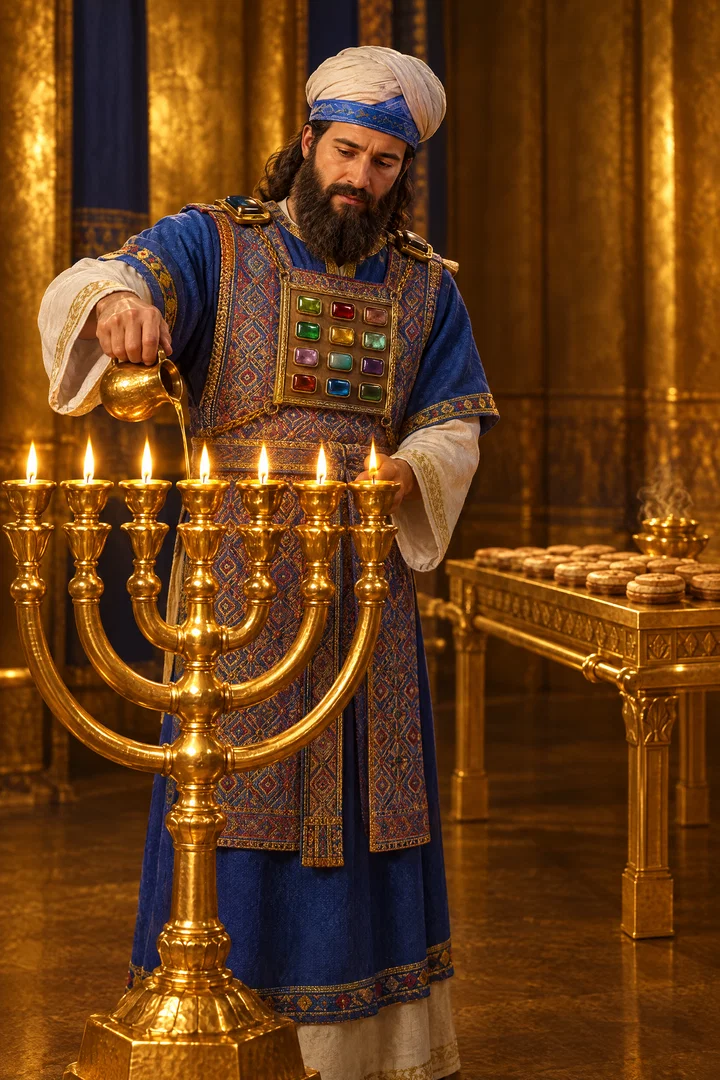
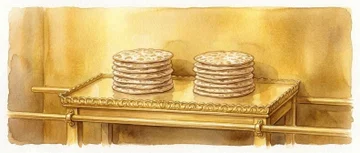
Every Sabbath the showbread was set in order before the Lord as a continuing part of Israel's worship.PP 348.1 Twelve cakes were placed by the priests on the table in two piles and sprinkled with frankincense.PP 348.1 The bread removed at the weekly replacement was holy and was eaten by the priests.PP 348.1
Sources
Pioneers and periodicals
55 sources
Every Sabbath twelve fresh unleavened loaves were arranged in two rows with frankincense on the table in the holy place before the Lord, and after remaining there through the week the old loaves were eaten by the priests alone in the holy place.ST May 6, 1897RH Dec 25, 1900RH Jan 21, 1862RH Sep 8, 1874RH Jan 26, 1905 This baking, setting in order, removing and eating on the Sabbath did not break the Sabbath, because the command forbids one's own work and not public service done for God, which increased on that day.RH Dec 25, 1900RH Feb 4, 1862ST Apr 5, 1883RH Dec 25, 1900RH Nov 4, 1858 The twelve loaves for the twelve tribes acknowledged that Israel depended continually on God for temporal and spiritual food through Christ's mediation, and they point to Christ himself as the living bread from heaven on whom the soul feeds and lives.RH Apr 14, 1910RH Sep 2, 1915ST May 8, 1901 Their renewal with fresh, warm bread every Sabbath morning pictures fresh supplies of grace and strength from Christ's special presence, bringing a blessing to be carried through the week and increased at each return of the day.RH Apr 14, 1910RH Jan 26, 1905RH Sep 2, 1915ST Jun 20, 1911ST May 8, 1901 So the Sabbath renewal calls every believer and every household to partake personally of the bread of heaven in the Word each Sabbath, taking it into life for strength in service and for growth into Christ through the week.ST Nov 19, 1912RH Dec 25, 1900RH Feb 2, 1911ST Feb 7, 1906RH Mar 23, 1916
Ritual Words and Arrangement
Every Sabbath the bread of the presence was to be set in order anew before the Lord and kept there continually, supplied by the children of Israel under an everlasting covenant.ST May 6, 1897RH Jan 26, 1905ST Feb 14, 1911ST Apr 1, 1913 It was brought in on the Sabbath and left in the sanctuary through the week, then on the next Sabbath it was replaced and eaten by the priests.RH Dec 25, 1900RH Jan 26, 1905RH Dec 25, 1900 Because it was brought in hot, it was baked on the Sabbath as well, so its preparation, placing, removal, and eating were all Sabbath service.RH Dec 25, 1900RH Dec 25, 1900 Through the week it lay covered with frankincense, and the twelve cakes sprinkled with frankincense that were removed were eaten by the priests in the holy place.ST Apr 1, 1913RH Dec 25, 1900
The offering was twelve unleavened loaves, arranged in two rows with frankincense on the pure table, renewed with fresh loaves every Sabbath.ST Nov 19, 1912ST Apr 1, 1913 The table stood in the holy place on the north side opposite the candlestick, in the front eastern apartment occupying two thirds of the sanctuary, just to the right of the entrance.ST Nov 21, 1892RH Jul 27, 1916 Each Sabbath new hot bread was put in its place and the old bread taken away to be eaten by the priests.RH Jan 21, 1862ST Nov 21, 1892 The bread given to David at Nob was that old bread taken from before the Lord that day to put hot bread in its place.RH Jan 21, 1862ST Feb 10, 1904
The loaves removed after remaining through the week were eaten by the priests alone, representing the people.RH Jan 26, 1905ST May 8, 1901ST May 6, 1897 The Levites prepared the bread and the priests received and cared for it in the sanctuary, and the old bread had to be eaten by them in the holy place.ST Nov 19, 1912ST May 6, 1897 This weekly change was appointed for those who ministered in the temple.RH Feb 4, 1862
The name means literally bread of the face or faces because it was continually in the presence of God, a symbol of the life for which men are continually dependent on God, and the English name shewbread comes from the German schau-brote given in Luther's translation.RH Sep 8, 1874 Showbread means bread of the presence, signifying that God intended His presence to abide in the inner life of every person in every tribe, and His presence in the soul cleanses from all unrighteousness.ST Feb 7, 1906 By placing His presence within what is hallowed God blesses and sanctifies it, so Sabbath rest is spiritual rest in Christ's presence received by faith rather than mere cessation from labor.ST Feb 7, 1906ST Jan 30, 1896 The making, setting in order, and eating of this bread pertained to the holy place ministry, and no bread pertained to or was offered in the most holy place.RH Aug 28, 1853
Sabbath Date and History
The Sabbath named here is the weekly Sabbath, the Sabbath of the Lord, not a festival day nor a sabbath of the land.ST May 16, 1878RH Mar 19, 1857 Its ordering of the sacred bread before the Lord belonged to Sabbath worship and to sanctuary service, with priests ministering in the sanctuary.ST Nov 1, 1877 The showbread was replaced every Sabbath as part of the worship service in the Lord's house.ST May 5, 1909
Because the showbread was commanded to be set forth every Sabbath, the setting up of the tabernacle with its table and showbread on the first day of the first month shows that Abib 1 was the weekly Sabbath, and therefore Abib 15 was the weekly Sabbath also.ST Jul 17, 1879 Another understanding holds that the command to set forth the showbread every Sabbath was a ceremonial precept given some time after Moses set up the tabernacle and set in it the table and the showbread on the first day of the first month in Exodus 40, so it furnishes no proof that Abib 1 or Abib 15 was the weekly Sabbath.ST Jul 17, 1879 The law for presenting the showbread on the Sabbath was no part of the Sabbath institution itself but grew out of the Sabbath being entrusted to the Hebrews.RH Jan 7, 1862RH Mar 21, 1865 It belonged to that nation rather than to the Sabbath itself.RH Mar 21, 1865
Twelve loaves were required to be set forth in the sanctuary on the pure table before the Lord every Sabbath, with new hot bread put in place each Sabbath and the old bread taken away to be eaten by the priests.RH Jan 21, 1862 The twelve loaves were kept in the sanctuary and changed every Sabbath, and after the fresh bread was set out the priests used the old loaves.ST Feb 10, 1904 The showbread given to David at Nob was the old bread that had that day been taken from before the Lord to put hot bread in its place, which shows that David received it on the Sabbath.RH Jan 21, 1862 The fresh bread had been sanctified that day, and David and his hungry men received it from the priest at Nob, as Jesus recalls in Mark that David ate this bread lawful for priests to eat and shared it with his companions when they were hungry.ST Feb 10, 1904ST Oct 22, 1894
His act in eating the showbread violated the letter of the law and kept it in no sense in the spirit.ST Jan 16, 1879 Letter and spirit always agree, for the spirit may reach farther than the letter but never in an opposite direction, and never requires or permits anything the letter forbids, so the spirit cannot be kept while the letter is violated.ST Jan 16, 1879 The table provided for here was among the sacred vessels from the holy place taken as spoils to Rome after Titus conquered Jerusalem and destroyed the temple.RH Dec 8, 1859ST May 14, 1902 Its form is preserved in the sculptures on the triumphal arch erected in Rome to commemorate that conquest, which furnish the only existing representations of the table, the golden candlestick with its seven branches, and the silver trumpets.RH Dec 8, 1859 These furnishings were regarded as especially important and sacred, and stand as a verification of prophecy and divine history.RH Dec 8, 1859ST May 14, 1902
Lawful Sabbath Work
The loaves were brought in hot, so they were baked on the Sabbath itself, and their preparing, placing, removing, and eating all belonged to Sabbath work, including manual labor.RH Dec 25, 1900ST Apr 5, 1883RH Dec 25, 1900RH Dec 25, 1900 The fresh loaves were set in order before the Lord every Sabbath and left there continually through the week, covered with frankincense, and on the next Sabbath they were replaced and eaten by the priests.RH Dec 25, 1900RH Dec 25, 1900RH Dec 25, 1900 Both the new bread then brought in and the bread that had remained before the Lord during the week formed part of that Sabbath service.RH Dec 25, 1900RH Dec 25, 1900
The Levites prepared this sanctuary bread on the Sabbath, receiving and caring for it for the holy place, while bread for household use on the Sabbath was baked on the sixth day.ST Nov 19, 1912ST May 6, 1897 The twelve unleavened loaves were arranged in two rows with frankincense and remained before the Lord through the week, and at the week's end the priests removed them and ate them, the old bread being given to the priests alone.ST Nov 19, 1912ST May 6, 1897
This appointed Sabbath duty of those ministering in the sanctuary was not blameworthy and did not break the Sabbath.RH Feb 4, 1862ST Apr 5, 1883RH Nov 4, 1858 Sanctuary service did not rest on the Sabbath but increased, since the daily offerings were still offered with added work besides, proving that labor done for that service does not break the Sabbath.RH Feb 4, 1862RH Nov 4, 1858ST Oct 31, 1906 The command against work forbids one's own work, not work done for God, so public service to God should be greater on that day, and the Sabbath is a day of wholesome spiritual activity rather than idleness.ST Apr 5, 1883RH Nov 4, 1858ST Oct 31, 1906
Christ and Covenant Meaning
The twelve loaves set out each Sabbath stood for the twelve tribes of Israel, one loaf for each tribe, as a memorial of God's goodness and of His sustaining care in providing for His people.ST May 8, 1901ST Nov 21, 1892RH Jul 27, 1916 They signified that He intended His presence to abide in the inner life of every person in every tribe, and His presence in the soul cleanses from all unrighteousness. Eaten by the priests in the holy place, the bread illustrates God's word, grace and favor continually sustaining His people, the manifold grace of God received through Christ as the heavenly manna on which the Christian replenishes spiritual life.ST Nov 21, 1892 Its weekly renewal pledged fresh heavenly blessings to follow through the succeeding week.ST May 8, 1901RH Jul 27, 1916
The bread of the presence acknowledged that Israel depended continually on God for temporal and spiritual food, and both kinds of food come through Christ, who continually intercedes for them before the Father.ST May 8, 1901ST Nov 19, 1912 What was received through His mediation was the living bread itself, for the manna and the showbread pointed to Christ, the true bread from heaven, the living bread and bread of life revealed in the Word.RH Apr 14, 1910RH Sep 2, 1915ST May 8, 1901ST May 8, 1901RH Dec 25, 1900 He has prepared Himself as spiritual food for His people, to be received, made their own, and lived upon for nourishment; He remains continually in God's presence for His people, gives life, satisfies the hungry soul, and cleanses the soul when His presence abides within.ST May 8, 1901ST May 6, 1897 His freshness on the Sabbath shows that God gives spiritual nourishment on that day in a richness not received on other days, bringing His special presence anew to His humble children and making the day holy.RH Apr 14, 1910RH Sep 2, 1915
The loaves were unleavened and did not become stale through the week, remaining covered with frankincense until they were replaced and eaten by the priests on the next Sabbath.RH Dec 25, 1900RH Dec 25, 1900 The bread was not merely for display but to be consumed and taken into the body.RH Dec 3, 1901 The words everlasting, continual and perpetual are not confined to the Mosaic dispensation, but as the priesthood, the Sabbath, circumcision and other institutions described by the same terms continue today in antitype, so this institution continues as the Lord's table.RH Jul 8, 1873 That table holds twelve loaves for one body, with vessels of wine poured out as Christ poured out His soul and with incense for thanks before partaking, and as the bread was only for the priests so the Lord's Supper is only for the royal priesthood, to be observed weekly and by express example upon the first day, which proves the first day is the Lord's day.RH Jul 8, 1873
The use of everlasting for this arrangement does not by itself prove that the ordinance must remain in force forever, since a period described as perpetual or everlasting can have expired, as with other ceremonial requirements.RH Apr 15, 1873 The twelve loaves remaining seven days and eaten on the eighth day typify Christ, the bread of life, and their weeklong placement is compared with consecrated eucharistic bread retained from one first-day service until the next.RH Apr 17, 1879ST Apr 24, 1879 The bread kept continually before the Lord typifies Christ's continuous presence with His people by His Spirit, as He was present with Israel in the wilderness in the pillar of cloud.ST May 8, 1901 The continual service taught of the true Bread from heaven and of the true offering for sin, everlasting righteousness, forgiveness and God's presence, and those who become temples of the living God are to serve Him continually and Him alone.RH Aug 27, 1908ST May 8, 1901
Fresh Sabbath Blessing
The loaves were set before the Lord anew every Sabbath morning, replaced with fresh, warm bread to stand continually in His presence under covenant.RH Apr 14, 1910RH Sep 2, 1915ST Jun 20, 1911ST Sep 8, 1909ST May 6, 1897 That weekly freshness pictures fresh supplies of grace from the Father and renewed strength and warmth from Christ, the true and living bread from heaven, giving Himself to His people.RH Apr 14, 1910RH Sep 2, 1915ST Jun 20, 1911ST Sep 8, 1909ST May 6, 1897 His special presence comes anew to His humble children on that day and makes it holy.RH Sep 2, 1915ST Sep 8, 1909 After feeding on Him through the six days, His people receive a double portion on the Sabbath, with spiritual nourishment in a richness not given on other days.RH Apr 14, 1910ST May 6, 1897
Their renewal pledges fresh heavenly blessings to follow through the succeeding week.ST May 8, 1901RH Jul 27, 1916 The blessing continues through the week and is renewed and increased each Sabbath, representing Christ's abiding presence and the believer's growing experience of partaking of Him.RH Jan 26, 1905 The twelve loaves, a memorial of His goodness and sustaining care in providing for each tribe, were eaten by the priests as representing the people.RH Jan 26, 1905ST May 8, 1901 The special spiritual food God gives on the Sabbath brings strength and blessing to the soul to be carried through the week, so that each Sabbath supports continued growth in a higher life in Christ.RH Mar 23, 1916RH Jul 27, 1916
The name bread of God's presence shows God's presence was associated with the bread set continually before Him.ST Feb 7, 1906ST Jan 30, 1896 He blesses and sanctifies by placing His presence within what is hallowed.ST Jan 30, 1896 So Sabbath rest is spiritual rest in Christ's presence, received by faith, rather than mere cessation from physical labor.ST Feb 7, 1906ST Jan 30, 1896 The instruction for keeping the bread continually before the Lord, set in order every Sabbath and supplied by the children of Israel, belongs to the showbread passage to be compared with the living bread.ST Oct 1, 1896
Living the Bread
The bread set in order before the Lord Sabbath by Sabbath and then eaten by the priests is the bread of God's presence, a symbol of the Christian's duty and privilege to observe the Sabbath and partake of the bread of heaven to receive strength for service.ST Nov 19, 1912RH Dec 25, 1900RH Feb 2, 1911 It was to be fresh when placed on the table, even unleavened bread that did not become stale, and then taken into the priests' bodies when they ate the loaves prepared the Sabbath before.ST Nov 19, 1912RH Dec 25, 1900 This pictures God's people receiving a fresh experience through His Word each Sabbath and taking its teaching into their lives for the duties and temptations of the week.ST Nov 19, 1912RH Dec 25, 1900
Its renewal each Sabbath teaches those who serve and teach to offer fresh, living spiritual nourishment rather than merely repeating stale, familiar thoughts.ST Nov 19, 1912RH Dec 25, 1900 Merely reading the Word as a form, or only for the benefit of others, gives no abiding strength unless it is received personally and lived out.ST Nov 19, 1912 Parents, as priests of their households, are therefore to prepare and share fresh spiritual nourishment from Scripture with their families each Sabbath, and themselves to take in the same Word they give their children.RH Dec 25, 1900 As they do, the Word becomes part of their own lives and strengthens them through the week, while their children see its effects in their conduct.RH Dec 25, 1900
The bread was not merely for display but to be consumed, as part of a continual service supplied under an everlasting covenant that taught of Christ the true Bread from heaven, the true offering for sin, everlasting righteousness, forgiveness, and God's presence.RH Aug 27, 1908RH Dec 3, 1901 That weekly ordering stands as an example of service wholly given to God.RH Dec 3, 1901 Those who become temples of the living God are thus to serve Him continually and Him alone.RH Aug 27, 1908
Sources