1 Samuel 21:4
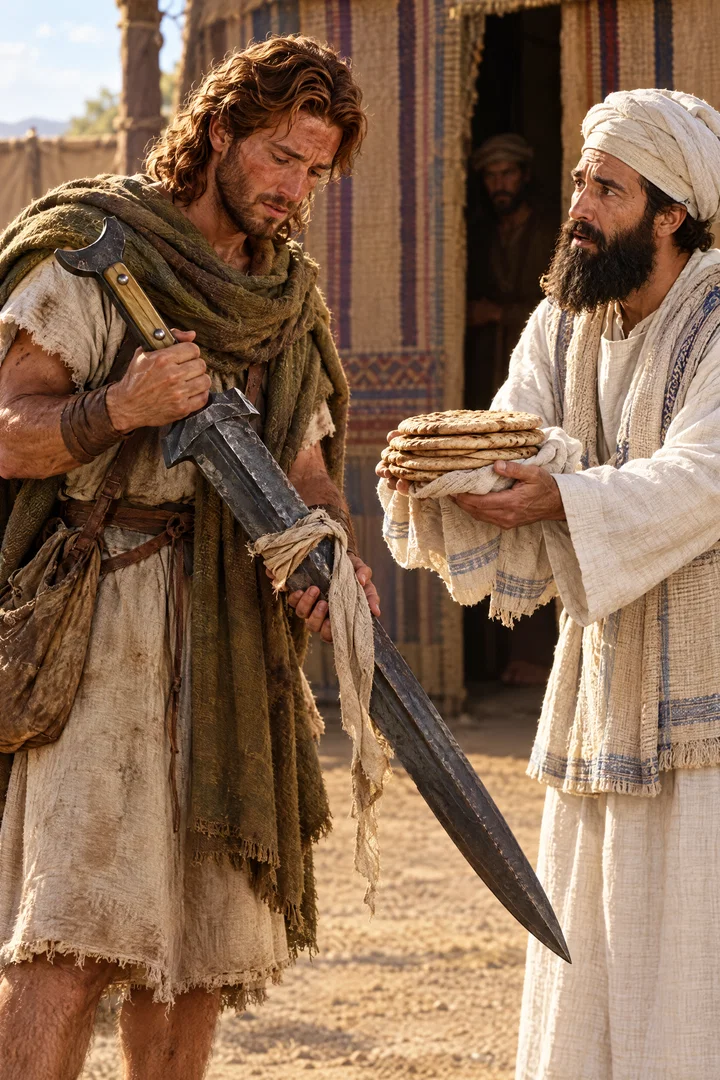
And the priest answered David, and said, There is no common bread under mine hand, but there is hallowed bread; if the young men have kept themselves at least from women.
Translations
American King James Version, Webster Bible
And the priest answered David, and said, There is no common bread under my hand, but there is hallowed bread; if the young men have kept themselves at least from women.
King James Version, KJV Cambridge Paragraph Bible
And the priest answered David, and said, There is no common bread under mine hand, but there is hallowed bread; if the young men have kept themselves at least from women.
And the priest answered David, and said, There is no common bread under mine hand, but there is holy bread; if only the young men have kept themselves from women.
And the priest answered David, and said, There is no common bread under my hand, but there is holy bread; if only the young men have kept themselves from women.
And the priest answereth David, and saith, 'There is no common bread under my hand, but there is holy bread; if the youths have been kept only from women.'
And the priest answered David and said, There is no common bread under my hand, but there is holy bread; if the young men have kept themselves at least from women.
And the priest answered David, and said, There is no common bread under my hand,—but, hallowed bread, there is, if the young men have kept themselves, at least from women.
Berean Standard Bible, Majority Standard Bible
“ There is no common bread on hand,” the priest replied, “ but there is some consecrated bread— provided that the young men have kept themselves from women.”
The priest answered David, and said, “ I have no common bread, but there is holy bread; if only the young men have kept themselves from women.”
And the priest, answering David, said, I have no common bread here but there is holy bread; if only the young men have kept themselves from women.
And the Priest answered Dauid, and saide, There is no common bread vnder mine hande, but here is halowed bread, if the yong men haue kept themselues, at least from women.
Douay-Rheims (Challoner revision)
And the priest answered David, saying: I have no common bread at hand, but only holy bread, if the young men be clean, especially from women?
Pictures
Cross-references
- Matthew 12:3-4
But he said unto them, Have ye not read what David did, when he was an hungred, and they that were with him;
Jesus cites David’s eating the showbread to defend his hungry disciples.
- Mark 2:25-26
And he said unto them, Have ye never read what David did, when he had need, and was an hungred, he, and they that were with him?
Jesus recalls David eating the holy bread when hungry with his companions.
- Luke 6:3-4
And Jesus answering them said, Have ye not read so much as this, what David did, when himself was an hungred, and they which were with him;
Jesus cites David’s eating the sacred bread to defend his disciples in the Sabbath dispute.
- Leviticus 24:9
And it shall be Aaron’s and his sons’; and they shall eat it in the holy place: for it is most holy unto him of the offerings of the LORD made by fire by a perpetual statute.
The sacred bread was reserved for priests to eat in the holy place.
- 1 Samuel 22:18-19
And the king said to Doeg, Turn thou, and fall upon the priests. And Doeg the Edomite turned, and he fell upon the priests, and slew on that day fourscore and five persons that did wear a linen ephod.
Saul has Doeg kill the priests and destroy Nob after Ahimelech feeds David.
- 1 Chronicles 9:32
And other of their brethren, of the sons of the Kohathites, were over the shewbread, to prepare it every sabbath.
It records the Sabbath preparation of the showbread.
- Mark 2:27-28
And he said unto them, The sabbath was made for man, and not man for the sabbath:
The Sabbath was made for human need, as David received bread to satisfy hunger.
- Matthew 12:7
But if ye had known what this meaneth, I will have mercy, and not sacrifice, ye would not have condemned the guiltless.
Jesus uses David’s example to show mercy toward the guiltless.
- Matthew 12:5
Or have ye not read in the law, how that on the sabbath days the priests in the temple profane the sabbath, and are blameless?
Priests’ necessary temple service and David’s need for holy bread show necessity overriding ordinary restrictions.
- Mark 2:26
How he went into the house of God in the days of Abiathar the high priest, and did eat the shewbread, which is not lawful to eat but for the priests, and gave also to them which were with him?
The next verse recounts David eating the holy bread.
- Leviticus 24:8
Every sabbath he shall set it in order before the LORD continually, being taken from the children of Israel by an everlasting covenant.
The bread was set out each Sabbath.
- Leviticus 24:6-7
And thou shalt set them in two rows, six on a row, upon the pure table before the LORD.
Describes the loaves’ arrangement and frankincense.
- Matthew 12:1
At that time Jesus went on the sabbath day through the corn; and his disciples were an hungred, and began to pluck the ears of corn, and to eat.
The disciples’ hunger parallels David’s.
- 1 Kings 2:27
So Solomon thrust out Abiathar from being priest unto the LORD; that he might fulfil the word of the LORD, which he spake concerning the house of Eli in Shiloh.
continues fate of Ahimelech's line
- Exodus 19:15
And he said unto the people, Be ready against the third day: come not at your wives.
Israel abstained from sexual relations while preparing to meet God.
- 1 Samuel 21:9
And the priest said, The sword of Goliath the Philistine, whom thou slewest in the valley of Elah, behold, it is here wrapped in a cloth behind the ephod: if thou wilt take that, take it: for there is no other save that here. And David said, There is none like that; give it me.
both received by David at Nob
- Matthew 12:2
But when the Pharisees saw it, they said unto him, Behold, thy disciples do that which is not lawful to do upon the sabbath day.
The disciples’ grain-gathering prompts the accusation Jesus answers with David’s example.
- Matthew 9:13
But go ye and learn what that meaneth, I will have mercy, and not sacrifice: for I am not come to call the righteous, but sinners to repentance.
Christ’s preference for mercy explains why he did not condemn David’s act.
- Matthew 12:6
But I say unto you, That in this place is one greater than the temple.
Declares Jesus greater than the temple.
- 2 Samuel 8:17
And Zadok the son of Ahitub, and Ahimelech the son of Abiathar, were the priests; and Seraiah was the scribe;
identifies Ahimelech's son as high priest
Commentary
Each commentary is drawn from primary sources: the writings of Ellen G. White and Adventist pioneers and periodicals. Each commentary is separate. Its own words are not a quotation; follow the references to read the source passages.
Ellen G. White
5 sources
Ahimelech had no ordinary bread under his hand to give, only hallowed bread to offer.PP 655.3–656.12SP 195.2–197.14RED 48.2–49.1 He would give that hallowed bread only if the young men had kept themselves at least from women.PP 655.3–656.12SP 195.2–197.14RED 48.2–49.1 David, hungry with his companions, overcame the priest's scruples, received the consecrated bread, ate it and shared it with them to satisfy hunger.PP 655.3–656.12SP 195.2–197.14RED 48.2–49.1Lt 422, 1907, par. 5COS 71.4–73.4
Although the shewbread was ordinarily reserved for priests, extreme and urgent hunger excused its use, so the act was guiltless.2SP 195.2–197.14RED 48.2–49.1COS 71.4–73.4 This was especially so to sustain those engaged in God's service.4RED 48.2–49.1 Christ appealed to this precedent to show that meeting human need is right, so His hungry disciples were not to be condemned for plucking grain on the Sabbath.2SP 195.2–197.1COS 71.4–73.4
The episode shows that exceptional need can justify using what is ordinarily set apart.Lt 422, 1907, par. 5 It does not excuse careless neglect of the tithe.Lt 422, 1907, par. 5
Sources
Pioneers and periodicals
43 sources
Fleeing for his life from Saul, David came to Ahimelech at Nob and entered the house of God where the tabernacle then stood.RH Mar 3, 1910RH Jun 10, 1852RH Feb 3, 1852 The priest had no ordinary bread on hand, only the hallowed showbread set before the Lord and replaced with fresh bread each Sabbath.RH Jan 21, 1862ST Feb 10, 1904RH Aug 28, 1856 He gave that holy bread, ordinarily reserved for priests alone, to David and his hungry companions because pressing hunger required it and they had kept themselves continent.RH Jan 21, 1862RH Mar 3, 1910ST Feb 10, 1904ST Oct 22, 1894ST Nov 11, 1897 Their eating in urgent need was guiltless mercy in harmony with God's law, which was made for people and not to bring them to destruction.RH Jun 10, 1852RH Feb 4, 1862RH Feb 3, 1852ST Apr 14, 1881ST Oct 22, 1894 Jesus used this eating to defend His disciples for relieving hunger on the Sabbath, proving that meeting human need and doing good on the Sabbath does not break God's law.ST Apr 14, 1881RH Feb 4, 1862ST Aug 25, 1909ST Nov 11, 1897RH May 17, 1906
Historical Setting at Nob
1 Samuel 20 to 22 stands amid Saul's jealousy and effort to slay David and shows its bitter fruit.RH Mar 23, 1916ST Apr 7, 1909 The same chapters hold the covenant between David and Jonathan and Jonathan's noble, unselfish generosity.ST Apr 7, 1909 They set jealous Saul in contrast with his noble son.ST Apr 7, 1909 They also show David's hope and trust in God and his utter refusal to take vengeance into his own hands upon the enemy who was pursuing him.ST Apr 7, 1909
David, fleeing for his life from Saul, came to Ahimelech at Nob and entered the house of God.RH Mar 3, 1910RH Jun 10, 1852RH Feb 3, 1852RH Apr 5, 1860RH Jan 12, 1911 There he received consecrated bread from the priest because he was in need and famished.RH Mar 3, 1910RH Jun 10, 1852RH Feb 3, 1852RH Apr 5, 1860RH Feb 3, 1852 The bread was ordinarily reserved for the priests, and the priest had no ordinary bread to give, only consecrated bread made conditional on the young men having kept themselves from women.RH Mar 3, 1910RH Aug 28, 1856RH Feb 3, 1852 Giving it in those circumstances was an act of mercy in accord and harmony with God's law, illustrating that human need may justify an action not lawful on ordinary occasions, while the same act would have been wrong under different or ordinary circumstances.RH Jun 10, 1852RH Feb 3, 1852RH Apr 5, 1860RH Feb 3, 1852 At Nob David also took the sword of Goliath.ST Oct 27, 1898
The tabernacle was then at Nob, the city of the priests, after the ark had been taken from the sanctuary at Shiloh.RH Jan 6, 1853ST Nov 5, 1912ST Oct 27, 1898 Its sacred vessels remained there, and the priests kept the showbread set before the Lord each Sabbath.RH Jan 6, 1853ST Nov 5, 1912 Nob lay about a mile from Anathoth toward Jerusalem and a little more than a mile from Gibeah where Saul lived.ST Oct 27, 1898 Ordinary bread was unavailable in the priest's keeping, so he offered hallowed bread rather than common bread.RH Aug 28, 1856ST Nov 5, 1912
The encounter occurred on the Sabbath, the seventh day, when the old showbread was removed and replaced with fresh bread.RH Jan 21, 1862RH Feb 4, 1862RH May 17, 1906RH Feb 4, 1862 David fleeing for his life entered the house of God on the Sabbath with those who were with him when hungry and ate the shewbread to satisfy hunger though it belonged only to the priests.RH Feb 4, 1862RH Feb 4, 1862 He did right in his necessity, and his act proves that satisfying hunger on the Sabbath is not a violation of its sacredness.RH Feb 4, 1862RH Feb 4, 1862 Ordinary bread for Sabbath use was to be baked on the sixth day, while the Levites were directed to prepare the showbread every Sabbath, so Ahimelech had no ordinary bread to give David on the Sabbath because the priests ate the hallowed showbread then.ST Nov 19, 1912 Jesus referred to David's experience when the Pharisees challenged His disciples for plucking grain on the Sabbath, also the seventh day.RH May 17, 1906
The surrounding account indicates that the bread had been removed that day to replace it with fresh bread as required each Sabbath, so David's request and the priest's reply probably occurred on the Sabbath, and the lack of ordinary bread and the giving of the holy bread fit that setting.RH Jan 21, 1862 The priest told David that only holy bread was available and made its use conditional on the young men having kept away from women.RH Jan 21, 1862 David and his hungry men in taking it broke the rules and violated the sanctity of the holy place, setting aside for the time even the strictest of the temple regulations, yet pressing hunger vindicated the act.ST Apr 14, 1881 The eating of the hallowed bread may have been done on a Sabbath day, which makes Christ's reference to this conduct of David, esteemed as a model of Jewish piety, as a shield of defense for the act of His own hungry disciples doubly appropriate, though the essential point remains the principle that hunger justifies the act.ST Apr 14, 1881
The feeding was reported to Saul, who called the trembling Ahimelech before him for an explanation.RH Jan 12, 1911 Ahimelech, Abiathar's father who had given bread to David and his men, became the victim of Saul's wrath.ST Sep 18, 1884RH Jan 12, 1911 Doeg at Saul's command slew eighty-five priests.RH Jan 12, 1911 Abiathar was the only one of Ahimelech's household and sons to escape Saul's slaughter of the priestly household.ST Sep 18, 1884
Hallowed Bread and Condition
Ahimelech had no common or ordinary bread under his hand to give to David and his men, but only hallowed bread.ST Aug 31, 1888RH Jan 21, 1862ST Feb 10, 1904RH Aug 28, 1856RH Feb 3, 1852 Ordinary bread was unavailable in the priest's keeping at Nob when David came there, so the priest offered the hallowed bread instead.ST Aug 31, 1888ST Feb 10, 1904RH Aug 28, 1856RH Feb 3, 1852RH Jan 8, 1857
That hallowed bread was the sanctuary showbread placed on the altar and table before the Lord.ST Feb 10, 1904ST Jan 17, 1911RH Sep 1, 1859 It was removed and replaced with fresh bread each Sabbath, and the old bread removed each Sabbath was for the use of those ministering in the temple.ST Feb 10, 1904ST Jan 17, 1911RH Feb 4, 1862 Making that preparation and eating that bread involved work on the Sabbath, yet those who did it were guiltless.RH Feb 4, 1862 Ordinary bread for Sabbath use was to be baked on the sixth day, while the Levites were directed to prepare the showbread every Sabbath.ST Nov 19, 1912
The bread was ordinarily reserved and lawful only for the priests, not for ordinary use.RH Mar 3, 1910ST Oct 22, 1894ST Nov 11, 1897RH Apr 5, 1860 David and his hungry companions received the sanctuary's hallowed bread from the priest though it was not lawful for ordinary use.ST Oct 22, 1894ST Oct 22, 1894
The priest made giving it conditional on the young men having kept themselves at least from women.RH Jan 21, 1862ST Feb 10, 1904RH Feb 3, 1852RH Jan 8, 1857RH Apr 21, 1863 They could eat because they had been temperate and continent.ST Jan 17, 1911
Hunger Justifies the Eating
David and his hungry companions were in need of food, and with no ordinary bread at hand they received the hallowed bread that was ordinarily lawful only for priests and ate it to satisfy hunger.ST Oct 22, 1894ST Oct 22, 1894RH Apr 5, 1860ST Oct 22, 1894ST Nov 14, 1900 Famished while fleeing, David was permitted to take the consecrated showbread reserved for the priests, showing that human need may justify an action not lawful on ordinary occasions.RH Apr 5, 1860RH Aug 15, 1854ST Nov 14, 1900 Jesus recalled this need of David and his men as the example for His own disciples' need for food.ST Oct 22, 1894ST Oct 22, 1894ST Oct 22, 1894
Pressing hunger vindicated setting aside for the time even the strictest of the temple regulations, for urgent need took precedence over the ceremonial restriction.ST Apr 14, 1881ST Oct 22, 1894RH Apr 5, 1860RH Aug 15, 1854ST Nov 14, 1900 God did not intend His laws to bring people to destruction, but desires mercy rather than sacrifice, and the Sabbath was made for people.ST Apr 14, 1881ST Oct 22, 1894ST Nov 11, 1897 Urgent need therefore does not make necessary provision wrong, and need could justify an exception to the ordinary restriction.RH Apr 5, 1860RH Aug 15, 1854ST Nov 14, 1900 Giving the bread in that need was an act of mercy in accord and harmony with God's law.RH Jun 10, 1852RH Feb 3, 1852RH Feb 3, 1852
A deed done from necessity only seems to break the law but is in harmony with it and is in reality obedience to it, so satisfying hunger and eating when hungry does not violate the law or the sacredness of the Sabbath.RH Jun 10, 1852RH Feb 4, 1862RH Feb 3, 1852RH Oct 21, 1851 David did right in his necessity when he entered the house of God and ate the shewbread that belonged only to the priests, and his act proves that satisfying hunger on the Sabbath is not a violation of its sacredness.RH Feb 4, 1862RH Oct 21, 1851RH Feb 4, 1862 David overcame the priest's scruples and obtained the bread, breaking the rules and violating even the holiness of the sanctuary, yet he was left guiltless and not condemned because God understood the circumstances and hunger excused him.ST Aug 31, 1888ST Apr 14, 1881ST Apr 14, 1881ST Mar 30, 1888 God did not condemn him for eating what was lawful only for priests, and their need was met without condemnation.ST Mar 30, 1888RH Sep 30, 1915
The same act would have been wrong under different or ordinary circumstances, for it was a departure pardonable only under pressure of necessity and gives no warrant for doing so ordinarily.RH Jun 10, 1852RH Feb 3, 1852RH Apr 25, 1871RH Feb 3, 1852RH Sep 2, 1851 While need and mercy excuse eating, needless work remains unlawful.RH Apr 25, 1871RH Sep 2, 1851 From this it follows that if a family has no bread it is lawful from necessity to buy or provide it even with physical labor on the Sabbath, though the one forced to do so is often guilty of sin for neglecting to make proper provision the day before. The disciples who relieved hunger by eating corn on the Sabbath are even less to blame than David, because they had not even violated a precept of the ceremonial law as David did in eating what belonged only to priests.RH Feb 4, 1862RH Feb 4, 1862
Those who held the other view taught that the act was unlawful and a departure from the law that violated its letter without keeping its spirit, since the spirit of a law may reach farther than its letter but never requires or permits what the letter forbids.ST Aug 25, 1909RH Apr 25, 1871ST Jan 16, 1879 In that view necessity demanded what was unlawful, and the incident likewise shows that healing suffering people and doing good on the Sabbath does not break God's law.ST Aug 25, 1909ST Jan 16, 1879
Christ's Defense on Sabbath
Jesus brought forward David's entering the house of God and eating the showbread with those who were with him to defend his own hungry disciples when they were challenged for plucking grain on the Sabbath.ST Nov 11, 1897RH May 17, 1906ST Oct 22, 1894RH Aug 15, 1854 David, fleeing for his life and in extreme need of food, received the consecrated bread that was ordinarily reserved for the priests because no common bread was at hand.ST Oct 22, 1894ST Oct 22, 1894RH Aug 15, 1854 The encounter belonged to the seventh day, the same day on which the disciples plucked the corn, which made the reference doubly fitting.RH Feb 4, 1862RH May 17, 1906 The example supports the teaching that mercy matters more than sacrifice and that the Sabbath was made for people, showing that urgent need does not make necessary provision wrong without rejecting the rule governing the bread.ST Nov 11, 1897ST Oct 22, 1894RH Aug 15, 1854
Jesus did not condemn the act, showing that mercy and urgent necessity take precedence over a merely technical restriction.ST Feb 10, 1904ST Oct 22, 1894 Ahimelech had no ordinary bread available and offered the hallowed sanctuary bread, which was replaced each Sabbath, because David and his men were hungry.ST Feb 10, 1904ST Oct 22, 1894 Their need took precedence over the ceremonial restriction, since God did not intend his laws to bring people to destruction but desires mercy rather than sacrifice.ST Feb 10, 1904ST Oct 22, 1894 By the same principle the disciples' need for food outweighed human traditions restricting Sabbath conduct.ST Oct 22, 1894
David's case proves that satisfying hunger on the Sabbath is not a violation of its sacredness and does not break God's law.RH Feb 4, 1862ST Mar 30, 1888RH Feb 4, 1862 Those who meet human need on that day are guiltless, and doing good on the Sabbath, including healing suffering people, does not break God's law.ST Aug 25, 1909ST Mar 30, 1888 The service of God comes first, and satisfying hunger and fatigue to sustain bodily strength for use in his service is right and lawful even upon the Sabbath day.ST Apr 14, 1881 The Sabbath was made to give rest and peace and to remind of the Creator's work, not to interfere with the needs of the being with pain and discomfort as a grievous burden, and this frees the Sabbath from useless traditions.ST Apr 14, 1881ST Mar 30, 1888 A deed done from such necessity only seems to break the law but is in harmony with it and is in reality obedience to it, so that even violating the holiness of the sanctuary in such need left David guiltless because hunger excused him.ST Apr 14, 1881 The disciples who only relieved hunger by eating the corn were even less to blame, because they had not even violated a precept of the ceremonial law as David did in eating what belonged only to priests.RH Feb 4, 1862RH Feb 4, 1862 If a family has no bread it is lawful from necessity to buy or provide it even with physical labor on the Sabbath, though the one forced to do so is often guilty of sin for neglecting to make proper provision the day before.
Joined to the case of the priests, David's eating proves the disciples free from guilt in following one greater than the temple who had nowhere to lay his head when they ate standing corn on the Sabbath to relieve hunger.RH Feb 4, 1862RH Feb 3, 1852 The old bread removed from the table before the Lord each Sabbath when new bread was prepared was for the use of those ministering in the temple, and making that preparation and eating that bread involved work on the Sabbath, yet those who did it were guiltless.RH Feb 4, 1862 David's act, used alongside the priests' temple service to justify the disciples, did not relax or weaken the Sabbath law but showed that the law was not being set aside.RH Feb 4, 1862RH Feb 3, 1852
Warning and Holy Living
David’s falsehood to Ahimelech at Nob was his first misstep when flight and fear pressed him, an act of distrust in which shaken faith made him behave as if he must meet danger by himself.ST Aug 31, 1888ST Aug 31, 1888 That unbelief darkened his view of others until he regarded men as spies and betrayers.ST Aug 31, 1888 The narrative’s silence about guilt does not approve or excuse the deceit, for principles stated elsewhere in Scripture condemn such conduct and the record of its baneful results lays bare its sinfulness.ST Aug 31, 1888RH Oct 29, 1861 The lie cost the life of Ahimelech, and the lesson stands that God’s people are to speak truth even under threat of death while learning from this failure their own weakness and need of unceasing reliance on God.ST Aug 31, 1888ST Aug 31, 1888RH Oct 29, 1861
The priest had no ordinary loaf on hand but only consecrated loaves taken out of the sanctuary to make room for fresh ones, and the young men were permitted to eat because they had lived temperately and kept themselves continent.ST Aug 31, 1888ST Jan 17, 1911 Their restraint shows that those who draw near to God in sacred things must shun self-indulgence and hold their minds in readiness to meet with Him.ST Jan 17, 1911 So all who share in the Lord’s ordinances are to come with clean minds and with hearts consecrated and washed from sin through the blood of Christ.ST Jan 17, 1911
Sources