Luke 14:5
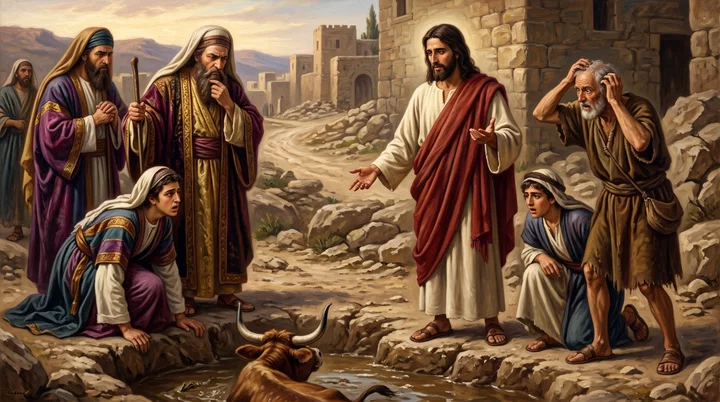
And answered them, saying, Which of you shall have an ass or an ox fallen into a pit, and will not straightway pull him out on the sabbath day?
Translations
American King James Version, King James Version
And answered them, saying, Which of you shall have an ass or an ox fallen into a pit, and will not straightway pull him out on the sabbath day?
and answered them, saying, Which of you shall have an ass or an ox fallen into a pit, and will not straightway pull him out on the sabbath day?
And answered them, saying, Which of you shall have an ass or an ox fallen into a pit, and will not forthwith pull him out on the sabbath?
Revised Version, American Standard Version
And he said unto them, Which of you shall have an ass or an ox fallen into a well, and will not straightway draw him up on a sabbath day?
and answering them he said, 'Of which of you shall an ass or ox fall into a pit, and he will not immediately draw it up on the sabbath-day?'
And answering he said to them, Of which of you shall an ass or ox fall into a well, that he does not straightway pull him up on the sabbath day?
and, unto them, said—Which of you, shall have a son or an ox that, into a pit, shall fall, and will not straightway pull him up, on the day of rest?
Berean Standard Bible, Majority Standard Bible
And He asked them, “ Which of you whose son or ox falls into a pit on the Sabbath day will not immediately pull him out?”
He answered them, “ Which of you, if your son or an ox fell into a well, wouldn’ t immediately pull him out on a Sabbath day?”
And he said to them, Which of you, whose ox or ass has got into a water-hole, will not straight away get him out on the Sabbath?
And answered them, saying, Which of you shall haue an asse, or an oxe fallen into a pit, and wil not straightway pull him out on the Sabbath day?
Douay-Rheims (Challoner revision)
And answering them, he said: Which of you shall have an ass or an ox fall into a pit, and will not immediately draw him out, on the sabbath day?
Pictures
Cross-references
- Matthew 12:11-12
And he said unto them, What man shall there be among you, that shall have one sheep, and if it fall into a pit on the sabbath day, will he not lay hold on it, and lift it out?
Jesus uses rescuing an animal to show that doing good is lawful on the Sabbath.
- Luke 13:15-16
The Lord then answered him, and said, Thou hypocrite, doth not each one of you on the sabbath loose his ox or his ass from the stall, and lead him away to watering?
Jesus appeals to Sabbath care for animals to defend freeing and healing a suffering person.
- Exodus 20:8-11
Remember the sabbath day, to keep it holy.
Jesus’ defense of Sabbath mercy accords with the fourth commandment.
- Mark 3:4
And he saith unto them, Is it lawful to do good on the sabbath days, or to do evil? to save life, or to kill? But they held their peace.
Jesus teaches that doing good and saving life are lawful on the Sabbath.
- Mark 2:27
And he said unto them, The sabbath was made for man, and not man for the sabbath:
Both show the Sabbath was made for humanity’s benefit.
- Luke 6:9
Then said Jesus unto them, I will ask you one thing; Is it lawful on the sabbath days to do good, or to do evil? to save life, or to destroy it?
Both teach that doing good and saving life are lawful on the Sabbath.
- John 5:9-18
And immediately the man was made whole, and took up his bed, and walked: and on the same day was the sabbath.
Jesus heals on the Sabbath, prompting accusations of Sabbath-breaking.
- Matthew 12:5
Or have ye not read in the law, how that on the sabbath days the priests in the temple profane the sabbath, and are blameless?
Jesus defends Sabbath conduct against accusations based on human rules.
- John 9:1-16
And as Jesus passed by, he saw a man which was blind from his birth.
both are merciful Sabbath healings honoring the Sabbath
- Luke 14:1
And it came to pass, as he went into the house of one of the chief Pharisees to eat bread on the sabbath day, that they watched him.
Begins the same Sabbath setting.
- Matthew 12:11
And he said unto them, What man shall there be among you, that shall have one sheep, and if it fall into a pit on the sabbath day, will he not lay hold on it, and lift it out?
Both affirm that rescuing an animal from a pit is lawful on the Sabbath.
- Exodus 23:12
Six days thou shalt do thy work, and on the seventh day thou shalt rest: that thine ox and thine ass may rest, and the son of thy handmaid, and the stranger, may be refreshed.
Both teach Sabbath rest refreshes animals and people.
- Luke 13:16
And ought not this woman, being a daughter of Abraham, whom Satan hath bound, lo, these eighteen years, be loosed from this bond on the sabbath day?
both healings honor the Sabbath
- Genesis 2:2-3
And on the seventh day God ended his work which he had made; and he rested on the seventh day from all his work which he had made.
God rested on and sanctified the seventh day, the Sabbath rest Jesus makes an exception to.
- Exodus 31:15
Six days may work be done; but in the seventh is the sabbath of rest, holy to the LORD: whosoever doeth any work in the sabbath day, he shall surely be put to death.
commands six-day work and Sabbath rest
- Deuteronomy 5:12-15
Keep the sabbath day to sanctify it, as the LORD thy God hath commanded thee.
Cited as instruction about Sabbath observance.
- Mark 3:2
And they watched him, whether he would heal him on the sabbath day; that they might accuse him.
same insidious watching to accuse of Sabbath breach
- Luke 6:3-4
And Jesus answering them said, Have ye not read so much as this, what David did, when himself was an hungred, and they which were with him;
Both show necessity does not make the act sin.
- John 7:23
If a man on the sabbath day receive circumcision, that the law of Moses should not be broken; are ye angry at me, because I have made a man every whit whole on the sabbath day?
Jesus defends healing on the Sabbath as consistent with the law.
- Exodus 35:2
Six days shall work be done, but on the seventh day there shall be to you an holy day, a sabbath of rest to the LORD: whosoever doeth work therein shall be put to death.
The Sabbath law is understood alongside mercy toward an animal in need.
Commentary
Each commentary is drawn from primary sources: the writings of Ellen G. White and Adventist pioneers and periodicals. Each commentary is separate. Its own words are not a quotation; follow the references to read the source passages.
Ellen G. White
4 sources
Jesus accepted an invitation to dine with a Pharisee, and used the meal as an occasion to teach lessons suited to His hearers.MYP 406.2 By doing so He also showed His disciples how to conduct themselves among both religious and nonreligious people.MYP 406.2 The saying about the ass or ox fallen into a pit belongs to His discourse in Luke 14:2-14, which establishes the right position on the Sabbath question.Ms 58, 1895, par. 1–3
The Sabbath law does not forbid promptly pulling out an ox or an ass fallen into a pit, nor does it forbid relieving suffering.ST Feb 6, 1896Ms 8, 1866, par. 1 Labor may therefore be done even on the Sabbath to save the life of a man or of an animal, and healing a suffering person on that day is lawful and proper.ST Feb 6, 1896Ms 8, 1866, par. 1 The argument exposes inconsistency in accepting care for animals on the Sabbath while objecting to acts of mercy and healing for people.ST Feb 6, 1896 Yet this allowance does not extend to work done for personal pecuniary advantage.Ms 8, 1866, par. 1 To violate the letter of the fourth commandment for gain makes a person a Sabbathbreaker guilty of transgressing the whole law.Ms 8, 1866, par. 1
Sources
Pioneers and periodicals
45 sources
Spoken in the house of a ruler of the Pharisees on the Sabbath while being watched, after asking whether healing is lawful and receiving silence, Jesus healed the man with dropsy and let him go, then asked who would not at once pull his own ass or ox out of a pit on the Sabbath to show the rightness of what he had done.RH Feb 11, 1862ST Jul 23, 1894ST Jul 23, 1894ST Mar 2, 1882 The question teaches that to heal and do good and save life on the Sabbath is lawful, proper and worthy of the day and its Lord, because the Sabbath was hallowed for humanity.ST Feb 6, 1896RH Feb 3, 1852RH Feb 11, 1862 It reasons from the accepted duty of straightway rescuing an animal fallen into a pit, well or mire to expose condemning mercy to a suffering person as inconsistent by the objectors' own standard.ST Feb 6, 1896ST Sep 16, 1880 It does not relax or abolish the fourth commandment or make a new Sabbath law, but upholds the binding law to do no work except what necessity or mercy requires, restoring the day to God's merciful purpose of refreshment and delight apart from burdensome human traditions.ST Jul 8, 1897RH Jun 18, 1861RH Apr 7, 1851RH Jan 7, 1862RH May 19, 1851 The leave given is for sudden, occasional emergency and not for ordinary profitable work repeated every Sabbath, so a pit that keeps catching the same animal should be filled and unnecessary work like hiving bees is not covered.RH Jan 13, 1859ST Nov 9, 1882ST Oct 29, 1894
Setting and Wording
Jesus spoke these words on the Sabbath in the house of a ruler of the Pharisees where He had gone to eat bread, while lawyers and Pharisees watched Him and a man with dropsy stood before Him.ST Jul 23, 1894ST Mar 2, 1882 After asking whether healing on the Sabbath is lawful and receiving only silence, He healed the man and let him go, then asked which of them would not straightway draw up an ass or an ox fallen into a well or pit on the Sabbath day.ST Jul 23, 1894 The question was meant to show that healing on the Sabbath is lawful, just as immediate rescue of the animal would be.ST Jul 23, 1894
The invitation had not come from friendship and affection but as a trap, with malicious, private, insidious watching to catch Him off guard in the freer talk of eating and drinking in order to accuse Him and take His life.ST Mar 2, 1882 The dropsical man had likely been deliberately brought there because compassion would move Him to heal him at once, giving plausible ground to charge Him with breaking the Sabbath.ST Mar 2, 1882 The question about the animal was His answer exposing that charge.ST Mar 2, 1882
He first put the question about the lawfulness of healing, then after the healing put this question about the ass or ox to show the righteousness of what He had done and to justify His course.ST Jul 23, 1894ST Jul 23, 1894RH Apr 28, 1863 As the second question it exposed and embarrassed His enemies, and like the first they did not dare answer it.RH Apr 28, 1863 They could say nothing in reply to these things and could not answer again.RH Feb 11, 1862ST Jul 23, 1894ST Jul 23, 1894
The saying stands together with Luke 13:31-35 and the rest of Luke 14:1-14 as Sabbath teaching about being humbled and exalted.ST Jul 23, 1894 It belongs to the account of healing the man with dropsy, standing together with instruction concerning self-exaltation and the exaltation that comes from humility and instruction as to invitations to a feast.ST Jul 23, 1894 The phrase Sabbath-day means the whole day, not merely its hours of daylight, as an example of hemera referring to a full twenty-four-hour day.RH Dec 12, 1871
At the time Christ began His ministry Jewish teaching allowed a man whose sheep had fallen into a pit on the Sabbath readily to lift it out and bear it to a place of safety.RH Jan 28, 1862 This stood even while about forty primary works were forbidden with many secondary works under each, including ploughing, sowing, reaping, winnowing, cleaning, and grinding with breaking or dividing what was united counted under grinding.RH Jan 28, 1862 Threshing included bruising as threshing so that walking on green grass was forbidden, hunting was forbidden so that catching a flea was forbidden, and carrying a burden was forbidden so that carrying water to a thirsty animal was forbidden though pouring water into a trough and leading the animal to it was allowed.RH Jan 28, 1862 Healing disease was forbidden, though ministering to relieve distress, covering a diseased eye, or anointing it with eye-salve to ease pain was allowed.RH Jan 28, 1862
The wider chapter contains the parable of the call to the marriage supper in which none who in heart rejected the first call shall ever appear as guests at that table.RH Mar 6, 1855 That exclusion applies to the churches that rejected the preaching of the hour of God's judgment and the immediate coming of the Lord.RH Mar 6, 1855 That preaching was both the test that showed their heart was with the world and heaven's last means to heal them of false hope, false views, oppression, pride and conformity, so that having failed God gave them up to their own heart's desire.RH Mar 6, 1855
Christ's Sabbath Argument
Healing on the Sabbath is lawful and proper, reasonable and consistent with the commandment, and worthy of the Sabbath and its Lord.ST Feb 6, 1896RH Feb 3, 1852RH Feb 11, 1862RH Apr 7, 1851ST Sep 2, 1897 The Sabbath was hallowed for humanity, so honoring it by merciful acts is fitting.RH Feb 3, 1852RH Feb 11, 1862 To do good and to save life is right on that day, and the Sabbath law does not forbid relieving suffering or promptly rescuing an animal in danger.ST Feb 6, 1896ST Sep 2, 1897ST Mar 2, 1882 The Sabbath in view is the seventh day seen in its proper light according to the purpose and object of the Sabbath law, apart from burdensome human restrictions and traditions, as Jesus looked at it.ST Jul 8, 1897ST Sep 2, 1897
Jesus appealed to the ordinary, accepted duty of straightway pulling an ass or ox or sheep fallen into a pit, well, ditch or mire on the Sabbath.ST Feb 6, 1896ST Sep 16, 1880ST Mar 2, 1882 He used that rescue to expose the inconsistency of condemning mercy to a sick person, justifying his healing by his opponents’ own standards.ST Feb 6, 1896ST Sep 16, 1880RH May 19, 1851RH Nov 25, 1852 They accepted care for animals while objecting to acts of mercy for people.ST Feb 6, 1896ST Mar 2, 1882 Lawful means agreeable to law and conformable to the existing Sabbath law, and he gave no new Sabbath law in this, relaxed nothing of the fourth commandment, and introduced no new rule.RH Apr 7, 1851RH May 19, 1851RH Nov 25, 1852 He thereby exposed the hypocrisy of the false charge of Sabbath-breaking and declared well-doing lawful on the Sabbath, including healing the sick, relieving dumb beasts in distress, and eating when hungry.RH May 19, 1851RH Nov 25, 1852RH Apr 25, 1854
When first asked whether healing is lawful, the Pharisees and lawyers stayed silent because yes would condemn their own tradition and no could not be sustained by fair argument.RH Feb 11, 1862 After he healed the dropsical man and let him go, they could not answer again the question about the animal.RH Feb 11, 1862ST Sep 16, 1880 His repeated Sabbath arguments had taught them that silence about their traditions was wiser than speech.RH Feb 11, 1862 As a second question it exposed and embarrassed his enemies, and like the first they did not dare answer it and could say nothing.RH Apr 28, 1863
The healing it defends was done in the house of a chief Pharisee and stands as the last of the glorious acts with which Jesus honored the Sabbath.RH Feb 11, 1862ST Nov 14, 1900RH Apr 28, 1863 His Sabbath acts of doing good won favor with the people.ST Nov 14, 1900 At the same time they increased the antagonism of the chief priests, Pharisees and Herodians.ST Nov 14, 1900
His example restores the Sabbath’s spirit rather than abolishing or weakening the fourth commandment. By precept and example he removed the rubbish of burdensome human traditions to teach proper observance as God intended, as a day of delight and holy joy in the Lord, showing that healing the sick and doing well on the Sabbath is according to the law and in keeping with its true letter and spirit.ST Jun 11, 1894 Human traditions do not define the Sabbath but God’s purpose for the day does.ST Jul 8, 1897
Sabbath Law Upheld
The Sabbath law remains binding, commanding work in six days and no work on the Sabbath, with the only exceptions being what necessity or mercy requires as laid down together with Christ's other Sabbath healings and teachings.RH Jun 18, 1861 Pulling an animal fallen into a pit on the Sabbath is such a work of necessity and mercy and therefore lawful, but this allowance does not permit other Sabbath work and must not be abused to defend violations of the day.RH Jun 18, 1861 Lawful means agreeable to law and conformable to the existing Sabbath law, and rescuing the animal conforms to that law.RH May 19, 1851RH Nov 25, 1852RH Oct 21, 1851 Jesus gave no new Sabbath law in this saying, relaxed nothing of the fourth commandment, introduced no new rule, and abolished nothing of the Sabbath, but showed that relieving distress and doing good are lawful under it.RH Apr 7, 1851RH May 19, 1851RH Nov 25, 1852RH Oct 21, 1851
He used the case to expose the hypocrisy of condemning merciful acts as unlawful and to answer the false charge of Sabbath-breaking, declaring well-doing lawful on the Sabbath, including healing the sick, relieving dumb beasts in distress, and eating when hungry.RH May 19, 1851RH Nov 25, 1852RH Oct 21, 1851 The incident did not modify the Sabbath law.RH Jul 28, 1904 When asked whether healing on the Sabbath is lawful, opponents stayed silent because yes would condemn their own tradition and no could not be sustained by fair argument, and after the healing they again could not answer about the animal, having learned by repeated arguments that silence about their traditions was wiser than speech.RH Feb 11, 1862 The saying proves the Sabbath is a merciful institution to be rid of Pharisaic traditions that perverted its original purpose, not to be overthrown by removing those traditions.RH Feb 11, 1862ST Jul 8, 1897
It is unfair to call those Pharisaic rigors part of the Sabbath itself or to call their removal an overthrow of the Sabbath, for human traditions do not define the Sabbath but God's purpose for the day does.RH Feb 11, 1862ST Jul 8, 1897 The passage shows the merciful and beneficent character of the Sabbath, which was not designed to be a cause of distress and suffering but of refreshment, of delight and of blessing.RH Jan 7, 1862 God regards the sufferings of the brute creation and would have them alleviated upon the Sabbath, how much more the distress and the needs of His people for whose refreshment and delight the Sabbath was made.RH Jan 7, 1862
The Sabbath spoken of is the seventh day, to be viewed in its proper light according to the purpose and object of the Sabbath law apart from burdensome human restrictions and traditions, and to be looked at as Jesus looked at it.ST Sep 2, 1897 It belongs among New Testament references to the Lord's weekly Sabbath, not among references to ceremonial sabbaths.RH Mar 19, 1857 It took place on the seventh day, while Sunday is the first day of the week, the two being distinct days.RH Jul 28, 1904 Proper keeping of the Sabbath had become the chief point of contention between Christ and His disciples and the Jews and Pharisees, who had gone to the extreme of making the commandments void by burdensome traditions forbidding healing the sick and deeds of mercy and goodness, and who complained against Christ and accused Him of violating the Sabbath because of such deeds.ST Jun 11, 1894 Christ, who spoke the law from Mount Sinai, removed that rubbish by precept and example to teach proper observance as God intended, as a day of delight and holy joy in the Lord, showing that healing the sick and doing well on the Sabbath is according to the law and in keeping with its true letter and spirit.ST Jun 11, 1894
Mercy and Necessity Permitted
Pulling a distressed animal from a pit on the Sabbath is lawful, and doing good and acts of mercy for animals or people do not violate the commandment but receive divine approval.RH May 5, 1874ST Feb 16, 1882RH Apr 27, 1911ST Feb 16, 1882 Rescuing an animal from danger, meeting animals' needs, relieving their distress, caring for animals, meeting the hungry person's needs, and healing human suffering are permitted, so the Sabbath is for merciful helpful activity and not mere inactivity.ST Feb 16, 1882RH Apr 27, 1911ST Feb 16, 1882RH May 5, 1874 Christ used this teaching to establish that the Sabbath permits merciful deeds while its sanctity remains intact, and his answer justified compassionate action as lawful observance, not transgression.STST Feb 16, 1882
The permission is for a sudden, occasional emergency of immediate danger, not ordinary work for personal profit or work that repeats every Sabbath by habit.RH Jan 13, 1859ST Nov 9, 1882ST Oct 29, 1894ST Dec 3, 1874 If the same ass falls into the same pit every Sabbath, the pit should be filled up or the ass sold or gotten rid of instead of using the emergency to justify regular Sabbath labor.RH Jan 13, 1859ST Nov 9, 1882ST Dec 3, 1874 The case of an animal fallen into a pit is distinct from hiving bees to avoid a loss arising in the regular course of nature; the verse supports necessary care and rescue, not using the Sabbath for unnecessary work.ST Oct 29, 1894
By the same rule of mercy and necessity, kindling a fire when warmth is needed in the cold season, preparing proper food in sickness, and building a fire for comfort in cold weather are lawful when the work is truly necessary for relief and health.RH May 19, 1851RH Jul 30, 1861RH Apr 23, 1857 The Sabbath was made for man and not to injure health, and the law is holy and just and good and does not oblige suffering cold or hunger.RH Jul 30, 1861RH Apr 23, 1857 Necessity must be certain, work that could be prepared on the sixth day must not be put off until the Sabbath, and neglecting such preparation remains a violation.RH May 19, 1851RH Jul 30, 1861RH Apr 23, 1857
The same principle permits helping a bereaved neighbor prepare burial clothes when need calls for it, as more important than rescuing an animal.ST Nov 25, 1908 If others can provide the help it may be left to them so more important service can be done after the Sabbath, and the saying about letting the dead bury the dead does not rule out this help unless Christ has called someone to more important work.ST Nov 25, 1908 The example does not justify creating the emergency, so one must not put an ox into a ditch merely to create a reason to pull it out.ST Jun 21, 1905
Following and Applying Verse
The way Jesus kept the Sabbath after becoming the Son of Man is the pattern for keeping it, and the indwelling Spirit of God produces that same keeping in those who follow His example. Keeping the Sabbath in that way brings delight in the Lord and gives living knowledge that the Sabbath is a sign between God and His people that He is the Lord their God. It gives living knowledge that the power that created all things is able to recreate them and make them new creatures in Christ Jesus. Proper keeping of the Sabbath as shown here becomes the chief point of contention between Christ and His disciples and the Jews and Pharisees, and so a test of proper and lawful obedience to the commandments of God in the last great reformation.ST Jun 11, 1894 The Jews had gone to the extreme of making the commandments void by burdensome traditions about the Sabbath, forbidding healing the sick and deeds of mercy and goodness, and accusing Him of violating the Sabbath, while Christ who spoke the law from Mount Sinai removed that rubbish by precept and example to teach proper observance as God intended, as a day of delight and holy joy in the Lord according to the true letter and spirit of the law.ST Jun 11, 1894
The image of an animal fallen into a pit shows that urgent need is a proper time to help even on the Sabbath.ST Jan 25, 1899 Poor, hungry, homeless, and suffering people are as oxen in a pit, and helping them is not wrong or sinful but the right thing to do.ST Jan 25, 1899 The question of whose ox is fallen into a pit on the Sabbath applies to Sunday laws, to the state Sabbath versus the divine Sabbath, and to the defense of religious liberty.RH Jul 12, 1906
Sources