Matthew 12:11
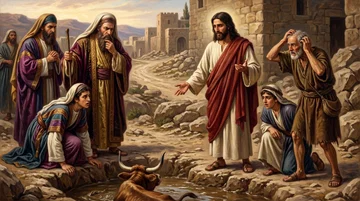
And he said unto them, What man shall there be among you, that shall have one sheep, and if it fall into a pit on the sabbath day, will he not lay hold on it, and lift it out?
Translations
And he said to them, What man shall there be among you, that shall have one sheep, and if it fall into a pit on the sabbath day, will he not lay hold on it, and lift it out?
King James Version, KJV Cambridge Paragraph Bible
And he said unto them, What man shall there be among you, that shall have one sheep, and if it fall into a pit on the sabbath day, will he not lay hold on it, and lift it out?
And he said to them, What man shall there be among you, that shall have one sheep, and if it shall fall into a pit on the sabbath, will he not lay hold on it, and lift it out?
Revised Version, American Standard Version
And he said unto them, What man shall there be of you, that shall have one sheep, and if this fall into a pit on the sabbath day, will he not lay hold on it, and lift it out?
And he said to them, 'What man shall be of you, who shall have one sheep, and if this may fall on the sabbaths into a ditch, will not lay hold on it and raise [it]?
But he said to them, What man shall there be of you who has one sheep, and if this fall into a pit on the sabbath, will not lay hold of it and raise [ it] up?
And said unto them, What man, from among yourselves, [shall there be],—Who shall have one sheep, and, if this should fall, on the sabbath, into a pit, will not lay hold of it, and raise it?
Berean Standard Bible, Majority Standard Bible
He replied, “ If one of you has a sheep and it falls into a pit on the Sabbath, will he not take hold of it and lift it out?
He said to them, “ What man is there among you who has one sheep, and if this one falls into a pit on the Sabbath day, won’ t he grab on to it and lift it out?
And he said to them, Which of you, having a sheep, if it gets into a hole on the Sabbath day, will not put out a helping hand and get it back?
And he said vnto the, What man shall there be among you, that hath a sheepe, and if it fal on a Sabbath day into a pit, doth not take it and lift it out?
Douay-Rheims (Challoner revision)
But he said to them: What man shall there be among you, that hath one sheep: and if the same fall into a pit on the sabbath day, will he not take hold on it and lift it up?
Pictures
Cross-references 20 of 47
- Exodus 20:8-11
Remember the sabbath day, to keep it holy.
Jesus shows that the Sabbath command does not forbid works of mercy.
- Mark 2:27-28
And he said unto them, The sabbath was made for man, and not man for the sabbath:
Jesus teaches that the Sabbath serves humanity and that he is its Lord.
- Mark 3:1-5
And he entered again into the synagogue; and there was a man there which had a withered hand.
Jesus heals on the Sabbath and challenges restrictions on doing good.
- Luke 13:15-16
The Lord then answered him, and said, Thou hypocrite, doth not each one of you on the sabbath loose his ox or his ass from the stall, and lead him away to watering?
Jesus compares Sabbath care for animals with freeing a suffering woman.
- Luke 14:5
And answered them, saying, Which of you shall have an ass or an ox fallen into a pit, and will not straightway pull him out on the sabbath day?
Jesus uses the same fallen-animal example to defend Sabbath help.
- Luke 6:9-10
Then said Jesus unto them, I will ask you one thing; Is it lawful on the sabbath days to do good, or to do evil? to save life, or to destroy it?
Jesus teaches that doing good and saving life is lawful on the Sabbath, then heals the man.
- Isaiah 58:13
If thou turn away thy foot from the sabbath, from doing thy pleasure on my holy day; and call the sabbath a delight, the holy of the LORD, honourable; and shalt honour him, not doing thine own ways, nor finding thine own pleasure, nor speaking thine own words:
It describes honoring the Sabbath as the Lord’s holy day.
- John 5:8-9
Jesus saith unto him, Rise, take up thy bed, and walk.
both show mercy is not Sabbath-breaking
- Matthew 12:5
Or have ye not read in the law, how that on the sabbath days the priests in the temple profane the sabbath, and are blameless?
Priests serve in the temple on the Sabbath and remain blameless.
- John 9:14
And it was the sabbath day when Jesus made the clay, and opened his eyes.
Jesus heals a man born blind on the Sabbath, prompting dispute.
- Genesis 2:2-3
And on the seventh day God ended his work which he had made; and he rested on the seventh day from all his work which he had made.
God established the Sabbath at creation by resting and sanctifying the seventh day.
- Matthew 12:7
But if ye had known what this meaneth, I will have mercy, and not sacrifice, ye would not have condemned the guiltless.
Mercy over sacrifice guides Sabbath conduct and forbids condemning the guiltless.
- John 5:16
And therefore did the Jews persecute Jesus, and sought to slay him, because he had done these things on the sabbath day.
Jesus is opposed for healing on the Sabbath.
- Matthew 12:1-2
At that time Jesus went on the sabbath day through the corn; and his disciples were an hungred, and began to pluck the ears of corn, and to eat.
The disciples’ Sabbath actions offended their critics.
- John 7:22-23
Moses therefore gave unto you circumcision; ( not because it is of Moses, but of the fathers;) and ye on the sabbath day circumcise a man.
Jesus argues that healing on the Sabbath is consistent with the law.
- 1 Samuel 21:1-6
Then came David to Nob to Ahimelech the priest: and Ahimelech was afraid at the meeting of David, and said unto him, Why art thou alone, and no man with thee?
David received consecrated bread to meet his need, illustrating mercy in necessity.
- Exodus 31:13
Speak thou also unto the children of Israel, saying, Verily my sabbaths ye shall keep: for it is a sign between me and you throughout your generations; that ye may know that I am the LORD that doth sanctify you.
Merciful Sabbath keeping reflects the sign of God sanctifying his people.
- Numbers 15:32-36
And while the children of Israel were in the wilderness, they found a man that gathered sticks upon the sabbath day.
Contrasts necessary care with the man punished for gathering sticks on the Sabbath.
- Luke 6:1-5
And it came to pass on the second sabbath after the first, that he went through the corn fields; and his disciples plucked the ears of corn, and did eat, rubbing them in their hands.
A related Sabbath dispute illustrates the law’s spirit and Jesus’ authority.
- Mark 2:28
Therefore the Son of man is Lord also of the sabbath.
Jesus’ authority over the Sabbath supports its proper observance.
Commentary
Each commentary is drawn from primary sources: the writings of Ellen G. White and Adventist pioneers and periodicals. Each commentary is separate. Its own words are not a quotation; follow the references to read the source passages.
Ellen G. White
24 sources
In the synagogue where a man with a withered hand had come hoping to be healed, those watching Jesus asked whether healing on the Sabbath was lawful in order to accuse Him, and He answered by appealing to their own accepted practice of laying hold of a sheep fallen into a pit on the Sabbath day and lifting it out.DA 286.2–3Ms 31a, 1898, par. 4–6COS 73.5–74.74RED 53.12SP 294.2 A person is much better than a sheep and is made in God's image, so it is lawful to do well on the Sabbath days and healing and other acts of compassion and mercy honor the day in harmony with the fourth commandment.DA 286.2–3Ms 31a, 1898, par. 4–6COS 73.5–74.74RED 50.3–51.1 The comparison exposes valuing an animal's loss above a person's suffering, rejects restrictive human rules that misrepresented God, and shows the charge that He broke the Sabbath was false because as Lord of the Sabbath His healing was not contrary to the law He Himself had given.4RED 50.3–51.12SP 198.2–199.1PK 183.1 Work to rescue an animal from danger and to save the life of a person or animal is permitted as saving life, so relieving suffering on the Sabbath is a work of necessity and mercy and not a desecration, and physicians and nurses may visit, minister to the sick, and travel when there is real suffering to be alleviated.CH 238.2–34T 539.3–4Ms 8, 1866, par. 17T 106.1–21T 531.2 That necessary care must be distinguished from ordinary work that can wait until the next day, for the Sabbath remains God's sanctified time to be kept free from unnecessary work, while as a sheep is lifted from a pit so a fallen man must be lifted with tender pitying love, and keeping the Sabbath holy in this way identifies God's people as belonging to Him.Lt 6, 1901, par. 1–4CH 238.2–37T 106.1–2HSFM 217.3–218.2
Setting and Teaching
The question was put in the synagogue where a man with a withered hand had come hoping to be healed, in the same course of events as going through the grain fields and plucking grain.Ms 31a, 1898, par. 4–64RED 53.12SP 294.2 The scribes and Pharisees were watching Jesus, knew He meant to heal, and asked whether healing on the Sabbath was lawful in order to accuse Him, the Lord who made the Sabbath, judging Him blindly.Ms 31a, 1898, par. 4–618MR 155.1–3 The healing provoked malice, anger, and rage because He did good on the Lord's day.4RED 53.12SP 294.22SP 201.13RED 70.1–2
He answered by appealing to His accusers' own accepted practice with one sheep, that if it fall into a pit on the Sabbath day they will lay hold on it and lift it out.DA 286.2–3Ms 31a, 1898, par. 4–6COS 73.5–74.7 They themselves had performed that very act that morning, and rescuing an animal from danger and preventing loss on the Sabbath was permitted and did not violate the day.Ms 31a, 1898, par. 4–64RED 50.3–51.12SP 198.2–199.1 The argument rests on the greater worth of a person, that a man is much better than a sheep and is worth more than a sheep.DA 286.2–3Ms 31a, 1898, par. 4–6COS 73.5–74.7Lt 6, 1901, par. 1–4 Man is made in God's image, and a human life matters even more than a sheep.DA 286.2–34RED 50.3–51.12SP 198.2–199.1
Therefore it is lawful to do well on the Sabbath days.DA 286.2–3Ms 31a, 1898, par. 4–6COS 73.5–74.7ST Jan 16, 1896 Healing, relieving the suffering of man or beast, and other acts of compassion and mercy are fitting, honor the Sabbath, and are in harmony with the fourth commandment as God gave it, with God's law, and with every command of the Decalogue.4RED 50.3–51.12SP 198.2–199.14RED 51.2ST Jan 16, 1896 Christ's Sabbath miracles meeting the needs of people afflicted by Satan revealed this work of mercy, and He had not violated God's command.ST Jan 16, 1896
The sheep example exposes the inconsistency of allowing help to an animal while refusing relief to a suffering person and valuing an animal's loss above a person's suffering.4RED 50.3–51.12SP 198.2–199.14RED 51.2 It corrects false Sabbath teachings, rejects restrictive human rules and human-made restrictions that misrepresented God and dishonored the day, and shows the Sabbath should be kept according to God's law.2SP 198.2–199.1PK 183.14RED 51.2 The charge that Jesus broke the Sabbath came from ignorance of the Scriptures, the power of God, and the true meaning and principles of the law He Himself had spoken from the pillar of cloud.ST Jan 16, 1896 He declared Himself Lord of the Sabbath, His healing was not contrary to the law, and the charge was false.ST Jan 16, 1896ST Oct 1, 1896 His enemies could find no fault in Him for Sabbath healing, dared not press the accusation because examining the good He had done would expose their purpose and undermine their attempt to condemn Him, and had to hire false witnesses to condemn Him.ST Jan 16, 1896
Sabbath Mercy in Practice
Work to pull an animal out of danger on the Sabbath is permitted as an exception for saving life.Ms 8, 1866, par. 11T 531.2 Work to save the life of a person or animal stands on different ground from breaking the Sabbath for personal financial advantage, and does not give permission for that.Ms 8, 1866, par. 11T 531.2 Relieving suffering on the Sabbath is right, a work of necessity and mercy rather than a violation or desecration of the day.CH 238.2–34T 539.3–47T 106.1–2HSFM 217.3–218.2Ms 162, 1897, par. 23–25 The needs of the sick must not be neglected, so physicians and nurses may visit, help, and minister to the sick, and may travel on the Sabbath when there is real suffering to be alleviated.CH 238.2–34T 539.3–4Ms 162, 1897, par. 23–25
Necessary care is to be distinguished from ordinary work that can be postponed.CH 238.2–37T 106.1–2 Unnecessary Sabbath duties, ordinary treatments and operations, work and pleasure seeking that are not necessary, and avoidable work allowed to accumulate until more Sabbath labor is done than necessary, must wait until the next day.CH 238.2–33MR 245.1Ms 3, 1879, par. 6–7Ms 162, 1897, par. 23–25 The Sabbath remains God's sanctified and blessed time set apart for His service rather than personal use, and its sacred hours are to be kept free from unnecessary work.HSFM 217.3–218.2Ms 3, 1879, par. 6–7 Physicians must still honor the Sabbath and plan their work to obey God, doing no unnecessary work, deferring what can wait, and letting patients know that physicians must have one day for rest.Ms 162, 1897, par. 23–25
As a sheep fallen into a pit is laid hold of and lifted out, how much more must a man fallen into trouble be lifted out with tender, pitying love and hope.Lt 6, 1901, par. 1–4 No soul for whom Christ has paid so great a price can be afforded to be imperiled, passed by, or left discouraged under Satan, but must be encouraged, set to work, and have his path cleared.Lt 6, 1901, par. 1–4 Those in responsible positions are tested by whether they will yoke up with Christ and manifest His compassion and love in thus lifting out the fallen.Lt 6, 1901, par. 1–4 Keeping the Sabbath holy in this way identifies God's people as belonging to Him.CH 238.2–3
Sources
Pioneers and periodicals
81 sources
Confronted in the synagogue at Capernaum when accusers watching to condemn Him questioned healing the man with the withered hand on the Sabbath, Jesus answered with the case of a single sheep fallen into a pit on the Sabbath that its owner would take hold of and lift out.RH Feb 4, 1862ST Feb 17, 1898ST Sep 18, 1884 Such rescue is lawful and right, and the Sabbath was never meant to forbid compassionate care.ST Feb 10, 1904RH Mar 1, 1864ST Jan 31, 1911 A person is far better and worth more than a sheep or property, so relieving human suffering, healing, preserving life and doing good on the Sabbath are lawful and in harmony with the commandment, for the Sabbath was made for humanity's blessing and highest good and not as a burden.RH Feb 4, 1862ST Feb 17, 1898ST Jan 31, 1911RH Apr 5, 1860ST Apr 19, 1883 The word lawful upholds the Sabbath law of the fourth commandment as still in force and binding, settling what may be done on the day with no relaxing, abolishing or changing it to another day.RH Mar 1, 1864RH May 19, 1851ST Mar 10, 1898 As Lord of the Sabbath Christ kept the seventh day Himself, honored and magnified the law without changing a jot or tittle, and left His way of mercy as the pattern for keeping it.ST Mar 16, 1904RH Jul 15, 1915
Setting and Wording
The saying was given as a reply when those watching to bring a charge asked whether curing on the Sabbath was permitted, with the man whose hand was withered present in the synagogue at Capernaum.RH Feb 4, 1862ST Feb 17, 1898ST Sep 18, 1884RH Sep 19, 1854ST Sep 17, 1896 The question about a single sheep fallen into a pit on the Sabbath day, whether its owner would not take hold of it and draw it out, was put to meet that charge, followed by the reasoning that a person is of far greater worth than a sheep and then by the command to stretch out the hand, which was restored whole like the other through obedient action of faith.RH Feb 4, 1862ST Feb 17, 1898RH Sep 19, 1854RH Mar 19, 1901ST Sep 17, 1896
The incident belongs to the instruction on the true use of the Sabbath recorded in Matthew 12:1-15, with parallels in Mark 2:23-28, Mark 3:1-7, and Luke 6:1-11, and standing within the longer sequence of Luke 4:33 to 6:11.ST Apr 14, 1881ST Jan 16, 1896ST Oct 19, 1882 Its place is Capernaum on the Sea of Galilee, and it is reckoned among thirty-six distinct miracles described in the Gospels, with sixty-seven reports besides many miracles noticed but not recorded in detail.ST Jan 16, 1896 It is counted as one of the greatest miracles, deliberately performed on the Sabbath to honor the Sabbath day.ST Nov 17, 1909RH Oct 15, 1872
In wording, the case is one sheep fallen into a pit on the Sabbath day, laid hold of and lifted out, and the conclusion turns on what is permitted.RH Mar 1, 1864RH Apr 13, 1869RH Nov 25, 1852ST Sep 18, 1884RH Nov 1, 1864 Permitted means according to law, agreeable to law, constituted by law, and conformable to law, referring to the law guarding the sacredness of the Sabbath.RH Mar 1, 1864RH Apr 13, 1869RH Nov 25, 1852ST Sep 18, 1884ST Jan 25, 1910 The singular Sabbath and the plural sabbaths, including the Greek sabbata in Matthew 12:5-11, mean the Sabbath day, not a week.RH Apr 13, 1869
The day in dispute was the seventh-day Sabbath, Saturday, kept by the Jews who were addressed.ST Sep 2, 1897ST Oct 23, 1893ST May 1, 1884RH Jan 13, 1852 There was no dispute which day was the Sabbath, only what work was proper on that day.ST Sep 18, 1884 Those met were very strict in Sabbath observance, and the same day they kept was kept, with no indication given that they had the wrong day.ST Sep 2, 1897RH Jan 13, 1852
Confronting the Accusers
When asked whether healing on the Sabbath is lawful by men watching to accuse, Jesus turned the trap back on them with a pointed, unanswerable question appealing to their own evident custom.RH Feb 4, 1862ST Feb 17, 1898ST Feb 17, 1898 He asked what person among them with one sheep fallen into a pit on the Sabbath day would not lay hold of it and lift it out, reasoning from that accepted rescue to the greater worth of a man and to the lawfulness of doing good.ST Feb 17, 1898RH Apr 21, 1868ST Feb 17, 1898 That answer was sound logical reasoning in vindication of what is lawful, furnishing doctrine, reproof, correction, theory and practice for a full defense of the Sabbath and its proper observance.RH Apr 21, 1868 It was sifting justice that left the adversaries silent, ashamed, and exposed before He commanded the man with the withered hand to stretch it forth and restored it whole like the other.RH Feb 4, 1862RH Apr 21, 1868ST Apr 13, 1904
The sheep example exposes the inconsistency and hypocrisy of condemning the healing of a person while rescuing property.ST Feb 10, 1904RH Apr 25, 1854ST Oct 29, 1896ST Nov 11, 1897RH Nov 4, 1858 Even strict teachers and Pharisees allowed lifting a sheep or an ox from a pit on that day, so the Sabbath was never meant to forbid such merciful acts for people or animals.RH Apr 25, 1854RH Nov 4, 1858RH Jan 13, 1852 Their willingness to save an animal in danger, whether from mercy or to avoid losing its value, placed financial interest and an animal above human life and love while objecting to relieving human suffering.ST Oct 29, 1896ST Nov 11, 1897RH Jan 13, 1852ST Nov 14, 1900
The exchange exposes malignity of heart, hardness, utter perversion of the Sabbath, and ignorance of Scripture and of God's power and of the true principles of the law.ST Jan 16, 1896RH Feb 4, 1862ST Nov 14, 1900 No act violated any command of the Decalogue, for the healing itself was only a word and the stretching out of the withered arm, neither of which the law forbids, so the accusation came from ignorance of the true meaning of the law.ST Jan 16, 1896RH Feb 4, 1862 Sweeping away that wicked tradition was necessary if the Sabbath itself was to be preserved for man, and Jesus in answering and healing acted in behalf of the Sabbath, not against it, though it moved the Pharisees to go out and plot how they might destroy Him.RH Feb 4, 1862RH Feb 4, 1862 That rejection of Christ leads to crucifixion, and His Sabbath teaching in the face of the last apostasy of the Jewish church calls out a remnant from apostasy by faith in Him.ST Jan 30, 1896
Doing Good Is Lawful
Rescuing a sheep fallen into a pit on the Sabbath by laying hold of it and lifting it out is lawful, proper, and right, and was accepted as such even by those who questioned Jesus.ST Feb 10, 1904RH Mar 1, 1864ST Jan 31, 1911RH May 19, 1851RH Jan 8, 1857 The Sabbath does not forbid such compassionate care and was never meant to prevent acts of mercy.ST Feb 10, 1904RH May 19, 1851RH Oct 21, 1851RH Jan 8, 1857ST Aug 6, 1912 Lawful means according to law, and the example recognizes the Sabbath law of the fourth commandment as still in force, without relaxing, abating, abolishing, or replacing it with a new rule.RH Mar 1, 1864RH May 19, 1851RH Oct 21, 1851 Relieving distress, healing the sick, helping animals in distress, and meeting hunger are doing good rather than Sabbath-breaking and do not violate the commandment.RH May 19, 1851RH Oct 21, 1851RH Jan 8, 1857 The Sabbath's purpose is not opposed to works of benevolence that relieve suffering and bring gratitude, joy, and blessing.ST Jan 31, 1911RH Jan 8, 1857
A man is much better than a sheep and of far more value than an animal or property.RH Feb 4, 1862ST Feb 17, 1898ST Jan 31, 1911ST Oct 29, 1896RH Jul 18, 1912 People made in their Maker's image matter at least as much as an animal, so the natural impulse to help an animal points to the stronger duty to relieve people.RH Jul 18, 1912ST Jan 21, 1903 The accepted custom of rescuing an animal on the Sabbath therefore exposes the inconsistency of objecting to healing a person on that day.ST Feb 10, 1904ST Feb 17, 1898ST Oct 29, 1896
Therefore doing good, doing well, healing, relieving suffering, preserving life, and saving life on the Sabbath are lawful and in harmony with the commandment.RH Feb 4, 1862ST Feb 17, 1898ST Apr 19, 1883RH May 5, 1874ST Sep 10, 1896 The Sabbath was made for man and for humanity's highest good, a benign and merciful institution for blessing, refreshment, joy, and delight, not a burden, yoke of bondage, or day of misery.RH Apr 5, 1860RH May 5, 1874ST Jan 6, 1881STST Nov 7, 1900 This allowance for merciful acts and genuine needs distinguishes proper use of the day from superstitious abuse and does not diminish its sacredness or weaken the law.RH Apr 5, 1860ST Jan 6, 1881 The Sabbath was made for all humanity, not for Jews alone, and remains binding on Christians, explaining how to keep it rather than abolishing the day, with temporal work kept to a minimum to God's glory.RH Apr 5, 1860ST Apr 19, 1883ST Jan 6, 1881ST
By this teaching Jesus set aside senseless human restrictions, lifted the Sabbath from restrictive and burdensome traditions, restored its simplicity and original purpose and appointed use from the beginning, and acted in behalf of the Sabbath, not against it.ST Aug 6, 1912ST Dec 5, 1892STST Mar 13, 1907 He honored the day as His own as Lord of the Sabbath while those who complained dishonored it, laboring by precept and example to rid its observance of abuse and bring it back to joy and delight.ST Aug 6, 1912ST Dec 5, 1892 His authority as Lord of the Sabbath meant authority to restore its proper use according to God's commandment, not to abolish it, showing that doing good and saving life are consistent with Sabbath keeping.ST Mar 13, 1907ST Sep 10, 1896
Sabbath Law Remains
The word lawful means according to law, agreeable to law and conformable to law, and therefore recognizes that a Sabbath law is still in force and binding in the New Testament, for nothing can be according to law where there is no law on the point.RH Mar 1, 1864RH May 19, 1851RH Apr 13, 1869 The question settled is what may be done on the Sabbath, not whether it is sacred, and rescuing a sheep fallen into a pit, healing the sick, and meeting hunger are shown to be lawful under that law rather than violations of it.RH Mar 1, 1864RH May 19, 1851RH Oct 21, 1851 That law is identified as the fourth commandment given on Sinai, and the teaching magnifies and honors God's law without changing it, relaxing it, abating it, abolishing it, replacing it with a new rule, or moving the Sabbath from the seventh day to the first.RH Mar 1, 1864RH May 19, 1851ST Mar 10, 1898RH Oct 21, 1851RH Feb 3, 1852 Wilful violation is not excused, and an act of mercy does not prove the commandment was relaxed or would be abolished.RH Oct 21, 1851RH Feb 3, 1852
Christ as Lord of the Sabbath had no purpose to abolish it, since as its Lord He had authority to restore its proper use and free it from abuses imposed by human tradition.ST Mar 16, 1904 He kept the Sabbath Himself during His earthly ministry, treated the day He had honored as His own in keeping with its sacred character, rebuked slavish keeping, and showed by His own example how it should be observed.ST Dec 5, 1892RH Jul 15, 1915RH May 20, 1909 By precept and example He labored to rid its observance of burdensome traditions, bring it back to the place and use appointed for it in the beginning as a day of joy and delight, and teach its proper observance to others, giving no suggestion of changing observance to another day after His death.ST Dec 5, 1892RH May 20, 1909 His way of keeping it after He became Son of Man is the pattern His people follow, and keeping according to His example brings delight in the Lord. His Sabbath works of healing and mercy did not break the Decalogue, did not lessen the holiness of the day, did not remove the need to keep the day in a special way, did not transfer sacredness to the first day, and did not portray healing as a Sunday act.ST Mar 16, 1904
The Sabbath so defended is unchanged from creation, made for all humanity and not for Jews alone, and remains binding on Christians as well as before Christ's coming.RH Apr 5, 1860ST Mar 25, 1889 It remains His memorial of creation and of redemption, a sign that the power that created all things is sufficient to re-create new creatures in Christ Jesus.ST Mar 16, 1904 Doing good does not diminish its sacredness or weaken the law, but distinguishes proper use from superstitious abuse and corrects traditions that had made it a burden in order to restore its original purpose as part of God's law.RH Apr 5, 1860ST Apr 19, 1883ST The dispute concerned human regulations, not the Sabbath itself, and if its reckoning had been lost during the Levitical period its Lord sets it right and confirms the seventh day as the Sabbath.ST Apr 19, 1883ST Mar 25, 1889 He still recognized it and directed His disciples to keep it, telling them to pray that their flight at the destruction of Jerusalem would not be on the Sabbath day.ST Mar 16, 1904
Mercy and Necessity
The Sabbath forbids a person's own secular work but allows what necessity or mercy requires, and rescuing a sheep fallen into a pit on the Sabbath day is lawful and lays down the mercy exception to the command to do no work on the seventh day after six days of work.ST Jul 1, 1908RH Jun 18, 1861RH May 12, 1863 The Sabbath law does not forbid necessary work that protects life or provides human comfort, and Sabbath rest does not forbid every kind of work, for doing good for the Lord is not forbidden work.ST Jul 1, 1908ST Nov 18, 1889ST Sep 10, 1902 Work done for selfish purposes, profit, or pleasure is forbidden, while labor that relieves suffering or saves life is allowed and labor done merely for personal financial gain is not.ST Jul 1, 1908RH May 12, 1863RH Jun 11, 1872 Whether Sabbath work is justified is tested by whether it is mercy or necessity, a limit that requires judgment and cannot be fully settled by legislation, with temporal work kept to a minimum and all actions done to God's glory.STRH Jun 18, 1861
Relieving suffering on the Sabbath is lawful, just as loosing a suffering ox to lead it to watering and loosing a woman bound in infirmity and suffering eighteen years is lawful, so healing and caring for the sick and suffering and loosing the bound are permitted.ST Apr 10, 1893ST Apr 19, 1877 Meeting hunger and the needs of the suffering, hungry, and freezing is lawful, including building a fire, cooking, or doing whatever is necessary to help them, and caring for necessary needs including warmth in a cold climate does not break the Sabbath law.ST Apr 10, 1893 Watering and feeding livestock, milking cows, hiving bees, saving crops wasting in the field, rescuing what would otherwise be lost, and helping a bereaved neighbor prepare burial clothes are permitted as acts that relieve suffering, save life, or meet immediate human need.STRH Jun 11, 1872 Using animals to travel to worship is consistent with keeping the Sabbath holy, provided they are properly fed and cared for and receive sufficient rest through the week, for the Sabbath was made for man and not man for the Sabbath and is a day of rest, blessing, and enjoyment of God's works rather than a yoke of bondage.ST Apr 10, 1893ST Sep 7, 1904
The allowance covers only genuine, immediate need and does not excuse avoidable work, so chores that could have been done before the Sabbath are distinguished from necessary acts of mercy and necessity.RH Jul 29, 1862RH May 2, 1854 Food that can be prepared on the sixth day should not be put off until the seventh, and providing needed warmth or lifting an animal to safety does not break the Sabbath when truly necessary.ST Apr 10, 1893RH May 2, 1854 If an animal repeatedly falls into the same pit on the Sabbath, its owner should prevent the recurring problem rather than use it as an excuse for regular Sabbath work, and deliberately created necessity does not justify labor.RH Jul 29, 1862RH Jan 13, 1859 Where fire or other work is unnecessary, as with Israel in the wilderness, doing it on the Sabbath remains sinful, and unnecessary fire or cooking to satisfy appetite remains sinful.ST Apr 10, 1893 A monthly resident worker may do necessary chores while a day worker hired for six workdays may not take regular Sabbath livestock employment, keeping the Sabbath as delight and blessing rather than burden by human restrictions.STST Sep 7, 1904
Following Christ's Example
Jesus' way of keeping the Sabbath after He became Son of Man is the pattern His people follow, and keeping it according to His example brings delight in the Lord.RH Jul 15, 1915 He rebuked slavish Sabbath-keeping, lifted the Sabbath from restrictive traditions, restored its simplicity, and taught His disciples to observe it according to God's commandment.ST Aug 6, 1912 He Himself observed the Sabbath during His earthly ministry, showing by His own example how it should be kept as a merciful institution that does not prevent acts of mercy.ST Aug 6, 1912RH Jul 15, 1915ST Jul 18, 1878 His Sabbath healings show the day as a fitting time for God to bless, heal, and forgive, and the Sabbath is not merely for physical rest but a day to cease from one's own secular work and engage in pleasant activity in God's service and salvation work.ST Nov 28, 1906 That keeping is a sign between God and His people that He is the Lord their God, whose creative power is sufficient to re-create them as new creatures in Christ Jesus.
The man with the withered, powerless hand had often willed to move and use his hand but could not, until Jesus willed for him to use it and supplied the lacking power.ST Jun 21, 1905 He was commanded to stretch it forth, and his action showed the faith that ventured to obey, for he was not healed before acting but was healed as he acted.RH Mar 19, 1901ST Sep 17, 1896 When he did so without difficulty it was made whole like the other, restoring his ability to work and care for his family.ST Jun 21, 1905 A life of delightful obedience to the heavenly Father's will never fails, because His omnipotent power supplements whatever lack there is in man to do His will.ST Jun 21, 1905 Christ still has power to heal in answer to faith, and the deepest disease is sin, from which He can forgive.ST Sep 13, 1910 This healing identifies Jesus as the Messiah, whose mission is to preach to the poor, heal the brokenhearted, and free captives, and while muttering and sour looks objected to His act, the man praised God and offered his restored strength to Jesus.
His teaching proves He did nothing but what was lawful to do on the Sabbath day, violating only human traditions and not the Sabbath itself.ST Jan 16, 1896ST Mar 3, 1890 The case of a sheep fallen into a pit proves that relieving the suffering of man or beast on the Sabbath is in harmony with the commandment, for a man is much better than a sheep, so it is lawful to do well on the Sabbath days.ST Jan 16, 1896 He thus answered the charge of Sabbath-breaking by pointing to rescue of the sheep, declared Himself Lord of the Sabbath, defended the Sabbath from Pharisaic austerities, and exposed ignorance of the Scriptures and the power of God and of the true principles of the law He Himself had spoken.ST Jan 16, 1896ST Oct 1, 1896RH Oct 10, 1854 Because no act of His violated any command of the Decalogue His enemies could find no fault and had to hire false witnesses to condemn Him, while He did good on the Sabbath and the Pharisees and other religious leaders were angered by His act.ST Jan 16, 1896ST Oct 16, 1879 The accusation of Sabbath-breaking is false, though many Christians repeat it, and to claim He broke the Sabbath treats Him as a transgressor of God's law and a sinner, which would undermine the saving value of His sacrifice.ST Mar 3, 1890RH Nov 1, 1853
His Sabbath teaching gave a message of reform in the face of the last apostasy of the Jewish church, exposing a rejection of Christ that leads to crucifixion and by faith calling out a remnant from apostasy.ST Jan 30, 1896 The Jews' effort to harm Him because He healed on the Sabbath serves as a parallel to the opposition He faced after healing the cripple at Bethesda.ST Mar 15, 1899 A sheep may fall into a ditch while trying to leap over it and remain there until the shepherd finds and helps it out, so a fall does not by itself show the direction of its course.ST Sep 17, 1902 Likewise faithful Sabbath-keeping by God's word could be denounced as breaking, while Christ's rescue of the sheep exposes the inconsistency of strict rules that forbid necessary acts of mercy.ST Nov 9, 1882 That mercy principle supports an exception for work of mercy or necessity and connects to ordinances allowing work only when proved charitable or merciful, yet it does not authorize governments to impose religious observance by law, since observance should arise from personal acknowledgment of God.
Sources