Luke 22:8
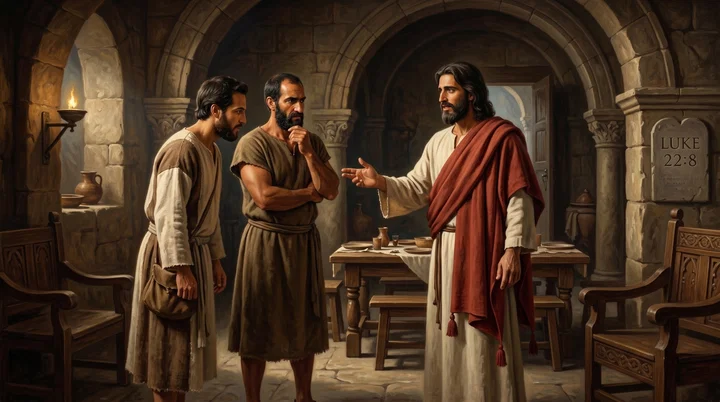
And he sent Peter and John, saying, Go and prepare us the passover, that we may eat.
Translations
American King James Version, King James Version, KJV Cambridge Paragraph Bible
And he sent Peter and John, saying, Go and prepare us the passover, that we may eat.
And he sent Peter and John, saying, Go and prepare for us the passover, that we may eat.
Revised Version, American Standard Version
And he sent Peter and John, saying, Go and make ready for us the passover, that we may eat.
and he sent Peter and John, saying, 'Having gone on, prepare to us the passover, that we may eat;'
And he sent Peter and John, saying, Go and prepare the passover for us, that we may eat [ it].
And he sent forth Peter and John, saying—Go, and make ready, for us, the passover, that we may eat.
Jesus sent Peter and John, saying, “ Go and prepare for us to eat the Passover.”
Jesus sent Peter and John, saying, “ Go and make preparations for us to eat the Passover.”
Jesus sent Peter and John, saying, “ Go and prepare the Passover for us, that we may eat.”
And Jesus sent Peter and John, saying, Go and make the Passover ready for us, so that we may take it.
And he sent Peter and Iohn, saying, Go and prepare vs the Passeouer, that we may eate it.
Douay-Rheims (Challoner revision)
And he sent Peter and John, saying: Go, and prepare for us the pasch, that we may eat.
Pictures
Cross-references
- Exodus 12:6
And ye shall keep it up until the fourteenth day of the same month: and the whole assembly of the congregation of Israel shall kill it in the evening.
defines lamb-killing time Jesus fulfilled
- Mark 14:12-16
And the first day of unleavened bread, when they killed the passover, his disciples said unto him, Where wilt thou that we go and prepare that thou mayest eat the passover?
The disciples prepare the Passover meal as Jesus directs.
- Matthew 26:17-19
Now the first day of the feast of unleavened bread the disciples came to Jesus, saying unto him, Where wilt thou that we prepare for thee to eat the passover?
Parallel account of preparing the Passover meal.
- Exodus 12:18
In the first month, on the fourteenth day of the month at even, ye shall eat unleavened bread, until the one and twentieth day of the month at even.
Sets the timing of the Passover observance.
- 1 Corinthians 5:7
Purge out therefore the old leaven, that ye may be a new lump, as ye are unleavened. For even Christ our passover is sacrificed for us:
Christ is identified as the Passover Lamb who was sacrificed.
- Luke 22:14-20
And when the hour was come, he sat down, and the twelve apostles with him.
Jesus eats the prepared Passover meal and institutes the Lord’s Supper.
- Leviticus 23:5
In the fourteenth day of the first month at even is the LORD’s passover.
Identifies the Passover as occurring on the fourteenth day at evening.
- John 13:1-27
Now before the feast of the passover, when Jesus knew that his hour was come that he should depart out of this world unto the Father, having loved his own which were in the world, he loved them unto the end.
Places events at the supper, including Judas’s departure to betray Jesus.
- 1 Corinthians 11:23
For I have received of the Lord that which also I delivered unto you, That the Lord Jesus the same night in which he was betrayed took bread:
Describes Jesus instituting the supper on the night he was betrayed.
- Luke 22:12
And he shall shew you a large upper room furnished: there make ready.
Jesus identified the furnished room where they should prepare.
- Luke 22:15
And he said unto them, With desire I have desired to eat this passover with you before I suffer:
Jesus expresses his desire to eat the prepared Passover with his disciples.
- Deuteronomy 16:2
Thou shalt therefore sacrifice the passover unto the LORD thy God, of the flock and the herd, in the place which the LORD shall choose to place his name there.
Both concern preparing the Passover sacrifice.
- John 18:28
Then led they Jesus from Caiaphas unto the hall of judgment: and it was early; and they themselves went not into the judgment hall, lest they should be defiled; but that they might eat the passover.
shows Jews had not yet eaten
- Matthew 26:2
Ye know that after two days is the feast of the passover, and the Son of man is betrayed to be crucified.
It identifies the Passover before Jesus is betrayed and crucified.
- John 19:14
And it was the preparation of the passover, and about the sixth hour: and he saith unto the Jews, Behold your King!
Both texts bear on when the Passover could be eaten.
- Luke 22:19-24
And he took bread, and gave thanks, and brake it, and gave unto them, saying, This is my body which is given for you: this do in remembrance of me.
The prepared Passover meal led to the supper and the disciples’ dispute.
- Deuteronomy 16:4
And there shall be no leavened bread seen with thee in all thy coast seven days; neither shall there any thing of the flesh, which thou sacrificedst the first day at even, remain all night until the morning.
Forbids leaven during the feast.
- Hebrews 10:1-10
For the law having a shadow of good things to come, and not the very image of the things, can never with those sacrifices which they offered year by year continually make the comers thereunto perfect.
The earlier sacrifices prefigured Christ’s final offering.
- John 1:29
The next day John seeth Jesus coming unto him, and saith, Behold the Lamb of God, which taketh away the sin of the world.
Identifies Jesus as the Lamb whose death the feast commemorates.
Commentary
Each commentary is drawn from primary sources: the writings of Ellen G. White and Adventist pioneers and periodicals. Each commentary is separate. Its own words are not a quotation; follow the references to read the source passages.
Ellen G. White
6 sources
Jesus sent Peter and John, who were to be closely associated in labor, to prepare the Passover so that He might eat it with His disciples.Ms 54, 1897, par. 1–2Ms 106, 1903, par. 1–5Ms 19, 1897, par. 30–33Ms 35, 1897, par. 1–2COS 105.1–6 He told them to go and prepare, giving exact directions for finding the place: on entering the city they would meet a man bearing a pitcher of water, follow him into the house, ask the master of the house in the form of a command where the guest chamber is where the Master will eat the Passover with His disciples, and make ready the large furnished upper room in a dwelling at Jerusalem that would be shown them.Ms 106, 1903, par. 1–5COS 105.1–6 He arranged it this way to guard against traitors coming to the supper and joining the action designed by Judas with premature movements, though such a command would seem unbecoming for two Galileans to speak to a stranger.Ms 106, 1903, par. 1–5
Everything happened as He foretold: they met the man, followed him, repeated the message, received ready assent from the master of the house, and made the meal ready, since it was customary for those living in Jerusalem to accommodate strangers desiring to celebrate the Passover.Ms 54, 1897, par. 1–2Ms 106, 1903, par. 1–5COS 105.1–6 The feast they prepared was the yearly Passover kept at Jerusalem on the night their ancestors left Egypt, eating roasted lamb, bread and bitter herbs and recalling God's deliverance from slavery.COS 105.1–6 It was eaten before Jesus suffered, on the day He was to be sacrificed as the true Passover Lamb, and after the supper with His disciples He went with them to Gethsemane, where He often prayed.Ms 54, 1897, par. 1–2COS 113.2
That meal was the setting in which foot washing and the Lord's Supper were established, while the disciples' dispute over who was greatest revealed their need to learn humility.Ms 19, 1897, par. 30–33 The Passover meal was about to give way to the Lord's Supper, for Christ established the sacramental service to replace it as a lasting memorial of His death.Ms 35, 1897, par. 1–2
Sources
Pioneers and periodicals
18 sources
He sent Peter and John to prepare the Passover meal for himself and the disciples to eat together.RH Dec 19, 1907ST Apr 2, 1912RH Dec 10, 1867 The preparation meant securing a furnished upper room by following a man bearing a pitcher of water, with table, couches, unleavened bread, bitter herbs, wine, and a lamb slain in the temple between three and five o'clock and cooked where it would be eaten.ST May 18, 1904ST May 12, 1898 The place was kept from the other disciples because Judas had already agreed to betray him and sought opportunity to do it, lest foreknowledge disturb the supper and its instruction.ST May 18, 1904RH Dec 10, 1867 It was the fourth and last Passover of the ministry, eaten at the appointed legal time on the evening beginning the fourteenth day, Thursday evening, with the crucifixion following on Friday, while those who held it otherwise teach that it anticipated the Jews' Passover by a day.ST Oct 22, 1894ST Sep 27, 1910ST Mar 11, 1886RH Dec 19, 1907ST Apr 2, 1912 After eating it he instituted the Lord's Supper as a memorial of his death as the Lamb of God until he should come again, standing at the close of the sacrificial system whose blood had prefigured his death.ST Apr 3, 1907RH Dec 19, 1907ST Apr 2, 1912RH Mar 7, 1912
Passover Timing and Preparation
He sent Peter and John to prepare the Passover meal for himself and the disciples, naming those two disciples as the ones sent for this work.RH Dec 19, 1907ST Apr 2, 1912RH Dec 10, 1867 The preparation called for finding a furnished room with table, couches and fixtures for cooking and eating by following detailed directions to recognize a man bearing a pitcher of water who would show the place.ST May 18, 1904ST May 12, 1898 What was to be made ready there was a place for cooking and eating, unleavened bread, bitter herbs, wine or grape juice, and a paschal lamb slain in the temple court between 3 and 5 o'clock and then cooked in the private house where it would be eaten, since the lamb had to be slain at the temple and cooked at the house of the meal.ST May 18, 1904ST May 12, 1898
The place was withheld from the other disciples because Judas had already agreed with the chief priests to betray Jesus and was seeking opportunity to do so.ST May 18, 1904 Had he known the place beforehand he might have warned Jesus' enemies, and the supper with all its sacred associations and instruction could have been disturbed.ST May 18, 1904 That the plan succeeded through going at the right time and meeting the right servant illustrates foreknowledge, with the events occurring in precise detail.ST May 18, 1904RH Dec 10, 1867
By that period the observance had become a leisurely meal with wine and reclining rather than a hurried meal eaten standing with a staff.ST Apr 2, 1912 In that changed practice it could be eaten on its regular day or the following day.ST Apr 2, 1912 The meal was eaten at the regular appointed legal time on the fourteenth day of the first month, when the Passover lamb was slain between the two evenings, between about three o'clock and sunset on the first day of the Feast of Unleavened Bread, with the meal eaten after the fifteenth day began.ST Oct 22, 1894ST Mar 11, 1886RH Jun 24, 1873 This keeping of the Passover at its appointed legal time was obedience to the law, and it could not have been a day early because the lamb had to be offered in the Temple at the appointed time.RH Jun 24, 1873RH Feb 5, 1914
On that dating the preparation was for the meal eaten that evening, Thursday evening, the fourteenth day of the month when the Passover lamb was to be killed, with the crucifixion on the following day, Friday, the fifteenth day of the month.ST Mar 11, 1886ST Mar 11, 1886 So the Lord's Supper was celebrated on Thursday evening rather than on the first day of the week.ST Mar 11, 1886ST Jan 13, 1881 On a different understanding, the meal He ate with His disciples was on the evening before the Passover the Jews ate, anticipating their Passover by a day in order to teach a great lesson and to institute the Lord's Supper before death.ST Apr 3, 1907 He still met the true time by dying Himself upon the cross at the very time the Passover lamb was killed between the evenings, between three o'clock and sunset, as the Passover sacrificed for us.ST Apr 3, 1907
On another variant, the supper was eaten a few hours before the regular Passover but on the same day, with the exact appointed time met by death upon the cross after the ninth hour had passed and the darkness had ended, between the two evenings.ST Jun 20, 1911 The divisions of the day were known by the first hour in the division, the first hour continuing till nine o'clock, the third hour till twelve, the sixth hour till three p.m., and the twelfth hour till six.ST Jun 20, 1911
Meaning and Later Observance
The preparation was for the last Passover Jesus ate with His disciples before His apprehension in the garden.ST Sep 27, 1910RH Dec 19, 1907ST Apr 2, 1912 It was the final Passover of His ministry, the fourth and last Passover supper, coming immediately before arrest that same night and crucifixion.RH Dec 19, 1907ST Apr 2, 1912RH Mar 7, 1912 It was the next event of importance after the triumphal entry into Jerusalem.ST Jesus desired these final hours with His disciples before the momentous events and His death.RH Mar 7, 1912
After eating that meal He instituted the Lord's Supper as a feast to commemorate His death as the Lamb of God.ST Apr 3, 1907RH Dec 19, 1907ST Apr 2, 1912 It was ordained as a memorial of His death until He should come again.RH Dec 19, 1907 The supper stood at the transition between two dispensations, where His final offering for sin brought the sacrificial system to an end.RH Mar 7, 1912 The blood of that system had prefigured His death since the sacrifices of humanity's first parents.RH Mar 7, 1912
The guest room had been made ready with a basin, towel, and water so that someone could wash the guests' feet.ST Apr 11, 1906 At the meal jealousy and ambition kept the disciples from taking a servant's place.ST Apr 11, 1906 They sought honor in a worldly kingdom, contrary to the loving service required in Christ's kingdom.ST Apr 11, 1906 The holy gathering at the Lord's table benefits the whole congregation, and participation with fellow believers is a serious duty.RH Mar 7, 1912
Sources