Mark 15:12
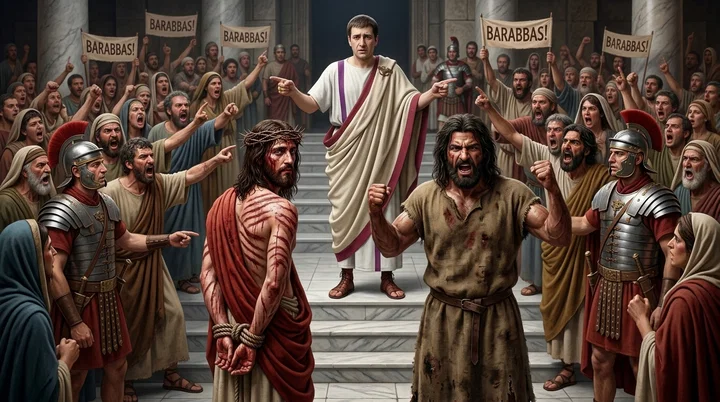
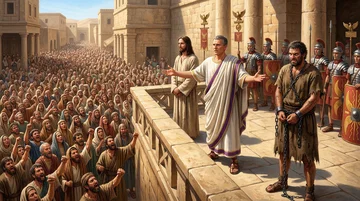
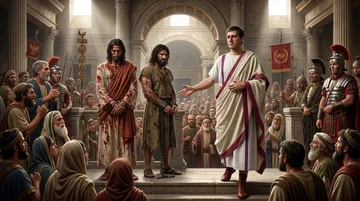
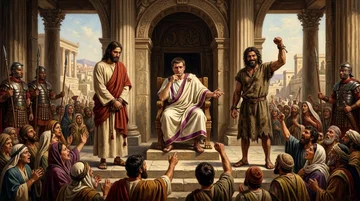
And Pilate answered and said again unto them, What will ye then that I shall do unto him whom ye call the King of the Jews?
Translations
And Pilate answered and said again to them, What will you then that I shall do to him whom you call the King of the Jews?
King James Version, KJV Cambridge Paragraph Bible
And Pilate answered and said again unto them, What will ye then that I shall do unto him whom ye call the King of the Jews?
And Pilate answered, and said again to them, What will ye then that I shall do to him whom ye call the King of the Jews?
Revised Version, American Standard Version
And Pilate again answered and said unto them, What then shall I do unto him whom ye call the King of the Jews?
And Pilate answering, again said to them, 'What, then, will ye [that] I shall do to him whom ye call king of the Jews?'
And Pilate answering said to them again, What will ye then that I do [ to him] whom ye call King of the Jews?
But, Pilate, again answering, was saying unto them—What then shall I do with him whom ye call, the King of the Jews?
Berean Standard Bible, Majority Standard Bible
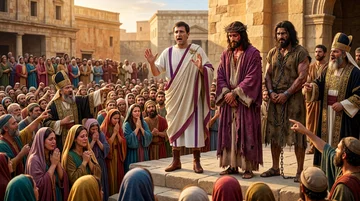
So Pilate asked them again, “ What then do you want me to do with the One you call the King of the Jews?”
Pilate again asked them, “ What then should I do to him whom you call the King of the Jews?”
And Pilate again said in answer to them, What then am I to do to him to whom you give the name of the King of the Jews?
And Pilate answered, and said againe vnto them, What will ye then that I doe with him, whom ye call the King of the Iewes?
Douay-Rheims (Challoner revision)
And Pilate again answering, saith to them: What will you then that I do to the king of the Jews?
Pictures
Cross-references 20 of 21
- Matthew 27:22
Pilate saith unto them, What shall I do then with Jesus which is called Christ? They all say unto him, Let him be crucified.
Pilate asks what to do with Jesus, and the crowd demands his crucifixion.
- Luke 23:18-23
And they cried out all at once, saying, Away with this man, and release unto us Barabbas:
The crowd demands Barabbas and rejects Jesus.
- John 18:39-40
But ye have a custom, that I should release unto you one at the passover: will ye therefore that I release unto you the King of the Jews?
Pilate offers to release Jesus, but the crowd chooses Barabbas.
- John 19:4-6
Pilate therefore went forth again, and saith unto them, Behold, I bring him forth to you, that ye may know that I find no fault in him.
Pilate declares Jesus faultless, but the crowd demands his crucifixion.
- Luke 23:7-15
And as soon as he knew that he belonged unto Herod’s jurisdiction, he sent him to Herod, who himself also was at Jerusalem at that time.
Pilate sends Jesus to Herod, who also finds no punishment due.
- John 19:15
But they cried out, Away with him, away with him, crucify him. Pilate saith unto them, Shall I crucify your King? The chief priests answered, We have no king but Cæsar.
The people demand Jesus’ crucifixion and deny that he is their king.
- Luke 23:22
And he said unto them the third time, Why, what evil hath he done? I have found no cause of death in him: I will therefore chastise him, and let him go.
Pilate finds no cause for Jesus’ death and proposes to chastise and release him.
- Matthew 27:24-25
When Pilate saw that he could prevail nothing, but that rather a tumult was made, he took water, and washed his hands before the multitude, saying, I am innocent of the blood of this just person: see ye to it.
Pilate seeks to evade responsibility, while the crowd accepts responsibility for Jesus’ blood.
- Luke 23:4
Then said Pilate to the chief priests and to the people, I find no fault in this man.
Pilate finds no fault in Jesus
- Matthew 27:19
When he was set down on the judgment seat, his wife sent unto him, saying, Have thou nothing to do with that just man: for I have suffered many things this day in a dream because of him.
Pilate's wife told him of Jesus
- Luke 23:16-18
I will therefore chastise him, and release him.
Pilate offers to release Jesus, but the crowd demands Barabbas.
- Matthew 27:23
And the governor said, Why, what evil hath he done? But they cried out the more, saying, Let him be crucified.
Pilate asks what evil Jesus had done.
- Matthew 27:21
The governor answered and said unto them, Whether of the twain will ye that I release unto you? They said, Barabbas.
The crowd chooses Barabbas when Pilate asks whom to release.
- John 19:5
Then came Jesus forth, wearing the crown of thorns, and the purple robe. And Pilate saith unto them, Behold the man!
Pilate presents scourged Jesus as Behold the man
- John 19:6
When the chief priests therefore and officers saw him, they cried out, saying, Crucify him, crucify him. Pilate saith unto them, Take ye him, and crucify him: for I find no fault in him.
The crowd cries for crucifixion, and Pilate answers, “Take ye him, and crucify him.”
- Mark 15:17
And they clothed him with purple, and platted a crown of thorns, and put it about his head,
Jesus is clothed in purple and crowned with thorns in mockery and suffering.
- Mark 15:19
And they smote him on the head with a reed, and did spit upon him, and bowing their knees worshipped him.
They strike Christ with a reed and bow mockingly before him.
- John 18:28
Then led they Jesus from Caiaphas unto the hall of judgment: and it was early; and they themselves went not into the judgment hall, lest they should be defiled; but that they might eat the passover.
Jesus is led to the judgment hall before Pilate’s question.
- Genesis 49:10
The sceptre shall not depart from Judah, nor a lawgiver from between his feet, until Shiloh come; and unto him shall the gathering of the people be.
Shiloh is named as the promised figure whose coming brings deliverance.
- Mark 14:64
Ye have heard the blasphemy: what think ye? And they all condemned him to be guilty of death.
council condemns Jesus before sending to Pilate
Commentary
Each commentary is drawn from primary sources: the writings of Ellen G. White and Adventist pioneers and periodicals. Each commentary is separate. Its own words are not a quotation; follow the references to read the source passages.
Ellen G. White
12 sources
The question belongs to the trial of Jesus before Pilate the Roman governor, in his judgment hall, on the way from the judgment hall to Calvary.DA 722.5DA 723.1–724.1 Christ stands there bound as a prisoner with a guard of soldiers about Him and the hall fast filling with spectators, while just outside the entrance are the judges of the Sanhedrim, priests, rulers, elders and the mob.DA 723.1–724.1 That journey from judgment hall to Calvary is bound up with the guilt of those responsible for His death, upon whom retribution was already visiting.DA 722.5
The council of the Sanhedrim has already condemned Him and has come to have the sentence confirmed and executed.DA 723.1–724.1 The Jewish officials will not enter the Roman hall, lest by ceremonial law they be defiled and kept from the Passover feast, though murderous hatred has defiled their hearts.DA 723.1–724.1 Christ Himself is the real Passover lamb, so by rejecting Him the great feast has lost its significance for them.DA 723.1–724.1
Pilate has been called in haste from his bedchamber at an early hour, looks on Jesus with no friendly eyes, and means to do his work quickly with magisterial severity, knowing the authorities want hasty trial and punishment.DA 723.1–724.1 Yet his searching gaze finds no guilt and no fear or boldness or defiance, but goodness, nobility, and calm and dignified bearing.DA 723.1–724.1 The countenance bears not the marks of a criminal but the signature of heaven, which makes a favorable impression, rouses his better nature, and holds him back from hasty condemnation.DA 723.1–724.1
He has heard of Jesus and His works, and his wife has told him of the wonderful deeds of the Galilean prophet who cured the sick and raised the dead.DA 723.1–724.1 Rumors from several sources revive in his mind, and he remembers how not long before Jesus raised Lazarus who had been dead four days.DA 723.1–724.1 He therefore resolves to demand of the Jews their charges against the prisoner and whether they can be proved before signing sentence of condemnation.DA 723.1–724.1
He then asks the crowd what he should do with Him whom they call the King of the Jews.Ms 22, 1900, par. 17–20ST Jun 3, 18895RED 62.3Ms 112, 1897, par. 33–3416MR 259.3–260.1 The question comes before their demand that Jesus be crucified and recalls the rulers' choice to reject Christ and claim Caesar as their king.Ms 22, 1900, par. 17–20 Though he recognizes Jesus' innocence and has no proof of wrongdoing, he appeals to the people and yields his judgment to the mob, compromising his authority and losing control.ST Jun 3, 18895RED 62.3 His effort to conciliate the crowd and appease them while seeking a way to release Jesus shows weakness.ST Jun 3, 1889ST Jul 11, 1878 His appeal fails because he does not understand the priests' hatred of Jesus.ST Jul 11, 1878
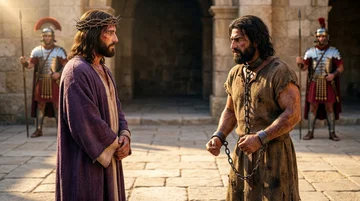
Trying to save Jesus' life while seeming to satisfy the Jews, he proposes to have Him scourged and then release Him, hoping punishment short of death will excite pity and satisfy malice.DA 735.1–55RED 62.3ST Jul 11, 1878 He has Jesus scourged and mocked, has Barabbas brought and sets the two prisoners side by side, solemnly declares Jesus innocent, and makes entreaty for sympathy, trusting the contrast will move the multitude to choose Jesus.DA 735.1–5Ms 112, 1897, par. 33–34 For in suffering Jesus shows gentleness, resignation, pity, strength and dignity, while Barabbas shows himself a hardened ruffian, a notorious criminal who falsely claimed to be Christ.DA 735.1–5Ms 112, 1897, par. 33–34
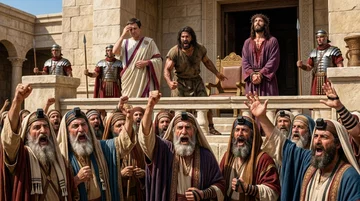
The Jews with keen perception see the weakness of punishing a man declared innocent and know Pilate is trying to release the prisoner, and they are determined He shall not be released.DA 735.1–5 Moved by priests, rulers and people to mad fury, His own nation clamors for His blood and demands crucifixion until the demand prevails.DA 735.1–55RED 62.3ST Jul 7, 1898 Jesus is scourged to satisfy the fury of the priests and rulers, and the murderous Barabbas is chosen in place of their beloved Teacher.5RED 62.3ST Jul 7, 1898 Pilate despairingly tells them to take Jesus and crucify Him themselves while repeating that he finds no fault in Him.DA 735.1–5
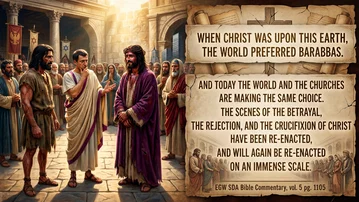
The choice between Barabbas and Christ is a choice between Satan and the Son of God.16MR 259.3–260.1 Choosing Barabbas and demanding Christ's crucifixion is repeated in the world, and each person demonstrates whom they choose.16MR 259.3–260.1 The crowd's demand shows what people do when not controlled by God's Spirit and the hostile spirit that will be shown by those aligned with the powers of darkness in a coming crisis.19MR 277.1–278.1 The crowd's later demand to crucify Jesus and its abuse of Him fulfills the trial Jesus had prepared His disciples to face, when the people who had hailed Him as king turn against Him.4RED 102.2–103.1 His faithful disciples are not caught by surprise or led to abandon their faith.4RED 102.2–103.1
The choice belongs to Christ's approach to the cross and descent into humiliation into the hands of wicked men, in which He whom the disciples thought was to take His place on David's throne and in whom their hopes of eternal life were centered is scourged as the worst of criminals and then lifted on the cross dying as a malefactor.ST Jul 7, 1898 Witnessing that rejection and humiliation tries their faith so that hope and courage fail and gives them cause to mourn and fast.ST Jul 7, 1898
Sources
Pioneers and periodicals
21 sources
After the chief priests stirred the multitude to ask for Barabbas to be released instead, Pilate asked again what he should then do with Him whom they themselves call the King of the Jews.ST May 25, 1904ST May 10, 1905ST Mar 13, 1901ST May 25, 1904 The question was part of his repeated efforts to release a man in whom he had found no fault and to shift responsibility to others, even while Christ's dignified, unresentful bearing under insult and scourging convinced him that One more than man stood before him.ST Jul 11, 1878ST Oct 27, 1898ST Mar 13, 1901 He hoped the people would answer differently about Jesus, but their answer was the final rejection of their King when they demanded that He be crucified.ST Nov 9, 1882ST Oct 10, 1895 That rejection with the call for crucifixion fulfills the prediction that the Messiah would be despised and rejected in Isaiah 53:3, and Pilate's declaration that he found no fault in Christ stands as the world's official declaration that Christ was unjustly put to death as the just for the unjust to bring people to God.ST Jun 15, 1904RH Jun 24, 1858 The clash turns on kingship and the hope that Jesus would lead Israel to political deliverance, and when He would not act as they wished they chose Barabbas, a robber convicted of the crime charged against Jesus, instead of the innocent Lamb of God.RH Jun 24, 1915ST Oct 4, 1910
Question in Pilate's Court
After the chief priests stirred the multitude to ask for Barabbas to be released instead, Pilate asked again what he should then do with Him whom they call the King of the Jews.ST May 25, 1904ST May 25, 1904 It was a further question put to the multitude following their choice of Barabbas.ST May 25, 1904ST May 25, 1904
Jesus stood before Pilate, the Roman governor whose sentence was needed before execution could proceed, after Caiaphas sent Him for condemnation to secure execution.RH Feb 11, 1862RH Jul 16, 1861 Pilate had attempted to place the case under Herod's jurisdiction on the ground that Jesus was a Galilean, but that effort failed when Herod put His fate back in his hands and forced him to decide.RH Jul 16, 1861 He was then pressed by three united parties and a seditious mob shouting for crucifixion.RH Jul 16, 1861 The Herodians and Sadducees were moved both by hatred of Jesus and impatience with the Roman yoke and by anger over Roman banners bearing the emperor's image brought into the holy city and over the proposal to use part of the temple treasure for public works, the Pharisees were moved by bitterness at three years of public rebukes and, too weak to act alone, joined the others, and the reckless populace eager for disorder and gain joined the cry.RH Jul 16, 1861
By calling Him one whom they themselves call the King of the Jews, Pilate appealed to the crowd's own title for Jesus.ST May 10, 1905ST Mar 13, 1901 He did so while still seeking a way to release Him.ST May 10, 1905ST Mar 13, 1901
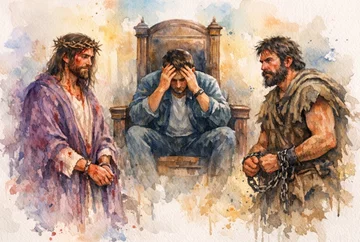
The question was one of Pilate's repeated efforts to release an innocent Man and to induce the priests to withdraw their unproved charges, and to shift responsibility to others.ST Oct 27, 1898 He had already found no evidence of crime, and Christ's dignified bearing unlike common criminals, His trust in a higher power, His unresentful silence under the malignity of the priests in choosing Barabbas and under scourging, beating, bruising and insult, together with Herod's finding Him worthy of no punishment, had convinced him that One more than man stood before him and appealed to him to do right whatever the consequences.ST Oct 27, 1898 Joined with the warning through his loved wife Claudia Procula, to whom God gave a dream-vision of Christ, in God's effort to present the gospel in its glorious perfection before great Rome represented by Pilate, the question was Pilate's last chance.ST Oct 27, 1898 He remained undecided from fear of the Jews, refused to identify himself with the suffering Innocent One, and delivered Jesus to the mob while hoping to escape responsibility and ease conscience by washing his hands in water.ST Oct 27, 1898
The verse belongs to the final scene of Christ's earthly life, in which He stood in humble posture at Pilate's judgment seat amid the cruelty and madness of sin that culminated in crucifixion.RH Jun 10, 1862RH Dec 28, 1911RH Dec 21, 1911 That humble posture stands in contrast with later papal pomp as an eloquent sermon.RH Dec 28, 1911RH Dec 21, 1911 The crowd's immediate demand for crucifixion shows that crucifixion was a familiar Roman method of executing criminals at that time.ST May 6, 1913
Rejection and Gospel Meaning
After the multitude chose Barabbas for release, Pilate altered his question about Jesus in hope the people would answer differently concerning Him, but their answer was the final rejection of their King, for they demanded that He be crucified.ST Nov 9, 1882ST Oct 10, 1895 That rejection before Pilate, with its call for crucifixion in Mark 15:9-14, fulfills the prediction in Isaiah 53:3 that the Messiah would be despised and rejected.RH Jun 24, 1858 Pilate's declaration that he found no fault in Christ was the world's official declaration that Christ was unjustly put to death, showing that Christ once suffered for sins as the just for the unjust to bring people to God, put to death in the flesh but made alive by the Spirit.ST Jun 15, 1904 That a heathen judge could see His innocence while God's apostate people could not shows how great is the darkness when the light within is darkness.ST Jun 15, 1904
The clash turns on kingship and the expectation that Jesus would lead Israel to political deliverance and establish the kingdom by crowning Him and raising an army, and when He refused to act as they wished they turned to Barabbas instead.ST Oct 4, 1910 They chose Barabbas, a robber convicted of the crime charged against Jesus, instead of the innocent Lamb of God, so that Jesus was crucified between criminals.RH Jun 24, 1915 Though Pilate recognized Jesus' innocence and had declared Him innocent, he appealed to the people and yielded his judgment to the mob, compromising his authority and losing control as they demanded crucifixion.ST Jun 3, 1889 In leaving Jesus' fate to the choice of His avowed enemies he exposed his own inconsistency and the chief priests' insincerity in urging the choice of Barabbas.
Pilate used the question as another attempt to shift responsibility for Jesus' release onto others, though he knew he should release Him.ST Mar 13, 1901 Yielding to pressure, he offered to have Jesus chastised and then released to appease them, hoping that scourging would satisfy the crowd, but they kept demanding crucifixion.ST Jul 11, 1878ST Mar 13, 1901 His appeal failed because he did not understand the priests' hatred of Jesus, and his effort to conciliate the crowd showed his weakness.ST Jul 11, 1878 His own nation clamored for His blood and the murderous Barabbas was chosen in place of their Teacher, as Christ approached the cross and descended into humiliation into the hands of wicked men.ST Jul 7, 1898 He in whom the disciples thought eternal life was centered and whom they thought would sit on David's throne was scourged as the worst of criminals and lifted on the cross dying as a malefactor, and witnessing that rejection tries faith so that hope and courage fail and gives cause to mourn and fast.ST Jul 7, 1898
Sources