Translations
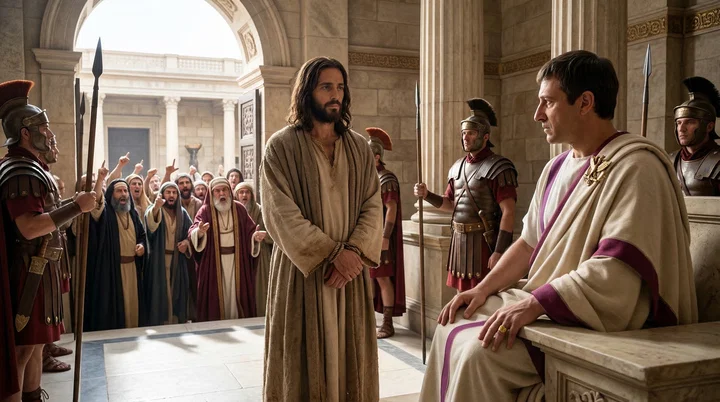
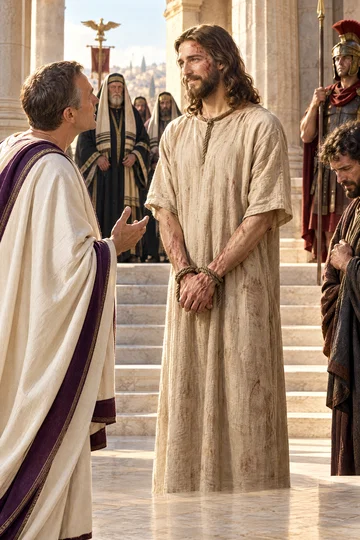
But Jesus yet answered nothing; so that Pilate marveled.
King James Version, KJV Cambridge Paragraph Bible
But Jesus yet answered nothing; so that Pilate marvelled.
But Jesus yet answered nothing: so that Pilate marveled.
But Jesus no more answered anything; insomuch that Pilate marveled.
But Jesus no more answered anything; insomuch that Pilate marvelled.
and Jesus did no more answer anything, so that Pilate wondered.
But Jesus still answered nothing, so that Pilate marvelled.
But, Jesus, no further, answered, anything, so that Pilate began to marvel.
Berean Standard Bible, Majority Standard Bible
But to Pilate’s amazement, Jesus made no further reply.
But Jesus made no further answer, so that Pilate marveled.
But Jesus gave no more answers, so that Pilate was full of wonder.
But Iesus answered no more at all, so that Pilate marueiled.
Douay-Rheims (Challoner revision)
But Jesus still answered nothing; so that Pilate wondered.
Pictures
Cross-references
- Matthew 27:12-14
And when he was accused of the chief priests and elders, he answered nothing.
Jesus gives no answer to the accusations, and Pilate marvels.
- Isaiah 53:7
He was oppressed, and he was afflicted, yet he opened not his mouth: he is brought as a lamb to the slaughter, and as a sheep before her shearers is dumb, so he openeth not his mouth.
Jesus remains silent before his accusers, as the suffering servant does.
- Luke 23:4
Then said Pilate to the chief priests and to the people, I find no fault in this man.
Pilate declares Jesus innocent.
- John 18:28-38
Then led they Jesus from Caiaphas unto the hall of judgment: and it was early; and they themselves went not into the judgment hall, lest they should be defiled; but that they might eat the passover.
Records Jesus’ hearing before Pilate.
- Luke 23:9
Then he questioned with him in many words; but he answered him nothing.
Jesus gives Herod no answer to his questions.
- John 19:9
And went again into the judgment hall, and saith unto Jesus, Whence art thou? But Jesus gave him no answer.
Jesus gives Pilate no answer.
- Luke 23:13-24
And Pilate, when he had called together the chief priests and the rulers and the people,
parallel account of Jesus before Pilate
- Matthew 26:63
But Jesus held his peace. And the high priest answered and said unto him, I adjure thee by the living God, that thou tell us whether thou be the Christ, the Son of God.
Jesus remains silent during questioning at his trial.
- Matthew 27:2
And when they had bound him, they led him away, and delivered him to Pontius Pilate the governor.
parallel account of Jesus before Pilate
- 1 Peter 2:23
Who, when he was reviled, reviled not again; when he suffered, he threatened not; but committed himself to him that judgeth righteously:
Jesus bears insult without retaliating.
- John 18:33
Then Pilate entered into the judgment hall again, and called Jesus, and said unto him, Art thou the King of the Jews?
silence leads Pilate to question privately
- John 18:38
Pilate saith unto him, What is truth? And when he had said this, he went out again unto the Jews, and saith unto them, I find in him no fault at all.
Pilate’s question about truth follows his exchange with Jesus.
- John 18:37
Pilate therefore said unto him, Art thou a king then? Jesus answered, Thou sayest that I am a king. To this end was I born, and for this cause came I into the world, that I should bear witness unto the truth. Every one that is of the truth heareth my voice.
both cited to show Jesus died for truth yet kept silent
- Matthew 27:19
When he was set down on the judgment seat, his wife sent unto him, saying, Have thou nothing to do with that just man: for I have suffered many things this day in a dream because of him.
Pilate’s wife makes a final appeal to him concerning Jesus.
Commentary
Each commentary is drawn from primary sources: the writings of Ellen G. White and Adventist pioneers and periodicals. Each commentary is separate. Its own words are not a quotation; follow the references to read the source passages.
Ellen G. White
10 sources
Mark 15:5 belongs to the trial before Pilate in his judgment-hall, before Jesus is led out from Pilate's hall toward Calvary.DA 722.5DA 723.1–724.1 At the scene Jesus stands bound as a prisoner among soldiers and filling spectators, while the priests, rulers, elders and mob remain outside to avoid ceremonial defilement before the Passover.DA 723.1–724.1 They are blind to the murderous hatred defiling their own hearts and to Christ as the real Passover lamb.DA 723.1–724.1 Pilate comes hastily from rest intending quick and severe action and looks at first with no friendly eyes, then studies Jesus and finds in him no guilt, fear, boldness or defiance but goodness, nobility, calm and dignified bearing marked by heaven.DA 723.1–724.1
The sight makes a favorable impression on Pilate and rouses his better nature, as he remembers what he heard of cures of the sick and raisings of the dead, what his wife told him of the Galilean prophet, and rumors from several sources.DA 723.1–724.1 He resolves on seeing this to demand the charges against the prisoner.DA 723.1–724.1 It is part of the condemnation and humiliation in which the crowd that had hailed Jesus as king turns against him and cries for his crucifixion.4RED 102.2–103.1 He had prepared his disciples for this ordeal so that the rejection does not take them by surprise or make their faith depend on changing popular opinion.4RED 102.2–103.1
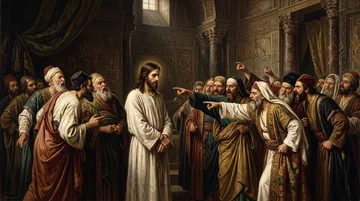
Jesus answers nothing and remains silent despite the many accusations against him, even when Pilate urges and challenges him to answer.ST Jun 3, 18893SP 130.2–131.2COS 138.5–9ST Jul 4, 18785RED 50.2–51.1 The accusations are false and are pressed amid noise, excitement, fury and the uproar of the crowd, which contrasts with his noble appearance and quiet manner.ST Jun 3, 1889COS 138.5–9DA 726.1–4 His silence expresses conscious innocence and steadfastness, in that accusation and abuse do not provoke retaliation or disturb him.DA 726.1–4 His bearing is dignified, calm, self-possessed, good and noble, and his serenity amid suffering shows a character unlike that of an ordinary man.ST Jun 3, 1889COS 138.5–9DA 723.1–724.15RED 50.2–51.1ST Jun 3, 1889
As before his accusers, so before Herod his silence and calm submission to indignity speak conviction more powerfully than words.ST Jun 3, 1889 Pilate is perplexed, amazed and astonished, and marvels at Jesus and his bearing.ST Jun 3, 18893SP 130.2–131.2COS 138.5–9ST Jul 4, 18785RED 50.2–51.1 Pilate sees no evidence of crime and no sign that Jesus is seditious, does not trust the priests' charges, becomes convinced of his innocence and doubts that he is unjust, while hoping to learn the truth from him.3SP 130.2–131.2COS 138.5–9ST Jul 4, 18785RED 50.2–51.1DA 726.1–4 The silence together with the calm bearing wins Pilate deep respect.ST Jun 3, 18895RED 50.2–51.1
Sources
Pioneers and periodicals
16 sources
When Pilate pressed Him to answer the many charges brought by the priests and rulers, Jesus answered nothing more and remained silent before him.ST May 25, 1904ST Sep 30, 1886ST Oct 26, 1882 Pilate marvelled and was astonished because He showed a calm, dignified self-possession unlike any criminal he was used to seeing, convincing him that He bore no mark of sedition and that no fault could be found in Him.ST Jun 3, 1889ST Jul 4, 1878ST Jun 15, 1904ST Sep 30, 1886 That silent endurance under reproach, scourging and insult was flawless meekness, fulfilling the prophecy of the afflicted One led as a lamb to the slaughter who opens not His mouth.ST Jun 3, 1889ST Oct 12, 1904ST Oct 27, 1898 His innocence, declared even by a heathen judge, proves He suffered as the just for the unjust to bring sinners to God.ST Jun 15, 1904 His silence shows that strength and self-command can keep silent under trial without ever speaking falsehood, and that such bearing can appeal to the heart more powerfully than words.ST Jun 3, 1889ST Apr 22, 1903ST Oct 27, 1898ST Apr 7, 1881
Trial Before Pilate
Mark 15:5 belongs to the trial of Jesus before Pilate, parallel to Luke 23:13-24, Matthew 27:11-31, and John 18:28 to 19:16.ST Mar 13, 1901 It is the final scene of His life at Pilate's judgment seat, where He endured cruelty and mockery before His crucifixion.RH Jun 10, 1862 In that trial Pilate declares he finds no fault in Jesus yet gives sentence that the crowd's demand for crucifixion should be done.ST Mar 13, 1901
The silence came after Caiaphas claimed Jesus had admitted guilt, after priests, scribes and rulers joined in noisy denunciations demanding a death sentence, after their lawless uproar confused Pilate, and after quiet was restored.ST Sep 30, 1886 When Pilate asked why He made no answer to the many charges witnessed against Him and urged Him to answer, Jesus answered nothing more.ST May 25, 1904ST Sep 30, 1886ST Oct 26, 1882 He treated the governor's urging with continued silence and indifference, remaining completely silent despite the priests' uproar and the charges.ST May 25, 1904ST Sep 30, 1886ST Oct 26, 1882
That continued refusal to answer caused Pilate to marvel, perplexed him, left him amazed and astonished.ST Jun 3, 1889ST Jul 4, 1878ST May 25, 1904 He was perplexed and had no confidence in the priests' accusations because he saw in Jesus no marks of a seditious character.ST Jul 4, 1878ST Sep 30, 1886 He was struck and astonished by Jesus' dignified bearing and calm self-possession and serenity under pressure amid the leaders' noisy accusations, which won his deep respect.ST Jun 3, 1889ST Jun 3, 1889 That bearing was unlike the criminals and men Pilate was used to seeing and showed a character unlike that of an ordinary man, convincing Pilate that before him stood One more than man.ST Jun 3, 1889ST Oct 27, 1898
Pilate's perplexity moved him to seek the truth away from the clamor of the crowd by taking Jesus alone with him into his house and respectfully asking if He was the King of the Jews.ST Sep 30, 1886
In this trial before Pilate the world's official declaration was made that Christ was unjustly put to death.ST Jun 15, 1904 Pilate repeatedly declared he found no fault in Him yet gave sentence that the crowd's demand for crucifixion should be done.ST Mar 13, 1901 The details of the trial and execution fit the customs and political circumstances of the time and support the account's historical credibility.RH Feb 11, 1862
Meekness Prophecy and Example
The silence answers to flawless, humble meekness in Jesus of Nazareth, a meekness that excelled even the meekness of Moses.ST Oct 12, 1904 Before the governor who passed sentence of death though no fault could be found, He remained humble and silent, dignified, unresentful and unresisting.ST Oct 12, 1904ST Oct 27, 1898RH Dec 28, 1911 Before the mob and Pilate He kept silence even as reproach and taunts and the cry for crucifixion pressed upon Him and terrified His followers, and before Herod as well, enduring scourging, beating, bruising, bleeding and every indignity, insult and suffering with peace, patience, calm self-possession and complete self-renunciation, trusting in a higher power.ST Jun 3, 1889ST Oct 27, 1898ST Apr 7, 1881ST Nov 5, 1912
That silence literally fulfilled the prophecy that the oppressed and afflicted One would not open His mouth, like a lamb brought to the slaughter and like a sheep dumb before its shearers.ST Oct 12, 1904 Even with such perfect meekness, He did not inherit the earth during His earthly pilgrimage.ST Oct 12, 1904
Pilate's finding no fault proves He suffered for sins as the just for the unjust, that He might bring sinners to God, put to death in the flesh but quickened by the Spirit.ST Jun 15, 1904 That a heathen judge saw His innocence while the apostate people of God could not see it shows how great is the darkness when the light within is darkness.ST Jun 15, 1904
By that bearing and by the repeated declarations of His innocence, God set the Gospel in its glorious perfection before Rome in Pilate in order to save him.ST Oct 27, 1898 Meeting even the choice of Barabbas over Himself with no word of retaliation, His bearing appealed to Pilate's heart to do right whatever the consequences.ST Oct 27, 1898 Before Herod also His silence and calm submission to indignity spoke conviction more powerfully than words, and His serenity amid suffering showed a character unlike that of an ordinary man.ST Jun 3, 1889
His silence proves that hard or demanding situations may require keeping silent, but they never require speaking falsehood, because He held to the truth even to death for the truth's sake.ST Apr 22, 1903 His silence displays strength, dignity and self-command, and shows that silence can be an effective response, while on the cross He spoke to give blessing.ST Apr 7, 1881
Sources