Mark 15:6
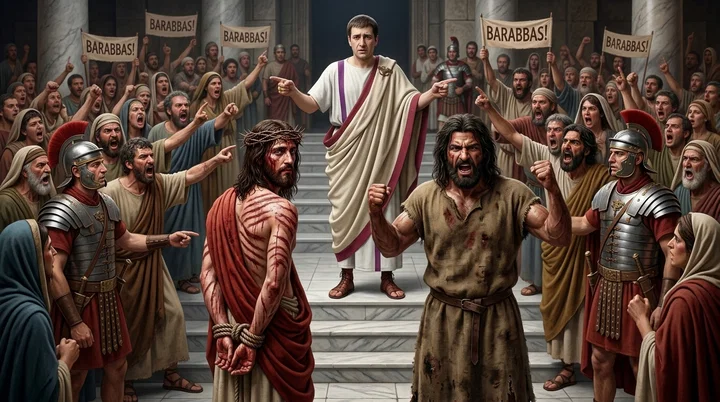
Now at that feast he released unto them one prisoner, whomsoever they desired.
Translations
Now at that feast he released to them one prisoner, whomsoever they desired.
King James Version, KJV Cambridge Paragraph Bible
Now at that feast he released unto them one prisoner, whomsoever they desired.
Now at that feast he released to them one prisoner, whom they desired.
Revised Version, American Standard Version
Now at the feast he used to release unto them one prisoner, whom they asked of him.
And at every feast he was releasing to them one prisoner, whomsoever they were asking;
But at [ the] feast he released to them one prisoner, whomsoever they begged [ of him].
Now, at feast time, he was wont to release unto them one prisoner, whom they were claiming.
Berean Standard Bible, Majority Standard Bible
Now it was Pilate’s custom at the feast to release to the people a prisoner of their choosing.
Now at the feast he used to release to them one prisoner, whomever they asked of him.
Now at the feast every year he let one prisoner go free at their request.
Nowe at the feast, Pilate did deliuer a prisoner vnto them, whomesoeuer they woulde desire.
Douay-Rheims (Challoner revision)
Now on the festival day he was wont to release unto them one of the prisoners, whomsoever they demanded.
Pictures
Cross-references
- Matthew 27:15-21
Now at that feast the governor was wont to release unto the people a prisoner, whom they would.
Describes Pilate’s feast custom and the crowd choosing Barabbas.
- Luke 23:18-25
And they cried out all at once, saying, Away with this man, and release unto us Barabbas:
The crowd demands Barabbas’s release instead of Jesus, and Pilate gives sentence.
- John 18:39-40
But ye have a custom, that I should release unto you one at the passover: will ye therefore that I release unto you the King of the Jews?
Pilate offers to release Jesus, but the crowd chooses Barabbas.
- Luke 23:4
Then said Pilate to the chief priests and to the people, I find no fault in this man.
Pilate declares that he finds no fault in Jesus.
- Luke 23:17
( For of necessity he must release one unto them at the feast.)
Describes releasing a prisoner at the feast.
- Luke 23:16
I will therefore chastise him, and release him.
Pilate proposed chastising Jesus and releasing him, reflecting the prisoner-release custom.
- John 19:12-16
And from thenceforth Pilate sought to release him: but the Jews cried out, saying, If thou let this man go, thou art not Cæsar’s friend: whosoever maketh himself a king speaketh against Cæsar.
The crowd pressures Pilate to condemn Jesus and deliver him to be crucified.
- Matthew 27:20-26
But the chief priests and elders persuaded the multitude that they should ask Barabbas, and destroy Jesus.
The crowd chooses Barabbas and demands Jesus’ crucifixion.
- John 18:19-28
The high priest then asked Jesus of his disciples, and of his doctrine.
Parallel account of Jesus’ trial before his release of Barabbas.
- Mark 15:13
And they cried out again, Crucify him.
The crowd demanded crucifixion instead of release.
- John 18:38
Pilate saith unto him, What is truth? And when he had said this, he went out again unto the Jews, and saith unto them, I find in him no fault at all.
Pilate's no-fault declaration before using pardon
- Luke 23:13
And Pilate, when he had called together the chief priests and the rulers and the people,
Pilate gathers the leaders and people before his decision.
- Mark 14:2
But they said, Not on the feast day, lest there be an uproar of the people.
Uses the same Greek word for a feast day.
- Matthew 26:5
But they said, Not on the feast day, lest there be an uproar among the people.
Uses the same Greek word for a feast day.
- Matthew 27:19
When he was set down on the judgment seat, his wife sent unto him, saying, Have thou nothing to do with that just man: for I have suffered many things this day in a dream because of him.
God's last appeal to Pilate through his wife's dream
Commentary
Each commentary is drawn from primary sources: the writings of Ellen G. White and Adventist pioneers and periodicals. Each commentary is separate. Its own words are not a quotation; follow the references to read the source passages.
Ellen G. White
6 sources
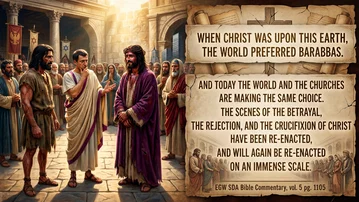
It was Passover, early in the morning, in the judgment hall of Pilate the Roman governor, where Christ stood bound as a prisoner surrounded by soldiers and spectators while the priests, rulers, elders and mob remained outside.DA 723.1–724.1 The Jewish officials would not enter the hall, because ceremonial defilement would keep them from the Passover, yet murderous hatred had already defiled their hearts.DA 723.1–724.1 By rejecting Christ, the real Passover Lamb, they had emptied the great feast of its meaning.DA 723.1–724.1 Pilate had been called hastily from rest to confirm and execute their sentence, ready to act with severity, but he was struck by Jesus, who showed no guilt, fear, boldness or defiance but calm and dignified bearing, goodness and nobility with the signature of heaven.DA 723.1–724.1 That sight roused Pilate's better nature and his memory of Jesus curing the sick and raising the dead.DA 723.1–724.1
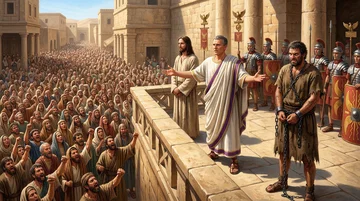
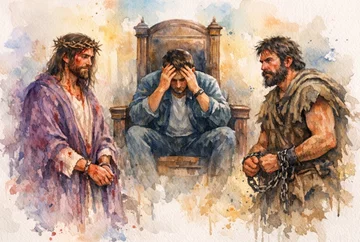
It was the governor's custom at the feast to release to the crowd one prisoner, whomever they desired and chose at the people's request.DA 735.1–5ST Jun 3, 1889Ms 112, 1897, par. 33–3416MR 259.3–260.15RED 61.1 Pilate tried to use this custom to save Jesus, whom he knew to be innocent and repeatedly declared to be without fault, by offering the crowd a choice between Jesus and Barabbas.DA 735.1–5Ms 112, 1897, par. 33–345RED 61.1 He hoped they would choose Jesus and that the matter would end with His punishment, expecting the contrast between innocence and guilt to persuade them.DA 735.1–5Ms 112, 1897, par. 33–345RED 61.1 The alternative set before them was a notorious criminal who falsely claimed to be Christ.Ms 112, 1897, par. 33–34 He was also a notorious robber and murderer.5RED 61.1 Stirred up by the priests, the people chose Barabbas and demanded his release and Jesus' crucifixion.DA 735.1–5ST Jun 3, 18895RED 61.1
The choice of Barabbas over Jesus was choosing Satan over Christ, the Son of God and Creator.16MR 259.3–260.1 This choice is repeated in the world whenever people reject Christ.16MR 259.3–260.1 Each person by that rejection shows whom he chooses.16MR 259.3–260.1
Sources
Pioneers and periodicals
18 sources
At the Passover feast it was customary for the Roman governor to release to the Jews one prisoner condemned under Roman law, whomever the people requested.RH Sep 17, 1861RH Dec 5, 1907ST Mar 28, 1906ST Aug 17, 1904 After publicly declaring that he and Herod found nothing worthy of death in Jesus, Pilate sought to free Him through that pardon by offering the crowd a choice between Jesus and Barabbas.ST Jun 3, 1889ST Mar 13, 1901ST Mar 28, 1906ST Aug 17, 1904 The chief priests and rulers stirred the people to ask for Barabbas and to demand that Jesus be crucified, so the multitude preferred a noted robber imprisoned for insurrection and murder to the innocent Lamb of God.ST Jun 3, 1889ST Mar 13, 1901ST Mar 28, 1906 In doing so Pilate acted inconsistently by placing One he had declared faultless on a level with a convicted criminal and leaving His fate to His avowed enemies, and every evasion only made his guilt heavier.ST Oct 27, 1898ST Mar 13, 1901 His repeated declaration that he found no fault in Christ stands as the world's official testimony that Christ was unjustly put to death, the just suffering for the unjust to bring sinners to God.ST Jun 15, 1904ST Oct 27, 1898
Words and Release Custom
The small word rendered at carries the sense of time, so the release took place during and at the time of the feast.ST Apr 26, 1883RH Sep 17, 1861 The Greek word behind feast is heorte, which means a feast or festival day and not the weekly Sabbath.ST Jul 29, 1875ST Mar 25, 1875 In this place it denotes the Passover feast and the festival at which the governor released a prisoner chosen by the people, showing that the same word rendered holy day in Colossians 2:16 means a feast day.ST Jul 29, 1875RH Nov 7, 1854ST Mar 25, 1875 The word feast here stands without the definite article yet refers definitely to the Passover, at which it was customary to release a prisoner chosen by the people.RH Dec 5, 1907
The origin of that custom is unknown.ST Nov 9, 1882 Its wording in the Synoptic Gospels suggests it may have applied at every feast, while John indicates it may have applied only at Passover, perhaps in remembrance of Israel's release from Egyptian bondage.ST Nov 9, 1882 It may have begun under Roman rule as a political measure, but it was more likely Jewish in origin and continued by the Roman governors.ST Nov 9, 1882 It was the Roman custom at the annual Passover feast to release to the Jews whichever prisoner they requested.ST Mar 28, 1906 The privilege was intended to ease their sense of Roman oppression and to calm the national spirit that could flare during the gathering, since prisoners held for resistance to Roman rule could be regarded by the Jews as patriots.ST Mar 28, 1906
Roman governors released one Jewish prisoner condemned under Roman law at the Passover, when people gathered from all parts of the province for their principal feast, as good policy to please them by letting them choose the prisoner.ST Aug 17, 1904 The account of the trial and execution to which this release belongs is a detailed and historically grounded narrative consistent with the customs and circumstances of the time.RH Feb 11, 1862
Pilate, Jesus, and Barabbas
Mark’s account of Jesus and Pilate tells the same events as Luke 23:13-24, where Pilate declares that he has examined Jesus and with Herod finds nothing worthy of death in Him, proposes to chastise and release Him according to the feast custom of releasing a prisoner, and is answered by the united cry of the chief priests, rulers and people to away with Jesus and release Barabbas, who was in prison for insurrection and murder, followed by repeated demands to crucify Jesus until Pilate yields and sentences that what they asked should be done.ST Mar 13, 1901 After publicly declaring that Jesus had no fault, Pilate tried to free Him through the Passover pardon by offering the crowd a choice between Jesus and Barabbas, with the person released chosen at the people’s request.ST Jun 3, 1889ST Mar 28, 1906ST Aug 17, 1904 He knew the chief priests had delivered Jesus from envy, yet he trusted the people could be moved to act justly.ST Aug 17, 1904
Pilate tried to shift responsibility for releasing Jesus onto the priests and rulers by getting them to consent to the Prisoner’s pardon under the Passover custom of pardoning a prisoner.ST Mar 13, 1901 His wavering had already strengthened the Jews to press their case with more urgency, and this evasion failed and made his responsibility heavier.ST Mar 13, 1901 The chief priests and rulers moved and stirred the people to ask for Barabbas and reject Jesus, and the crowd demanded Barabbas’s release and Jesus’ death by crucifixion.ST Jun 3, 1889ST Mar 28, 1906ST Mar 13, 1901 The Jews showed insincerity and inconsistency because Barabbas had been convicted of the same crime they charged against Jesus and for which they demanded Jesus’ death.
The people preferred Barabbas, a robber and noted criminal charged with insurrection and murder, to Jesus, the innocent Lamb of God.ST Mar 13, 1901RH Jun 24, 1915 Pilate showed inconsistency by placing a man he had declared innocent on a par with a convicted man and by leaving the fate of the innocent Jesus to the choice of His avowed enemies. He then appealed again to be allowed to do his duty and offered to have Jesus chastised and then released to appease the mob, showing that every evasion of duty made the situation more difficult.ST Mar 13, 1901 Pilate’s statement to the chief priests and to the people that he found no fault in Christ was the world’s official declaration that Christ was unjustly put to death, showing that Christ suffered for sins, the just for the unjust, to bring sinners to God, put to death in the flesh but quickened by the Spirit.ST Jun 15, 1904
What was clear to the mind of a heathen judge could not be seen by the apostate people of God, showing how great the darkness is when the light that is within is darkness.ST Jun 15, 1904 Rome, represented by Pontius Pilate, was confronted with the Gospel in glorious perfection in Jesus Christ as part of God’s effort to save Pilate.ST Oct 27, 1898 Pilate found no evidence of crime despite unproved charges and malignant clamoring by priests and scribes, yet the Jews yielded neither to law nor justice in the declarations of innocence by both Pilate and Herod nor to pity at the sight of the scourged, beaten, bruised, bleeding Man, answering further efforts to release Him with malignity in choosing Barabbas and fresh outbursts against Him.ST Oct 27, 1898
Jesus met the choice of Barabbas and every indignity and insult with dignified, unresentful, unresisting bearing, trusting in a power higher than Pilate knew and offering no word of retaliation.ST Oct 27, 1898 All this convinced Pilate that before him stood One more than man and appealed to him to do right whatever the consequences, yet he remained undecided because he feared the Jews, refused to identify himself with the suffering Innocent One, and sought to escape responsibility by delivering Jesus to the mob.ST Oct 27, 1898 The scene of Christ before Pilate portrays Christ as humble, in contrast with the Pope.RH Dec 21, 1911
Sources