Matthew 12:6
But I say unto you, That in this place is one greater than the temple.
Translations
But I say to you, That in this place is one greater than the temple.
King James Version, KJV Cambridge Paragraph Bible
But I say unto you, That in this place is one greater than the temple.
But I say to you, that in this place is one greater than the temple.
Revised Version, American Standard Version
But I say unto you, that one greater than the temple is here.
and I say to you, that a greater than the temple is here;
But I say unto you, that there is here what is greater than the temple.
But I say unto you,—Something greater than the Temple, is here!
But I tell you that something greater than the temple is here.
But I tell you that One greater than the temple is here.
But I tell you that one greater than the temple is here.
But I say to you that a greater thing than the Temple is here.
But I say vnto you, that here is one greater then the Temple.
Douay-Rheims (Challoner revision)
But I tell you that there is here a greater than the temple.
Pictures
Cross-references
- Mark 2:28
Therefore the Son of man is Lord also of the sabbath.
The Son of man is declared Lord of the Sabbath.
- 1 Samuel 21:4-6
And the priest answered David, and said, There is no common bread under mine hand, but there is hallowed bread; if the young men have kept themselves at least from women.
David receives and eats the consecrated bread in need, providing a precedent in Jesus’ Sabbath defense.
- Luke 6:1-5
And it came to pass on the second sabbath after the first, that he went through the corn fields; and his disciples plucked the ears of corn, and did eat, rubbing them in their hands.
Parallel account of the grain-plucking dispute and Jesus’ defense.
- Hosea 6:6
For I desired mercy, and not sacrifice; and the knowledge of God more than burnt offerings.
Mercy takes priority over sacrifice, rebuking the condemnation of guiltless disciples.
- Exodus 20:8-11
Remember the sabbath day, to keep it holy.
Identified as the Sabbath law Jesus interprets.
- Matthew 23:21
And whoso shall swear by the temple, sweareth by it, and by him that dwelleth therein.
Both texts connect the temple with God who dwells in it.
- Matthew 12:11-12
And he said unto them, What man shall there be among you, that shall have one sheep, and if it fall into a pit on the sabbath day, will he not lay hold on it, and lift it out?
Jesus teaches that rescuing and healing on the Sabbath are lawful acts of mercy.
- Mark 2:23
And it came to pass, that he went through the corn fields on the sabbath day; and his disciples began, as they went, to pluck the ears of corn.
Parallel account of the grainfield dispute over Sabbath observance.
- Leviticus 24:8-9
Every sabbath he shall set it in order before the LORD continually, being taken from the children of Israel by an everlasting covenant.
The Sabbath shewbread was reserved for the priests, as with the bread David ate.
- John 2:21
But he spake of the temple of his body.
Jesus identifies His body with the temple.
- Matthew 12:1
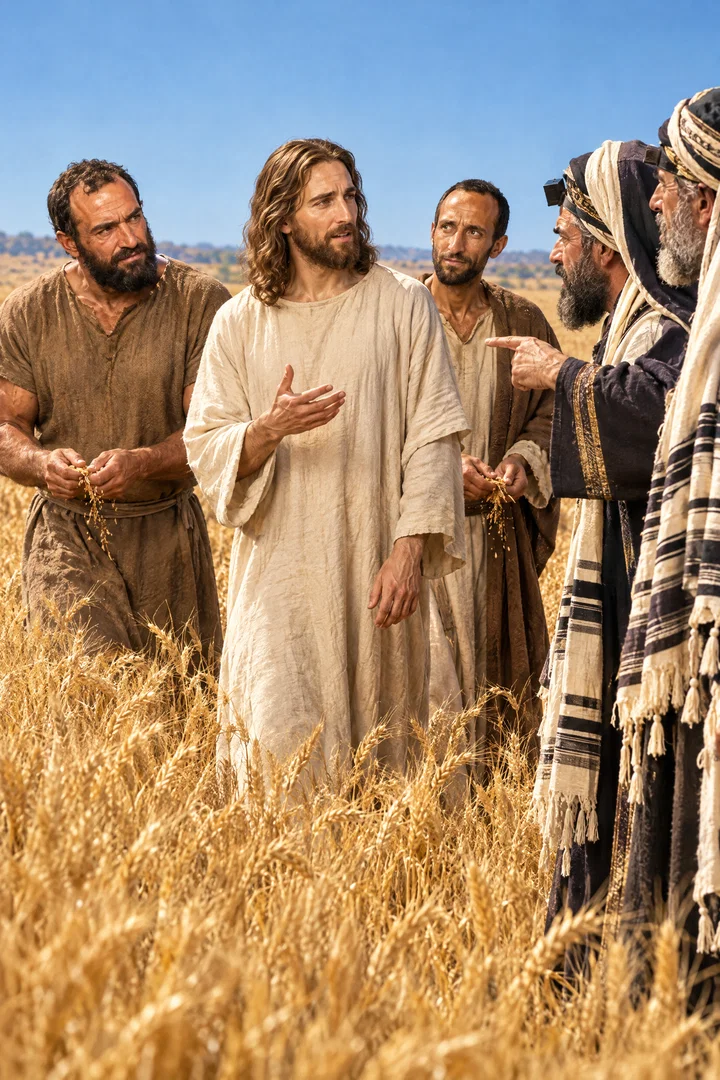
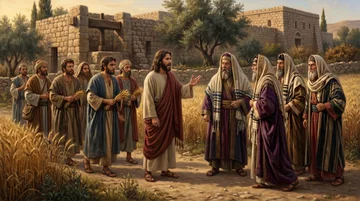
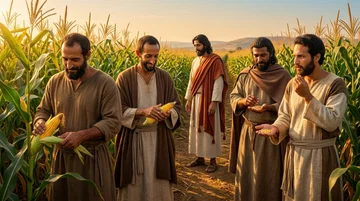
At that time Jesus went on the sabbath day through the corn; and his disciples were an hungred, and began to pluck the ears of corn, and to eat.
hungry disciples eating wheat prompts defense
- John 2:16
And said unto them that sold doves, Take these things hence; make not my Father’s house an house of merchandise.
Jesus calls the temple his Father’s house.
- John 5:17-18
But Jesus answered them, My Father worketh hitherto, and I work.
Jesus defends his Sabbath work by affirming his Sonship and equality with God.
- Numbers 28:9-10
And on the sabbath day two lambs of the first year without spot, and two tenth deals of flour for a meat offering, mingled with oil, and the drink offering thereof:
Prescribes Sabbath offerings, illustrating work permitted on the Sabbath.
- Hebrews 10:8-10
Above when he said, Sacrifice and offering and burnt offerings and offering for sin thou wouldest not, neither hadst pleasure therein; which are offered by the law;
Christ’s offering fulfills the former sacrifices and ceremonies.
- Matthew 27:51
And, behold, the veil of the temple was rent in twain from the top to the bottom; and the earth did quake, and the rocks rent;
The torn veil marks the temple’s loss of sacred standing after Christ’s death.
- Luke 6:9
Then said Jesus unto them, I will ask you one thing; Is it lawful on the sabbath days to do good, or to do evil? to save life, or to destroy it?
Both allow works of mercy on the Sabbath.
- Matthew 23:38
Behold, your house is left unto you desolate.
The rejected temple is declared desolate.
- Matthew 12:10
And, behold, there was a man which had his hand withered. And they asked him, saying, Is it lawful to heal on the sabbath days? that they might accuse him.
Shows Christ addressing what is lawful on the Sabbath.
Commentary
Each commentary is drawn from primary sources: the writings of Ellen G. White and Adventist pioneers and periodicals. Each commentary is separate. Its own words are not a quotation; follow the references to read the source passages.
Ellen G. White
12 sources
The saying was spoken in the Sabbath controversy when the disciples were accused of breaking the Sabbath for plucking grain and rubbing the wheat in their hands to eat the kernels and satisfy their hunger as they passed through a field.Ms 31a, 1898, par. 1–3ST Jul 29, 1897ST Sep 16, 1913PP 531.1–2 Their act was in accordance with the law of God that gives a hungry person liberty to enter a neighbor's field, orchard, or vineyard and eat grain or fruit to satisfy hunger, with the gleanings of harvest-field, orchard, and vineyard belonging by right to the poor.PP 531.1–2 In defense He pointed to David eating the shewbread when hungry and to the priests who work in the temple on Sabbath days and are blameless.Ms 31a, 1898, par. 1–3
By one greater than the temple is meant Christ Himself, who is greater than the temple and has authority above its sacred institutions, taking its place so that the Jewish ceremonies and services find their fulfillment in Him and the church's offices center in Him.DA 284.2–285.3FE 398.1–399.1 He is greater than the temple because He is one with the Father, possessing all the attributes of the Godhead under the garb of humanity, having laid off His royal robe and crown and hidden His glory in a body God prepared.Ms 51, 1890, par. 10–13 He came into the world as a Teacher sent from God to be a living personation of God whom humanity could touch, unveiling in humanity the perfection of Jehovah and revealing His paternal character as a God of infinite love, sympathy, and compassion.Ms 51, 1890, par. 10–13
He stands on the highest elevated platform holding the salvation of the lost world in His hands, with all things delivered to Him by the Father and with sole authority to reveal the Father, with truth as the law of His lips and love revealed in all His works.Ms 51, 1890, par. 10–13 In asserting His divine prerogatives in defense of His disciples, though divine and human were united in Him, He was God in the flesh with the fullness of the Godhead, speaking and acting with authority given by the Father.Ms 43b, 1891, par. 9 The verse declares the disciples guiltless: satisfying hunger did not break the Sabbath but was in harmony with the Sabbath commandment and God's law, upholding the Sabbath according to God's law rather than the rabbis' distorted requirements and showing its true character reflects God rather than human rules.Ms 31a, 1898, par. 1–3ST Jul 29, 1897ST Sep 16, 1913PK 183.1RH May 28, 1901
The priests' Sabbath work served God and pointed to Christ's redeeming work, and now that Christ had come the disciples served God by doing His work, so what was necessary for that work was lawful on the Sabbath because the Sabbath serves God's purpose of redeeming people, with mercy required rather than sacrifice and with His authority standing as Lord even of the Sabbath day.DA 284.2–285.3Ms 31a, 1898, par. 1–3 The setting shows scribes, Pharisees, and Jewish rulers condemning Christ, the greatest Teacher sent by God and the Lord and maker who made the Sabbath, as a Sabbath-breaker, which shows how blindly they misunderstood the Sabbath and its Lord and shows the folly and weakness of human judgment in condemning Christ despite clear evidence of His divine authority.STMW6 43.2Ms 43b, 1891, par. 1 His prediction of the temple's destruction teaches that religion is purified when forms and ceremonies give way to Christ, the way, the truth, and the life.FE 398.1–399.1 The vindication of guiltlessness in harmony with the Sabbath commandment stands secure even where greatness above the temple receives no further exposition.ST Sep 16, 1913
Sources
Pioneers and periodicals
91 sources
In this place present among them was Jesus Himself, greater than the temple in authority and worth as its Creator and Maker to whom all its services pointed.ST Feb 10, 1904ST Mar 11, 1889ST Feb 17, 1898RH Apr 21, 1863ST Apr 22, 1889 He spoke on the Sabbath when the hungry disciples plucked grain and the Pharisees charged them with doing what is not lawful, answering first from David eating the showbread in need and from the priests doing Sabbath work in the temple and being blameless.RH Aug 15, 1854RH Feb 4, 1862ST Feb 17, 1898RH Jan 8, 1857ST Nov 11, 1897 He declared the disciples completely guiltless, for they broke only human tradition and not the law, since works of necessity and mercy and doing good are lawful and in harmony with the commandment.ST Jul 8, 1897ST Mar 30, 1888ST Mar 16, 1904RH Jan 28, 1873RH Aug 27, 1857 As Maker and Lord of the Sabbath He kept it Himself and did only what was lawful, freeing it from oppressive rabbinical rules and restoring it as a blessing, without relaxing or abolishing it or changing it to another day.ST Jan 31, 1911RH Jul 25, 1912RH May 5, 1874ST Mar 25, 1889ST Mar 11, 1889 Those who held otherwise taught that the giving of the first fruits to the disciples abolished the Jewish priesthood and ended the Jewish Sabbath and commanded labor on the Sabbath.RH Sep 30, 1858RH Apr 19, 1870
Dispute Setting and Wording
The saying was spoken on the Sabbath in the cornfields, when the hungry disciples plucked ears of grain and ate as they went, and the Pharisees charged them with doing what is not lawful on the Sabbath.RH Aug 15, 1854RH Feb 4, 1862ST Feb 17, 1898ST Mar 30, 1888 It belongs to the defense of the disciples, whom it declares guiltless, with the surrounding argument pointing to the priests' Sabbath service and offerings as lawful work to show that necessity did not make the act a violation.RH Aug 15, 1854ST Mar 30, 1888RH May 19, 1851 The day in dispute was the seventh-day Sabbath, and the charge answered the plucking and eating of grain as they went through the corn.ST Feb 17, 1898ST Apr 15, 1886
The defense appeals first to what David did when hungry in entering the house of God and eating the showbread lawful only for priests, with those with him, and then to what is written in the law of the priests in the temple profaning the Sabbath and being blameless.RH Feb 4, 1862ST Feb 17, 1898 It then declares One greater than the temple present in that place, requires mercy and not sacrifice instead of condemning the guiltless, and declares the Son of man Lord even of the Sabbath day.RH Feb 4, 1862ST Feb 17, 1898 That same authority is then shown in healing the withered hand, proving it is lawful to do good on the Sabbath day, with the account of the eating of the corn standing in immediate connection with that healing.ST Feb 17, 1898ST Nov 11, 1897
The passage stands in Matthew 12:1-14, which parallels Luke 4:33-6:11 and Luke 5:17-26 in the Capernaum ministry and belongs to the series of miracles displaying power to heal and to forgive sins.ST Jan 16, 1896 Jesus went from the cornfield directly to the synagogue where the healing was done, and together the two episodes show that it is lawful to do well on the Sabbath days and that the Sabbath was made for man.ST Nov 11, 1897 That movement included healing on another Sabbath.ST Nov 11, 1897ST Jan 16, 1896
The Sabbath at issue was the seventh day alone, the day before Sunday, not the first day and not Sunday, so the defense in no way sets aside the authority of holy time and gives no scriptural warrant for Sunday observance and no instruction about Sunday.ST Apr 15, 1886RH May 17, 1906ST Jul 23, 1912ST Nov 21, 1895 No agreement of the world or the churches to treat the first day as sacred makes it sacred, and it does not remove God's blessing and sanctification from the seventh day or transfer them to the first day.ST Jul 23, 1912 To call the disciples' meal of plucked wheat a Sunday dinner is a perversion that holds souls to a counterfeit man-made sabbath and makes them miss the blessings of the genuine.ST Jul 23, 1912 Those who held otherwise presented the plucking of green corn as done on a Sunday when He sat at meat with publicans and sinners.ST Sep 22, 1909
Meaning of Greater Temple
The One greater than the temple is Jesus Himself, present in that place among them, speaking of His own relative greatness over the temple in reply to the Pharisees' charge against His disciples about what was lawful on the Sabbath, alongside His appeal to David and to the priests' Sabbath service.ST Feb 10, 1904ST Feb 17, 1898RH Apr 21, 1863ST Feb 10, 1904 His authority and worth exceed the temple, placing His authority above question as He defends the disciples and teaches about the Sabbath, upholding God's Sabbath principles against burdensome human rules rather than changing the Sabbath.RH Nov 15, 1906ST Jul 8, 1897ST Feb 10, 1904ST Jan 31, 1911ST Mar 11, 1889 As its Creator and Maker and Lord He knows it was given as blessing for humanity and doing good on it is lawful, revealing that keeping it means receiving and bringing blessing and not treating it as a burden through human restrictions.ST Jan 31, 1911ST Mar 11, 1889RH Feb 6, 1879 He is greater because the temple existed only because of Him and His work, and all its services pointed to Him as the one to whom it pointed.ST Mar 11, 1889ST Apr 22, 1889ST Feb 17, 1898
As reality is greater than its shadow, the priests' Sabbath labor in the temple was a type of Christ's work, while Jesus and His disciples carried out the real work of the gospel and worship of God, so since the priests were blameless in performing that shadowy service, Jesus and His disciples were guiltless in doing what was needed to carry forward the work of the gospel. Actions necessary for the work of the gospel or the worship of God are therefore lawful on the Sabbath. As the greater One He has authority to interpret the meaning of the temple service and to apply and adapt its requirements and letter according to their purpose in each circumstance.ST Feb 10, 1904ST Feb 10, 1904 His being greater than the temple does not make Him greater than God who dwelt there, and does not give Him authority to abolish the Sabbath or exempt His disciples from it or change or relax the law, but He defended their actions on the same basis as the priests' temple service and David's eating of the showbread, and He submitted to the law's penalty and died for the unjust.RH Feb 3, 1852RH Feb 3, 1852
His presence makes the place of worship greater than the temple, so Sabbath service done for God's glory is not a violation of the commandment, including going to church or Sabbath school by horse, ox, or ass when needed if the animals are properly fed, cared for, and rested, since such travel for worship is not selfish use for profit.ST Sep 7, 1904 A righteous character is more valuable and enduring than even the grandest sacred building, for the leaders prized the temple's beauty, ceremonies, and traditions above the Redeemer whose mission they failed to recognize, and by rejecting Christ and clinging to empty forms they left its service lifeless and desolate.ST Oct 5, 1904 The tearing of the veil from top to bottom showed that God no longer recognized the most holy place as His dwelling and no longer acknowledged it as His house.ST Oct 5, 1904 Because He was rejected and would be condemned in the temple, the temple was doomed to destruction, for a divinely appointed institution or ordinance that is perverted and abused ceases to be owned by God and faces judgment.ST Apr 22, 1889
The Jews killed Christ to save the temple, proving the Christian's business in this world is never the salvation of institutions but the salvation of men, and the human soul is greater than any institution that can be set up or destroyed by man.RH Aug 26, 1902 His spirit is sublime, everlasting in faith in God, one with the better spirit of Moses, Isaiah, and the holy psalms, refusing to put the new wine of God into old rotten wineskins of human tradition, so worshiping the letter misses that spirit.ST Jan 28, 1875 As Lord of the Sabbath He stands above those wineskins while remaining one with that better spirit.ST Jan 28, 1875
Vindication of the Disciples
He declared the disciples completely guiltless, proving they did only what was lawful on the Sabbath and did not breach the law.ST Jul 8, 1897ST Mar 30, 1888RH Aug 27, 1857RH May 19, 1851RH Nov 2, 1911 Their conduct was lawful and governed by divine law, and Christ did not break the Sabbath in defending them.ST Mar 30, 1888RH Aug 27, 1857RH May 19, 1851RH Nov 2, 1911RH Feb 25, 1873 Their hunger and need while attending Him in His homelessness excused their plucking standing corn to relieve hunger.RH Jan 8, 1857RH Feb 4, 1862 If priests are guiltless in preparing new showbread every Sabbath for temple ministers, much more are disciples guiltless in serving need by following One greater than the temple.RH Jan 8, 1857RH Feb 4, 1862 The verse supports their complete acquittal, not a general license to disregard the Sabbath, showing the Sabbath law must be understood with mercy and in light of the authority of the One greater than the temple.RH Jan 8, 1857
The priests' Sabbath work was commanded and necessary to keep up appointed worship, not their own thy work forbidden by the fourth commandment which says six days shalt thou labor.RH Aug 15, 1854RH Jun 10, 1852ST Mar 30, 1888RH Aug 27, 1857RH Feb 4, 1862 They profane the Sabbath and are blameless because serving God, not engaged in secular business, and Christ's saving and healing work as high priest likewise fulfilled the law rather than violating it.RH Aug 15, 1854RH Jun 10, 1852ST Mar 30, 1888RH Jan 13, 1852 Their Sabbath service and offerings were lawful work, supporting that necessity did not make the disciples' actions a violation.ST Mar 30, 1888RH Jan 13, 1852 David's taking and eating the showbread with those with him was an act of mercy in an emergency of hunger, showing circumstances and mercy matter in applying the law.RH Feb 4, 1862ST Feb 17, 1898RH Jun 10, 1852RH Jan 8, 1857 In defense of the disciples Jesus cites what David did when hungry in entering the house of God and eating the shewbread with those with him, and what is written in the law of the priests in the temple profaning the Sabbath and being blameless, then declares Himself present in that place as greater than the temple, requires mercy and not sacrifice instead of condemning the guiltless, and declares the Son of man Lord even of the Sabbath-day.RH Feb 4, 1862ST Feb 17, 1898
The cases of the priests and David are joined to bear together on the disciples to show what labor does not break the Sabbath's sacredness and so clear them of blame.RH Feb 4, 1862RH Feb 4, 1862 Jesus as judge declares that priestly labor kept up the appointed worship of God in His temple and was not the thy work forbidden by the commandment, so it was not and never had been a violation of the Sabbath.RH Feb 4, 1862 He was fully competent to answer because He was with the Father when the Sabbath was made, and rather than asserting His own independent judgment He appeals to scriptural precedent, first David eating the shewbread and then the priests who profane the Sabbath and are blameless.RH Feb 4, 1862 The Pharisees who condemned them lacked knowledge of mercy and not sacrifice; God's instructions do not oppose mercy, and the disciples were guiltless in disregarding human traditions about Sabbath observance.ST Jul 8, 1897RH Feb 4, 1862ST Feb 17, 1898RH Jun 10, 1852 Christ's answer does not change the Sabbath; it upholds God's Sabbath principles against burdensome human rules while affirming the Sabbath's sacred character and original purpose.ST Jul 8, 1897RH Jun 10, 1852
The meaning is not spirit against letter but truth against tradition; the disciples broke only Jewish tradition and punctilios.ST May 17, 1910RH Feb 11, 1858ST Mar 21, 1878 Christ and His followers were guided by Scripture and upheld judgment, mercy, faith, and the smallest duties, whereas critics relied on the Mishna and corruptions and loaded the day with traditions like treating rubbing grain as threshing or killing a flea as hunting.ST May 17, 1910RH Feb 11, 1858ST Mar 21, 1878 Jesus never broke the Sabbath law; He interpreted the law and did only what is lawful and in perfect harmony with law, and the Sabbath was made for man and not against him.ST May 17, 1910ST Mar 21, 1878 Their traveling was not Sabbath-breaking because they went to the synagogue in obedience to the requirement to have a holy convocation.RH Aug 27, 1857 The Sabbath labor required of the priests did not relax the claims of the law or prove the Sabbath was not moral, but foreshadowed the necessary consequence of its transgression, and the law remained in its fullest unrelaxed force after that priestly work was instituted, as proved when the man in the wilderness was stoned for Sabbath-breaking.RH Aug 27, 1857 To charge Christ and His followers with needless Sabbath-breaking would make them deserve that man's fate and denies Christ's testimony that He kept His Father's commandments.RH Aug 27, 1857
The teaching held by fewer is that the taking and giving of the first fruits to the disciples signified that He had abolished the Jewish priesthood and transferred its work to them as future priests, bringing a change of law and the end of the Jewish Sabbath.RH Sep 30, 1858 The teaching held by fewer still is that Christ commanded His disciples to labor on the Sabbath, so men ought to labor on the Sabbath and are not forbidden to work thereon.RH Apr 19, 1870
Lawful Works on Sabbath
The Sabbath remains sacred yet is not a yoke of bondage nor a ban on all labor, for works commanded for God's service and works of necessity and mercy and doing good are lawful and in harmony with the commandment.RH Aug 27, 1914ST Jul 1, 1908STST Sep 10, 1902 The commandment must be understood in light of the needs it was meant to serve rather than as forbidding helpful work, and the Sabbath should be devoted to mercy and benevolent deeds.RH Jan 28, 1873RH Aug 27, 1914ST Jul 1, 1908 Doing good on the Sabbath does not lessen its holiness, and the day is still to be kept in a special way with ordinary work minimized and God honored.ST Mar 16, 1904RH Oct 29, 1914ST Jesus defended His disciples when they plucked and ate grain, going directly from the cornfield to the synagogue where He healed the man with the withered hand, and together these show it is lawful to do well on the Sabbath days.ST Feb 17, 1898ST Nov 11, 1897
Lawful works include healing the withered hand and healing the sick, pulling a suffering sheep from a pit and rescuing an animal from a pit, loosing and watering a suffering ox, loosing the woman whom Satan had bound in suffering eighteen years, and relieving animals in distress.ST Feb 17, 1898ST Apr 10, 1893RH Aug 27, 1914RH Oct 21, 1851ST Dec 30, 1913 They include satisfying hunger by taking grain when hungry, and building a fire or cooking to relieve suffering, freezing, starvation and hunger, including keeping warm in a cold climate.ST Apr 10, 1893RH Jan 21, 1915RH Oct 21, 1851ST Dec 30, 1913 Where fire is unnecessary, as with Israel in the wilderness, to build it remains sinful, and unnecessary work is to be avoided while necessary work bringing relief or comfort does not violate the commandment.ST Apr 10, 1893RH Jan 21, 1915ST Dec 30, 1913
The Sabbath was made for man as a day of rest, blessing, enjoyment in God's works, joy and delight, not against him.ST Dec 5, 1892ST Mar 13, 1907RH Oct 29, 1914ST As its Maker and Lord, Christ corrected false ideas and stripped away burdensome human traditions to restore it to its appointed place and use from the beginning and to reveal keeping it as receiving and bringing blessing rather than treating it as a burden.ST Jan 31, 1911ST Dec 5, 1892ST Mar 13, 1907RH Oct 29, 1914 It is not a day for personal profit nor for oppressive restriction, but for joyful service instead of a burdensome yoke.RH Aug 27, 1914ST
Work belonging to the worship of God was permitted and even commanded, just as the priests performed double regular work on that day without blame because they were serving God in holy things and not engaged in secular business or their own work.STST Sep 10, 1902RH May 2, 1854RH Jan 17, 1871 Christ's saving and healing work fulfilled the law through holy service as high priest rather than being the toil the commandment forbids.RH May 2, 1854RH Jan 17, 1871 His explanation clarifies the command and confirms the law rather than abolishing it, proving the work forbidden on the seventh day is our own work, not all activity.RH Jan 17, 1871RH Mar 24, 1903
Boiling, frying, baking, washing dishes, sweeping, and farm chores on God's holy day, when not really necessary and possible to have been done before the Sabbath commenced, remain contrary to the fourth commandment, with no change in the manner of observing the Sabbath from the former dispensation.RH Jul 29, 1862 How much household work is necessary is a matter for each person's conscience before God, since the Lord does not forbid necessary work or works of mercy on the Sabbath.
Christ Authority Over Sabbath
As Creator and Maker and author and Lord of the Sabbath He knows it was given as a blessing for humanity, and keeping it means receiving and bringing blessing rather than treating it as a burden through human restrictions.ST Jan 31, 1911ST Mar 11, 1889ST Jul 21, 1898 He recognizes the Sabbath as part of His kingdom while rejecting a severe interpretation that treats it as bondage, and true observance includes thoughtful love and does not forbid necessary or merciful acts.ST Jan 31, 1911ST Mar 11, 1889ST Jul 21, 1898 If time had been lost during the Levitical dispensation He could set its reckoning right, and the Sabbath He recognized remained the original seventh day.ST Mar 25, 1889 He is the divinely authorized teacher and example of the true Sabbath, and His practice of relieving hunger and healing exposes Pharisaical restrictions as contrary to God's Sabbath.ST Mar 12, 1894ST Nov 18, 1880 He upheld the Sabbath as His own institution, fulfilled the law and added sanctity to the Sabbath consecrated by the Father rather than transferring its sacredness to another day, and His healing work showed what beneficial work was proper on it without abolishing the law.ST Nov 18, 1880
He used His authority to rebuke slavish keeping and to show by His own example how the Sabbath should be observed.ST Jan 31, 1911 He corrected false and superstitious ideas about outward observance, for hostility toward Him more than genuine zeal drove the complaints against Him.ST Jan 31, 1911RH Nov 4, 1858 His teaching exposed malevolence and inconsistency, and as the embodiment of the true meaning of the Sabbath He stood opposed to oppressive restrictions and fanciful rules that obscured its true purpose.RH Nov 4, 1858ST By precept and example He carefully taught how the Sabbath should be kept and grounded His authority to explain and defend it in being greater than the temple, rather than abolishing it.ST Jan 6, 1881RH Feb 6, 1879
He lifted the Sabbath from the traditions that obscured it, freed it from human traditions and austerities and oppressive rabbinical rules, and restored it to its original simplicity and to the place and use appointed in the beginning.ST Aug 6, 1912ST Dec 5, 1892STRH Nov 14, 1871 By precept and example He labored to rid its observance of burdensome traditions and to bring it back as a day of joy and delight and blessing and helpful service.ST Dec 5, 1892ST Mar 13, 1907 He taught His disciples to observe it according to God's commandment and recognized the law and the Sabbath as part of that law, and He instructed people in the true manner of its observance.ST Aug 6, 1912STRH Nov 16, 1914 His lordship served the proper purpose of restoring the Sabbath and humanity to their places in the Creator's design and vindicating it for Christians in this dispensation, and gives no claim that He changed the Sabbath day from the seventh day.RH Nov 14, 1871
He kept the seventh-day Sabbath Himself according to the law and taught its proper observance to others, spending the day lawfully in God's service and showing great regard for the Sabbath of the Lord.ST Oct 8, 1894RH Apr 7, 1851RH May 20, 1909 His Sabbath conduct upheld the Sabbath as part of God's law, honored rather than rejected it, and His healing showed that doing good was lawful and in harmony with its true spirit and exactly adapted to the sabbatic institution.RH Jul 25, 1912RH May 5, 1874 His work was fully accordant with God's law rather than breaking it, and His accusers condemned the guiltless when they charged Him with Sabbath breaking.ST Apr 10, 1893RH May 5, 1874 Lawful works include pulling a suffering sheep from a pit and loosing and watering a suffering ox and loosing a woman Satan had bound in suffering eighteen years, and building a fire or cooking to relieve suffering and freezing and starvation and hunger is lawful because the Sabbath was made for man, though where fire is unnecessary as with Israel in the wilderness to build it remains sinful.ST Apr 10, 1893 To say He broke the Sabbath denies His keeping and would make Him a sinner unable to atone, for He committed no sin and remained the sinless sacrifice, and He made no suggestion that its observance would change to another day after His death.RH May 20, 1909
None of His acts were done carelessly or irreverently but for the relief of suffering and the honor of God, and therefore were no violation of the Sabbath.RH May 5, 1874 His actions provide no excuse for lax observance, for He kept the commandment while rejecting Pharisaical additions that were not part of the original law. His conflict with the leaders over eating grain and healing the withered hand to correct the false notion that every act of healing was unlawful is the account those leaders would have used to challenge the early Christians if the Sabbath had been treated as abolished.RH May 5, 1874ST Oct 19, 1882
Sabbath Continuity and Application
The incident proves the Sabbath was not a carnal ordinance destroyed by death, not relaxed or set aside by teaching, and not changed to another day after death.ST Jul 8, 1897ST Mar 16, 1904RH Nov 14, 1871RH May 20, 1909 Lordship over the Sabbath served its proper purpose of freeing it from human traditions and restoring it and humanity to the Creator's design, not changing it from the seventh day.ST Jul 8, 1897ST Mar 25, 1889RH Nov 14, 1871 The Sabbath recognized remained the original seventh day, which could have had its reckoning set right if time had been lost, and regard for it included keeping it personally, teaching its proper observance, and giving no suggestion of a later change.ST Mar 25, 1889RH May 20, 1909 The fulfillment embraced in the promise of a Saviour included no more than its scope, so neither teaching nor death overthrew or abolished it, and submission to the penalty of the law in dying for the unjust left it intact.ST Mar 16, 1904 The seventh-day Sabbath is moral rather than ceremonial, the Sabbath of the Lord and a divine institution upheld on the authority of the original law like the other nine commandments, and a memorial of creation and of redemption.ST Mar 16, 1904RH Aug 13, 1857 Doing good does not lessen its holiness, and it is still to be kept in a special way.ST Mar 16, 1904RH Aug 13, 1857 Recognition of the Sabbath included requiring its keeping, as in telling disciples to pray that their flight at the destruction of Jerusalem about thirty-six years later would not be on the Sabbath day.ST Mar 16, 1904
The Sabbath law remains binding in the gospel age, with acts of mercy and doing good lawful and in accord with it rather than diminishing its sacredness.RH Mar 1, 1864RH Apr 5, 1860RH Jan 13, 1852RH Apr 18, 1871 The comparison with priests doing necessary temple work without profaning it shows the disciples' meeting of human need did not break the Sabbath, which was made for all humanity and not for Jews alone, while superstitious abuse is distinguished from merciful necessary use.RH Mar 1, 1864RH Apr 5, 1860RH Jan 13, 1852 Commandments are quoted on the authority of the original law rather than brought over on a new score, and this is as true of the Sabbath as of the other nine.RH Apr 18, 1871 Faithful keeping according to God's word will be denounced as Sabbath breaking, just as rubbing wheat and healing the sick brought watching and accusation.ST Mar 12, 1894ST Apr 9, 1894ST Nov 21, 1895 That easily offended propriety and religious sentiment behind laws for Sunday observance has a purely religious basis which logically followed leads to persecution in which people of conviction are the persecuted, and the same spirit is at work when Adventists doing quiet Sunday labor are prosecuted for not observing the day according to the prosecutors' ideas.ST Apr 9, 1894ST Nov 21, 1895 Those who work Sundays but keep Saturday holy fulfill the law of God as it should be of man, and whether their faith is right or wrong is conscience that no one should meddle with by swearing warrants and arresting them, which conduct in sitting at meat with publicans and sinners and defending the plucking of corn condemns.ST Sep 22, 1909
Sabbath worship cannot be made genuine by human law because worship must be voluntary, and the challenge to the religious view of the day was revolutionary against what modern Sabbatarians seek to apply to Sunday.ST May 28, 1912RH Jul 24, 1913 The passage belongs to the last apostasy of the Jewish church when Christ was rejected and crucified and a remnant was called out by a message of reform in Christ Jesus.ST Jan 30, 1896 Correcting burdensome human interpretations and traditional rules that turned the blessing into a burden did not lessen the commandment's claim, add a new rule, or replace the weekly rest day.ST Jan 6, 1888ST Aug 24, 1888 The commandment itself does not forbid work of necessity or mercy, so people may meet their own needs, care for dependents and animals, and relieve distress.ST Jan 6, 1888ST Aug 24, 1888 Relieving suffering and doing good and healing honors the Maker and fulfills the highest requirements of the law, while ordinary work and trade for personal gain profanes the day, and this practice taught disciples how to keep it.ST Jul 21, 1898ST Feb 2, 1915
Sources