Translations
Saying, Prophesy to us, you Christ, Who is he that smote you?
Saying, Prophesy unto us, thou Christ, Who is he that smote thee?
saying, Prophesy unto us, thou Christ, Who is he that smote thee?
Saying, Prophesy to us, thou Christ, Who is he that smote thee?
Revised Version, American Standard Version
saying, Prophesy unto us, thou Christ: who is he that struck thee?
saying, 'Declare to us, O Christ, who he is that struck thee?'
saying, Prophesy to us, Christ, Who is it who struck thee?
saying—Prophesy unto us, O Christ! Who is he that struck thee?
Berean Standard Bible, Majority Standard Bible
and said, “ Prophesy to us, Christ! Who hit You?”
saying, “ Prophesy to us, you Christ! Who hit you?”
Be a prophet, O Christ, and say who gave you a blow!
Saying, Prophecie to vs, O Christ, Who is he that smote thee?
Douay-Rheims (Challoner revision)
Saying: Prophesy unto us, O Christ, who is he that struck thee?
Pictures
Cross-references
- Mark 14:65
And some began to spit on him, and to cover his face, and to buffet him, and to say unto him, Prophesy: and the servants did strike him with the palms of their hands.
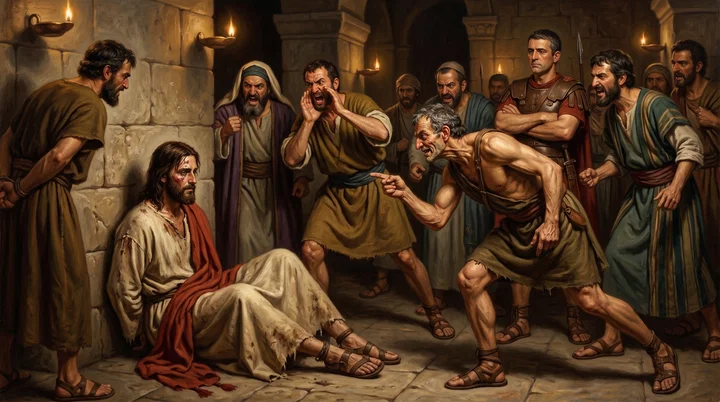
Jesus is struck and taunted to prophesy who struck him.
- Luke 22:63-64
And the men that held Jesus mocked him, and smote him.
Guards blindfold, strike, and taunt Jesus to prophesy.
- John 18:22-23
And when he had thus spoken, one of the officers which stood by struck Jesus with the palm of his hand, saying, Answerest thou the high priest so?
Jesus is struck during questioning and answers his accusers.
- Matthew 26:63-64
But Jesus held his peace. And the high priest answered and said unto him, I adjure thee by the living God, that thou tell us whether thou be the Christ, the Son of God.
Jesus’ affirmation that he is the Christ and Son of God prompts the mocking challenge.
- Luke 22:54-62
Then took they him, and led him, and brought him into the high priest’s house. And Peter followed afar off.
Parallel account of the same night before Caiaphas.
- Isaiah 53:7
He was oppressed, and he was afflicted, yet he opened not his mouth: he is brought as a lamb to the slaughter, and as a sheep before her shearers is dumb, so he openeth not his mouth.
Jesus suffers unjustly without answering or resisting.
- Matthew 27:27-31
Then the soldiers of the governor took Jesus into the common hall, and gathered unto him the whole band of soldiers.
Jesus is mocked and abused by the soldiers before his crucifixion.
- Isaiah 53:3
He is despised and rejected of men; a man of sorrows, and acquainted with grief: and we hid as it were our faces from him; he was despised, and we esteemed him not.
The Messiah is despised and rejected, and suffers sorrow.
- Mark 15:19
And they smote him on the head with a reed, and did spit upon him, and bowing their knees worshipped him.
Soldiers strike and mock Jesus.
- Matthew 26:57
And they that had laid hold on Jesus led him away to Caiaphas the high priest, where the scribes and the elders were assembled.
Jesus is taken to Caiaphas before the abuse.
- Isaiah 53:5
But he was wounded for our transgressions, he was bruised for our iniquities: the chastisement of our peace was upon him; and with his stripes we are healed.
The wounded and bruised sufferer bears transgressions.
- 1 Peter 2:22-23
Who did no sin, neither was guile found in his mouth:
Jesus suffers unjustly without deceit or retaliation.
- Matthew 16:16
And Simon Peter answered and said, Thou art the Christ, the Son of the living God.
affirms the title mocked in the challenge
- Matthew 26:58
But Peter followed him afar off unto the high priest’s palace, and went in, and sat with the servants, to see the end.
warns not to follow afar off
- Revelation 1:7
Behold, he cometh with clouds; and every eye shall see him, and they also which pierced him: and all kindreds of the earth shall wail because of him. Even so, Amen.
Those who pierced Christ will see him when he comes.
- Isaiah 53:12
Therefore will I divide him a portion with the great, and he shall divide the spoil with the strong; because he hath poured out his soul unto death: and he was numbered with the transgressors; and he bare the sin of many, and made intercession for the transgressors.
The servant pours out his life in death for others.
Commentary
Each commentary is drawn from primary sources: the writings of Ellen G. White and Adventist pioneers and periodicals. Each commentary is separate. Its own words are not a quotation; follow the references to read the source passages.
Ellen G. White
20 sources
In the palace of Caiaphas Jesus stood on trial for His life, blindfolded with a garment thrown over His head, struck in the face and challenged to use His prophetic office to name who had smitten Him.Ms 29, 1909, par. 5–9COS 131.2–5Ms 43, 1894, par. 14–165RED 35.3–36.2DA 714.5–715.2 The demand mocked His claim to be Christ the Messiah, turning prophecy into humiliation with a jeering call for a sign while priests, rulers and the rabble joined in satanic fury.Ms 29, 1909, par. 5–9COS 131.2–5Ms 43, 1894, par. 14–16DA 714.5–715.2ST Jun 27, 1878 He bore the shame, reproach and blows meekly, making no retaliation in word, look or angry response.3SP 122.1–3SG1 51.1EW 139.2 Though as Prince of life He had supreme power to stop the smiting hands or strike the multitude down, and though the hosts of heaven witnessed it, He did not use that power and angels were restrained from rescuing Him.EW 139.2Lt 98, 1906, par. 15ST Jun 27, 1878 His willing endurance was part of the plan of redemption, wounded for transgressions and bruised for iniquities to ransom humanity and bring many sons and daughters to glory, and those who scorned His calm face will one day see it in glory brighter than the sun.Ms 43, 1894, par. 14–16Ms 142, 1906, par. 55–563SP 122.1–3SG1 51.1Ms 9, 1910, par. 11–13
Trial Setting and Mockery
The taunt belongs to the examination in the high priest Caiaphas's palace, where Jesus stood on trial for His life before Caiaphas as presiding officer after condemnation as guilty.5RED 35.3–36.2DA 714.5–715.25RED 27.13SP 115.3–116.2 It was a mock trial conducted under pretense of legal process and kept secret, so the people could not testify in His defense and expose His works, lest they turn against the Sanhedrin, undo its actions, and secure His release and renewed honor.5RED 33.1 Caiaphas had regarded Jesus as a rival because His simple, eloquent, and wise teaching drew large crowds ready to accept His doctrines, rousing bitter jealousy.3SP 115.3–116.2 Though momentarily struck with admiration for His bearing and convicted that He was akin to God, Caiaphas banished the thought.3SP 115.3–116.2
Caiaphas sat on the throne of judgment in gorgeous robe with glittering tiara and costly breastplate where the light of God's glory had formerly flashed, with judges and those specially interested on either side and Roman soldiers ranged on the platform below.3SP 115.3–116.2 Jesus stood beneath at the foot of the throne in coarse, homely garb, though He had reigned in the courts of heaven crowned and in garments of brightness attended by holy angels.3SP 115.3–116.2 He stood calm, serene, dignified, majestic, and heavenly as King before the earthly tribunal.5RED 35.3–36.23SP 115.3–116.2 He heard Caiaphas's sneering, haughty demand for a mighty miracle as though He heard not, and made no answer to the mocking demand.5RED 35.3–36.23SP 115.3–116.2ST Jun 13, 1878
His calm bearing stood in contrast to the excited, malignant agitation and deportment of Annas and Caiaphas.5RED 35.3–36.23SP 115.3–116.2 A holy influence emanated from Him and pervaded the atmosphere, so that even the hardened multitude questioned whether one of God-like presence should be sentenced as a common criminal.3SP 115.3–116.2 Perceiving that influence, Caiaphas hastened the trial.3SP 115.3–116.2 After the judges pronounced Him guilty, a satanic fury seized priests, rulers, and the rabble together, and forgetting the dignity of office they joined in abuse, roaring like wild beasts and rushing upon Him crying He was guilty and must die and be put to the most shameful death.COS 131.2–5DA 714.5–715.2ST Jun 27, 1878
Bound and held by two men, He would have been torn in pieces or killed before crucifixion had not Roman authority intervened by force of arms, with soldiers and officers restraining the mob and rebuking the Jewish authorities for condemning a man unproved and on His own testimony.COS 131.2–5DA 714.5–715.2ST Jun 27, 1878 An old garment was thrown over His head to cover and blindfold Him, and His persecutors struck Him in the face.COS 131.2–53SP 122.1–3DA 714.5–715.2SG1 51.1 They clothed Him with an old purple robe and bowed to Him in mockery as to a king, and when the covering was removed He was spat upon in the face.COS 131.2–5Ms 43, 1894, par. 14–16SG1 51.1ST Jun 27, 1878 The words, "prophesy" and name who struck Him, mocked His prophetic office and His claim to be Christ the Messiah, turning prophecy into humiliation.Ms 29, 1909, par. 5–9COS 131.2–5Ms 43, 1894, par. 14–16DA 698.1–700.53SP 122.1–3 They joined to that challenge a jeering demand for a sign or miracle to prove He was the Saviour, while despising Him for His low birth and parentage.3SP 115.3–116.2ST Jun 13, 1878ST Jun 27, 1878
Endurance and Redemptive Meaning
Blindfolded and struck while challenged to name by prophecy who had hit Him, He bore the humiliation meekly and made no retaliation in word, look, or angry response toward the deluded souls emboldened by priestly sanction.3SP 122.1–3SG1 51.1EW 139.25RED 41.3–43.1ST Jun 27, 1878 He endured the covering of His head, the blows, and the taunt without answering abuse with anger.3SP 122.1–3SG1 51.1EW 139.25RED 41.3–43.1 Though He was the Prince of life with supreme power and divinity by which He could have stopped the smiting hands, struck the multitude down, or driven them away, He did not use that power.Lt 98, 1906, par. 15ST Jun 27, 1878 Though the hosts of heaven witnessed His humiliation and the least angel could have dispersed the throng, angels were restrained from rescuing Him.EW 139.2ST Jun 27, 1878
His willing endurance of shame, reproach, pain, scorn, and abuse was part of the plan of redemption and His work as humanity's Redeemer in giving His life.Ms 43, 1894, par. 14–16Ms 142, 1906, par. 55–563SP 122.1–35RED 41.3–43.1ST Jun 27, 1878 It was part of the bitter cup of agony He drank to the full without refusing, strengthened by God to drink it.Ms 9, 1910, par. 11–13 In this He is a man of sorrows acquainted with grief, wounded for transgressions, bruised for iniquities, bearing the chastisement that brings peace, with healing by His stripes.Ms 43, 1894, par. 14–16 He suffered to pay the debt of sin incurred by transgression, to ransom with His own life the humanity He created, to bring many sons and daughters to glory and elevate humanity to God, becoming a propitiation for a lost world, so that every temptation He endured and every stroke that fell on Him places man on vantage ground with God.Ms 43, 1894, par. 14–16Ms 9, 1910, par. 11–13
His present shame stands in contrast to the glory He will have in the city of God.SG1 51.1 Angels recorded every insulting look, word, and act against their Commander, and those who scorned His calm, pale face will one day see it in glory brighter than the sun and pray to be hidden from Him.ST Jun 27, 1878 The scene shows how people without His Spirit, like the scribes and Pharisees with false statements and hostile actions, reflect a spirit opposed to Him that can inflame others and make Him appear in the worst light.Lt 50, 1889, par. 6–9 Even those who mocked and abused Him could have been forgiven if they had repented, as Saul was.Ms 29, 1898, par. 14–15 His willingness to bear such insult calls believers to Christlikeness, to labor as He labored, and to understand what it means to suffer for His sake.Ms 9, 1910, par. 11–13
Sources
Pioneers and periodicals
33 sources
The verse shows Jesus bound and blindfolded in the night trial before Caiaphas and the Sanhedrin, struck in the face and taunted to use His prophetic power to name who hit Him in mockery of His claim to be the Christ.ST Mar 6, 1901ST Mar 6, 1901ST Mar 27, 1901RH Dec 9, 1858ST Dec 24, 1912 This came right after He affirmed He is the Son of God who would sit at the right hand of power and come on the clouds of heaven, for which Caiaphas charged blasphemy and the council answered He is worthy of death.ST Mar 6, 1901ST Dec 24, 1912ST Dec 6, 1883 Though innocent and able to call angels to His aid or strike the multitude down by His own divinity, He stood calm and endured being spit upon, buffeted, reviled and abused without resentment, complaint or retaliation.ST May 27, 1889RH Nov 5, 1872RH Feb 13, 1872ST Mar 19, 1896 The plan of redemption required Him to suffer this scorn and abuse of wicked men in order to save sinners, showing His love for humanity and answering persecution by continuing to bless and pray for forgiveness.RH Nov 5, 1872RH Feb 13, 1872ST Mar 19, 1896 His rejection as the promised Messiah by Israel's highest court is an example for believers to follow Him through unjust judgment and suffering without denying Him or following afar off, for those who judged, mocked and struck Him must rise again to see Him in the glory of His return to judge the world.ST Jun 27, 1878RH Oct 27, 1874ST Mar 19, 1896RH May 26, 1868RH Nov 17, 1868
Trial Setting and Mockery
The saying belongs to the night Jesus was seized in the Garden, when all the disciples forsook Him and fled and left Him alone with His enemies, bound with utterly needless precaution.ST Mar 14, 1906 He was taken first to Annas the former high priest and father-in-law of Caiaphas, then to the palace of Caiaphas and the judgment hall before the Sanhedrin, the chief priests, and the Jewish authorities.ST Mar 14, 1906ST Feb 3, 1909ST Dec 24, 1912 The proceedings stood within the account of His arrest and trials before the Sanhedrin and chief priests, held at night when condemning a prisoner was contrary to Jewish law.ST Feb 3, 1909ST Dec 24, 1912
He stood there as an accused culprit before Caiaphas sitting as judge as head of the highest court of His own nation, after He affirmed that He is the Christ, the Son of God, who would sit at the right hand of power and come on the clouds of heaven.ST Mar 6, 1901ST Mar 6, 1901 At that Caiaphas rent his garments charging blasphemy and the council answered He is worthy of death.ST Mar 6, 1901 Annas condemned Him without authority to judge, and Caiaphas could not enforce a death sentence before He was ultimately sentenced by Pilate.ST Dec 24, 1912 The charge was blasphemy, not breaking the Sabbath, the Sabbath-breaking charge for healing belonging to another occasion where He answered it is lawful to do good on that day; the event is not a mere incident of a day but of world-wide and ages-long import.ST Dec 6, 1883ST Mar 6, 1901
Upon the condemnation a satanic fury seized the people, and brutal servants seeking favor with their masters by abusing those their masters hated, with jeering dissolute men and the rabble acting with the priests' and rulers' approval, spit in His face, buffeted Him, smote Him with the palms of their hands and struck Him in the face.ST May 27, 1889ST Mar 6, 1901ST Mar 6, 1901ST Mar 28, 1906 He was bound and held by two men with His eyes covered by His head covered and an old garment thrown over it.ST May 27, 1889RH Dec 9, 1858ST Jul 14, 1881ST Mar 28, 1906 The reviling and smiting went on until malevolence and brutality grew weary, and when the covering was removed He was spat upon.ST May 27, 1889ST Mar 28, 1906 Rulers in this forgot the dignity of their office, so that Roman soldiers and officers had to restrain the mob and rebuke the Jewish authorities for condemning a man unproved and on His own testimony.ST May 27, 1889
The words mock His claim to be the Christ and Messiah by tauntingly challenging His prophetic knowledge to prophesy and identify who struck Him.ST Mar 6, 1901ST Mar 6, 1901ST Mar 27, 1901RH Nov 18, 1862RH Dec 9, 1858 The taunt turned His prophetic identity into an occasion for insult, cruelty, bitter scorn, contempt and humiliation.RH Nov 18, 1862RH Dec 9, 1858ST Jul 14, 1881 This was in keeping with the Messiah as despised and rejected.RH Nov 18, 1862
Patient Endurance and Redemption
Though innocent and able to call angels to His aid, He stood calm before His accusers and submitted to the authorities rather than answering resistance with resistance or deceit.ST Jun 13, 1878ST Mar 19, 1896RH May 26, 1868 When despitefully used He did not answer the mocking demand for a miracle, but endured being struck, reviled, reproached, scoffed at and abused without resentment, complaint, or retaliation in word or look.ST May 27, 1889ST Jun 13, 1878ST Jun 27, 1878RH Nov 5, 1872RH May 26, 1868 Bound and held while His head was covered, He was struck in the face by men who taunted Him to identify by prophecy who had hit Him, and when the covering was removed He was spat upon, yet He made no retaliation toward those deluded souls.ST May 27, 1889ST Jun 27, 1878RH Nov 5, 1872
He remained faithful to His mission and accepted death rather than deny it.ST Mar 19, 1896 The plan of redemption required Him to suffer the scorn and abuse of wicked men in order to save sinners, for though harmless He endured indignity to save them.ST Jun 27, 1878RH Nov 5, 1872 Though the hosts of heaven witnessed His humiliation and the least angel could have dispersed the throng, and though by His own divinity He could have struck the multitude down or driven them away, He endured.ST Jun 27, 1878 That day of betrayal, trial, mocking and condemnation stands among the most memorable in His life, and the events of His death showed His love for humanity above all other days, as the Son of God sent to be a Saviour upon whom evil came even unto crucifixion.RH Feb 13, 1872ST May 8, 1879 His mistreatment did not stop Him from blessing and helping others, for He answered persecution with a prayer for forgiveness.RH Mar 27, 1900
Angels recorded every insulting look, word, and act against their Commander.ST Jun 27, 1878
Rejection, Return and Discipleship
The taunt belongs to His rejection as the promised Messiah by Israel's highest spiritual court and religious leaders, though His words were true and He was blameless.RH Oct 27, 1874RH Oct 27, 1874 That court condemned Him without fairly examining His claims against Scripture, because its members interpreted the law wrongly and expected the Messiah to come in a different way.RH Oct 27, 1874RH Oct 27, 1874 They might have been convinced of His Messiahship if they had consented to examine anew the Scriptures to which He appealed, and their error and guilt teach everyone who would know the mind of Jesus to come to the Bible with a simple desire to learn its teachings.RH Oct 27, 1874 The trial where He stands as an accused culprit before Caiaphas sitting as judge as head of the highest court of His own nation is not a mere incident of a day but of world-wide and ages-long import, holding vital lessons in the name, the character, the mission, and the end of each of the two persons centered in it.ST Mar 6, 1901
Matthew 26:20-75 records the day Christ was betrayed, tried, mocked, and condemned among the most memorable in His life, showing His love for humanity above all other days, but it does not identify the day as sacred or direct that it be observed.RH Feb 13, 1872 His mock trial and suffering are past and will never be repeated.ST Dec 7, 1904 The men who judged, mocked, and struck Him, demanding that He identify who struck Him, must rise again to see Him in the glory of His return, when He comes to judge the world and reign forever.RH Nov 17, 1868 Those who scorned His calm, pale face will one day see it in glory brighter than the sun and pray to be hidden from Him.ST Jun 27, 1878
His suffering under striking and mocking is an example to consider so believers will not grow weary or lose heart, leaving patience for bearing God's holy will in all things.RH May 26, 1868RH Mar 17, 1853 Though innocent and able to call angels to His aid, He submitted to the authorities and did not answer with resistance or deceit, but remained faithful to His mission and accepted death rather than deny it.ST Mar 19, 1896 He is to be followed closely under all circumstances, in shame and suffering as well as in glory, never denying the Master and never following afar off, with His humiliation in the judgment hall and His toiling up to Calvary set against the Mount of Transfiguration and the triumphal entry as times of glory and honor.ST Mar 14, 1906 Christian perfection is shown not by extraordinary visions, constant joy, uninterrupted transports of praise, ceaseless raptures, ecstasies and extraordinary revelations, or building a tabernacle on Mount Tabor to enjoy rare sights there, but by resolutely taking up the cross and following Christ through unjust judgment and suffering to the palace of proud Caiaphas, to the judgment hall of Pilate, and to the top of Calvary.RH Jul 30, 1867RH Aug 14, 1860
Mere outward profession that confesses Christ with the lips while denying Him in the life is the same mocking as the hollow homage of Hail, Master.RH Dec 29, 1863 Between Christ mocked and Christ rejected there is but a single step, and that hollow homage quickly passes into smiting and buffeting and leads directly to broader denial and rejection.RH Dec 29, 1863 The taunt after He declared Himself the Son of God and was condemned as a blasphemer worthy of death was spoken by brutal servants seeking favor with their masters by abusing those their masters hated, and the reviling and smiting went on until malevolence and brutality grew weary, and the same spirit has treated His followers the same way in the crises of later centuries.ST Mar 28, 1906 That open outrage in smiting and buffeting parallels the abuse of Sabbath keepers by priests and armed policemen for refusing to renounce their faith.RH Jul 23, 1914 When condemned as a heretic before the Sanhedrin and mistreated, mocked and struck, He received what He would receive again if He returned to earth from the Vatican.RH Dec 13, 1906
Sources