Translations
American King James Version, King James Version, KJV Cambridge Paragraph Bible, Webster Bible, Douay-Rheims (Challoner revision)
And Pilate gave sentence that it should be as they required.
Revised Version, American Standard Version
And Pilate gave sentence that what they asked for should be done.
and Pilate gave judgment for their request being done,
And Pilate adjudged that what they begged should take place.
And, Pilate, consented, that their request should be granted;
Berean Standard Bible, Majority Standard Bible
So Pilate sentenced that their demand be met.
Pilate decreed that what they asked for should be done.
And Pilate gave his decision for their desire to be put into effect.
So Pilate gaue sentence, that it should be as they required.
Pictures
Cross-references 20 of 30
- Matthew 27:24-26
When Pilate saw that he could prevail nothing, but that rather a tumult was made, he took water, and washed his hands before the multitude, saying, I am innocent of the blood of this just person: see ye to it.
Pilate yields to the crowd, releases Barabbas, and hands Jesus over to be crucified.
- Mark 15:1-20
And straightway in the morning the chief priests held a consultation with the elders and scribes and the whole council, and bound Jesus, and carried him away, and delivered him to Pilate.
Parallel account of Pilate sentencing Jesus.
- John 19:12-16
And from thenceforth Pilate sought to release him: but the Jews cried out, saying, If thou let this man go, thou art not Cæsar’s friend: whosoever maketh himself a king speaketh against Cæsar.
Pilate yields to pressure and delivers Jesus to be crucified.
- John 18:39-40
But ye have a custom, that I should release unto you one at the passover: will ye therefore that I release unto you the King of the Jews?
Pilate finds Jesus without fault, but the crowd chooses Barabbas instead.
- Luke 23:4
Then said Pilate to the chief priests and to the people, I find no fault in this man.
Pilate declares Jesus innocent before yielding to the crowd.
- Matthew 27:22
Pilate saith unto them, What shall I do then with Jesus which is called Christ? They all say unto him, Let him be crucified.
The crowd demands Jesus’ crucifixion, and Pilate yields to their demand.
- Luke 23:14-15
Said unto them, Ye have brought this man unto me, as one that perverteth the people: and, behold, I, having examined him before you, have found no fault in this man touching those things whereof ye accuse him:
Pilate declares Jesus innocent before sentencing him.
- Acts 3:14
But ye denied the Holy One and the Just, and desired a murderer to be granted unto you;
The people rejected Jesus and chose a murderer, which Pilate granted.
- Mark 15:15
And so Pilate, willing to content the people, released Barabbas unto them, and delivered Jesus, when he had scourged him, to be crucified.
Pilate gives in to the crowd’s demand and sentences Jesus to crucifixion.
- Matthew 27:17
Therefore when they were gathered together, Pilate said unto them, Whom will ye that I release unto you? Barabbas, or Jesus which is called Christ?
Jesus is contrasted with Barabbas when Pilate offers the crowd a choice.
- Matthew 27:2
And when they had bound him, they led him away, and delivered him to Pontius Pilate the governor.
Cited as a parallel account of Jesus before Pilate.
- John 18:19-28
The high priest then asked Jesus of his disciples, and of his doctrine.
This recounts Jesus’ trial leading to Pilate’s decision.
- Luke 23:33
And when they were come to the place, which is called Calvary, there they crucified him, and the malefactors, one on the right hand, and the other on the left.
Jesus is crucified between two criminals.
- John 19:4-6
Pilate therefore went forth again, and saith unto them, Behold, I bring him forth to you, that ye may know that I find no fault in him.
Pilate declares Jesus faultless while the crowd demands crucifixion.
- John 19:12
And from thenceforth Pilate sought to release him: but the Jews cried out, saying, If thou let this man go, thou art not Cæsar’s friend: whosoever maketh himself a king speaketh against Cæsar.
The leaders threaten Pilate’s standing with Caesar.
- Luke 23:18
And they cried out all at once, saying, Away with this man, and release unto us Barabbas:
mob demanded death and Barabbas release
- John 18:31
Then said Pilate unto them, Take ye him, and judge him according to your law. The Jews therefore said unto him, It is not lawful for us to put any man to death:
Jews could not execute death penalty
- Acts 4:27
For of a truth against thy holy child Jesus, whom thou hast anointed, both Herod, and Pontius Pilate, with the Gentiles, and the people of Israel, were gathered together,
Names Pilate and Herod among those involved in Jesus’ condemnation.
- Matthew 27:19
When he was set down on the judgment seat, his wife sent unto him, saying, Have thou nothing to do with that just man: for I have suffered many things this day in a dream because of him.
wife's dream warning was Pilate's last chance before sentencing
- Mark 15:7
And there was one named Barabbas, which lay bound with them that had made insurrection with him, who had committed murder in the insurrection.
Barabbas was imprisoned for murder during an insurrection.
Commentary
Each commentary is drawn from primary sources: the writings of Ellen G. White and Adventist pioneers and periodicals. Each commentary is separate. Its own words are not a quotation; follow the references to read the source passages.
Ellen G. White
18 sources
Pilate's sentence granted the crowd's demand and gave legal force to the Sanhedrin's condemnation, sending Jesus from his hall to Calvary to be crucified.DA 722.5DA 723.1–724.1ST May 17, 1899 Before he did so he repeatedly declared he found no fault in Him and tried to avoid executing an innocent man by having Him scourged to excite pity and by offering to release Him under the festival custom beside Barabbas.5RED 62.3DA 735.1–55RED 63.1ST Jul 11, 1878Ms 112, 1897, par. 33–34 Though he knew Jesus was innocent and brought from envy, he sacrificed justice to appease his accusers and let the frenzied demand of priests, rulers and mob become Roman law.DA 735.1–5ST Jul 11, 1878RH Nov 11, 1915Ms 55, 1886, par. 28–30ST Apr 15, 1897 That demand was driven by Satan standing at the head of priests, rulers and mob to kill Christ, yet though He could have called heavenly hosts to His aid He submitted with calmness and kept Himself without stain as a perfect offering.5RED 62.3Lt 12, 1911, par. 8–11ST Apr 15, 1897 With one voice the people chose the robber and murderer Barabbas over the Son of God, which was choosing Satan over Christ, and that same choice is repeated whenever people reject Christ and persecute Him in His saints.16MR 259.3–260.1ST May 17, 1899Lt 31, 1898, par. 13ST Apr 15, 1897
Trial Context and Sentence
Luke 23:24 records the moment when Pilate confirmed the sentence the Sanhedrin sought and granted the crowd's demand that it should be as they required, and after that judgment Jesus was taken from Pilate's hall to Calvary for crucifixion.DA 722.5DA 723.1–724.1ST May 17, 1899 Before sentencing, Pilate repeatedly declared that he found no fault in Jesus, asking what evil He had done and pleading against putting to death One against whom nothing could be proved.5RED 62.3ST Jul 11, 18783SP 142.2–3Lt 12, 1911, par. 8–11 To avoid executing an innocent man while trying to conciliate an enraged crowd, Pilate proposed to chastise Jesus and let Him go.5RED 62.3ST Jul 11, 1878 He had Him scourged before the multitude in the vain hope that pity would make that punishment seem enough.5RED 63.1ST Jul 11, 1878
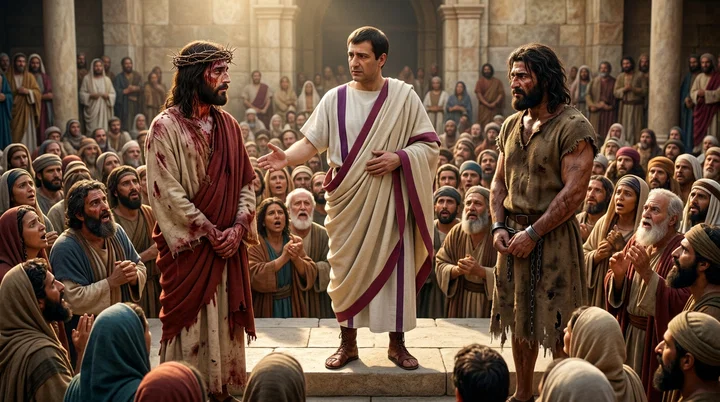
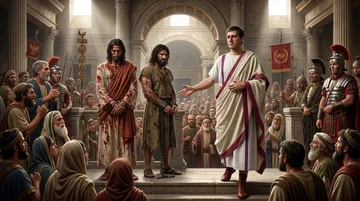
In terrible conflict of soul Pilate also tried to save Jesus by subterfuge, because he dared not in soul give up an innocent man to that maddened power.DA 735.1–5Ms 112, 1897, par. 33–34 He used the unjust pagan festival custom without justice by which one prisoner condemned to death should be set at liberty at the great national festival.Ms 112, 1897, par. 33–34 He presented the true and innocent Christ side by side with Barabbas and flattered himself that the contrast between innocence and guilt would be so convincing that the people would choose Jesus.Ms 112, 1897, par. 33–34 The scourged Jesus appeared pale and suffering, crowned with thorns, stripped to the waist with long cruel stripes and freely flowing blood, His face stained with blood and marked by exhaustion and pain yet still noble, placed beside Barabbas to make the contrast stand out.5RED 63.1 Barabbas stood in striking contrast as a notorious, debased and hardened robber chief and murderer.5RED 63.1ST May 17, 1899Lt 12, 1911, par. 8–11 He did wickedness and wonders through satanic agencies, pretending to be Christ and claiming religious power and right to set the world right and to take what he wanted by theft, robbery and murder.Ms 112, 1897, par. 33–34
Pilate's sentence gave the unanimous, frenzied demand of priests, rulers and mob the force of Roman law.RH Nov 11, 1915ST Apr 15, 1897ST Jul 7, 1898 Even the Roman governor, with Herod acting with him and stirred up by the chief priests, was thus made to carry out their will.RH Nov 11, 1915Ms 55, 1886, par. 28–30 That will was to condemn the just and holy Son of God and to put a murderer in His place as the people required.Ms 55, 1886, par. 28–30ST Apr 15, 1897ST Jul 7, 1898
Yielding Justice to Pressure
Pilate knew Jesus was innocent, knew the leaders had brought Him from envy, and knew the charges were unproved, yet he sacrificed justice to appease his accusers and yielded to pressure from the priests and mob in giving sentence that it should be as they required.DA 735.1–5ST Jul 11, 1878Ms 112, 1897, par. 33–34 He repeatedly declared that he found no fault in Him, asked what evil He had done, and pleaded against putting to death One against whom nothing could be proved.5RED 62.3ST Jul 11, 18783SP 142.2–3 His offer to chastise Jesus by scourging and then let Him go was a vain attempt to satisfy the accusers and to avoid both releasing Him outright and condemning Him to death.5RED 62.3DA 735.1–5ST Jul 11, 1878
His yielding came step by step from violating conscience and failing to judge fairly, until he was left nearly powerless before the people.3SP 142.2–3 In terrible conflict of soul he dared not in his soul give up an innocent man to that maddened power, and tried to save Jesus by subterfuge.3SP 142.2–3Ms 112, 1897, par. 33–34 The demand for death came from priests and rulers possessed by Satan and his army and acting in satanic fury, insisting that the Saviour, already faint with weariness, covered with wounds and subjected to shameful humiliation, must have His sacred flesh further bruised and mangled.5RED 62.3 The crowd that had once hailed Him as king turned on Him in the judgment hall with hissing and reviling, crying for His crucifixion and for the release of Barabbas the robber and murderer.4RED 102.2–103.1Lt 12, 1911, par. 8–11
Satan stood at the head of those who reviled and crucified Him, confederating with priests and rulers and working with his band with fierce determination to kill Christ.Lt 12, 1911, par. 8–11ST Apr 15, 1897 With the whole energies of apostasy they assailed the light in one desperate act to destroy the champion of God and of truth and to cut off all communication between heaven and earth.ST Apr 15, 1897 Their aim in leading the cruel mob in abuse was to provoke Christ to retaliation or to work a miracle to free Himself and break up the plan of salvation.Lt 12, 1911, par. 8–11 That satanic work, in which Herod stirred up by the chief priests acted with Pilate to put to death the just and holy Son of God and put a murderer in His place, was done before the heavenly universe and watched with intense interest from the heavenly courts.Ms 55, 1886, par. 28–30ST Apr 15, 1897 It displayed the murderous spirit of Satan and not the saving spirit of Christ, who came to save human lives, and for it man must receive a recompense.Ms 55, 1886, par. 28–30ST Apr 15, 1897
Though by a command He could have brought the heavenly hosts to His aid and driven the mob away by flashing forth divine majesty, Christ submitted with perfect calmness to insult and outrage.Lt 12, 1911, par. 8–11 He kept His human life without stain, so that the Lamb of God remained a perfect offering.Lt 12, 1911, par. 8–11 His cruel death of shame on Calvary vindicated God in the sight of the angels as One willing to make the greatest sacrifice for man, proved false Satan's charges against God, and by His sinless life from the manger to the cross proved false Satan's assertion that God's law could not be kept.Lt 12, 1911, par. 8–11
Choice Repeated Through History
Luke 23:24 records Pilate giving sentence as the people required, yielding to their demand and sentencing Jesus to death though he had declared he found no fault in Him, and that sentence led to Christ's crucifixion.ST May 17, 1899 The verse means the people with one voice made their choice between Barabbas the robber and murderer and Christ the Son of God.ST May 17, 1899ST Apr 15, 1897 In making that unanimous and frenzied demand that Christ be crucified, they accepted responsibility for Jesus' blood.ST May 17, 1899
The choice of Barabbas over Christ represents Satan being chosen before the Son of God.16MR 259.3–260.1 The same choice is made in the world whenever people reject Christ, and each person's actions show whom they choose.16MR 259.3–260.1 Jesus was innocent, yet He was murdered for speaking truths they did not want to hear, and the verse stands as a pattern repeated when people choose Barabbas and persecute Christ in His saints.16MR 259.3–260.1Lt 31, 1898, par. 13
His disciples had been prepared for this trial and were not surprised by the crowd's fickleness.4RED 102.2–103.1 The crowd that had once hailed Him as king turned on Him in the judgment hall with hissing and reviling, crying for His crucifixion, while He was humiliated and condemned as the crowd demanded.4RED 102.2–103.1 They would see their beloved Teacher treated as a criminal and led toward crucifixion while the criminal Barabbas was chosen in His place.Ms 3, 1898, par. 20–21ST Jul 7, 1898 This trial would test their faith and cause their hope and courage to fail, giving them cause to mourn and fast.Ms 3, 1898, par. 20–21ST Jul 7, 1898
Sources
Pioneers and periodicals
42 sources
Pilate as governor holding the power of life and death gave the formal sentence that it should be as they required, condemning Jesus to death by crucifixion and handing Him over to the will of the crowd.ST Nov 19, 1894ST Mar 13, 1901RH Feb 11, 1862 He gave that sentence although he had repeatedly declared Jesus innocent, finding no fault and no cause of death in Him, while Herod also found nothing worthy of death and sent Him back.ST Jul 11, 1878ST Mar 13, 1901RH Jun 15, 1911 The chief priests, rulers and people together with one voice demanded that Barabbas be released instead and that Jesus be crucified, choosing a robber and murderer imprisoned for insurrection and murder instead of the innocent Son of God and Prince of life.ST May 17, 1899ST Mar 13, 1901 Pilate yielded from fear and selfish interest to protect his office and position, surrendering his authority to the mob and failing to uphold justice, and his washing his hands and the crowd's willingness to accept the blood did not lessen his guilt.ST Mar 27, 1901ST Mar 28, 1911ST Nov 19, 1894ST Oct 27, 1898ST Mar 13, 1901 Both Jews and Gentiles are responsible for the sentence, with the Jews bearing the greater responsibility, for the Jews condemned Jesus and Rome acting through Pilate delivered Him up to be crucified.ST Mar 28, 1911ST Dec 24, 1894RH Dec 24, 1867
Sentence and Its Setting
Pilate as governor of Judea held the power of life and death, and his formal sentence was legally necessary before the execution could proceed as required.ST Nov 19, 1894ST Mar 13, 1901RH Feb 11, 1862 He gave sentence that it should be as they required, condemning Jesus to death by crucifixion and handing Him over to the crowd's will.ST Nov 19, 1894ST Mar 13, 1901RH Feb 11, 1862RH Jul 16, 1861 The crowd's demand prevailed, and Jesus was handed over to their will despite Pilate repeatedly finding no cause for His death.ST Nov 19, 1894ST Mar 13, 1901
The sentence came although Pilate had three times declared he found no fault and no cause of death in Him, while Herod also had sent Him back having found nothing worthy of death.ST Jul 11, 1878ST Mar 13, 1901 Pilate still desired to release Jesus and proposed only to chastise Him and release Him to appease the crowd, yet failed to uphold justice and gave sentence under pressure from the priests and mob.ST Jul 11, 1878ST Mar 13, 1901 He had over and over pronounced Jesus innocent and just and had marveled at His silence when abused, and he was troubled when he heard Jesus claimed to be the Son of God because he knew Jesus was different from any man he had ever met, while Herod also could not understand how Jesus could endure such treatment without complaint.ST Mar 13, 1901RH Jun 15, 1911 Pilate yielded because the terrible, demon-like howling of the Jewish mob crying for crucifixion prevailed in the crisis.ST Mar 13, 1901RH Jun 15, 1911
The sentence came because the chief priests, rulers, and people cried out together with one voice for Barabbas to be released instead and were instant with loud voices asking that Jesus be crucified, until their voices prevailed over the governor.ST Apr 15, 1897ST Jul 7, 1898ST Mar 13, 1901 Barabbas stood imprisoned and convicted for insurrection and murder, and also stood as a robber and murderer and debased robber chief, yet the Jews at the instigation of the chief priests demanded the death of Jesus for a crime while asking for the release of Barabbas who had been convicted of that same crime.ST May 17, 1899ST Mar 13, 1901 Pilate inconsistently placed the innocent Jesus on a par with the convicted Barabbas and left the fate of the innocent man to the choice of His avowed enemies.ST Mar 13, 1901 The people chose a robber and murderer instead of the Son of God, rejecting Jesus the innocent Lamb of God and Creator and Prince of life to be condemned and sentenced to die between criminals, and accepting responsibility for Jesus' blood, and the sentence led to Christ's crucifixion.ST May 17, 1899ST Apr 15, 1897ST Jul 7, 1898RH Jun 24, 1915
Before giving that sentence Pilate tried in vain hope to turn the multitude from death by pity and let them decide that scourging was sufficient punishment.ST Oct 7, 1886 He had Jesus scourged in the presence of the multitude, with a crown of thorns upon His head and stripped to the waist so the long cruel stripes from which blood flowed freely could be seen, and placed Him side by side with Barabbas.ST Oct 7, 1886 Although the face of Jesus was stained with blood and bore marks of exhaustion and pain, His noble character could not be hidden but stood out in marked contrast with Barabbas, whose every feature proclaimed a debased and hardened robber chief.ST Oct 7, 1886
The decision was made at Passover when a hostile crowd filled the city and disorder threatened and Pilate saw himself as too weak to suppress it, leaving the Nazarene's blood on the stairs of the Praetorium.RH Jul 16, 1861RH Jul 16, 1861 Political pressure brought Pilate and Herod together in their treatment of Jesus, ending in Pilate's sentence that Jesus be crucified, a unity that served an unjust and oppressive outcome.ST Apr 15, 1889RH Mar 9, 1905 The same setting places this decision alongside Pilate's earlier massacre of Galileans, showing him as a ruler ready to use lethal violence.RH Jul 16, 1861ST Feb 16, 1882 The verse belongs to the final scene of Jesus' life before Pilate and Herod in which He faced judgment and went on to mockery, cruelty, and death on the cross without murmur, and that cruelty displays the madness and folly of sin.RH Jun 10, 1862RH Mar 9, 1905 Afterward Pilate granted the kneeling, weeping request of Joseph of Arimathea for permission to bury Jesus and ordered soldiers to superintend the burial lest it be profaned, and a few days afterward the sepulcher was found empty and the disciples published everywhere that Jesus had risen from the dead as He had foretold.RH Jul 16, 1861
Pilate's Conviction and Yielding
Luke 23:24 marks God's last effort to save Pilate, with Rome represented by Pilate and the gospel in its perfection represented by Jesus Christ.ST Oct 27, 1898 Pilate had become convinced that One more than man stood before him, appealing to him to do right whatever the consequences, by Jesus' dignified, unresentful bearing under false charges, by finding no crime in Him, by Herod also finding no punishment worthy of death, by Jesus' silence when Barabbas was chosen, and by the sight of the scourged, bleeding, unresisting Man.ST Oct 27, 1898 God then reached for Pilate's will through his wife Claudia Procula by giving her a dream-vision of Christ warning Pilate to have nothing to do with that righteous Man.ST Oct 27, 1898
After that final warning Pilate still feared the Jews and refused to identify himself with the suffering Innocent One.ST Oct 27, 1898 He sought to escape responsibility and ease conscience by delivering Jesus to the mob and washing his hands in water.ST Oct 27, 1898 The crowd's willingness to accept responsibility for Jesus' blood did not lessen Pilate's own guilt, and his attempts to shift responsibility and wash away guilt could not excuse his decision to hand Jesus over to be killed.ST Oct 27, 1898ST Mar 13, 1901
Pilate yielded from fear and selfish interest to protect himself, his office and his position, fearing the consequences of refusing the mob and fearing his office would be endangered, and for political reasons he surrendered Christ to popular clamor.ST Mar 27, 1901ST Mar 28, 1911ST Nov 19, 1894ST Nov 19, 1894 His vacillation and fear led him to surrender his authority to the mob, failing to do his duty, to uphold justice, and to stand by a just verdict after having declared Him innocent and testified three times to His innocence.ST Mar 27, 1901ST Nov 19, 1894ST Nov 19, 1894ST Mar 13, 1901 Inconsistently he placed the innocent Jesus on a par with the convicted Barabbas and left the fate of the innocent man to the choice of His avowed enemies.ST Mar 13, 1901 He is an example of one who may feel sorry yet continue in wrongdoing without the broken heart that comes from a true sense of sin.ST Mar 27, 1901ST Nov 19, 1894ST Nov 19, 1894ST Mar 13, 1901
Prejudice turned Pilate from the truth and led him to send Christ to the cross as a criminal, for although he had asked what truth was he did not wait for an answer, showing how prejudice can silence truth and foster intolerance.ST Aug 20, 1896 He delivered Jesus to be crucified under pressure from religious leaders who used misrepresentation and threats.ST Mar 28, 1911ST Feb 12, 1894 The Jews had condemned Jesus to death for blasphemy but could not carry out the execution, and because Pilate cared nothing for blasphemy they pressed a charge of sedition before him.ST Mar 28, 1911 Their threat had the same effect on Pilate as political pressure had on Congress when it passed a Sunday proviso, with fear of consequences leading those in authority to yield to religious demands.ST Feb 12, 1894
Guilt for Christ's Death
Both Jews and Gentiles are responsible for the sentence that it should be as they required, with the greater responsibility resting on the Jews.ST Mar 28, 1911 The Jews had condemned Jesus to death for blasphemy but could not carry out the execution themselves, and because Pilate cared nothing for blasphemy they pressed a charge of sedition before him.ST Mar 28, 1911 Pilate had declared he found no fault in Him and had acquitted Him as innocent, yet when the Jews demanded the crucifixion after that declaration he gave sentence for death, fearing his office would be endangered.ST Mar 28, 1911 In this Rome acting through Pilate delivered Christ up to be crucified, so that even the Roman governor was made to carry out the will of the Jewish priests and rulers who demanded it.RH Nov 11, 1915ST Dec 24, 1894 Human judgment thus condemned the innocent Christ, while the people chose a murderer and had Jesus crucified, and public opinion was responsible for Christ's crucifixion.RH Dec 24, 1867ST Jun 17, 1903
The crowd's insistence led the representative of Rome's power to condemn the One who was Himself the Voice of God.ST Jun 28, 1905 That outcome shows that the voice of the people can oppose God's will and is not, by itself, the voice of God.ST Jun 28, 1905
Sabbath Sequence Confirmed
Pilate's sentence that it should be as they required belongs to the events leading to Jesus' crucifixion and burial, after which His followers rested on the Sabbath according to the commandment. In those events leading to His burial, Jesus was laid in the tomb on Friday, the preparation day before the Sabbath. The setting is rendered as the day of Parasceve, which is explained as the day of preparation for the Sabbath, matching the Protestant wording.RH Apr 28, 1874 The account that includes this sentence identifies the preparation day as the day before the Sabbath, and together with the following account of the first day of the week it supports the sequence of the seventh-day Sabbath and the first day after it.ST May 11, 1904
The account surrounding Christ's death and burial places the Sabbath between the preparation day and the first day of the week.ST May 11, 1904 This sequence shows that the New Testament's first day immediately followed the Sabbath and that the weekly order corresponded to the Old Testament week. The crucifixion and resurrection record mentions the seventh day and the first day in immediate connection.ST Feb 1, 1905 That close naming shows the two days have traveled side by side ever since without any loss or break in reckoning, so if Sunday is kept in true succession from the cross the seventh day kept at the cross is certainly the true seventh day in true succession from the beginning to the present.ST Feb 1, 1905
Prophecy and Judgment Foretold
Rome acting through Pilate in delivering Christ up to be crucified shows that the little horn of Daniel 8 stood against the Prince of princes.ST Dec 24, 1894 Pilate giving sentence as the people required was their unanimous frenzied demand with one voice that Christ be crucified, making their choice between Barabbas the robber and murderer and Christ the Son of God.ST Apr 15, 1897 That choice was driven by Satan the great apostate working with fierce determination with his band of evil and confederating with the priests and rulers of the Jewish nation to kill Christ.ST Apr 15, 1897 It was an assault of light with the whole energies of apostasy in one desperate act to destroy the champion of God and of truth and to cut off all communication between the world and heaven.ST Apr 15, 1897
It was a Satanic work done before the heavenly universe, watched with intense interest from the heavenly courts, for which man must receive a recompense.ST Apr 15, 1897 The choice of a murderer over the Son of God was a rejection of the salvation offered through Him, and it brought judgment upon them in Jerusalem's destruction, mass slaughter by the Romans, and dispersion among the nations.RH Aug 19, 1873 Those who condemned Him will in the last day cry for the rocks and mountains to fall on them to hide them from the wrath of Him they condemned.RH Jul 15, 1875 The condemnation remembered in the cry Crucify Him joins that rejection of Jesus with the warning that human sin may reject Him when He comes again.RH Jul 15, 1875ST Mar 8, 1910 Those who now by their actions say away with the commandments of God and give us the traditions of the man of sin speak even louder than those who cried away with Jesus and release Barabbas, and will likewise cry in vain for the rocks and mountains to fall, for it will be impossible to flee the wrath of the soon-coming Lord, and to gain a home in the earth made new they must keep the commandments of God and the faith of Jesus.RH Jul 15, 1875
Warnings and Present Applications
Pilate gave sentence that it should be as they required, surrendering Jesus to the crowd to protect himself although he had testified to His innocence, and this warns that fear and selfish interest can lead people to deny Jesus or give Him up even at the cost of their own life, since Christ alone can bestow life.ST Nov 19, 1894ST Nov 19, 1894 Though he had three times declared Jesus innocent, he yielded to the mob because he feared the consequences of refusing them.ST Nov 19, 1894ST Nov 19, 1894 The disciples would see their beloved Teacher condemned while the murderous Barabbas was chosen in His place, a trial that would shake their faith and cause them to mourn and fast.ST Jul 7, 1898
Jesus endured undeserved torture, mockery, scourging, and crucifixion, and His life was sacrificed so that human lives might be saved.ST Mar 13, 1901 Human judgment condemned the innocent Christ while the people chose a murderer and had Jesus crucified, making the blood-stained path of suffering an example for His followers.RH Dec 24, 1867 His repeated appeals to the people and His offer to scourge an innocent man revealed His failure to do His duty.ST Mar 13, 1901 That final scene of mockery and cruelty before the crucifixion displays the madness and folly of sin.RH Jun 10, 1862 His condemnation meant that God would not pronounce sentence against those He saves, and His yielding to that sentence brings justification and the hope that their souls may receive what they desire.RH Dec 19, 1854
The Jews all cried, Away with Jesus and release Barabbas, and Pilate gave sentence as they required and condemned Him.RH Jul 15, 1875 Those who condemned Him will in the last day cry for the rocks and mountains to fall on them to hide them from the wrath of Him they condemned.RH Jul 15, 1875 People today who by their actions say, Away with the commandments of God and give us the traditions of the man of sin, speak even louder than the Jews of old and will likewise cry for the rocks and mountains to fall on them.RH Jul 15, 1875 Their cries will be in vain, for it will be impossible to flee the wrath of the soon-coming Lord, and to gain a home in the earth made new they must keep the commandments of God and the faith of Jesus.RH Jul 15, 1875
The verse means civil government gave legal force to a religiously driven popular demand when the religious leaders spoke and the masses demanded that Christ be crucified.RH Jun 4, 1908 Pilate delivered Jesus to be crucified under pressure from religious leaders who used misrepresentation and threats, and their threat had the same effect on him as political pressure had on Congress when it passed a Sunday proviso, for fear of consequences led those in authority to yield to religious demands.ST Feb 12, 1894 This granting of the demand of those calling for Jesus' death is compared to politicians granting religious leaders' demands to preserve their own position, leading to persecution of Christ's followers.ST Aug 6, 1894 Allowing the demand for religious uniformity to result in Jesus' crucifixion is a fatal parallel to governments that maintain Sunday by law because religious organizations and the masses demand it.RH Jun 4, 1908RH Sep 1, 1910 Political pressure brought Pilate and Herod together in their treatment of Jesus, ending in the sentence that Jesus be crucified, and their unity was not a sign of good but served an unjust and oppressive outcome.ST Apr 15, 1889
Sources