Matthew 26:25
Then Judas, which betrayed him, answered and said, Master, is it I? He said unto him, Thou hast said.
Translations
Then Judas, which betrayed him, answered and said, Master, is it I? He said to him, You have said.
King James Version, KJV Cambridge Paragraph Bible
Then Judas, which betrayed him, answered and said, Master, is it I? He said unto him, Thou hast said.
Then Judas, who betrayed him, answered and said, Master, is it I? He said to him, Thou hast said.
And Judas, which betrayed him, answered and said, Is it I, Rabbi? He saith unto him, Thou hast said.
And Judas, who betrayed him, answered and said, Is it I, Rabbi? He saith unto him, Thou hast said.
And Judas — he who delivered him up — answering said, 'Is it I, Rabbi?' He saith to him, 'Thou hast said.'
And Judas, who delivered him up, answering said, Is it I, Rabbi? He says to him, Thou hast said.
And Judas, who was delivering him up, answering, said—Can it be, I, Rabbi? He saith unto him—Thou, hast said.
Berean Standard Bible, Majority Standard Bible
Then Judas, who would betray Him, said, “ Surely not I, Rabbi?”Jesus answered, “ You have said it yourself.”
Judas, who betrayed him, answered, “ It isn’ t me, is it, Rabbi?”He said to him, “ You said it.”
And Judas, who was false to him, made answer and said, Is it I, Master? He says to him, Yes.
Then Iudas which betraied him, answered and sayde, Is it I, Master? He sayde vnto him, Thou hast sayd it.
Douay-Rheims (Challoner revision)
And Judas that betrayed him, answering, said: Is it I, Rabbi? He saith to him: Thou hast said it.
Pictures
Cross-references 20 of 22
- Mark 14:18-21
And as they sat and did eat, Jesus said, Verily I say unto you, One of you which eateth with me shall betray me.
Mark records Jesus’ warning and the disciples’ questions at the supper.
- John 13:21-30
When Jesus had thus said, he was troubled in spirit, and testified, and said, Verily, verily, I say unto you, that one of you shall betray me.
John’s account also describes Jesus identifying Judas at the supper.
- Luke 22:21
But, behold, the hand of him that betrayeth me is with me on the table.
Jesus announces at supper that the betrayer is at the table.
- John 13:18
I speak not of you all: I know whom I have chosen: but that the scripture may be fulfilled, He that eateth bread with me hath lifted up his heel against me.
Jesus applies Scripture’s prediction of a companion turning against him to Judas.
- Psalms 41:9
Yea, mine own familiar friend, in whom I trusted, which did eat of my bread, hath lifted up his heel against me.
Judas’s betrayal fulfills the prophecy of a close companion turning against Jesus.
- Luke 22:3-6
Then entered Satan into Judas surnamed Iscariot, being of the number of the twelve.
Judas agrees to betray Jesus and seeks an opportunity.
- John 13:10-11
Jesus saith to him, He that is washed needeth not save to wash his feet, but is clean every whit: and ye are clean, but not all.
Jesus identifies Judas as not clean, showing he knows who will betray him.
- John 13:30
He then having received the sop went immediately out: and it was night.
Judas leaves after the questioning, having received the sop.
- 1 Corinthians 11:23-26
For I have received of the Lord that which also I delivered unto you, That the Lord Jesus the same night in which he was betrayed took bread:
Jesus institutes the Supper as a memorial of his death.
- John 6:70-71
Jesus answered them, Have not I chosen you twelve, and one of you is a devil?
Jesus had already identified Judas as the betrayer among the chosen twelve.
- Matthew 26:49
And forthwith he came to Jesus, and said, Hail, master; and kissed him.
Judas continues his betrayal with a friendly salute.
- Matthew 27:3-10
Then Judas, which had betrayed him, when he saw that he was condemned, repented himself, and brought again the thirty pieces of silver to the chief priests and elders,
Judas returns the silver after betraying Jesus and learning he was condemned.
- John 13:27
And after the sop Satan entered into him. Then said Jesus unto him, That thou doest, do quickly.
Jesus tells Judas to carry out his betrayal quickly.
- John 12:6
This he said, not that he cared for the poor; but because he was a thief, and had the bag, and bare what was put therein.
Judas feigns concern for the poor while concealing his greed.
- Matthew 26:21
And as they did eat, he said, Verily I say unto you, that one of you shall betray me.
Jesus' warning one will betray Him prompts Judas' question
- Matthew 26:14-16
Then one of the twelve, called Judas Iscariot, went unto the chief priests,
Judas’s agreement to betray Jesus precedes his address to Him.
- Mark 14:20
And he answered and said unto them, It is one of the twelve, that dippeth with me in the dish.
Jesus identifies the betrayer as one sharing the dish.
- John 13:23-24
Now there was leaning on Jesus’ bosom one of his disciples, whom Jesus loved.
Peter prompts the beloved disciple to ask who will betray Jesus.
- Mark 14:21
The Son of man indeed goeth, as it is written of him: but woe to that man by whom the Son of man is betrayed! good were it for that man if he had never been born.
Betrayal brings woe and confirms the betrayer’s judgment.
- Zechariah 11:13
And the LORD said unto me, Cast it unto the potter: a goodly price that I was prised at of them. And I took the thirty pieces of silver, and cast them to the potter in the house of the LORD.
Predicts the silver being cast in the house of the Lord.
Commentary
Each commentary is drawn from primary sources: the writings of Ellen G. White and Adventist pioneers and periodicals. Each commentary is separate. Its own words are not a quotation; follow the references to read the source passages.
Ellen G. White
11 sources
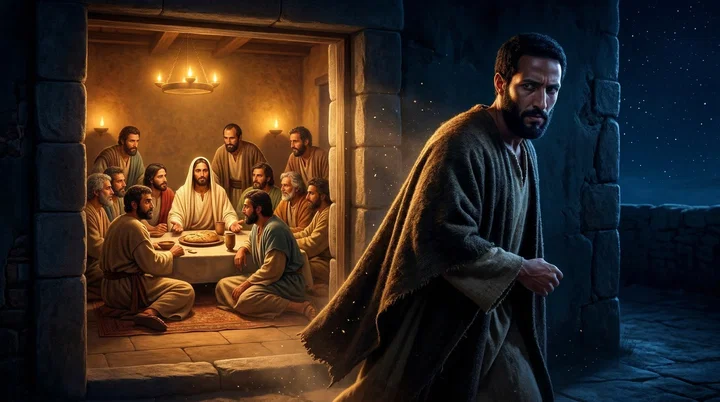
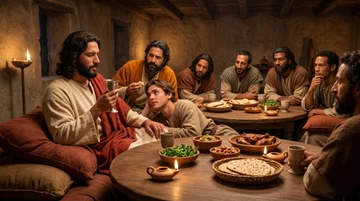
The words were spoken at the table during the Passover supper eaten with the disciples on the night of the betrayal, at the passing from the Passover to the Lord's Supper established to commemorate the death soon to follow.COS 110.1–6DA 652.1–2 After the supper the company went to the garden of Gethsemane, where He often went to pray, talking with them and teaching them as they walked but becoming strangely silent as they neared the garden.COS 113.2 As they ate in silence He seemed greatly troubled and a cloud settled over them all when He said one of them would betray Him, and the disciples, grieved and amazed, each looked into his own heart for any shadow of evil thought against their Master and asked one after another whether it was he, using the title Lord.COS 110.1–6
Judas alone remained silent, and his silence drew the eyes and searching scrutiny of all to him.COS 110.1–63SP 85.1–25RED 6.2–7.2 Only when he saw he was observed did he ask the same question in order to escape detection and scrutiny, calling Jesus Master rather than Lord.COS 110.1–6DA 654.1–25RED 6.2–7.2 He had not heard the identification already given to John amid the confusion.5RED 6.2–7.2 Jesus solemnly answered that Judas himself had said so, thereby affirming with certainty that Judas was the betrayer.COS 110.1–6DA 654.1–23SP 85.1–2ST May 23, 18785RED 6.2–7.2 That answer exposed his hidden purpose, crime, guilt and thoughts, and proved full knowledge of what Judas planned.3SP 85.1–2ST May 23, 18785RED 6.2–7.23SP 86.1
The answer was an act of touching forbearance and infinite mercy and a final convincing proof of divine knowledge, foreknowledge and Messiahship.ST May 23, 18785RED 6.2–7.23SP 86.1 It was meant to give Judas one more chance to repent and turn from treachery and save himself from the betrayer's doom before it was too late.ST Dec 23, 1908ST May 23, 18785RED 6.2–7.23SP 86.1 It was meant to give the disciples crowning evidence that would strengthen their faith when the betrayal took place.ST May 23, 18785RED 6.2–7.2 Even knowing Judas's character and betrayal, He continued to treat him with patience and mercy, washing his feet and allowing him to share in the sacrament.DA 655.4
Judas was confused and overcome and surprised and alarmed by the unexpected discovery that his crime was made known.3SP 85.1–25RED 6.2–7.23SP 86.1 But he was not moved to repentance.ST Dec 23, 19085RED 6.2–7.23SP 86.1 He responded with greater determination and remained fixed in his plan.ST Dec 23, 1908ST May 23, 18783SP 86.1 He rose hastily to leave the room, and went out to carry out the work he had engaged to do.ST Dec 23, 1908ST May 23, 18785RED 6.2–7.2 He was a false disciple whose outward place among the followers concealed a selfish, covetous heart.SG1 44.1 Though he had witnessed mighty works and accepted strong evidence of Messiahship, he loved money and was ready for Satan's temptation, and his angry objection to Mary's costly gift was an excuse for greed rather than concern for the poor, while her generosity rebuked him.SG1 44.1
His dealing with Judas teaches that those who are erring should not be carelessly abandoned or driven toward temptation but should be given opportunity to repent and be cleansed.DA 655.4 In this setting the faults of the disciples likewise led all but Judas to repentance.DA 655.4
Sources
Pioneers and periodicals
37 sources
At the last Passover meal Jesus announced that one of the twelve would betray Him, and when Judas asked if it was himself Jesus answered with a direct affirmation that he was the betrayer.ST May 18, 1904ST May 12, 1898ST Feb 4, 1903ST May 23, 1878ST Aug 12, 1886 The answer showed that He already discerned Judas's hidden purpose and deceit, a proof of divine foreknowledge.ST May 23, 1878ST Oct 20, 1898RH Nov 20, 1913ST Aug 12, 1886 It was a final act of mercy meant to turn Judas from his covetous design, but he was only alarmed and confused and went on with greater determination without repenting.ST Dec 23, 1908ST May 23, 1878ST May 18, 1904 Judas Iscariot, the long-serving treasurer counted loyal almost to the last, then left the company forever into the night to carry out the bargain he had already made for thirty pieces of silver, and he had no part with the eleven in the Lord's Supper instituted at that table.RH Nov 18, 1862ST Nov 22, 1883ST Oct 20, 1898RH Dec 10, 1867RH Jul 14, 1863 His covetousness, which is idolatry, led him to perdition and warns all others to examine themselves, since holding a divinely appointed office did not make him holy.ST Jun 15, 1904ST Jun 4, 1912
Passover Setting and Sequence
The exchange belongs to the last Passover feast Jesus ate with the twelve before His death, taking place during the Passover meal itself after Jesus announced that one of the disciples would betray Him.ST May 12, 1898ST Nov 22, 1883ST Jun 15, 1904 It was the Lord's last supper with His disciples, celebrated in the evening after the sun had sunk behind the hills of Judea.ST Jan 10, 1911ST Oct 13, 1898 At that supper Jesus pointed out Judas as the traitor, answered his question with affirmation, and Judas left the company forever.ST Nov 22, 1883ST Jun 15, 1904ST Jan 10, 1911 The same feast is where the ordinance of the Lord's Supper was instituted in commemoration of the death of Christ, with Christ Himself as the Passover sacrificed for us, and where the ordinance of feet-washing was instituted as a memorial of His humble life.ST Nov 22, 1883ST Jun 15, 1904
In the order of events at that supper the questioning about the betrayer comes after the foot-washing and after the breaking of the bread and before the departure of Judas.ST Feb 4, 1903 The blessing of the cup follows immediately upon the breaking of the bread, and Judas receives the dipped sop and then leaves immediately, so he is not present at the institution of the memorial supper.ST Nov 22, 1883ST Feb 4, 1903 The conversation at the table is one of four Gospel accounts found in Matthew 26, Mark 14, Luke 22 and John 13.ST The portion in Matthew 26:21-25 belongs together with Mark 14:18-21 and Luke 22:21-23 to give the full record of that conversation.ST
On that evening the disciples had disputed about greatness, and Jesus grew sad and said one of them would betray Him.ST Jan 10, 1911 John was leaning on Jesus' breast and was asked to inquire who the betrayer was, while each disciple asked whether he himself was the one.ST Jan 10, 1911 After the supper Jesus, weighed down by the bitter cup of agony He must soon drink, went with His little band of followers into the evening cool to the quiet retreat of the Garden of Gethsemane, where He had often enjoyed communion with His Father and been filled with light from heaven and strengthened for His ministry.ST Oct 13, 1898 Judas was no longer a member of that little band, but with furtive glance and nervous step was treading through the streets and alleys of Jerusalem to the palace of the high priest, where the plan for seizing the Saviour had been laid and that night chosen for its execution in utmost secrecy.ST Oct 13, 1898
After Judas left, the remaining disciples sang a solemn hymn with Jesus, and Judas did not join them.ST
Wording of the Exchange
After the announcement that one of the twelve would betray Him, each disciple asked whether it was himself, and Judas asked with them, the question expressing earnest searching of heart over the warning.ST Feb 4, 1903ST May 23, 1878ST Aug 12, 1886ST Jan 10, 1911 The inquiry followed the washing of feet and the breaking of the bread and came before the departure of Judas, with the blessing of the cup coming immediately upon the breaking of the bread.ST Feb 4, 1903 While the others sat inquiring, Judas at first sat silent as they examined themselves.ST Aug 12, 1886
Judas framed his question with the word Rabbi, whereas the rest addressed Him as Master.ST May 18, 1904ST Jan 10, 1911 Those who hold otherwise teach that Judas said Master exactly as the other disciples did, even while on the verge of betraying Him.ST Dec 20, 1899 His being able to look Jesus in the face and use a title of attachment is the measure of how hardened his heart had become, whether from unbelief that he could be discerned or from sinking into profound darkness of mind.ST Dec 20, 1899
The answer, Thou hast said, was a solemn and direct affirmative, confirming out of Judas's own words that he was the betrayer.ST Dec 23, 1908ST May 23, 1878ST May 18, 1904ST May 12, 1898ST May 18, 1904 It was a confirmation belonging to the fulfillment of the prediction that the Messiah would be betrayed by an intimate friend.RH Nov 18, 1862 It took place during the Passover meal before the institution of the Lord's Supper, after which Judas received the dipped sop and left immediately.ST May 12, 1898ST Nov 22, 1883 By it Judas knew that Jesus knew his purpose.ST May 18, 1904ST May 18, 1904
Judas asked only to escape the scrutiny of the other disciples, since to remain silent while they all inquired would have exposed him.ST Dec 23, 1908RH Nov 20, 1913ST May 18, 1904ST May 18, 1904 Their questions and attention had turned toward him, so he put the same question to divert attention from himself.RH Nov 20, 1913
Christ's Knowledge and Mercy
Jesus' answer showed that He already discerned the traitor and knew Judas's hidden purpose, his thoughts, and his deceitful and unfaithful character, making clear during the meal that He knew the secret purpose Judas sought to hide by joining the questioning.ST May 23, 1878ST Oct 20, 1898RH Nov 20, 1913ST Aug 12, 1886RH Jan 8, 1914 Knowing all, He solemnly confirmed what Judas himself had spoken, and that reply was a final convincing proof of His divine knowledge and divinity, showing divine foreknowledge.ST May 23, 1878ST Aug 12, 1886 Yet He still ate the Passover at the same table with him even while that treachery was in his heart.RH Jan 8, 1914
The disclosure was an act of mercy and a final call and chance to repent before it was too late and before the treachery was carried out.ST Dec 23, 1908ST May 23, 1878ST Aug 12, 1886 He had done all He could to turn Judas from his covetous design, but Judas had fully quenched the Spirit striving with him, and their ties were severed.ST May 18, 1904 He had loved Judas and called him as a disciple in order to save him, giving him responsibility and the best instruction and example, but Judas refused to be taught and cherished what led him to fail.ST Jun 3, 1897
Judas was surprised and alarmed, and the unexpected discovery confused and overwhelmed him.ST Aug 12, 1886 He did not repent but remained fixed in his plan with greater determination, becoming more firmly set upon it, and hastily left to carry it out.ST Dec 23, 1908ST May 23, 1878ST May 18, 1904ST Aug 12, 1886 That foreknowledge strengthened the faith of the other disciples when the betrayal took place, and reading His solemn prediction of His own death as He instituted the Supper stands among His repeated predictions that He must die and strengthens faith in Him as the Son of God and Saviour.ST May 23, 1878ST Sep 3, 1896
Judas Exposed and Departing
The verse names Judas Iscariot as the betrayer, one of the chosen disciples and apostles who had long served as treasurer and had been regarded as loyal almost to the last, yet who was false to his trust, showing that office itself does not make holy or cleanse the heart and that long service does not prove present loyalty apart from a living connection with God.RH Nov 18, 1862RH Dec 10, 1867ST Jun 4, 1912ST Jun 1, 1904 He shared the dish with his Lord, a custom of great friendliness and familiarity, and Jesus still ate the Passover at the same table with him even while his heart was full of wickedness and treachery and though He knew him to be deceitful and unfaithful.RH Dec 10, 1867RH Jan 8, 1914 The exchange lays bare deliberate treachery behind a mask of love and deep attachment, outward faithfulness covering inward selfishness, profession of closest attachment joined to meditation of secret betrayal, feigned astonishment beyond measure, cold selfishness under the guise of friendship sacrificing another for covetousness and ambition.ST Oct 20, 1898
He had already bargained away the life of Christ for thirty pieces of silver and had agreed on a friendly salute as the signal.ST Oct 20, 1898 His power to look Jesus in the face and use the title of attachment shows how hardened his heart had become, either from not believing Jesus could discern him or from being sunk in profound darkness of mind.ST Oct 20, 1898ST Dec 20, 1899 That hardening was the growth of a blinding process in which a single dominant passion persistently indulged overcame conscience and daily counsel on true righteousness and steadfastness.ST Oct 20, 1898
Jesus pointed him out as the traitor, answering his question with solemn confirmation, and Judas, surprised, confused and overwhelmed by the discovery yet fixed in his plan, arose and hastily left the company forever.ST May 23, 1878ST Jun 15, 1904ST Jan 10, 1911ST Aug 12, 1886 He went out into the darkness of the night to carry out the deed that sealed his eternal destiny, being told to do quickly what he intended.ST Oct 20, 1898ST Aug 12, 1886 The departure came after the dispute about greatness and the questioning at the table, and after this exposure he had no further lot with the eleven.ST Jan 10, 1911RH Jul 14, 1863
The exposure took place while eating the Passover, before the account of the institution of the Lord's Supper, and Judas received the dipped sop and went out immediately.ST Nov 22, 1883RH Jul 14, 1863ST Nov 15, 1883 He was therefore not present at the Lord's table and did not partake of it when the memorial supper was instituted.ST Nov 22, 1883RH Jul 14, 1863RH Jul 29, 1873 The timing of that departure in relation to the memorial must be established from the Gospel accounts, since a casual reading of Matthew, Mark and Luke appears to show Judas present and sharing in the meal.RH Jul 29, 1873
Passover Type and Supper
Matthew 26:25 belongs to the account of Christ's last Passover with His disciples, in connection with which He instituted the Lord's Supper while still at the Passover table.ST Jun 9, 1914ST Jun 9, 1898STST Nov 15, 1883 The exchange in which Judas asks whether he is the betrayer and Jesus confirms it takes place during the Passover meal, before the description of the memorial supper.ST Nov 22, 1883ST Nov 15, 1883 It stands as one of four Gospel accounts of the institution, found in Matthew 26, Mark 14, Luke 22, and John 13.ST Judas receives the dipped sop and then leaves immediately, so he is not present at the institution of the memorial supper.ST Nov 22, 1883
The bread used on that occasion was unleavened.ST Jun 9, 1914 The cup used was unfermented wine, because God had commanded that all leaven of every form be excluded from the homes of His people at Passover, which excludes fermented wine as well as leavened bread.ST Jun 9, 1914ST Jun 18, 1885 As an observant Jew keeping the Passover supper described in Matthew 26:17-29, Jesus would not have used intoxicating wine at the meal.ST Jun 18, 1885 The later Jewish custom of drinking fermented wine at the Passover feast, introduced after the return from Babylonian captivity, was a tradition of men of the kind rebuked as vain worship.ST Jun 9, 1914
The Passover lamb was a type of Christ, the true Passover, and Christ Himself is the Passover sacrificed for us.ST Jun 9, 1898ST Jun 15, 1904 When Christ came, a new memorial was instituted to remind people of His sacrifice and to show the Lord's death until He comes.ST Jun 9, 1898 The same feast instituted the ordinance of the Lord's Supper in commemoration of the death of Christ and the ordinance of feet-washing as a memorial of His humble life.ST Jun 15, 1904 Matthew 26:17-29 records the solemn prediction Jesus made of His own death as He instituted the Supper, standing among His repeated predictions to His disciples and to others that He must die.ST Sep 3, 1896
The account raises whether Christ or His apostles drove Judas away from the table instead of letting him examine himself and so eat.RH Nov 4, 1873 It thereby raises whether any man or set of men has power or right to tell this and that one they are not worthy and drive them away from the Lord's table.RH Nov 4, 1873
Prophecy Doctrine and Warning
The question at the table fulfills the prediction that the Messiah would be betrayed by an intimate friend, one of His own chosen disciples asking if he himself was the betrayer and receiving confirmation that he was.RH Nov 18, 1862 At that Passover supper in the evening, after the disciples had disputed about greatness, Jesus grew sad and said one of them would betray Him, and each asked if it was he while John was leaning on His breast and was asked to inquire who it was.ST Jan 10, 1911 Judas waited until the others looked on him and then asked using Rabbi rather than Master as the rest had done, and Jesus answered with sadness that he had said it, declaring that the Son of Man goes as it is written of Him but woe to the betrayer for whom it would have been better never to have been born, after which Judas arose and went out.ST Jan 10, 1911 After the supper Jesus, weighed down by the bitter cup of agony He must soon drink, went with His little band of followers into the evening cool to the quiet retreat of Gethsemane where He had often enjoyed communion with His Father and been filled with light from heaven and strengthened for ministry.ST Oct 13, 1898 Judas was no longer a member of that little band but was possessed by a great evil purpose so terrible it would have been better for him had he never joined himself to it, and while Jesus made His way to Gethsemane Judas with furtive glance and nervous step was treading through the streets and alleys of Jerusalem to the palace of the high priest where the plan for seizing the Saviour in utmost secrecy that night had been laid.ST Oct 13, 1898
The Passover table as spread in the days of Jesus yields striking gospel lessons proving Jesus is the true Messiah, the only Saviour of Jew and Gentile.RH Jun 10, 1915 That Judas though an apostle was false to his trust shows that holding a divinely appointed office did not make him holy or cleanse his heart.ST Jun 4, 1912 To call an administrator a Judas means he may later be shown to have been unfaithful, yet his later apostasy does not make a recipient's sincere obedient acceptance of baptism unacceptable to God.RH Sep 6, 1870 Judas's covetousness, which is idolatry, led him to perdition at that last Passover feast with His disciples before His death where Jesus pointed him out as the traitor and he left the company forever, and it will lead to perdition everyone else who yields to covetousness.ST Jun 15, 1904
His course warns of the danger of delaying full surrender after the Spirit has long striven.ST May 18, 1904ST May 18, 1904 He asked only because remaining silent while the others inquired might have exposed him, and Jesus' reply was a direct affirmative answer so that Judas then knew that Jesus knew his purpose.ST May 18, 1904ST May 18, 1904 Jesus had done all He could to turn Judas from his covetous design, but Judas had fully quenched the Spirit striving with him and their ties were severed.ST May 18, 1904ST May 18, 1904 That he asked just as the other disciples did, while himself betraying Jesus, warns that human nature is deceitful and that those who condemn Judas must examine themselves, since the betrayal's pattern can be repeated. Though he had been considered loyal almost to the last during long service as treasurer among the disciples, his asking shows that long service did not prove present loyalty, for loyalty depends on a living connection with God.ST Jun 1, 1904
Sources