Translations
American King James Version, King James Version, KJV Cambridge Paragraph Bible, Webster Bible, Revised Version, American Standard Version, Darby Translation
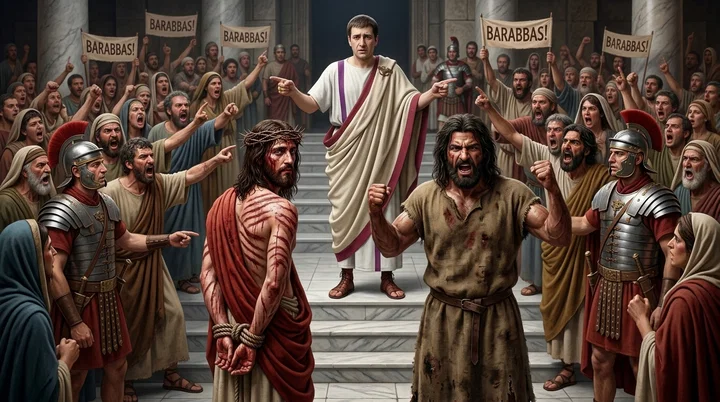
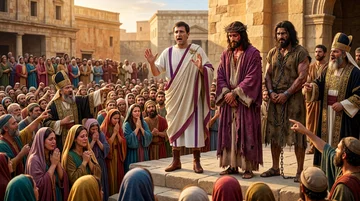
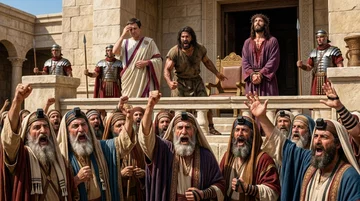
And they cried out again, Crucify him.
and they again cried out, 'Crucify him.'
And, they, again, cried out—Crucify him!
Berean Standard Bible, Majority Standard Bible
And they shouted back, “ Crucify Him!”
They cried out again, “ Crucify him!”
And they said again loudly, To the cross with him!
And they cried againe, Crucifie him.
Douay-Rheims (Challoner revision)
But they again cried out: Crucify him.
Pictures
Cross-references
- Matthew 27:22-23
Pilate saith unto them, What shall I do then with Jesus which is called Christ? They all say unto him, Let him be crucified.
Pilate asks what to do with Jesus, and the crowd repeatedly demands his crucifixion.
- Luke 23:21
But they cried, saying, Crucify him, crucify him.
The crowd cries out for Jesus to be crucified.
- John 19:6
When the chief priests therefore and officers saw him, they cried out, saying, Crucify him, crucify him. Pilate saith unto them, Take ye him, and crucify him: for I find no fault in him.
The chief priests and officers cry out for Jesus to be crucified.
- John 18:39-40
But ye have a custom, that I should release unto you one at the passover: will ye therefore that I release unto you the King of the Jews?
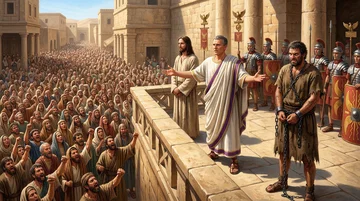
The crowd chooses Barabbas for release instead of Jesus.
- John 19:15
But they cried out, Away with him, away with him, crucify him. Pilate saith unto them, Shall I crucify your King? The chief priests answered, We have no king but Cæsar.
The people demand Jesus’ crucifixion and declare allegiance to Caesar.
- Luke 23:4
Then said Pilate to the chief priests and to the people, I find no fault in this man.
Pilate declares Jesus innocent despite the demand for his condemnation.
- Matthew 27:17-21
Therefore when they were gathered together, Pilate said unto them, Whom will ye that I release unto you? Barabbas, or Jesus which is called Christ?
The crowd chooses Barabbas after Pilate asks whom to release.
- Matthew 27:24-25
When Pilate saw that he could prevail nothing, but that rather a tumult was made, he took water, and washed his hands before the multitude, saying, I am innocent of the blood of this just person: see ye to it.
The crowd accepts responsibility for Jesus’ blood as Pilate tries to evade responsibility.
- Isaiah 53:3
He is despised and rejected of men; a man of sorrows, and acquainted with grief: and we hid as it were our faces from him; he was despised, and we esteemed him not.
Jesus’ rejection fulfills the picture of the despised, rejected servant.
- Luke 23:23-25
And they were instant with loud voices, requiring that he might be crucified. And the voices of them and of the chief priests prevailed.
The crowd’s cries prevail over Pilate’s judgment.
- Luke 23:18
And they cried out all at once, saying, Away with this man, and release unto us Barabbas:
The crowd demands Barabbas’s release instead of Jesus.
- John 19:4-5
Pilate therefore went forth again, and saith unto them, Behold, I bring him forth to you, that ye may know that I find no fault in him.
Pilate declares Jesus faultless before the demand to crucify him.
- Acts 4:10
Be it known unto you all, and to all the people of Israel, that by the name of Jesus Christ of Nazareth, whom ye crucified, whom God raised from the dead, even by him doth this man stand here before you whole.
Peter identifies the crucified and risen Jesus as Israel’s rejected Messiah.
- Luke 23:15
No, nor yet Herod: for I sent you to him; and, lo, nothing worthy of death is done unto him.
Herod's verdict joins Pilate's in rejecting the charge against Jesus.
- Mark 15:17-19
And they clothed him with purple, and platted a crown of thorns, and put it about his head,
The soldiers mock Christ with a purple robe and crown of thorns, then beat him with a reed.
Commentary
Each commentary is drawn from primary sources: the writings of Ellen G. White and Adventist pioneers and periodicals. Each commentary is separate. Its own words are not a quotation; follow the references to read the source passages.
Ellen G. White
21 sources
In Pilate's judgment-hall the priests, rulers and mob outside repeatedly shouted for the innocent Jesus to be crucified, though Pilate found no fault in Him and was impressed by His calm dignity.ST Jun 3, 1889DA 723.1–724.1ST Jun 3, 1889ST Jun 3, 18895RED 62.3 Pilate tried to save Him by offering Him against the guilty Barabbas for release and by having Him scourged to excite pity, but the leaders saw weakness in this and stirred the crowd to mad fury until he yielded.DA 735.1–5Ms 112, 1897, par. 33–34 The cry was the climax of Satan's effort to turn men against Christ, showing what people do when without God's Spirit and under the powers of darkness.4SP 321.1–219MR 277.1–278.1GC88 501.1–2 They demanded His death because His pure life and holy teaching exposed and condemned their sin, though many of the same fickle voices had once hailed Him as king.CT 424.3–425.14RED 102.2–103.1STE 59.3 In choosing Barabbas over Christ the crowd chose Satan over the Son of God, a choice every person repeats today by accepting or rejecting Christ, so that rejecting present light leaves one open to join that same cry.Ms 10, 1894, par. 24–2516MR 259.3–260.1MWISDAP 15.3–4
Trial Setting and Demand
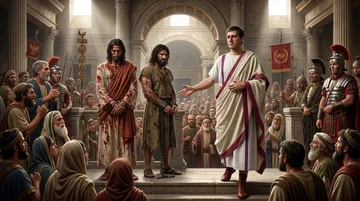
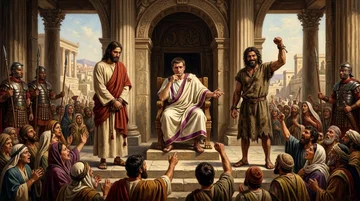
The cry, Crucify him, was uttered in the judgment-hall of Pilate the Roman governor, where Christ stood bound as a prisoner with a guard of soldiers around Him while the hall fast filled with spectators and just outside the entrance stood the judges of the Sanhedrim, priests, rulers, elders, and the mob.DA 723.1–724.1 The council of the Sanhedrim had already condemned Jesus and had come to Pilate to have the sentence confirmed and executed, yet these Jewish officials would not enter the Roman hall lest ceremonial defilement prevent them from the feast of the Passover, though murderous hatred had defiled their hearts.DA 723.1–724.1 Since they had rejected Christ the real Passover lamb, the great feast had for them lost its significance.DA 723.1–724.1 Pilate had been called from his bedchamber in haste at an early hour, determined to do his work quickly and with magisterial severity, yet when he looked searchingly on Jesus he found no sign of guilt, no fear, no boldness or defiance, but calm and dignified bearing, goodness and nobility, and the signature of heaven.DA 723.1–724.1 That sight made a favorable impression and roused his better nature as he recalled what his wife had told him and what he had heard from rumors of the wonderful deeds of the Galilean prophet who cured the sick and raised the dead.DA 723.1–724.1
The crowd joined the priests and rulers in demanding Jesus' death amid a lawless uproar that confused Pilate, even though he found no fault in Him and believed Him an innocent victim of the leaders' plot.ST Jun 3, 1889ST Jun 3, 1889 No charge could be established against Him, yet though convinced of His innocence Pilate yielded to the mob's pressure.ST Jun 3, 1889ST Jun 3, 1889 The crowd again and repeatedly demanded crucifixion even after Pilate asked what evil Jesus had done and offered to chastise Him and release Him.ST Jun 3, 18895RED 62.3ST Jul 11, 1878 Their louder, furious demand for an innocent man arose not from evidence of any crime, since nothing could be proved against Him, but from hatred stirred up by the priests and rulers in satanic fury.ST Jun 3, 18895RED 62.3ST Jul 11, 1878 Pilate's submission of the decision to the mob and his unavailing efforts to appease them showed weakness and failure to uphold justice and could not move them to pity.ST Jun 3, 1889ST Jul 11, 1878
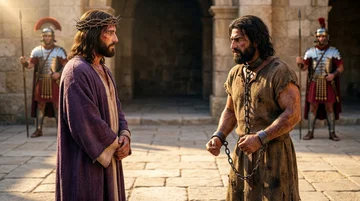
The cry belongs to Pilate's attempt to save Jesus by offering Him alongside Barabbas for release at the festival, hoping the contrast between Jesus' innocence and Barabbas' guilt as a hardened ruffian would lead the people to choose Jesus and move them to sympathy.DA 735.1–5Ms 112, 1897, par. 33–34 Pilate had Jesus scourged and mocked to excite pity and to satisfy even priestly malice, but the Jews saw weakness in punishing a man declared innocent and knew Pilate was trying to save the prisoner, and they were determined He should not be released.DA 735.1–5 The contrast convicted even priests and rulers and drew tears and pity from spectators and Roman soldiers, and Pilate was amazed at the Saviour's patient, gentle, dignified, uncomplaining suffering.DA 735.1–5 The priests, as darkness exposed by the light of the world, moved the mob to mad fury to raise again the awful cry, Crucify Him, crucify Him, until Pilate in despair over their unreasoning cruelty told them to take Him and crucify Him for he found no fault in Him.DA 735.1–5
Later that same day that same wicked throng led Jesus from Pilate's hall to Calvary to the place of crucifixion with shouts and jeers.DA 722.5 On the way they saw the body of Judas at the foot of a lifeless tree, where the cord he hanged himself with broke under his weight and his falling body was horribly mangled and devoured by dogs before being buried out of sight.DA 722.5 That revolting sight lessened mockery, paled faces with inward thought, and showed retribution already visiting those guilty of the blood of Jesus.DA 722.5 The frenzied demand was raised only a few years before Herod's death by the same voices that later glorified Herod as a god, showing that the multitude that exalted a vile sinner was the same multitude that called for Jesus to be put to death.3SP 343.2 His own nation clamored for His blood as He approached the cross and descended into humiliation, with Him in whom the disciples' hopes of eternal life were centered in the hands of wicked men.ST Jul 7, 1898 They chose the murderous Barabbas in place of their beloved Teacher, and the cry joined His scourging as the worst of criminals, the plaiting of the crown of thorns for His sacred brow, the purple robe, the mock bowing and striking Him with the reed placed in His hand, and His being lifted up on the cross to die as a malefactor.ST Jul 7, 1898
Reasons for the Cry
The cry to crucify Him was the climax of Satan's effort to turn the people against Christ and to lead them to reject His love.4SP 321.1–2GC88 501.1–2 It revealed the malice that drove His rejection and helped expose Satan's character before the universe.4SP 321.1–2GC88 501.1–2 That revelation stirred the indignation of the loyal universe.GC88 501.1–2
It came from people acting without the control of God's Spirit and inspired by Satan.19MR 277.1–278.1 They raised it after choosing Barabbas, a thief and murderer, instead of Jesus, the innocent and holy Prince of heaven.19MR 277.1–278.1 The scene shows what people under the powers of darkness will do.19MR 277.1–278.1 It represents the spirit of those who will be met in the coming great crisis.19MR 277.1–278.1
The Jews demanded His crucifixion while He was on trial because His pure life and holy teaching exposed their sin and condemned them.CT 424.3–425.1STE 59.3 For that same reason many oppose God's word in their hearts.STE 59.3 Many may hate the Bible because it convicts them.CT 424.3–425.1
It was the cry of a fickle crowd for Him to be crucified after He was betrayed, condemned, and humiliated, though many of them had once hailed Him as king.4RED 102.2–103.1 Jesus prepared His faithful disciples for this reversal so they would not be shocked or have their faith shaken when the crowd and professed followers turned against Him.4RED 102.2–103.1 The rulers' demand in that cry showed their rejection of Him and their part in His cruel death.Ms 22, 1900, par. 17–20 That decision later stood as evidence against them when the miracles of the apostles confirmed that the crucified Jesus was the Messiah.Ms 22, 1900, par. 17–20
Warning and Present Choice
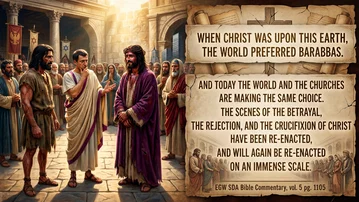
The cry stands as a warning that turning away from light already received leaves a person open to Satan's influence.Ms 10, 1894, par. 24–25 The proof that one would not have joined in demanding His death is obedience to the light given today.Ms 10, 1894, par. 24–25 It was the answer of a people rejecting and disowning Him, and disloyalty to Christ now shows that one would have joined that same cry had one lived then.MWISDAP 15.3–4 In calling for crucifixion and choosing Barabbas over Christ, the crowd chose Satan, whom Barabbas represents, in preference to Christ, the Son of God and Maker of the world.16MR 259.3–260.1 That same choice is repeated in the world today, with every person revealing whom he chooses by accepting or rejecting Christ.16MR 259.3–260.1
His own nation clamored for His blood as He approached the cross and went down into the depths of humiliation, while He in whom the disciples' hopes of eternal life were centered was in the hands of wicked men.ST Jul 7, 1898 They chose the murderous Barabbas in place of their beloved Teacher, and the cry went with His scourging as the worst of criminals, the plaiting of the crown of thorns for His sacred brow, the purple robe, the mock bowing before Him and striking Him with the reed placed in His hand, and His being lifted up on the cross to die as a malefactor.ST Jul 7, 1898 This taking away of the Bridegroom gave the children of the bridechamber cause to mourn and fast.ST Jul 7, 1898 For then their faith would be tried and their hope and courage would fail.ST Jul 7, 1898
Sources
Pioneers and periodicals
28 sources
The verse records the crowd's answer to Pilate's question of what to do with Him whom they called the King of the Jews, who is called Christ, demanding that He be crucified in their final rejection of Jesus as their King.ST May 25, 1904ST Oct 10, 1895ST May 25, 1904 The demand was cried out again and pressed even more loudly and urgently despite Pilate's renewed appeals and questions of what evil He had done, until with loud voices the people prevailed and Pilate gave sentence as they asked.ST May 10, 1905ST Mar 13, 1901RH Dec 15, 1863 Stirred up by the chief priests in envy and malice, they asked for Barabbas, imprisoned for insurrection and murder, to be released instead of Jesus.ST Jun 3, 1889ST May 25, 1904ST Mar 13, 1901 Pilate had publicly declared after examination that he found no fault in Jesus and no cause of death in Him, yet though convinced of His innocence he yielded step by step to the lawless, infuriated mob and violated conscience rather than uphold justice.ST Jun 3, 1889ST Jun 3, 1889ST May 25, 1904ST Mar 13, 1901ST Oct 7, 1886 The cry exposes the blindness and groundless hatred of apostate Israel, who could not see Christ's innocence though it was clear to a heathen judge, and proves that a majority can be tyrannical and morally wrong, for popular opinion is not the voice of God.ST Jun 15, 1904RH Dec 15, 1863ST Sep 9, 1889RH Jun 4, 1908RH Jun 10, 1862
Cry Before Pilate
When Pilate asked what should be done with Him whom they call the King of the Jews, who is called Christ, the multitude answered by demanding that He be crucified, and that answer was their final rejection of Jesus as their King.ST May 25, 1904ST Oct 10, 1895ST May 25, 1904ST Oct 7, 1886 The demand was renewed and repeated, cried out again and then even more loudly and urgently despite Pilate's renewed appeals and his question about what evil He had done.ST Jun 3, 1889ST May 10, 1905ST Mar 13, 1901RH Dec 15, 1863ST Mar 13, 1901 It was pressed a third time with loud voices until those voices prevailed and Pilate gave sentence that what they asked should be done.ST Jul 11, 1878ST Mar 13, 1901
The cry came after the chief priests, moved by envy and malice, stirred up the people into fury and pressed unproved charges, leading them to ask for Barabbas to be released instead of Jesus.ST Jun 3, 1889ST Jul 11, 1878ST May 25, 1904 Barabbas was in prison for insurrection and murder, a robber convicted of the same crime charged against Jesus, yet he was preferred and chosen in place of the innocent Christ.ST Mar 13, 1901RH Jun 24, 1915 Pilate had called together the chief priests and rulers and people and publicly declared after examination that he found no fault in Jesus touching the accusations and no cause of death in Him, and Herod had sent Him back with nothing worthy of death done by Him.ST Jun 3, 1889ST Mar 13, 1901 Pilate perceived that the leaders had delivered Him up for envy and believed Him an innocent victim of their plot, and he proposed to chastise and release Him.ST Jun 3, 1889ST Jun 3, 1889ST May 25, 1904ST Mar 13, 1901 That offer was inconsistent, setting the innocent Jesus and a convicted man before His avowed enemies as if they were equivalent choices.ST Nov 9, 1882
Pilate, though convinced of Jesus' innocence, showed weakness and failure to uphold justice by submitting the sentence to a lawless, infuriated mob amid an uproar that confused him.ST Jun 3, 1889ST Jun 3, 1889ST Jun 3, 1889ST Oct 7, 1886 He compromised his dignity, violated conscience step after step, and yielded to pressure and intimidation until he was almost helpless in the hands of the Jews.ST Oct 7, 1886 He paled with surprise and disappointment at the demand, for he had repeatedly pronounced Jesus innocent and had not expected Him to be consigned to the most dreaded, most severe and shameful of deaths.ST Nov 9, 1882ST Oct 7, 1886 Yet his efforts to appease the crowd could not move them to pity.ST Jul 11, 1878
The seized Jesus had been dragged before the council of the priests and condemned to death, then sent by Caiaphas to Pilate for condemnation and execution, and Pilate had sent Him as a Galilean to Herod before Herod put His fate back into Pilate's hands.RH Jul 16, 1861 The repeated demand came from a seditious rabble that knew it had nothing to fear from the Roman Praetorium but believed on the word of its leaders that Pilate allowed the uproar.RH Jul 16, 1861 It was driven by combined parties and a reckless populace ready to join sedition, with Herodians and Sadducees acting from hatred of Jesus and impatience with the Roman yoke over imperial images brought into the holy city and over the proposal to use temple treasure for public works.RH Jul 16, 1861 The Pharisees, as avowed enemies resenting His severe public rebukes against them, were too weak to act alone and joined the others' quarrel.RH Jul 16, 1861
The death demanded by crucifixion was a Roman method of executing criminals already in use at the time.ST May 6, 1913 It was considered deeply dishonorable and was generally inflicted on slaves and the lowest-class offenders.ST May 6, 1913 It was insisted upon as the most severe and shameful punishment, viewed as the usual punishment for sedition and as the punishment Barabbas would have faced.ST Nov 9, 1882
Rejection Prophecy and Application
The cry to crucify Him was the outcome of Israel's departure from God and the culmination of the kingdom's rejection of its rightful ruler.ST Oct 10, 1895 It belongs to the trial before Pilate in which, after examination, he declared he found no fault in Him, giving the world's official declaration that Christ was unjustly put to death.ST Jun 15, 1904 In that cry Christ suffered as the just for the unjust to bring sinners to God, put to death in the flesh but quickened by the Spirit.ST Jun 15, 1904 It fulfills the prediction of Isaiah 53:3.RH Jun 24, 1858
The demand exposes the blindness of God's apostate people, who could not see Christ's innocence even though it was clear to a heathen judge, proving how great is the darkness when the light within is darkness.ST Jun 15, 1904 Their renewed and more insistent answer to Pilate's question about what evil He had done exposes their blind fury and groundless hatred despite His innocence.RH Dec 15, 1863 The demand for His crucifixion in the final scene before Pilate and Herod, amid mockery and cruelty, displays the madness and cruelty of sin.RH Jun 10, 1862
Jesus endured this rejection and suffering as part of the sacrifice He willingly bore to save fallen humanity, while Barabbas the robber was preferred over the innocent Christ.RH Jun 24, 1915 He descended into the depths of humiliation with Him in whom the disciples' hopes of eternal life were centered in the hands of wicked men, choosing the murderous Barabbas in place of their Teacher and joining His scourging as the worst of criminals, the plaiting of thorns for His brow, the purple robe, mock homage, striking with the reed, and lifting Him on the cross as a malefactor.ST Jul 7, 1898 The scene stands against the expectation that Shiloh would bring Israel deliverance, despite the common people's potential support for Him, against which Judas wrongly imagined Jesus should establish an earthly kingdom by force and that Barabbas might serve that cause instead.ST Oct 4, 1910 The humiliation when the multitude who had hailed Him as king turned to hiss, revile, and join the jeering demand was foreseen by Jesus together with Gethsemane and the cross.ST Oct 8, 1896
He knew which followers were unbelieving and weak in faith, that if the faint-hearted had still been with Him they would have sunk under fear and disappointment, and that their apostasy at that hour would have been more than the twelve could have borne on top of grief and ruined hopes, and therefore He had earlier forced a sifting crisis to separate them while still present to comfort and strengthen the chosen and prepare them for what was to follow.ST Oct 8, 1896 The repeated demands that met every effort by Pilate to release Him belonged to God's presentation of the Gospel in its perfection to Rome in the person of Pilate.ST Oct 27, 1898 They came from priests, scribes and Jews pressing unproved charges and choosing Barabbas, yielding neither to law and justice in the declarations of innocence by both Pilate and Herod nor to pity at the sight of Jesus scourged, beaten, bruised and bleeding yet unresentful and unresisting under indignity and insult, while convincing Pilate that Jesus was more than man and appealing to him to do right whatever the consequences.ST Oct 27, 1898 Yet Pilate stayed undecided because he feared the Jews, refused to identify himself with the suffering Innocent One, rejected a final appeal through his wife Claudia Procula's dream-vision warning to have nothing to do with the righteous Man, and delivered Jesus to the mob while trying to escape responsibility and ease conscience by washing his hands.ST Oct 27, 1898
This taking away of the Bridegroom in the clamoring of His own nation for His blood gave the children of the bridechamber cause to mourn and fast, when their faith would be tried and hope and courage would fail.ST Jul 7, 1898 The verse shows a majority condemning what is right, proving a majority can be tyrannical and morally wrong and that popular opinion is not the voice of God, so that a righteous minority may have to suffer for truth.ST Sep 9, 1889ST Feb 10, 1887 The demand of the religious leaders and the people becoming the voice of the masses, which Pilate as government ratified, illustrates the danger of treating popular demand as sufficient basis for government action, especially when directed against religious liberty.RH Jun 4, 1908 The cruel cry demanding His crucifixion at His first coming will be reversed at His return in glory, when the whole earth will instead acclaim Him as Lord and King.RH Nov 4, 1915 The scene presents Christ as humble before the governor and is contrasted with the Pope.RH Dec 21, 1911
Sources