Mark 15:14
Then Pilate said unto them, Why, what evil hath he done? And they cried out the more exceedingly, Crucify him.
Translations
Then Pilate said to them, Why, what evil has he done? And they cried out the more exceedingly, Crucify him.
King James Version, KJV Cambridge Paragraph Bible
Then Pilate said unto them, Why, what evil hath he done? And they cried out the more exceedingly, Crucify him.
Then Pilate said to them, Why, what evil hath he done? And they cried out the more exceedingly, Crucify him.
Revised Version, American Standard Version
And Pilate said unto them, Why, what evil hath he done? But they cried out exceedingly, Crucify him.
And Pilate said to them, 'Why — what evil did he?' and they cried out the more vehemently, 'Crucify him;'
And Pilate said to them, What evil then has he done? But they cried out the more urgently, Crucify him.
But, Pilate, was saying unto them—Why! what, evil, hath he done? And, they, vehemently, cried out—Crucify him!
Berean Standard Bible, Majority Standard Bible
“ Why?” asked Pilate. “ What evil has He done?”But they shouted all the louder, “ Crucify Him!”
Pilate said to them, “ Why, what evil has he done?”But they cried out exceedingly, “ Crucify him!”
And Pilate said to them, Why, what evil has he done? But their cry was the louder, To the cross!
Then Pilate said vnto them, But what euill hath he done? And they cryed the more feruently, Crucifie him.
Douay-Rheims (Challoner revision)
And Pilate saith to them: Why, what evil hath he done? But they cried out the more: Crucify him.
Pictures
Cross-references
- Matthew 27:23
And the governor said, Why, what evil hath he done? But they cried out the more, saying, Let him be crucified.
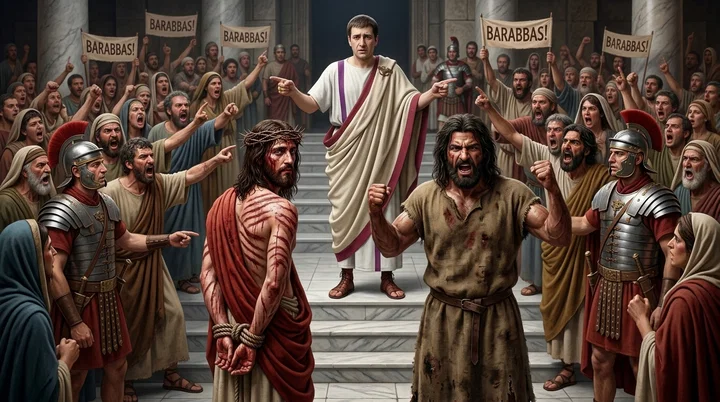
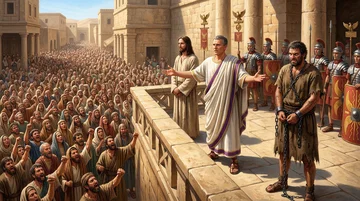
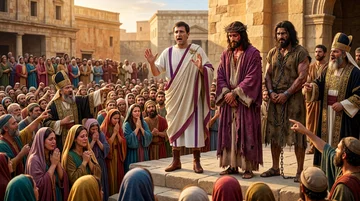
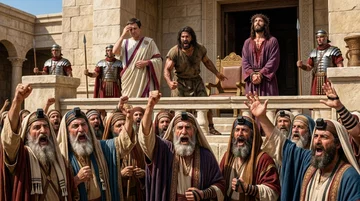
Pilate asks what evil Jesus has done, and the crowd demands his crucifixion.
- Luke 23:22-23
And he said unto them the third time, Why, what evil hath he done? I have found no cause of death in him: I will therefore chastise him, and let him go.
Pilate asks what evil Jesus has done, but the crowd insists on his crucifixion.
- John 19:6
When the chief priests therefore and officers saw him, they cried out, saying, Crucify him, crucify him. Pilate saith unto them, Take ye him, and crucify him: for I find no fault in him.
The leaders cry for Jesus to be crucified while Pilate declares him innocent.
- John 18:28-40
Then led they Jesus from Caiaphas unto the hall of judgment: and it was early; and they themselves went not into the judgment hall, lest they should be defiled; but that they might eat the passover.
Jesus’ hearing before Pilate ends with the crowd rejecting him and demanding Barabbas.
- Luke 23:4
Then said Pilate to the chief priests and to the people, I find no fault in this man.
Pilate declares Jesus innocent while the crowd demands his crucifixion.
- John 19:15
But they cried out, Away with him, away with him, crucify him. Pilate saith unto them, Shall I crucify your King? The chief priests answered, We have no king but Cæsar.
The people reject Jesus as king and demand his crucifixion.
- John 18:38
Pilate saith unto him, What is truth? And when he had said this, he went out again unto the Jews, and saith unto them, I find in him no fault at all.
Pilate declares that he finds no fault in Jesus.
- Matthew 27:19
When he was set down on the judgment seat, his wife sent unto him, saying, Have thou nothing to do with that just man: for I have suffered many things this day in a dream because of him.
Pilate’s wife warns him not to condemn Jesus.
- Luke 23:6-11
When Pilate heard of Galilee, he asked whether the man were a Galilæan.
Pilate sends Jesus to Herod, who returns him without condemning him.
- Isaiah 53:3
He is despised and rejected of men; a man of sorrows, and acquainted with grief: and we hid as it were our faces from him; he was despised, and we esteemed him not.
Jesus is rejected and suffers despite his innocence.
- Matthew 27:22
Pilate saith unto them, What shall I do then with Jesus which is called Christ? They all say unto him, Let him be crucified.
same question and demand for crucifixion
- John 19:4
Pilate therefore went forth again, and saith unto them, Behold, I bring him forth to you, that ye may know that I find no fault in him.
Pilate declares he finds no fault in Him
- Luke 23:18
And they cried out all at once, saying, Away with this man, and release unto us Barabbas:
The crowd demands Barabbas’s release and Jesus’s removal.
- Luke 23:15
No, nor yet Herod: for I sent you to him; and, lo, nothing worthy of death is done unto him.
Herod also finds nothing worthy of death in Jesus.
- Matthew 27:24
When Pilate saw that he could prevail nothing, but that rather a tumult was made, he took water, and washed his hands before the multitude, saying, I am innocent of the blood of this just person: see ye to it.
washing hands to escape responsibility
- Luke 23:16
I will therefore chastise him, and release him.
Pilate proposes chastising Jesus and releasing Him.
- John 19:5
Then came Jesus forth, wearing the crown of thorns, and the purple robe. And Pilate saith unto them, Behold the man!
Pilate presents scourged Jesus to the crowd
- John 19:7
The Jews answered him, We have a law, and by our law he ought to die, because he made himself the Son of God.
The leaders demand Jesus’ death because he claimed to be the Son of God.
Commentary
Each commentary is drawn from primary sources: the writings of Ellen G. White and Adventist pioneers and periodicals. Each commentary is separate. Its own words are not a quotation; follow the references to read the source passages.
Ellen G. White
19 sources
Pilate stood convinced that no evil had been proved against Jesus and asked what wrong justified His death, and the mob answered only by shouting still more fiercely for His crucifixion while demanding Barabbas in His place.ST Jun 3, 1889ST Jun 3, 18895RED 62.3 He repeatedly declared that he found no fault in Him.ST Jun 3, 1889ST Jun 3, 1889DA 735.1–5 Though certain of His innocence, he weakly yielded the life of an innocent man to a lawless crowd inflamed by the priests instead of upholding justice by his own authority.ST Jun 3, 1889ST Jun 3, 1889ST Jun 3, 1889 That cry was driven by the fanatical hatred of priests and rulers whose sin was exposed and condemned by His pure life and holy teaching.DA 735.1–55RED 62.3CT 424.3–425.1 Behind their fury Satan was stirring priests and people to destroy Him, so their demand exposed his malice before the universe, and in choosing Barabbas, who stands for Satan, instead of the Maker of the world, they made a choice every person still repeats.5RED 62.34SP 321.1–216MR 259.3–260.1GC88 501.1–2
Trial Before Pilate
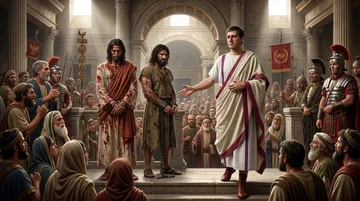
Mark 15:14 belongs to the trial in the judgment-hall of Pilate the Roman governor, where Christ stands bound as a prisoner with a guard of soldiers around Him and the hall fast filling with spectators, while just outside are the judges of the Sanhedrim, priests, rulers, elders, and the mob, after the council condemned Him and came to have the sentence confirmed and executed.DA 723.1–724.1 The Jewish officials would not enter lest ceremonial defilement keep them from the Passover, though murderous hatred had defiled their hearts, and Christ was the real Passover lamb whom they had rejected so the feast had lost its significance for them.DA 723.1–724.1 Pilate had been called hastily from his bedchamber at an early hour, and looking searchingly on Jesus found no sign of guilt, fear, boldness or defiance but goodness and nobility, calm dignity and the signature of heaven.DA 723.1–724.1 He had heard of Jesus and His works, and his wife had told him of the Galilean prophet who cured the sick and raised the dead, and he resolved to demand the charges against the prisoner.DA 723.1–724.1
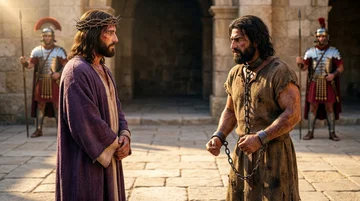
Pilate recognized that Jesus was innocent and that no charge of evil against Him had been proved, repeatedly declaring he found no fault in Him.ST Jun 3, 1889DA 735.1–55RED 62.33SP 142.2–3 To save Jesus he used the festival custom of releasing one condemned prisoner and set Jesus beside the notorious Barabbas, a hardened ruffian, hoping the contrast between the gentle, dignified sufferer and Barabbas would win sympathy and lead the people to choose Jesus and accept His release.ST Jun 3, 1889DA 735.1–5Ms 112, 1897, par. 33–34 He also had Jesus scourged and mocked to excite pity, hoping that suffering would satisfy the priests and move the multitude to accept it as sufficient punishment, so that even priests, rulers, soldiers and weeping spectators were convicted and pitied Him, and he kept offering to have Jesus chastised and released to appease the crowd.DA 735.1–55RED 62.3ST Jul 11, 1878
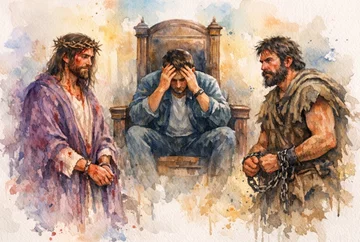
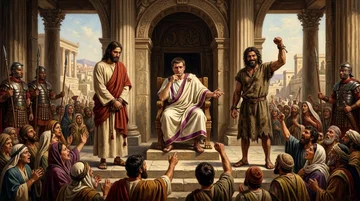
In the verse Pilate asks what evil Jesus has done and what charge justifies His death, and the crowd answers his appeal by crying out still more exceedingly and insistently, Crucify Him, rejecting Jesus and demanding Barabbas.ST Jun 3, 1889ST Jun 3, 18895RED 62.3Ms 112, 1897, par. 33–343SP 142.2–3 The choice of Barabbas in place of Christ shows the appeal had failed and fury had overrode the evidence that the charges were unsubstantiated.ST Jun 3, 188916MR 259.3–260.119MR 277.1–278.1Ms 112, 1897, par. 33–34 Pilate's question and yielding expose his weakness and reluctance: though convinced of Jesus' innocence he feared the people, submitted the decision about an innocent man's life to a lawless, furious mob inflamed by the priests and rulers instead of exercising his authority to uphold justice, and after compromising his conscience to appease the crowd was left nearly helpless while justice was overturned.ST Jun 3, 1889ST Jun 3, 1889ST Jun 3, 18893SP 142.2–3ST Jul 11, 1878 Losing patience with their unreasoning cruelty, he despairingly told them to take Jesus and crucify Him themselves.DA 735.1–5
Why They Cried Crucify
The cry for crucifixion was driven by the fury of the priests and rulers, a fanatical hatred kindled because His light exposed their darkness and error.DA 735.1–55RED 62.3 His pure life and holy teaching convicted them of sin and condemned them, and for that reason they moved the mob to mad fury until priests, rulers and people together demanded His death.DA 735.1–5CT 424.3–425.1STE 59.3 Behind that hatred Satan was at work, stirring priests and people to resist Jesus' love and to cry for His crucifixion even when Pilate asked what evil He had done.5RED 62.34SP 321.1–2GC88 501.1–2 That demand revealed Satan's malice and exposed his character before the loyal universe, arousing its amazement and indignation.4SP 321.1–2GC88 501.1–2
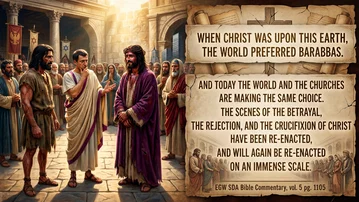
In choosing Barabbas and demanding that Jesus be crucified, the crowd chose Barabbas in place of Christ the maker of the world.16MR 259.3–260.1 Barabbas represents Satan, and the choice between Barabbas and Christ is repeated in the world, where each person shows by his course whom he chooses.16MR 259.3–260.1 The same crowd that had hailed Jesus as king now hissed at Him and reviled Him, and its sudden change revealed how fickle the world's favor is.4RED 102.2–103.1 The disciples had seen this inconstancy before, so the demand did not take them by surprise nor lead them to base their faith on other people's opinions.4RED 102.2–103.1 The frenzied cry for Jesus to be crucified was raised only a few years before Herod's death by the same voices that later glorified Herod as a god, contrasting their rejection of Jesus with their worship of a vile sinner.3SP 343.2
The verse marks Christ descending into the depths of humiliation as He approached the cross, placed in the hands of wicked men while His own nation clamored for His blood.ST Jul 7, 1898 It marks the taking away of the Bridegroom from the disciples, giving them cause to mourn and fast.ST Jul 7, 1898 Seeing Him in whom their hopes of eternal life were centered rejected, seeing the murderous Barabbas chosen in place of their Teacher, seeing Him scourged as the worst of criminals, crowned with thorns, clothed in the purple robe, mocked by bowing and struck with the reed, and lifted on the cross to die as a malefactor, tried their faith and caused their hope and courage to fail.ST Jul 7, 1898 The cry reveals what people do when they are not governed by the Spirit of God, and it represents the spirit of those who will oppose Christ's followers in the coming great crisis.CT 424.3–425.119MR 277.1–278.1 It shows why those who love sin hate God's word, because its truth exposes wrongdoing and pricks the conscience.CT 424.3–425.1STE 59.3 Those who reject Christ would still demand His crucifixion even when asked what evil He has done, which applies to disloyal professors who would oppose Christ if He were present on earth, and their guilt and future punishment are greater in proportion to the light and position they have received.MWISDAP 15.3–4
Sources
Pioneers and periodicals
29 sources
Pilate's question and the answering shout belong to the trial of Jesus before the Roman governor, whose sentence was required to put Him to death after the priests' council had condemned Him.ST Jun 3, 1889RH Feb 11, 1862RH Jul 16, 1861 Pilate had examined Him and found no fault and no cause of death, and his repeated question of what evil He had done was an effort to dissuade the people and release Him with a milder punishment.ST May 25, 1904ST Nov 9, 1882ST May 10, 1905 Instead of answering, the crowd, stirred by the chief priests and rulers from envy and hatred, shut their ears and cried out the more exceedingly for crucifixion until their loud voices prevailed, choosing Barabbas, imprisoned for insurrection and murder, in place of the Innocent One.ST Jun 3, 1889ST May 25, 1904ST Nov 9, 1882ST May 10, 1905ST Mar 28, 1906 His question stands as the world's official declaration that Christ was unjustly put to death with no evil in Him, suffering as the just for the unjust to bring sinners to God in fulfillment of Isaiah 53:3.ST Jun 15, 1904RH Jun 24, 1858 The cry exposes the darkness of an apostate people who could not see His innocence though it was clear to a heathen judge, exposes Pilate's weakness in yielding a just man to a lawless mob against conscience and justice from fear, and warns that popular demand even by religious leaders and majorities does not make an act right nor prove God's will.ST Jun 3, 1889ST Jun 3, 1889ST Jun 15, 1904ST Oct 10, 1895RH Jun 4, 1908
Trial Before Pilate
The verse belongs to the trial of Jesus before Pontius Pilate, the Roman governor whose sentence was required before Jesus could be executed.ST Jun 3, 1889RH Feb 11, 1862 After He had been condemned by the priests' council He was sent to Pilate to obtain His execution.RH Jul 16, 1861 There Pilate recognized Jesus as innocent but faced pressure from the Jewish leaders and the crowd, and was reluctant to condemn Him from fear of the people.ST Jun 3, 1889
Pilate recognized that Jesus was innocent and had done no provable evil, finding no crime in Him in contrast with the crowd's demand for His death.ST Nov 9, 1882ST May 10, 1905RH Dec 15, 1863 His question why, what evil He had done was an endeavor to dissuade the people from crucifying Jesus and to secure His release.ST May 25, 1904ST May 25, 1904RH Dec 15, 1863 It was asked even a third time after examination before the chief priests and rulers and people in which he found no fault in Him touching the accusations and no cause of death in Him, a finding confirmed when Herod sent Him back.ST Mar 13, 1901 Upon that finding he proposed to chastise Him and release Him, declaring His innocence and offering a milder punishment.ST Nov 9, 1882ST Mar 13, 1901
Instead of answering what evil He had done, they shut their ears and would not name any ground for their hatred.RH Dec 15, 1863 They cried out exceedingly and the more insistently for His crucifixion, growing more insistent at each appeal.ST May 25, 1904ST Nov 9, 1882ST May 10, 1905ST May 25, 1904 They shouted with loud voices all together to crucify Him and to release Barabbas, until their voices prevailed and Pilate gave sentence that what they asked should be done.ST Mar 13, 1901
The clamoring mob had been incited and inflamed by the chief priests and rulers, and amid pressure from hostile religious and political groups the accusers' hatred and the crowd's readiness for sedition drove the demand.ST Jun 3, 1889RH Jul 16, 1861 Acting from envy, malice and hatred, the priests moved the people to seek the release of Barabbas instead.RH Jul 16, 1861 The crowd thus rejected Pilate's judgment that Jesus had committed no crime worthy of death and pressed for the execution of an innocent man, though the charges against Jesus were unsubstantiated.ST Jun 3, 1889ST Mar 28, 1906 Barabbas had been cast into prison for insurrection and murder, convicted of the same kind of crime they charged against Jesus and for which they demanded His death.ST Mar 13, 1901 The same multitude had earlier hailed Jesus as their king, but after His betrayal and condemnation in the judgment hall turned against Him as a cruel, jeering crowd demanding His crucifixion.ST Oct 8, 1896 That demand stood in sharp contrast with the claim that Israel needed a political deliverer, for which some pointed to Barabbas as a possible champion.ST Oct 4, 1910
Meaning and Warning
Pilate's question stands as the world's official declaration that Christ was unjustly put to death, with no evil found in Him.ST Jun 15, 1904 It proves He suffered as the just for the unjust, to bring sinners to God through death in the flesh.ST Jun 15, 1904 It fulfills Isaiah 53:3, that Christ would be despised and rejected of men when the crowd before Pilate refused His release and demanded His crucifixion.RH Jun 24, 1858
The cry for crucifixion exposes the darkness of God's apostate people, who could not see His innocence even though it was clear to a heathen judge.ST Jun 15, 1904 It shows how great the darkness is when the light within becomes darkness.ST Jun 15, 1904 Their rejection of Jesus as King was the final result of the nation's departure from God and rejection of His rule.ST Oct 10, 1895
Pilate recognized Jesus as innocent but showed weakness by submitting the sentence to a lawless, furious mob instead of exercising his authority.ST Jun 3, 1889ST Jun 3, 1889 After compromising his dignity and losing control by appealing to the people and yielding his own judgment, he left himself almost helpless in their hands, having taken step after step in violating his conscience and excusing himself from judging with the equity and fairness his position demanded.ST Oct 7, 1886 Though repeatedly pronouncing Jesus innocent and just, and convinced that before him stood One more than man, he paled at the terrible cry for crucifixion, the most dreaded of deaths, because he had not thought it would come to consigning such a man to that death.ST Oct 27, 1898ST Oct 7, 1886 By placing the life of a just man in the balance against the decision of those who had delivered Him up, he acted inconsistently by setting an innocent man on a level with a convicted criminal and leaving His fate to His avowed enemies.ST Oct 7, 1886 He tried to appease the mob by proposing to chastise Him and release Him and to inflict a milder punishment, but his repeated attempts to evade his duty only encouraged their demands and made the situation harder to resolve.ST Mar 13, 1901 He stayed undecided because he feared the Jews and refused to identify himself with the suffering Innocent One.ST Oct 27, 1898
The scene was God's effort to save Pilate, as great Rome in Pilate was confronted with the Gospel in glorious perfection in Jesus Christ.ST Oct 27, 1898 Pilate's question and the louder cry for crucifixion was one of his repeated efforts to release an innocent Man, met with fresh outbursts of malignity from priests, scribes and Jews.ST Oct 27, 1898 They would yield neither to law nor justice in the declarations of both Pilate and Herod that Jesus was worthy of no punishment, nor to pity at the sight of the scourged, beaten, bruised, bleeding Man, unresentful and unresisting under every indignity and insult.ST Oct 27, 1898 The scene appealed to his heart to do right whatever the consequences.ST Oct 27, 1898
The verse reveals the depths of Christ's humiliation as He approached the cross, placed in the hands of wicked men while His own nation clamored for His blood and demanded His death.ST Jul 7, 1898 It marks the taking away of the Bridegroom from the disciples, giving them cause to mourn and fast.ST Jul 7, 1898 Witnessing Him in whom their hopes of eternal life were centered rejected, seeing the murderous Barabbas chosen in place of their Teacher, seeing Him scourged as the worst of criminals, crowned with thorns, clothed in the purple robe, mocked and struck, and lifted up on the cross to die as a malefactor, tried their faith and caused their hope and courage to fail.ST Jul 7, 1898 That hour of betrayal and condemnation in the judgment hall, with the multitude who had hailed Jesus as king turning to hiss, revile and humiliate Him in a cruel, jeering crowd demanding His crucifixion, was the great trial of fear and disappointment that would have made faint-hearted, weak and undecided followers sink and fall away.ST Oct 8, 1896 Jesus brought about an earlier sifting crisis for that reason, while He was still present to comfort and strengthen His chosen ones and prepare them for His betrayal, His agony in Gethsemane, and His crucifixion.ST Oct 8, 1896 The scene reveals the cruelty and madness of sin in His final hours.RH Jun 10, 1862 It presents Christ's humility in contrast with the Pope.RH Dec 28, 1911 At His return, the whole earth will instead acclaim Him as Lord of all.RH Nov 4, 1915
The demand for an innocent Man's death warns that popular demand, even when voiced by religious leaders, does not make a government's action right.RH Jun 4, 1908 The crowd's demand to crucify Jesus was not proof that He had done wrong, for a majority can act unjustly and popular opinion is not necessarily right.ST Feb 10, 1887 Their pressing for His crucifixion even after Pilate asked what evil He had done is an example of a majority condemning what is right, showing that popular opinion is not proof of God's will and that minorities may have to suffer for truth and righteousness.ST Sep 9, 1889
Pilate's challenge, what evil hath He done, is turned upon the visions, against which no charge of evil can be sustained since they do not lead into sin or make men less faithful to God.RH Jun 12, 1866 Since they produce no evil and instead promote holiness and faithfulness, the same challenge asks what evil they have done.RH Jun 13, 1871
Sources