John 13:23
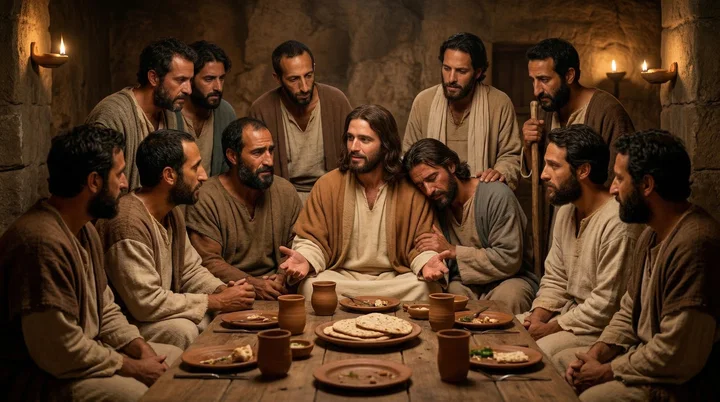
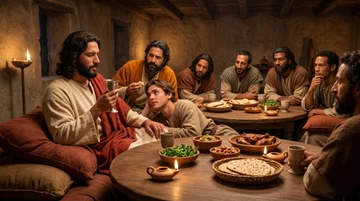
Now there was leaning on Jesus’ bosom one of his disciples, whom Jesus loved.
Translations
American King James Version, King James Version, KJV Cambridge Paragraph Bible, Douay-Rheims (Challoner revision)
Now there was leaning on Jesus’ bosom one of his disciples, whom Jesus loved.
Now there was leaning on Jesus' bosom, one of his disciples, whom Jesus loved.
Revised Version, American Standard Version
There was at the table reclining in Jesus’ bosom one of his disciples, whom Jesus loved.
And there was one of his disciples reclining (at meat) in the bosom of Jesus, whom Jesus was loving;
Now there was at table one of his disciples in the bosom of Jesus, whom Jesus loved.
One of Jesus’ disciples was reclining in his bosom, one whom Jesus loved:
Berean Standard Bible, Majority Standard Bible
One of His disciples, the one whom Jesus loved, was reclining at His side.
One of his disciples, whom Jesus loved, was at the table, leaning against Jesus’ chest.
There was at table one of his disciples, the one dear to Jesus, resting his head on Jesus' breast.
Nowe there was one of his disciples, which leaned on Iesus bosome, whom Iesus loued.
Pictures
Cross-references 20 of 23
- Matthew 26:20-25
Now when the even was come, he sat down with the twelve.
Jesus identifies Judas as his betrayer during the meal.
- Mark 14:17-21
And in the evening he cometh with the twelve.
Jesus announces that one of the disciples will betray him, prompting their questions and distress.
- John 13:2-5
And supper being ended, the devil having now put into the heart of Judas Iscariot, Simon’s son, to betray him;
Jesus washes his disciples’ feet during supper, giving them an example of humble service.
- Luke 22:21-23
But, behold, the hand of him that betrayeth me is with me on the table.
Jesus announces the betrayer during the meal, prompting the disciples to ask who it is.
- John 21:20
Then Peter, turning about, seeth the disciple whom Jesus loved following; which also leaned on his breast at supper, and said, Lord, which is he that betrayeth thee?
It again identifies the disciple who leaned on Jesus at supper as the one Jesus loved.
- John 13:30
He then having received the sop went immediately out: and it was night.
Judas leaves the supper immediately after receiving the sop to betray Jesus.
- John 19:26
When Jesus therefore saw his mother, and the disciple standing by, whom he loved, he saith unto his mother, Woman, behold thy son!
John identifies himself as the disciple Jesus loved, standing near the cross.
- Psalms 41:9
Yea, mine own familiar friend, in whom I trusted, which did eat of my bread, hath lifted up his heel against me.
Judas, a close companion who shared Jesus’ bread, turned against him.
- John 13:18
I speak not of you all: I know whom I have chosen: but that the scripture may be fulfilled, He that eateth bread with me hath lifted up his heel against me.
Jesus foretold that a companion at the meal would betray him.
- Luke 22:14-20
And when the hour was come, he sat down, and the twelve apostles with him.
Records Jesus sharing the supper with his disciples.
- John 20:2
Then she runneth, and cometh to Simon Peter, and to the other disciple, whom Jesus loved, and saith unto them, They have taken away the Lord out of the sepulchre, and we know not where they have laid him.
Also calls the disciple Jesus loved.
- Matthew 26:22-24
And they were exceeding sorrowful, and began every one of them to say unto him, Lord, is it I?
The disciples ask who will betray Jesus, and he warns of the betrayer.
- John 13:27
And after the sop Satan entered into him. Then said Jesus unto him, That thou doest, do quickly.
Satan enters Judas, and Jesus sends him to act quickly.
- John 18:15-16
And Simon Peter followed Jesus, and so did another disciple: that disciple was known unto the high priest, and went in with Jesus into the palace of the high priest.
Cited in identifying the unnamed disciple.
- John 13:12
So after he had washed their feet, and had taken his garments, and was set down again, he said unto them, Know ye what I have done to you?
Jesus explains the foot washing after sitting down again.
- Revelation 1:12-19
And I turned to see the voice that spake with me. And being turned, I saw seven golden candlesticks;
John beholds the glorified Lord on Patmos.
- Mark 14:17
And in the evening he cometh with the twelve.
Both describe Jesus at the supper with his disciples.
- Revelation 1:9
I John, who also am your brother, and companion in tribulation, and in the kingdom and patience of Jesus Christ, was in the isle that is called Patmos, for the word of God, and for the testimony of Jesus Christ.
John is identified as a faithful companion in tribulation, banished to Patmos for Christ.
- John 13:10-11
Jesus saith to him, He that is washed needeth not save to wash his feet, but is clean every whit: and ye are clean, but not all.
Jesus says the disciples are not all clean because Judas is present.
- Daniel 9:23
At the beginning of thy supplications the commandment came forth, and I am come to shew thee; for thou art greatly beloved: therefore understand the matter, and consider the vision.
Daniel is called greatly beloved, paralleling the beloved disciple.
Commentary
Each commentary is drawn from primary sources: the writings of Ellen G. White and Adventist pioneers and periodicals. Each commentary is separate. Its own words are not a quotation; follow the references to read the source passages.
Ellen G. White
38 sources
At the Passover meal the guests reclined with head toward the breast of the one above, so the disciple next to Jesus could lean back against Him, and that place beside Him belonged to John at the supper where the betrayal was announced.DA 652.1–23SP 86.1DA 653.1 John sat on Jesus' right while Judas pressed for the place on His left, with the seating itself revealing jealousy and striving for standing even as treachery was at work.DA 643.2–644.1 The honored one was John, the disciple Jesus loved, who in his own account hid his name from humility rather than boasting of his nearness.ST Nov 16, 1882BS 67.1 He loved to stay close to his Master in longing for sympathy and companionship, and in that intimate communion he received light and life until his character reflected Christ's own love.ST Jan 8, 1885ST Nov 23, 1915ST Mar 8, 190511MR 26.2 That nearness is given for believers today to seek through earnest faith and loving obedience, bringing humility instead of contention for first place, and patient love toward the faulty even as Jesus patiently bore with Judas at the table.Lt 117, 1897, par. 8–1021MR 346.1–3Ms 14, 1889, par. 27GC 470.2–471.2GC88 471.1
Supper Setting and Posture
At the Passover meal in that time guests reclined resting on their left arms with their right hands free for eating, so that one guest could lean his head back against the breast of the one seated next above him.DA 653.1 At that supper John was on Jesus' right and Judas pressed for the place on Jesus' left, and the seating reflected jealousy and a contest for status among the disciples.DA 643.2–644.1 Judas sought the highest place because he was determined to be next to Christ, even while he was a traitor.DA 643.2–644.1
The beloved disciple was thus beside Jesus at the Passover meal as the events leading to the betrayal unfolded.DA 652.1–2 He reclined close beside him in the scene where Jesus reveals that one of the disciples will betray him.3SP 86.1 After Jesus said that receiving whom he sends receives him and receives him that sent him, he was troubled in spirit and testified that one of the disciples would betray him.RH Nov 4, 1902 Then the disciples looked on one another doubting of whom he spoke, and the disciple lying on his breast asked Lord, who is it.RH Nov 4, 1902 Jesus answered it was he to whom he would give the dipped sop, and he gave it to Judas Iscariot the son of Simon, after which Satan entered into Judas.RH Nov 4, 1902 Jesus said that what he did he should do quickly, and Judas having received the sop went immediately out, and it was night.RH Nov 4, 1902
Sitting close beside Jesus, John could observe Jesus' troubled expression and movements.Ms 106, 1903, par. 31–35 When Jesus said one would betray him John was deeply distressed and asked whether he himself was the one.Ms 106, 1903, par. 31–35 His closeness allowed him to ask Jesus privately to identify the betrayer.ST May 23, 18783SP 85.1–2DA 654.1–2 That nearness showed intimate communion with his Master amid the distress caused by the announcement of betrayal.ST May 23, 1878
John the Beloved Disciple
The one leaning on Jesus' breast was John, the disciple Jesus loved, yet in his own Gospel he concealed that he himself was the one so honored, and that concealment shows humility, for he did not seek attention or boast of his standing.ST Nov 16, 1882BS 67.1 He was of warm, loving disposition and enjoyed Christ's friendship and special confidence, he was one of the three who witnessed the glory at the transfiguration and the agony in Gethsemane, and in the final hours on the cross Jesus entrusted His mother to John's care.ST Nov 2, 1882 He received tokens of Jesus' confidence and love, he delighted to stay near Him and listen to His teaching, and his affection led to obedience, so that day by day he was drawn to Christ until he lost sight of self in love for his Master.ST Jan 8, 1885
He sought and enjoyed close intimacy, sitting beside Jesus and leaning on His breast out of longing for love, sympathy, and companionship, and in that openness he received Christ's light and life.ST Nov 23, 1915ST Mar 8, 1905 That longing for companionship grew into adoration and fellowship with Jesus as his chief desire, and as he beheld the Saviour his character came to reflect Christ's.ST Nov 23, 1915ST Mar 8, 1905 His head had often rested on Jesus' bosom in the close companionship formed while walking and talking with Him. He is called the one loved most because he was the closest imitator of Christ's character and was filled with the spirit of love, showing that the pure, those who are good and do good, are very near to Jesus.11MR 26.2 His closeness belongs with knowing and believing God's love, with confidence that God loves His people through trials and sorrows.ST Aug 28, 1898
His mild, patient, meek character helped check Peter when ardent zeal went too far, and after Peter's denial and conversion John's mild caution restrained his ardor, while John's patient forbearance and deep devotion won many to Christ.SG1 122.2 Because he had laid his head on Jesus' bosom in close, loving fellowship, John had much to tell about Christ, and he was preserved as a witness to what Christ had done and to the revelation given to him.Ms 92, 1891, par. 9–11 He loved Jesus with all the power of his being and delighted to honor Him, and more than half a century passed between that leaning and his banishment to Patmos for fidelity to his Saviour, where he beheld his glorified Lord and Christ opened to him the future of the church and of the world.Ms 136, 1902, par. 3–5
Lessons for Believers Today
John 13 belongs to a chapter to be studied carefully and prayerfully in connection with humility, repentance and dependence on God rather than striving for a higher position or seeking to be first.Lt 117, 1897, par. 8–10 Its instruction expresses God's will for His people and is meant to cure dissension.21MR 346.1–3 That teaching is to be lived out in practical life, including living Christ's prayer, producing unity and love with one another and with Christ.21MR 346.1–3Lt 131, 1900, par. 1–3
The verse belongs to Jesus' last evening with the disciples, when Judas the false-hearted betrayer was present at the meal as one of the chosen apostles.MH 493.3–420MR 149.2–4 Jesus knew Judas would leave the table to betray Him and still bore with him patiently, washing his feet and sharing the sacrament with him.MH 493.3–4Ms 35, 1897, par. 11–1220MR 149.2–4 This shows Christ's long patience with perverse human nature and His desire not to lose a soul, which teaches patience toward those at fault.MH 493.3–4ST Feb 9, 1915
At that supper Jesus alone knew Judas's secret purpose to betray Him while the other disciples knew nothing of it.Ms 19, 1897, par. 56–57 They did not regard Judas as a villain but as a man of great capabilities, with breadth of knowledge and valuable qualifications.Ms 19, 1897, par. 56–57 Jesus did not expose him and gave him no word of rebuke, but treated him with goodness, humility and love as He had treated all the disciples through their whole association.Ms 19, 1897, par. 56–57 Judas was the first one whose soiled feet Jesus bathed and wiped with the towel, and Jesus tenderly served the disciples and included Judas in service as a final appeal before Judas went out to betray Him.DA 720.2Ms 120, 1897, par. 9Ms 19, 1897, par. 56–57 Angels were present witnessing what took place, including the disciples' contention.20MR 149.2–4 Judas's heart thrilled with an impulse to then confess and cast out Satan, but he turned the wrong way, braced his soul against light, and held to darkness until he became traitor and betrayer and his course was decided.DA 720.2Ms 19, 1897, par. 56–57
The other disciples were left ashamed, mortified, conscience-stricken, subdued and broken, with hearts going out to Jesus in deep earnest faith that works by love and purifies the soul.Ms 19, 1897, par. 56–57 Jesus washed even the feet of Judas and did not refuse him a place at the table.Ms 35, 1897, par. 11–12 The foot-washing before the Lord's supper is to call to mind the humility of the Lord, to clear away misunderstandings, evil surmisings and bitterness of spirit over trifles, and to bring man out of selfishness and self-exaltation and seeking the highest place into humility that will wash a brother's feet.Ms 35, 1897, par. 11–12 No one is to be deferred or refused as unworthy, and no one is to refuse to attend because another present is judged unworthy, because human beings cannot read the secrets of the soul and cannot tell who is worthy and who is not.Ms 35, 1897, par. 11–12
Earnest faith and loving obedience bring believers into the same close relationship John enjoyed as he leaned on Jesus' breast.Ms 14, 1889, par. 27 Even this beloved disciple who beheld His glory fell as one dead before the angel, showing that closeness to Jesus and a vision of divine glory lead to humility rather than self-exaltation.Ms 14, 1889, par. 27GC 470.2–471.2GC88 471.1 Yet the same loving disciple who had leaned on Jesus' breast fell asleep in Gethsemane while Jesus endured anguish and needed his prayers, showing that even his love for his Master did not keep him awake to share in Jesus' sorrow or pray with Him.ST May 30, 1878COS 116.2–33SP 96.2–98.1
The supper-table revelation showed Judas that Jesus knew he was about to betray Him, leaving him without reason to think Jesus was ignorant when he came to betray Him in Gethsemane.Ms 149, 1904, par. 13–15 Yet even then hope remained and free forgiveness would have been given if Judas had confessed his traitor's work, the same saving mercy Jesus afterward gave the thief on the cross.Ms 149, 1904, par. 13–15 The account of Judas betraying his Master teaches everyone, especially youth, to work out salvation with fear and trembling, to keep religious influence genuine and faith in Christ as a personal Saviour unwavering, so they will never betray Christ as Judas did.Ms 102, 1904, par. 39
Sources
Pioneers and periodicals
131 sources
At the Passover meal before his suffering, the disciple Jesus loved was reclining next to Jesus with his head near his breast, as guests then reclined on couches, and at Peter's beckoning he leaned back to ask privately who would betray him.ST Apr 9, 1896ST Jan 10, 1911ST Oct 24, 1878 That disciple was John the son of Zebedee, the youngest of the twelve, of mild and gentle character, admitted with Peter and James to special nearness to Christ.RH Apr 2, 1908ST Mar 8, 1905RH Mar 31, 1863ST May 28, 1885 The scene belongs to the last supper where Jesus washed his disciples' feet and gave them an example of humble service to practice, cleansing the heart of pride and strife over greatness before partaking of the bread and cup.RH Apr 2, 1908ST Jul 15, 1886RH Jun 23, 1910RH May 3, 1864 His letting John lean there reveals that his love is personal and tender toward each one who trusts him, with a special human affection that did not mean he loved the others less.ST Jan 8, 1885ST Aug 28, 1879RH May 12, 1904RH Jan 20, 1859RH Oct 4, 1853 That resting on his breast remains the picture of the trust, communion, comfort, and rest believers may have in him amid trial and sorrow, and of the hope of being forever near him and leaning on him in heaven.ST Nov 24, 1887RH Mar 3, 1874ST Nov 13, 1879RH Aug 11, 1863RH Nov 18, 1862
Supper Setting and Posture
The scene is the upper chamber at the Passover meal Jesus desired to eat with his disciples before he suffered.ST Aug 12, 1886 It was an occasion usually marked by calm joy, but now shadowed by his grief as he clearly foresaw the events of the near future, his heart wrung as he contemplated the ingratitude and cruelty of those he had come to save and the terrible fate awaiting them.ST Aug 12, 1886ST Aug 12, 1886 The quiet hours with them were spent for their benefit, and the disciples sympathized with him without knowing the cause of his touching sadness and being weighed down in mind.ST Aug 12, 1886ST Aug 12, 1886 He told them one of them would betray him and that he was soon leaving them, announcements that troubled them because they did not fully understand what was happening.RH May 18, 1869
Guests reclined on a couch at meals, with one person's head resting near another's breast and their limbs in contact.ST Oct 24, 1878 This made cleanliness important to avoid soiling one another's garments and the host's couch.ST Oct 24, 1878 Such reclining beside another at a feast was a position of special favor and honor, and being carried to Abraham's bosom likewise represents the choicest place at a feast and great favor.ST Apr 9, 1896 At the Last Supper the disciples reclined at table while eating, which made it possible for one to lean upon Jesus.RH Aug 29, 1871 The same custom of reclining at table while eating continues in Palestine, where domestic life has remained substantially unchanged, and so confirms the truth of the account.RH Aug 29, 1871
The disciple Jesus loved was reclining next to Jesus, leaning on his bosom, with John the disciple Jesus loved close beside him at the supper.ST Jan 10, 1911ST Aug 12, 1886 Because of that nearness Simon Peter beckoned to him to find out whom Jesus meant when he announced his betrayal.ST Jan 10, 1911 Leaning back on Jesus' breast he asked Jesus in deep distress who it was.ST Aug 12, 1886
The disciples were still at supper after Jesus had washed their feet, so the washing took place during the meal near its beginning rather than after it was finished.ST Nov 15, 1883ST Jul 30, 1885 After the foot washing they were still reclining at table and eating instead of having sung a hymn and gone out.RH Jul 21, 1868RH Dec 23, 1858 This places the washing after the Passover supper was ended but before the bread and cup of the Lord's Supper were eaten.RH Jul 21, 1868 This setting belongs to the sequence in which Jesus gave Judas the sop and Judas left, after the washing and before they sang a hymn and went out.RH Dec 23, 1858
The identification by the dipped sop took place during the Passover meal, before Jesus instituted the Lord's Supper.ST Nov 22, 1883 Judas then went out immediately and it was night and was not present at the memorial supper.ST Nov 22, 1883 His departure preceded Jesus' instruction to the disciples recorded in John 13:31 through 17.ST May 19, 1898 The verse belongs to the Passover supper setting where Jesus gave the instruction recorded in chapters 13 and 14, and falls within the upper-room discourse extending through John 13-17 which presents the divine glories of Christ.ST Mar 9, 1888ST Mar 18, 1897 It is part of the parallel account of the Lord's Supper and the events surrounding it.ST May 12, 1898
The account agrees substantially with Matthew, Mark, and Luke that Jesus ate the Passover at the appointed time before his arrest that night.ST Apr 2, 1912 It belongs to the account of the Passover meal and instruction that night, before his prayer in Gethsemane and his betrayal, in the setting of the events surrounding his betrayal that night.ST Nov 4, 1897RH Jan 28, 1862 Its circumstances and sequence merit careful study to understand the full significance of what Jesus did.ST Nov 15, 1883 Whether Judas was present at the institution is presented as disputed, with one view holding that Judas had already left and another claiming the Scriptures show he was present.RH Jul 29, 1873
The verse stands in the farewell evening when Jesus tells his disciples that where he goes they cannot come now but shall follow him afterwards.ST Aug 18, 1881 He promises that he goes to prepare a place and will come again and receive them to himself so that where he is they may be also.ST Aug 18, 1881ST Oct 10, 1911 This shows that his people get to be with him at his second coming and the resurrection, not immediately at death.ST Aug 18, 1881 As he spoke about heaven and eternal life with one disciple leaning close against him, that closeness was a sweet, blissful experience.RH Sep 2, 1873
At that supper Jesus both ate the Passover with his disciples and instituted the Lord's Supper to be continued until his coming again.ST Nov 19, 1912 The disciples were with Jesus in the upper room at the Passover, where he instituted the Lord's Supper and foot washing.ST May 21, 1896 These rites were to continue until his return and remind followers of his humility in taking human nature, his humble work of salvation, and his freely given body and blood.ST May 21, 1896
Disciple Whom Jesus Loved
The disciple leaning on Jesus at the meal is the one Jesus loved, and this is the ground for calling John the beloved disciple and for the name Jesus Christ's beloved; he is the apostle John, the son of Zebedee, who took the place nearest Jesus.RH Apr 2, 1908ST Mar 8, 1905RH Aug 25, 1904ST Oct 4, 1910 He is identified as leaning on Jesus' breast at the last supper.RH Sep 2, 1873
He was one of the two who first followed Jesus through the witness of John the Baptist, and he was among those admitted to a closer relationship with Christ than the other apostles.ST Feb 8, 1899 He had a warm, loving disposition and enjoyed Christ's friendship and special confidence, was among the three who witnessed the glory at the transfiguration and the agony in Gethsemane, and received the care of Jesus' mother in the final hours on the cross.ST Nov 2, 1882
He was the youngest among the disciples and was especially beloved by Jesus. His mild and gentle character complemented Peter's bold and rash temperament, so that their different qualities helped each other and served the early Christian work.RH Mar 31, 1863 His closeness to Christ, the embodiment of love, accords with his mild spirit and kind nature and with his teaching that people should love one another.ST Jan 3, 1878 His deep sense of Jesus' love appears in his repeated emphasis on love, and his closeness in eagerly receiving the Master's words and spirit is associated with the love that marks him as the beloved disciple whose writings reflect the Saviour.ST May 28, 1885RH May 9, 1871
Jesus had a particular human affection for him, had often let him lean on his bosom, and loved him with special tenderness.RH Nov 14, 1854RH Feb 14, 1854 This was a special personal, human attachment for John's own sake, an exception to his general way of neither seeking nor shunning anyone for his own sake, for though infinitely endowed with all excellence and beauty and infinitely humble he lived out the divine fullness of his life of suffering and love without regard to position or popularity.ST Feb 1, 1877 His love for John teaches that personal seeking of those congenial in principles and life is right, while associations in general should rest on moral and intellectual character rather than rank, wealth, or show.ST Feb 1, 1877
This particular friendship did not mean Jesus loved the other disciples less or excluded them from his love, and he did not rebuke or send John away from his intimate place leaning near him at the meal.ST John received tokens of Jesus' confidence and love, delighted to stay near him and listen to his teaching, and his affection led him to obey until day by day he was drawn to Christ and lost sight of self in love for his Master.ST Jan 8, 1885 He humbly concealed that he himself was the disciple thus honored, without seeking attention or boasting of his own standing.ST Nov 16, 1882
His head had often rested on Jesus' bosom in close companionship while walking and talking with him, and he had been close to Jesus during his earthly ministry in leaning on him, learning from him, loving him and being loved by him.ST Dec 2, 1897 He was the disciple who leaned on Jesus' bosom at the supper before the crucifixion and had been close to Jesus during his ministry.ST Apr 29, 1908 That resting of his head on Jesus' breast at the Last Supper illustrates his personal experience of Christ and firsthand knowledge of Jesus.RH Aug 17, 1916 He is numbered among the faithful who observed the seventh day.ST His faithfulness amid persecution stands with Daniel's faithfulness in exile to show that hardship does not force a person away from God but can turn attention from temporary earthly joys toward heaven's eternal glories.ST Jan 6, 1909
That close and loving relationship of often leaning on Jesus at supper helped John recognize the glorious Christ and regain strength when he saw him in vision.RH Aug 26, 1862 His closeness to Christ and the cross prepared him for the visions received on Patmos.ST Oct 7, 1913 Laying his head on his Saviour's bosom and hearing the throbbing of that loving heart gave him more knowledge of Christ than any other man had, so that he knew him well and thought well of him, as his Gospel and Revelation show.RH Feb 8, 1915 This personal nearness and experience of Jesus' love and goodness help explain his longing for Jesus to come again.ST Oct 6, 1898
Even as the loving disciple who had leaned on Jesus' breast, John slept in Gethsemane while Jesus endured anguish, showing that even his love did not keep him awake to share his Master's sorrow or pray with him.ST May 30, 1878 Though beloved of the Lord and close to Jesus, in old age he was rejected and spoken against with malicious words within the church.ST May 19, 1881 Even the fate of a beloved disciple rests on the Master's sovereign will.RH Feb 14, 1854
Betrayal Exposed at Supper
The saying that receiving the one he sends is receiving him and receiving the one who sent him comes just before he is troubled in spirit and declares that one of the disciples will betray him.RH Nov 4, 1902 The disciples look on one another in doubt about whom he means, while the disciple lying on his breast asks him, Lord, who is it.RH Nov 4, 1902 The answer is that it is the one to whom he will give the dipped sop, which he then gives to Judas Iscariot the son of Simon.RH Nov 4, 1902 After the sop Satan enters into Judas, Jesus says, That thou doest, do quickly, and Judas having received the sop goes immediately out, and it is night.RH Nov 4, 1902 This is the Passover meal at which the betrayal is disclosed, and the receiving of the sop exposes the treachery before the departure.RH Nov 4, 1902ST Oct 5, 1882
The place of the beloved disciple close beside Jesus shows the intimate communion of the disciples with their Master even amid the distress caused by the announcement of betrayal.ST May 23, 1878 Because of that nearness he is able to ask privately who will do it.ST May 23, 1878 He lifts his face from Jesus' breast in horror and sorrow at the word and asks whether he is the betrayer.ST In this way the account points out the betrayer among the disciples.ST May 26, 1909
In exposing Judas, Jesus acts with forbearance, mercy, and long patience toward perverse human nature, showing his desire not to lose a soul.ST Feb 9, 1915ST Aug 12, 1886 He gives Judas a final chance to repent and convincing proof that he knows his hidden thoughts and purposes and is divine.ST Aug 12, 1886 Judas is alarmed but does not repent, becoming more firmly set on his plan and going out to carry it through.ST Aug 12, 1886
Footwashing Ordinance Established
John 13:23 belongs to the account of the foot-washing ordinance instituted in connection with the last supper, when Jesus washed the feet of all his disciples on that evening and told them to do as he had done.RH Aug 19, 1858 That act stands as example and command for his followers to practice, a means of blessing to those who understand its lesson.RH Apr 2, 1908RH Aug 19, 1858 Its testimony stands fully valid as fact though stated only once, without needing repetition to be believed and obeyed.ST Jul 15, 1886 It enforced a great moral lesson timed to surrounding circumstances that called for it, as when he set a little child in their midst to teach humility and equality because they had disputed who should be greatest in the kingdom of heaven.RH Feb 24, 1859 To read it as mere hospitality leaves no such occasion, since they showed no inhospitality and needed none shown to them, making it a strange digression from the events then transpiring.RH Feb 24, 1859
The ordinance addresses pride, alienation, and dissension over who was greatest, establishing that before receiving the bread and wine as emblems of communion hearts must be made clean and fellowship restored.RH Jun 23, 1910RH May 3, 1864 Disciples are to serve one another in humble love rather than strive for status.RH May 3, 1864 The chapter shows Jesus' willingness to humble himself for others and gives his followers an example of humble service and a lesson of humility.ST Sep 24, 1912ST Oct 18, 1877 Its setting identifies the disciples who witnessed and experienced his act, with the beloved disciple close beside him at the supper where that humble service was given.ST Oct 31, 1878ST Oct 18, 1877 That close place belongs to the scene in which he teaches humble service, enforcing his rule that none should claim supremacy over another, the opposite of enslaving others.RH Oct 8, 1861
Foot washing is plain instruction establishing an ordinance to be practiced as a memorial of the humility of the Lord and Master, the Prince of glory, just as the bread and wine memorialize his death and baptism memorializes his resurrection.RH Jun 16, 1868 It was practiced in the earlier and purer ages until Rome laid polluting hands on the ordinances and either abolished or perverted them, with its real meaning forgotten and overloaded by superstitious feelings and mere outward practices.RH Jun 16, 1868 At the close of this age the gospel must be as pure as at the beginning, so this neglected ordinance must be restored to its appropriate place as a link in the golden chain.RH Jun 16, 1868 It is a humbling ordinance of the Lord's house to be kept regularly with the Lord's Supper and then followed by it, and knowing and doing these things brings happiness and refreshing.RH Jul 7, 1863RH May 19, 1859 It brings a sweet heavenly spirit that humbles God's people and unites them, removes distant feeling and alienation and restores union unless done as a hypocrite, and lays obligation to settle difficulties before coming around the Lord's table.RH Jul 7, 1863 It also serves as a memorial of his humiliation before his suffering and death.RH Jan 8, 1867
Jesus Tender Personal Love
Even in his own anguish Jesus tenderly supported and cared for the disciple leaning against him, without turning attention to his own suffering.ST Aug 28, 1879 His willingness to let a disciple recline beside him in intimate closeness reveals the tenderness and personal affection he showed his followers, and the same Jesus still loves believers and can be trusted as their Saviour.ST Aug 28, 1879RH Jan 20, 1859
The disciple whom Jesus loved shows that his love was personal and tender, reaching each person individually and not merely humanity in general.RH May 12, 1904 That tenderness and familiarity shared with his disciples extends still to those who trust and yield to him, for he remains the same Saviour.RH Oct 4, 1853 The beloved disciple resting his head on his breast is a sign of that tender love, and the same Jesus is the friend of his people now.RH Oct 4, 1853RH May 13, 1873
His intense affection for one follower known as the disciple whom Jesus loved reflects his human nature, in sharing human joys and sorrows and feeling personal attachment while remaining the Son of God. To be loved by him is the highest honor, an honor all may possess, but none can possess without his Spirit and without loving him. Resting in his bosom is an image of resting in Jesus himself, in whom eternal hope rests rather than in observance of religious forms.RH Apr 20, 1869
John sought and enjoyed close intimacy, sitting beside him and leaning upon his breast from longing for love, sympathy, and companionship.ST Nov 23, 1915ST Mar 8, 1905 In that closeness he received Christ's light and life and opened himself to divine life and teaching.ST Nov 23, 1915ST Mar 8, 1905 His longing for companionship and love grew into adoration and fellowship, with fellowship becoming his chief desire as he beheld the Saviour in adoration and love.ST Nov 23, 1915ST Mar 8, 1905 As he beheld him his character came to reflect his Master.ST Nov 23, 1915ST Mar 8, 1905 He leaned close and eagerly received the Master's words and spirit, and that closeness accompanies his testimony that believers receive from Christ's fullness.ST Aug 12, 1889ST May 28, 1885
Leaning as Fellowship and Hope
The beloved disciple staying close to Jesus and resting confidingly against him shows the loving trust believers may have in the compassionate Redeemer, whose friendship never fails or changes and whose help is sufficient for greater work for him.ST Nov 24, 1887RH Mar 3, 1874ST Nov 13, 1879 They need not lean faintly or remain at a distance, but may rest firmly in his love with childlike trust because he bore their sins.ST Nov 24, 1887RH Mar 3, 1874 Little trust brings fear and robs the soul of rest, while the desire awakened by his nearness is to listen to him, lean on him, and love him rather than seek anything else.RH Mar 3, 1874ST Nov 13, 1879
The posture is a model of trusting nearness for comfort and calm rest amid affliction, grief, trial, and sorrow, expressing confidence that God loves his people through trials.ST Aug 28, 1898RH Aug 11, 1863RH Nov 18, 1862 Jesus is a refuge where the weary heart finds rest by leaning on him.RH Aug 11, 1863RH Nov 18, 1862RH Jan 28, 1862 An hour in his bosom removes even sharp criticism of Scripture.RH Dec 9, 1909
Close to Jesus he could whisper confidential questions and receive answers, picturing how people in sorrow rest in his love and receive his assurances through the written Word.RH Mar 16, 1916 Resting close is intimate trust and loving care in which the soul finds shelter, safety, and rest.ST Apr 16, 1894 Sinners may lay their heads on his breast weeping to tell secret sins dwelling within, with scarcely need to speak because he knows.ST Feb 2, 1882
Resting on his bosom is the communion of faith open to the believer, in which Christ comes to the soul as a frequent guest within and the believer rests on him and resigns all to him.ST Aug 19, 1880 It means being shut in with Jesus with the world shut out, in soft rest and quiet for one tired and weary of serving, resting close to the Master in longing for his nearness.ST Apr 14, 1909 The image expresses the sweetness and blessing of intimate fellowship and nearness to him.RH Jul 3, 1900ST Jan 16, 1907 It answers the soul's need to lean on Jesus for perfect rest, which cannot be found on earth.RH Feb 26, 1861
Like the disciple, a child of God who leans on the Lord enjoys the real peace of God, of which the peace-offering was a type.RH Jun 6, 1912 That nearness brings peace and heavenly rest, and is the intimate closeness lonely and hurting people may seek with Jesus by faith.ST Sep 17, 1894ST Jesus as truest heart friend knows every hidden grief, and to recline on his bosom is joy in sensing he is gracious and strong, granting each seeker blessing for solace and cheer.RH Sep 18, 1913
The closeness expresses the joy of being near Jesus and pouring praise into his ear, cherished as a reward in heaven greater than its other joys.RH May 26, 1910RH Jul 30, 1908 It is the desire to lean upon Jesus and share in his glory.RH Jan 10, 1865 Leaning on his breast expresses the closeness and security of being with him, fulfilled in heaven where the redeemed will no longer feel friendless.RH Mar 3, 1910 There the redeemed will lean their heads on his bosom in the heavenly kingdom.RH Sep 30, 1915
The image becomes the hope of laying the head on his breast after faithfully laboring for him, as reward following patient service rather than self-seeking.RH Jan 16, 1866 It expresses longing to be near Jesus and rest with him in heaven.RH Sep 21, 1911 The departed laborer rests till he comes and then meets him still leaning on his breast.RH Nov 19, 1861 Believers long for that closeness in heaven, leaning with a smile on his breast in rest beyond the assault of foes, a repose no other pillow can give.RH Oct 14, 1852
At life's end the believer can face death without fear, trusting in his tender presence and looking forward to resting with him when life's day is over.RH May 21, 1901 The faithful await death as a sleep of rest, looking forward to lying forever on his breast. To lean on his breast is to die in calm assurance that sins are forgiven and that the Lord will take the dying one to himself, breathing life out peacefully and sweetly in his care.RH Dec 27, 1853
Drawing near and entrusting life to him comforts even in sickness and isolation.RH Feb 18, 1858 The troubled soul seeks mercy and rest in him, relying on his grace for forgiveness, his truth and promises for guidance, and his care amid fear, loss, sickness, and death.RH Jul 30, 1861 Leaning on his breast expresses waiting on him and finding rest in him.RH May 13, 1902 Leaning hard on his breast represents trusting him and resting cares in the safety of his love.ST Sep 1, 1898 It is the plea for close, restful fellowship and the longing to rest safely in his love and remain with him.RH Nov 17, 1863
That physical nearness stands among the special privileges given to those who were with Christ on earth, like sheltering him, sitting at his feet, feeling his rescuing hand, walking and talking with him, anointing him, and burying him.RH Oct 4, 1870 That privilege is past and cannot be ours now, but he still lives and all can live for the living Christ by believing, serving, loving, obeying, and doing good to his people as to him.RH Oct 4, 1870
John's close inward fellowship at the supper explains his Gospel.RH Apr 11, 1871 He writes from within, giving the gospel as poured into his heart, the rich deep discourses in which Jesus, shut in with the twelve and closer still with the three, unveiled mysteries.RH Apr 11, 1871 Matthew, Mark, and Luke write from without, giving his words and works as directed to a world lying in wickedness.RH Apr 11, 1871 He shows the fountain where the others trace the streams, the Sun where the others show beams of light from Galilee upon a darkened world.RH Apr 11, 1871
His close, loving fellowship stands against using his name to sponsor panting and heated pleasure-seeking fundraising festivities to draw money from sinners.ST Nov 16, 1876 The scene shows him close to Jesus while remaining clean and well-groomed.RH Dec 30, 1858 It pictures a weary soul resting on Jesus by reclining on his breast while embraced by his right hand.RH Aug 25, 1868 It pictures the tenderness of the relationship later seen when the disciple writes to little children about God's love and serves as a faithful undershepherd caring for others as Jesus cares for the weak and inexperienced.RH Sep 3, 1914 Resting on the Lord's bosom is intimate, trusting nearness pictured as the comfort of falling asleep in his presence and basking in his love, with assurance that by faith the unseen Saviour gives the same nearness and lasting joy.RH Oct 15, 1908RH Jan 28, 1862
The closeness was a special privilege and joy.RH Apr 16, 1867 After his death, John longs to rest his head on his Master's breast as before, recalling former intimacy and comfort.ST Jan 31, 1911 That intimacy remained a lasting comfort to John in old age, when his memories of Jesus remained vivid.RH Aug 25, 1904 It shows a disciple resting close in childlike tenderness.
Sources