Mark 2:24
And the Pharisees said unto him, Behold, why do they on the sabbath day that which is not lawful?
Translations
And the Pharisees said to him, Behold, why do they on the sabbath day that which is not lawful?
King James Version, KJV Cambridge Paragraph Bible, Revised Version, American Standard Version
And the Pharisees said unto him, Behold, why do they on the sabbath day that which is not lawful?
And the Pharisees said to him, Behold, why do they on the sabbath that which is not lawful?
and the Pharisees said to him, 'Lo, why do they on the sabbaths that which is not lawful?'
And the Pharisees said to him, Behold, why do they on the sabbath what is not lawful?
And, the Pharisees, were saying,—See! why are they doing, on the Sabbath, what is not allowed?
Berean Standard Bible, Majority Standard Bible
So the Pharisees said to Him, “ Look, why are they doing what is unlawful on the Sabbath?”
The Pharisees said to him, “ Behold, why do they do that which is not lawful on the Sabbath day?”
And the Pharisees said to him, Why are they doing what it is not right to do on the Sabbath?
And the Pharises saide vnto him, Beholde, why doe they on the Sabbath day, that which is not lawfull?
Douay-Rheims (Challoner revision)
And the Pharisees said to him: Behold, why do they on the sabbath day that which is not lawful?
Pictures
Cross-references 20 of 26
- Matthew 12:1-8
At that time Jesus went on the sabbath day through the corn; and his disciples were an hungred, and began to pluck the ears of corn, and to eat.
Parallel account of the disciples’ grain-plucking dispute and Jesus’ reply about the Sabbath.
- Luke 6:1-5
And it came to pass on the second sabbath after the first, that he went through the corn fields; and his disciples plucked the ears of corn, and did eat, rubbing them in their hands.
Parallel account of the disciples’ Sabbath dispute and Jesus’ reply.
- Exodus 20:10
But the seventh day is the sabbath of the LORD thy God: in it thou shalt not do any work, thou, nor thy son, nor thy daughter, thy manservant, nor thy maidservant, nor thy cattle, nor thy stranger that is within thy gates:
The commandment forbids work on the Sabbath, the law the disciples are accused of breaking.
- Mark 2:28
Therefore the Son of man is Lord also of the sabbath.
Jesus declares himself Lord of the Sabbath and claims authority over it.
- Matthew 12:12
How much then is a man better than a sheep? Wherefore it is lawful to do well on the sabbath days.
Jesus teaches that doing good on the Sabbath is lawful.
- 1 Samuel 21:6
So the priest gave him hallowed bread: for there was no bread there but the shewbread, that was taken from before the LORD, to put hot bread in the day when it was taken away.
David’s hunger and eating the consecrated bread provide Jesus’ precedent.
- Mark 3:1-5
And he entered again into the synagogue; and there was a man there which had a withered hand.
Jesus challenges the Pharisees over healing on the Sabbath.
- Genesis 2:2-3
And on the seventh day God ended his work which he had made; and he rested on the seventh day from all his work which he had made.
God rested on, blessed, and sanctified the seventh day.
- Isaiah 58:13
If thou turn away thy foot from the sabbath, from doing thy pleasure on my holy day; and call the sabbath a delight, the holy of the LORD, honourable; and shalt honour him, not doing thine own ways, nor finding thine own pleasure, nor speaking thine own words:
It calls the Sabbath the Lord’s holy day and describes honoring it.
- Deuteronomy 23:25
When thou comest into the standing corn of thy neighbour, then thou mayest pluck the ears with thine hand; but thou shalt not move a sickle unto thy neighbour’s standing corn.
Permits plucking grain by hand in a neighbor’s field.
- Matthew 12:7
But if ye had known what this meaneth, I will have mercy, and not sacrifice, ye would not have condemned the guiltless.
Mercy explains why the disciples, though accused over Sabbath observance, should not be condemned.
- John 5:9-10
And immediately the man was made whole, and took up his bed, and walked: and on the same day was the sabbath.
Listed among the New Testament Sabbath references.
- Matthew 12:5
Or have ye not read in the law, how that on the sabbath days the priests in the temple profane the sabbath, and are blameless?
Priests perform necessary temple service on the Sabbath without guilt.
- Luke 13:10-17
And he was teaching in one of the synagogues on the sabbath.
Jesus defends healing a woman on the Sabbath.
- Matthew 12:10
And, behold, there was a man which had his hand withered. And they asked him, saying, Is it lawful to heal on the sabbath days? that they might accuse him.
Jesus affirms that doing good on the Sabbath is lawful.
- John 5:10-18
The Jews therefore said unto him that was cured, It is the sabbath day: it is not lawful for thee to carry thy bed.
Jesus’ Sabbath actions provoke dispute, and he defends his work by citing the Father’s work.
- John 9:1-16
And as Jesus passed by, he saw a man which was blind from his birth.
Jesus’ Sabbath healing divided the people and drew accusations.
- Hosea 6:6
For I desired mercy, and not sacrifice; and the knowledge of God more than burnt offerings.
God desires mercy rather than sacrifice.
- Matthew 5:17
Think not that I am come to destroy the law, or the prophets: I am not come to destroy, but to fulfil.
Christ’s Sabbath actions fulfill rather than destroy the law.
- Exodus 31:16-17
Wherefore the children of Israel shall keep the sabbath, to observe the sabbath throughout their generations, for a perpetual covenant.
The Sabbath is a perpetual covenant and sign.
Commentary
Each commentary is drawn from primary sources: the writings of Ellen G. White and Adventist pioneers and periodicals. Each commentary is separate. Its own words are not a quotation; follow the references to read the source passages.
Ellen G. White
7 sources
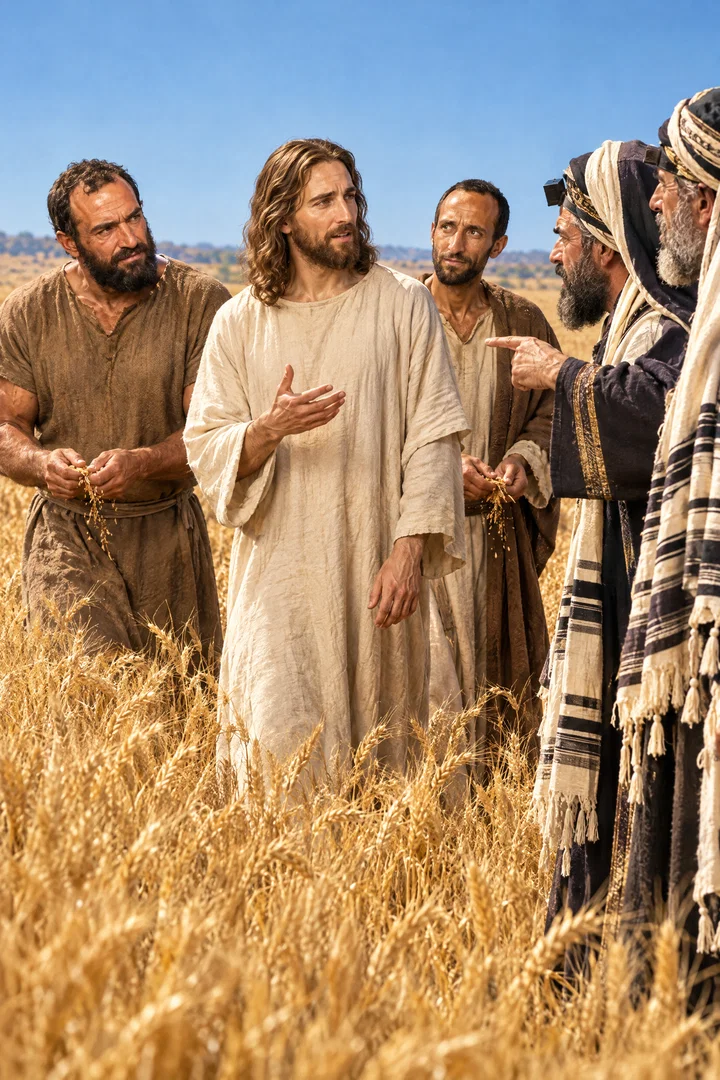
Mark 2:24 refers to what happened as Jesus and His disciples were returning from worship through a field of ripening grain, after His work had continued to a late hour, when the disciples, to satisfy hunger while passing through, plucked heads of grain, rubbed out the kernels in their hands, and ate them.DA 283.4–284.1PP 531.1–2ST Sep 16, 1913HSFM 165.2Ms 43b, 1891, par. 9 The Pharisees charged this as Sabbath desecration, as doing on the Sabbath day that which was not lawful, although the same act was lawful on any other day.DA 283.4–284.1 In rabbinical opinion it was a double offense, the gathering being treated as a kind of reaping and the rubbing as a kind of threshing.DA 283.4–284.1
The disciples' act was permitted by God's law, which allows a hungry person entering a neighbor's field, orchard, or vineyard to take grain or fruit to satisfy hunger, so that gathering grain to eat while passing through a field was lawful even on the Sabbath.PP 531.1–2HSFM 165.2 The charge came not from the law of God but from burdensome human requirements that had perverted the Sabbath after departing from God and failing to make the righteousness of Christ their own by faith.DA 283.4–284.1 That human perversion had made Sabbath observance reflect the character of selfish and arbitrary men rather than the loving Heavenly Father.DA 283.4–284.1 It virtually represented God as a tyrant giving laws impossible to obey and as requiring an observance that made men hard-hearted and cruel, though the Sabbath is the sign of Christ's power.DA 283.4–284.1
Jesus denied and repelled the charge and showed the disciples to be guiltless, establishing their innocence as fully in harmony with the Sabbath commandment.ST Sep 16, 1913Ms 43b, 1891, par. 9 He covered them with the shield of His own prerogatives with a dignity He alone possesses as God in the flesh in whom dwells all the fullness of the Godhead bodily.Ms 43b, 1891, par. 9 Christ did not conform to those human requirements but kept the Sabbath according to the law of God in order to clear away these misconceptions.DA 283.4–284.1
The accusers acted from impatience to accuse Christ, waiting and critically spying upon all His actions and words, and when they found nothing else they seized upon His disciples' act.Ms 43b, 1891, par. 9 Their accusation was foolish and blind, as if they had put out their eyes, and showed the weakness of human judgment.STMW6 43.2Ms 43b, 1891, par. 1 For in charging Jesus with transgressing the Sabbath they condemned the One who made the Sabbath and is its Lord.STMW6 43.2Ms 43b, 1891, par. 1
Sources
Pioneers and periodicals
62 sources
The Pharisees accused Jesus because his hungry disciples plucked ears of grain and ate them as they passed through a field on the Sabbath.ST Oct 22, 1894ST Nov 11, 1897RH Feb 4, 1862 Their charge of doing what is not lawful rested on human traditions that counted plucking as reaping and rubbing as threshing, not on God's Sabbath law.ST Apr 14, 1881ST Mar 4, 1889ST May 17, 1910ST Oct 22, 1894ST Oct 22, 1894 The disciples were guiltless and right, for need like David's hunger and mercy like feeding the hungry outweigh ceremonial restriction and human rules.ST Apr 14, 1881ST Nov 11, 1897RH Feb 4, 1862RH Sep 2, 1851ST Oct 22, 1894 The Sabbath was made for humanity's good and rest, allowing works of necessity and mercy, and Jesus as Son of man and Lord of the Sabbath had perfect right to interpret it and acquit them.ST Apr 14, 1881ST Nov 11, 1897ST Jan 6, 1881RH Jun 24, 1858RH Oct 14, 1873 He did not break or abolish it but honored it, and the day in question was the seventh day of the fourth commandment, still binding and not transferred to the first day.ST Dec 17, 1894RH Nov 5, 1861ST Jan 30, 1879ST Nov 18, 1880
Incident and Setting
The saying is a challenge addressed to Jesus because his hungry followers plucked heads of grain and ate them while going through a field on the Sabbath, an act the challengers judged unlawful.ST Oct 22, 1894ST Nov 11, 1897RH Feb 4, 1862RH Apr 5, 1860RH Apr 21, 1863 The complaint was about Sabbath observance, not Sunday, and about the plucking and eating to satisfy hunger, not about merely walking through the field or taking an ordinary or unlawful journey.RH Feb 4, 1862RH Apr 5, 1860RH Apr 21, 1863ST Nov 26, 1894 The disciples acted because they were hungry.ST Nov 26, 1894
The field lay in Galilee near a town on a Sabbath shortly after Passover when the barley was ripening, and the hungry disciples plucked ears of barley and rubbed them in their hands to eat.ST Apr 14, 1881ST Apr 15, 1886 The grain was still in its milky stage, when sweet, juicy and easy to digest.RH Jun 26, 1900 Their hunger arose because no Jew broke fast until after the morning synagogue service or ate supper until after the evening service.ST Apr 14, 1881
The Pharisees watched Jesus closely to accuse him for sanctioning the eating, treating eating rather than waiting hungry a few hours as Sabbath-breaking worthy of stoning.ST Apr 14, 1881 Any act regarded as desecration brought close watching at every turn, constant collision and debate, heated contests, trial and even violence.ST Oct 19, 1882
The account is part of the story of Jesus and the Sabbath parallel to Matthew 12:1-13, and the same account of plucking ears of corn to eat to satisfy hunger is also given by Luke.ST Feb 17, 1898RH Aug 15, 1854 The phrase on the Sabbath day renders the Greek dative plural form of Sabbath used with singular meaning.RH Jan 5, 1864
Charge From Tradition
The charge of doing what is not lawful rested on rabbinical rules and human traditions, on the Mishna and corruptions of Scripture, not on God's Sabbath law.ST May 17, 1910ST Oct 22, 1894ST Jan 30, 1879RH Feb 11, 1858RH May 31, 1864 It set truth against tradition, not spirit against letter, for the disciples were not breaking God's law and Jesus kept the Sabbath as it ought to be kept, doing only what is lawful and in perfect harmony with the law rightly interpreted.ST May 17, 1910ST Jan 30, 1879RH May 31, 1864 What the Pharisees meant by unlawful was unlawful according to their own traditions and interpretation of God's law, traditions claimed to be founded on the Sabbath law but working against love to neighbor and good toward man.ST Oct 22, 1894ST Oct 22, 1894ST Jan 30, 1879 Those added rules burdened the Sabbath, and necessity outweighed the ceremonial restriction and the human restrictions surrounding it, for God did not make His laws to bring people to destruction.ST Oct 22, 1894ST Oct 22, 1894
Plucking ears was counted as a kind of reaping, and rubbing them in the hands as a kind of grinding or threshing, even shelling.ST Apr 14, 1881ST Mar 4, 1889ST Sep 8, 1881ST Apr 26, 1905 Rubbing out wheat in the hands was counted as threshing and therefore unlawful labor, and rubbing was treated as preparing food that should have been prepared Friday before sunset.ST Apr 14, 1881ST Mar 4, 1889 The Pharisees so construed plucking and rubbing grain on the sacred day as reaping and threshing, classifying the rubbing of kernels from the heads as threshing.ST Sep 8, 1881
After suffering many things for Sabbath-breaking the Jews went to the other extreme, loading the Sabbath law down till it became a burden.ST Mar 4, 1889ST Jun 11, 1894 Their exacting restrictions turned the day God intended as delight and refreshing rest into a burden and hindered joy, obscuring proper attention to the sick.ST Apr 26, 1905 They would not heal the sick or relieve the needy and oppressed, counting healing the sick unlawful labor, especially when the lame man was bidden to carry his bed.ST Mar 4, 1889ST Mar 12, 1894 The dispute arose from traditions that treated ordinary actions and even satisfying hunger as unlawful, while Christ's practice and teaching opposed these rules while honoring the Lord's Sabbath and allowing acts of mercy and goodness.ST Jun 11, 1894ST Mar 12, 1894
The Pharisees accused the disciples directly and Christ indirectly, treating the disciples' action while walking through the field as unlawful.ST Sabbath violation was among the charges brought against Him, and the dispute formed part of the opposition to Christ for keeping God's commandments.ST The Sabbath they meant was the seventh day of the week and no other, not the first day.
The accusation does not by itself prove the law was broken, for Jesus declared the conduct lawful with His approval and said the accusers had condemned the guiltless.RH Nov 1850RH May 13, 1875 The disciples were charged with breaking the fourth commandment by gathering grain on the Sabbath, but the charge was false and reflected ideas of observance differing from God's.RH Nov 1850RH Nov 5, 1861 The work was a matter of urgent necessity and was in accord with the Sabbath's requirements, and Jesus answered that they were not guilty.RH Nov 1850RH Nov 5, 1861
Mercy and Necessity Justified
The plucking and eating on that Sabbath was excusable, guiltless, right and lawful, and the charge of violation was false.ST Apr 14, 1881ST Sep 16, 1913ST Nov 11, 1897RH Feb 4, 1862RH May 13, 1875 The accused were declared guiltless and their conduct was declared lawful with approval, acquitted from blame by appeal to the very statutes they were said to have violated.ST Apr 14, 1881ST Sep 16, 1913ST Nov 11, 1897RH Feb 4, 1862RH May 13, 1875 The dispute turned on whether the act was lawful when done in His presence and with His approval.ST Nov 11, 1897RH Feb 4, 1862RH May 13, 1875
The answer was given through David's need and hunger, for David and his men were justified by need in eating bread normally reserved for priests.ST Nov 11, 1897ST Oct 22, 1894RH Sep 1, 1859 As their need justified that eating, so the disciples' need for food likewise outweighed ceremonial restriction and the human traditions added to the Sabbath.ST Nov 11, 1897ST Oct 22, 1894ST Oct 22, 1894 The reply therefore points to hunger and necessity as outweighing the ceremonial restriction and the traditions surrounding the Sabbath.ST Nov 11, 1897ST Oct 22, 1894ST Oct 22, 1894
The priests' Sabbath temple service was also cited to show that such necessity and appointed worship did not violate the Sabbath.ST Apr 14, 1881RH Feb 4, 1862 Plucking and eating grain to sustain bodily strength for use in God's service stands in harmony with the law like the work done in the temple on the Sabbath.ST Apr 14, 1881RH Feb 4, 1862
The lesson missed was mercy and not sacrifice, for meeting hungry need was an act of mercy and not forbidden needless work.ST Nov 11, 1897RH Sep 2, 1851 Mercy takes precedence over ceremonial rules when human need calls, so the Sabbath was to be observed but not in a way that neglects mercy or imposes a burdensome yoke.ST Nov 11, 1897RH Sep 2, 1851ST Oct 22, 1894ST Oct 22, 1894 The grain was lawful to take from a neighbor's field, and because the disciples were hungry its taking was no Sabbath-breaking.ST Nov 11, 1897RH Sep 2, 1851
Service to God comes first, so when fatigue and hunger attend His work it is right to satisfy human need even on the Sabbath day.ST Apr 14, 1881 Such eating sustains bodily strength for use in His service, while the same labor done for ordinary business would violate the law.ST Apr 14, 1881
God did not make His laws to bring people to destruction, and necessity outweighed the human restrictions surrounding the Sabbath.ST Oct 22, 1894ST Oct 22, 1894
Sabbath Made for Humanity
The Sabbath was made for people, not for people to serve it as its servants, for it is a merciful institution for humanity's good.ST Jan 6, 1881RH Jun 24, 1858RH Oct 14, 1873ST Mar 28, 1878RH Apr 11, 1854 It was made to give rest and peace and to remind of the Creator's work, not to interfere with the needs of being with pain and discomfort as a grievous burden.ST Apr 14, 1881ST Jan 6, 1881RH Oct 14, 1873 It is perfectly adapted to human condition, meeting physical and spiritual wants for rest and a day devoted to the special service of God, and designed mercifully to provide needed physical, intellectual, moral and spiritual refreshment.ST Apr 14, 1881ST Mar 28, 1878RH Apr 11, 1854 Satisfying hunger by plucking and eating grain on that day did not violate it, and its proper use serves human good.RH Jun 24, 1858ST Jan 30, 1879RH Aug 15, 1854 Christ as its Lord protects it rather than abolishing it, and his appeal to it supports his merciful actions and defense against the charge of Sabbath-breaking.ST Apr 14, 1881ST Jan 6, 1881RH Oct 14, 1873
The charge mistook the real design of the institution and viewed it in a wrong light, as if it were a burden not adapted to human wants.RH Jun 24, 1858ST Jan 30, 1879RH Apr 11, 1854 Jesus corrected mistaken human ideas about its purpose and proper observance and restored it to its intended place, distinguishing its proper use from superstitious abuse.RH Apr 5, 1860RH Nov 14, 1871RH Jun 24, 1858 People may meet necessary needs and do merciful work, such as visiting the sick and preaching or hearing the gospel even when that requires travel or bodily effort, without violating its law.RH Apr 5, 1860ST Mar 12, 1894ST Jan 30, 1879 He opposed the counterfeit Sabbath of distorted human-made restrictive rules while honoring the real Sabbath established at Sinai, respecting it and teaching reverence for it.RH Nov 14, 1871ST Mar 12, 1894ST Jan 30, 1879ST Sep 15, 1887 His answer rebuked tradition without abrogating the commandment in its original purpose as given to humanity.ST Jan 30, 1879ST Sep 15, 1887
What he did on that day was lawful according to the Sabbath law, so he did not break or change it but honored it.ST Dec 17, 1894ST Jan 30, 1879ST Nov 18, 1880ST Jun 6, 1878RH Apr 23, 1872 He did not repeal or loosen the command to hallow the day, did not abolish the Sabbath or transfer its sanctity to another day, and did not replace the seventh day with the first.RH Nov 14, 1871ST Nov 18, 1880ST Jun 6, 1878RH Apr 23, 1872RH Aug 15, 1854 Satisfying hunger in this way was not treading the holy day under foot when it is kept holy according to the commandment, but added honor to it.ST Dec 17, 1894ST Nov 18, 1880RH Aug 15, 1854 His defense leaves it still unrevoked and binding like all the other commandments, upholding it as his own institution.ST Jan 30, 1879ST Nov 18, 1880ST Jun 6, 1878 The episode therefore supports its continuing importance and binding character rather than teaching its abolition.RH Apr 5, 1860RH Jun 24, 1858RH Apr 23, 1872
The law rightly understood allows acts of mercy and goodness and works of necessity, such as relieving hunger and healing, as distinct from work that violates its sacredness.ST Jun 11, 1894ST Nov 18, 1880ST Jun 20, 1911ST Mar 28, 1878 Keeping it does not mean idle rest, but resting from work done for personal profit or pleasure and honoring God.RH Apr 5, 1860ST Jun 20, 1911ST Mar 28, 1878 Necessary work and works of mercy are not forbidden, and how much work is needed must be settled by each conscience before God.RH Apr 5, 1860 Household tasks such as cooking, washing dishes and making beds should be kept as light as possible, though some may be necessary.
Lord of the Sabbath
Jesus identified himself as Son of man and Lord of the Sabbath, above all question and above all law.ST Apr 14, 1881ST Nov 11, 1897ST Jan 30, 1879 As Lord of the Sabbath day he has perfect right to interpret the meaning of the Sabbath law.ST Apr 14, 1881ST Jan 30, 1879 By that authority he acquitted the disciples from blame by appeal to the very statutes they were accused of violating, declaring them guiltless.ST Apr 14, 1881ST Nov 11, 1897 His answer defended meeting human need on the Sabbath and rebuked tradition without abrogating the commandment in its original purpose as given to man.ST Nov 11, 1897ST Jan 30, 1879
His lordship means he protects the Sabbath rather than abolishing it.ST Jan 6, 1881RH Nov 14, 1871RH Oct 14, 1873 He preserves it and upholds it rather than replacing the seventh day with the first.RH Nov 14, 1871RH Oct 14, 1873 His appeal to the Sabbath supports his merciful Sabbath actions and his defense against charges of Sabbath-breaking.ST Jan 6, 1881RH Oct 14, 1873 He was correcting human traditions and restoring the Sabbath to its intended place, not claiming authority to change its day.RH Nov 14, 1871RH Oct 14, 1873 The Sabbath so upheld is a merciful institution for humanity's good and a universal obligation for all mankind, not merely a church ordinance, and its observance is to be guided by what is lawful.ST Jan 6, 1881RH Nov 14, 1871RH Oct 14, 1873
He took special pains to teach what is lawful on the Sabbath day.RH Apr 18, 1871 This proves the Sabbath law is binding in the gospel age and shows duty in regard to the Sabbath.RH Apr 18, 1871 It proves the Bible a sufficient rule of faith and practice on the Sabbath question.RH Apr 18, 1871
His defense upholds the Sabbath as a divine institution with divine authority.RH Nov 1850ST Jan 28, 1903 That authority establishes the seventh-day Sabbath made for humanity and calls for enlightened, strict obedience to it.RH Nov 1850ST Jan 28, 1903 The work in question was a matter of urgent necessity and was in accord with the Sabbath's requirements, so accusation alone does not establish breach of the fourth commandment.RH Nov 1850 His action shows his authority as its teacher and interpreter.RH Nov 1850ST Jan 28, 1903RH Sep 3, 1908
Seventh Day Still Binding
The Sabbath named in the rebuke is the seventh day of the week, Saturday, the Sabbath of the Lord of the fourth commandment, not Sunday or the first day of the week.RH Nov 5, 1861RH Jun 5, 1860ST Apr 15, 1886ST Dec 4, 1884 The Pharisees accused the disciples, and indirectly Christ, of doing what was unlawful on that day because they plucked ears of grain, rubbed them in their hands, and ate them to satisfy hunger as they walked through the field.ST Apr 15, 1886ST Dec 4, 1884 Jesus answered that they were not guilty, and his declaration that the Son of man is Lord of the Sabbath was given to refute that accusation and therefore fixes the seventh-day Sabbath as the Lord's day in agreement with the fourth commandment.RH Nov 5, 1861ST Dec 4, 1884 The day is proved to be Saturday by the fact that it was the day the Pharisees themselves recognized as the Sabbath, and the incident took place on the seventh day, not on the sixth day.RH Nov 5, 1861ST Dec 4, 1884 To call the incident a Sunday meal misrepresents the account, for the seventh day remains the day God blessed and sanctified, and human agreement cannot make the first day sacred or transfer God's blessing to it.ST Apr 15, 1886ST Jul 23, 1912 The verse is thus one of the New Testament texts that call the seventh day the Sabbath, showing that the seventh-day Sabbath is recognized in the Christian dispensation.RH Jun 5, 1860
Christ and the Pharisees recognized the same day as the Sabbath, confirming that the seventh-day count had remained correct from the time of the law to Christ.RH May 17, 1870 Christ called no other day the Sabbath than the day recognized by his Father, and he did not tell his accusers that they had their Sabbath reckoning wrong.RH May 17, 1870RH Oct 21, 1858 His complaint shows the event was understood to have occurred on the Sabbath, and his defense of the disciples against the charge affirmed the Sabbath rather than treating it as lost or uncertain.RH Oct 21, 1858ST Nov 17, 1881 The day then observed was the true Sabbath, and the seventh day was to be kept holy.ST Nov 17, 1881
Christ was speaking of the definite seventh day made holy at creation, and the Sabbath institution and its day cannot be separated, so the verse does not support transferring the Sabbath to the first day of the week.RH Oct 24, 1871 He was correcting human traditions and restoring the Sabbath to its intended place, not claiming authority to change its day, for the Sabbath was made for all mankind as a universal obligation and not merely as a church ordinance.RH Nov 14, 1871 His lordship means he upholds and protects it rather than replacing the seventh day with the first.RH Nov 14, 1871 The disciples did not sin by picking and shelling grain as they walked, because they were meeting the necessity of eating their own meal.ST Sep 19, 1911 The incident concerns the Lord's Sabbath, Sunday was not regarded as the Sabbath, and the passage stands in contrast to later church festival days and Sunday legislation.ST Sep 19, 1911
The verse speaks of the weekly Sabbath, the Sabbath of the Lord, as one of fifty-nine such New Testament mentions showing the Sabbath of the Lord as existing in the present dispensation as really as in the former dispensation, in contrast to the eight mentions of the first day of the week, none of which sanctify that day.ST Mar 16, 1882RH Mar 19, 1857 The account parallels Matthew 12:1-13, and it stands under the teaching that Sabbath observance is an important duty by which man shows homage and loyalty to his Creator.ST Feb 17, 1898 The Sabbath command is in the bosom of the law of God and is the seal of God's law because it alone tells by whom the law was given, the reason for its establishment, and the authority of the Giver, and it is God's own appointed memorial of completed creation.ST Feb 17, 1898 Its only true observance is on the particular day God appointed, and changing the memorial day is unreasonable, so the claim that the commandment requires only one day of rest after six days of labor is false, as shown by the fourth commandment and by the miracle of the manna which would have corrected Israel in the wilderness if they had numbered the days to rest on another day.ST Feb 17, 1898 Whoever is tempted to set the command aside and teach others so brings upon himself the Saviour's warning.ST Feb 17, 1898 Merely listing Mark 2:23-28 among New Testament references concerning the Sabbath does not by itself show that it teaches that any day may be kept, for each passage must be considered in its own setting.ST Jan 29, 1902
Warning and Application
The strictness toward the Sabbath was so fanatical that any act regarded as desecration brought close watching at every turn, constant collision and debate, heated contests, trial and even violence.ST Oct 19, 1882 The hungry disciples eating of the standing corn through which they passed, and the repeated condemnations for healing on that day, show that pattern.ST Oct 19, 1882 Therefore the absence of such collisions and arrests over Sabbath desecration in the thirty-year record of Acts proves the early disciples were not Sabbath-breakers.ST Oct 19, 1882
The charge of doing what is not lawful on the Sabbath rested on straight-jacketed ideas of how the Sabbath must be kept, not on the positive command of God.ST Nov 21, 1895 Prosecuting Christ's followers for not observing the Sabbath according to those own rules is the same work as prosecuting Adventists for quiet Sunday labor simply because they do not observe according to the prosecutors' ideas.ST Nov 21, 1895 Treating Sabbath observance as a matter of enforcing rules, as in condemning the disciples for rubbing grain in their hands to eat, is condemned.ST May 28, 1912ST Feb 2, 1915 Compelling people to appear to keep a holy day cannot make them worship God or love the day, because worship must be voluntary, and the complaint illustrates how people try to impose their own rules about religious duty on others.ST May 28, 1912ST Feb 2, 1915
The challenging of the disciples' Sabbath activity raises the question of what work is necessary on the Sabbath. Necessary work and works of mercy are not forbidden, and how much work is needed must be settled by each person's conscience before God. Household tasks such as cooking, washing dishes, and making beds should be kept as light as possible, though some may be necessary. The accusation of breaking the Sabbath when they rubbed and ate grain was denied, and they were shown to be guiltless and fully in harmony with the Sabbath commandment.ST Sep 16, 1913 Those who held the opposite position used the opponents' accusation that the disciples did what was unlawful as evidence that Christ broke the Sabbath and taught His disciples to do so.RH Jun 18, 1872
Sources