John 19:5
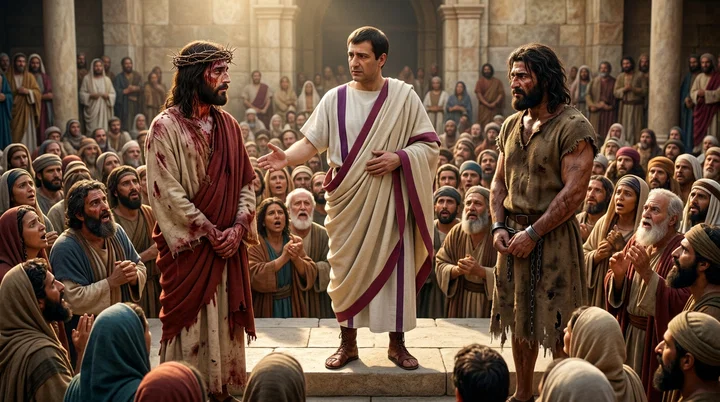
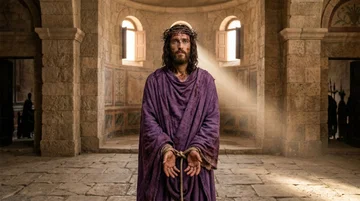
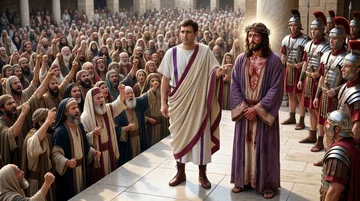
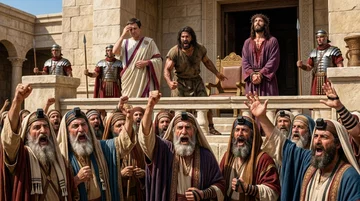
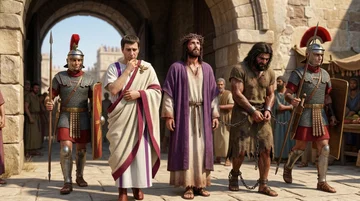
Then came Jesus forth, wearing the crown of thorns, and the purple robe. And Pilate saith unto them, Behold the man!
Translations
Then came Jesus forth, wearing the crown of thorns, and the purple robe. And Pilate says to them, Behold the man!
Then came Jesus forth, wearing the crown of thorns, and the purple robe. And Pilate saith unto them, Behold the man!
Then came Jesus forth, wearing the crown of thorns, and the purple robe. And Pilate saith unto them, Behold the man.
Then Jesus came forth, wearing the crown of thorns, and the purple robe. And Pilate saith to them, Behold the man!
Revised Version, American Standard Version
Jesus therefore came out, wearing the crown of thorns and the purple garment. And Pilate saith unto them, Behold, the man!
Jesus, therefore, came forth without, bearing the thorny crown and the purple garment; and he saith to them, 'Lo, the man!'
( Jesus therefore went forth without, wearing the crown of thorn, and the purple robe.) And he says to them, Behold the man!
Jesus, therefore, came forth outside, wearing the thorn crown, and the purple mantle. And he saith unto them—Lo! the Man!
Berean Standard Bible, Majority Standard Bible
When Jesus came out wearing the crown of thorns and the purple robe, Pilate said to them, “ Here is the man!”
Jesus therefore came out, wearing the crown of thorns and the purple garment. Pilate said to them, “ Behold, the man!”
Then Jesus came out with the crown of thorns and the purple robe. And Pilate said to them, Here is the man!
Then came Iesus foorth wearing a crowne of thornes, and a purple garment. And Pilate said vnto them, Beholde the man.
Douay-Rheims (Challoner revision)
( Jesus therefore came forth, bearing the crown of thorns and the purple garment.) And he saith to them: Behold the Man.
Pictures
Cross-references 20 of 24
- John 18:38
Pilate saith unto him, What is truth? And when he had said this, he went out again unto the Jews, and saith unto them, I find in him no fault at all.
Pilate asks what truth is, then declares Jesus innocent.
- Matthew 27:27-31
Then the soldiers of the governor took Jesus into the common hall, and gathered unto him the whole band of soldiers.
A parallel account of Jesus’ mocking and suffering before crucifixion.
- Luke 23:18-23
And they cried out all at once, saying, Away with this man, and release unto us Barabbas:
The crowd chooses Barabbas and demands Jesus’ crucifixion despite Pilate’s efforts to release him.
- Mark 15:16-20
And the soldiers led him away into the hall, called Prætorium; and they call together the whole band.
The soldiers mock Jesus before leading him away to be crucified.
- John 19:15
But they cried out, Away with him, away with him, crucify him. Pilate saith unto them, Shall I crucify your King? The chief priests answered, We have no king but Cæsar.
The leaders reject Jesus as King and demand his crucifixion.
- Matthew 27:24
When Pilate saw that he could prevail nothing, but that rather a tumult was made, he took water, and washed his hands before the multitude, saying, I am innocent of the blood of this just person: see ye to it.
Pilate declares Jesus innocent while trying to avoid responsibility.
- Luke 23:4
Then said Pilate to the chief priests and to the people, I find no fault in this man.
Pilate declares Jesus faultless yet delivers him.
- Matthew 27:22-23
Pilate saith unto them, What shall I do then with Jesus which is called Christ? They all say unto him, Let him be crucified.
The crowd demands Jesus’ crucifixion.
- Isaiah 53:3
He is despised and rejected of men; a man of sorrows, and acquainted with grief: and we hid as it were our faces from him; he was despised, and we esteemed him not.
The despised Saviour is presented as the Man of Sorrows.
- Revelation 19:12
His eyes were as a flame of fire, and on his head were many crowns; and he had a name written, that no man knew, but he himself.
The thorn-crowned Jesus returns wearing many crowns.
- Luke 23:11
And Herod with his men of war set him at nought, and mocked him, and arrayed him in a gorgeous robe, and sent him again to Pilate.
Herod’s soldiers also mocked Jesus and dressed him in a robe.
- John 19:1
Then Pilate therefore took Jesus, and scourged him.
Jesus is scourged before Pilate presents him.
- Matthew 27:2
And when they had bound him, they led him away, and delivered him to Pontius Pilate the governor.
A parallel account of Jesus before Pilate.
- Mark 15:12-14
And Pilate answered and said again unto them, What will ye then that I shall do unto him whom ye call the King of the Jews?
Pilate asks what to do with Jesus, and the crowd demands his crucifixion.
- Genesis 3:18
Thorns also and thistles shall it bring forth to thee; and thou shalt eat the herb of the field;
The crown of thorns reflects the thorns brought forth under the ground’s curse.
- Luke 23:20-23
Pilate therefore, willing to release Jesus, spake again to them.
Pilate seeks to release Jesus, but the crowd demands his death.
- Isaiah 53:5
But he was wounded for our transgressions, he was bruised for our iniquities: the chastisement of our peace was upon him; and with his stripes we are healed.
His wounds and stripes answer for transgressions and bring healing.
- Isaiah 53:7
He was oppressed, and he was afflicted, yet he opened not his mouth: he is brought as a lamb to the slaughter, and as a sheep before her shearers is dumb, so he openeth not his mouth.
Jesus endures abuse without resistance.
- John 1:29
The next day John seeth Jesus coming unto him, and saith, Behold the Lamb of God, which taketh away the sin of the world.
John’s “Behold the Lamb” contrasts with Pilate’s “Behold the man.”
- Psalms 22:6
But I am a worm, and no man; a reproach of men, and despised of the people.
Both describe Christ as publicly insulted and despised.
Commentary
Each commentary is drawn from primary sources: the writings of Ellen G. White and Adventist pioneers and periodicals. Each commentary is separate. Its own words are not a quotation; follow the references to read the source passages.
Ellen G. White
19 sources
After scourging and mocking with thorns and a purple robe, Jesus is led out and set before priests, rulers and people.3SP 144.1Lt 100, 1910, par. 165RED 63.2–64.1 Pilate's call to behold Him is a solemn plea for pity to persuade them He has suffered enough, joined to his public witness that he finds no fault in Him.3SP 144.1COS 152.1–4DA 735.1–5 Bloodied, wounded and weary, He stands without guilt or fear in calm dignity, pity and patient endurance rather than weakness, in stark contrast to the hardened criminal Barabbas set beside Him.DA 723.1–724.1DA 735.1–5ST Jul 11, 18783SP 143.1–2 The plea is refused by a pitiless cry for crucifixion from those whose hatred will not yield even under conviction, so Pilate surrenders Him to be crucified to save his own place while still declaring Him faultless.3SP 144.1COS 152.1–4ST Jul 11, 1878 The scene shows God veiled in humanity exchanging royal crown and robe of glory for mockery as the man of sorrows, wounded for human transgressions and bruised for human iniquities that people may be healed.12MR 413.4–414.2Lt 106a, 1896, par. 27 Though He could summon heaven and flash forth divine majesty, He submits without retaliation to shame and death to keep perfect allegiance, disprove the claim that God's law cannot be kept, and strengthen suffering believers to overcome by His blood and follow His serving example.Lt 100, 1910, par. 16Ms 74, 1911, par. 17Lt 12, 1911, par. 8–11Ms 11, 1885, par. 13
Pilate Presents Jesus Scourged
After the scourging and the soldiers' mocking with a thorny crown and a purple robe of derision, Jesus was led out and set before the priests, rulers, and people.3SP 144.15RED 63.2–64.1Ms 51, 1897, par. 31–32ST Nov 2, 18825RED 63.1 The scourged prisoner thus stood exposed in the emblems of mock royalty as Pilate called the multitude to look upon him.3SP 144.1Lt 100, 1910, par. 165RED 63.2–64.1ST Nov 2, 18825RED 63.1
That call to look was a solemn plea intended to awaken pity, to convince the crowd that He had suffered enough, and to satisfy their demand for punishment.DA 735.1–5ST Jul 11, 18785RED 63.2–64.1ST Nov 2, 18825RED 63.1 With it Pilate publicly declared again and again that he found no fault in Him.3SP 144.1COS 152.1–4DA 735.1–5ST Jul 11, 1878Ms 51, 1897, par. 31–32
Though bloodied, wounded, and exhausted, Jesus bore no mark of guilt or fear but calm dignity, gentleness, resignation, and pity for His enemies.DA 723.1–724.1DA 735.1–5ST Jul 11, 18783SP 143.1–2COS 151.2–4 His bearing was long-suffering strength and patient endurance, not weakness or cowardice.DA 735.1–5ST Jul 11, 18785RED 63.2–64.13SP 143.1–2 That composure made a favorable impression on Pilate and impressed even the soldiers who had abused Him, showing He was no dangerous criminal and had not lost His kingly bearing under suffering.DA 723.1–724.1DA 735.1–5
Beside Him stood Barabbas, a hardened and debased criminal, a robber and murderer.DA 735.1–53SP 143.1–25RED 63.1Lt 12, 1911, par. 8–11 Against that hardened appearance the innocence, noble character, and suffering patience of Jesus stood in stark contrast.DA 735.1–5ST Jul 11, 18783SP 143.1–25RED 63.1COS 151.2–4 The contrast moved some spectators to sympathy.COS 152.1–4DA 735.1–5
The appeal was rejected, for the crowd felt no pity but cried out for crucifixion.3SP 144.1ST Jul 11, 18785RED 63.2–64.1Ms 51, 1897, par. 31–32ST Nov 2, 1882 Even priests and rulers who were convicted that He was who He claimed to be refused to yield, and Pilate had failed to reckon with a hatred that had no room for pity because His light exposed their darkness and error.COS 152.1–43SP 143.1–2 Pilate then told them to take Him and crucify Him while still declaring Him faultless, surrendering Him to be derided and crucified to save his own office and releasing Barabbas at their demand.COS 152.1–4Lt 12, 1911, par. 8–11
The scene belongs to the trial and humiliation before the crucifixion, with what followed set on the way from Pilate's hall to Calvary.Lt 100, 1910, par. 16DA 722.54RED 102.2–103.1 It was one phase of a public, point-after-point exposure appointed by God and witnessed by a large company, ordered to take place at the Passover.12MR 413.4–414.2
What the Humiliation Accomplishes
The scene shows One who came from the heavenly courts as God veiled in humanity, the One to whom the Jewish sacrifices pointed and the foundation of the Jewish economy.12MR 413.4–414.2 He exchanged His royal crown and robe of majesty and glory to wear mockery, a crown of thorns and a cast-off purple robe, as the man of sorrows.12MR 413.4–414.2Lt 106a, 1896, par. 27 He was wounded for human transgressions and bruised for human iniquities, and through His suffering people are healed and may be saved.Lt 106a, 1896, par. 27 His being brought forth thus was one phase of humiliation in a public, point-after-point exposure appointed by God and witnessed by a large company, an intense suffering in a shameful crowning scene ordered to take place at the Passover.12MR 413.4–414.2 There He who was betrayed, forsaken, denied, scorned as a deceiver, given a mock trial and declared by Pilate to have no fault, was yet condemned as innocent to death and rejected by satanic and human agency in favor of a robber and Caesar.12MR 413.4–414.2
Though by a command He could bring the heavenly hosts to His aid and drive the mob in terror from His sight by the flashing forth of His divine majesty, He submitted with perfect calmness to the coarsest insults and outrage.Lt 12, 1911, par. 8–11 Satan stood at the head of those reviling and crucifying Him and led the cruel mob in abuse of the Saviour to provoke Him to retaliation if possible or to drive Him to perform a miracle to release Himself and break up the plan of salvation.Lt 12, 1911, par. 8–11 From the manger to the cross He lived a sinless life and never once swerved from allegiance to His Father, keeping Himself the perfect Lamb without stain so that one stain would not make the redemption of man a failure.Lt 12, 1911, par. 8–11 By enduring this open shame and by His cruel death of shame on the cross of Calvary He proved false Satan's assertion that the law of God could not be kept.Lt 12, 1911, par. 8–11 By His death He proved false Satan's charges against God and vindicated God in the sight of the angels in heaven as One willing to make in man's behalf the greatest sacrifice that could be made.Lt 12, 1911, par. 8–11 Pilate brought Him, humiliated, mocked and condemned, before the maddened throng and declared he found no fault in Christ, yet delivered Him into the hands of those demanding His death and called for the release of Barabbas, a robber and murderer.Lt 12, 1911, par. 8–11
The reversal from being hailed as king to being condemned, mocked and reviled, with the crowd crying for His death, had been prepared for beforehand.4RED 102.2–103.1 It was made known so that the crowd's fickleness and the apparent defeat of their hopes would not take faithful disciples by surprise nor make them abandon their faith.4RED 102.2–103.1 As part of the account of Christ's suffering and death, the scene of Jesus brought before the people after being scourged strengthens believers who suffer for their faith.Lt 100, 1910, par. 16 His death enables His followers to keep the faith, and those who hold fast receive His righteousness.Lt 100, 1910, par. 16 Pilate publicly declared before scornful accusers that he found no fault in Jesus, yet gave Him up to be derided and crucified to save his own office, letting Christ Jesus the Son of the living God have spikes driven through His hands and through His feet and hang upon the cruel cross, and this account of how Jesus was in the world and suffered is to be borne to those in the world as the word of testimony by which impurity and sin are overcome by the blood of the Lamb.Ms 74, 1911, par. 17 He is presented, crowned with thorns and wearing a purple robe, as the Man to behold, the Man of Calvary who lived for others and came to serve, and following His example leads others in the way of righteousness.Ms 11, 1885, par. 13
Sources
Pioneers and periodicals
38 sources
After the soldiers mocked him as a king, he came forth scourged, exhausted and bleeding, wearing a real crown of thorns that pierced him and a mock-royal purple robe.ST May 13, 1897ST Jul 14, 1881RH Dec 9, 1858RH Dec 2, 1873 Pilate presented him to priests, rulers and people as innocent, declaring he found no fault in him and displaying his miserable, bloodied condition in a last solemn appeal to stir pity and secure his release.ST Jul 11, 1878ST Nov 2, 1882ST May 13, 1897ST Oct 7, 1886ST Nov 9, 1882 The appeal failed because the stirred-up rulers answered with demands to crucify him, exposing Pilate's cowardly compromise in scourging an innocent man to appease the mob.ST Oct 7, 1886ST Feb 5, 1902ST Nov 9, 1882ST Oct 7, 1886 Beneath the mockery he stands revealed as the God-man, humanity's Brother, Redeemer and true King, spotless and sinless, humble and serene yet more than kingly in meekness.ST Mar 21, 1906ST Oct 28, 1897RH Jan 9, 1900RH Jun 24, 1902 The same one who stood thorn-crowned in humiliation will come triumph-crowned in glory to receive his people, and by often beholding him in that suffering condition people are changed into his image as the perfect pattern of life.ST Mar 21, 1906ST Oct 28, 1897RH Jul 24, 1856ST Aug 17, 1904RH Feb 7, 1871
Trial Before Pilate
After the soldiers had mocked him as a king, they put a royal-colored robe on him and a crown of thorns on his head, and he came forth scourged, exhausted, and bleeding, still wearing the crown and the purple garment.ST May 13, 1897ST Jul 14, 1881RH Dec 9, 1858 Pilate brought him out in that condition before the people to display him to them.ST May 13, 1897ST Jul 14, 1881RH Dec 9, 1858
Pilate presented him to priests, rulers, and people with the summons to behold the man, repeatedly declaring that he found no crime or fault in him.ST Jul 11, 1878ST Nov 2, 1882ST May 13, 1897ST Oct 7, 1886ST Nov 9, 1882 His presentation was meant to prove innocence and to show that the charges had not been substantiated.ST Oct 7, 1886ST Oct 7, 1886 He had ordered Jesus scourged, stripped to the waist and lacerated, in an attempt to appease the mob, and then displayed his helpless, miserable, bloodied form in a solemn, pathetic, last appeal.ST Jul 11, 1878ST Nov 2, 1882ST Nov 9, 1882ST Oct 7, 1886ST Dec 1, 1898 The appeal was meant to stir pity, to satisfy the demand for punishment, and to secure his release.ST Jul 11, 1878ST Nov 2, 1882ST Nov 9, 1882ST Oct 7, 1886
The appeal failed because the priests had stirred the mob to mad fury.ST Oct 7, 1886 Instead of pity they answered with railing laughter and renewed cries to crucify him.ST Jul 11, 1878ST Nov 2, 1882ST Oct 7, 1886ST Dec 1, 1898 The rulers pressed the demand for crucifixion, while the people at large may for a time have remained silent.ST Nov 9, 1882 Pilate in despairing impatience then told them to take him and crucify him themselves, since he found no fault in him.ST Oct 7, 1886 The episode is included among the accounts of Israel's rejection of the Son, in which he is brought before the people in crown and robe before they demand his death.ST Feb 5, 1902
The course Pilate took reveals weakness and cowardice despite his recognition that Jesus was innocent. Having declared him innocent yet having him beaten and mocked to stir pity, he compromised justice and put himself at a disadvantage.ST Oct 7, 1886 That compromise made the crowd bolder in demanding death.ST Oct 7, 1886
Jesus stood beside Barabbas as Pilate presented him as the man.RH Apr 2, 1908ST Jan 17, 1911 Barabbas had a forceful, defiant, hardened criminal appearance, even an evil face, which contrasted with Jesus' exhaustion and pain.RH Apr 2, 1908ST Jan 17, 1911ST Oct 7, 1886 Yet amid the roaring crowd Jesus remained serene and pure, with noble character, patience, gentleness, dignity, and Godlike majesty still evident.ST Jul 11, 1878RH Apr 2, 1908ST Jan 17, 1911ST Oct 7, 1886 Though Pilate had declared him innocent, he endured this unmerited suffering and was handed over to be crucified, sacrificing his life so that others might be saved, his suffering on the way to die being for each person.RH Apr 8, 1902ST Mar 13, 1901
The verse belongs to the closing events of his life recorded in John 19:1-18, in which he was bound, insulted, beaten, and crucified.ST Jul 16, 1885 Those scenes include the gall and vinegar offered to him, words he spoke on the cross, and the earthquake and darkness that followed his crucifixion.ST Jul 16, 1885 They are scenes of cruel mockery and suffering at Calvary that a reader can picture witnessing.ST Feb 16, 1882
An excavated pavement in Jerusalem is identified as the pavement of Pilate's judgment hall.ST Nov 10, 1898 Portions of two arches are connected with it, one called the arch of Ecce Homo because Pilate's presentation of Christ in this verse is claimed to have taken place above it.ST Nov 10, 1898
Crown Robe and Summons
The crown was a real crown of thorns, not a painless ornament, and it cut and pierced his head until his face bore wounds and blood and open agony.RH Dec 2, 1873 It stands as his true badge of suffering, the opposite of a merely costly and kingly circlet of golden thorns that does not hurt.RH Dec 2, 1873
The purple robe thrown over him was mock purple, suggesting kingly authority even while it mocked it, and in it he came forth in abasement, crownless in worldly honor, poor and bleeding and stripped.ST Jun 7, 1899RH Jun 24, 1902RH Aug 26, 1875 His hands were bound, yet he remained serene and calm before his enemies.ST Jun 7, 1899 So displayed, the lowly sufferer is set over against Pilate, high in Zion and Rome and compelling the world with arms in all their pride.RH Jun 24, 1902
The summons means see this Man and look at him.ST Sep 25, 1901 It challenged the charge that he was a dangerous insurgent or rival king by holding up his helpless condition for all to see.ST Nov 9, 1882 It was Pilate's appeal to compassion and pity and to justice.ST Nov 9, 1882ST Jun 7, 1899
Person of Christ Revealed
Pilate intended only to stir sympathy, yet his summons declares a deeper truth that the suffering man in thorns and purple is the God-man, the Son of God made flesh, humanity's Brother, Redeemer, Saviour, Friend and King.ST Mar 21, 1906 He is Incarnate Truth in humble beauty come down from the glorious court on high. In human flesh with its tendencies he is the full-orbed man in trial and temptation, in sympathy and excellence of character, in strength and victory, in helpfulness and leadership, and in that flesh he conquered sin for all.ST Mar 21, 1906
He is the one Man of all nations, brother to the whole human race, not defined by one nation, born of a woman and under the law and sharing the human condition common to all.ST Mar 21, 1906ST Mar 21, 1906 His purpose, sympathy, love and power to save embrace every class and grade of people.ST Mar 21, 1906ST Mar 21, 1906
His spotless character did not come from being incapable of sin or from having his will bypassed.ST Oct 28, 1897 Crushed and torn, bent and wan and bound, with sacred hands bound, he did not appear royal.RH Jan 9, 1900ST Jun 7, 1899RH Sep 28, 1911 Yet as the lowly Nazarene he stood humble, serene, calm and pure, godlike in look and majesty, in contrast to the evil and defiant forcefulness beside him.RH Apr 2, 1908ST Jan 17, 1911RH Jan 9, 1900ST Jun 7, 1899 He stands as the harmless, sinless, spotless One who did no evil.RH Jan 9, 1900 His hands had blessed mankind by healing the sick and the lame and the blind, by feeding the hungering multitude and satisfying the poor with food, and he is mighty to drive back the shades of death by his breath.RH Jan 9, 1900
Beneath the mock purple and thorns his divinity still revealed its light.RH Aug 26, 1875 That light fell upon the Roman heart, waking conscience and breaking the pride of his strong spirit like a mighty spell.RH Aug 26, 1875 In that weakness of abasement, crownless, poor, bleeding and stripped of honor, he is sublime and awful, more than kingly in meekness, revealing him as the Son of God.RH Jun 24, 1902 He is the true King who will reign, the same King who in glory now intercedes, truly a King without a throne and a sovereign Lord without command, forsaken by his own.RH Jun 24, 1902RH Aug 26, 1875
Passover and Coming Glory
His sacrifice was as the Passover antitype, fulfilling the type of the paschal lamb killed on the fourteenth day of the first month by the death of the Lamb of God on that same appointed day.RH Oct 30, 1855ST Aug 13, 1874RH Dec 15, 1868 The account of his suffering and death belongs to that fulfillment at its appointed time, identifying the day of his death as the day the Passover lamb was slain.RH Oct 30, 1855ST Aug 13, 1874RH Dec 15, 1868
The crown of thorns in which he was brought out is connected to the curse on the ground in Genesis, and stands in contrast to John the Baptist's identification of him as the Lamb of God.ST May 13, 1897 He stood in dignified humility, weakened by fatigue and torture, made the subject of public insult and reproach, despised, the victim of envy and false accusation.ST Aug 17, 1904 His heart bled in sorrow and pity for those rejecting their only hope of salvation from sin, because all like sheep have gone astray to their own way and the Lord laid the iniquity of all upon him, and he was stricken for the transgression of his people.ST Aug 17, 1904
The summons to behold him points to the same mighty Nazarene and Prince of David dying high between earth and sky with darkened sun and rent temple veil.RH Jan 9, 1900 Death with its cold grasp could not hold him, but two shining seraphs bid him arise, and he is coming again in love and pity as the glorious hope bringing joy and everlasting years.RH Jan 9, 1900 He does not come again in humiliation in purple robe and crown of thorns.RH Jul 24, 1856 The same Jesus who stood thorn-crowned in the judgment hall will be triumph-crowned in God's courts and come in glory to receive his people.ST Mar 21, 1906RH Jul 24, 1856 As Conqueror led to certain victory he comes with a brighter crown on his brow than ever shone on a monarch, descending in all the Father's glory with shining hosts of angels attending his burning chariot to gather his saints home to endless day.ST Mar 21, 1906RH Jul 24, 1856
Beholding Him Today
He is the pattern for human life and the only perfect example of religion, faith, obedience, and service.ST Oct 28, 1897RH Feb 7, 1871 No one becomes like him by personal effort, but by beholding him people are changed into his image, and for that reason he should often be beheld as he stood in dignified humility, weakened by fatigue and torture, made the subject of public insult, reproach, contempt, envy, and false accusation, with his heart bleeding in sorrow and pity for those rejecting their only hope of salvation, since all like sheep have gone astray, the Lord laid the iniquity of all upon him, and he was stricken for the transgression of his people.ST Oct 28, 1897ST Aug 17, 1904 Christians are imitators of him rather than perfect examples in their own right, so repentance must never be made to depend on finding an ideally penitent companion, nor should anyone become disheartened by another Christian's outward superiority or failures.RH Feb 7, 1871
Reading the account of his sufferings subdues pride and removes discontent, and it can help the fretful, gloomy, or discontented Christian.ST Apr 17, 1879 His suffering gives ground for comfort in grief and pain, and calls for bearing hardship without complaint, seeking self-denial, and drawing closer to him in sympathy. He met that hour with no complaint or murmur and no appeal to honor, compassion, or pity, though such an appeal could have touched the hardest heart, keeping his mind under full control through suffering to death.ST Dec 1, 1898 His calm silence came not from being crushed with sorrow but from having risen to the serene joy of a conqueror, and in this he stands as a shining example to his followers when they suffer unjustly.ST Dec 1, 1898
He is the true pattern of courage and integrity, the man to behold when seeking those who do what is right and fear wrongdoing rather than human opposition.RH Dec 31, 1901 To behold him as the Man in meek suffering is to learn from his character and his commands to make peace, to be merciful, to resist not evil, to overcome evil with good, and to love enemies, for God is love.ST Sep 25, 1901 These commands forbid war and the taking of human life, so that to stamp his words and suffering example upon rifles, cannon balls, and bayonets going into battle exposes contradiction, and to support armies and bloodshed proves lack of faith in his religion.ST Sep 25, 1901
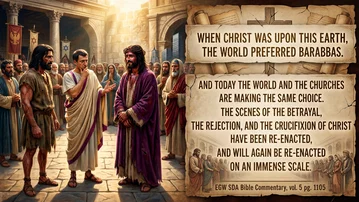
His humiliation belongs to the suffering by which sinners may be cleansed and made free from sin, as he stood before his enemies wearing the crown of thorns and the robe suggesting kingly authority, with bound hands yet serene and calm.ST Jun 7, 1899 With thorns pressing his anguished brow and blood slowly dripping as the price he pays as the perpetual sacrifice while heaven mourns, the mist must be lifted so that sinners see and know him in suffering as morality and hope of heavenly life.ST Jun 7, 1899ST Nov 17, 1898 Though he stood crushed and torn, crowned with thorns, bent and wan so that he did not appear royal, he was recognized as without fault, yet from fear of the crowd he was turned away and let be condemned instead of being saved by just power from scourging and crucifixion.RH Sep 28, 1911 That same choice remains a continuing danger when truth is rejected and Christ is yielded to his enemies, and the same test comes to every reader who must pass sentence and decide whether to take him as leader or condemn him to die.RH Sep 28, 1911
Sources