Translations
American King James Version, King James Version, KJV Cambridge Paragraph Bible
For he knew that the chief priests had delivered him for envy.
(For he knew that the chief priests had delivered him for envy.)
Revised Version, American Standard Version, World English Bible
For he perceived that for envy the chief priests had delivered him up.
for he knew that because of envy the chief priests had delivered him up;
for he knew that the chief priests had delivered him up through envy.
For he was getting to know that, for envy, had [the High-priests] delivered him up.
Berean Standard Bible, Majority Standard Bible
For he knew it was out of envy that the chief priests had handed Jesus over.
For he saw that the chief priests had given him up through envy.
For he knewe that the hie Priestes had deliuered him of enuie.
Douay-Rheims (Challoner revision)
For he knew that the chief priests had delivered him up out of envy.
Pictures

Cross-references 20 of 31
- Matthew 27:18
For he knew that for envy they had delivered him.
Pilate recognizes envy as the reason the leaders delivered Jesus.
- Luke 23:18-23
And they cried out all at once, saying, Away with this man, and release unto us Barabbas:
The crowd demands Barabbas’s release and Jesus’ crucifixion.
- John 18:39-40
But ye have a custom, that I should release unto you one at the passover: will ye therefore that I release unto you the King of the Jews?
Pilate offers to release Jesus, but the crowd chooses Barabbas.
- Luke 23:4
Then said Pilate to the chief priests and to the people, I find no fault in this man.
Pilate declares Jesus innocent despite the chief priests’ envy.
- Matthew 27:22
Pilate saith unto them, What shall I do then with Jesus which is called Christ? They all say unto him, Let him be crucified.
The crowd demands Jesus’ crucifixion after the leaders sway them to choose Barabbas.
- Acts 7:9
And the patriarchs, moved with envy, sold Joseph into Egypt: but God was with him,
Envy leads both Joseph’s brothers and Jesus’ accusers to betray him.
- John 19:4-5
Pilate therefore went forth again, and saith unto them, Behold, I bring him forth to you, that ye may know that I find no fault in him.
Pilate presents Jesus, declaring that he finds no fault in him.
- Matthew 26:3-4
Then assembled together the chief priests, and the scribes, and the elders of the people, unto the palace of the high priest, who was called Caiaphas,
Religious leaders conspire to kill Jesus.
- Matthew 27:19
When he was set down on the judgment seat, his wife sent unto him, saying, Have thou nothing to do with that just man: for I have suffered many things this day in a dream because of him.
Pilate’s wife warns him to release the innocent Christ.
- Matthew 26:59
Now the chief priests, and elders, and all the council, sought false witness against Jesus, to put him to death;
Religious leaders seek false testimony to condemn Jesus.
- John 18:38
Pilate saith unto him, What is truth? And when he had said this, he went out again unto the Jews, and saith unto them, I find in him no fault at all.
quotes Pilate's verdict of no fault
- Matthew 27:2
And when they had bound him, they led him away, and delivered him to Pontius Pilate the governor.
parallel account of delivery to Pilate
- John 19:6
When the chief priests therefore and officers saw him, they cried out, saying, Crucify him, crucify him. Pilate saith unto them, Take ye him, and crucify him: for I find no fault in him.
Pilate repeats no fault, crowd demands crucifixion
- Mark 14:63-64
Then the high priest rent his clothes, and saith, What need we any further witnesses?
The chief priest condemns Jesus at his trial.
- Matthew 27:24
When Pilate saw that he could prevail nothing, but that rather a tumult was made, he took water, and washed his hands before the multitude, saying, I am innocent of the blood of this just person: see ye to it.
Pilate refuses to stand for innocent Christ.
- John 18:19-28
The high priest then asked Jesus of his disciples, and of his doctrine.
listed as parallel account of same trial
- Genesis 37:28
Then there passed by Midianites merchantmen; and they drew and lifted up Joseph out of the pit, and sold Joseph to the Ishmeelites for twenty pieces of silver: and they brought Joseph into Egypt.
Joseph was sold by his brethren, foreshadowing Christ being delivered.
- Mark 14:43-46
And immediately, while he yet spake, cometh Judas, one of the twelve, and with him a great multitude with swords and staves, from the chief priests and the scribes and the elders.
Jesus’ betrayal precedes the trial and condemnation.
- Matthew 26:14-15
Then one of the twelve, called Judas Iscariot, went unto the chief priests,
Judas agrees to hand Jesus over.
- Luke 23:10-11
And the chief priests and scribes stood and vehemently accused him.
Herod’s leaders accuse Jesus, and Herod mocks him before sending him back to Pilate.
Commentary
Each commentary is drawn from primary sources: the writings of Ellen G. White and Adventist pioneers and periodicals. Each commentary is separate. Its own words are not a quotation; follow the references to read the source passages.
Ellen G. White
11 sources
Mark 15:10 belongs to the early-morning scene in Pilate's judgment hall, where Jesus stands bound as a prisoner among soldiers while the priests, rulers, elders and the mob wait outside, refusing to enter lest defilement keep them from the Passover.DA 723.1–724.1 They do not see that murderous hatred has already defiled their hearts, nor that Christ himself is the true Passover lamb.DA 723.1–724.1 Pilate has been called hastily from his bedchamber and at first means to act with severe, speedy efficiency to satisfy the Jewish authorities' demand for haste.DA 723.1–724.1 Looking searchingly at Jesus he finds no guilt, fear, boldness or defiance, but only calm, dignified bearing marked by goodness, nobility and heaven's signature.DA 723.1–724.1 That appearance stirs his better nature, and joined with what his wife told him and rumors he had heard from several sources about the Galilean prophet who healed the sick and raised the dead, it leads him to demand what charges the Jews bring against the prisoner.DA 723.1–724.1
Pilate knew the chief priests had handed Jesus over to him out of envy, and their charge arose from envy rather than from evidence of wrongdoing or any just cause for judgment.ST Jun 3, 1889Ms 112, 1897, par. 33–34 The chief priests delivered the innocent Jesus for condemnation driven by envy and malice.ST Jun 3, 18893SP 135.2 Both Pilate and Herod understood that envy and malice alone had led the Jews to accuse and condemn him.ST Jun 3, 18893SP 135.2COS 143.1–3
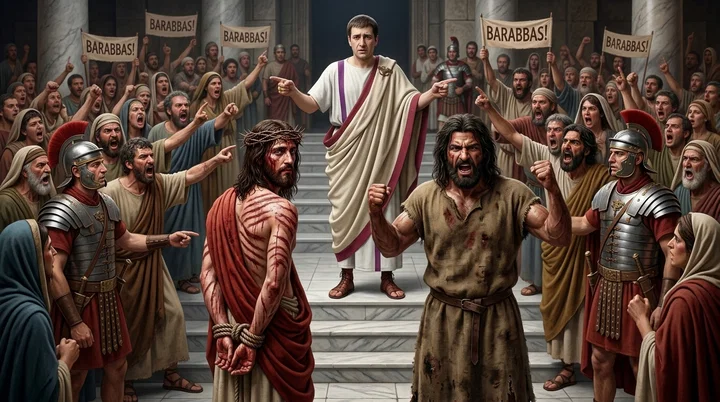
That envious malice and fanatical hatred arose because Jesus, as the light of the world, had exposed the priests' darkness and error.DA 735.1–5 Under their false accusations Jesus' calm silence showed conscious innocence and superior wisdom.ST Jan 24, 1900 The contrast between his restraint and the priests' fury strengthened Pilate's conviction that Jesus was innocent, that he had been handed over out of envy, and that his accusers were unjust.ST Jan 24, 1900 To save Jesus' life Pilate had him scourged and mocked in hope of exciting pity and satisfying that malice, then set Jesus in contrast with Barabbas and declared he found no fault in him.DA 735.1–5 But the priests saw through the plan to release him and, determined he should not be released, stirred the mob to furious cries for his crucifixion.DA 735.1–5
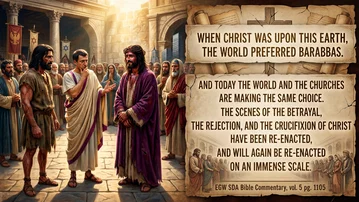
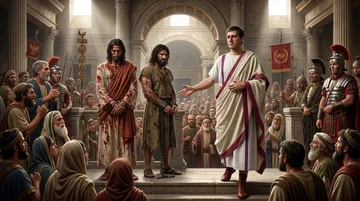
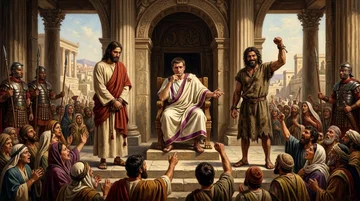
The verse belongs to the trial scene in which Pilate offered the crowd a choice between Jesus and Barabbas, and the choice of Barabbas over Jesus represented the choice of Satan over Christ.16MR 259.3–260.1 That same choice is repeated whenever people reject Christ by showing whom they choose.16MR 259.3–260.1 It belongs also to the condemnation in which the crowd that had once hailed Jesus as king turned against him with insults and rejection.4RED 102.2–103.1 Yet the disciples had been prepared for this reversal, so it did not surprise them or lead them to base their faith on public opinion.4RED 102.2–103.1 The account of the trial before Pilate connects Jesus' condemnation with the grisly death of Judas, which interrupted the crowd on the way to Calvary, quieted its mockery, and was seen by many as retribution already falling on those guilty of Jesus' blood.DA 722.5
Sources
Pioneers and periodicals
25 sources
Pilate saw through the trial before him and understood that the chief priests had handed Jesus over to him not for any crime but because they envied him.ST Jun 3, 1889ST May 25, 1904RH Nov 30, 1916 Their accusation had no ground in wrongdoing, for both he and Herod examined Jesus and found no fault in him deserving death, knowing he was innocent and just.ST Jun 3, 1889ST Jun 15, 1904ST Mar 13, 1901 Because he knew their motive, he tried to free Jesus by appealing to the Passover custom of releasing a prisoner and asking the multitude gathered for the feast whether he should release to them the King of the Jews, hoping they would choose Jesus.ST May 25, 1904ST Aug 17, 1904 What the priests envied was his holy character, his nearness to God, and his power over hearts longing to be free from sin, made sharper by the honors the people gave him at his triumphal entry while their own influence waned and by his driving from the temple the traffic they had sanctioned.ST Jun 24, 1897ST Oct 5, 1904 That same envy that slew Abel, moved Joseph's brothers against him, and rose against Moses lives on in religious persecution by those who have not known the Father nor Christ, yet those stirred by it may through Jesus share in their brother's righteousness and blessing.ST Jun 24, 1897RH Nov 11, 1858
Pilate's Trial of Jesus
Mark plainly states that Pilate perceived the chief priests had handed Jesus over to him because they envied him, and their charge arose from envy rather than from evidence of wrongdoing.ST Jun 3, 1889ST May 25, 1904RH Nov 30, 1916ST Jul 11, 1878RH Jul 25, 1854 He could plainly recognize that envy was their motive, that they were bitter opponents acting from envy and malice, and that envy can drive people to schemes and harmful actions.ST Jul 11, 1878RH Jul 25, 1854RH Jan 9, 1900 Because he knew this motive he asked the multitude whether he should release to them the King of the Jews.ST May 25, 1904
Their accusation had no ground in wrongdoing, for Pilate after examination found no fault touching the accusations, nor had Herod found anything worthy of death, and both knew Jesus was innocent and just.ST Jun 3, 1889ST Jun 3, 1889ST Jun 15, 1904ST Mar 13, 1901ST Oct 7, 1886 Herod like Pilate knew envy had caused the Jews to condemn him, though he was innocent.ST Jun 3, 1889 The trial therefore stands as the world's official declaration that Christ was unjustly put to death, showing he suffered as the just for the unjust to bring sinners to God.ST Jun 15, 1904 A heathen judge could see his innocence clearly while God's apostate people could not, showing how great is the darkness when the light within is darkness.ST Jun 15, 1904
The account gives accurate and natural details about the customs and events of the time.RH Feb 11, 1862 At the trial Pilate called together the chief priests and rulers and people, declared that having examined Jesus before them he found no fault, nor had Herod, and proposed to chastise and release him.ST Mar 13, 1901 Yet they cried out together for Barabbas, who was in prison for insurrection and murder, and shouted for Jesus to be crucified.ST Mar 13, 1901 Though Pilate appealed again desiring to release Jesus and asked what evil he had done, they were instant with loud voices, their voices prevailed, and Pilate gave sentence that what they asked should be done.ST Mar 13, 1901
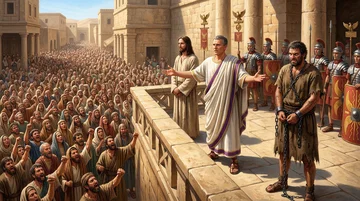
Because he knew their envy, Pilate tried to free Jesus through the governor's Passover custom of releasing a Jewish prisoner condemned under Roman law by letting the people gathered from the province for the feast choose who should be released.ST May 25, 1904ST Aug 17, 1904 He had examined Jesus on the charges of the Jewish council and publicly declared he found no fault in him, yet instead of acquitting him he virtually conceded condemnation and arranged the offer so the people would choose Jesus.ST Aug 17, 1904 He still trusted that the people could be moved to act for justice despite the priests' envy.ST Aug 17, 1904 In doing so he set the innocent Jesus on a par with Barabbas and left his fate to the choice of his avowed enemies. The insincerity and inconsistency of the Jews is shown in that the chief priests incited the people to ask for Barabbas instead of Jesus, when Barabbas had been convicted of the same crime with which they charged Jesus and for which they demanded Jesus' death.
Jesus stood before Pilate in noble form and bearing, fully in his power yet answering nothing to many false charges, and Pilate marveled greatly at his steady deportment.ST Jan 24, 1900RH Feb 27, 1872 His calm silence displayed conscious innocence and superior wisdom, while the priests' fury contrasted with his restraint.ST Jan 24, 1900 His bearing strengthened Pilate's conviction that Jesus was innocent and that the accusers were unjust.ST Jan 24, 1900
The whole trial was God's appeal to Pilate's heart to do right whatever the consequences, in a last effort to save him and to set the gospel in glorious perfection before great Rome.ST Oct 27, 1898 Pilate saw Christ's dignified bearing unlike the criminals he knew, his trust in a power higher than Pilate knew, his unretaliating silence when the Jews chose Barabbas, and his unresentful, unresisting endurance when scourged, beaten, bruised and bleeding under every indignity and insult.ST Oct 27, 1898 With Herod's finding him worthy of no punishment he became convinced that before him stood one more than man who was innocent.ST Oct 27, 1898 Though he repeatedly endeavored to release him and to induce the priests to withdraw their unproved charges in which he found no evidence of crime, they met every effort with fresh outbursts of malignity and would yield neither to law nor justice nor to pity, and Pilate feared them.ST Oct 27, 1898 The appeal was continued through the dream given to his loved wife Claudia Procula, before he refused to identify himself with the suffering innocent One and sought to escape responsibility and ease conscience by delivering Jesus to the mob and washing his hands in water.ST Oct 27, 1898
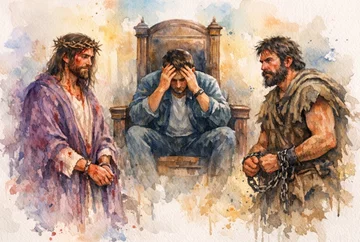
Pilate hoped to release Jesus, but his compromises with Jesus' enemies left him powerless to act despite his claim that he had authority to release him.ST May 10, 1905ST Oct 7, 1886ST Mar 13, 1901 He did a terrible thing in placing the life of a just man in the balance against the decision of envious men, yielding his own judgment, compromising his dignity, losing control of the crowd, and submitting the sentence to a lawless and infuriated mob.ST Oct 7, 1886 In violating his conscience step after step and excusing himself from judging with equity and fairness as his position demanded, he became almost helpless in the hands of the Jews who saw he could be intimidated.ST Oct 7, 1886 Their continued efforts to secure his death show them pressing their case while Pilate repeatedly tried to shift responsibility for releasing him.ST Mar 13, 1901
The setting involves struggle over his kingship and Israel's deliverance, with Judas expecting Jesus to lead a political revolt and believing force might bring the kingdom, and with Barabbas standing as another possible deliverer in the people's eyes.ST Oct 4, 1910 Pilate at first had no thought of sentencing Jesus to death on the cross, yet afterward did so.RH Feb 27, 1872 The Jews at first heard the fame of Jesus with favor as one of their own nation who spoke as no man ever spoke and worked miracles none before him worked, yet afterward they called for his crucifixion and desired that a murderer they knew to be such be released to them instead.RH Feb 27, 1872 This growth of hatred from its earliest beginnings to condemnation shows how little men know the future unless guided by God's word foretelling what men would do for the good of all who will be benefited.RH Feb 27, 1872
Envy That Delivered Him
The chief priests and scribes handed Jesus over to Pilate to be condemned and put to death from envy and malice as bitter opponents.ST Jun 3, 1889ST Jul 11, 1878RH Jul 25, 1854ST Oct 7, 1886ST Mar 28, 1906 Pilate plainly recognized that envy had caused them to deliver Him, for he found no evidence of crime in their unproved charges and repeatedly pronounced Him innocent and just.ST Jun 3, 1889ST Jul 11, 1878ST Oct 27, 1898ST Oct 7, 1886ST Mar 28, 1906 Their continued malignity in clamoring for His death, meeting every effort to release Him with fresh outbursts that would yield neither to law nor justice nor pity, and stirring the crowd to choose Barabbas and demand crucifixion, shows His rejection was driven by envy despite the absence of any fault deserving death.ST Oct 27, 1898ST Oct 7, 1886ST Mar 28, 1906 What they envied was His holy character, His nearness to God, and His power over hearts longing to be free from sin.ST Jun 24, 1897
Their envy was jealous indignation over the triumphal entry, both at the honors the people bestowed on Jesus in spite of their adverse counsel and at the influence wielded by a poor man of Nazareth while their own influence was waning.ST Oct 5, 1904 The feeling was so open and manifest that Pilate recognized it.ST Oct 5, 1904 Their anger was intensified when He rode to the temple and disregarded their prestige by driving out the unholy merchandising which they had sanctioned and in which they were peculiarly interested.ST Oct 5, 1904 Envy is hatred of another's happiness: toward superiors because not equal to them, toward inferiors lest they become equal, and toward equals because they are equal.RH Nov 11, 1858 It is the most cruel attribute of the sinful heart and can lead to schemes and harmful actions.RH Jan 9, 1900ST Dec 25, 1901
That same envy brought the fall of the world and the death of Christ.RH Nov 11, 1858 It slew Abel for the peace and blessing and power he received from God, moved Joseph's brothers against his good character and God's blessing on him, and moved the leaders in rebellion who envied Moses for the position to which God called him.ST Jun 24, 1897 Joseph sold into Egypt by the patriarchs moved with envy was a type of Christ in this, with the same envious betrayal by brethren delivering Christ to death by His brethren the Jews.ST Dec 25, 1901 The envy of the chief priests in delivering Jesus and His rejection by the people when the crowd in Mark 15:9-14 called for Barabbas instead of Him fulfills what Isaiah foretold in Isaiah 53:3 about Christ being despised and rejected of men.RH Jun 24, 1858
Their envy led to their destruction and the undoing of their nation.ST Jun 24, 1897 The verse stands as a lesson for all time exposing the heart motive behind religious persecution by those who think they do God service because they have not known the Father nor Christ.ST Jun 24, 1897 This is seen when Russians persecute dissenting sects, when Roman Catholics did the same when they had power, and when many Protestants follow the same steps in seeking human help, human law, and human aid to enforce religious observances.ST Jun 24, 1897 Those stirred by such envy may through Jesus share in their brother's righteousness and blessing, and those who know the Father and Christ will leave judgment and its execution to Jesus at His second coming.ST Jun 24, 1897
Sources