Matthew 27:13
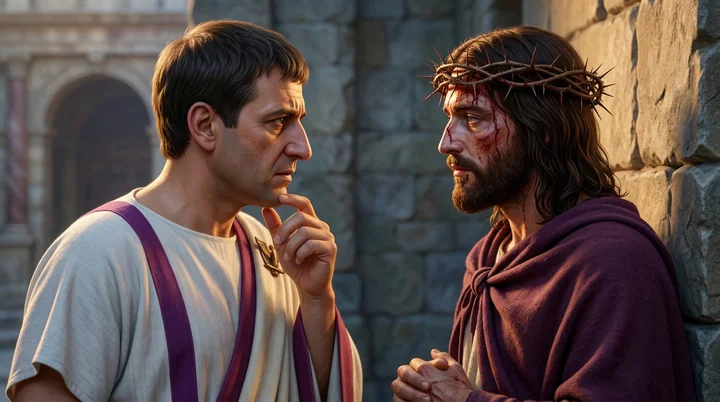
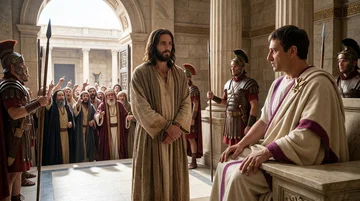
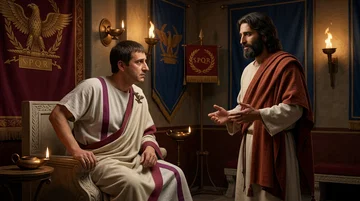
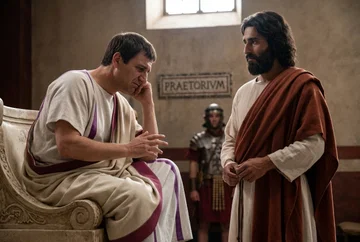
Then said Pilate unto him, Hearest thou not how many things they witness against thee?
Translations
Then said Pilate to him, Hear you not how many things they witness against you?
King James Version, KJV Cambridge Paragraph Bible
Then said Pilate unto him, Hearest thou not how many things they witness against thee?
Then saith Pilate to him, Hearest thou not how many things they testify against thee?
Revised Version, American Standard Version
Then saith Pilate unto him, Hearest thou not how many things they witness against thee?
then saith Pilate to him, 'Dost thou not hear how many things they witness against thee?'
Then says Pilate to him, Hearest thou not how many things they witness against thee?
Then, Pilate saith unto him—Hearest thou not how many things against thee they are bearing witness?
Berean Standard Bible, Majority Standard Bible
Then Pilate asked Him, “ Do You not hear how many charges they are bringing against You?”
Then Pilate said to him, “Don’ t you hear how many things they testify against you?”
Then says Pilate to him, Do you give no attention to what their witnesses say against you?
Then saide Pilate vnto him, Hearest thou not howe many things they lay against thee?
Douay-Rheims (Challoner revision)
Then Pilate saith to him: Dost not thou hear how great testimonies they allege against thee?
Pictures
Cross-references 20 of 22
- Isaiah 53:7
He was oppressed, and he was afflicted, yet he opened not his mouth: he is brought as a lamb to the slaughter, and as a sheep before her shearers is dumb, so he openeth not his mouth.
Jesus’ silence during his trial fulfills Isaiah’s prophecy.
- Mark 15:3-5
And the chief priests accused him of many things: but he answered nothing.
Pilate questions Jesus about the many accusations, but Jesus remains silent.
- Luke 23:9-10
Then he questioned with him in many words; but he answered him nothing.
Jesus remains silent while Herod and the chief priests question and accuse him.
- John 18:28-38
Then led they Jesus from Caiaphas unto the hall of judgment: and it was early; and they themselves went not into the judgment hall, lest they should be defiled; but that they might eat the passover.
Jesus is examined before Pilate.
- Luke 23:4
Then said Pilate to the chief priests and to the people, I find no fault in this man.
Pilate finds no fault in Jesus despite the accusations.
- John 19:9
And went again into the judgment hall, and saith unto Jesus, Whence art thou? But Jesus gave him no answer.
Jesus remains silent during Pilate’s questioning.
- 1 Peter 2:23
Who, when he was reviled, reviled not again; when he suffered, he threatened not; but committed himself to him that judgeth righteously:
Christ endured reviling and suffering without retaliating or threatening.
- Matthew 27:22-23
Pilate saith unto them, What shall I do then with Jesus which is called Christ? They all say unto him, Let him be crucified.
The crowd demands Jesus’ crucifixion despite Pilate finding no evil in him.
- John 18:33-35
Then Pilate entered into the judgment hall again, and called Jesus, and said unto him, Art thou the King of the Jews?
Pilate questions Jesus about His kingship and asks what He has done.
- Matthew 26:63
But Jesus held his peace. And the high priest answered and said unto him, I adjure thee by the living God, that thou tell us whether thou be the Christ, the Son of God.
Jesus keeps silence when questioned before the high priest.
- Luke 23:13-16
And Pilate, when he had called together the chief priests and the rulers and the people,
Both recount Pilate’s examination of Jesus and the accusations brought against him.
- Mark 14:60-62
And the high priest stood up in the midst, and asked Jesus, saying, Answerest thou nothing? what is it which these witness against thee?
grouped as answering versus silence
- John 18:38
Pilate saith unto him, What is truth? And when he had said this, he went out again unto the Jews, and saith unto them, I find in him no fault at all.
Pilate questions Jesus about truth and declares that he finds no fault in him.
- John 19:12-16
And from thenceforth Pilate sought to release him: but the Jews cried out, saying, If thou let this man go, thou art not Cæsar’s friend: whosoever maketh himself a king speaketh against Cæsar.
Pilate yields to pressure from Jesus’ accusers.
- John 18:37
Pilate therefore said unto him, Art thou a king then? Jesus answered, Thou sayest that I am a king. To this end was I born, and for this cause came I into the world, that I should bear witness unto the truth. Every one that is of the truth heareth my voice.
Jesus tells Pilate that he came to bear witness to the truth.
- Matthew 27:24
When Pilate saw that he could prevail nothing, but that rather a tumult was made, he took water, and washed his hands before the multitude, saying, I am innocent of the blood of this just person: see ye to it.
Pilate washing hands to escape responsibility
- Matthew 27:19
When he was set down on the judgment seat, his wife sent unto him, saying, Have thou nothing to do with that just man: for I have suffered many things this day in a dream because of him.
Pilate’s wife warns him through a troubling dream about Jesus.
- John 18:4-8
Jesus therefore, knowing all things that should come upon him, went forth, and said unto them, Whom seek ye?
Christ shows power to resist arrest, yet submits and protects his disciples.
- John 18:23
Jesus answered him, If I have spoken evil, bear witness of the evil: but if well, why smitest thou me?
grouped as answering versus silence
- Matthew 27:26
Then released he Barabbas unto them: and when he had scourged Jesus, he delivered him to be crucified.
Pilate scourged Jesus before crucifixion
Commentary
Each commentary is drawn from primary sources: the writings of Ellen G. White and Adventist pioneers and periodicals. Each commentary is separate. Its own words are not a quotation; follow the references to read the source passages.
Ellen G. White
16 sources
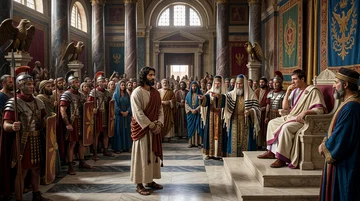
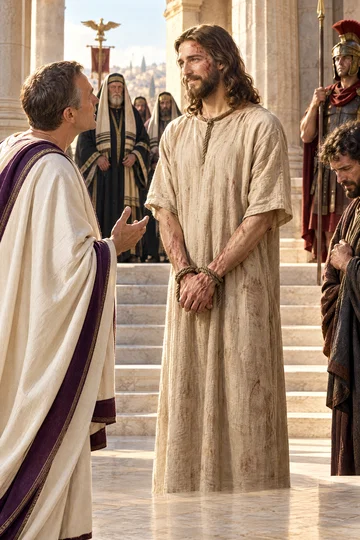
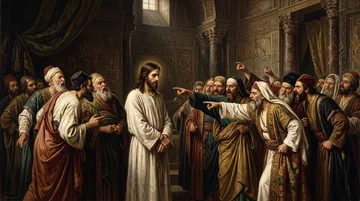
Pilate urges the bound Jesus standing in the judgment hall to hear the many accusations the priests and rulers bring against Him and to answer them.Ms 29, 1909, par. 12–175RED 53.23SP 130.2–131.2DA 723.1–724.14RED 102.2–103.1 Jesus makes no further answer to the false charges but meets them with silence.5RED 53.23SP 130.2–131.23SP 133.2 He is silent because He has already spoken the truth to Pilate in private to enlighten him, so that nothing more remains that would keep Pilate from condemning Him.5RED 53.23SP 133.2ST Jul 4, 1878 Amid fury, insult and mockery He remains calm, dignified, patient and conscious of innocence, with a noble bearing more like a king than a criminal, which amazes and troubles Pilate and the throng.3SP 130.2–131.2DA 723.1–724.13SP 133.2DA 726.1–4ST Jan 24, 1900 Pilate sees no sedition in Him and is convinced He was delivered for envy and is innocent, yet fails to do justice, while Jesus stands there innocent as man's representative, bearing the sins of the world to give His life that repentant sinners may be justified.Ms 29, 1909, par. 12–173SP 130.2–131.25RED 50.2–51.14MR 162.2–163.1
Trial Before Pilate
Pilate urges Jesus to listen to how many charges are being brought against Him and to answer them.Ms 29, 1909, par. 12–175RED 53.23SP 130.2–131.2DA 723.1–724.13SP 133.2 He presses Him with why He makes no reply to the accusations.3SP 130.2–131.2ST Jul 4, 18785RED 50.2–51.1ST Jul 4, 1878 The scene is the trial in the judgment hall, where Jesus stands as a bound prisoner before Pilate while Jewish leaders and priests accuse Him.DA 723.1–724.1DA 394.2–3RH Nov 11, 1915 There He is humiliated and reviled, with the crowd turned against Him and calling for His crucifixion, while the Jewish priests and rulers pressure the Roman governor to do their will.Ms 29, 1909, par. 12–174RED 102.2–103.1DA 394.2–3RH Nov 11, 1915
To the false charges and questions He gives no further answer but meets them with silence.5RED 53.23SP 130.2–131.23SP 133.2ST Jul 4, 18785RED 50.2–51.1 He answers nothing to the many questions and accusations put to Him.ST Jul 4, 1878DA 726.1–4ST Jan 24, 1900SG1 53.1 He is silent because He had already spoken to Pilate privately to bring the truth to his understanding.5RED 53.23SP 133.2ST Jul 4, 1878 There was nothing more He could say that would keep Pilate from condemning Him.5RED 53.23SP 133.2ST Jul 4, 1878
Amid the fury of His accusers He remains calm, dignified, composed and unmoved.DA 723.1–724.1DA 726.1–4ST Jan 24, 1900SG1 53.1 His appearance bears no sign of guilt, fear, or defiance, with no frown or troubled expression.DA 723.1–724.1SG1 53.1 His calm silence gives evidence of innocence amid the accusers' fury, and His calm, unmoved bearing shows conscious innocence and superior wisdom.DA 726.1–4ST Jan 24, 1900 His patience and forbearance under insult and mockery are joined to a noble, benevolent, God-like bearing, with perfect and noble form, mild clear undaunted eye, broad high forehead, and every feature marked with benevolence and noble principle, so unlike man that spectators compare Him with those sitting in judgment against Him and judge Him more like a king to be entrusted with a kingdom than any of the rulers or than a criminal.ST Jan 24, 1900SG1 53.1
His silence amazes, marvels, astonishes, perplexes and troubles Pilate and the throng.3SP 133.2ST Jul 4, 18785RED 50.2–51.1ST Jul 4, 1878ST Jan 24, 1900 It gains Him many sympathizers in that company and makes many tremble.SG1 53.1 The assembly is also astonished by His forbearance toward Judas and wonders why, if He is the Son of God, He does not free Himself and overcome His accusers.SG1 53.1 Pilate sees no sign of the seditious character alleged and does not trust the priests' charges.3SP 130.2–131.25RED 50.2–51.1ST Jul 4, 1878 He is convinced Jesus was handed over from envy and declares Him innocent, yet though recognizing that justice should be done, he fails to do it.Ms 29, 1909, par. 12–17ST Jan 24, 1900
Redemption and Example
At Pilate's bar Jesus stood innocent, having done no wrong, as humanity's representative while Pilate pressed Him over the many accusations brought against Him.Ms 29, 1909, par. 12–174MR 162.2–163.1 He bore the sins of the world and was treated and condemned as a transgressor, willingly suffering humiliation and death to give His life for the world.4MR 162.2–163.1 This was done so that repentant sinners might be clothed with His righteousness and justified.4MR 162.2–163.1 Pilate recognized that justice should be done yet failed to do it.Ms 29, 1909, par. 12–17 His refusal to answer unto death stands in contrast with His readiness to answer all who seek the way of life.4MR 162.2–163.1
His condemnation before Pilate in the judgment hall, with the crowd turned against Him and demanding His crucifixion, became a severe test for His disciples.DA 394.2–3 In that trial the Jewish priests and rulers pressured the Roman governor to do their will, and Jesus on the cross is set forth as the example of trusting God and standing firm against human power.RH Nov 11, 1915 His silence under accusation teaches that silence can be eloquent.Lt 102b, 1899, par. 17 From Him His followers are to learn to restrain their words even when indignation is strong.Lt 102b, 1899, par. 17
Sources
Pioneers and periodicals
40 sources
Pilate asks Jesus whether He hears how many charges the chief priests, elders and people bring against Him, and Jesus answers him nothing, not even one word in reply to those accusations.ST May 19, 1898ST May 19, 1898RH Nov 18, 1862ST May 6, 1897 He had already spoken to Pilate privately to make the truth clear, and knew when to stop speaking, since Pilate had no ears to hear and further words would only waste truth and increase guilt.ST Jul 4, 1878ST Feb 6, 1907RH Apr 17, 1900RH Mar 21, 1912 Pilate marvels greatly at His silence and steady bearing, is perplexed and astonished, sees no sign of sedition, distrusts the unproved charges, and becomes convinced He was handed over from envy and is innocent.ST Jul 4, 1878ST May 19, 1898ST Sep 30, 1886 In humble silence without complaint or retaliation He fulfills the prophecy of the afflicted servant who would not open His mouth, meeting false charges with calm, composed dignity and loving confidence in God and a higher power than Pilate knows.ST Jan 24, 1900RH Nov 18, 1862RH Apr 17, 1855ST Oct 27, 1898ST Jul 29, 1886 His silent endurance sets the pattern for His followers to bear unjust accusation, insult and suffering with meek courage and self-command, for there is a time to be silent as well as to speak, and closed lips before empty babbling give time for reflection and prayer.ST Apr 17, 1879RH Jan 12, 1869ST Apr 7, 1881ST May 2, 1916RH May 5, 1863
Trial Setting and Wording
The verse belongs to the morning hearing after the chief priests and the elders of the people took counsel against Jesus to put Him to death and brought Him before Pilate.ST Oct 26, 1882 The hearing was before Pontius Pilate, who was at that time governor of Judea.RH Feb 11, 1862 A sentence from Pilate was necessary before Jesus could be executed, because the power of life and death was vested in the Roman governor.RH Feb 11, 1862 He stood at Pilate's judgment seat in the Roman hall.RH Nov 12, 1872
It was part of the account of Christ's trial before Pilate on the day of His crucifixion, one of the eventful days of Christ's life.RH Feb 13, 1872 That day included His betrayal, agony, arrest, trial, condemnation, mocking, scourging, and crucifixion, and above all the others it showed His love for humanity.RH Feb 13, 1872 It was the final scene of His life on earth, as He faced accusations and bore cruelty and reproach before His crucifixion.RH Jun 10, 1862
He stood there as an innocent man whom the Jewish council brought to an unjust and illegal trial and whose condemnation they secured from the Roman governor through threats and intimidation.ST Jun 9, 1898 The accusations were pressed by the chief priests, rulers and people while Pilate questioned Him in examination.ST Mar 13, 1901 In that examination Pilate found no fault in Him touching the things charged against Him, nothing worthy of death, yet after the cry for Barabbas and for crucifixion gave sentence that what the crowd asked should be done.ST Mar 13, 1901 Jew and Gentile were joined together in hatred against Him as He stood there mocked and beaten, crowned and wounded.RH Nov 12, 1872
The exchange shows He had enough knowledge of the languages current in Palestine to speak with Pilate, without identifying which language they used.ST Mar 10, 1881
Pilate's Question and Silence
Pilate asks Jesus whether He hears how many things are witnessed against Him by the chief priests and elders, by the rulers and scribes, and by the people.ST May 19, 1898ST May 19, 1898RH Nov 18, 1862ST Apr 17, 1879RH Apr 17, 1855 The accusers bring many charges, and the question names their number and weight as what He is called to hear.ST May 19, 1898RH Nov 18, 1862ST Apr 17, 1879RH Apr 17, 1855
The question is prompted by His silence under those charges, for He remains silent before the chief priests and elders and then gives Pilate no answer, not even one word.ST May 19, 1898ST May 19, 1898ST May 6, 1897RH Jan 12, 1869RH Feb 27, 1872 He refuses to answer here while He answered other questions in His trial, which raises why He spoke at some points and remained silent at others.ST May 19, 1898ST May 19, 1898ST May 6, 1897RH Jan 12, 1869RH Apr 17, 1900 He knew when to stop speaking.ST Jul 4, 1878RH Apr 17, 1900
He had already spoken to Pilate privately to make the truth clear, and He has nothing more to say that would prevent Pilate from condemning Him.ST Jul 4, 1878RH Apr 17, 1900 His silence amid abuse and accusation therefore follows a full private disclosure rather than a failure to speak.ST Jul 4, 1878RH Apr 17, 1900
Pilate marvels greatly at the silence, and is perplexed, astonished, and hoping to learn the truth from Jesus.ST Jul 4, 1878ST Jul 4, 1878ST Jan 24, 1900ST May 19, 1898ST Sep 30, 1886 He sees no sign that Jesus is seditious and does not trust the malignant, unproved charges of the priests.ST Jul 4, 1878ST Oct 27, 1898ST Sep 30, 1886 He becomes convinced that Jesus was handed over from envy and declares Him innocent, amazed at His steady bearing while fully in his power.ST Jul 4, 1878ST Jan 24, 1900ST May 19, 1898RH Feb 27, 1872
Jesus meets the false charges with silence and with a calm, unmoved, composed and self-possessed bearing that shows conscious innocence, superior wisdom, and dignity.ST Jan 24, 1900ST Oct 27, 1898ST Jul 29, 1886 That bearing shows faith and loving confidence in God and trust in a higher power than Pilate knows.ST Oct 27, 1898ST Jul 29, 1886 He is unresentful and unresisting under indignity, insult, scourging, beating and bleeding, with no word of retaliation.ST Jan 24, 1900ST Oct 27, 1898
His silence is judicial and merciful, because Pilate has no ears to hear, so that speaking would waste His words and increase Pilate's guilt.ST Feb 6, 1907RH Mar 21, 1912 Even though silence may leave a wrong impression about the reason for His trials, He does not answer in a way that could give further cause to accuse Him.ST Feb 6, 1907RH Mar 21, 1912 He communes privately with His Father for strength to remain silent.ST Feb 6, 1907RH Mar 21, 1912
In this scene God presents the Gospel in glorious perfection to Rome in the person of Pilate.ST Oct 27, 1898 Pilate hears the malignant, unproved charges of the priests and scribes, questions Jesus, and finds no evidence of crime.ST Oct 27, 1898 He is convinced that One more than man stands before him, unlike common criminals, and is appealed to in heart to do right whatever the consequences.ST Oct 27, 1898 Yet he stays undecided from fear of the Jews, refuses to identify himself with the suffering Innocent One, and tries to escape responsibility by turning Jesus over to Herod and then to the mob.ST Oct 27, 1898 Even when the Jews choose Barabbas and reject law, justice and pity, God makes one more effort through his wife to save him.ST Oct 27, 1898
Prophecy and Historical Trust
When accused by the chief priests and elders, Jesus remained silent and made no defense for himself, and Pilate's question whether He heard how many charges were witnessed against Him marks that silence.RH Nov 18, 1862RH Apr 17, 1855 That humble refusal to speak in His own defense fulfills the prophecy that the suffering Messiah would not open His mouth in complaint.RH Nov 18, 1862 It fulfills Isaiah's picture of the afflicted servant who does not open his mouth.RH Apr 17, 1855
The hearing took place before Pontius Pilate when he was governor of Judea, whose sentence was necessary before Jesus could be executed because the power of life and death was vested in the Roman governor.RH Feb 11, 1862 This question is one small detail in the history of the trial, execution and burial whose minute accuracy matches the customs, opinions, political events and circumstances of that period.RH Feb 11, 1862 This natural and undesigned consistency with other histories and with known manners and institutions proves the Gospel account true.RH Feb 11, 1862
The surrounding narrative also exposes as manufactured the story that the disciples stole away the body of Jesus.ST Nov 2, 1882 Breaking the Roman seal meant death, so if the disciples had broken the seal on the tomb they would certainly have been put to death.ST Nov 2, 1882 The disciples had no object or motive to go up and down the land lying about His resurrection, to live in dens and caves as the offscouring of the earth and to die for a fraud.ST Nov 2, 1882 By contrast the Jews and the soldiers had a motive to say the body was stolen away and were bribed to say it.ST Nov 2, 1882
Unjust Sentence and Liberty
Matthew 27:13 belongs to the condemnation to death brought about when religious leaders joined with the state and used civil law to punish refusal to follow their traditions, the Jewish priests and rulers pressing the Roman governor to do their will while Jesus stood firm trusting God against human power.RH Nov 11, 1915 Every step in that trial, condemnation and execution was illegal, yet though He could have pointed out and convicted the instigators of the crime He brought no charge against any of them with intent to have them arrested or punished.ST Aug 29, 1895 He never made formal complaint against any individual to secure arrest or punishment, but refused to use His knowledge of guilt and His power to invoke civil law against offenders.ST Aug 29, 1895
He did not answer to conciliate Herod or to secure human support, and His silence showed freedom from fear of death and of people and of torture.ST Nov 14, 1900 That silence exposed the emptiness of human justice and power.ST Nov 14, 1900 The trial was one in which the chief priests and elders rejected light and misled the people during His sojourn on earth.RH Jun 13, 1865 Protestant churches repeat the same crime by rejecting God's holy law and the testimony of the Old and New Testaments about the fulfillment of prophecy, and by covering with error and confusion the truths expressly made known for the last perilous days, and the light they reject is even greater than the light rejected at His trial.RH Jun 13, 1865
Jesus as the Truth stood before Pilate, yet Pilate, pressured by the crowd, failed to stand by the truth.RH Sep 28, 1911 The scene warns that people may judge truth, fear public opinion, and turn away from what they know is right.RH Sep 28, 1911 By dealing so with Jesus, Pilate set himself with Nimrod, the Pharaohs, Sennacherib, Agag, Belshazzar, Herod, Judas Iscariot and others who lifted puny hands against the truth and its mighty plans and precepts.ST Jul 15, 1908 His name lives only in infamy and hopeless doom, and while Pilate is dead the Rock of the word he opposed still stands.ST Jul 15, 1908
Example for Believers
The arraignment before Pilate is where He faces accusations and does not turn away from suffering, shame, or loss, and it teaches His followers to learn from Him to bear the cross.RH Mar 26, 1861 It belongs to His path through the judgment hall of an unjust Pilate toward Calvary, and Christian perfection is shown not by constant joy or extraordinary spiritual experiences but by resolutely taking up the cross and following Christ through suffering and through unjust judgment.RH Jul 30, 1867RH Aug 14, 1860 Going with Christ to the judgment hall is to be distinguished from complete consecration, for the offering represented the one who brought it, and only the giving of life, pictured by shed blood and the offering consumed on the altar, represented willingness to follow Him even to Calvary.ST Sep 12, 1900
He faces questioning, insults, and abuse with unwavering courage, yet remains gentle and innocent, not yielding to pressure or seeking ease at the cost of truth.RH May 5, 1863 By not answering or resisting His accusers He sets an example of meek endurance of persecution for His followers.RH Jan 12, 1869 Though abused and treated unjustly without retaliation, He embodies His own teaching to turn the other cheek.ST May 2, 1916
His silence before inquisitive Pilate, answering nothing to the many things witnessed against Him, expresses reserve power, conscious strength, dignity, self-command, and contempt for empty babbling.ST Apr 7, 1881 His silent endurance of reproach amid scoffing and jeers and taunts displays greatness, broken only on the cross to bestow benediction and blessing.ST Apr 7, 1881 There is a time to be silent as well as to talk, and closed lips before the babbling of the empty soul is right and effective, a habit to be cultivated now and not deferred until death stills the tongue forever.ST Apr 7, 1881
In the face of taunts and accusations Christians should not react in irritation, provoke opponents, or rush to escape humiliation, but like Christ remain silent and continue faithfully.ST Dec 20, 1910 Silence can show strength, giving time for reflection and prayer and allowing God to speak to the soul.ST Dec 20, 1910 His composed and self-possessed bearing in the judgment hall amid accusations shows a faith and loving confidence in God that sustains the mind through pressure and turmoil.ST Jul 29, 1886 This scene from the account of Christ's sufferings can help subdue pride and discontent.ST Apr 17, 1879
Sources